
Quick Summary: No, babies should not sleep on their side. The safest sleep position for all infants is on their back, for every sleep, until their first birthday. Side sleeping increases the risk of rolling onto the stomach, which is strongly linked to SIDS and accidental suffocation.
You put your baby down on their back, following all the safe sleep rules. But when you check the monitor an hour later, they’ve somehow wiggled onto their side. Or maybe your little one seems fussier on their back and you’re wondering if side sleeping might help them rest better.
Here’s the thing though — when it comes to infant sleep positions, the research is crystal clear. Back sleeping is the only recommended position for babies under 12 months, and side sleeping carries risks that many parents don’t fully understand.
This guide breaks down exactly why pediatricians and health organizations worldwide recommend against side sleeping, what the actual data shows about SIDS risk, and what to do when your baby starts rolling on their own.
Why Back Sleeping Is the Safest Position
According to the CDC, the back sleep position is the most effective action parents can take to reduce the risk of Sudden Infant Death Syndrome and other sleep-related deaths. The NIH’s Safe to Sleep campaign has been emphasizing this message since the early 1990s, and the results speak for themselves.
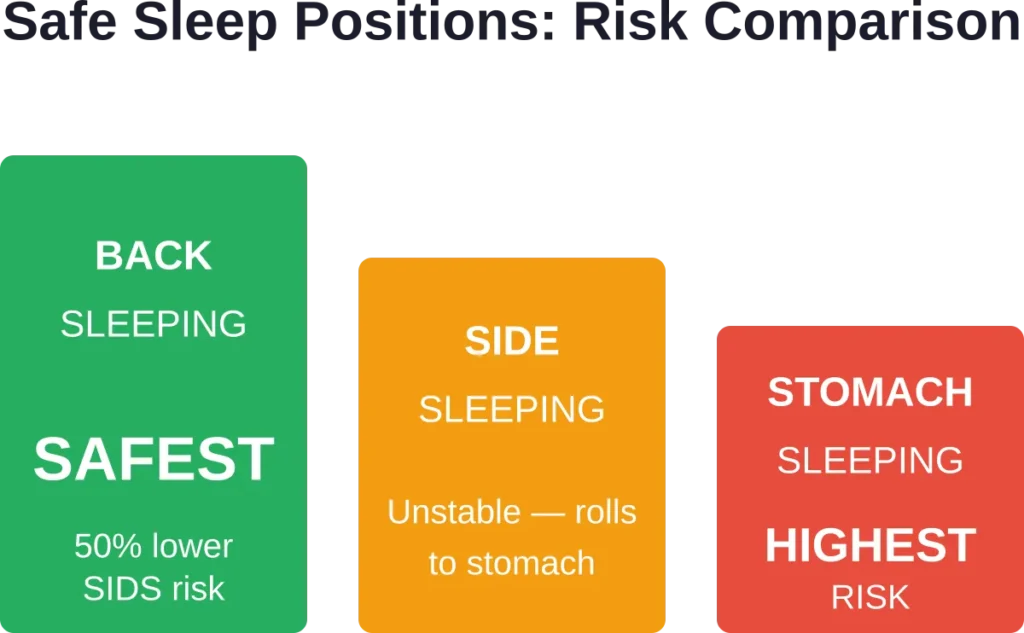
Research involving 474,672 infants across 54 studies found that supine (back) sleeping reduced SIDS risk with an odds ratio of 0.39 compared to other positions. That means back sleeping cuts the risk roughly in half.
The back position keeps airways clear and reduces the chance of rebreathing carbon dioxide — a potential contributor to SIDS. When a baby sleeps face-down or at an angle on their side, they can end up breathing the same air they just exhaled, which has less oxygen and more CO2.
Room sharing also plays a massive role in safety. The CDC reports that sharing a room with your baby (but not the same bed) can decrease SIDS risk by as much as 50%. Conversely, not room sharing increased the chance of sleep-related suffocation by more than 18 times compared to room sharing.
The Hidden Danger of Side Sleeping
So what makes side sleeping specifically risky? The problem isn’t necessarily the side position itself — it’s that side sleeping is inherently unstable.
A baby placed on their side can easily roll forward onto their stomach, especially if they’re swaddled or if there’s any soft bedding nearby. And stomach sleeping is where the real danger lies. The stomach position has the highest association with SIDS and accidental suffocation.
Think about the mechanics: when a baby is on their side, gravity is already pulling them in one direction. It takes very little movement — a startle reflex, a stretch, a shift during a sleep cycle — for them to complete that roll onto their belly.
The AAP and CDC data from 2015 showed that 21.6% of parents from 32 states and New York City reported placing their infant in a nonsupine (non-back) sleep position. That percentage varied dramatically by state, from 12.2% in Wisconsin to 33.8% in Louisiana. These numbers represent millions of babies potentially at increased risk.
What About Reflux and Spitting Up?
One of the most common concerns parents raise is choking. Won’t my baby choke if they spit up while on their back?
The short answer: no. Babies actually protect their airways better when lying on their backs. The anatomy of the throat means that when a baby is supine, the trachea (windpipe) sits on top of the esophagus (food pipe). If the baby spits up, the material naturally flows to the sides of the mouth rather than blocking the airway.
Even babies with reflux should sleep on their backs unless a physician has given specific medical instructions otherwise — and those cases are exceptionally rare. The NIH’s Safe to Sleep resources explicitly state that back sleeping remains safest for babies with reflux.
Real talk: it’s counterintuitive. It feels like a baby would choke more easily on their back. But decades of research and real-world data prove the opposite.
When Babies Roll Over on Their Own
Okay, so what happens when your baby develops the motor skills to roll from back to side or back to stomach during sleep? Do you need to spend all night repositioning them?
Here’s where the guidance shifts. Once a baby can roll both ways — back to stomach AND stomach to back — on their own, pediatricians generally agree you don’t need to reposition them constantly throughout the night. At that point, the baby has developed enough head and neck control to adjust their position if their breathing is compromised.
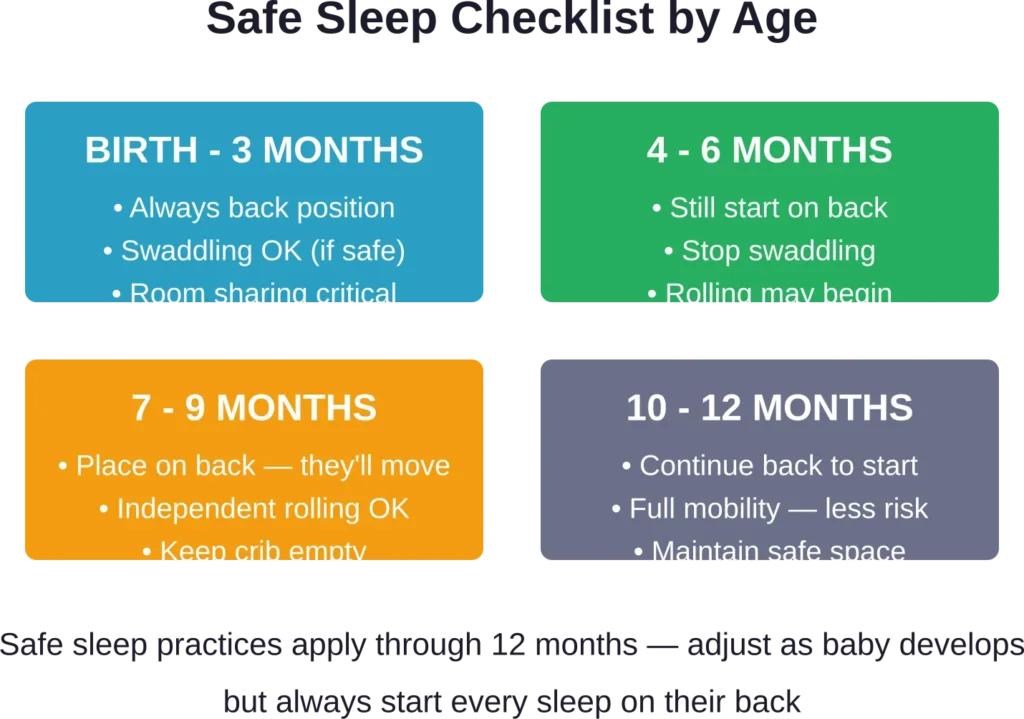
The critical part: you still place the baby on their back at the start of every sleep. Always. The “roll-over rule” only applies after the baby initiates the movement independently during sleep.
Most babies start rolling between 4 and 6 months, though the timeline varies widely. Some early movers manage it at 3 months, while others take until 7 or 8 months. Motor development operates on a spectrum, and that’s completely normal.
But wait. What if your 4-month-old can roll back-to-side or back-to-stomach but can’t yet roll the opposite direction? That’s the tricky phase. During this window, many pediatricians suggest continuing to gently reposition the baby onto their back when you notice they’ve rolled, especially early in the transition period.
Creating a Safe Sleep Environment
Sleep position is crucial, but it’s only one piece of safe sleep. The sleep environment matters just as much.
According to the NIH and CDC guidelines, a safe sleep surface is firm, flat, and level. Think of a firm mattress as one that returns to its original shape quickly when you press on it — not a plush pillow-top or a memory foam that contours to the baby’s shape.
| Safe Sleep Element | Recommended | Unsafe/Not Recommended |
|---|---|---|
| Sleep Surface | Firm, flat crib mattress with fitted sheet | Soft mattress, adult bed, couch, cushion, inclined surface |
| Sleep Position | Back, every time | Side or stomach |
| Sleep Space | Completely empty — no objects | Blankets, pillows, bumpers, toys, positioners |
| Room Setup | Baby in own sleep space, same room as parents | Bed sharing, separate room before 6 months |
| Temperature | Cool and comfortable | Overheated room, too many layers |
The sleep space should be empty. Not “mostly empty” or “just a thin blanket.” Actually empty. No blankets, no pillows, no stuffed animals, no crib bumpers, no positioning devices. Just a fitted sheet over a firm mattress.
CDC data found that more than one third reported using soft bedding in the infant’s sleep environment. That’s a significant number given how strongly soft bedding correlates with suffocation risk.
More than one half reported bed sharing with their infant. Bed sharing significantly increases the risk of sleep-related deaths, particularly in the first four months and when combined with other risk factors like parental smoking or alcohol use.
Swaddling and Sleep Position
Swaddling can help newborns feel secure and sleep better, but it comes with its own set of rules. Once a baby shows any signs of attempting to roll — even if they haven’t successfully done it yet — swaddling must stop immediately.
A swaddled baby who rolls onto their stomach is in serious danger. The swaddle restricts arm movement, meaning the baby can’t push up or reposition their head if their face ends up against the mattress. That’s a recipe for suffocation.
When swaddling is appropriate (roughly birth to 8-12 weeks, or whenever rolling attempts begin), the baby should still sleep on their back. Swaddling doesn’t change the safe sleep position — it just adds an extra safety consideration as the baby develops motor skills.
Flat Head Concerns and Tummy Time
Some parents worry that back sleeping will cause positional plagiocephaly — a flat spot on the back or side of the baby’s head. This concern is valid; flat spots do happen more often since the Back to Sleep campaign began.
But here’s the perspective that matters: flat spots are cosmetic and usually resolve on their own or with simple interventions. SIDS is fatal. The risk-benefit analysis isn’t even close.
To prevent or minimize flat spots while maintaining safe sleep practices:
- Alternate which end of the crib the baby’s head faces each night, so they turn their head different directions to look at the room
- Reposition the baby’s head gently during sleep if you notice they always turn the same way
- Do supervised tummy time every day when the baby is awake — aim for at least 30 minutes total by 3 months of age
- Reduce time in car seats, bouncers, and swings when not necessary, since these also create pressure on the back of the head
- Hold and carry the baby in different positions throughout the day
Tummy time serves double duty. It prevents flat spots AND builds the neck, shoulder, and core strength babies need to eventually roll, crawl, and hit other motor milestones. Starting from the first days of life with short sessions — even just 30 seconds at first — helps babies get comfortable with the position while awake and supervised.
Some research suggests supine sleeping may show effects on motor development scales at 6 months. But those differences typically even out by 18 months, and the protective effect against SIDS far outweighs any temporary developmental variation.
Common Myths About Baby Sleep Positions
Let’s clear up some persistent misconceptions that still circulate among parents, grandparents, and well-meaning friends.
Myth: “Babies sleep better on their stomach or side.” Some babies do seem to settle more easily on their stomach. But better sleep isn’t worth increased mortality risk. Safe sleep sometimes means a little less sleep — and that’s a trade-off parents have to accept.
Myth: “I slept on my stomach as a baby and I’m fine.” Survivorship bias. The babies who died from sleep-related causes can’t share their stories. SIDS rates dropped by more than 50% after the Back to Sleep campaign launched in 1994. That’s not a coincidence.
Myth: “Side sleeping is a safe compromise between back and stomach.” Nope. Side sleeping is unstable and transitions easily to stomach sleeping. It’s not a middle ground — it’s a stepping stone to the riskiest position.
Myth: “Special positioning devices make side sleeping safe.” Positioning devices, wedges, and sleep positioners are not recommended by the AAP or FDA. Several have been associated with infant deaths. The only safe sleep surface is a flat, firm mattress with nothing else in the space.
Myth: “Once my baby can lift their head, stomach sleeping is fine.” Head control is a piece of the puzzle, but it’s not sufficient on its own. Babies need to independently roll both directions before the risk substantially decreases — and even then, you still place them on their back to start each sleep.
What About Supervised Naps and Exceptions?
The safe sleep guidelines apply to all sleep situations — nighttime, naps, at home, at daycare, at grandma’s house. Every sleep, every caregiver, every location.
That said, tummy time during fully awake periods is different from sleep. Babies can be on their stomach as much as you want when they’re awake and an adult is actively watching. That’s not sleep; that’s play and development time.
There’s no such thing as a “supervised tummy nap” for young babies who can’t roll independently. Even if you’re watching, the risk remains. Babies can stop breathing silently and without obvious distress signals. Supervision reduces risk compared to being completely alone, but it doesn’t eliminate the physiological factors that make stomach sleeping dangerous.
Some parents ask about brief contact naps — when a baby sleeps on a parent’s chest. While not identical to unsupervised stomach sleeping, this still carries risks. If the parent falls asleep or the baby shifts position, the situation can become dangerous quickly. Safest practice: transfer the baby to a safe sleep surface when both parent and baby are ready to sleep.
When to Contact Your Pediatrician
Most questions about sleep position can wait until the next scheduled well-visit. But reach out to a healthcare provider if:
- Your baby consistently seems to have trouble breathing in any position
- Your baby has been diagnosed with a condition that might affect their airway or breathing during sleep
- Your baby developed a pronounced flat spot (beyond typical mild flattening) that doesn’t improve with repositioning
- Your baby strongly resists back sleeping to the point where sleep is severely disrupted for weeks
- You received conflicting safe sleep advice from family, friends, or even other healthcare providers
In extremely rare cases, a doctor might recommend a different sleep position due to specific medical conditions. These situations are the exception, not the rule, and require documented medical guidance — not just a preference or family tradition.
Cultural Practices and Caregiver Consistency
Sleep practices vary across cultures and generations. In many communities, side or stomach sleeping was traditional and widespread. Older family members might insist that “we did it this way and everyone was fine.”
These conversations can be tough. The science has changed. The recommendations have changed. What was considered normal 30 or 40 years ago is now understood to be risky based on decades of epidemiological data and controlled research.
It’s essential that every caregiver who looks after the baby — parents, grandparents, babysitters, daycare providers — follows the same safe sleep guidelines. Consistency matters. A baby who sleeps on their back at home but on their side at grandma’s house is still exposed to increased risk during those side-sleeping periods.
Having a calm, evidence-based conversation with family members and caregivers helps. Share resources from the AAP, CDC, or NIH. Ask the pediatrician to explain the recommendations during a visit that includes the extended family member. Frame it as “this is what the experts recommend now based on research” rather than “you did it wrong back then.”
The Bottom Line: Back Is Best, Every Time
Safe sleep guidance boils down to a few core principles that work together to minimize risk:
- Place the baby on their back for every sleep until 12 months
- Use a firm, flat surface with only a fitted sheet
- Keep the sleep space completely empty — no blankets, pillows, toys, or bumpers
- Room share (but don’t bed share) for at least the first 6 months, ideally the full first year
- Stop swaddling when rolling attempts begin
- Do daily tummy time when the baby is awake and supervised
- Ensure all caregivers follow the same safe sleep practices
Side sleeping doesn’t offer a compromise or a gentler middle path. It’s unstable, it increases risk, and it’s not recommended by any major pediatric or public health organization.
Sleep deprivation is brutal. Babies who fight back sleeping are frustrating. The temptation to try “just this once” or “just for naps” is real. But the data is clear, the recommendations are consistent, and the stakes are life-and-death.
Back sleeping is the single most effective action parents can take to reduce SIDS and sleep-related infant death. It’s not optional, it’s not old-fashioned, and it’s not negotiable.
Frequently Asked Questions
No. Sleep positioners, wedges, and similar products are not recommended by the AAP or FDA. Several have been linked to infant suffocation deaths. The safest approach is an empty sleep space with no devices — the baby should be free to move their head naturally.
Many babies initially resist back sleeping, but most adapt within a few days to a couple of weeks. Try a bedtime routine, white noise, swaddling (if the baby isn’t rolling yet), and ensuring the baby isn’t overtired at bedtime. If sleep struggles persist beyond 2-3 weeks, consult a pediatrician for tailored guidance.
It depends on the baby’s age and rolling ability. If the baby can roll both ways independently (back to front AND front to back), most pediatricians say repositioning isn’t necessary — though you should still place them on their back at the start of each sleep. If the baby can only roll one direction, gently repositioning them is safer, especially in the early weeks of rolling development.
Side sleeping is less risky than stomach sleeping, but it’s still not safe. The main problem is that side sleeping is unstable and often leads to stomach sleeping. The only position recommended by the AAP, CDC, and NIH is back sleeping for all infants under 12 months.
No. Research shows that back sleeping doesn’t increase choking risk, even in babies with reflux. The anatomy of the airway actually protects babies better when they’re on their back. If reflux is severe, talk to a pediatrician about feeding adjustments, burping techniques, or medical evaluation — but sleep position should remain on the back.
Once a baby can roll independently in both directions and consistently does so during sleep, the risk decreases significantly. Even so, guidelines recommend continuing to place the baby on their back to start every sleep through 12 months. After the first birthday, the risk of SIDS drops sharply, and babies typically choose their own sleep position.
In extremely rare cases, a physician might recommend a different sleep position due to specific medical conditions affecting the airway or anatomy. These situations require clear medical documentation and monitoring. General fussiness, reflux, or gas are not medical reasons to deviate from back sleeping.
Take Action for Safer Sleep
Safe sleep isn’t about perfection. It’s about stacking the odds in your baby’s favor night after night. Back sleeping, room sharing, and an empty crib reduce risk substantially — and those practices are within every parent’s control.
If you’ve been placing your baby on their side, tonight is the night to switch to back sleeping. If you’re a grandparent or caregiver reading this, commit to following updated safe sleep guidelines even if they differ from what was common years ago.
Share this information with anyone who cares for your baby. Print out the ABCs of safe sleep (Alone, on their Back, in a Crib) and post them where caregivers can see them. Have the conversation with family members before they babysit.
The research is overwhelming. The guidelines are clear. Back sleeping saves lives.