

Quick Summary: A two-page resume is perfectly acceptable for professionals with 10+ years of experience, senior-level candidates, or those with extensive relevant achievements. The outdated “one-page only” rule no longer applies in 2026—what matters most is relevance, readability, and impact, not arbitrary length restrictions.
The advice about keeping resumes to one page has been circulating for decades. But here’s the thing—that guidance was never universal, and it’s become even less relevant in 2026.
Hiring managers don’t want shorter resumes. They want relevant ones. And sometimes, showcasing relevant experience, achievements, and skills simply requires more than a single page.
So when is a two-page resume not just acceptable but actually better than cramming everything onto one page? Let’s break down what actually matters when deciding how long a resume should be.
Why the One-Page Rule Became Outdated
The one-page resume rule originated in an era of paper applications and in-person submissions. Recruiters had limited time to shuffle through physical stacks of resumes, so brevity made practical sense.
But that’s not how hiring works anymore. According to data from SHRM, most Fortune 500 companies use applicant tracking systems (ATS) to screen resumes, along with many large and small organizations. These systems parse digital files, not paper pages.
The average reader spends only 20 seconds reading a résumé, according to Yale’s Office of Career Strategy. What matters in those 20 seconds isn’t whether the document is one or two pages—it’s whether the most important information is easy to find and clearly presented.
Real talk: forcing 15 years of relevant experience into a single page with tiny fonts and zero white space doesn’t make a resume easier to read. It makes it harder. And that’s precisely what gets a resume rejected, not its length.
When a Two-Page Resume Is the Right Choice
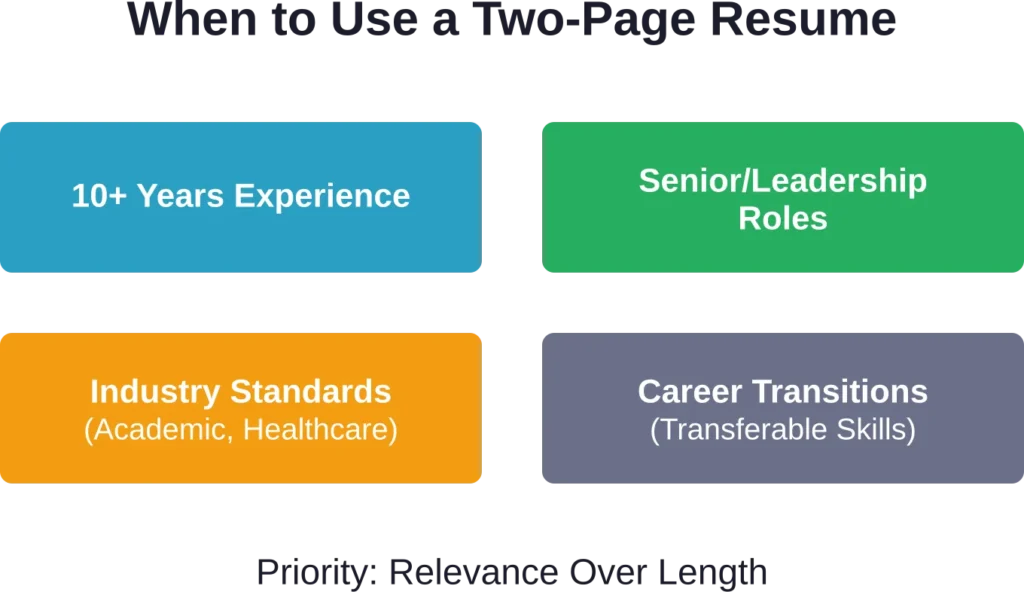
A two-page resume makes sense in several specific situations. These aren’t exceptions to a rule—they’re common scenarios where two pages simply work better.
You Have 10+ Years of Relevant Experience
Once professionals reach a decade or more in their field, they’ve accumulated substantial achievements worth showcasing. Cutting significant accomplishments just to meet an arbitrary page limit means sacrificing the very information that demonstrates value.
Career progression over 10+ years typically includes multiple roles, leadership responsibilities, major projects, and quantifiable results. All of that matters to hiring managers evaluating senior candidates.
You’re Applying for Senior or Leadership Positions
Executive roles, director positions, and senior management jobs require demonstrating strategic impact, leadership capabilities, and business results. These accomplishments need context and detail.
A one-page resume for a VP-level candidate looks sparse and underdeveloped. Two pages allows space to showcase the scope of responsibility, team sizes managed, budgets overseen, and transformational results delivered.
Your Industry Expects Detailed Work History
Certain fields have different resume norms. Academic positions typically require CVs (curriculum vitae) that run 2-12 pages, according to Oregon State University’s Career Development Center. Healthcare, research, government, and technical roles often expect comprehensive documentation of credentials, certifications, projects, and publications.
Resumes for scientific positions should generally be 2-3 pages in length, according to guidance from George Washington University’s Scientific Writing resource. Fighting industry norms puts candidates at a disadvantage.
You’re Making a Career Change and Need to Show Transferable Skills
Career changers face a unique challenge: they must connect experience from one field to requirements in another. That translation requires more explanation than a straightforward linear career path.
Demonstrating how skills from marketing transfer to product management, or how teaching experience applies to corporate training roles, needs space for context and specific examples.
When a One-Page Resume Still Makes Sense
Now, this is where it gets interesting. Two pages aren’t always better. Some situations genuinely benefit from the discipline of a single page.
Early Career Professionals and Recent Graduates
Candidates with less than 5-7 years of experience typically don’t have enough substantial achievements to fill two pages meaningfully. Padding a resume with filler content or inflating descriptions creates the opposite of a good impression.
Recent graduates should focus on relevant coursework, internships, projects, and skills. That almost always fits comfortably on one page while maintaining good white space and readability.
Entry-Level and Internship Applications
Entry-level roles and internships are evaluated primarily on potential, education, and foundational skills rather than extensive work history. A concise one-page resume demonstrates the ability to prioritize and communicate efficiently.
Focused, Specialized Roles
Some career paths remain relatively narrow and specialized. A graphic designer with 8 years of experience might have a strong portfolio that carries more weight than resume length. A one-page resume paired with a comprehensive portfolio link can be more effective than spreading thin experience across two pages.
What Actually Matters More Than Page Count
Here’s what hiring managers care about: Can they quickly identify whether a candidate has the right experience and skills? That’s it.
Length doesn’t determine that. Organization, clarity, and relevance do.
Relevance Beats Length Every Time
Research shows that some resumes lack personal statements or professional summaries, and employment gaps can be problematic. These content issues matter far more than whether a resume is one or two pages.
Candidates with unexplained employment gaps face reduced chances of landing interviews. The issue isn’t resume length—it’s missing explanations and context.
Scannability and White Space
Cramming text to fit one page creates dense, hard-to-scan documents. Recruiters won’t reward that effort by reading more carefully. They’ll move to the next resume that’s easier to process quickly.
Adequate white space, clear section headers, and consistent formatting make information accessible. Whether that takes one page or two is secondary.
Accuracy and Truthfulness
According to SHRM data, 85% of employers uncovered lies or misrepresentations on candidate resumes during screening. Yet only half of employers verify education credentials, according to SHRM data.
Padding a resume to fill space, or cutting crucial details to meet a page limit, both create problems. The content itself needs to be accurate, relevant, and substantiated.
How to Structure a Two-Page Resume Effectively
Okay, so what about the actual mechanics? If two pages make sense for a given situation, how should those pages be organized?
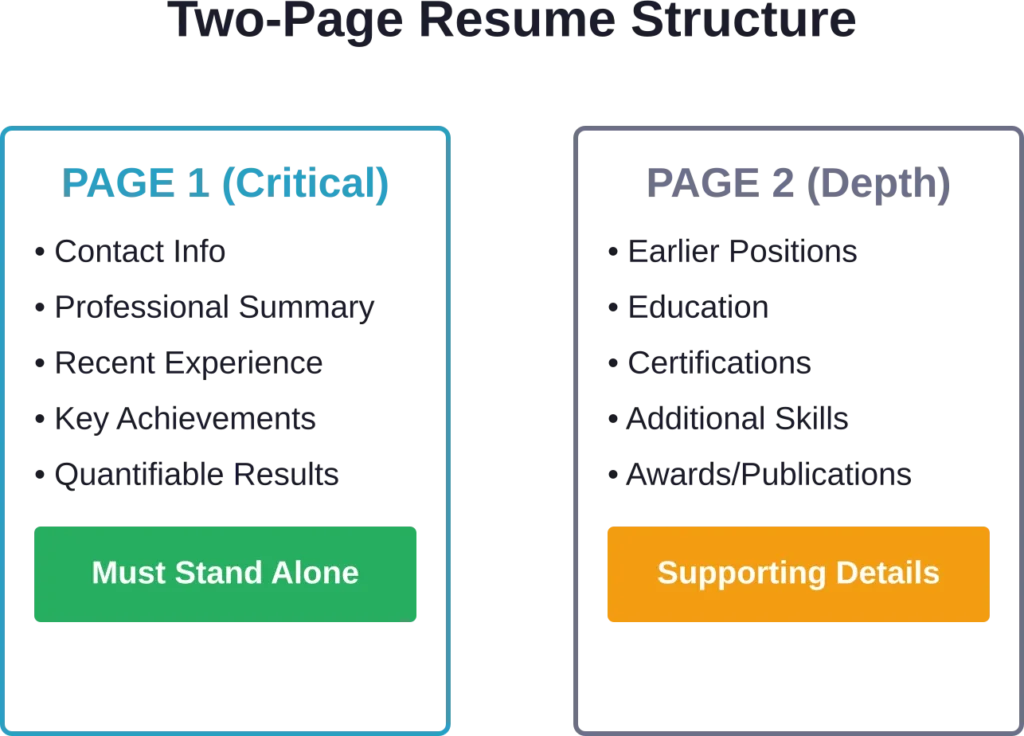
Put the Most Important Information on Page One
The first page needs to capture attention immediately. That means:
- Contact information and professional headline at the top
- A concise professional summary highlighting key qualifications
- The most recent and relevant work experience
- Quantifiable achievements and results from current or recent roles
Assume some recruiters might not flip to page two. Page one should be strong enough to stand alone if necessary.
Use Page Two for Supporting Details
The second page provides space for:
- Earlier career positions (condensed to key points)
- Additional skills and certifications
- Education and professional development
- Awards, publications, or speaking engagements
- Volunteer work or board positions (for senior roles)
Think of page two as depth that reinforces the case made on page one, not as equally weighted content.
Maintain Consistent Formatting Across Both Pages
Both pages should use the same font (10-12 point standard fonts like Times New Roman or Helvetica work best), margins, spacing, and section header styling. The document should feel like a cohesive whole, not two separate pages stapled together.
Include a header on page two with name and page number. Simple but professional: “[Your Name] – Page 2” in a smaller font at the top.
Don’t Stretch Content to Fill Space
A two-page resume should contain two pages of valuable information. It shouldn’t be a one-page resume with inflated descriptions and excessive white space stretched across two pages.
If content naturally ends at 1.5 pages, that’s fine. The goal is clarity and impact, not hitting exactly two full pages.
Common Mistakes That Make Resume Length a Problem
Length becomes an issue when the wrong content fills the space—or when the right content gets buried under poor formatting.
Including Irrelevant Work Experience
Listing every job since college when applying for a senior director role adds length without adding value. Work experience from 20 years ago rarely matters unless it’s directly relevant to the target position.
Generally speaking, 10-15 years of work history is sufficient for most resumes. Earlier experience can be summarized in a single line under “Early Career” if needed at all.
Using Paragraphs Instead of Bullet Points
Dense paragraph blocks eat up space while making information harder to extract. Bullet points with strong action verbs and quantifiable results communicate more effectively in less space.
Compare “Responsible for managing a team that handled customer service inquiries and worked to resolve issues in a timely manner” with “Led 12-person customer service team, reducing average resolution time by 34% and improving satisfaction scores from 3.2 to 4.6/5.0.”
The second version is shorter and far more impactful.
Repeating the Same Information Multiple Times
Some resumes list identical skills in a skills section, in the professional summary, and in job descriptions. That’s not reinforcement—it’s wasted space.
State skills once in a dedicated section, then demonstrate them through specific achievements in work experience descriptions.
Tiny Fonts and Narrow Margins
Shrinking fonts to 9-point or setting margins to 0.5 inches to squeeze more content onto one page backfires. Readability drops and the resume looks cramped and desperate.
Standard formatting—10-12 point fonts and 0.75-1.0 inch margins—isn’t negotiable. If content doesn’t fit with proper formatting, the solution is editing content or adding a page, not destroying readability.
| Resume Element | One-Page Resume | Two-Page Resume |
|---|---|---|
| Experience Level | 0-7 years typically | 10+ years typically |
| Career Stage | Entry to mid-level | Senior to executive |
| Detail Level | Concise, essential only | Comprehensive, contextual |
| Work History Depth | Recent 5-7 years focus | 10-15 years detailed |
| Achievement Count | 2-3 per major role | 4-6 per major role |
| White Space | Moderate, balanced | Generous, scannable |
How Applicant Tracking Systems Handle Multi-Page Resumes
One concern about two-page resumes involves applicant tracking systems. Will ATS properly parse both pages? Will the second page even be read?
The short answer? ATS handle multiple pages just fine. These systems parse content from digital files, not physical pages. Whether content is on page one or page two makes no difference to the parsing algorithm.
What does matter: file format, heading consistency, and standard section labels. ATS scan for specific keywords and phrases throughout the entire document, regardless of length.
The real ATS concern isn’t page count—it’s using unusual formatting, graphics-heavy templates, tables within job descriptions, or non-standard section headers that confuse parsing algorithms.
A clean, well-formatted two-page resume in a standard Word or PDF format will process through ATS exactly as effectively as a one-page version.
Industry-Specific Resume Length Norms
Different fields have different expectations. Understanding industry norms helps candidates avoid unforced errors.
Corporate and Business Roles
Standard business resumes follow the general guidelines outlined above: one page for early career, two pages for experienced professionals. Marketing, finance, operations, sales, and management roles all fit this pattern.
Technical and Engineering Fields
Technical resumes often require more space to list programming languages, frameworks, tools, certifications, and complex projects. Two pages is standard for mid-career and senior technical professionals.
That said, technical skills lists shouldn’t become exhaustive catalogs. Focus on currently relevant technologies and proficiency levels that match job requirements.
Academic and Research Positions
Academic CVs operate under completely different rules. These documents include publications, presentations, grants, teaching experience, research projects, and committee work. Length ranges from 2-12 pages depending on career stage, according to Oregon State University career guidance.
Don’t confuse academic CVs with industry resumes—they’re different documents for different purposes.
Creative Fields
Designers, writers, artists, and other creative professionals often rely more heavily on portfolios than resumes. The resume might be one page with a link to an extensive online portfolio where the real evaluation happens.
What Hiring Managers Actually Say About Resume Length
Community discussions among recruiters and hiring managers reveal consistent themes about resume length.
The consensus? Length itself rarely disqualifies candidates. Poor organization, irrelevant content, and lack of quantifiable achievements do.
Experienced recruiters report seeing excellent two-page resumes and terrible one-page resumes regularly. They also see terrible two-page resumes and excellent one-page resumes. The quality of content matters, not the page count.
One common observation: candidates hurt themselves more often by cutting too much than by including too much. Removing specific achievements and metrics to hit one page eliminates exactly the information that distinguishes strong candidates from average ones.
But wait. Recruiters also consistently complain about resumes that include obvious filler, outdated experience, and poorly organized information. Adding a second page full of that content doesn’t help.
Making the Final Decision: One Page or Two?
So how should individual candidates decide? Here’s a practical framework.
First, draft everything that might be relevant without worrying about length. Include all significant achievements, roles, skills, and credentials.
Second, prioritize ruthlessly. What matters most for the specific roles being targeted? What demonstrates the strongest value proposition?
Third, format properly with 10-12 point fonts, appropriate margins, and adequate white space. See where content naturally falls.
If everything fits comfortably on one page with good readability and white space, stick with one page. If forcing content onto one page requires sacrificing significant achievements, tiny fonts, or cramped formatting, use two pages.
The decision should be driven by content and readability, not by following a rule.
Frequently Asked Questions
Always format two-page resumes as two separate pages, not front-and-back on a single sheet. Most applications are digital, where this distinction doesn’t matter, but for printed copies, two separate pages ensure both pages are easily readable without flipping a sheet.
Yes, but not always immediately. Recruiters typically scan page one first to determine basic fit. If page one is compelling, they’ll continue to page two for additional detail. That’s why page one must contain the most critical information and strongest achievements.
Recent graduates can use two pages if they have substantial relevant experience through internships, co-ops, research projects, or extensive relevant coursework. However, most new graduates have enough content for a strong one-page resume. Adding a second page filled with coursework, high school achievements, or inflated descriptions weakens rather than strengthens the application.
No. Recent and relevant positions should include 4-6 bullet points with specific achievements and metrics. Earlier positions can be summarized with 2-3 points or even just a title, company, and dates for roles from 15+ years ago. The detail should decrease as positions become older and less relevant.
PDF format ensures formatting stays consistent across different devices and operating systems. Word documents can reflow text and break pagination unexpectedly. When submitting PDFs, make sure the file isn’t locked against text extraction, since applicant tracking systems need to parse content.
If content naturally ends at 1.5 pages, that’s fine—don’t add filler just to reach exactly two full pages. However, if a resume is 1.5 pages, review whether it’s possible to trim to a strong single page or expand relevant achievements to fill two pages naturally. The awkward middle length suggests the prioritization and editing process might need another pass.
Update resumes after every significant achievement, new role, completed certification, or major project—even if not actively job searching. Waiting until job search time means forgetting details and metrics that strengthen the document. For length management, this also makes it easier to remove older, less relevant content as new accomplishments are added.
The Bottom Line on Resume Length
The question “Is it OK for a resume to be 2 pages?” has a clear answer in 2026: Yes, when the content warrants it.
What matters isn’t hitting a specific page count. What matters is presenting relevant experience, quantifiable achievements, and clear qualifications in a format that’s easy for hiring managers to scan and evaluate quickly.
For experienced professionals with substantial relevant accomplishments, two pages provides the space needed to make a compelling case without sacrificing readability. For early-career candidates with limited experience, one page maintains focus and demonstrates concise communication skills.
The decision should be strategic, driven by career stage, industry norms, and the strength of content available. Not by following an outdated rule that was never universally true in the first place.
Stop worrying about page count. Start focusing on relevance, clarity, and impact. That’s what actually determines whether a resume leads to interviews.
Ready to optimize your resume for 2026? Review your current document against the guidelines above, prioritize achievements over duties, and format for scannability. Whether that takes one page or two will become clear once the content is right.