

Quick Summary: The landscaping web design industry in 2026 demands specialized agencies that understand seasonal service cycles, visual storytelling, and local search optimization. The top 15 companies profiled here excel at creating conversion-focused websites that showcase outdoor transformations through striking photography, mobile-responsive layouts, and strategic calls-to-action that turn browsers into booked clients.
Your landscaping business deserves more than a generic website template.
The best landscaping websites don’t just look pretty—they convert visitors into paying customers by showcasing transformations, building trust through testimonials, and making it ridiculously easy to request quotes. But finding an agency that truly understands the outdoor services industry? That’s where things get complicated.
Most web design companies treat landscaping sites like any other small business project. They miss the nuances: seasonal service promotion, regional plant knowledge, before-and-after visual storytelling, and the local search signals that actually drive phone calls.
This curated list focuses exclusively on agencies that have proven track records building websites for landscapers, lawn care companies, hardscape installers, and outdoor design firms. Each company brings specialized expertise to the unique challenges of marketing outdoor services online.
What Makes a Landscaping Web Design Company Stand Out
Not every web design agency can deliver what landscaping businesses actually need.
The agencies that succeed in this niche understand that landscaping websites function differently than typical service business sites. Visual impact matters more—potential clients need to see your work before they’ll trust you with their property. Project galleries must load fast on mobile devices, since most homeowners browse while standing in their own yards imagining possibilities.
Great landscaping web design companies also grasp the importance of seasonal content strategies. Your website should promote spring cleanup services in March, highlight irrigation installation in June, and push fall leaf removal by October. Static websites that never change miss massive revenue opportunities.
Core Features Every Landscaping Website Needs
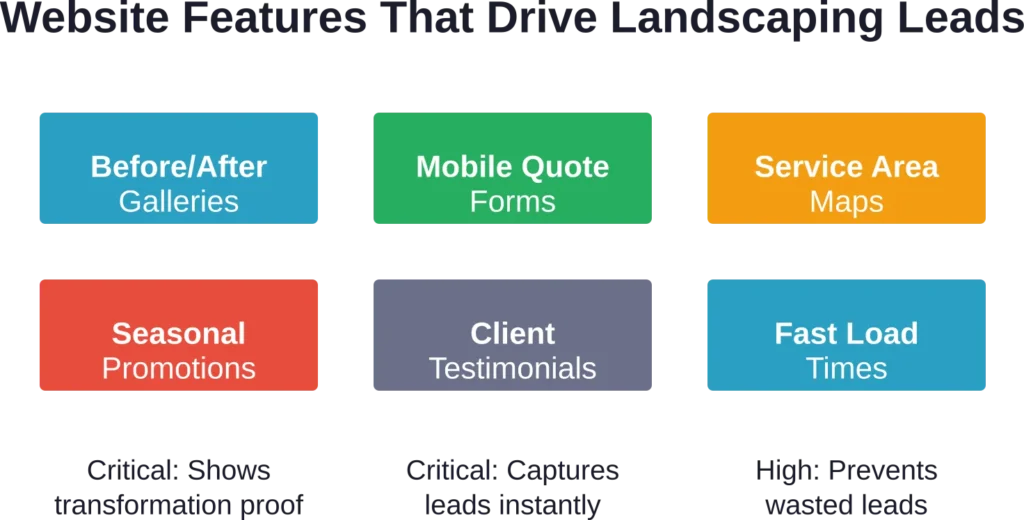
Based on analyses of high-performing landscaping websites, certain features consistently separate successful sites from mediocre ones:
| Feature | Why It Matters | Implementation Priority |
|---|---|---|
| Visual-first design with large project photos | Showcases real results and builds immediate trust | Critical |
| Before-and-after galleries | Demonstrates transformation capabilities | Critical |
| Mobile-responsive layouts | Most searches happen on smartphones in yards | Critical |
| Clear service area maps | Prevents wasted leads from outside coverage zones | High |
| Online quote request forms | Captures leads 24/7 when office is closed | High |
| Customer testimonials with photos | Social proof from real local clients | Medium |
| Seasonal service promotion sections | Matches offerings to current customer needs | Medium |
The agencies listed below understand these requirements and build them into every landscaping website project they deliver.
1. Mobian Studio
Mobian Studio builds dedicated engineering teams that deliver production-ready websites and digital products for landscaping companies that demand speed, quality, and reliability.
They specialize in creating modern web solutions with strong mobile performance, helping landscaping businesses showcase their transformations effectively while providing smooth customer journeys from inspiration to quote request.
Core Strengths
Mobian excels at full-stack development for landscaping websites, including beautiful project galleries, service configurators, and backend systems that keep everything running efficiently. They support both complete website builds and enhancements to existing platforms, always focusing on clean architecture and excellent user experience.
Their approach ensures landscaping companies get fast-loading, visually striking websites that reflect the quality of their physical work and help generate more qualified leads.
Contact Information
- Website: mobian.studio
- Phone: [email protected]
- Address: Harju maakond, Tallinn, Kesklinnalinnaosa, Masina tn 22, 10113
- LinkedIn: www.linkedin.com/company/mobian-studio
2. Lengreo

Lengreo specializes in full-funnel digital marketing and website development for home service businesses, with a strong focus on helping landscaping companies generate consistent high-quality leads.
Their approach combines strategic B2B marketing with conversion-oriented web design that turns visitors into quote requests. Lengreo builds websites that not only look premium but are engineered to rank locally and convert mobile traffic effectively.
Signature Capabilities
Lengreo excels at creating integrated digital systems where SEO, paid ads, and lead generation work together with the website. For landscaping companies, they develop custom service pages, project galleries, and lead capture forms optimized for local searches like “landscaping services near me” or “patio installation [city]”.
The agency also implements hyper-personalized outreach campaigns and appointment-setting systems that connect directly with website visitors who show interest in landscaping projects. Their clients see significant improvements in lead volume and conversion rates through this unified marketing and web strategy.
Contact Information
- Website: Lengreo.com
- Phone: +31 686 147 566
- Email: [email protected]
- Address: Vrijstraat 9 C/D, 5611 AT Eindhoven, Netherlands
- LinkedIn: Lengreo
- Twitter: @Lengreo
- Instagram: @lengreo
3. A-listware

A-listware provides dedicated software development and web solutions for businesses in the home services sector, helping landscaping companies build robust, professional online presences.
They focus on delivering clean, secure, and responsive websites that serve as powerful lead-generation tools. Their team acts as an extension of the client’s business, creating digital platforms specifically aligned with the visual and practical needs of landscaping services.
Specialized Features
A-listware develops custom project showcases, service area pages, and integrated quote systems that help landscaping websites convert visitors effectively. They also provide UX/UI design, quality assurance, and ongoing support to ensure the website continues performing as the business grows.
Their solutions include cloud-based features and data management tools that make maintaining fresh content and responding to leads much smoother for landscaping business owners.
Contact Information
- Website: a-listware.com
- Phone: +1 (888) 337 93 73
- Email: [email protected]
- Address: North Bergen, NJ 07047, USA
- LinkedIn: www.linkedin.com/company/a-listware
- Facebook: www.facebook.com/alistware
4. Gilzor

Gilzor builds custom digital products and web applications tailored for service-based businesses, including landscaping companies looking to stand out with modern, high-performance websites.
They focus on creating intuitive platforms that combine beautiful design with functional tools landscaping businesses need — from project visualization to streamlined quote requests. Their user-centric approach ensures websites feel premium while delivering excellent user experiences on all devices.
Key Strengths for Landscaping
Gilzor develops custom web solutions including advanced project galleries, service configurators, and booking systems that help landscaping companies showcase transformations and convert visitors into clients. They also build mobile applications that complement the main website, allowing easier management of project portfolios and customer communications.
Their go-to-market expertise helps landscaping businesses attract the right audience through well-structured websites that support both organic growth and paid acquisition channels.
Contact Information
- Website: www.gilzor.com
- Email: [email protected]
- Address: Poland, Warsaw, Office 58, street Adama Mickiewicza 37, 01-625
- LinkedIn: www.linkedin.com/company/gilzor-softwaredevelopment
5. Oski

Oski creates smart, scalable software solutions and websites for ambitious service businesses, with particular strength in building digital experiences for landscaping and outdoor service companies.
They combine clean design, powerful frontend development, and AI-enhanced features to produce websites that impress visually while performing at a high level. Their solutions help landscaping companies present their work professionally and operate more efficiently online.
Signature Capabilities
Oski builds responsive websites with strong emphasis on cloud architecture, seamless user interfaces, and intelligent features such as AI-powered project recommenders or automated content updates for seasonal landscaping services. They also develop custom tools that integrate with business operations, making it easy for landscaping teams to update project photos, availability, and service offerings.
Their expertise across multiple industries allows them to bring fresh technical ideas to landscaping websites, creating experiences that feel both premium and highly functional.
Contact Information
- Website: oski.site
- Phone: +48571282759
- Email: [email protected]
- Address: Kaupmehe tn 7, 10114 Tallinn, Estonia
- LinkedIn: www.linkedin.com/company/oski-solutions
6. Searchbloom

Searchbloom combines web design with comprehensive digital marketing services, making them particularly valuable for landscaping companies ready to invest in complete online presence rather than just a website.
Their landscaping website projects integrate tightly with local SEO strategies, Google Business Profile optimization, and reputation management systems. The websites they build serve as hubs for broader marketing ecosystems rather than standalone digital brochures.
Searchbloom’s design work emphasizes technical performance—fast loading times, clean code, and mobile optimization—recognizing that search engines reward sites that deliver excellent user experiences. Their landscaping clients benefit from both attractive designs and the technical foundation needed to rank well in local search results.
Ongoing Optimization Approach
The agency doesn’t consider websites finished at launch. Searchbloom implements tracking, runs conversion rate optimization tests, and makes iterative improvements based on actual visitor behavior data. They might test different quote form placements, experiment with project gallery layouts, or adjust calls-to-action based on which versions generate more leads.
This ongoing refinement proves particularly valuable for landscaping companies in competitive markets where small conversion rate improvements directly impact revenue.
7. HigherVisibility

HigherVisibility has built a strong reputation in the home services sector, with landscaping companies representing a core client vertical.
Their web design philosophy centers on conversion architecture—structuring every page to guide visitors through awareness, consideration, and decision stages. For landscaping sites, this means homepage designs that quickly establish credibility through client testimonials and project photos, service pages that address common concerns and objections, and strategically placed quote request opportunities throughout the user journey.
HigherVisibility specializes in multi-location landscaping companies, building website architectures that effectively represent businesses serving multiple cities or regions without creating confusing navigation or diluted messaging.
Search Intent Alignment
The agency invests heavily in understanding search intent behind keywords that bring visitors to landscaping websites. Someone searching “landscape design ideas” has different needs and readiness than someone searching “landscaping companies near me hiring today.” HigherVisibility designs page templates and content strategies that align with these different intent stages.
This search intent alignment helps landscaping companies capture visitors at various stages of the buying journey, nurturing early-stage researchers while quickly converting ready-to-buy prospects.
8. Thrive Internet Marketing Agency
Thrive has emerged as one of the most prominent digital marketing agencies serving small and medium businesses, with substantial expertise in the landscaping sector.
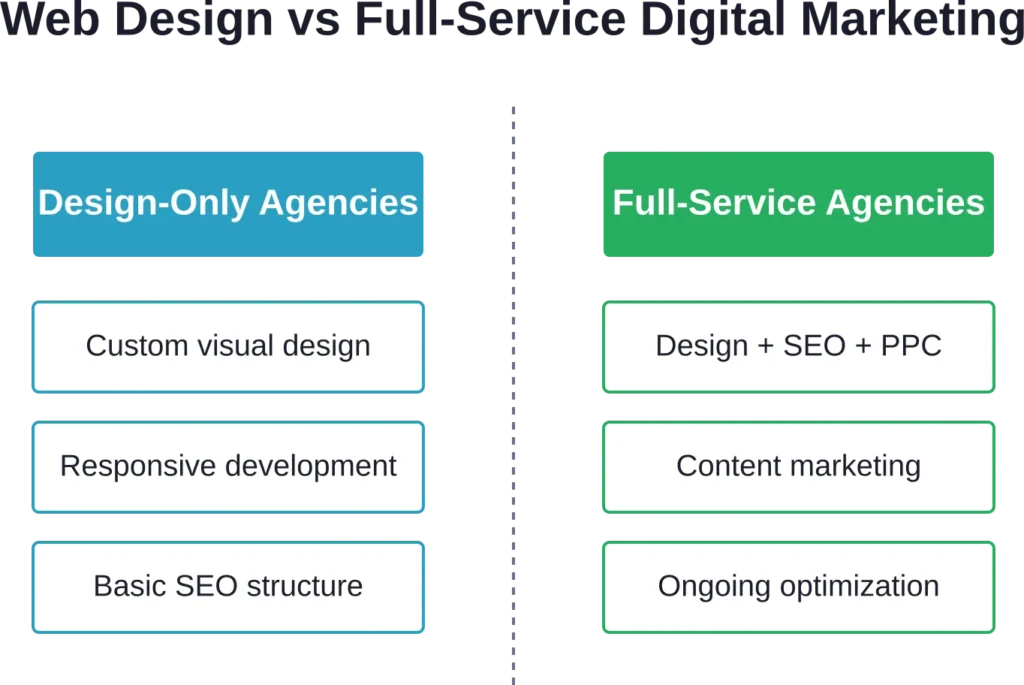
Their web design services integrate with full-spectrum digital marketing capabilities: search engine optimization, pay-per-click advertising, social media management, and email marketing. For landscaping companies ready to build comprehensive online presence, Thrive offers the advantage of coordinated strategy across all channels.
According to internal results from 2025, Thrive has demonstrated significant capabilities in adapting to AI-driven search, with increases of over 4,000% in traffic from AI-driven sources and over 800% in ChatGPT traffic for their client portfolio.
Data-Driven Design Decisions
Thrive’s approach relies heavily on data and testing rather than design trends or aesthetic preferences. They analyze which layouts, color schemes, and content structures actually generate leads for landscaping businesses, then apply those insights to new client projects.
The agency also maintains a dedicated research and development team that continuously refines approaches to adapt to algorithm updates and changing search behaviors—particularly important as voice search and AI assistants change how people find landscaping services.
9. Blue Corona

Blue Corona specializes exclusively in home services companies, with landscaping businesses forming a significant part of their client roster.
Their approach treats websites as conversion tools within larger marketing systems. Blue Corona designs landscaping websites to work seamlessly with call tracking, lead management software, and attribution systems that show exactly which marketing channels drive actual revenue—not just traffic or leads.
The agency is particularly strong in markets where landscaping companies face intense competition. Their websites emphasize differentiation through strategic positioning, client success stories, and clear communication of specialized capabilities or service guarantees.
Call Conversion Optimization
Blue Corona pays special attention to phone call conversions, recognizing that many landscaping services still close primarily through phone conversations rather than digital forms. Their websites include click-to-call buttons prominently on mobile devices, strategic placement of phone numbers throughout the user journey, and even call tracking that attributes phone conversions back to specific website pages or marketing campaigns.
This focus on call optimization proves especially valuable for landscaping companies selling higher-ticket services like landscape design, major hardscape installations, or commercial property maintenance contracts where personal consultation remains essential.
10. Straight North
Straight North brings enterprise-level digital marketing capabilities to middle-market businesses, including established landscaping companies ready to scale operations.
Their web design work emphasizes professional polish and sophisticated functionality. Straight North builds websites for landscaping companies that compete against larger national players—sites that convey stability, expertise, and the capacity to handle significant projects.
The agency excels at developing websites for landscaping companies with complex service offerings: residential and commercial divisions, design-build capabilities, maintenance contracts, and specialized services like irrigation, lighting, or water features. Their information architecture keeps these diverse offerings organized and accessible without overwhelming visitors.
Lead Quality Focus
Straight North emphasizes lead quality over lead volume. They design quote forms and qualification questions that filter out tire-kickers while making it easy for serious prospects to connect. For landscaping companies that struggle with low-quality leads or price shoppers, this qualification approach helps sales teams spend time on opportunities more likely to convert.
The agency also provides transparent reporting that connects website performance to business outcomes. Landscaping company owners can see not just traffic and leads but also close rates, average project values, and return on investment from their website and broader digital marketing efforts.
11. Comrade Web Agency

Comrade Web specializes in creating conversion-focused websites for home services companies, with a particularly strong portfolio in the landscaping sector.
Their approach emphasizes visual storytelling through large hero images, strategic use of white space, and project galleries that load quickly despite high-resolution photography. The agency’s design philosophy centers on reducing friction in the customer journey—every page should guide visitors toward requesting a quote or calling.
What sets Comrade apart is their integration of web design with local search optimization. They don’t just build attractive sites; they structure every page to rank for location-specific keywords like “landscaping in [city]” or “hardscape installation near me.”
The agency serves landscaping companies across multiple service categories: residential lawn care, commercial property maintenance, landscape design and installation, hardscaping, and irrigation systems. Their client portfolio includes both solo operators and multi-crew operations serving entire metropolitan areas.
Signature Capabilities
Comrade excels at creating custom project gallery systems that let landscaping companies showcase work by service type, property style, or project size. Potential clients can filter galleries to see only patio installations or only front yard transformations—making it easier for visitors to envision similar results for their own properties.
The agency also builds comprehensive service area pages that target multiple cities within a region. These aren’t thin doorway pages but substantive content hubs that address local climate considerations, regional plant selections, and area-specific landscaping trends.
12. Wix Studio for Landscaping Businesses

Wix has evolved far beyond its reputation as a DIY website builder, now offering Wix Studio—a professional platform specifically designed for agencies and freelancers building client sites.
For landscaping businesses, Wix Studio provides an interesting middle ground: professional design capabilities without the complexity of custom development. The platform includes industry-specific templates for landscaping companies that serve as solid starting points rather than restrictive boxes.
What makes Wix Studio relevant for landscaping sites is the visual editor that allows precise control over layout and spacing while maintaining mobile responsiveness. Designers can create unique project showcase sections without writing code, yet still achieve the polished, custom feel that landscaping companies need to stand out.
When Wix Studio Makes Sense
Landscaping companies with limited budgets or those just starting their digital presence often find Wix Studio delivers 80% of what custom development provides at a fraction of the investment. The platform handles the technical infrastructure—hosting, security, updates—so landscaping business owners can focus on updating project photos and seasonal service offerings.
The booking and scheduling features integrate particularly well for landscaping businesses that offer consultations or design appointments. Potential clients can see available time slots and book directly through the website, eliminating phone tag.
13. FreshySites

FreshySites has built its reputation entirely around websites for local service businesses, with landscaping companies representing a significant portion of their client base.
Their design aesthetic leans toward bold, modern layouts with striking typography and generous white space. FreshySites doesn’t create timid, forgettable websites—their landscaping projects make strong visual statements that reflect the transformation work their clients perform.
The agency emphasizes ongoing website performance rather than one-and-done projects. They track metrics like quote form completion rates, phone call conversions from mobile clicks, and time-on-site for project galleries. When something isn’t performing, they adjust rather than simply hoping for better results.
Specialized Landscaping Features
FreshySites builds custom project calculators that give visitors instant rough estimates based on property size, service type, and material selections. These calculators don’t replace formal quotes but help qualify leads by letting homeowners understand approximate investment levels before requesting detailed proposals.
The agency also creates seasonal content rotation systems that automatically feature relevant services based on the calendar. Spring cleanup promotions appear automatically in March; fall aeration specials highlight in September. This automation prevents landscaping websites from looking stale or out-of-season.
14. CyberOptik

CyberOptik brings nearly two decades of experience building websites for outdoor service companies, with particular depth in landscaping and lawn care sectors.
Their design approach balances visual impact with practical functionality. CyberOptik understands that landscaping websites must impress aesthetically—because that’s what the business sells—while still loading quickly and guiding visitors toward clear conversion actions.
The agency specializes in WordPress development, giving landscaping companies a robust content management system that allows easy updates to project galleries, service descriptions, and seasonal promotions. Their custom WordPress themes for landscaping businesses include built-in schema markup for better search visibility and mobile-first responsive frameworks.
Content Strategy Integration
What distinguishes CyberOptik is their emphasis on content strategy alongside design. They help landscaping companies develop editorial calendars that address seasonal questions customers actually search for: “When should I aerate my lawn?” “Best time to plant shrubs in [region]?” “How to prepare flowerbeds for winter?”
This content serves dual purposes—establishing expertise while capturing organic search traffic from homeowners researching landscaping topics. When someone finds helpful content about lawn care timing, they’re far more likely to hire that same company when they’re ready for service.
15. Jobber Academy Resources
While Jobber is primarily known for field service management software, their educational resources and website examples provide valuable insights into effective landscaping web design.
Jobber has analyzed thousands of successful landscaping businesses using their platform, identifying patterns in website features, content strategies, and conversion optimization that correlate with business growth. They’ve documented these findings in detailed guides and real-world examples.
The Jobber ecosystem includes website templates and integrations specifically designed for landscaping operations that use their scheduling and invoicing platform. This creates seamless experiences where website visitors can request quotes, clients can approve proposals, and scheduling happens without manual data entry between systems.
Practical Implementation Focus
Jobber’s approach emphasizes practical features over design awards. Their landscaping website examples prioritize clear service descriptions, prominent phone numbers and quote forms, and integration with the operational systems that landscaping companies actually use to run their businesses.
For smaller landscaping operations without dedicated marketing staff, this practical focus makes website management feasible. Owners can update service offerings, add project photos, and adjust seasonal messaging without needing technical skills or agency support for every change.
How to Choose the Right Landscaping Web Design Company
With dozens of agencies claiming expertise in landscaping websites, how do landscape business owners actually make smart selection decisions?
Start by examining portfolios critically. Don’t just look at whether the sites are attractive—evaluate whether they clearly communicate services, showcase projects effectively, and make quote requests obvious. Browse portfolio sites on your phone, since that’s how most potential customers will find them.
Questions to Ask Prospective Agencies
During initial consultations, ask these specific questions to gauge whether an agency truly understands landscaping business needs:
- Can you show me three landscaping websites you’ve built and explain the specific conversion strategies you implemented?
- How do you handle seasonal service promotion for landscaping companies?
- What’s your approach to local SEO and Google Business Profile integration?
- How do you optimize project galleries for fast mobile loading without sacrificing image quality?
- What analytics and reporting will I receive to understand website performance?
- How do you handle ongoing updates, security, and maintenance after launch?
The answers reveal whether agencies have genuine landscaping industry experience or just general web design capabilities they’re trying to apply to your business.
Red Flags to Watch For
Certain warning signs suggest an agency might not deliver the specialized expertise landscaping companies need:
Generic portfolios with no landscaping or home services examples indicate the agency lacks relevant experience. Template-heavy approaches that don’t allow customization won’t differentiate your business from competitors using the same themes.
Agencies that talk exclusively about design aesthetics without discussing conversion strategy, lead generation, or business outcomes probably prioritize awards over results. And firms that can’t explain their approach to local search optimization miss a critical component of how landscaping customers actually find service providers.
| Agency Type | Best For | Key Strengths | Potential Limitations |
|---|---|---|---|
| Specialized Landscaping Agencies | Companies wanting industry-specific expertise | Deep understanding of seasonal cycles, visual requirements, local search | May have smaller teams or limited service scope |
| Full-Service Digital Marketing | Businesses ready for comprehensive online presence | Integrated strategy across web, SEO, PPC, social media | Higher investment required for full service value |
| Local Web Design Firms | Companies prioritizing in-person collaboration | Local market knowledge, face-to-face meetings | May lack specialized landscaping experience |
| Platform-Specific Builders | Budget-conscious startups or solopreneurs | Lower costs, DIY maintenance capability | Less customization, potential scalability limits |
Beyond the Website: Integration with Business Operations
The best landscaping web design companies understand that websites don’t exist in isolation—they must integrate with the operational systems landscaping businesses use daily.
Look for agencies that can connect websites with field service management platforms like Jobber, ServiceTitan, or LMN. These integrations allow quote requests from websites to flow automatically into estimation and scheduling systems, eliminating manual data entry and reducing response times.
Calendar integrations let potential clients book consultation appointments directly through websites, seeing real-time availability. Payment processing integrations allow customers to pay deposits or invoices online, improving cash flow and reducing collection friction.
Marketing Automation Capabilities
Advanced agencies help landscaping companies implement marketing automation that nurtures leads over time. Someone who requests a quote in February for spring landscape installation might receive automated follow-up emails with design inspiration, financing information, and seasonal planting guides—keeping your company top-of-mind until they’re ready to commit.
These automation systems can also segment contacts based on service interests, property types, or budget signals, allowing more targeted and relevant communication than one-size-fits-all email blasts.
The Role of Content in Landscaping Websites
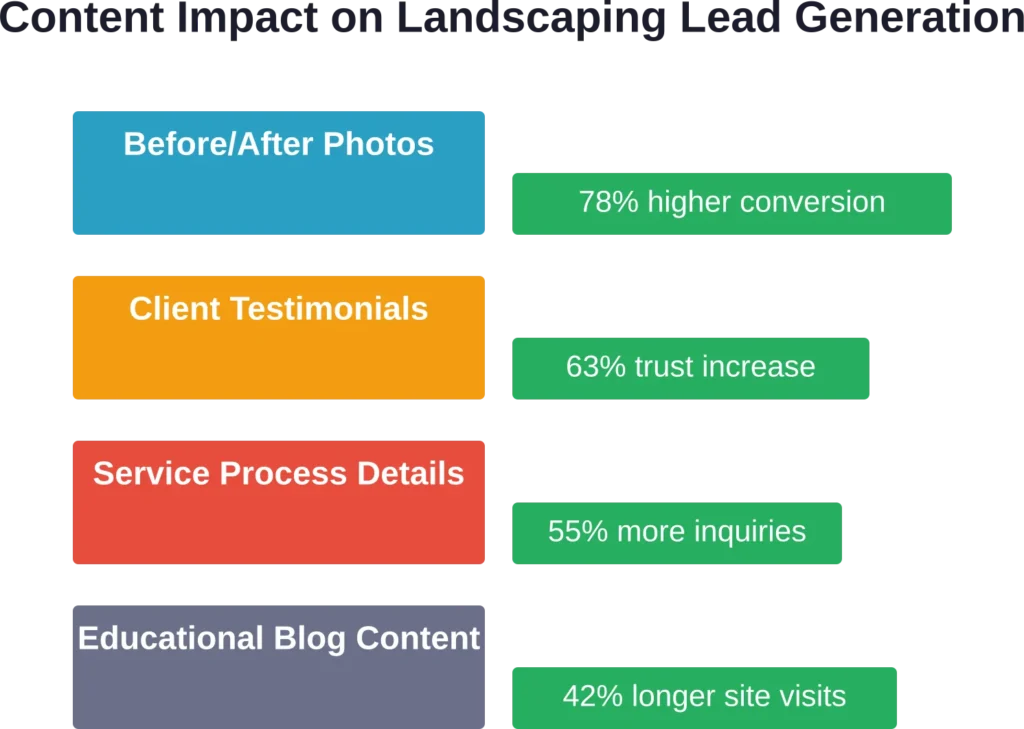
Design and functionality matter, but content often determines whether landscaping websites actually generate business.
The best agencies help landscaping companies develop content strategies that address the questions and concerns potential customers actually have. This includes detailed service descriptions that explain processes, timelines, and what clients can expect; project showcases with context about challenges solved and client goals achieved; and educational content about landscaping topics relevant to your service area.
Visual Content Strategy
For landscaping businesses, visual content carries even more weight than written material. Professional photography of completed projects provides the proof potential clients need to trust your capabilities.
Smart agencies help landscaping companies develop photography guidelines for ongoing project documentation: consistent angles for before-and-after comparisons, shots that show both detail work and overall impact, and images that represent the range of property types and styles you serve.
Video content increasingly matters too. Project time-lapses, client testimonials, and seasonal maintenance tip videos all help landscaping companies stand out in crowded markets while building the know-like-trust factors that drive hiring decisions.
Mobile-First Design for Landscaping Services
Most homeowners research landscaping services while standing in their yards, phone in hand, imagining what could be done with their outdoor spaces.
This reality makes mobile-first design absolutely critical for landscaping websites. The best agencies design for smartphone screens first, then scale up to tablets and desktops—ensuring the majority of visitors get optimal experiences.
Mobile-first design for landscaping sites means large, tappable buttons for calls and quote requests; project galleries optimized for thumb-scrolling; fast-loading images that don’t eat data plans; and forms simplified for smartphone completion.
Location-Based Mobile Features
Advanced mobile implementations use geolocation to automatically detect visitor locations, immediately answering the “Do you serve my area?” question. Some landscaping websites show estimated response times based on visitor location or highlight the nearest completed projects to build local credibility.
Click-to-call functionality with proper tracking allows landscaping companies to measure which pages and content drive phone calls, optimizing the user journey for this critical conversion action.
Accessibility and Inclusive Design
Often overlooked in landscaping web design, accessibility ensures websites work for visitors with disabilities—and provides broader benefits for all users.
Accessible design includes proper color contrast for visitors with vision impairments, keyboard navigation for those who can’t use mice, alt text for images so screen readers can describe project photos, and clear heading structures that help everyone scan and navigate content.
Beyond ethical considerations, accessible websites often rank better in search results and provide better experiences for all visitors—including older homeowners who represent prime customers for many landscaping services.
Security and Maintenance Considerations
Landscaping websites collect sensitive customer information through quote forms—names, addresses, phone numbers, email addresses, and sometimes even property values or budget information.
Responsible agencies implement proper security measures: SSL certificates for encrypted connections, regular software updates to patch vulnerabilities, secure form submissions, and GDPR-compliant data handling for any international visitors.
Ongoing maintenance matters too. Websites need regular backups, security monitoring, broken link fixes, and compatibility updates as browsers and devices evolve. The best agencies include maintenance plans or clearly explain what ongoing support clients should expect.
Measuring Success: Analytics That Matter
Pretty websites mean nothing if they don’t generate actual business results.
Smart agencies implement analytics tracking that measures outcomes landscaping business owners actually care about: quote form submissions, phone calls from mobile click-to-call, consultation bookings, and geographic sources of visitors.
Advanced implementations track complete customer journeys—from first website visit through quote request, estimate provided, and project completed. This attribution helps landscaping companies understand which marketing channels and website content actually drive revenue, not just traffic.
Conversion Rate Optimization
The best agencies don’t stop at launch—they continuously test and refine elements to improve conversion rates. Small changes often drive meaningful results: different quote form placements might increase submissions by 20%; simplified forms might boost completion rates by 30%; revised service descriptions might improve consultation bookings by 40%.
This ongoing optimization approach treats websites as evolving assets rather than static projects, maximizing return on the initial design investment.
Common Mistakes to Avoid When Hiring
Landscaping companies often make predictable mistakes when selecting web design partners.
The biggest error? Choosing agencies based primarily on price rather than value and capabilities. The cheapest website option rarely delivers the lead generation results that make the investment worthwhile. Similarly, selecting agencies without relevant landscaping or home services experience forces you to educate them about your industry rather than benefiting from their expertise.
Another common mistake is treating the website as a one-time project rather than an ongoing asset requiring updates, content additions, and optimization. Agencies that disappear after launch leave landscaping companies with stale websites that don’t reflect current services or seasonal offerings.
Finally, many landscaping businesses fail to establish clear success metrics before starting projects. Without defined goals—leads per month, cost per acquisition, phone call volume—there’s no objective way to evaluate whether the website delivers acceptable return on investment.
The Future of Landscaping Web Design
Looking ahead, several trends will shape how landscaping companies use websites to attract and convert customers.
AI-powered chat systems will increasingly handle initial visitor questions, qualifying leads and scheduling consultations automatically. Voice search optimization will matter more as homeowners ask Alexa or Siri to “find landscaping companies near me.” And augmented reality features may let potential clients visualize landscape designs overlaid on their actual properties through smartphone cameras.
But despite technological advances, fundamental principles will remain: showcasing transformation through compelling before-and-after photography, building trust through client testimonials and professional presentation, and making it ridiculously easy for interested homeowners to take the next step toward becoming paying customers.
The agencies that succeed in landscaping web design will balance innovative capabilities with proven conversion strategies—using new technologies to enhance results rather than chasing trends that don’t serve actual business objectives.
Frequently Asked Questions
Every effective landscaping website needs compelling project galleries with before-and-after photos, clear descriptions of services offered, prominent contact information and quote request forms, client testimonials with photos when possible, service area maps, and mobile-responsive design. Additionally, strong landscaping sites include seasonal service promotions, about pages that establish credentials and build trust, and educational content addressing common customer questions about landscaping services.
Timeline varies based on project complexity and agency processes, but typical landscaping websites take 6-12 weeks from kickoff to launch. This includes discovery and strategy phases where agencies learn business details and goals, design and revision cycles where visual direction is established and refined, development where designs become functional websites, content creation or migration, and testing before public launch. Rush timelines are possible but often compromise quality or require premium fees.
Most modern landscaping websites use content management systems like WordPress that allow business owners to update project galleries, adjust service descriptions, change seasonal promotions, and publish blog content without technical skills. Smart agencies provide training and documentation for common updates landscaping companies need to make regularly. However, major design changes, functionality additions, or technical troubleshooting typically still require agency support.
Local search optimization proves absolutely critical for landscaping companies since customers almost always hire providers serving their specific geographic areas. Effective local SEO includes Google Business Profile optimization with complete information and regular updates, location-specific service pages targeting cities within your coverage area, local business schema markup that helps search engines understand your service area, customer reviews actively collected and responded to, and locally-relevant content addressing regional landscaping considerations. Most landscaping leads originate from local search queries, making this optimization essential rather than optional.
Template websites start from pre-designed themes created for broad industries, offering faster launch timelines and lower costs but limited differentiation from competitors using similar templates. Custom designs are built specifically for individual businesses, providing unique visual identity and functionality tailored to specific needs but requiring larger investments and longer development timelines. For landscaping companies, the right choice depends on budget, competitive positioning goals, and specific functional requirements. Strong template implementations with quality customization often serve small operations well, while established companies competing in saturated markets typically benefit from custom approaches.
Effective measurement tracks quote requests submitted through website forms, phone calls generated from mobile click-to-call buttons or listed numbers, consultation appointments booked through online scheduling, and attributed revenue from customers who first discovered the company through the website. Advanced tracking connects specific marketing sources to completed projects, revealing true return on investment. Landscaping companies should establish baseline metrics before new website launches, then monitor changes in lead volume, lead quality, and conversion rates. Comparing customer acquisition cost through the website against other marketing channels provides clear ROI perspective.
Online payment capabilities benefit both landscaping companies and clients, though necessity varies by business model. For maintenance contracts and recurring services, online payment options improve cash flow and reduce collections friction. For design-build projects with deposit and milestone payments, online options provide customer convenience while accelerating payment receipt. Implementation requires secure payment processing integration, clear invoicing systems, and often connection to accounting software. Smaller operations focused primarily on one-time project work may find online payments less critical initially, while larger companies or those with significant recurring revenue should prioritize this functionality.
Making Your Decision
Choosing the right web design partner represents a significant decision for landscaping companies.
Your website serves as the digital face of your business—often the first impression potential customers form. It needs to showcase your best work, communicate your unique value, build trust, and convert visitors into booked consultations and signed contracts.
The agencies profiled here all bring proven capabilities to landscaping web design, but the best fit depends on your specific business situation, budget, and goals. Smaller operations just establishing online presence have different needs than established companies ready to dominate competitive markets.
Take time to review portfolios carefully. Schedule consultations with multiple agencies. Ask the tough questions about their specific landscaping industry experience, conversion optimization approach, and ongoing support models.
And remember—the goal isn’t the prettiest website but the one that generates the most qualified leads and grows your landscaping business most effectively. Let that outcome focus guide your selection decision, and you’ll find the right partner to transform your online presence into a powerful lead generation asset.
Ready to elevate your landscaping company’s digital presence? Start by auditing your current website against the best practices outlined here, then reach out to agencies whose capabilities align with your growth objectives. Your next level of business success might be just one website redesign away.