

Quick Summary: Generative AI tools for marketing include platforms like Extuitive, ChatGPT for content automation, Jasper for brand-consistent copywriting, Midjourney for visual creation, and specialized solutions for SEO, video editing, and campaign optimization. According to Goldman Sachs research, generative AI could boost productivity growth by 1.5 percentage points over a 10-year period and increase global GDP by 7%, making these tools essential for competitive marketing teams in 2026.
Marketing teams face relentless pressure to produce more content, launch campaigns faster, and prove ROI with shrinking budgets. Generative AI has shifted from experimental technology to essential infrastructure.
But here’s the thing—not all AI tools deliver on their promises. Some create generic content that tanks engagement. Others require so much prompt engineering that manual work would be faster.
This guide cuts through the noise. It covers the generative AI tools actually delivering results for marketing teams in 2026, organized by use case with honest assessments of what works and what doesn’t.
What Makes Generative AI Different for Marketing
Generative AI creates new content—text, images, video, code—rather than just analyzing existing data. That distinction matters for marketing workflows.
Traditional marketing automation handles repetitive tasks: scheduling social posts, sending email sequences, updating CRM records. Generative AI goes further by producing the actual creative assets and copy those systems distribute.
Research from MIT Sloan, Harvard Business School, and Wharton examined how generative AI affects highly skilled workers. The study tracked 700 consultants and found that when AI operates within its capability boundaries, worker performance improved by nearly 40% compared with those not using the technology.
That performance boost comes with a critical caveat. When workers deployed AI outside its effective range, results deteriorated. Harvard Business School’s Fabrizio Dell’Acqua, the study’s lead author, describes this as AI’s “jagged frontier”—the irregular boundary where AI capabilities suddenly drop off.
For marketing teams, understanding which tasks fall inside versus outside that frontier determines whether AI amplifies or undermines performance.
The Economic Stakes
Goldman Sachs projects generative AI will increase gross domestic product by 7% and lift productivity growth by 1.5 percentage points over the next decade. Marketing departments represent a significant portion of that potential productivity gain.
Stanford’s Center for Computational Market Design hosted a conference in February 2026 examining how artificial intelligence reshapes markets. The consensus: AI won’t just optimize existing marketing channels but will create entirely new market mechanisms and customer touchpoints.
Organizations that map AI capabilities to appropriate marketing tasks gain competitive advantages measured in quarters, not years.
Content Creation and Copywriting Tools
Content production consumes massive marketing resources. Generative AI tools in this category handle blog posts, ad copy, social media updates, email campaigns, and product descriptions.
Extuitive
Extuitive is a predictive AI platform for ad generation and validation, purpose-built for Shopify stores and ecommerce brands. Its core differentiator is consumer simulation technology trained on 100,000–150,000 real buyer profiles, allowing marketers to forecast creative performance before spending a single dollar on ads.
Marketing teams and Shopify store owners use Extuitive for the full creative-to-launch workflow: connect the store → automatic product analysis → AI generation of copy, images, videos, pricing strategies, and full campaign concepts → instant performance scoring (High/Medium/Low) via virtual consumer testing. This compresses campaign creation from weeks to minutes, dramatically reduces wasted ad spend, and replaces expensive manual A/B testing in the early stages.
Pricing is subscription-based with usage elements, tailored for ecommerce teams (exact 2026 rates available after demo). It is positioned as a cost-effective alternative to hiring agencies or running large-scale manual tests.
The main limitation: Extuitive delivers maximum value for established Shopify stores with existing sales history. Brand-new stores or non-ecommerce verticals require more manual input, and prediction accuracy improves significantly as the platform accumulates data from the brand’s own products and past campaigns.
Contact Information:
- Website: extuitive.com
- Email: [email protected]
- LinkedIn: www.linkedin.com/company/extuitive
- Twitter: x.com/Extuitive_Inc
- Instagram: www.instagram.com/extuitiveinc
ChatGPT

OpenAI’s ChatGPT dominates general-purpose text generation. The interface accepts natural language prompts and produces coherent responses across topics.
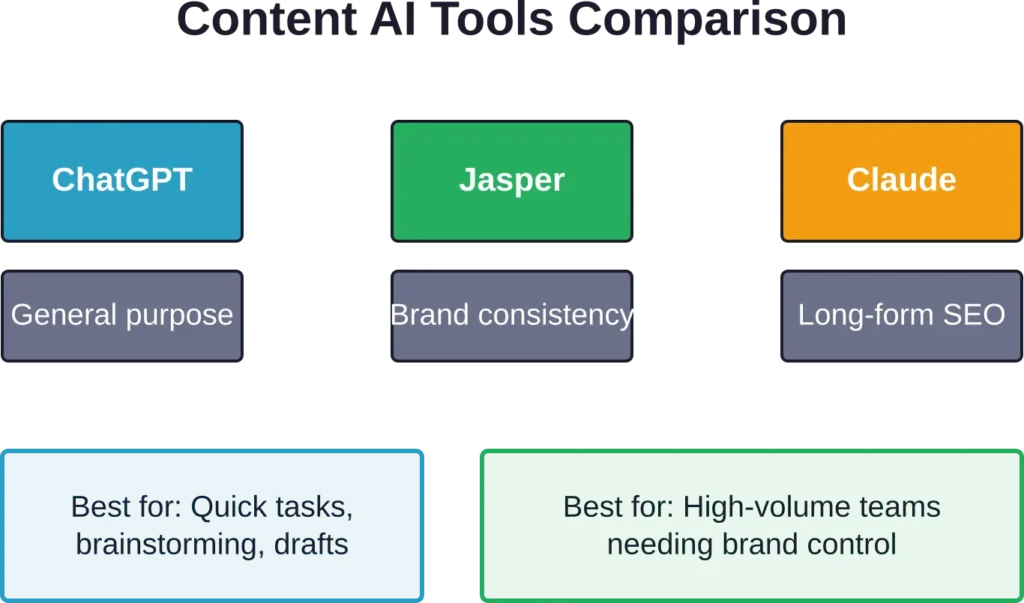
Marketing teams use ChatGPT for brainstorming campaign concepts, drafting initial copy, repurposing content across formats, and answering customer service questions. The tool excels at ideation and first drafts but requires significant editing for brand voice consistency.
The free tier provides access to GPT-3.5. ChatGPT Plus costs approximately $20 monthly, which handles complex instructions more reliably and maintains context through longer conversations.
The main limitation: ChatGPT lacks access to real-time data or proprietary brand information unless explicitly provided in prompts. It can’t automatically maintain consistent brand voice across campaigns without detailed style guidelines fed into each conversation.
Jasper

Jasper markets itself as the AI content platform built specifically for businesses. The differentiator is Brand IQ, a feature that learns company voice, style, and knowledge to maintain consistency across content.
Marketing teams upload brand guidelines, product catalogs, and previous high-performing content. Jasper analyzes these assets and generates new content matching established patterns. The system integrates with workflows through templates for specific content types: blog posts, Google ads, Facebook ads, email subject lines, product descriptions.
Pricing starts around $59 monthly per seat for the Pro tier (based on 2026 market data). The platform targets teams producing high volumes of content who need brand consistency without constant manual oversight.
The trade-off: Jasper’s specialized features come with steeper learning curves than general chatbots. Teams must invest time configuring Brand IQ properly to see results.
Claude

Anthropic’s Claude has earned recognition for SEO-focused writing. The model handles longer context windows than many competitors, maintaining coherence across extensive documents.
Marketing applications include drafting comprehensive guides, analyzing competitor content, and generating content briefs. Claude tends toward formal, structured outputs—useful for informational content, less so for casual social media.
The free tier supports basic usage. Paid tiers provide higher usage limits and priority access during peak times.
Notion AI

For teams already using Notion for project management and documentation, Notion AI integrates content generation directly into existing workspaces. The system can draft documents, summarize meeting notes, extract action items, and generate content based on information stored in Notion databases.
The feature costs either $8 or $10 per member monthly depending on billing cycle. The main advantage is contextual awareness—Notion AI can reference information from other pages in the workspace without manual copying.
The limitation: Notion AI works best for internal documentation and planning rather than customer-facing marketing content.
Visual Content and Design Tools
Visual assets—social graphics, ad creatives, product images, illustrations—represent another massive time investment. Generative AI tools now produce publication-ready visuals from text descriptions.
Midjourney

Midjourney generates photorealistic images, illustrations, and concept art through Discord-based prompts. Marketing teams use it for campaign mood boards, social media visuals, ad concepts, and product mockups.
The system excels at stylized imagery and artistic interpretations. Commercial use is permitted under paid plans. The main workflow hurdle: all interaction happens through Discord servers, which feels clunky for teams not already using that platform.
Prompt engineering matters significantly. Vague descriptions produce mediocre results. Detailed prompts specifying composition, lighting, style, and mood generate dramatically better outputs.
DALL-E

OpenAI’s DALL-E integrates with ChatGPT Plus subscriptions and generates images directly in chat conversations. The interface simplicity makes it accessible for teams without design experience.
DALL-E handles photorealistic images, diagrams, and illustrations. Recent versions improved text rendering within images—historically a weakness for image generation models. Marketing applications include social media graphics, blog post illustrations, and presentation visuals.
The constraint: DALL-E enforces content policies that sometimes reject prompts for unclear reasons, requiring rephasing and multiple attempts.
Canva AI

Canva embedded generative AI features into its existing design platform. Magic Write generates text content. Magic Design creates full layouts from brief descriptions. Background Remover isolates subjects. Magic Expand extends images beyond original borders.
The integration advantage: AI features work alongside Canva’s templates, stock libraries, and collaboration tools. Marketing teams can generate initial concepts with AI, then refine using traditional design tools without switching platforms.
Canva’s free tier includes limited AI feature usage. Pro plans provide higher limits and additional capabilities.
Adobe Firefly

Adobe integrated generative AI across Creative Cloud through Firefly. Features include text-to-image generation, generative fill (replacing image sections with AI-generated content), and text effects.
The differentiator: Adobe trained Firefly exclusively on licensed content, stock images, and public domain works. This approach aims to reduce copyright concerns compared with models trained on scraped internet data.
Firefly works within Photoshop, Illustrator, and Express. Marketing teams already invested in Adobe ecosystems gain AI capabilities without learning new platforms.
Video Creation and Editing Tools
Video dominates social media algorithms and drives higher engagement than static content. Generative AI has lowered barriers to video production—but results vary significantly by tool.
Runway ML

Runway provides AI-powered video editing and generation. Features include text-to-video, image-to-video, motion tracking, green screen removal, and frame interpolation for slow motion.
Marketing teams use Runway for social media clips, product demonstrations, and explainer videos. The platform handles both generating new video from descriptions and editing existing footage with AI assistance.
The learning curve sits between consumer apps like CapCut and professional tools like Premiere Pro. Pricing scales with usage—teams producing occasional videos can use lower tiers, while agencies need higher-capacity plans.
Synthesia

Synthesia generates videos featuring AI avatars that speak scripted text. Marketing applications include training videos, product tutorials, personalized sales videos, and multilingual content.
The workflow: write a script, select an avatar and voice, configure basic visuals, and generate the video. No filming, actors, or studio time required. The system supports dozens of languages, enabling localization without hiring native speakers.
The obvious limitation: AI avatars still occupy the uncanny valley. They work for straightforward informational content but lack the authentic personality needed for brand storytelling or emotional connection.
Lumen5

Lumen5 converts blog posts and articles into social media videos. The system analyzes text content, selects relevant stock footage and images, generates captions, and assembles everything into short videos optimized for social platforms.
Marketing teams use Lumen5 to repurpose written content for video-first channels like TikTok, Instagram Reels, and YouTube Shorts. The platform includes a library of stock photos, videos, and music tracks.
Real talk: Lumen5 shouldn’t replace skilled video editors for high-stakes campaigns. It excels at producing acceptable videos quickly when the alternative is no video at all.
SEO and Content Optimization Tools
Search visibility determines content ROI for most marketing teams. These generative AI tools focus specifically on search engine optimization and content performance.
eesel AI Blog Writer

eesel positions itself for end-to-end SEO content automation. The platform generates complete, publish-ready blog posts including assets.
The workflow integrates keyword research, content generation, and optimization. Marketing teams input target keywords or topics, and the system produces drafts structured for search visibility. Pricing includes a free trial, then starting at $99 for 50 blogs.
The platform targets teams needing consistent content volume more than highly specialized expertise. It handles informational content effectively but struggles with complex technical topics requiring deep subject matter knowledge.
Clearscope

Clearscope analyzes top-ranking content for target keywords and identifies topics, terms, and questions to cover for competitive content. While not purely generative AI, it guides human writers toward comprehensive coverage.
Marketing teams use Clearscope during content planning and editing. Writers receive real-time feedback on content completeness and relevance as they draft. The system integrates with Google Docs and WordPress.
The investment: Clearscope pricing targets agencies and in-house teams producing significant content volumes. Casual bloggers will find the cost prohibitive.
Perplexity

Perplexity functions as an AI-powered research engine. Unlike ChatGPT, it cites sources for claims and provides real-time web access for current information.
Marketing applications include market research, competitor analysis, trend identification, and fact-checking. The citation feature makes it particularly useful for content requiring accuracy and credibility.
Teams use Perplexity during research and planning phases rather than content generation itself. The free tier supports basic usage; Pro subscriptions provide unlimited queries and advanced features.
Marketing Automation and Workflow Tools
These platforms embed generative AI into broader marketing workflows, handling repetitive tasks beyond just content creation.
Gumloop

Gumloop automates marketing workflows by chaining AI operations together. The platform handles tasks like data enrichment, research compilation, content generation, and report assembly.
Marketing teams build custom automation flows: scrape competitor pricing, summarize findings, generate comparison content, and format for publication—all without manual intervention between steps.
Community discussions mention a 20% discount code (MARKETERMILK) offered through certain channels. The platform targets teams with repetitive workflows that require multiple tool integrations.
Make and Zapier

Both platforms now integrate generative AI models into their workflow automation. Marketing teams can trigger AI operations based on events: new CRM entries generate personalized email drafts, form submissions create custom follow-up content, calendar events produce meeting summaries.
The advantage: teams already using these platforms for marketing automation can add AI capabilities without learning entirely new systems.
HubSpot AI Tools

HubSpot embedded AI features across its marketing, sales, and service hubs. Content Assistant generates blog posts, emails, and social media content. ChatSpot provides conversational access to CRM data and performs tasks through natural language commands.
For organizations already using HubSpot, these features reduce friction. Data stays within the existing system, and AI operations integrate with established workflows.
The limitation: HubSpot AI works best within HubSpot’s ecosystem. Teams using competing platforms or custom tech stacks won’t benefit from the integration advantages.
Practical Implementation Strategies
Tool selection matters less than deployment strategy. These approaches help marketing teams extract actual value from generative AI rather than accumulating unused software subscriptions.
Start With High-Volume, Low-Stakes Tasks
The MIT Sloan research on AI and worker productivity highlighted the importance of operating within AI capability boundaries. For marketing teams, that means identifying tasks where AI performs reliably and mistakes cause minimal damage.
Good starting points include:
- First drafts of social media posts (human review catches tone issues)
- Product description variations for A/B testing (performance data reveals winners)
- Email subject line generation (open rates provide immediate feedback)
- Image background removal (visual inspection catches errors)
- Meeting notes summarization (participants remember what was said)
Bad starting points include brand positioning statements, crisis communications, legal disclaimers, or anything requiring perfect accuracy on the first attempt.
Establish Output Quality Thresholds
AI-generated content exists on a spectrum from unusable to publication-ready. Most falls somewhere in the middle—decent but requiring edits.
Teams should define explicit quality thresholds: what percentage of generated content meets standards without edits? How much editing time does the average AI draft require compared with writing from scratch?
If AI drafts require more editing time than manual writing, the tool isn’t saving time regardless of how impressive the technology seems. Honest performance measurement prevents productivity theater.
Build Prompt Libraries
Generative AI responds to instructions. Better instructions produce better outputs. Teams that document and share effective prompts see more consistent results.
A marketing prompt library might include:
- Blog post outline generation with specific section requirements
- Social media post formulas for different platforms and objectives
- Email sequence templates with tone and length parameters
- Image generation prompts with successful composition patterns
- Research query formats that produce actionable competitive intelligence
Treat prompts as reusable assets. When someone discovers an effective instruction pattern, document it for team use.
Maintain Human Decision Points
Full automation appeals emotionally but fails practically. Effective AI implementation includes human decision points at critical junctures.
Consider a content workflow: AI generates outlines, humans approve direction, AI writes drafts, humans edit for brand voice, AI generates social promotion, humans schedule based on audience insights.
The pattern alternates AI speed with human judgment. Automation handles volume; people handle strategy and quality control.
| Task Type | AI Contribution | Human Contribution | Best Approach |
|---|---|---|---|
| Blog Post Creation | Research, outline, first draft | Strategy, editing, brand voice | AI drafts, human refines |
| Social Media | Variations, scheduling ideas | Final selection, timing | AI generates options, human chooses |
| Email Campaigns | Subject lines, body copy | Segmentation, send strategy | AI writes, human strategizes |
| Visual Assets | Concept generation, variations | Art direction, final polish | AI explores, human directs |
| Market Research | Data gathering, summarization | Analysis, strategic implications | AI aggregates, human interprets |
Compliance and Ethical Considerations
Generative AI introduces new compliance risks. Marketing teams need awareness of regulatory concerns and ethical boundaries.
FTC Enforcement Actions
The Federal Trade Commission has taken action against deceptive AI marketing claims. In June 2024, the FTC filed suit against FBA Machine and Bratislav Rozenfeld for falsely guaranteeing that consumers could make money operating online storefronts using AI-powered software. The scheme defrauded consumers of approximately $15 million.
In July 2024, the FTC took action against NGL Labs related to deceptive marketing practices.
In September 2024, the FTC launched Operation AI Comply, announcing five law enforcement actions against operations using AI hype or selling AI technology for deceptive purposes.
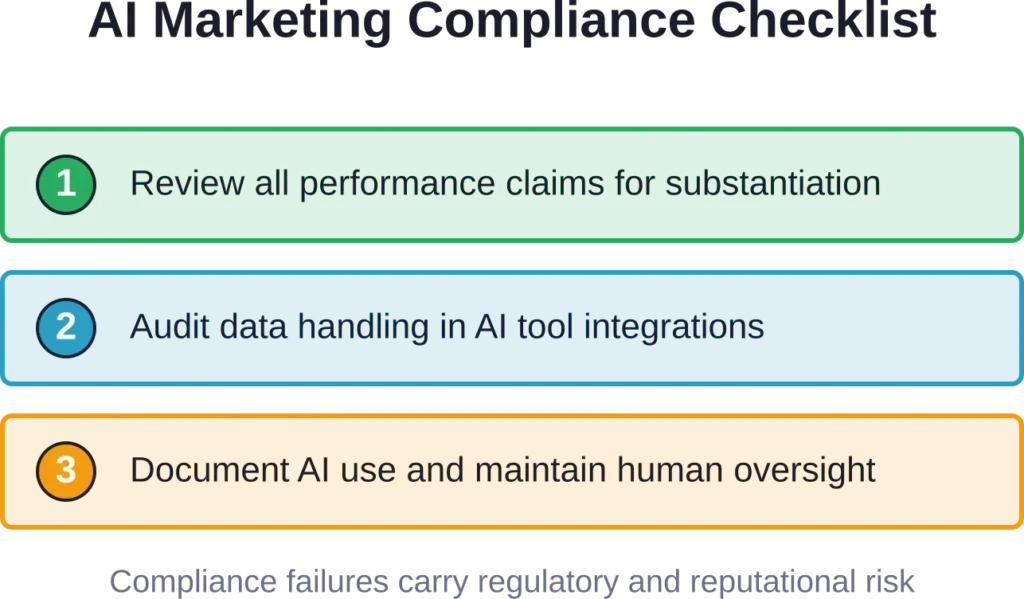
The pattern is clear: regulators scrutinize AI marketing claims. Teams making performance promises or guarantees based on AI capabilities face enforcement risk if claims prove unsubstantiated.
Privacy and Data Handling
Many generative AI tools process data through external APIs. Marketing teams must understand what data gets transmitted and how vendors use it.
The FTC published guidance in January 2024 reminding AI companies to uphold privacy and confidentiality commitments. Organizations using AI marketing tools remain responsible for how customer data is handled, regardless of whether processing happens through third-party services.
Practical implications: don’t feed customer personally identifiable information into AI tools without understanding data handling policies. Review terms of service for data retention, model training, and sharing provisions.
Copyright and Licensing
Generative AI copyright remains legally unsettled. Some models train on copyrighted works without explicit permission. Generated outputs might closely resemble training data.
Marketing teams should consider:
- Using AI tools trained on licensed content (like Adobe Firefly) for commercial applications
- Treating AI-generated content as drafts requiring human creative input rather than finished works
- Documenting AI tool use in content creation workflows for transparency
- Avoiding AI generation of content closely mimicking competitor materials
The safest approach: AI assists human creativity rather than replacing it entirely. Content with substantial human authorship and editing occupies less ambiguous legal territory.
Tool Selection Framework
Marketing teams waste resources testing tools that don’t match actual needs. This framework filters options systematically.
Identify the Specific Bottleneck
“We need AI for marketing” is too vague. What specific workflow currently limits output or quality?
Useful questions include:
- What task consumes disproportionate time relative to its strategic value?
- Where does content quality suffer due to volume pressure?
- Which repetitive tasks prevent focus on high-leverage activities?
- What content types see persistent production delays?
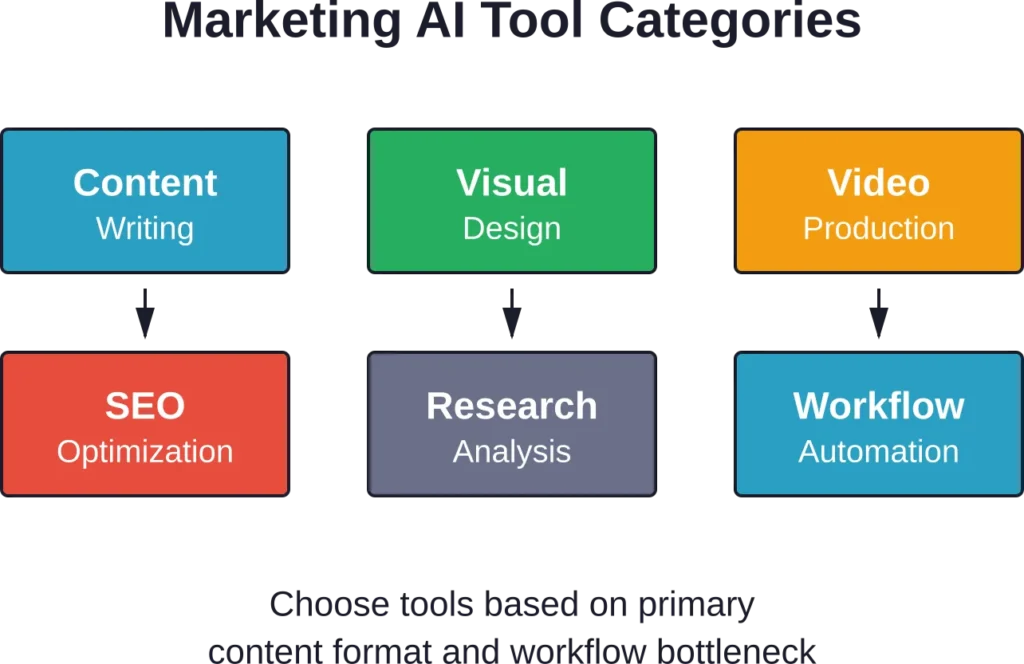
The bottleneck determines which AI category matters. If blog production lags, content writing tools help. If social engagement suffers from inconsistent posting, visual creation tools matter. If campaign analysis gets delayed, research automation helps.
Test With Realistic Scenarios
Demo environments with sample data don’t reveal how tools perform with actual marketing content. Free trials should involve real use cases.
Run parallel tests: produce content both manually and with AI assistance, measuring time investment and output quality. Compare results honestly rather than optimizing for the conclusion that justifies the tool budget.
Calculate True Cost
Subscription prices don’t capture total cost. Factor in:
- Setup time configuring brand guidelines and templates
- Training time for team adoption
- Editing time for AI-generated outputs
- Integration work connecting tools to existing systems
- Opportunity cost of focus on tool management versus strategy
A tool with a low subscription price but high setup and editing overhead often costs more than expensive platforms that work reliably.
Assess Vendor Stability
The generative AI market moves rapidly. Startups appear promising then disappear. Features get deprecated. Pricing models change.
Consider:
- How long has the vendor operated?
- What’s the funding situation?
- Do they have sustainable revenue or rely on venture capital?
- How frequently do major features change or break?
- What happens to content if the service shuts down?
Building critical workflows around unstable platforms creates risk. Established vendors with clear business models offer more predictability.
| Evaluation Criteria | Questions to Ask | Red Flags |
|---|---|---|
| Output Quality | Does it meet standards without extensive editing? | Generic content, poor brand fit, factual errors |
| Time Savings | Does it actually reduce time-to-completion? | High setup overhead, slow generation, complex workflows |
| Integration | Does it work with existing marketing stack? | Requires duplicate data entry, manual file transfers |
| Pricing | Is cost justified by productivity gains? | Opaque pricing, frequent upsells, usage limits |
| Support | Can issues be resolved quickly? | Chatbot-only support, slow response times |
Common Implementation Mistakes
Marketing teams repeat predictable errors when adopting generative AI. Awareness helps avoid them.
Deploying AI Without Process Changes
Adding AI tools to unchanged workflows rarely produces results. The technology works differently than manual processes.
Example: a team adopts AI writing tools but maintains the same approval chains designed for human writers. AI generates drafts in minutes, but content still waits days for review. The bottleneck shifted but throughput didn’t improve.
Effective implementation redesigns workflows around AI capabilities. Approval processes should match AI output speed. Quality checks should focus on AI-specific failure modes rather than human writer issues.
Over-Automating Creative Decisions
The MIT Sloan research identified a “jagged frontier” where AI capabilities drop off unpredictably. Creative strategy and brand positioning sit firmly outside AI’s reliable range.
Teams that automate creative direction—letting AI choose campaign themes, brand messaging, or positioning—typically produce bland, generic marketing that underperforms.
AI handles execution of creative decisions more reliably than making them. Humans determine strategy; AI produces variations and options within strategic boundaries.
Neglecting Brand Voice Consistency
Each generative AI tool has a default writing style. Without explicit direction, all output sounds similar regardless of brand.
Teams producing content with multiple AI tools often see brand voice fragment. Blog posts sound different from social media, which differs from email campaigns.
Solutions include documented style guidelines, prompt templates that specify tone and voice, and tools like Jasper’s Brand IQ that learn and maintain consistent style.
Ignoring Output Verification
Generative AI confidently produces incorrect information. Models generate plausible-sounding facts, statistics, and claims that don’t exist.
Marketing content containing false claims creates liability regardless of whether humans or AI wrote it. Teams must verify factual claims, statistics, and specific details before publication.
This is especially critical for regulated industries, technical content, and anything making performance claims.
Future Developments in Marketing AI
The generative AI landscape continues evolving rapidly. Several trends will shape marketing applications over the next few years.
Multimodal Capabilities
Current tools typically handle one content type: text, images, or video. Emerging models process and generate across multiple formats simultaneously.
Marketing implications: campaigns could be conceptualized once and automatically expressed across formats. A single creative brief generates coordinated copy, visuals, video, and audio assets maintaining consistent messaging.
Real-Time Personalization
Generative AI will increasingly power real-time content customization based on user behavior, demographics, and context.
Rather than A/B testing predefined variations, systems will generate customized content for each visitor. Email campaigns could feature unique copy and offers for every recipient based on their specific interests and history.
Voice and Conversational Interfaces
Voice-activated AI assistants will handle more marketing tasks through natural conversation rather than interface navigation.
Marketers might instruct systems conversationally: “Create a campaign promoting the spring collection to customers who bought winter coats, emphasizing the new sustainable materials.” The AI handles execution details autonomously.
Tighter Integration With Analytics
Current AI tools generate content but don’t necessarily learn from performance data. Future systems will automatically optimize based on engagement metrics.
Content that performs well influences future generation. Messaging that drives conversions gets emphasized. Creative approaches that fail get deprioritized—all without manual intervention.
The Stanford market design conference in February 2026 explored how AI creates entirely new market mechanisms. Marketing won’t just use AI tools but will operate within AI-mediated marketplaces with different dynamics than current digital advertising.
Frequently Asked Questions
No. Research shows AI amplifies skilled workers rather than replacing them. The MIT Sloan study found workers using AI within its capability boundaries improved performance by nearly 40%. The technology handles execution speed; humans provide strategy, judgment, and quality control. Marketing roles will evolve to focus more on creative direction, strategy, and AI supervision rather than manual content production.
Pricing varies dramatically. ChatGPT Plus costs around $20 monthly. Jasper’s Pro tier starts near $59 monthly per seat. eesel AI charges starting at $99 for 50 blogs. Notion AI adds $8-10 per member monthly to existing subscriptions. Enterprise platforms often require custom pricing. Total cost includes subscription fees plus setup time, training, and ongoing editing overhead.
Yes, if the content provides value and meets quality standards. Google’s guidance states that content quality matters regardless of production method. AI-generated content that answers user queries comprehensively, demonstrates expertise, and provides unique insights can rank well. Low-quality AI content that merely restates common information typically doesn’t rank competitively. Human editing and optimization remain important for search visibility.
Key risks include: generating factually incorrect content that damages credibility, producing generic messaging that harms brand differentiation, violating copyright through outputs resembling training data too closely, mishandling customer data through third-party AI services, and making unsubstantiated performance claims that trigger FTC enforcement. The Federal Trade Commission has taken multiple actions against deceptive AI marketing claims, including a case involving $15 million in consumer fraud.
Start by identifying the specific bottleneck: Is it blog production, social media volume, email campaigns, or ad copy? Test tools with realistic scenarios using actual marketing content rather than demo data. Measure both time savings and output quality. Calculate true cost including setup, training, and editing time. Consider vendor stability and integration with existing systems. Tools like ChatGPT work well for general-purpose drafting, Jasper excels at brand consistency for high-volume teams, and Claude handles long-form SEO content effectively.
Most modern tools require no coding or technical expertise. Platforms like ChatGPT, Jasper, Canva AI, and Lumen5 use conversational interfaces or simple forms. The main skill needed is effective prompting—writing clear instructions that produce desired outputs. Teams that document successful prompts and share them improve results faster than those treating each use as a fresh start. Some workflow automation platforms like Gumloop require more setup but still avoid traditional programming.
Create detailed brand guidelines documenting tone, vocabulary, sentence structure, and style preferences. Include examples of on-brand and off-brand content. Use tools with brand learning features like Jasper’s Brand IQ that maintain consistency automatically. Build prompt templates that specify brand voice characteristics for common content types. Establish human review checkpoints specifically evaluating brand voice alignment. Consider AI as producing first drafts that humans refine for brand fit rather than publishing AI outputs directly.
Conclusion: Strategic AI Adoption for Marketing Success
Generative AI has moved from experimental technology to essential marketing infrastructure. Goldman Sachs projects it will contribute to a 7% increase in gross domestic product and lift productivity growth by 1.5 percentage points over the next decade.
But technology alone doesn’t create results. The MIT Sloan research showed that AI improves performance by nearly 40% when deployed within capability boundaries—and damages results when applied outside those boundaries.
Successful marketing teams match specific AI tools to specific bottlenecks: content writing platforms for blog production, visual generators for social media assets, video tools for campaign content, SEO platforms for search optimization. They maintain human decision points at strategic junctures while letting AI handle execution speed.
The regulatory environment adds complexity. The FTC has taken enforcement action against deceptive AI claims and continues scrutinizing the space. Teams must ensure AI-generated content meets accuracy standards, respects privacy obligations, and avoids copyright risks.
Start small. Identify one high-volume, low-stakes workflow where AI can demonstrate value quickly. Measure results honestly—both time savings and output quality. Document what works. Scale gradually based on proven results rather than technology hype.
The competitive advantage goes to teams that deploy AI strategically rather than comprehensively. Choose outcomes over tools, measure productivity over adoption, and maintain the human judgment that AI still can’t replicate.
Ready to implement AI in marketing workflows? Start by auditing current bottlenecks, testing tools with realistic content, and establishing quality thresholds before scaling deployment.