

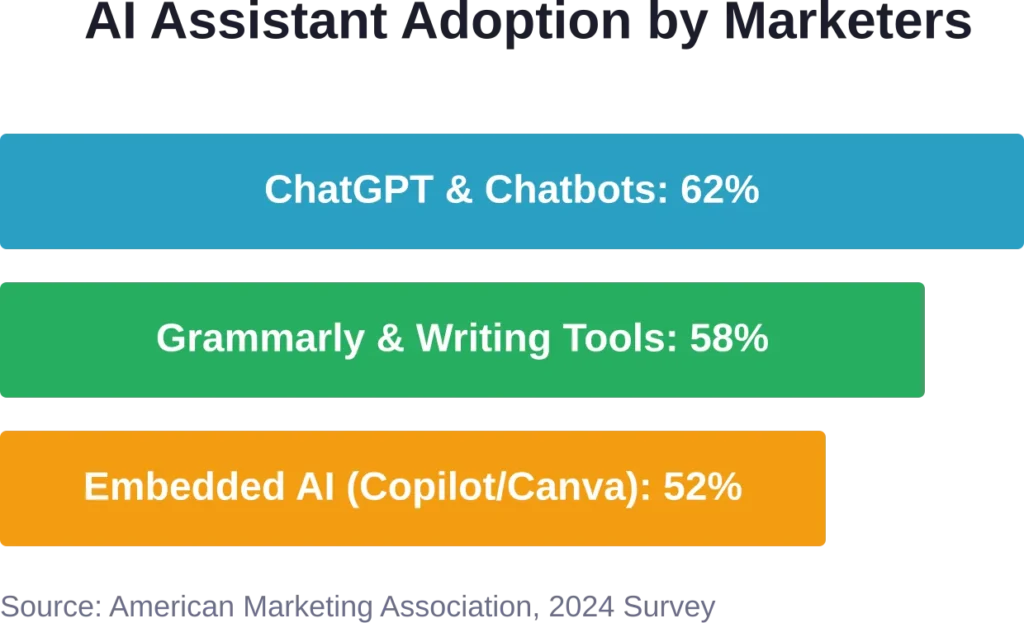
Quick Summary: Marketing agencies in 2026 are deploying AI tools across content creation, automation, research, and design to scale output without sacrificing quality. According to the American Marketing Association’s September 2024 survey, 62% of marketers now use chatbots like ChatGPT for content generation, while 58% rely on AI-powered tools like Grammarly. The most effective agency stacks combine AI assistants, SEO platforms, automation workflows, and design suites to reduce manual work by up to 40% while maintaining brand authenticity.
Marketing agencies face a brutal reality in 2026: clients expect more deliverables, faster turnarounds, and better ROI—often with tighter budgets. Research from Forrester shows that 78% of respondents to Forrester’s Q4 2023 B2C Marketing CMO Pulse Survey said they “will be expected to do more”, and that pressure has only intensified.
AI tools aren’t replacing marketers. They’re multiplying what each team member can accomplish.
Here’s the thing though—most agency leaders don’t need another listicle of 50 tools they’ll never use. What works is a focused stack: the right tools for ideation, research, content production, design, and automation. That’s what this guide delivers.
Why AI Tools Became Essential for Marketing Agencies
The marketing technology landscape crossed a threshold in 2023-2024. Generative AI moved from experimental to operational. According to Forrester research, 67% of AI decision-makers plan to increase investment in generative AI within the next year.
But adoption hasn’t been frictionless. Concerns about AI and employment persist among employees.
The agencies winning in 2026 aren’t the ones replacing humans with bots. They’re the ones amplifying human creativity with the right AI scaffolding.
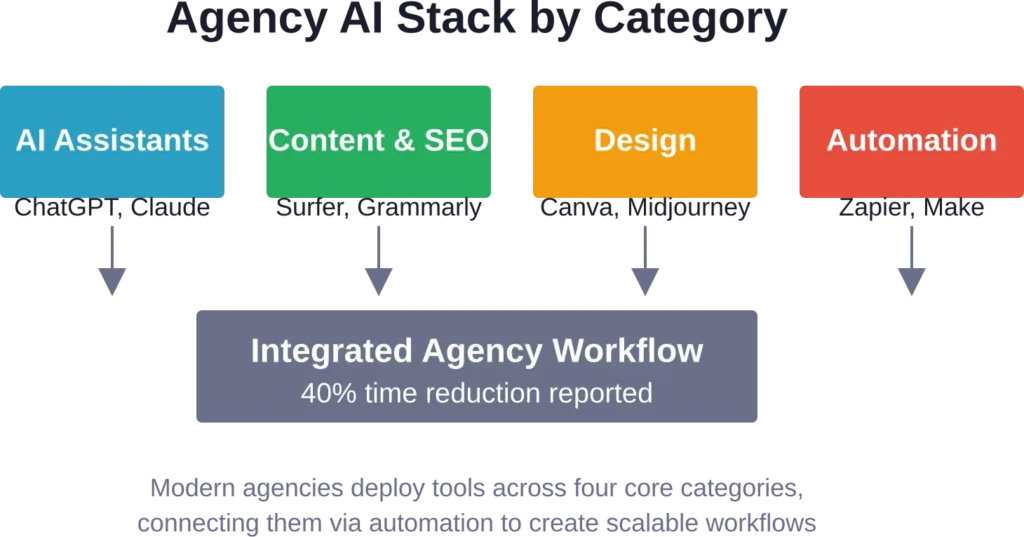
Real talk: AI tools reducing time spent creating content by 40% have been reported by agencies that implement them properly. That’s not theoretical—it’s the documented experience of teams who’ve integrated these tools into daily workflows.
What Changed Between 2024 and 2026
Two years ago, most AI marketing tools were point solutions—good at one narrow task. Today’s tools are platforms. ChatGPT evolved into a research assistant, coding partner, and strategic advisor. Design tools like Canva embedded AI into every feature.
The cost structure shifted too. Where early AI tools charged premium prices, competition drove practical pricing. Many professional-grade tools now cost $20-30 per user monthly, with robust free tiers for testing.
And the sophistication leap? Massive. Early chatbots produced generic fluff. Today’s models handle brand voice, maintain context across long conversations, and cite sources.
Category 1: AI for Advertising Creative & Predictive Testing
While most AI tools focus on creation, the smartest agencies in 2026 also invest heavily in validation. This category covers tools that predict how creatives will actually perform in the real world before any media spend is committed. These platforms help reduce wasted budget and dramatically increase win rates on paid campaigns.
Extuitive
Extuitive is a specialized AI platform for predictive ad creative testing, particularly valuable for performance-focused marketing agencies and Shopify brands in 2026. The tool forecasts real-world advertising performance before launch, using AI models trained on thousands of historical campaigns and consumer behavior simulations.
Extuitive excels at:
- Predictive scoring of creatives (CTR, ROAS, Conversion Rate, Purchase Intent)
- Generation and optimization of ad assets (copy, images, and video)
- Simulation of 150,000+ AI consumers based on real behavioral data
- Automatic Shopify store analysis and campaign idea generation
- Rapid validation of large volumes of creatives before media buying
- Significant reduction of wasted ad spend on underperforming concepts
The platform is especially powerful for agencies running high-volume Meta, TikTok, and Google Ads campaigns. Instead of spending weeks and thousands of dollars on live testing, teams can get accurate data-driven predictions in minutes and focus only on the highest-potential creatives.
Pricing starts at approximately $1,000/month for the Starter plan (500 ads scored), with the Professional plan at $2,500/month (2,500 ads). Enterprise plans are available with custom volume and features.
One caution: Like all predictive tools, Extuitive’s accuracy is highest when the product/offer and target audience closely match the training data. Always run a small live test to validate the top predictions before scaling budget.
Contact Information:
- Website: extuitive.com
- Email: [email protected]
- LinkedIn: www.linkedin.com/company/extuitive
- Twitter: x.com/Extuitive_Inc
- Instagram: www.instagram.com/extuitiveinc
Category 2: AI Assistants for Strategy and Content
Every agency stack in 2026 starts with a foundational AI assistant. These tools handle ideation, first drafts, client briefs, and strategic frameworks.
ChatGPT

ChatGPT remains the most widely adopted tool for good reason. According to the American Marketing Association, 62% of marketers use chatbots like ChatGPT for content generation at work.
ChatGPT excels at:
- Campaign ideation and brainstorming
- Content briefs and outlines
- Email copy and social posts
- Persona development
- Competitive analysis synthesis
The free tier is surprisingly capable, but the paid plan costs approximately $20 per month and unlocks GPT-4, longer context windows, and custom GPTs—pre-configured assistants trained for specific agency workflows.
One caution: ChatGPT hallucinates citations. Always fact-check statistics and references.
Claude

Anthropic’s Claude offers longer context windows than ChatGPT—critical when analyzing client documents, campaign reports, or lengthy research. It handles nuance better for brand voice work.
Claude particularly shines for agencies working with complex briefs or multi-stakeholder input. It can ingest a 50-page brand guidelines document and apply those rules consistently.
Microsoft Copilot

For agencies embedded in the Microsoft ecosystem (Outlook, Word, Excel, Teams), Copilot integrates AI directly into daily tools. According to the American Marketing Association data, 52% of marketers use tools with embedded AI functionality like Microsoft Copilot or Canva.
Copilot drafts emails, summarizes meeting notes, builds Excel reports from natural language requests, and generates PowerPoint decks. The productivity gain comes from never leaving your workflow.
Category 3: AI-Powered Content and SEO Tools
Content remains the currency of digital marketing. AI tools in this category handle research, optimization, and production at scale.
Grammarly

Grammarly evolved from a grammar checker into a comprehensive writing assistant. The American Marketing Association reports that 58% of marketers use AI-powered tools like Grammarly.
Beyond fixing typos, Grammarly now adjusts tone, checks brand consistency, and flags unclear messaging. The Business tier includes brand guidelines enforcement—critical for agencies managing multiple client voices.
Surfer SEO

Surfer combines AI content generation with SERP analysis. It analyzes top-ranking pages for target keywords, then provides structural and semantic guidance for outranking them.
Agencies use Surfer for:
- Content briefs based on competitive analysis
- Real-time optimization scores while writing
- Keyword clustering and topical authority planning
- AI article generation (with heavy editing required)
The Content Editor is where Surfer shines. Write in their interface and watch the optimization score update in real time as you hit semantic keywords and structural benchmarks.
Jasper
Jasper positions itself as an end-to-end content platform. It generates blog posts, social copy, ad variants, and email sequences. The brand voice feature learns client tone from sample content.
Jasper works best for high-volume content needs—agencies producing dozens of social posts or blog articles weekly. It won’t replace senior writers, but it accelerates junior team members significantly.
Frase

Frase focuses on content research and question answering. It scrapes “People Also Ask” boxes, related searches, and top-ranking content to build comprehensive briefs.
The AI writer generates first drafts, but Frase’s real value is research compression. It turns hours of manual SERP analysis into a five-minute automated report.
Category 3: Visual Content and Design Tools
Visual content production used to bottleneck agencies. AI design tools removed that constraint.
Canva
Canva’s AI features now handle background removal, image generation, text-to-design, and smart resizing across formats. According to American Marketing Association data, 52% of marketers use tools with embedded AI functionality like Canva.
Canva’s Magic Studio includes:
- Magic Write (AI text generation)
- Magic Eraser (object removal)
- Magic Edit (image manipulation)
- Text to Image (AI image generation)
- Magic Design (template generation from prompts)
For agencies managing social media, Canva’s batch creation and brand kit features are essential. Create one design, resize for Instagram, LinkedIn, Facebook, and Twitter in seconds.
Midjourney and DALL-E


Specialized image generators handle custom visuals that stock photography can’t provide. The American Marketing Association found that 45% of marketers use specialized image and video generators like Midjourney or LTX Studio.
Midjourney excels at stylized, artistic imagery—brand storytelling, concept work, mood boards. DALL-E (OpenAI’s tool) integrates with ChatGPT and handles more literal, instruction-following tasks.
Neither replaces professional photography for hero images or product shots. But for blog headers, social graphics, and conceptual work? They’re transformative.
Runway ML

Runway brings AI to video production. Text-to-video, video editing via text prompts, background removal, and motion tracking all happen through natural language commands.
Agencies producing video content use Runway to accelerate editing, create B-roll, and generate animated graphics. It doesn’t replace videographers, but it dramatically reduces post-production time.
Category 4: Marketing Automation and Workflow Tools
AI automation connects the stack. These tools eliminate repetitive tasks and maintain consistency across campaigns.
Zapier
Zapier remains the automation backbone for most agencies. It connects 6,000+ apps without code, triggering actions across platforms based on events.
Common agency Zaps:
- New lead in CRM → Slack notification + add to Google Sheet
- Instagram post published → cross-post to Twitter and LinkedIn
- Client email received → create task in project management tool
- Form submission → add to email sequence + notify account manager
Zapier’s AI features now include error handling suggestions, Zap building via natural language, and intelligent data formatting.
Make (formerly Integromat)
Make offers more complex automation logic than Zapier—conditional branches, data transformation, multi-step workflows. It requires more technical skill but handles sophisticated agency processes.
Make excels when agencies need custom workflows that don’t fit Zapier’s linear trigger-action model.
HubSpot (AI Features)
HubSpot embedded AI across its marketing, sales, and service hubs. The AI assistant drafts emails, suggests content, scores leads, and optimizes send times.
For agencies managing client CRMs, HubSpot’s AI features reduce manual data entry and improve lead qualification accuracy.
Notion AI

Notion handles project management, documentation, and knowledge bases for many agencies. Notion AI adds content generation, summarization, and translation directly in workspaces.
Pricing varies—check Notion’s official site for current plans for AI features.
Agencies use Notion AI to:
- Summarize client meeting notes
- Generate project briefs from loose ideas
- Translate content for international clients
- Create first-draft SOPs and documentation
Category 5: Research and Competitive Intelligence
Understanding markets, competitors, and audiences separates strategic agencies from order-takers. AI research tools compress weeks of analysis into hours.
Perplexity AI
Perplexity combines search with AI summarization and cites its sources—solving ChatGPT’s hallucination problem. It’s particularly valuable for market research, competitor analysis, and trend identification.
Agencies use Perplexity to:
- Quickly research new client industries
- Track competitor campaigns and messaging
- Identify emerging trends in target markets
- Gather cited statistics for client reports
The Pro tier adds deeper search capabilities and priority access during peak times.
Consensus

Consensus searches academic research papers and extracts findings. For agencies working in regulated industries (healthcare, finance, education), it provides credible, peer-reviewed evidence for marketing claims.
Where ChatGPT might fabricate a study, Consensus links directly to the published paper.
Brandwatch (AI Features)

Brandwatch’s social listening platform added AI analysis that identifies sentiment shifts, emerging topics, and influencer impact automatically.
For agencies managing brand reputation or social strategy, Brandwatch turns millions of social mentions into actionable intelligence.
How to Build an Agency AI Stack (Practical Steps)
Most agencies don’t need 30 tools. They need the right six to eight tools, properly integrated.
Here’s a practical implementation sequence:
Phase 1: Foundation (Month 1)
- Deploy ChatGPT Plus or Claude Pro for the core team
- Add Grammarly Business for writing consistency
- Set up Zapier for basic automations
Phase 2: Content Production (Months 2-3)
- Implement one SEO tool (Surfer or Frase)
- Add Canva Pro for design production
- Test AI image generation (Midjourney or DALL-E)
Phase 3: Workflow Integration (Months 4-6)
- Build automation workflows connecting tools
- Train team on prompt engineering and best practices
- Establish quality control processes
- Measure time savings and output quality
The biggest mistake? Subscribing to 15 tools simultaneously. Teams get overwhelmed, adoption fails, and budgets get wasted.
Start narrow. Master each tool. Then expand.
Pricing Reality Check
A functional agency AI stack typically costs $150-300 per user monthly when fully deployed. Here’s what that might include:
| Tool Category | Example Tool | Typical Monthly Cost |
|---|---|---|
| AI Assistant | ChatGPT Plus | ~$20 |
| Writing Enhancement | Grammarly Business | ~$15 |
| SEO & Content | Surfer SEO | ~$89 |
| Design Platform | Canva Pro | ~$13 |
| Automation | Zapier Professional | ~$20 |
| Image Generation | Midjourney | ~$30 |
| Project Management | Notion AI | ~$10 |
Prices vary by plan tier and change frequently—check each provider’s official website for current pricing.
The ROI calculation is straightforward: if AI tools save 10 hours per team member monthly, and those hours generate $100+ per hour in billable work, the stack pays for itself many times over.
Common Implementation Mistakes and How to Avoid Them
Agencies rush into AI adoption and hit predictable problems. Here’s what to watch for:
Mistake 1: No Quality Control Process
AI generates content fast—but not always accurately. Agencies that publish AI output without review face credibility damage.
Solution: Establish a human review gate. AI drafts, humans refine and fact-check, then publish.
Mistake 2: Forgetting Brand Voice
Generic AI output sounds generic. Clients hire agencies for distinctive thinking, not chatbot commodity content.
Solution: Train AI tools on brand voice samples. Create custom prompts that include tone guidelines. Edit aggressively to inject personality.
Mistake 3: Tool Overload
Subscribing to 20 AI tools creates complexity, not capability. Teams spend more time switching contexts than doing work.
Solution: Build incrementally. Master one tool before adding another. Prioritize integration over feature count.
Mistake 4: Ignoring Data Privacy
Pasting client data into public AI tools can violate NDAs and regulations.
Solution: Use business tiers with data protection guarantees. Anonymize sensitive information before using AI tools. Establish clear usage policies.
Mistake 5: Replacing Strategy With Execution Speed
AI accelerates execution brilliantly. It doesn’t replace strategic thinking—yet.
Solution: Use AI for research, drafting, and production. Keep humans responsible for strategy, positioning, and creative direction.
The Investment Landscape: What Forrester Data Reveals
Forrester research indicates global martech spending reached $148 billion.
Forrester found that 67% of AI decision-makers plan to increase generative AI investment within the next year. That’s not cautious experimentation—that’s mainstream adoption.
But challenges remain. Trust is the biggest barrier to genAI adoption.
Concerns about AI and employment persist among employees.
Real-World Agency Results
Numbers matter less than outcomes. What are agencies actually achieving with these tools?
Consistent patterns include:
- Content production timelines shortened by 40-50% for blog posts and social content
- Research and competitive analysis compressed from days to hours
- Design asset production accelerated by 60%+ for standard formats
- Administrative and repetitive tasks reduced by 30-40%
What About Advertising Platforms?
Google Ads, Meta Ads, and LinkedIn Campaign Manager all embedded AI features. These aren’t separate tools—they’re built into the platforms agencies already use.
Google’s Performance Max campaigns use AI to optimize ad creative, placement, and bidding across channels. Meta’s Advantage+ automates audience targeting and creative testing.
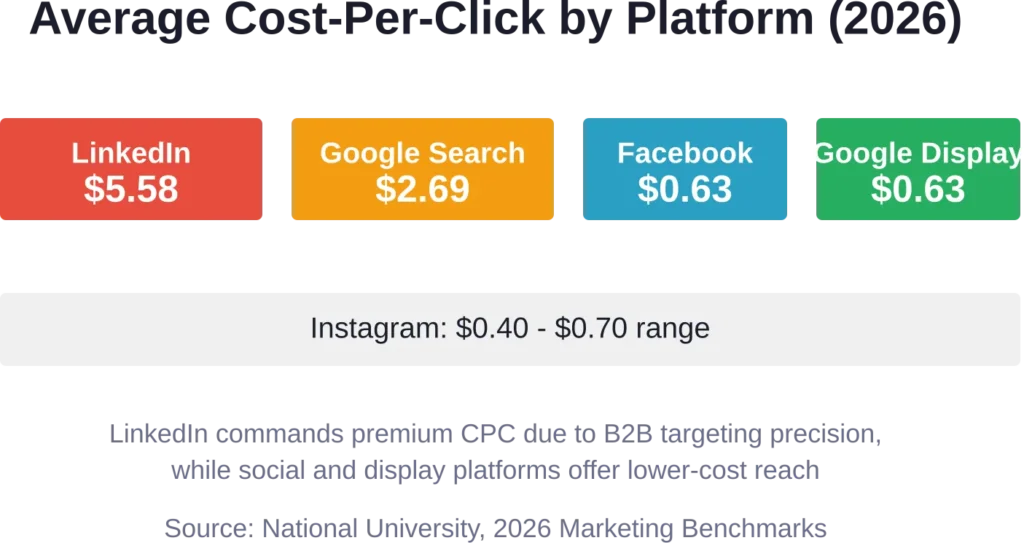
Average advertising costs in 2026 reflect increasing efficiency and competition. According to National University’s 2026 marketing benchmark data, average cost-per-click benchmarks include:
- Google Ads Search: $2.69 average cost-per-click
- Google Ads Display: $0.63 average cost-per-click
- Facebook ads: $0.63 average cost-per-click
- Instagram ads: $0.40-$0.70 average cost-per-click
- LinkedIn ads: $5.58 average cost-per-click
These platform AI features deliver performance improvements, but Forrester research warns that “efficiencies can come at the expense of advertisers’ control and transparency.” Agencies need to balance automation with strategic oversight.
Skills That Matter in an AI-Augmented Agency
Tools change fast. Skills matter more.
According to National University’s 2026 marketing skills reporting, significant changes in tech skill requirements are expected. That doesn’t mean half of marketers lose their jobs—it means the skill mix is shifting.
What matters now:
Prompt Engineering: Getting quality output from AI tools requires specific, context-rich instructions. Vague prompts produce vague results.
Strategic Thinking: AI handles execution speed. Humans still own positioning, differentiation, and creative strategy.
Quality Control: Someone needs to verify AI outputs for accuracy, brand alignment, and effectiveness.
Integration Skills: Connecting tools into workflows creates leverage. Technical fluency matters.
Ethical Judgment: When to use AI (and when not to), how to handle data privacy, and maintaining transparency with clients.
Agencies hiring in 2026 look for marketers who combine traditional skills (writing, strategy, analysis) with AI fluency.
What About Smaller Agencies and Freelancers?
The democratization of AI tools may benefit smaller agencies most. A two-person shop can now deliver output volume that required ten people three years ago.
Freelance marketers and boutique agencies gain leverage previously available only to larger firms with bigger budgets.
The recommended starter stack for small agencies:
- ChatGPT Plus ($20/month) for strategy and content
- Canva Pro ($13/month) for design
- Grammarly (~$15/month) for writing quality
- Zapier Starter or Free tier for basic automation
That’s under $50/month for capability that dramatically expands capacity. Add specialized tools (SEO, image generation) as client needs and budgets justify.
The Governance Question
As agencies deploy more AI tools, governance becomes critical. Questions to address:
- Which tools can staff use with client data?
- How do we handle AI-generated content disclosure?
- What’s our fact-checking process for AI outputs?
- How do we maintain brand voice consistency?
- What’s our stance on copyright for AI-generated creative?
Forward-thinking agencies establish AI usage policies that address these questions explicitly. The policies evolve as regulations clarify and best practices emerge, but having a framework matters.
Future Trajectory: Where This Goes Next
AI tools in 2026 are capable but not autonomous. They augment human work rather than replace it.
The next evolution is multimodal AI—tools that seamlessly work across text, image, video, audio, and code. GPT-4 already handles images and text together. Video generation is improving rapidly.
Voice interfaces will mature. Instead of typing prompts, marketers will have conversational AI assistants that handle complex multi-step requests.
And the integration layer will tighten. Today, tools mostly operate in silos. Tomorrow’s platforms will orchestrate entire workflows—research, strategy, content creation, design, distribution, and analysis—with minimal human intervention.
But the human role won’t vanish. It will shift further toward judgment, creativity, and client relationships—work that requires empathy, context, and strategic thinking.
Frequently Asked Questions
Most agencies deploy a stack across five categories: AI assistants (ChatGPT, Claude), content tools (Grammarly, Surfer SEO), design platforms (Canva, Midjourney), automation (Zapier, Make), and research tools (Perplexity). According to the American Marketing Association survey, 62% of marketers use chatbots like ChatGPT for content generation, 58% use AI-powered tools like Grammarly, and 52% use embedded AI functionality in tools like Canva or Microsoft Copilot.
A functional agency AI stack typically costs $150-300 per user monthly when fully deployed. Small agencies can start with a minimal stack (ChatGPT Plus, Canva Pro, Grammarly) for under $50/month per person. Enterprise-level implementations with specialized tools, team licenses, and premium tiers can exceed $500 per user monthly. Most tools offer tiered pricing—check provider websites for current plans, as pricing changes frequently.
AI tools accelerate execution but don’t replace strategic thinking, creative direction, or client relationships. Agencies report reducing content production time by 40% and taking on additional clients without hiring, but the human role shifts to oversight, quality control, strategy, and refinement of AI outputs. Concerns about AI and employment persist, but the evidence shows AI augments rather than replaces skilled marketers.
Tool overload is the most common mistake—subscribing to 15+ AI tools simultaneously, overwhelming teams and wasting budgets. Other critical mistakes include publishing AI content without human review, ignoring brand voice consistency, and neglecting data privacy when using client information in AI tools. Successful agencies implement incrementally, master each tool before adding another, and establish clear quality control processes.
Effective agencies treat AI as a first-draft generator, not a finished product. Best practices include: establishing human review gates for all AI outputs, training AI tools on brand voice samples and guidelines, fact-checking all statistics and claims, editing aggressively to inject personality and strategic thinking, and creating custom prompts with specific tone and style instructions. Quality comes from treating AI as an acceleration tool, not a replacement for editorial judgment.
Surfer SEO and Frase lead for content optimization and research. Surfer analyzes top-ranking pages and provides real-time optimization guidance while writing. Frase excels at research compression, turning hours of SERP analysis into automated reports. ChatGPT and Claude handle keyword research and content briefs effectively. Grammarly ensures writing quality. Most agencies combine 2-3 tools: an AI assistant for ideation, an SEO platform for optimization, and a writing tool for polish.
Social media AI capabilities are typically embedded in broader platforms rather than standalone tools. Canva offers AI-powered design and batch creation for social posts. ChatGPT generates social copy variations. Zapier and Make automate cross-platform posting. Meta Business Suite and LinkedIn Campaign Manager include built-in AI for ad targeting and creative testing. Specialized tools exist, but most agencies find that general-purpose AI assistants combined with design platforms handle social media needs effectively.
Taking Action: Where to Start
Reading about AI tools doesn’t create leverage. Implementation does.
Here’s the practical next step: pick one category from this list where your agency has the biggest bottleneck. Content production taking too long? Start with ChatGPT Plus and Grammarly. Design capacity constrained? Add Canva Pro and test Midjourney. Drowning in repetitive tasks? Deploy Zapier.
Master that single category for 30 days. Build processes. Train the team. Measure results.
Then expand to the next category.
AI tools won’t fix broken strategy or replace skilled marketers. But they will multiply what capable teams can accomplish—if implemented thoughtfully.
The agencies thriving in 2026 aren’t the ones with the longest tool lists. They’re the ones who integrated AI into daily workflows, established quality standards, and freed their teams to focus on high-value strategic work.
That capability is available to any agency willing to invest the time to build their stack properly.