

Quick Summary: AI-powered Facebook ads reporting tools automate data analysis, visualization, and insight generation from Meta campaigns. Top platforms include Extuitive, Madgicx, Triple Whale, Northbeam, and Supermetrics, which offer automated reporting dashboards, predictive analytics, and cross-channel attribution. These tools save 10+ hours weekly while reducing manual errors and identifying optimization opportunities faster than traditional reporting methods.
Reporting used to be the part everyone postponed until the end of the week. Numbers scattered across spreadsheets, screenshots pasted into slides, and the same questions surfacing in every client meeting.
That changed when AI entered the reporting workflow.
Ad platforms deliver data—CPM, CPC, impressions, conversions—but raw numbers rarely provide clarity. What’s actually working? Which audience segments drive revenue? Where should budget shift next week?
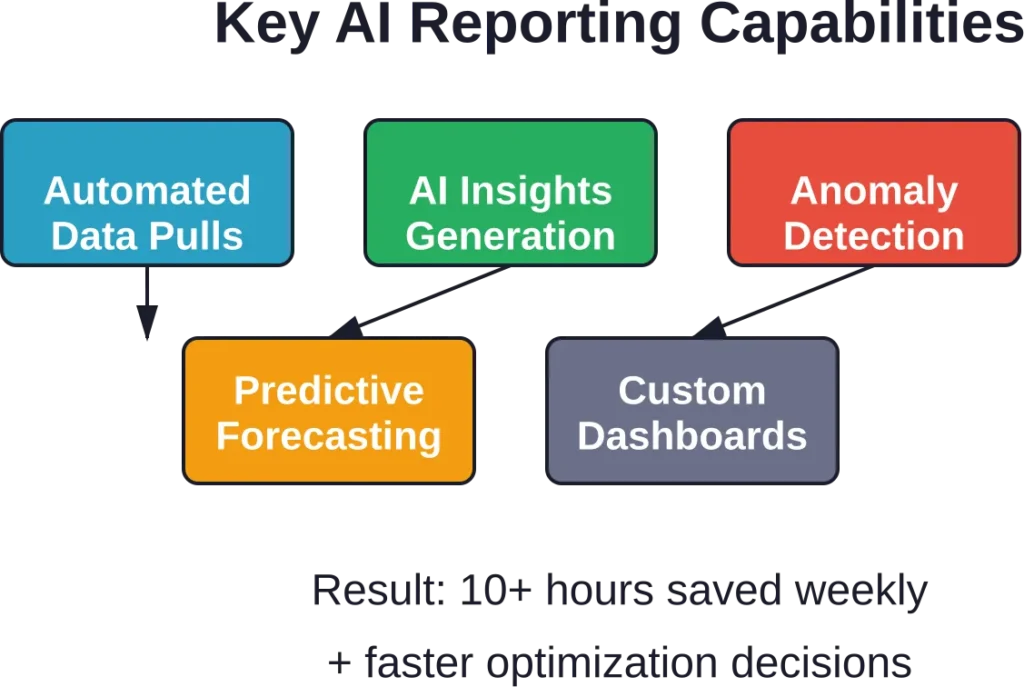
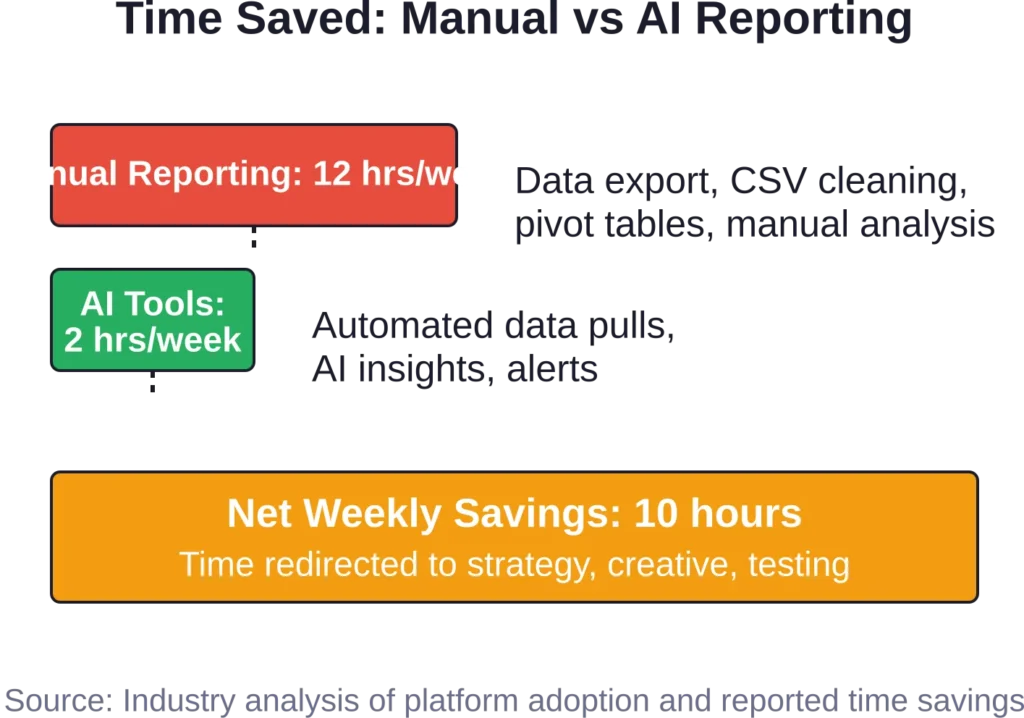
AI-powered reporting tools answer these questions automatically. They pull performance data from Meta’s API, identify patterns across campaigns, and generate plain-language summaries that explain what happened and why. Platform case studies and industry analysis suggest time savings can exceed 10 hours per week for performance marketers managing multiple accounts.
According to research from UC Berkeley’s Haas School of Business, generative AI is reshaping marketing infrastructure, with studies indicating widespread adoption among marketing professionals. Modern AI analytics platforms don’t just visualize data—they monitor campaign metrics continuously, detect anomalies like a 15% drop in sign-ups, and autonomously trigger deeper analysis into segment behavior or channel performance.
This guide covers the AI-powered Facebook ads reporting tools worth knowing in 2026, breaking down core capabilities, pricing structures, and what each platform does best.
Why AI-Powered Reporting Beats Manual Analysis
Traditional reporting means logging into Ads Manager, exporting CSVs, building pivot tables, and manually hunting for insights. The process burns hours and introduces human error.
AI reporting tools eliminate that friction.
They connect directly to Meta’s advertising API and pull real-time performance data—impressions, spend, conversions, ROAS—without manual exports. Automated dashboards refresh hourly or daily, so stakeholders always see current numbers.
But automation alone isn’t the breakthrough. The real shift happens when AI interprets the data.
Research indicates that AI-based campaign management can reduce cost per action by up to 28%. Advanced platforms now deploy multiple specialized AI agents that collaborate in agentic workflows. One agent monitors campaign metrics. Another detects a 10% overall conversion rate decline. A third segments the data and discovers conversions dropped 15% in Europe, specifically 25% from organic search traffic in that region.
These platforms don’t wait for humans to ask the right questions. They surface insights proactively.
Some generate plain-language executive summaries, translating complex data into narratives stakeholders understand. This feature alone saves 20–30 minutes per report. According to MIT Sloan Review, Voxpopme claimed a 30% to 50% reduction in the cost of qualitative research projects, a 50% increase in the use of existing research insights, and an impressive 60-times-faster research analysis.
Real talk: AI reporting tools aren’t perfect. They lack the contextual understanding a human analyst brings—seasonal patterns, brand positioning shifts, competitive moves. But for the repetitive work of data aggregation, anomaly detection, and trend identification, AI outperforms manual processes in both speed and consistency.
Core Features to Look for in AI Reporting Tools
Not every tool labeled “AI-powered” actually uses machine learning to improve reporting. Some simply automate data pulls and slap a chatbot on top.
Here’s what separates useful AI reporting platforms from marketing fluff.
Automated Data Aggregation Across Platforms
Facebook ads rarely run in isolation. Most campaigns coordinate across Instagram, Google Ads, TikTok, and other channels. The best reporting tools pull data from multiple sources into unified dashboards.
Look for native integrations with Meta Ads Manager, Google Analytics, Google Ads, Shopify, and other platforms in the stack. API connections should refresh automatically—hourly for active campaigns, daily for historical analysis.
Natural Language Summaries and Insights
AI should explain what the numbers mean, not just display them. Advanced platforms generate written summaries highlighting key changes: “CPM increased 18% week-over-week due to auction competition in the 25-34 age bracket” or “Carousel ads outperformed single-image ads by 23% ROAS in the past 30 days.”
This capability transforms reporting from data delivery into strategic guidance.
Anomaly Detection and Alerting
Campaigns don’t wait for weekly check-ins to break. AI monitoring should detect sudden performance drops—CTR crashes, budget overspend, conversion spikes—and send alerts immediately.
The best systems distinguish between normal fluctuation and genuine anomalies, reducing false positives that create alert fatigue.
Predictive Analytics and Forecasting
Historical data predicts future performance. AI models trained on campaign history can forecast next week’s ROAS, estimate month-end spend, or flag when creative fatigue will likely degrade CTR.
Predictive capabilities help allocate budget proactively instead of reacting to problems after they occur.
Customizable Dashboards and White-Label Reports
Agencies need client-facing reports. In-house teams need executive dashboards. The platform should support custom branding, drag-and-drop widgets, and exportable PDF reports.
Templates accelerate setup, but flexibility matters when reporting needs evolve.
Multi-Workspace and Client Management
Agencies managing dozens of accounts need workspace isolation—separate client folders with independent data access and user permissions. Switching accounts shouldn’t require logging out.
Transparent pricing structures that scale with client count prevent surprise charges as the business grows.
Top AI-Powered Facebook Ads Reporting Tools in 2026
The following platforms represent the strongest options for automating Meta ads reporting, ranked by capability breadth and adoption among performance marketers.
Extuitive
Extuitive operates as an AI-powered predictive platform focused on pre-launch validation and reporting for Facebook/Meta ads. The system uses 150,000+ modeled AI consumer agents combined with brand historical data to forecast ad performance (CTR, ROAS, purchase intent) before any budget is spent.
Reporting features include predictive scoring of creatives (High/Medium/Low), pre-launch performance forecasts, post-campaign comparison between predicted vs actual results, and AI-generated insights on why certain creatives are expected to win or lose. It automatically analyzes visual elements, copy angles, and structure, then delivers structured reports with winning pattern identification.
Extuitive shines for Shopify e-commerce brands that want to eliminate wasteful creative testing and get reliable performance predictions before launching Meta campaigns. The platform integrates directly with Shopify to pull products and generate validated ad variants ready for Meta Ads Manager.
Strengths: Strong pre-launch predictive analytics, massive AI consumer simulation panel, fast creative validation (minutes instead of weeks), Shopify-native integration, predicted vs actual reporting loops.
Limitations: Less focused on real-time post-launch optimization or autonomous bidding compared to all-in-one tools. Primarily built for e-commerce (weaker for lead-gen or non-Shopify use cases).
Extuitive offers tiered pricing plans; check the official website for current pricing details.
Contact Information:
- Website: extuitive.com
- Email: [email protected]
- LinkedIn: www.linkedin.com/company/extuitive
- Twitter: x.com/Extuitive_Inc
- Instagram: www.instagram.com/extuitiveinc
Madgicx
Madgicx operates as an all-in-one Meta ads management platform with advanced AI reporting baked in. The platform’s AI Marketer continuously analyzes campaign performance and recommends budget reallocations, audience refinements, and creative swaps.
Reporting features include automated dashboards pulling real-time data from Facebook and Instagram campaigns, cross-campaign performance comparisons, and AI-generated insights explaining why metrics shifted. The Creative Intelligence module tracks which ad formats, copy angles, and visual styles drive the highest ROAS.
Madgicx shines for teams running high-volume creative testing who need both reporting and optimization in one interface. The AI identifies winning creative patterns faster than manual analysis.
Strengths: Deep creative analytics, autonomous budget optimization recommendations, unified creative library with performance tagging.
Limitations: Pricing scales quickly for agencies managing multiple clients. Steeper learning curve than simpler reporting-only tools.
Madgicx offers tiered pricing plans; check the official website for current pricing details.
Triple Whale

Triple Whale targets e-commerce brands running Facebook ads alongside other acquisition channels. The platform aggregates data from Meta Ads Manager, Google Ads, Shopify, Klaviyo, and TikTok into a single dashboard.
The AI assistant answers natural language queries: “What’s my blended ROAS this month?” or “Which products had the highest conversion rate from Facebook traffic last week?” The system parses campaign data and returns plain-language answers with supporting charts.
Automated reports deliver daily or weekly summaries via email or Slack. Anomaly alerts flag budget overruns, conversion drops, or sudden CTR spikes.
Strengths: E-commerce-specific metrics (product-level ROAS, LTV cohorts), Shopify native integration, clean interface with low onboarding friction.
Limitations: Less robust for lead generation campaigns outside e-commerce. Creative analytics capabilities trail Madgicx.
For current pricing, visit Triple Whale’s official website.
Northbeam
Northbeam specializes in multi-touch attribution, reconstructing the customer journey across paid social, paid search, email, and organic channels. For Facebook ads, this means understanding which touchpoints assisted conversions even when Meta’s pixel didn’t fire.
The platform uses machine learning to weight attribution across channels, providing a clearer picture of Facebook’s true contribution to revenue. Reporting dashboards show channel-specific ROAS, incrementality analysis, and predictive LTV by acquisition source.
Northbeam works best for brands spending six figures monthly across multiple channels who need attribution precision beyond Meta’s native reporting.
Strengths: Industry-leading attribution modeling, cross-channel customer journey mapping, incrementality testing capabilities.
Limitations: Premium pricing starts around $1,000/month, making it cost-prohibitive for smaller advertisers. Setup requires technical integration work.
Supermetrics
Supermetrics doesn’t generate AI insights natively, but it powers countless reporting workflows by automating data transfers. The platform pulls Facebook ads data into Google Sheets, Excel, Looker Studio, Tableau, Power BI, and other visualization tools.
Once data lands in these destinations, users build custom dashboards, apply formulas, and layer in data from other sources. Supermetrics handles the extraction and refresh scheduling; analysis happens downstream.
For teams already comfortable with spreadsheet-based reporting or BI platforms, Supermetrics provides the data pipeline without forcing adoption of a new dashboard interface.
Strengths: Flexible destination options, supports 150+ marketing platforms beyond Meta, affordable entry pricing around $39/month.
Limitations: No native AI insights—users build intelligence layers themselves. Requires proficiency with destination tools (Google Sheets, Looker Studio, etc.).
Whatagraph

Whatagraph focuses on client-facing reporting for agencies. The platform auto-generates white-label PDF and live dashboard reports pulling data from Facebook Ads Manager, Google Analytics, Instagram Insights, and 40+ other sources.
AI features include automated performance summaries and anomaly highlighting—unexpected metric changes appear flagged with context. Report templates accelerate setup for new clients, and drag-and-drop widgets let agencies customize layouts without code.
Agencies managing 10+ clients appreciate the multi-workspace architecture and user permission controls that isolate client data.
Strengths: Beautiful pre-built report templates, white-label branding, straightforward agency pricing with client scaling options.
Limitations: AI insight depth doesn’t match Madgicx or Northbeam. Best for presentation-layer reporting rather than optimization recommendations.
Pricing information is available on Whatagraph’s official site.; check the official site for current agency tiers.
SegmentStream

SegmentStream tackles conversion tracking in the post-iOS 14 era using predictive analytics. When Meta’s pixel can’t fire due to browser restrictions, SegmentStream’s AI models estimate conversions based on user behavior patterns and historical data.
The platform feeds these predicted conversions back into Meta’s Conversions API, improving campaign optimization even when tracking is incomplete. Reporting dashboards compare pixel-tracked conversions against predicted totals, revealing the gap created by tracking limitations.
For advertisers in heavily iOS-skewed audiences (e-commerce, DTC, mobile apps), SegmentStream’s attribution correction delivers more accurate performance data than native Meta reporting.
Strengths: Addresses iOS 14+ tracking loss, CAPI integration, predictive conversion modeling.
Limitations: Requires technical setup and ongoing calibration. Pricing reflects enterprise positioning.
Google Analytics (with Looker Studio)
Google Analytics tracks website behavior downstream of Facebook ad clicks. When paired with Looker Studio (formerly Data Studio), it creates powerful custom reporting dashboards pulling Meta campaign data via Supermetrics or native connectors.
While GA4 itself isn’t inherently AI-powered, Google has integrated machine learning features—predictive metrics like purchase probability, churn probability, and revenue forecasts—that surface in custom reports.
The combination costs nothing for most users (Google Analytics is free; Looker Studio is free; connectors like Supermetrics start at $39/month).
Strengths: Free base platform, infinitely customizable dashboards, seamless integration with Google Ads for cross-channel reporting.
Limitations: Requires significant setup effort and data modeling knowledge. No out-of-the-box Meta-specific insights.
ThoughtMetric

ThoughtMetric provides e-commerce attribution with a focus on clarity over complexity. The platform connects Shopify stores with Facebook Ads, Google Ads, and other acquisition channels, then attributes revenue using first-click, last-click, and multi-touch models.
Reporting dashboards show product-level performance, customer acquisition cost by channel, and revenue attribution over custom windows. AI features include automated spend recommendations and alerts when ROAS falls below target thresholds.
ThoughtMetric appeals to DTC brands that find Northbeam too expensive and Triple Whale too feature-heavy.
Strengths: Clean interface focused on essential e-commerce metrics, affordable pricing around $99-$199/month based on traffic volume, Shopify-native integration.
Limitations: Narrower platform support than competitors. Best for Shopify-centric tech stacks.
Juma (Formerly Team-GPT)

Juma takes a different approach: instead of pre-built dashboards, it provides collaborative AI workspaces where teams generate custom reports through natural language prompts. Users access multiple AI models (GPT-4, Claude, Gemini) and build reports by asking questions.
For Facebook ads reporting, teams create prompt libraries—reusable queries like “Compare this week’s CPM to last month’s average by age group” or “Generate a summary of creative performance for carousel vs. video ads.” The AI pulls data from connected sources and formats responses as tables, charts, or prose.
Juma shines for teams that want reporting flexibility without hiring data analysts or learning dashboard builders.
Strengths: Multi-model AI access, prompt-based customization, collaborative workspaces with shared prompt libraries.
Limitations: Requires upfront investment in prompt design. Not ideal for clients expecting traditional dashboard interfaces.
For current pricing details, see Juma’s official website.
| Tool | Best For | Core Strength | Starting Price Range |
|---|---|---|---|
| Madgicx | High-volume creative testing | AI-powered creative intelligence | ~$49/mo and up |
| Triple Whale | E-commerce brands | Multi-channel e-commerce metrics | Check official site |
| Northbeam | Enterprise multi-channel attribution | Advanced attribution modeling | ~$1,000/mo and up |
| Supermetrics | Custom BI and spreadsheet workflows | Data pipeline flexibility | ~$39/mo and up |
| Whatagraph | Agency client reporting | White-label automated reports | ~$99/mo and up |
| SegmentStream | iOS 14+ tracking recovery | Predictive conversion modeling | Enterprise pricing |
| ThoughtMetric | DTC Shopify brands | Simple e-commerce attribution | ~$99-$199/mo |
How to Choose the Right Tool for Your Needs
Selecting a reporting platform depends on campaign complexity, budget, technical skill, and whether reporting happens in-house or for external clients.
For Small Businesses and Solo Advertisers
Smaller operations running a few Facebook campaigns need simplicity over sophistication. Supermetrics paired with Google Sheets or Looker Studio provides affordable automation without overwhelming features.
ThoughtMetric works well for Shopify stores prioritizing clean e-commerce attribution. Whatagraph suits solopreneurs managing a handful of local business clients who need professional-looking reports.
Budget here typically stays under $100/month.
For E-Commerce Brands Scaling Spend
DTC brands spending $50K+ monthly on Facebook ads benefit from dedicated e-commerce platforms. Triple Whale delivers product-level ROAS, customer cohort analysis, and Shopify-native integration.
As spend crosses $100K/month and campaigns expand across Meta, Google, TikTok, and influencer partnerships, Northbeam’s attribution modeling justifies the premium price by clarifying true channel contribution.
For Performance Marketing Agencies
Agencies juggling 10+ client accounts need multi-workspace platforms with white-label reporting and transparent pricing that scales with client count. Whatagraph and Supermetrics both handle agency workflows well.
Agencies emphasizing creative performance and audience optimization lean toward Madgicx, which combines reporting with hands-on campaign management features.
For Enterprise Teams With Complex Attribution Needs
Large advertisers running integrated campaigns across digital, offline, and partner channels require enterprise-grade attribution. Northbeam and SegmentStream address these needs with multi-touch modeling, predictive analytics, and custom implementation support.
Expect pricing in the thousands monthly, offset by improved budget allocation and reduced wasted spend.
For Teams Prioritizing Flexibility Over Pre-Built Dashboards
Data-savvy teams comfortable with prompts and queries might prefer Juma’s collaborative AI workspace approach. Build custom reports through natural language, access multiple AI models, and avoid rigid dashboard constraints.
This route demands more upfront prompt engineering but delivers maximum customization.
Common Implementation Challenges and Solutions
Adopting AI reporting tools isn’t always smooth. Here’s what frequently goes wrong and how to avoid it.
Data Integration Gaps
Most platforms promise seamless integrations but occasionally hit snags with custom implementations, server-side tracking setups, or niche e-commerce platforms. Before committing, verify the tool supports existing infrastructure—Meta pixel and CAPI, Shopify or WooCommerce, email platforms, analytics properties.
Run a trial period with live data before canceling existing reporting systems.
Over-Reliance on AI Recommendations
AI suggestions improve performance on average but don’t understand business context—seasonal promotions, brand positioning shifts, product launches. Treat AI insights as hypotheses requiring validation, not directives to execute blindly.
Combine AI analysis with human strategic judgment.
Dashboard Overload
Feature-rich platforms tempt users to track every available metric. Dashboards become cluttered, obscuring the KPIs that actually matter.
Start with 3-5 core metrics (ROAS, CPA, CTR, conversion rate) and expand only when those are stable and actionable. Simplicity beats comprehensiveness.
Team Adoption Resistance
New tools disrupt workflows. Team members accustomed to spreadsheets resist switching to dashboards. Agencies face client pushback on unfamiliar report formats.
Ease transitions by running old and new reporting systems in parallel for a month, demonstrating time savings with real examples, and customizing outputs to match familiar formats.
What’s Next for AI in Facebook Ads Reporting
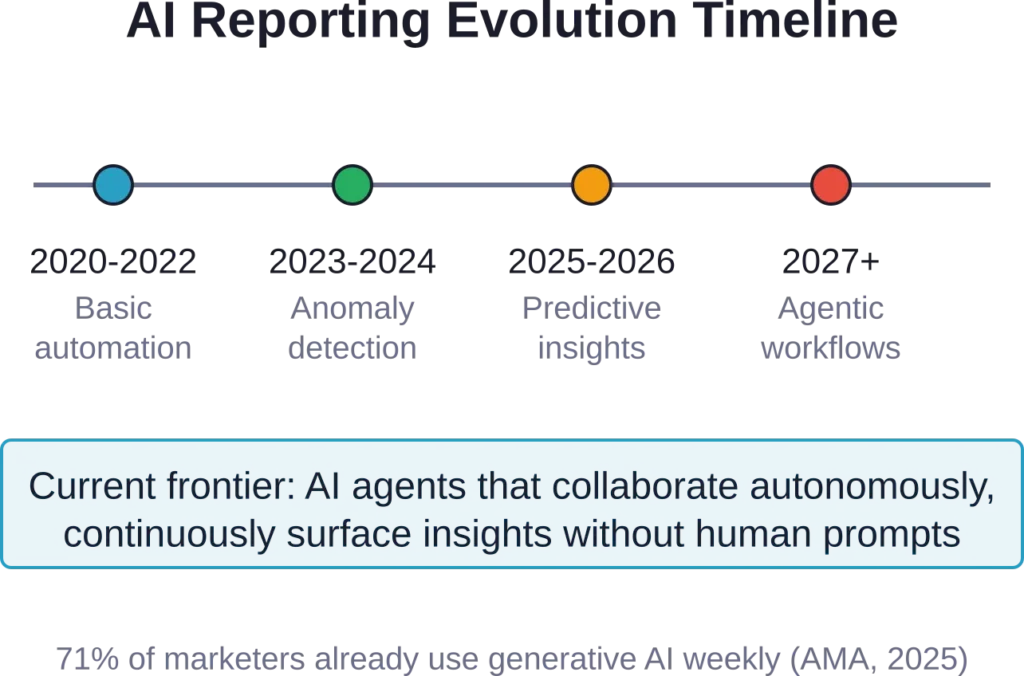
AI capabilities in advertising reporting continue advancing rapidly. Emerging trends reshaping the space include:
Agentic Workflows: Multiple AI agents collaborating autonomously—one monitoring metrics, another segmenting audiences, a third generating creative briefs based on performance gaps. These systems work continuously, not just when humans query them.
Multimodal Analysis: AI evaluating video ads, image composition, ad copy tone, and landing page design together, identifying which combinations drive performance. Current tools analyze these elements separately; next-generation platforms assess them holistically.
Predictive Budget Allocation: Real-time AI adjusting campaign budgets based on predicted conversion likelihood, auction dynamics, and customer lifetime value forecasts. Meta’s Advantage+ campaigns already automate aspects of this; third-party tools will extend these capabilities with cross-platform intelligence.
Privacy-First Attribution: As third-party cookies disappear and tracking restrictions tighten, AI attribution models rely increasingly on probabilistic signals, cohort analysis, and incrementality testing rather than deterministic user-level tracking. Tools like SegmentStream pioneer this shift; expect broader adoption.
Meta’s 2025 Andromeda Update introduced new AI-powered targeting and creative tools within Ads Manager itself. As platform-native AI improves, third-party reporting tools will differentiate through superior cross-channel aggregation, deeper creative analytics, and more sophisticated attribution modeling.
The competitive advantage shifts from “Can I see my Facebook data?” to “Can I understand what drives performance across all channels and act on it faster than competitors?”
Frequently Asked Questions
Standard automated reporting pulls data from ad platforms and displays it in dashboards—essentially replacing manual exports. AI-powered reporting goes further by analyzing the data, detecting anomalies, identifying patterns, generating natural language summaries, and recommending actions. The AI interprets what the numbers mean and why they changed, not just what they are.
Not entirely. AI excels at data aggregation, pattern recognition, and anomaly detection—tasks that consume hours of analyst time. But AI lacks contextual understanding of business strategy, competitive positioning, seasonal factors, and brand nuance. The best approach combines AI for repetitive analysis with human judgment for strategic decisions.
Industry data and platform case studies suggest 10+ hours per week for marketers managing multiple campaigns. Specific time savings depend on campaign complexity and current workflow efficiency. Teams handling client reporting or multi-channel attribution see larger gains than those running simple single-platform campaigns.
It depends on opportunity cost. If the time saved allows focus on creative development, audience research, or scaling profitable campaigns, even $100/month tools generate positive ROI quickly. For advertisers spending under $5K monthly on ads, free tools like Google Analytics paired with Looker Studio provide sufficient reporting without subscription costs.
Most AI reporting platforms support multiple advertising channels—Google Ads, TikTok, LinkedIn, Pinterest—plus analytics platforms, CRMs, and e-commerce systems. Cross-channel reporting is a core value proposition. Check each tool’s integration list before committing.
Native Meta reporting tracks conversions via pixel and Conversions API but struggles with iOS users blocking tracking and cross-device journeys. AI attribution tools use probabilistic modeling, historical patterns, and statistical inference to estimate conversions that Meta can’t directly track. Accuracy varies by implementation, but platforms like Northbeam and SegmentStream often reveal 10-20% more conversions than Meta reports natively.
Trust strategy over algorithms. AI analyzes historical data and statistical patterns but doesn’t understand brand positioning, product launches, or competitive dynamics. Use AI insights as hypotheses to test, not mandates to execute. When recommendations seem counterintuitive, investigate the underlying data before acting.
Final Thoughts
AI-powered Facebook ads reporting tools transformed what used to be the most tedious part of performance marketing—compiling data and hunting for insights—into an automated process that delivers clarity in minutes instead of hours.
The strongest platforms combine automated data aggregation with genuine intelligence: anomaly detection, predictive forecasting, natural language summaries, and autonomous insight generation. They don’t just show what happened; they explain why it happened and what to do next.
Choosing the right tool depends on campaign scale, budget, technical comfort, and whether reporting serves internal teams or external clients. Small advertisers gain value from affordable options like Supermetrics or ThoughtMetric. E-commerce brands scale faster with Triple Whale or Northbeam. Agencies need white-label capabilities from Whatagraph or Madgicx. Enterprise teams require advanced attribution from Northbeam or SegmentStream.
But here’s the thing: tools alone don’t improve campaign performance. They surface opportunities faster and reduce reporting friction, but humans still make the strategic calls—which audiences to test, what creative angles to explore, how aggressively to scale winners.
The competitive advantage comes from combining AI efficiency with human creativity and judgment. Automate the repetitive work. Invest the reclaimed time in the strategic work that actually moves the needle.
Start with one tool. Run it in parallel with existing workflows. Measure time savings and insight quality. Scale adoption once the value is proven.
The best reporting system is the one that gets used consistently and drives better decisions.