

Quick Summary: Amazon FBA product research tools help sellers identify profitable products by analyzing sales data, competition, and market trends. Top tools for 2026 include Helium 10 ($129-$359/month), Jungle Scout ($49-$129/month), SmartScout ($29-$187/month), and AMZScout ($49/month), each offering features like keyword research, competitor tracking, and profit calculation. Free options like Keepa and Amazon’s own Product Opportunity Explorer provide basic functionality, while AI-powered tools increasingly automate trend detection and listing optimization.
Finding profitable products on Amazon in 2026 isn’t guesswork anymore. With millions of products listed on Amazon and competition fiercer than ever, manual research just doesn’t cut it.
That’s where Amazon product research tools come in. These platforms analyze millions of data points—sales estimates, keyword trends, competition levels, profit margins—and surface opportunities that would take months to find manually.
But here’s the thing: not all tools are created equal. Some excel at bulk product analysis for wholesale sellers. Others shine for private label research. A few have jumped on the AI bandwagon, automating trend detection and listing optimization.
This guide breaks down the most popular Amazon FBA product research tools available right now, what they actually do, how much they cost, and which one matches your selling strategy.
Transition from FBA Product Research to Profitable Scaling

After validating a product through FBA research, the focus must shift to scaling advertising performance and maintaining long-term profitability. WisePPC provides a suite of analytics and automation tools designed to bridge the gap between initial product selection and sustainable marketplace growth.
Key features include:
- Long-Term Data Storage: Retains performance history beyond Amazon’s standard retention windows to better track seasonality and long-term trends.
- Bulk Campaign Management: Allows for large-scale bid and budget adjustments across multiple campaigns and ad groups in a single click.
- Unified Analytics Dashboard: Integrates advertising and organic sales data to provide a clearer view of actual profitability and conversion drivers.
- Advanced Data Segmentation: Enables granular filtering by campaign type, match type, and bidding strategy to identify winning approaches.
To start optimizing campaigns and access advanced performance analytics, create a WisePPC account today.
What Are Amazon Product Research Tools?
Amazon product research tools are software platforms that aggregate and analyze marketplace data to help sellers make informed decisions. They pull information from Amazon’s public-facing data, third-party sources, and proprietary algorithms to estimate sales volume, track pricing changes, monitor competitor inventory, and identify trending niches.
The core functions typically include:
- Product database search: Filter millions of products by category, price, sales rank, review count, and other criteria
- Keyword research: Discover what shoppers are searching for and how competitive those terms are
- Sales estimation: Calculate approximate monthly revenue for any product or niche
- Profit calculation: Factor in FBA fees, shipping, and other costs to estimate actual margins
- Competitor tracking: Monitor other sellers’ pricing, inventory levels, and review velocity
- Supplier sourcing: Connect with manufacturers and wholesalers for products
Tools differ in how they present this data, which marketplaces they cover (US, UK, EU, Japan, etc.), and whether they lean toward private label, wholesale, arbitrage, or all three business models.
Why Product Research Tools Matter for FBA Sellers
Product research determines everything else in an Amazon business. Pick a saturated niche with thin margins, and no amount of listing optimization or PPC spend will save profitability. Launch in a niche with actual demand and manageable competition, and the path to consistent sales becomes much clearer.
According to Amazon Seller Central resources, proper keyword research and competitive analysis directly impact search rankings and visibility. Products that don’t index for relevant keywords won’t appear in search results—meaning zero organic traffic.
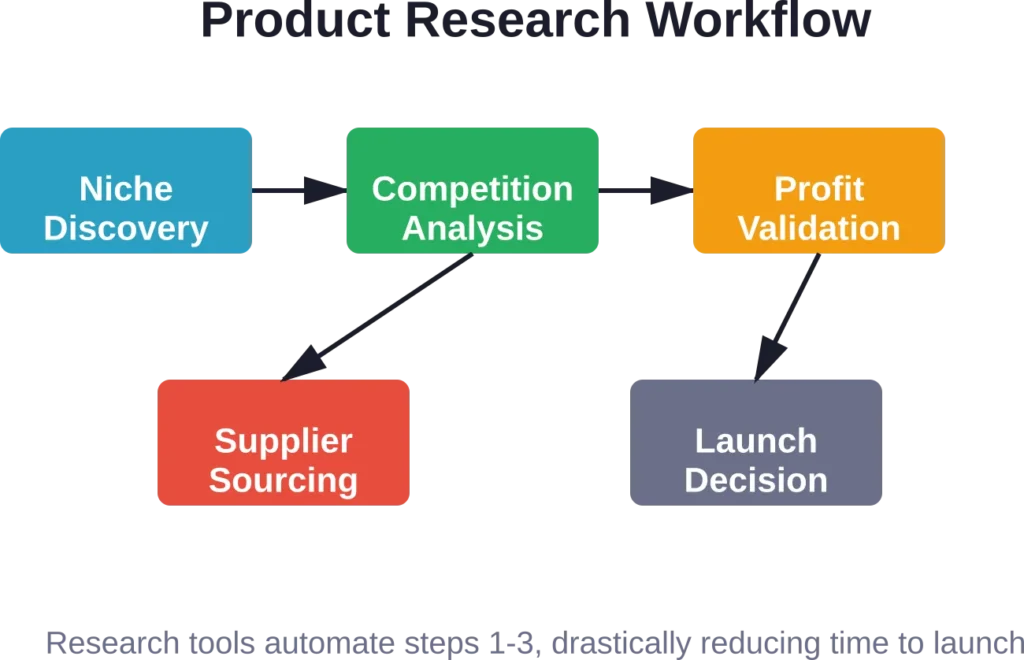
Research tools compress weeks of manual analysis into hours. Instead of clicking through hundreds of listings, checking price histories on multiple sites, and estimating sales from BSR charts, these platforms surface actionable data in dashboards and reports.
Community discussions among sellers consistently highlight that tools like Jungle Scout help validate whether a product idea has enough demand before committing thousands to inventory. Manual research simply can’t match the speed or scale these platforms provide.
Top Amazon Product Research Tools (2026)
The landscape has consolidated around several major platforms, each with distinct strengths. Here’s what actually matters when choosing one.
Helium 10

Helium 10 positions itself as the all-in-one Amazon seller suite, and it’s earned that reputation. The platform bundles product research, keyword tracking, listing optimization, PPC management, and inventory tools into one subscription.
For product research specifically, two features stand out: Black Box and Trendster. Black Box lets sellers filter Amazon’s entire catalog by category, price range, monthly revenue, review count, and dozens of other criteria. Set parameters like “kitchen products between $20-$40 with 500+ monthly sales and fewer than 150 reviews,” and it returns matching ASINs in seconds.
Trendster tracks seasonality, showing whether a product category spikes in Q4 or maintains steady demand year-round. This matters enormously for inventory planning and avoiding cash flow crunches.
Helium 10 covers 10+ Amazon marketplaces, making it the go-to for sellers expanding internationally. The Chrome Extension (X-Ray) overlays sales estimates, profitability data, and competition metrics directly on Amazon search results and product pages.
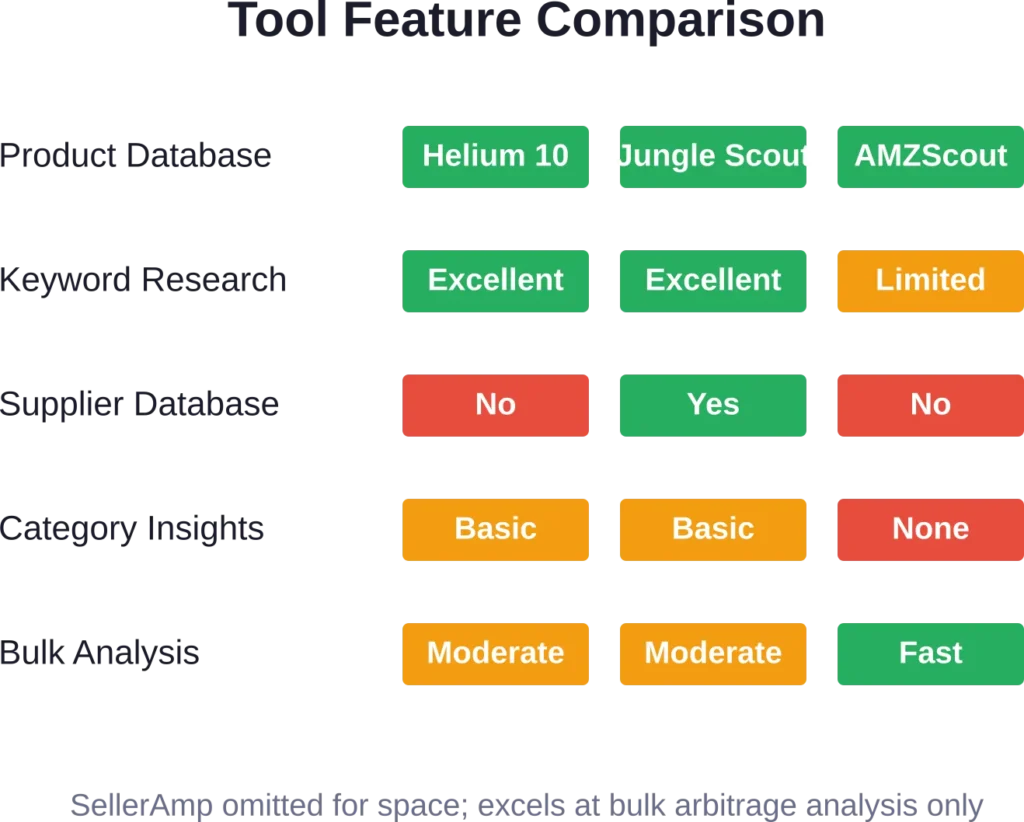
According to verified pricing data, Helium 10 plans range from $129 to $359 per month. The entry tier limits database searches and keyword tracking, while higher tiers unlock full access and additional users.
The learning curve is steeper than simpler tools, but the feature breadth justifies it for serious sellers managing multiple products or marketplaces.
Jungle Scout

Jungle Scout pioneered the Amazon product research tool category and remains one of the most popular choices. The interface is cleaner and more intuitive than Helium 10, making it a frequent recommendation for beginners.
The Product Database functions similarly to Helium 10’s Black Box—filter by niche, sales volume, competition level, and other criteria. Jungle Scout’s sales estimates are generally considered reliable, though no tool can guarantee perfect accuracy since Amazon doesn’t publish actual sales figures.
Where Jungle Scout differentiates itself is the Supplier Database. It connects directly to verified manufacturers and wholesalers, showing MOQs, production timelines, and past client reviews. For private label sellers sourcing inventory, this cuts weeks out of the supplier vetting process.
The Opportunity Finder feature analyzes niches by demand level, competition intensity, and listing quality scores. It surfaces categories where demand outpaces supply—exactly where new sellers have the best shot at gaining traction.
Pricing sits between $49 and $129 per month depending on the plan. The mid-tier option unlocks full database access and typically represents the best value for active sellers.
Jungle Scout also offers a Chrome Extension that works directly on Amazon, displaying estimated sales, revenue, and profit margins without leaving the browser.
SmartScout

SmartScout takes a different approach, focusing heavily on category-level analysis and traffic insights. Rather than starting with individual products, it helps sellers understand entire subcategories—total market size, top brands, growth trends, and Amazon’s own private label presence.
TrafficGraph is the standout feature. It estimates how many shoppers visit a category each month and which keywords drive that traffic. This intelligence reveals whether a niche has enough search volume to support new entrants or whether it’s dominated by a few big players.
The AI Visibility Monitor tracks how algorithm changes affect listing performance. When Amazon tweaks search ranking factors, SmartScout flags which products gained or lost visibility and why.
Another unique capability: SellerMap, which identifies which sellers dominate specific niches and whether they’re private label brands, wholesalers, or arbitrage flippers. Understanding the competitive landscape this granularly helps sellers position products more strategically.
SmartScout pricing ranges from $29 to $187 per month. The lower tier provides basic category insights, while higher tiers unlock full traffic data and unlimited searches.
It’s particularly strong for wholesale and online arbitrage sellers who need to evaluate entire brands or categories quickly, rather than researching individual products one at a time.
AMZScout

AMZScout competes directly with Jungle Scout and Helium 10 but at a lower price point, typically starting around $49 per month. The feature set is narrower, but the core product research tools work well.
The Product Database covers standard filtering—category, price, sales rank, review count. Sales estimates align closely with Jungle Scout’s, and the profit calculator factors in FBA fees, referral fees, and product costs to show actual margins.
AMZScout’s Chrome Extension (PRO Extension) is solid, offering on-page analysis for any Amazon listing or search results page. It’s fast, lightweight, and displays key metrics without slowing down the browser.
One drawback: AMZScout’s keyword research capabilities lag behind Helium 10 and Jungle Scout. The keyword database is smaller, and search volume estimates occasionally miss the mark.
For budget-conscious sellers who need reliable product research without the full suite of listing optimization and PPC tools, AMZScout delivers solid value.
ZonGuru

ZonGuru bundles product research, keyword tracking, and review automation into one platform. The Niche Finder tool operates similarly to competitors—filter by category, sales, competition—but the interface feels dated compared to Jungle Scout or Helium 10.
Where ZonGuru shines is the Business Dashboard, which aggregates sales, profit, and inventory data across all products in one view. For sellers managing 10+ ASINs, this centralized reporting saves significant time.
The Love-Hate feature analyzes customer reviews to identify what buyers love and what they complain about. This intelligence informs product improvements and helps craft more compelling bullet points that address common objections.
Pricing isn’t widely advertised publicly, so checking the official website for current plans is necessary. Community discussions suggest it sits in the $30-$70/month range depending on features.
SellerAmp

SellerAmp focuses almost exclusively on online arbitrage and wholesale sellers who analyze products in bulk. The SAS (SellerAmp SAS) Chrome Extension is lightning-fast, calculating profitability for entire search results pages in seconds.
It integrates directly with Keepa, pulling historical pricing and sales rank data without opening separate tabs. For arbitrage sellers scanning hundreds of products daily, this speed advantage is massive.
The mobile app extends this functionality to retail arbitrage, letting sellers scan barcodes in stores and instantly see Amazon pricing, sales rank, and profit potential.
SellerAmp doesn’t offer a product database or keyword research tools—it’s purely for deal analysis. That narrow focus makes it less useful for private label sellers but indispensable for arbitrage and wholesale.
Pricing starts around $20-$30 per month, significantly cheaper than all-in-one platforms.
Keepa

Keepa isn’t a traditional product research tool—it’s a price and sales rank tracker. But it’s so fundamental to Amazon research that most sellers consider it essential.
Keepa tracks historical pricing, sales rank fluctuations, buybox ownership, and review count changes for products on Amazon. This data reveals seasonality, pricing trends, and whether competitors frequently run promotions.
The free version provides basic price tracking. The paid subscription unlocks sales rank history and additional features.
Most other research tools integrate Keepa data directly into their platforms. But having a standalone Keepa subscription allows deeper analysis and custom tracking alerts.
| Tool | Monthly Price | Best For | Key Strengths |
|---|---|---|---|
| Helium 10 | $129 – $359 | All-in-one solution | Black Box, Trendster, 10+ marketplaces |
| Jungle Scout | $49 – $129 | Private label beginners | Supplier Database, intuitive interface |
| SmartScout | $29 – $187 | Category analysis | TrafficGraph, SellerMap, AI Visibility |
| AMZScout | ~$49 | Budget-conscious sellers | Reliable sales estimates, lower cost |
| SellerAmp | ~$20 – $30 | Arbitrage & wholesale | Bulk analysis speed, Keepa integration |
| Keepa | ~€19 (~$20) | Price & rank tracking | Historical data, trend analysis |
Free Amazon Product Research Tools
Not every seller can justify $50-$300/month on research tools, especially when starting out. Several free options provide basic functionality that’s enough for initial validation.
Amazon Product Opportunity Explorer

Amazon itself offers Product Opportunity Explorer, a free tool available in Seller Central. It identifies growing niches by analyzing search trends, click-through rates, and conversion data.
The interface shows categories with high customer search volume but relatively low product selection—exactly the sweet spot for new launches. It also surfaces commonly searched terms that don’t match existing listings well, revealing content gaps sellers can fill.
The data comes directly from Amazon, so accuracy isn’t an issue. The limitation is granularity—it won’t provide product-level sales estimates or detailed competition analysis like paid tools do.
Google Trends

Google Trends tracks search interest over time for any keyword. While it doesn’t provide Amazon-specific data, it reveals whether a product category is growing, stable, or declining.
Enter a product keyword and check the five-year trend. Steady upward growth suggests sustainable demand. Sharp spikes followed by crashes indicate fad products that won’t support long-term business.
It’s completely free and takes seconds to check, making it a useful first filter before investing time in deeper analysis.
CamelCamelCamel
CamelCamelCamel tracks Amazon price history similarly to Keepa, though with fewer features. It’s entirely free and provides enough data for basic trend analysis and seasonality checks.
The main limitation: no sales rank tracking. Without BSR history, estimating actual sales volume becomes guesswork.
Seller Assistant (Free Extension)

Seller Assistant offers a free Chrome Extension with limited daily searches. It overlays FBA fees, profit estimates, and competition metrics on Amazon pages.
The free tier restricts how many products can be analyzed per day, but for casual research or validating a few specific ASINs, it’s sufficient.
AI-Powered Product Research Features
AI integration has accelerated in product research tools over the past year. Rather than just displaying data, platforms now automate pattern recognition and predictive analysis.
SmartScout’s AI Visibility Monitor automatically flags when listing performance changes due to algorithm updates. Instead of manually comparing keyword rankings weekly, the system alerts sellers to drops or gains and suggests likely causes.
Helium 10 rolled out AI-powered listing optimization that analyzes top-ranking competitor content and generates optimized titles, bullet points, and descriptions. While the output still requires human editing, it drastically cuts drafting time.
Several tools now offer predictive trend analysis—identifying products gaining momentum before they peak. These algorithms scan search volume growth rates, social media mentions, and competitor stock levels to forecast which niches will surge in the next 30-90 days.
The accuracy isn’t perfect, and sellers still need to validate AI suggestions with their own analysis. But the automation eliminates hours of manual trend tracking and surfaces opportunities that would otherwise stay hidden.
How to Choose the Right Tool
Choosing a product research tool depends on selling model, budget, and experience level. Here’s how to narrow it down.
For Private Label Sellers
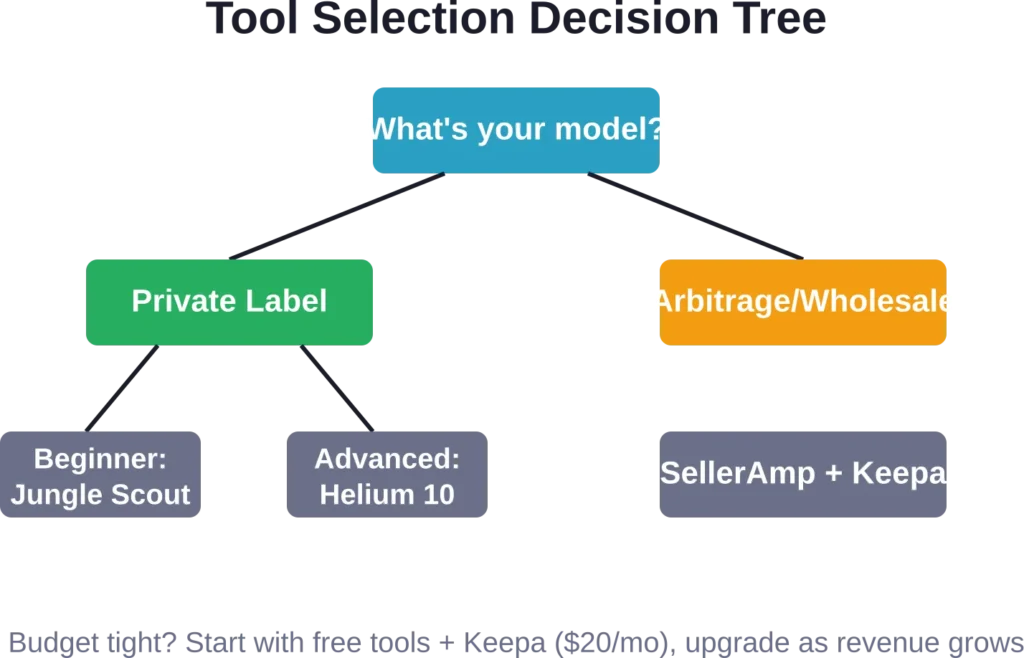
Private label sellers need deep keyword research, competition analysis, and supplier sourcing. Jungle Scout or Helium 10 fit best. Jungle Scout wins on ease of use and the integrated Supplier Database. Helium 10 wins on feature depth and international marketplace coverage.
Starting out? Jungle Scout’s entry tier provides everything needed to validate a first product without overwhelming complexity.
Scaling internationally? Helium 10’s multi-marketplace support becomes essential.
For Arbitrage & Wholesale Sellers
Arbitrage and wholesale require speed—analyzing hundreds of products quickly to find profitable deals. SellerAmp dominates here with its bulk analysis capabilities and Keepa integration.
Pair SellerAmp with a standalone Keepa subscription for enhanced historical data and trend tracking.
SmartScout also works well for wholesale sellers evaluating entire brands or categories rather than individual products.
Budget Constraints
Budget-conscious sellers have several options:
- Start with free tools (Product Opportunity Explorer, Google Trends, CamelCamelCamel) for initial validation
- Add Keepa ($20/month) for historical data
- Upgrade to AMZScout (~$49/month) for basic product database access
- Scale into Jungle Scout or Helium 10 once generating consistent revenue
There’s no point paying for Helium 10’s full suite before validating that Amazon selling actually works for the business.
Experience Level
Beginners benefit from simpler interfaces with guided workflows. Jungle Scout explicitly targets newer sellers with tooltips, tutorials, and streamlined dashboards.
Experienced sellers managing multiple products or expanding internationally need the advanced filtering, automation, and reporting that Helium 10 or SmartScout provide.
Common Mistakes When Using Research Tools
Even the best tools produce misleading conclusions when used incorrectly. Here are the most frequent mistakes.
Trusting Sales Estimates as Gospel
Sales estimates are educated guesses, not facts. Tools reverse-engineer sales from Best Seller Rank using proprietary algorithms. BSR fluctuates constantly, and the relationship between rank and sales varies by category.
Treat estimates as directional indicators—”this product probably sells 100-300 units/month”—not precise forecasts. Cross-reference data from multiple tools when possible, and look at trends over weeks or months rather than single-day snapshots.
Ignoring Seasonality
Many products spike during specific seasons or holidays. A product selling 1,000 units/month in November might drop to 100 in February.
Always check historical sales rank data in Keepa or use Helium 10’s Trendster to identify seasonal patterns. Launching a Christmas-themed product in August without accounting for post-holiday crashes is a recipe for excess inventory and cash flow problems.
Focusing Only on Sales Volume
High sales volume means nothing if margins are thin or competition is brutal. A product selling 5,000 units/month with 15 established competitors and 20% margins is often less profitable than a 500-unit/month niche with weak competition and 40% margins.
Always run full profit calculations factoring in FBA fees, referral fees, product costs, shipping, and PPC spend. Most tools include profit calculators—use them for every product before committing.
Overlooking Review Velocity
New sellers launching against competitors with 1,000+ reviews face an uphill battle. Even with a superior product, gaining visibility and trust takes months when established sellers dominate the review count.
Look for niches where top listings have fewer than 200 reviews and relatively slow review accumulation rates. This signals room for new entrants to compete on equal footing.
Integrating Research Tools Into Daily Workflow
Research tools deliver maximum value when integrated into a consistent workflow, not just used sporadically.
For private label sellers, a typical workflow looks like:
- Weekly niche exploration using Black Box (Helium 10) or Product Database (Jungle Scout) with saved filters
- Shortlist 5-10 promising products and run detailed competition analysis
- Check keyword difficulty and search volume for each product
- Validate seasonality trends in Keepa or Trendster
- Calculate full profit margins including all costs
- If metrics look strong, source quotes from suppliers via Jungle Scout’s Supplier Database or Alibaba
- Order samples, test, and make final launch decision
For arbitrage sellers, the workflow is faster:
- Scan online retail sites or store shelves for discounted products
- Use SellerAmp or Seller Assistant Chrome Extension to instantly check Amazon pricing and profitability
- Verify sales rank history in Keepa to ensure consistent turnover
- Purchase inventory if metrics hit minimum thresholds (ROI above 30%, BSR below 50,000 in relevant category, etc.)
Automation features—saved searches, alert notifications, scheduled reports—reduce the manual effort required to maintain these workflows.
FAQ
Jungle Scout is widely considered the best starting point for beginners due to its intuitive interface, built-in tutorials, and Supplier Database that simplifies sourcing. The mid-tier plan ($49-$129/month) provides full product database access and sufficient searches for validating initial product ideas without overwhelming complexity.
Free tools like Amazon’s Product Opportunity Explorer, Google Trends, and CamelCamelCamel provide enough data for initial validation but lack the granularity for confident launch decisions. They won’t provide sales estimates, detailed competition analysis, or keyword difficulty scores. Adding a Keepa subscription (~$20/month) for historical sales rank data significantly improves free-tool workflows.
Sales estimates are directional rather than precise. Tools reverse-engineer sales from Best Seller Rank using proprietary algorithms, but Amazon doesn’t publish actual sales data. Estimates typically fall within 20-40% of reality when averaged over weeks or months. Cross-reference multiple tools and focus on trends rather than single-day snapshots for better accuracy.
Jungle Scout suits beginners and private label sellers focused on the US marketplace, offering simpler navigation and integrated supplier sourcing. Helium 10 suits experienced sellers managing multiple products across international marketplaces, providing deeper keyword research, more advanced filtering, and broader feature coverage. Budget also matters—Jungle Scout starts at $49/month while Helium 10 starts at $129/month.
The most critical features are: (1) accurate sales estimates, (2) historical sales rank data for seasonality checks, (3) keyword search volume and difficulty scores, (4) profit calculators that factor in all FBA fees, and (5) competition analysis showing review counts and dominant sellers. Advanced features like supplier databases and category traffic insights add value but aren’t essential for initial validation.
Many sellers combine tools to leverage each platform’s strengths. Common combinations include Jungle Scout for product database searches plus Keepa for historical tracking, or Helium 10 for keywords plus SellerAmp for bulk arbitrage analysis. This approach increases monthly costs but provides more comprehensive data and reduces blind spots from relying on a single tool’s algorithms.
Starting sellers can operate effectively with $20-$50/month (Keepa plus a basic Chrome Extension or AMZScout’s entry tier). Sellers launching private label products typically budget $50-$130/month for full-featured platforms like Jungle Scout. Experienced sellers managing multiple products or scaling internationally often invest $130-$300/month in comprehensive suites like Helium 10 with advanced features and multiple user seats.
Final Verdict
Amazon product research in 2026 demands tools—manual analysis simply can’t compete with automated data aggregation and algorithmic pattern detection at scale. The right choice depends entirely on selling model, budget, and growth stage.
For private label beginners: Jungle Scout delivers the cleanest learning curve and integrated supplier sourcing without feature overload. The mid-tier plan provides everything needed to validate and launch a first product successfully.
For experienced private label sellers scaling internationally: Helium 10 justifies the higher cost through superior keyword depth, multi-marketplace coverage, and automation features that save hours weekly.
For arbitrage and wholesale sellers: SellerAmp’s bulk analysis speed paired with Keepa’s historical data creates the fastest workflow for evaluating hundreds of deals daily.
For budget-conscious starters: Begin with Amazon’s free Product Opportunity Explorer and Google Trends for initial niche validation, add Keepa ($20/month) for trend tracking, then upgrade to a paid platform once generating consistent revenue.
The landscape will continue evolving as AI capabilities expand. Tools that automate trend prediction, optimize listings dynamically, and provide predictive inventory recommendations will increasingly separate serious sellers from hobbyists. The barrier to entry keeps rising, making early investment in quality research tools more critical than ever.
Ready to find profitable products? Start with the tool that matches where the business is right now, not where it might be in two years. Master the basics, validate the model works, then scale up tools as revenue justifies the investment.