

Quick Summary: Payment gateway integration companies specialize in connecting e-commerce platforms and websites to secure payment processing systems. The top 15 agencies include Lengreo, Gilzor, OSKI Solutions, A-listware, Mobian Studio, PayCompass, Stripe Connect Partners, Adyen Implementation Specialists, Square Integration Experts, PayPal Partner Network, Authorize.Net Solution Providers, Braintree Integration Agencies, Worldpay Professional Services, 2Checkout Integration Partners, and ConnectPay Implementation Teams—each offering expertise in technical setup, security compliance, and custom payment workflows across different business models and regions.
Choosing the right payment gateway integration company isn’t just a technical decision. It shapes how customers experience your checkout, impacts your revenue flow, and determines whether your business stays compliant with evolving financial regulations.
The market has matured significantly. Gone are the days when plugging in a basic PayPal button counted as integration. Modern businesses need partners who understand multi-currency processing, fraud prevention, subscription billing, and platform-specific compliance requirements—all while keeping checkout friction minimal.
Industry reports suggest that by 2026, the majority of B2B organizations will rely on data-driven financial decision-making, making the technical sophistication of your payment infrastructure more critical than ever. According to HighRadius analysis, Gartner predicts 65% of B2B organizations will transition to data-driven financial decision-making in 2026.
But here’s the thing: not every integration company excels at every type of payment scenario. Some specialize in e-commerce storefronts. Others focus on SaaS subscription models or multi-vendor marketplaces. Understanding which agency matches your specific business model determines whether your integration becomes a competitive advantage or a constant source of technical headaches.
What Payment Gateway Integration Companies Actually Do
Payment gateway integration companies bridge the technical gap between your website or application and the financial networks that process transactions. They don’t just install plugins—they architect secure, compliant pathways that move money from your customers’ accounts into yours.
The work involves several specialized layers. Technical implementation covers API connections, webhook configurations, and error handling. Security compliance ensures PCI DSS standards are met, tokenization is properly implemented, and customer payment data never touches your servers in ways that create liability.
Then comes the business logic: setting up subscription billing, handling refunds and chargebacks, managing multi-currency conversion, implementing fraud scoring, and building custom checkout flows that match your brand experience. Most businesses discover these complexities only after attempting a DIY integration.
Professional integration companies bring experience from dozens or hundreds of similar projects. They’ve encountered edge cases you haven’t imagined yet—what happens when a customer’s bank is offline during checkout, how to handle split payments across multiple vendors, or how to manage subscription upgrades mid-billing cycle without double charging.
Real talk: the difference between a basic integration and a professional one becomes painfully obvious when something breaks at scale. Amateur implementations fail silently, lose transactions, or expose security vulnerabilities that don’t surface until audit time.
The Top 15 Payment Gateway Integration Companies
This list represents specialized integration agencies with proven track records across multiple payment platforms, industries, and business models. Each brings distinct strengths to different types of projects.
1. Oski Integration Specialists

Oski builds smart, scalable software solutions for enterprises and ambitious startups that need advanced payment technology. Their integration approach leverages AI-accelerated engineering and modern cloud architecture for fast, reliable deployment.
The company serves industries including fintech, e-commerce, travel, and logistics, where complex payment orchestration and compliance requirements are critical. This positions them strongly for businesses requiring enterprise-grade payment systems.
Their technical stack includes React, Angular, Vue, Node.js, .NET, AWS, Azure, AI/ML integrations, serverless computing, and CMS solutions. They deliver custom frontend checkout experiences, secure backend payment processing, and intelligent automation for routing and fraud prevention.
Oski delivers value through full development, deployment, and maintenance cycles. They focus on clean architecture, performance optimization, and solutions that scale effortlessly as transaction volumes grow.
Contact Information:
- Website: oski.site
- Phone: +48571282759
- Email: [email protected]
- Address: Kaupmehe tn 7, 10114 Tallinn, Estonia
- LinkedIn: www.linkedin.com/company/oski-solutions
2. A-listware Integration Specialists

A-listware provides dedicated development teams and consulting for companies that need flexible, high-quality payment gateway implementations. Their model allows seamless team augmentation or full outsourcing of complex integration projects.
The company works with enterprises, SMBs, and startups on custom software solutions, making them a strong fit for businesses requiring tailored payment architecture and ongoing technical support.
Their technical stack covers software development, cloud solutions, data analytics, UI/UX design, AI/ML, infrastructure services, and cybersecurity. They specialize in building secure, responsive payment systems, legacy modernization, and enterprise integrations including ERP and CRM connections.
A-listware delivers value through 24/7 expert access and end-to-end project management. They ensure smooth integration with existing systems while maintaining security, scalability, and performance standards.
Contact Information:
- Website: a-listware.com
- Phone: +1 (888) 337 93 73
- Email: [email protected]
- Address: North Bergen, NJ 07047, USA
- LinkedIn: www.linkedin.com/company/a-listware
- Facebook: www.facebook.com/alistware
3. Mobian Integration Specialists

Mobian builds dedicated engineering teams that deliver production-ready payment and fintech solutions for companies in high-stakes industries. Their approach guarantees on-time delivery of clean, scalable payment architecture.
The company specializes in mobile-first and AI-enhanced payment experiences for fintech, logistics, and healthcare clients. This makes them particularly valuable for businesses needing compliant, high-performance transaction systems.
Their technical stack includes full-stack mobile (iOS, Android, Flutter), backend development, AI agents and automation, scalable cloud architecture, legacy integration, and domain-specific compliance features. They handle everything from payment flows to complex orchestration.
Mobian delivers value through dedicated teams, post-launch partnership, and warranty support. They maintain deep codebase knowledge and provide rapid scaling assistance as payment volumes increase.
Contact Information:
- Website: mobian.studio
- Phone: [email protected]
- Address: Harju maakond, Tallinn, Kesklinnalinnaosa, Masina tn 22, 10113
- LinkedIn: www.linkedin.com/company/mobian-studio
4. Gilzor Integration Specialists

Gilzor specializes in custom software development for startups and scale-ups that require robust, user-friendly payment infrastructure. Their approach emphasizes full-cycle product development from idea validation to production-ready payment flows.
The company builds secure, scalable solutions that support both web and mobile payment experiences across iOS and Android. This makes them ideal for businesses launching new payment features or entire fintech products.
Their technical stack covers mobile development, web development, UI/UX design focused on checkout optimization, quality assurance, backend architecture, cloud infrastructure, and go-to-market strategy for payment solutions. They create seamless integration layers that connect multiple payment gateways and methods.
Gilzor delivers value through end-to-end delivery and post-launch support. They ensure high performance, security compliance, and continuous iteration based on user feedback and transaction data.
Contact Information:
- Website: www.gilzor.com
- Email: [email protected]
- Address: Poland, Warsaw, Office 58, street Adama Mickiewicza 37, 01-625
- LinkedIn: www.linkedin.com/company/gilzor-softwaredevelopment
5. Lengreo Integration Specialists

Lengreo focuses on B2B companies seeking high-performance lead generation and conversion optimization for their payment solutions. Their integration approach combines technical implementation with data-driven marketing strategies that accelerate client acquisition.
The company excels at multi-channel campaigns that target decision-makers in software, fintech, and tech services sectors across the US, UK, and Europe. This makes them particularly effective for payment platforms looking to expand their merchant base rapidly.
Their technical stack includes advanced website development for custom checkout experiences, SEO optimization for payment-related keywords, LinkedIn and Meta ad campaigns, hyper-personalized outreach, and conversion rate optimization. They build and refine complete digital funnels that support complex payment gateway implementations.
Lengreo delivers value through continuous performance monitoring and iterative improvements. They track lead quality, reduce cost per acquisition, and boost conversion rates using real campaign data and A/B testing insights.
Contact Information:
- Website: Lengreo.com
- Phone: +31 686 147 566
- Email: [email protected]
- Address: Vrijstraat 9 C/D, 5611 AT Eindhoven, Netherlands
- LinkedIn: Lengreo
- Twitter: @Lengreo
- Instagram: @lengreo
6. Authorize.Net Solution Providers

Authorize.Net represents one of the longest-running payment gateways, and solution providers specializing in this platform typically work with established businesses that prioritize stability and broad bank support over cutting-edge features.
These providers excel at traditional e-commerce integrations—shopping carts, donation platforms, membership sites. They’ve implemented Authorize.Net across virtually every content management system and e-commerce platform that exists.
The technical focus includes customer payment profiles for recurring billing, fraud detection suite configuration, and integration with accounting systems for automated reconciliation. Authorize.Net solution providers often serve businesses with mature operational processes that need payments to integrate cleanly into existing workflows.
Stability matters more than innovation for many Authorize.Net clients. The gateway doesn’t chase every new payment trend, but it processes billions reliably. Solution providers deliver implementations optimized for uptime, predictable behavior, and minimal ongoing maintenance.
7. Braintree Integration Agencies

Braintree, owned by PayPal but operating as a separate platform, serves businesses needing sophisticated payment orchestration with strong mobile support. Integration agencies specializing in Braintree often work with mobile-first applications and marketplaces.
Technical expertise centers on Braintree’s Drop-in UI—pre-built payment forms that reduce development time—and custom integrations using Braintree’s client SDKs for iOS, Android, and web. These agencies optimize mobile checkout flows where every extra tap increases abandonment risk.
Braintree partners also implement the platform’s advanced vault functionality, which securely stores payment methods for one-click repeat purchases. This capability proves critical for subscription services and marketplaces where customers make frequent transactions.
The GraphQL API introduced by Braintree offers modern integration approaches that appeal to development teams using contemporary frameworks. Specialized agencies leverage these newer capabilities to build cleaner, more maintainable integration code.
8. Worldpay Professional Services
Worldpay (now FIS Worldpay) processes enormous global volume and serves enterprise clients with complex requirements. Professional services teams working with Worldpay implement high-availability systems designed for massive scale.
These specialists handle multi-region deployments where businesses need payment processing infrastructure distributed across continents for performance and regulatory compliance. Technical architecture includes redundancy, failover, and monitoring to ensure payment availability matches enterprise SLAs.
Worldpay implementations often involve extensive customization: industry-specific compliance requirements for travel, gaming, or subscription businesses; custom fraud rules tuned to business-specific risk profiles; and integration with enterprise resource planning systems for automated financial operations.
The services extend into managed operations. Many enterprise clients want payment infrastructure that “just works” without requiring internal technical teams to become payment experts. Worldpay professional services fill this role through ongoing management, optimization, and strategic guidance.
9. 2Checkout (Verifone) Integration Partners

2Checkout, acquired by Verifone, specializes in global digital commerce with particular strength in software, SaaS, and digital goods. Integration partners focusing on this platform typically serve businesses selling downloadable products, subscriptions, or online services.
Technical implementations emphasize recurring billing flexibility—free trials, upgrade paths, proration, dunning management for failed payments. The platform handles subscription complexity that would require significant custom development on more basic gateways.
Global reach differentiates 2Checkout partners. The platform supports localized checkout experiences in dozens of countries, handling local payment methods, currencies, and tax calculations. This matters enormously for software companies selling worldwide without establishing local business entities everywhere.
Integration work includes connecting 2Checkout’s subscription system to license management, access control, and product delivery systems. The goal: fully automated customer lifecycle from signup through renewal, upgrade, or cancellation without manual intervention.
10. ConnectPay Implementation Teams

ConnectPay serves regulated businesses operating in European markets—fintechs, SaaS platforms, and marketplaces needing robust payment infrastructure with strong regulatory compliance. Implementation teams specializing in ConnectPay understand both technical integration and European financial regulation.
The platform’s strength lies in its design specifically for European regulatory frameworks. Teams implement solutions compliant with PSD2 requirements, Strong Customer Authentication mandates, and GDPR data protection standards from the foundation up.
Technical implementations cover the full European Economic Area with multi-currency support, local payment method integration, and cross-border payment optimization. Businesses expanding across Europe benefit from ConnectPay’s unified approach rather than juggling multiple country-specific providers.
ConnectPay implementation teams often work with businesses building financial products themselves—embedded finance platforms, marketplace split payments, or innovative payment flows. The platform’s flexibility supports these custom scenarios while maintaining regulatory compliance throughout.
11. PayCompass Integration Specialists

PayCompass focuses on small to medium businesses requiring straightforward yet robust payment infrastructure. Their integration approach emphasizes speed-to-market without sacrificing security fundamentals.
The company maintains partnerships with major gateways and specializes in multi-currency implementations spanning more than 170 countries. This makes them particularly strong for businesses planning international expansion from day one.
Their technical stack covers common e-commerce platforms—Shopify, WooCommerce, Magento—plus custom integrations for Laravel, React, and Node.js applications. They’ve developed reusable integration frameworks that reduce implementation timelines compared to building everything from scratch.
PayCompass delivers value through their post-launch optimization services. They monitor transaction success rates, identify friction points causing cart abandonment, and iteratively improve checkout flows based on real performance data.
12. Stripe Connect Partner Network

Stripe’s official partner network comprises agencies certified in implementing Stripe’s full product suite. These partners understand not just basic payment acceptance but advanced features like Connect for marketplace platforms, Billing for subscription management, and Terminal for in-person payments.
What sets Stripe partners apart is their depth of knowledge around platform business models. If your application involves facilitating payments between multiple parties—think Airbnb, Uber, or Etsy models—Stripe Connect partners architect the split payment logic, manage vendor onboarding, and handle regulatory requirements like 1099 tax reporting.
According to Stripe’s documentation, using Stripe’s In-app Payments and APIs allows businesses to design customized payments integration and checkout flows. Partner agencies accelerate this by bringing pre-built components, tested workflows, and experience avoiding common implementation pitfalls.
Stripe partners also stay current with the company’s rapid feature releases. When Stripe launches new capabilities—like their recent work on agentic commerce or embedded financial services—certified partners receive early training and can implement these features for clients immediately.
13. Adyen Implementation Specialists

Adyen serves enterprise clients and high-growth companies processing significant volume. Integration specialists focusing on Adyen typically work with businesses handling millions in monthly transaction volume across multiple markets.
These agencies excel at complex, global payment orchestration. They implement Adyen’s unified commerce approach, which treats online, in-store, and mobile payments through a single platform. This becomes critical for omnichannel retailers needing consistent payment experiences regardless of where customers shop.
Adyen implementation requires understanding sophisticated features: network tokenization for improved authorization rates, account-to-account payments in European markets, local payment method integrations across dozens of countries, and revenue optimization through intelligent payment routing.
The integration work often extends beyond technical implementation into strategic consulting. Which local payment methods drive highest conversion in Japan? How should authentication flows differ between European and US customers? Experienced Adyen partners answer these questions based on benchmarks from similar businesses.
14. Square Integration Experts

Square built its reputation on small business payments, but the platform now serves businesses of all sizes. Square integration experts specialize in unified commerce scenarios where online and offline payment acceptance must work seamlessly together.
Their strength lies in point-of-sale integrations. Restaurants, retail stores, and service businesses need payment systems that sync inventory, process refunds across channels, and provide unified reporting whether transactions happen via website, mobile app, or physical register.
Square partners implement the full ecosystem: payment processing, inventory management, employee management, and customer loyalty programs. This holistic approach works particularly well for businesses where payments represent just one piece of a larger operational puzzle.
Integration projects often include hardware setup—physical card readers, receipt printers, cash drawers—alongside digital payment flows. This end-to-end capability distinguishes Square specialists from purely software-focused integration companies.
15. PayPal Partner Network Agencies

PayPal remains one of the world’s most recognized payment brands, and official partner agencies help businesses maximize the platform’s capabilities beyond basic PayPal buttons.
Partner agencies implement advanced PayPal features: Braintree’s sophisticated payment orchestration, Venmo integration for US mobile commerce, PayPal Credit financing options, and subscription billing through PayPal’s recurring payment APIs.
According to PayPal’s documentation, PayPal’s Payflow Gateway provides secure and open payment gateway services with extensive customization options. Partner agencies leverage these capabilities to build custom checkout experiences while maintaining the trust and convenience of PayPal branding.
PayPal partners also navigate the company’s complex product portfolio. PayPal Payments Pro differs from Payflow Pro, which differs from Braintree—each with distinct capabilities, compliance requirements, and ideal use cases. Expert partners match products to business needs rather than force-fitting whatever they know best.
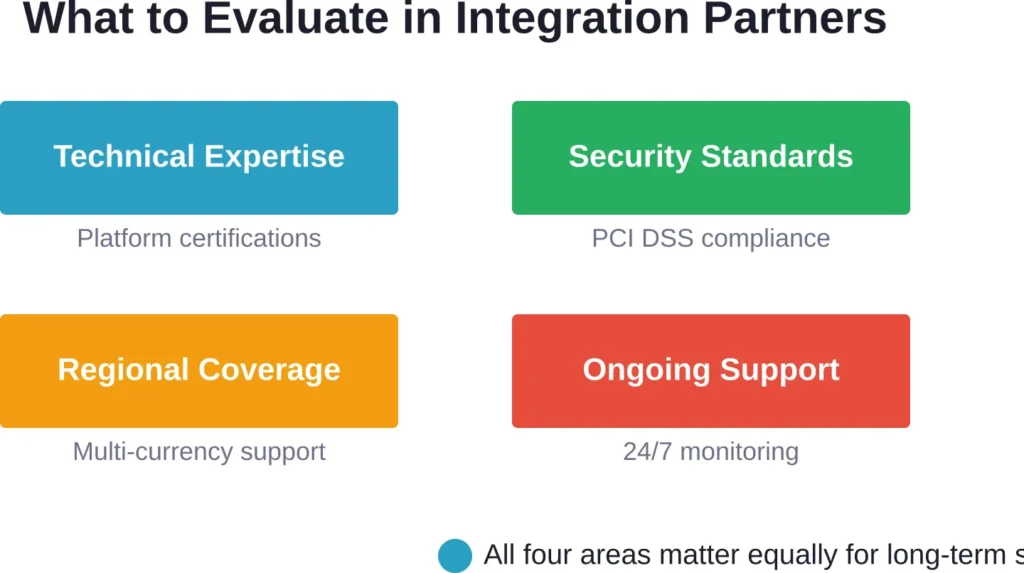
Key Factors When Evaluating Integration Companies
Not every payment gateway integration company deserves your attention. The market includes thousands of development shops claiming payment expertise, but only a fraction possess the specialized knowledge that separates functional integrations from bulletproof ones.
Technical Expertise Across Payment Platforms
The best integration companies maintain certified partnerships with major payment gateways. These partnerships require passing technical exams, completing training programs, and demonstrating successful client implementations.
Look for companies with documented experience on your specific platform. Integrating Stripe into a custom Laravel application differs fundamentally from implementing Adyen on Shopify Plus or building PayPal subscriptions into a WordPress membership site.
Ask potential partners about their most complex integration. The answer reveals whether they’ve handled scenarios beyond basic transactions—things like marketplace split payments, subscription proration, or multi-gateway failover systems.
Security and Compliance Knowledge
Payment security isn’t optional. Every integration must comply with PCI DSS standards, but compliance exists on a spectrum. Level 1 compliance (processing over 6 million transactions annually) requires significantly more rigorous controls than Level 4 (fewer than 20,000 e-commerce transactions).
Professional integration companies understand these distinctions. They implement tokenization strategies that minimize your PCI scope, configure proper TLS encryption, and ensure cardholder data never flows through non-compliant systems.
According to Federal Reserve announcements about payment systems, the industry has seen rapid developments with innovative approaches to banking and payment services. Integration partners should stay current with regional requirements—GDPR in Europe, PSD2 for Strong Customer Authentication, and emerging frameworks around instant payments like the FedNow Service.
Regional and Multi-Currency Experience
Cross-border commerce introduces complications most domestic merchants never encounter. Currency conversion, local payment methods, regional tax calculations, and country-specific compliance requirements all multiply integration complexity.
Companies with genuine international experience demonstrate this through their portfolio. They’ve implemented iDEAL for Netherlands customers, Giropay for Germany, Alipay for China, or PIX for Brazil—not just the global card networks everyone knows.
For businesses targeting European markets, multi-currency support across the EEA becomes critical. ConnectPay offers multi-currency support across more than 170 countries. The platform is designed specifically for regulated EU businesses, fintechs, SaaS, and marketplaces.
Post-Launch Support and Optimization
Integration isn’t a one-time project. Payment systems require ongoing maintenance—gateway API updates, security patches, new fraud rule configurations, and periodic PCI compliance audits.
The best integration companies offer clear support agreements. When a transaction fails at 2 AM during a flash sale, response time matters. Some companies provide 24/7 incident support; others work business hours only.
Optimization services separate great partners from adequate ones. After your integration goes live, analytics reveal drop-off points, failed transactions patterns, and opportunities to reduce friction. Companies that actively monitor and improve your payment flows deliver ongoing ROI, not just initial implementation.
Comparing Integration Approaches and Technical Methods
Payment gateway integration follows several technical patterns, each with distinct trade-offs around development time, customization capability, and ongoing maintenance burden.
Hosted Payment Pages
The simplest integration redirects customers to gateway-hosted checkout pages. Customers enter payment details on the gateway’s servers, then return to your site after completion.
This approach minimizes PCI compliance scope since cardholder data never touches your infrastructure. Development time stays minimal—often just a few days for basic implementations. Security responsibility falls primarily on the gateway provider.
But customization remains limited. Checkout pages follow the gateway’s design, which may not match your brand experience. Customer experience suffers slightly from the redirect—some shoppers abandon when moved to unfamiliar payment domains.
Hosted pages work well for businesses prioritizing speed and simplicity over perfect brand consistency. Many B2B companies, nonprofits, and service businesses operate successfully with hosted checkout.
Embedded Payment Forms
Embedded forms (like Stripe Elements or Braintree Drop-in UI) place payment fields directly on your checkout page while handling sensitive data through tokenization. Customers never leave your site, but payment data flows securely to gateway servers before reaching your backend.
This middle-ground approach provides better branding and user experience than hosted pages while maintaining reduced PCI scope. Integration complexity increases moderately—typically one to three weeks for competent developers.
Customization options expand significantly. You control the entire page layout, checkout flow, and visual design. Payment fields integrate seamlessly into your existing interface rather than feeling like a separate step.
Most modern integration companies recommend embedded forms as the optimal balance for typical e-commerce and SaaS businesses. The technical complexity remains manageable while delivering professional, branded checkout experiences.
Direct API Integrations
Full API integrations provide maximum control and customization at the cost of significant development complexity. Your application handles the entire payment flow, communicating directly with gateway APIs for authorization, capture, refunds, and reconciliation.
These implementations require substantial security expertise. You’re responsible for ensuring payment data transmission meets PCI standards, implementing proper tokenization, and maintaining secure key management. PCI compliance scope expands considerably.
But capabilities expand proportionally. Complex workflows become possible: split payments across multiple parties, custom approval flows, integrated fraud scoring, dynamic payment routing based on customer location or transaction type.
Direct API integrations suit businesses with sophisticated requirements that can’t be met through simpler approaches. Marketplaces, large enterprises with custom processes, and fintech companies building payment features into their products typically choose this path.
| Integration Method | Development Time | PCI Scope | Customization Level | Best For |
|---|---|---|---|---|
| Hosted Payment Pages | Few days | Minimal | Low | Simple checkouts, quick launches |
| Embedded Forms | 1-3 weeks | Reduced | Medium | Branded experiences, most businesses |
| Direct API Integration | 4-12 weeks | Extensive | Complete | Complex workflows, marketplaces |
| Hybrid Approach | 2-6 weeks | Variable | Medium-High | Multi-channel businesses |
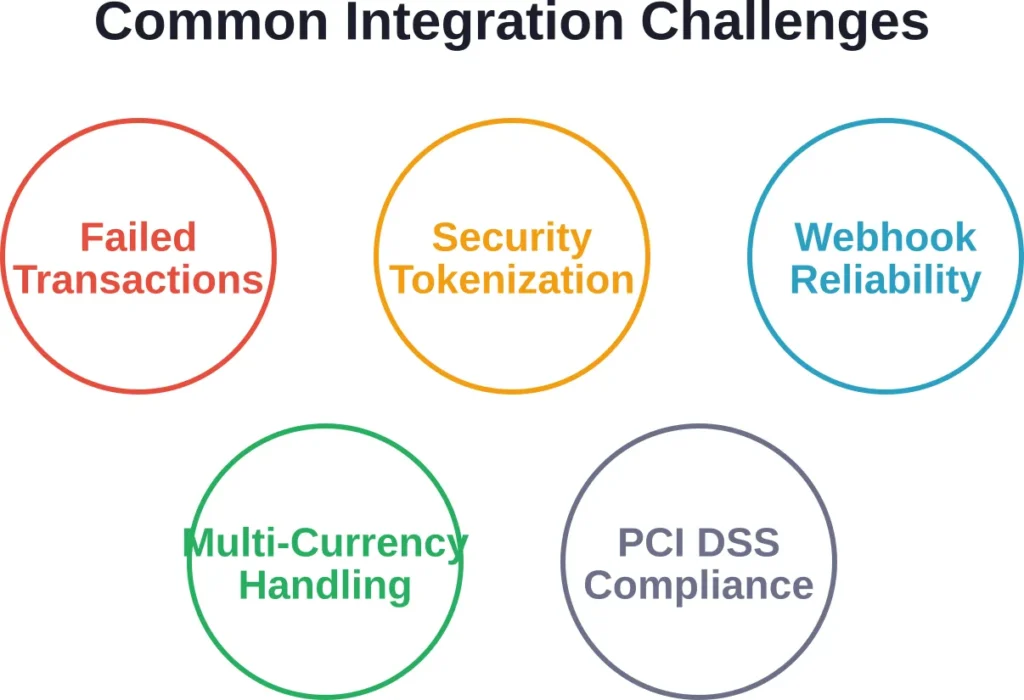
Common Integration Challenges and How Companies Address Them
Every payment integration encounters predictable challenges. Experienced integration companies prevent these issues through established patterns and testing protocols.
Failed Transaction Handling
Payment failures happen constantly—expired cards, insufficient funds, bank system downtime, fraud blocks. Amateur integrations display generic error messages that confuse customers and kill conversions.
Professional implementations parse gateway response codes and display specific, actionable guidance: “Your card was declined. Please verify the card number or try a different payment method.” They implement retry logic for temporary failures and gracefully handle every possible error state.
PayPal’s Payflow Gateway documentation includes extensive error code and transaction response handling, with RESULT values and RESPMSG text providing specific transaction status information.
Security and Tokenization
Handling payment data securely requires understanding tokenization, TLS configuration, and PCI compliance requirements. Poor implementations create massive liability by storing or transmitting card data insecurely.
Professional integrations implement tokenization from day one. Customer payment information gets exchanged for tokens at the earliest possible point—often in the browser before data ever reaches your servers. These tokens can be stored and reused safely for recurring billing.
But tokenization must be implemented correctly. Tokens require different storage security than raw card data, proper expiration handling, and secure transmission protocols. Integration companies that do this professionally prevent the security nightmares that plague DIY implementations.
Webhook Reliability
Most payment platforms use webhooks to notify applications about asynchronous events—successful charges, failed payments, dispute notifications. These webhooks arrive at unpredictable times and must be processed reliably even during server maintenance or traffic spikes.
Professional integrations implement webhook handling with proper queuing, retry logic, and idempotency checks. The same webhook might arrive multiple times; implementations must handle duplicate notifications without double-processing.
They also implement webhook verification, confirming that notifications actually came from the payment gateway rather than malicious actors. This signature verification prevents attackers from triggering false payment confirmations.
Multi-Currency Complexities
International businesses face currency conversion challenges that domestic merchants never encounter. Exchange rates fluctuate, different gateways handle conversion differently, and customers expect transparent pricing in their local currency.
Integration companies experienced with multi-currency implementations build proper currency handling: presenting prices in customer currency, processing transactions in the most cost-effective currency, handling rounding properly, and managing refunds when exchange rates have changed since the original transaction.
They also implement local payment method support where needed. European customers expect SEPA transfers, Chinese customers want Alipay, Brazilian customers use PIX. True global payment acceptance requires integration with regional payment networks beyond just Visa and Mastercard.
Industry-Specific Integration Considerations
Payment requirements vary dramatically across industries. What works for an online retailer fails completely for a marketplace or subscription business.
E-commerce Storefronts
Traditional e-commerce needs reliable, fast checkout with minimal abandonment. Integration companies focus on reducing friction—one-click purchasing, saved payment methods, guest checkout options.
Technical priorities include shopping cart integration, inventory synchronization, tax calculation, shipping rate calculation, and order management system connections. The payment gateway must communicate with multiple systems to complete each transaction successfully.
Most e-commerce integrations benefit from embedded payment forms that keep customers on-site during checkout while maintaining security. Integration companies implement these with careful attention to mobile optimization—more than half of online shopping happens on phones where every extra field or step increases abandonment risk.
SaaS and Subscription Businesses
Subscription businesses require entirely different payment infrastructure. One-time transactions matter less than recurring billing reliability, dunning management, proration logic, and subscription lifecycle handling.
Integration companies working with SaaS platforms implement sophisticated subscription logic: free trial periods, automatic upgrades and downgrades, proration when customers change plans mid-cycle, grace periods for failed payments, and dunning workflows that recover failed renewals without annoying customers.
Building proper subscription and recurring billing involves handling multiple edge cases, such as free trial periods, plan upgrades and downgrades, proration, and dunning management for failed payments. Professional integration companies have implemented these scenarios dozens of times and choose the right approach for each business model.
Marketplaces and Platform Businesses
Marketplaces introduce payment complexity that single-merchant businesses never face. Money flows from buyers through the platform to multiple sellers, often with the platform taking a commission.
This requires split payment logic, vendor onboarding and identity verification, separate payment accounts for each seller, accurate financial reporting for tax compliance, and careful escrow or payout timing that protects buyers while paying sellers promptly.
Integration companies specializing in marketplaces typically work with platforms like Stripe Connect or PayPal for Marketplaces designed explicitly for these scenarios. They implement the complex account structures, payment splitting, and compliance workflows that marketplace businesses require.
B2B and High-Value Transactions
Business-to-business payments involve larger transaction amounts, longer payment terms, and different payment methods than consumer transactions. Integration companies serving B2B clients implement NET-30 payment terms, purchase order handling, invoice generation, and payment methods like ACH transfers or wire payments.
According to PayPal developer documentation, different payment types have different transaction limits and handling requirements. B2B integration companies navigate these limits and implement appropriate payment methods for high-value transactions.
Security requirements intensify for large B2B transactions. Multi-factor authentication, approval workflows, and detailed audit trails become standard. Integration companies implement these controls while keeping the payment process efficient enough for business buyers.
Evaluating Vendor Payment Automation Systems
Some integration companies specialize in vendor payment automation—the other side of the payment equation where businesses pay suppliers, contractors, and service providers.
Traditional accounts payable processes involve manual invoice processing, approval workflows, and payment execution. Modern vendor payment systems automate these workflows, reducing errors and freeing finance teams for strategic work.
According to HighRadius analysis, automated payment solutions have transitioned from basic workflow digitizers to strategic engines that optimize working capital and mitigate sophisticated fraud.
Integration companies implementing vendor payment automation connect accounting systems, approval workflows, fraud detection, payment execution across multiple methods (ACH, wire, check, virtual card), and reconciliation processes. The goal: complete automation from invoice receipt through payment and accounting reconciliation.
These systems particularly benefit businesses making hundreds or thousands of monthly payments to diverse suppliers. The automation recovers significant staff time while improving accuracy and creating detailed audit trails.
The Role of No-Code and Low-Code Integration Platforms
Not every payment integration requires custom development. No-code and low-code platforms enable faster implementations for businesses with standard requirements.
Stripe’s no-code integration options, for instance, allow launching payment programs without writing code through the dashboard. According to Stripe documentation, businesses can launch Capital programs, customize integrations with embedded components, and manage payment infrastructure through visual interfaces.
These approaches dramatically reduce time-to-market and lower technical requirements. Small businesses without development resources can implement professional payment acceptance. Companies can prototype payment flows before committing to full custom development.
But limitations exist. No-code solutions handle standard workflows well but struggle with unique business logic. Complex marketplace splits, custom approval workflows, or integration with legacy systems typically require traditional development.
Integration companies increasingly offer hybrid approaches: leveraging no-code tools for standard components while developing custom code only where unique business requirements demand it. This optimizes development time and cost without sacrificing capabilities where they matter.
Future Trends Shaping Payment Integration
Payment technology continues evolving. Integration companies staying current with emerging trends deliver longer-lasting value than those implementing yesterday’s patterns.
Instant Payments and Real-Time Settlement
Traditional payment processing involves settlement delays—transactions clear in 1-3 business days. Instant payment networks like the Federal Reserve’s FedNow Service enable real-time fund transfers 24/7/365.
The Federal Reserve has developed a round-the-clock payment and settlement service, called the FedNow Service, to support instant payments in the United States. Integration companies implementing FedNow connectivity enable businesses to receive payments instantly rather than waiting days for settlement.
This matters enormously for cash flow. Service businesses can deliver products immediately upon confirmed payment. Marketplaces can pay sellers instantly rather than holding funds in escrow. Treasury management becomes more precise when fund availability is immediate.
Embedded Finance and Banking-as-a-Service
Software platforms increasingly embed financial services directly rather than referring customers to external banks or payment providers. Integration companies now implement issuing payment cards, offering loans, or providing savings accounts as native features within applications.
According to Stripe’s card issuing APIs documentation, businesses can issue physical or virtual cards directly from their systems, or manage cards through Stripe’s APIs. Applications for expense management, employee benefits, creator monetization, or financial services become possible when payment capabilities embed natively.
Integration complexity increases—these implementations must navigate banking regulations, money transmitter licensing, and complex compliance requirements. Companies specializing in embedded finance understand both the technical implementation and regulatory frameworks.
AI and Fraud Prevention
Payment fraud continues growing in sophistication. Modern integration includes machine learning-based fraud scoring, behavioral analysis, and risk assessment that adapts continuously.
Integration companies implement fraud prevention at multiple layers: device fingerprinting to identify suspicious patterns, velocity checks to detect unusual transaction frequency, machine learning models that score transactions based on hundreds of factors, and 3D Secure authentication for high-risk transactions.
The goal: block fraudulent transactions while minimizing false positives that reject legitimate customers. This balance requires continuous tuning based on actual fraud patterns specific to each business.
Agentic Commerce and AI-Initiated Payments
Emerging “agentic commerce” frameworks enable AI agents to initiate payments on behalf of users. According to Stripe’s agentic commerce documentation, this requires new integration approaches for accepting AI-initiated payments through third-party processors.
While still in early stages, these frameworks point toward futures where AI assistants handle routine purchases, subscription management, and payment decisions based on user preferences. Integration companies implementing these systems architect authentication, authorization, and security appropriate for AI-mediated transactions.
Questions to Ask Potential Integration Partners
When evaluating payment gateway integration companies, these questions reveal whether they possess genuine expertise or just surface-level familiarity.
What payment gateways have you integrated most frequently? Depth of experience with your chosen gateway matters more than breadth across dozens of platforms. You want a partner who’s implemented your gateway enough times to know its quirks.
Can you show examples of integrations similar to our business model? E-commerce, SaaS, marketplace, and B2B integrations differ fundamentally. Examples matching your model demonstrate relevant experience.
How do you handle PCI compliance? The answer should include specific implementation details about tokenization, secure transmission, and scope reduction—not just “we’re PCI compliant.”
What’s your approach to failed payment handling? This reveals attention to detail. Amateur implementations ignore failed transactions; professionals implement comprehensive error handling and retry logic.
How do you manage webhook reliability? The answer should mention queuing, idempotency, signature verification, and retry logic. If they don’t know why these matter, keep looking.
What post-launch support do you provide? Understanding ongoing support options—monitoring, optimization, maintenance—prevents surprises after launch.
Can you provide references from similar businesses? Speaking with current clients reveals whether promises match reality. Ask those references about post-launch support quality, not just initial implementation.
Cost Structures for Payment Integration Services
Integration companies structure payment projects differently. Understanding common approaches helps budget appropriately and compare proposals fairly.
Fixed-price projects work when requirements are clearly defined upfront. The integration company quotes a total price for specified deliverables. This provides budget certainty but requires detailed specifications before starting.
Time-and-materials pricing bills for actual hours worked. This flexibility suits projects where requirements evolve during implementation but makes final costs harder to predict. Most companies provide estimates but don’t guarantee maximum costs.
Retainer agreements cover ongoing support after initial implementation. Monthly fees provide continued access to technical support, optimization services, and assistance with gateway updates or feature additions.
Value-based pricing ties fees to business outcomes—percentage of transaction volume processed or success metrics achieved. Less common for integration work but increasingly popular for managed payment services.
Beyond integration services, remember that gateway fees continue forever. Transaction percentages, monthly minimums, and per-transaction fees compound over millions in processing volume. Integration companies can’t control these costs but should help choose gateways with favorable economics for your transaction patterns.
| Pricing Model | Best For | Budget Certainty | Flexibility |
|---|---|---|---|
| Fixed-Price Project | Clear requirements, standard implementations | High | Low |
| Time-and-Materials | Evolving requirements, complex custom work | Medium | High |
| Monthly Retainer | Ongoing optimization and support needs | High | Medium |
| Value-Based | Managed services, strategic partnerships | Low | Medium |
Making the Final Decision
Choosing a payment gateway integration company ultimately comes down to matching expertise with your specific requirements, budget, and timeline.
Technical expertise matters most. A company that’s implemented exactly your gateway on exactly your platform dozens of times will deliver faster, cheaper, and more reliably than one learning as they go on your dime.
Communication quality predicts project success surprisingly well. Companies that ask clarifying questions, explain technical concepts clearly, and respond promptly during pre-sale conversations typically maintain that quality during implementation.
Portfolio alignment reveals specialization. If all their examples serve enterprise clients and you’re a startup, or vice versa, the cultural and process fit may be poor regardless of technical capabilities.
Support agreements protect long-term success. Payment systems require ongoing maintenance. Clear support terms prevent being stranded when issues arise months after launch.
References matter more than marketing materials. Speaking with three current clients reveals the real working relationship—responsiveness, problem-solving ability, and whether they deliver what they promise.
Start with a small test project if uncertain. Many companies offer pilot implementations or proof-of-concept work before full commitments. This reveals working style and technical capability with limited risk.
Frequently Asked Questions
Payment gateways handle the technical connection between your website and payment networks, securely transmitting transaction data. Payment processors actually move money between bank accounts, settling transactions. Many modern providers bundle both services, but they represent distinct functions in the payment chain.
Implementation timelines range from a few days for simple hosted payment pages to several months for complex custom integrations. Standard e-commerce integrations using embedded forms typically complete in two to four weeks. Marketplace platforms with split payments and complex workflows may require three to six months. Timeline depends primarily on integration complexity and requirement clarity.
Yes, but compliance scope varies dramatically based on implementation approach. Businesses using hosted payment pages or properly tokenized embedded forms qualify for simplified PCI compliance questionnaires. Direct API integrations where payment data touches your servers require more extensive compliance measures. Integration companies should implement approaches that minimize your PCI scope and associated compliance costs.
Switching gateways is possible but involves significant work. All integration code must change, checkout flows require retesting, stored payment tokens typically cannot migrate, and compliance documentation needs updating. Professional integrations use abstraction layers that isolate gateway-specific code, making future switches somewhat easier. But switching should be avoided if possible by choosing the right gateway initially.
Gateway downtime immediately stops transaction processing, potentially costing significant revenue during outages. Some integration companies implement multi-gateway architectures that automatically failover to backup gateways during outages. These architectures add complexity and cost but provide continuity during gateway incidents. Businesses processing high volumes should discuss failover strategies with integration partners.
Refunds are initiated through gateway APIs when merchants choose to return funds to customers. Chargebacks occur when customers dispute transactions with their banks, forcing the bank to investigate and potentially reverse charges. Gateways notify merchants about chargebacks and facilitate the dispute resolution process. Professional integrations implement automated refund processing and chargeback notification handling to minimize manual work.
No single gateway serves all international scenarios best. Adyen and Stripe excel at multi-currency processing across dozens of countries with strong compliance features. PayPal provides customer familiarity globally but with higher fees. 2Checkout specializes in digital goods and software sales worldwide. ConnectPay focuses specifically on European markets with strong regulatory compliance. The best choice depends on your target markets, transaction volumes, and business model.
Conclusion: Choosing Your Payment Integration Partner
Payment gateway integration represents one of those decisions that’s easy to underestimate until you’re dealing with failed transactions at scale, compliance audits, or checkout abandonment rates killing your conversion funnel.
The companies listed here—from PayCompass and Stripe partners to Adyen specialists and ConnectPay implementation teams—bring specialized expertise that prevents these problems before they start. They’ve debugged webhook failures at 2 AM, implemented fraud rules that actually work, and navigated regional compliance requirements across dozens of countries.
Look, choosing the cheapest developer who claims they can “add a payment button” might save money initially. But when that integration crumbles under real-world transaction volume, when security audits reveal vulnerabilities, or when you discover stored payment data creating massive PCI liability, the savings evaporate.
Professional integration companies cost more upfront because they’re building infrastructure that won’t require rebuilding in six months. They implement proper error handling, security controls, fraud prevention, and compliance measures from day one.
Match your choice to your specific needs. Small businesses with straightforward requirements benefit from companies like PayCompass offering efficient, proven implementations. Marketplaces need Stripe Connect or Adyen specialists understanding split payment complexity. European businesses require partners experienced with regional regulations and payment methods.
Start by defining your requirements clearly. Understand your transaction volume, whether you need subscription billing, if you process internationally, what your fraud risk looks like. Then interview companies with proven experience in those specific scenarios.
Check references thoroughly. Ask those references about post-launch support, not just whether the integration got delivered. Payment systems require ongoing optimization—authorization rate improvement, fraud rule tuning, gateway feature adoption. Partners providing strategic guidance post-launch deliver continuing value long after initial implementation.
Your payment infrastructure shapes customer experience, impacts conversion rates, affects fraud losses, and determines compliance liability. Investing in professional integration protects revenue, reduces risk, and enables growth. Choose the partner with proven expertise matching your exact needs, even if they don’t offer the lowest quote.
Ready to implement professional payment processing? Connect with integration specialists experienced in your industry and gateway platform. A consultation reveals whether their expertise matches your requirements—and whether they ask the detailed questions that indicate genuine competence versus surface-level familiarity.