

Quick Summary: Progressive web apps combine the reach of web technology with the performance of native apps. Finding the right development partner determines whether your PWA delivers speed, offline capability, and user engagement. This guide profiles 15 agencies with proven track records in building scalable, high-performing progressive web applications across industries.
Progressive web apps have shifted from experimental technology to production standard. Companies that once maintained separate web and mobile codebases now ship a single PWA that works everywhere—desktop browsers, mobile home screens, app stores, and offline environments.
The engineering challenge isn’t trivial. A well-built PWA needs service workers that cache intelligently, manifest files configured for every platform, performance budgets that keep initial load under two seconds, and push notification systems that don’t drain batteries.
Most internal teams lack the specialized experience to get this right on the first try. That’s where dedicated PWA development agencies matter. They’ve already solved the hard problems: handling flaky network conditions, optimizing asset delivery, making installability work across iOS and Android, debugging service worker edge cases.
But the agency landscape is cluttered. Every web shop claims PWA expertise now. So how do you separate teams with real production experience from those who added “PWA” to their homepage last month?
This guide profiles 15 agencies that have shipped multiple progressive web apps to production, supported them under real traffic, and built the infrastructure that keeps them fast. No fluff—just portfolios, technical stacks, and what each agency does best.
What Makes a Progressive Web App Development Company Worth Hiring
Not every web development shop can build a PWA that actually performs. The technology sits at the intersection of multiple disciplines: front-end engineering, back-end API design, DevOps, mobile optimization, and UX.
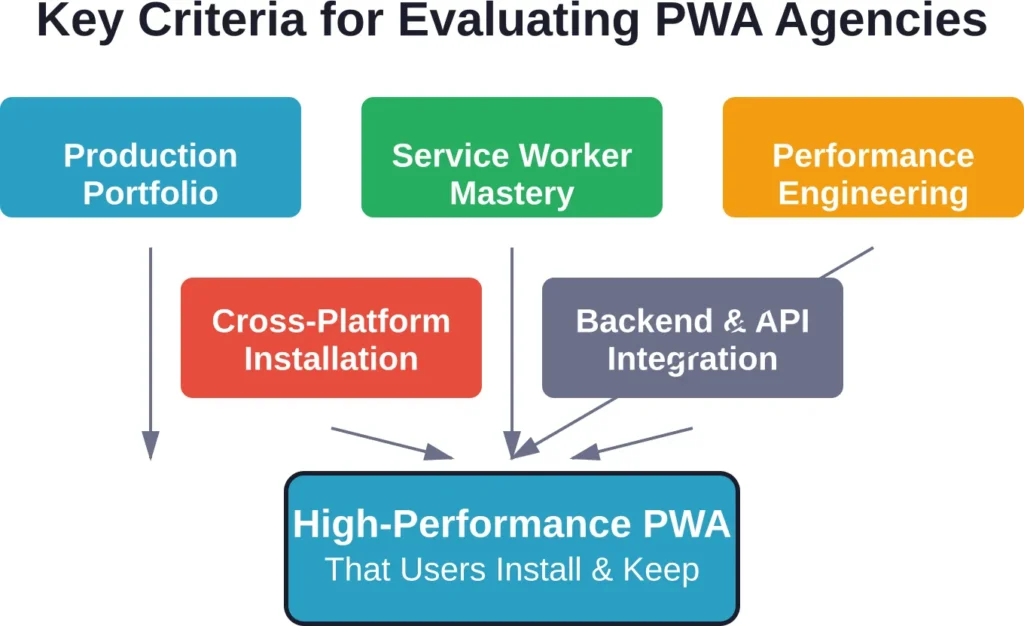
Here’s what separates competent PWA agencies from the rest.
Production PWA Portfolio
The agency should show you live PWAs they’ve shipped. Not mockups. Not prototypes. Apps that real users installed, that handled real traffic, that survived in production for months or years.
Ask for URLs. Install the apps. Check their Lighthouse scores. Test them offline. See if they launch instantly when you tap the home screen icon.
Service Worker Expertise
Service workers are the hardest part of PWA development. They run in a separate thread, intercept network requests, manage caches, and handle background sync. Debugging them requires specialized knowledge.
Strong agencies have engineers who understand the service worker lifecycle, know when to use cache-first versus network-first strategies, and can implement effective cache invalidation without breaking the app.
Performance Engineering
Progressive web apps live or die on performance. Users expect instant loading. Authoritative sources note that developers spend more than 17 hours each week on maintenance and fixing bad code, roughly 42 percent of their time.
The right agency builds performance into the architecture from day one. Code splitting. Lazy loading. Image optimization. Critical CSS inlining. Resource hints. They measure Core Web Vitals and treat them as non-negotiable requirements.
Cross-Platform Installation Knowledge
Getting a PWA to install smoothly on iOS, Android, Windows, macOS, and ChromeOS requires different techniques for each platform. Safari doesn’t support some features that Chrome does. Android’s install flow differs from desktop.
Experienced agencies know these platform quirks. They configure manifests correctly, handle install prompts gracefully, and test installation flows on every major browser and OS combination.
Backend and API Integration
PWAs need backends. Whether that’s a REST API, GraphQL endpoint, Firebase, Supabase, or a custom Node.js server, the agency should have backend engineers who can design APIs that work well with offline-first architectures.
They should understand background sync, conflict resolution when offline edits sync back to the server, and how to structure data for efficient caching.
The 15 Best Progressive Web App Development Companies
These agencies have shipped multiple progressive web apps to production, maintained them through real traffic, and built technical infrastructure that keeps them fast and reliable.
1. Gilzor

Gilzor builds custom digital products with a strong emphasis on progressive web apps for startups, SMBs, and product studios. They focus on creating scalable web solutions that work seamlessly across devices and deliver excellent user experiences.
Their process includes idea validation, business analysis, UI/UX design, full-cycle web development, and go-to-market support. They prioritize secure, high-performance applications with modern architecture and ongoing maintenance.
The engineering team excels at web development paired with user-centric design and quality assurance. They deliver functional, attractive products that connect effectively with target audiences while supporting automation and process improvements.
Best for: Startups and growing businesses that need PWAs to validate ideas quickly, scale operations, and reach users through reliable, conversion-focused web applications.
Contact Information:
- Website: www.gilzor.com
- Email: [email protected]
- Address: Poland, Warsaw, Office 58, street Adama Mickiewicza 37, 01-625
- LinkedIn: www.linkedin.com/company/gilzor-softwaredevelopment
2. Lengreo

Lengreo serves as a complete marketing and tech partner, delivering progressive web apps that drive lead generation and business growth for B2B companies. They combine website development with digital strategy to create fast, engaging web experiences that convert.
Their approach focuses on building high-performance websites and landing pages optimized for search visibility, user engagement, and offline capabilities. They emphasize discovery, prototyping, and ongoing optimization to ensure PWAs deliver measurable ROI through better conversion rates and qualified leads.
The team handles full-cycle development including business analysis, design implementation, quality assurance, and post-launch support. They integrate SEO, content strategy, and lead generation tactics directly into the PWA to maximize reach and results.
Best for: Companies seeking PWAs that combine strong technical performance with marketing-driven growth and lead generation capabilities.
Contact Information:
- Website: Lengreo.com
- Phone: +31 686 147 566
- Email: [email protected]
- Address: Vrijstraat 9 C/D, 5611 AT Eindhoven, Netherlands
- LinkedIn: Lengreo
- Twitter: @Lengreo
- Instagram: @lengreo
3. A-listware

A-listware provides software development and consulting services with proven capabilities in building progressive web apps. They deliver high-quality, responsive digital solutions through dedicated teams and full-cycle development.
Their expertise covers frontend and backend technologies, cloud application development, UI/UX design, and enterprise integrations. They focus on creating secure, scalable web applications that integrate smoothly with existing systems.
The team offers end-to-end services including custom development, application maintenance, testing, and infrastructure support. They ensure seamless collaboration whether extending client teams or managing complete projects.
Best for: Enterprises, SMBs, and startups needing reliable PWA development with strong technical execution, team augmentation, and long-term support.
Contact Information:
- Website: a-listware.com
- Phone: +1 (888) 337 93 73
- Email: [email protected]
- Address: North Bergen, NJ 07047, USA
- LinkedIn: www.linkedin.com/company/a-listware
- Facebook: www.facebook.com/alistware
4. Mobian
Mobian builds dedicated engineering teams specializing in progressive web apps and full-stack digital solutions for IT, healthcare, fintech, and logistics companies. They deliver production-ready software through outsourcing or outstaffing models.
Their approach emphasizes clean architecture, scalable systems, and end-to-end delivery from design to post-launch support. They create PWAs that handle real-world demands including legacy integrations and high user loads.
The team combines mobile-first thinking with web technologies to build fast, reliable applications. They maintain high standards in code quality, documentation, and ongoing partnership after deployment.
Best for: Companies in regulated or high-growth industries that require senior-level PWA development with dedicated teams and scalable architecture.
Contact Information:
- Website: mobian.studio
- Phone: [email protected]
- Address: Harju maakond, Tallinn, Kesklinnalinnaosa, Masina tn 22, 10113
- LinkedIn: www.linkedin.com/company/mobian-studio
5. Oski
Oski develops smart, well-engineered software solutions with expertise in progressive web apps for enterprises and ambitious startups. They specialize in frontend technologies that power responsive, high-performance web experiences.
Their technical approach combines modern frontend frameworks with cloud infrastructure, AI integrations, and robust architecture. They deliver scalable solutions optimized for industries including e-commerce, fintech, logistics, and travel.
The team manages the complete development lifecycle—from design and implementation to deployment and maintenance. They emphasize intuitive user interfaces, seamless performance, and solutions that adapt to business growth.
Best for: Tech-forward enterprises and startups requiring PWAs with strong frontend capabilities, cloud scalability, and industry-specific functionality.
Contact Information:
- Website: oski.site
- Phone: +48571282759
- Email: [email protected]
- Address: Kaupmehe tn 7, 10114 Tallinn, Estonia
- LinkedIn: www.linkedin.com/company/oski-solutions
6. Fortunesoft IT Innovations

Fortunesoft operates as an offshore development partner for companies in North America and Europe. They provide dedicated development teams that work as an extension of the client’s engineering organization.
Their PWA practice focuses on building custom business applications—CRMs, project management tools, inventory systems, booking platforms. These aren’t consumer apps but internal and B2B tools that need to work reliably.
The technical stack varies by project but centers around React and Vue.js for front ends, with Node.js, PHP, or Python backends. They work within clients’ existing technology choices rather than imposing their own preferences.
Fortunesoft structures engagements as dedicated teams rather than fixed-price projects. Clients get 2-8 engineers who work exclusively on their PWA for months or years.
Best for: Companies that need a dedicated offshore team to build and maintain custom business applications as progressive web apps.
7. Neoteric
Neoteric is a Polish software house that builds progressive web apps for European startups and scale-ups. They focus on fintech, health tech, and marketplace platforms.
Their process emphasizes product strategy and user research before any code gets written. They conduct user interviews, map customer journeys, and validate assumptions with prototypes.
On the technical side, Neoteric uses React with TypeScript as their standard stack. They implement automated testing, continuous integration, and infrastructure-as-code from project start.
The team stays small and senior. Most engineers have 5-10 years of experience. They avoid junior developers on client projects.
Best for: European startups that want a senior team focused on product success, not just code delivery.
8. RedBlink Technologies
RedBlink builds progressive web apps for clients across healthcare, education, real estate, and logistics. They operate as a mid-size agency with both onshore and offshore development capacity.
Their PWA work emphasizes mobile-first design and offline functionality. They build apps that work smoothly on slower networks and cache intelligently for offline use.
The engineering team works with React, Angular, and Vue.js depending on project requirements. They pair front-end work with cloud infrastructure—typically AWS or Google Cloud—and handle DevOps and deployment automation.
RedBlink provides ongoing support and maintenance after launch. They monitor performance, fix bugs, and release updates on a regular schedule.
Best for: Mid-market companies that need a reliable agency to build and maintain PWAs with strong mobile performance.
9. Sphinx Solutions

Sphinx Solutions focuses on progressive web apps for media, entertainment, and content businesses. They’ve built news apps, video platforms, and community sites.
Their technical specialty is handling media-heavy applications efficiently. They implement smart image optimization, progressive video loading, and caching strategies that balance quality with bandwidth constraints.
The team uses modern JavaScript frameworks with headless CMS backends—Contentful, Sanity, Strapi. This architecture lets content teams publish without developer involvement while maintaining fast performance.
Sphinx Solutions also handles push notification strategies for content apps. They help clients design notification systems that drive engagement without annoying users.
Best for: Media and content companies that need PWAs optimized for delivering text, images, and video efficiently.
10. iTechnolabs

iTechnolabs operates as a full-service mobile and web development agency with growing PWA expertise. They work with clients in healthcare, finance, retail, and logistics.
Their approach emphasizes thorough planning and documentation. They create detailed technical specifications, wireframes, and user flows before development starts.
The development team works across multiple technologies—React, Angular, Vue.js, Flutter for web. They also build hybrid apps using frameworks like Ionic when clients need both PWA and native app versions.
iTechnolabs provides flexible engagement models. Clients can hire dedicated teams, work on fixed-price projects, or pay hourly for smaller engagements.
Best for: Companies that want flexible engagement options and a development partner that can handle both PWAs and native mobile apps.
11. Simpalm

Simpalm specializes in enterprise PWA development for companies that need secure, scalable applications. Based in Maryland with offices in Chicago and Washington DC, they’ve built progressive web apps for healthcare, finance, and government clients.
Their technical approach emphasizes security and compliance. They architect PWAs that meet HIPAA requirements, handle sensitive financial data, and integrate with legacy enterprise systems.
The team works with React, Angular, and Vue.js on the front end, typically paired with Node.js or .NET backends. They implement robust authentication, encrypted data storage, and audit logging as standard features.
Simpalm handles the full development lifecycle—requirements gathering, architecture design, development, testing, deployment, and ongoing maintenance. They assign dedicated project managers and maintain transparent communication throughout.
Best for: Enterprise clients who need PWAs that integrate with existing systems and meet regulatory compliance requirements.
12. Monocubed

Monocubed builds progressive web apps for startups and mid-market companies launching new digital products. They focus on rapid development cycles and iterative releases.
Their process starts with a product workshop where they help clients define core features, prioritize the roadmap, and identify technical risks. Then they build an MVP in 8-12 weeks, release it to beta users, and iterate based on real usage data.
The engineering team uses modern JavaScript frameworks—primarily React and Next.js—combined with headless CMS systems and serverless backends. This stack allows them to ship features quickly while keeping infrastructure costs low.
Monocubed emphasizes product thinking alongside technical execution. They push back on feature requests that don’t serve users and suggest alternatives backed by UX research and analytics.
Best for: Startups and growing companies that need to validate product-market fit quickly with a well-engineered PWA.
13. EvinceDev
EvinceDev operates as a full-service digital agency with strong PWA capabilities. They combine development, design, and digital marketing under one roof.
Their PWA work focuses on e-commerce and content platforms. They’ve built shopping experiences that work offline, media apps with smart caching strategies, and content hubs that load instantly.
The technical team uses Vue.js and Nuxt.js for most projects, paired with REST or GraphQL APIs. They implement sophisticated caching strategies that balance freshness with offline capability.
EvinceDev also handles SEO and performance optimization post-launch. They monitor Core Web Vitals, fix performance regressions, and optimize conversion funnels based on real user behavior.
Best for: E-commerce businesses and content platforms that need PWAs optimized for both user experience and search rankings.
14. Innowise

Innowise is a European software development company with deep expertise in complex web applications. They build PWAs for clients in logistics, manufacturing, and enterprise SaaS.
Their projects typically involve integrating the PWA with multiple backend systems—ERPs, CRMs, IoT platforms, analytics engines. They excel at building the middleware layer that connects everything smoothly.
The team works with Angular for front-end development, often combined with TypeScript for type safety across large codebases. Backend work spans Node.js, Python, and Java depending on client infrastructure.
Innowise assigns dedicated technical architects to each project. These architects define the system design, review code, and ensure engineering best practices throughout development.
Best for: Mid-size and enterprise companies with complex system integration requirements and large-scale PWA deployments.
15. Angular Minds
As the name suggests, Angular Minds specializes in Angular development, including progressive web apps built on the Angular framework.
They’ve built PWAs for SaaS platforms, internal business tools, and customer portals. Their sweet spot is data-heavy applications with complex user interfaces—dashboards, admin panels, workflow management systems.
The team uses Angular with RxJS for reactive programming, paired with NgRx for state management in complex applications. They implement comprehensive testing with Jasmine and Karma.
Angular Minds emphasizes code quality and maintainability. They follow strict coding standards, conduct peer code reviews, and document architecture decisions thoroughly.
Best for: Companies that have already chosen Angular as their framework or need PWAs with complex, data-rich interfaces.
How to Choose the Right PWA Development Partner
Picking an agency from a list is the easy part. Picking the right agency requires understanding what your project actually needs.
Define Your Technical Requirements First
Before you contact any agency, document what your PWA needs to do. Not features—technical requirements.
Does it need to work offline? How much data should it cache? What’s the target load time? Which browsers and devices must it support? Does it integrate with existing APIs or services? What authentication system will it use?
Agencies can’t give you accurate proposals without this information. Vague briefs lead to mismatched expectations and scope creep.
Check Their Portfolio for Similar Projects
An agency that built five e-commerce PWAs won’t necessarily excel at building a data-heavy enterprise dashboard. The technical challenges differ.
Look for portfolio projects that match your domain and complexity level. If they’ve solved similar problems before, they’ll solve yours faster and with fewer surprises.
Evaluate Their Technical Stack
Ask which frameworks, libraries, and tools they use. Do those choices align with your requirements and constraints?
If your team already uses React, hiring an Angular-focused agency creates friction. If you need server-side rendering for SEO, the agency should have Next.js or Nuxt.js experience.
Technical stack matters. It determines how easy the PWA will be to maintain, extend, and hand off to your internal team later.
Understand Their Process
How do they handle requirements gathering? What does their typical sprint look like? How often will you see working software? How do they handle change requests and scope adjustments?
Agencies with mature processes document everything, communicate proactively, and deliver on predictable schedules. Agencies without processes ship late, miss requirements, and blame the client.
Ask About Post-Launch Support
Progressive web apps need ongoing maintenance. Browsers update. Dependencies need security patches. Performance regressions appear. Users report bugs.
Does the agency provide support after launch? What does that support include? How quickly do they respond to critical issues?
Some agencies only do project work and disappear after delivery. Others offer retainer-based support with guaranteed response times. Know which you’re getting before you sign.
Verify Their Testing Practices
PWAs have more testing surface area than traditional web apps. They need to work across browsers, devices, network conditions, and online/offline states.
Strong agencies implement automated testing—unit tests, integration tests, end-to-end tests. They test on real devices, not just emulators. They use tools like Lighthouse, WebPageTest, and real user monitoring.
Ask candidates how they test. The answer tells you whether they ship quality code or fire-and-forget.
| Selection Criterion | What to Look For | Red Flags |
|---|---|---|
| Portfolio | Live PWAs in production, similar to your project | Only mockups or outdated examples |
| Technical Stack | Modern frameworks, matches your needs | Outdated libraries or unfamiliar tech |
| Process | Documented workflow, clear communication | Vague methodology or no process at all |
| Testing | Automated tests, real device testing | Manual-only testing or no testing plan |
| Support | Defined SLA, ongoing maintenance options | No post-launch support offered |
| References | Recent clients willing to speak with you | No references or only old projects |
Common PWA Development Challenges and How Top Agencies Handle Them
Building progressive web apps involves recurring technical challenges. Here’s how experienced agencies solve the hard problems.
Service Worker Cache Management
Service workers cache assets and API responses to enable offline functionality. But caching everything bloats storage and slows updates. Caching nothing defeats the purpose.
Strong agencies implement tiered caching strategies. Critical assets—HTML, CSS, JavaScript, fonts—get cached immediately and updated only when the app version changes. Dynamic content uses cache-then-network strategies with time-based invalidation. Large media files stream from the network but cache on demand.
They also implement cache versioning. When the app updates, old caches get cleared automatically. This prevents users from seeing stale content after an update.
iOS Installation Limitations
Safari on iOS doesn’t support some PWA features that Chrome does. The installation experience differs. Push notifications work differently. Background sync isn’t available.
Experienced agencies work within these constraints. They implement graceful degradation—the PWA works everywhere but provides enhanced features on platforms that support them. They design custom install prompts for iOS since the browser-native prompt behaves differently than on Android.
Offline Data Synchronization
When users make changes offline, those changes need to sync back to the server once connectivity returns. But what if the server data changed while the user was offline? Conflicts happen.
Top agencies implement conflict resolution strategies appropriate to the application. Some use last-write-wins for simple cases. Others implement operational transforms or CRDTs for collaborative applications. They design the data model to minimize conflicts in the first place.
Performance Budgets
Progressive web apps need to load fast—ideally under two seconds on 3G networks. That requires aggressive optimization.
Strong agencies set performance budgets during architecture design. They choose lightweight frameworks, implement code splitting, optimize images, minimize third-party scripts, and use CDNs. They measure performance continuously during development and treat budget violations as bugs.
Push Notification Strategy
Push notifications can drive engagement or annoy users into uninstalling. The difference is strategy.
Good agencies help clients design notification systems that provide value—order updates, important alerts, relevant reminders. They implement frequency caps, respect user preferences, and provide granular control over notification types. They test notification copy and timing to maximize engagement without causing annoyance.
Technical Considerations When Building a Progressive Web App
Progressive web apps sit at the intersection of web and mobile. That creates unique technical requirements.
Framework Selection
React, Vue, and Angular all work for PWA development. Each has trade-offs.
React offers the largest ecosystem and the most third-party libraries. Vue provides a gentler learning curve and cleaner syntax. Angular includes more features out of the box—routing, state management, HTTP client—but requires steeper onboarding.
For most projects, the framework matters less than the team’s expertise with it. A skilled Angular team will ship faster than a mediocre React team, regardless of framework advantages.
State Management
Progressive web apps need robust state management because they handle offline scenarios, background sync, and complex user interactions.
Redux remains popular for React applications. Vuex serves Vue apps. NgRx handles Angular projects. These libraries provide predictable state containers, time-travel debugging, and clean separation between UI and business logic.
For simpler applications, built-in state management—React Context, Vue Composition API, Angular Services—often suffices without additional dependencies.
Backend Architecture
PWAs need APIs. The backend architecture determines performance, scalability, and development velocity.
REST APIs work well for simple CRUD operations. GraphQL shines when clients need flexible data fetching and multiple related resources. Firebase and Supabase provide backend-as-a-service with real-time sync, authentication, and storage built in.
For complex applications with existing backend systems, building a dedicated API layer that optimizes for PWA requirements often makes sense.
Authentication and Security
Progressive web apps handle sensitive data and need secure authentication. JWT tokens stored in memory prevent XSS attacks. HttpOnly cookies protect against JavaScript access. OAuth2 and OpenID Connect provide standard authentication flows.
HTTPS is mandatory—service workers only work over secure connections. Content Security Policy headers prevent injection attacks. Subresource Integrity ensures third-party scripts haven’t been tampered with.
Analytics and Monitoring
Progressive web apps need monitoring that tracks both web and app-like behaviors. Install rates, engagement metrics, offline usage, service worker errors, and performance metrics all matter.
Google Analytics works but wasn’t designed for PWAs. Tools like Firebase Analytics, Amplitude, and Mixpanel handle app-style events better. Performance monitoring requires Real User Monitoring solutions that track Core Web Vitals, service worker performance, and offline reliability.
Cost Considerations for PWA Development
Progressive web app development costs vary widely based on complexity, features, and the agency selected.
Project Scope Drives Cost
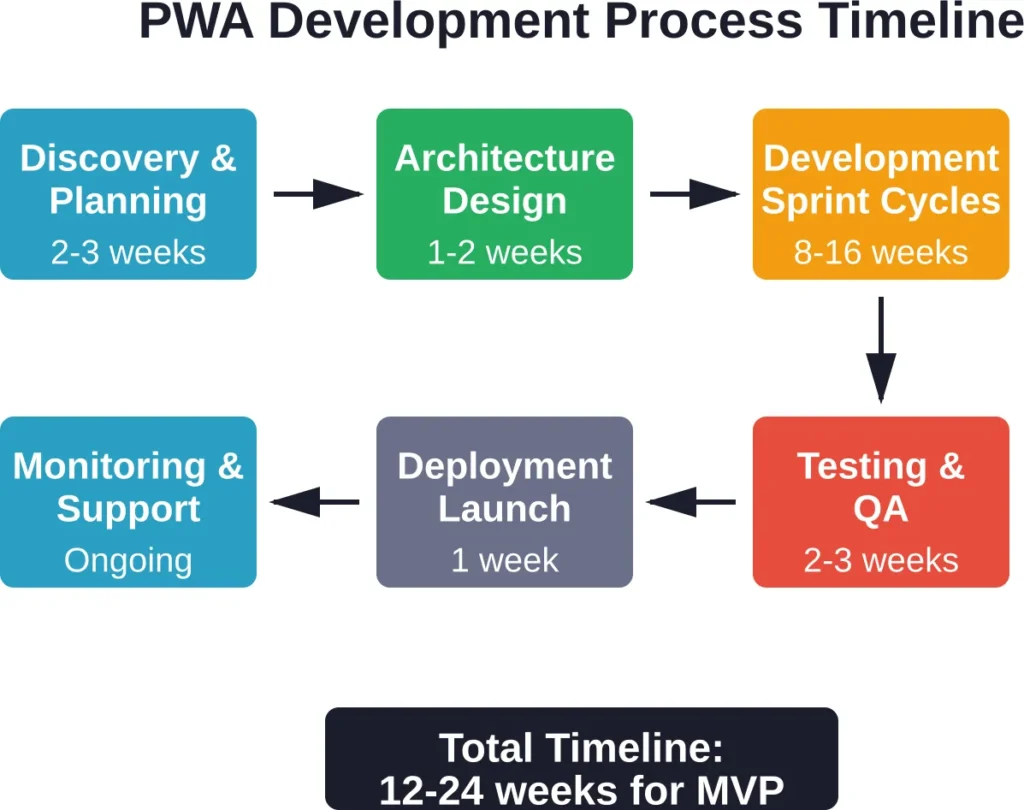
A simple content-based PWA with offline reading and push notifications might take 6-8 weeks. A complex e-commerce platform with inventory management, payment processing, and personalization might take 6-9 months.
The feature set determines timeline, which determines cost. Defining scope clearly before development starts prevents budget overruns.
Offshore vs. Nearshore vs. Onshore
Agency location affects rates significantly. Eastern European agencies typically charge less than Western European ones. Asian offshore teams offer lower rates but may face communication and timezone challenges.
Onshore agencies in the US or Western Europe command premium rates but provide easier collaboration, no timezone friction, and often faster development cycles.
The right choice depends on project complexity and the importance of real-time collaboration. Simple projects with clear requirements work well offshore. Complex projects with evolving requirements benefit from closer collaboration.
Fixed Price vs. Time and Materials
Fixed-price projects work when scope is clear and unlikely to change. The agency estimates total cost upfront and delivers the defined scope.
Time-and-materials engagements charge based on actual hours worked. This model provides flexibility for changing requirements but requires more client oversight.
Many agencies use hybrid models—fixed price for initial phases, time-and-materials for subsequent iterations and enhancements.
Ongoing Maintenance Costs
Progressive web apps require ongoing maintenance—bug fixes, security updates, browser compatibility fixes, feature enhancements, performance optimization.
Agencies typically offer maintenance retainers with guaranteed response times and monthly hour allocations. Retainer costs depend on support level, response time commitments, and expected maintenance volume.
Budgeting for maintenance from the start prevents surprises when the PWA needs updates after launch.
Questions to Ask Potential PWA Development Agencies
Schedule calls with 3-5 candidate agencies. Ask these questions to evaluate fit.
About Their Experience
- How many PWAs have you built and launched to production?
- Can you show me live examples similar to what we’re building?
- What’s the most complex PWA project you’ve completed?
- Have you worked in our industry before?
About Their Process
- How do you handle requirements gathering and project scoping?
- What does your typical sprint cycle look like?
- How often will we see working software?
- How do you handle change requests and scope adjustments?
- What project management and communication tools do you use?
About Technical Approach
- Which frameworks and tools do you recommend for our project and why?
- How do you handle offline functionality and data synchronization?
- What’s your approach to testing PWAs across devices and browsers?
- How do you ensure performance meets our requirements?
- What analytics and monitoring tools do you implement?
About Team and Resources
- Who will be assigned to our project and what are their experience levels?
- Will we work with a dedicated team or shared resources?
- How do you handle team members leaving during the project?
- What’s your team’s availability and timezone coverage?
About Post-Launch
- What support do you provide after launch?
- How quickly do you respond to critical issues?
- What’s included in your maintenance retainers?
- Will you provide documentation and knowledge transfer?
- Can you train our internal team to maintain the PWA?
Progressive Web Apps vs. Native Apps: When to Choose PWA Development
Progressive web apps aren’t always the right choice. Native apps sometimes make more sense.
PWAs Excel For
Content and media applications work brilliantly as PWAs. News sites, blogs, video platforms, and streaming services benefit from instant loading, offline reading, and the ability to update content without app store submissions.
E-commerce platforms see strong results with PWAs. Users can browse and purchase without downloading an app. The reduced friction increases conversion rates. Several major retailers report higher engagement and sales after launching PWAs.
Internal business tools—CRMs, project management, inventory systems, dashboards—work well as PWAs. Employees can access them from any device without installation. Updates deploy instantly to everyone.
Native Apps Work Better For
Games and graphics-intensive applications need native performance. While WebGL and WebAssembly improve, native graphics APIs still provide better performance and battery efficiency.
Apps that require deep platform integration—accessing Bluetooth, NFC, advanced camera features, or system-level permissions—often need native development. PWAs are gaining capabilities but don’t match native access yet.
Applications where discoverability through app stores matters significantly might favor native. While PWAs work on app stores now, native apps still have stronger discovery mechanisms.
Hybrid Approach
Some companies build both. They launch a PWA for broad reach and web distribution, then wrap it in a native shell for app store distribution. Tools like Capacitor and Cordova enable this approach.
This strategy provides web-based development velocity with app store presence. But it adds complexity—you’re essentially maintaining both web and native versions.
| Factor | Choose PWA | Choose Native |
|---|---|---|
| Installation friction | Users resist downloading apps | Target users expect native apps |
| Update frequency | Need instant updates without review | Infrequent updates acceptable |
| Platform features | Standard web APIs sufficient | Need advanced platform access |
| Performance needs | Standard UI and interactions | Graphics-intensive or realtime |
| Development resources | Web development team available | Native developers on staff |
| Cross-platform reach | Need to support all platforms equally | Focus on iOS or Android primarily |
The Future of Progressive Web App Development
Progressive web apps continue gaining capabilities that close the gap with native applications.
Emerging Capabilities
Web APIs keep expanding. File System Access API lets PWAs read and write files. Web Bluetooth enables device connectivity. WebUSB connects to USB peripherals. Web NFC handles contactless interactions.
These APIs transform what PWAs can do. Applications that once required native development work as web apps now.
Improved iOS Support
Apple historically lagged in PWA support. That’s changing. Recent iOS versions added push notifications for PWAs, better offline storage, and improved installation prompts.
As iOS support improves, PWAs become more viable for consumer applications where iPhone users represent significant market share.
App Store Integration
Major app stores now accept PWAs. Microsoft Store, Google Play, and Samsung Galaxy Store all support progressive web apps. This removes the distribution barrier that once favored native development.
Developers can build one codebase and distribute through web URLs, direct installation, and app stores simultaneously.
Better Developer Tools
Frameworks and tools continue improving. Workbox simplifies service worker implementation. PWA Builder generates manifest files and store packages. Framework-specific tools like Next.js and Nuxt.js include PWA features out of the box.
These improvements reduce the specialized knowledge required to build high-quality PWAs.
Frequently Asked Questions
Timeline depends on complexity and feature scope. Simple content-based PWAs with basic offline functionality typically take 6-10 weeks from requirements to launch. Mid-complexity applications with user accounts, data management, and custom features run 12-20 weeks. Complex platforms with extensive integrations, advanced functionality, and custom infrastructure can take 6-12 months. These timelines assume working with an experienced agency that has established processes and doesn’t need to learn PWA development during your project.
Yes, but with limitations. PWAs can cache all UI assets, application code, and static content for full offline functionality. Dynamic content requires connectivity initially but can be cached for offline access later. Applications can queue user actions taken offline and sync them when connectivity returns. However, features requiring real-time server interaction—payment processing, real-time chat, live data feeds—need network connectivity. The key is designing intelligent caching strategies that maximize offline utility while maintaining data accuracy.
Progressive web apps work across all modern browsers—Chrome, Edge, Firefox, Safari—and all major operating systems including Windows, macOS, Linux, Android, and iOS. However, feature support varies. Chrome and Edge offer the most complete PWA support. Safari has more limitations but has improved significantly in recent versions. The progressive enhancement approach means PWAs provide basic functionality everywhere and enhanced features where supported. Experienced agencies test across browsers and implement fallbacks for unsupported features.
Development costs vary based on scope, complexity, agency location, and engagement model. Without disclosing specific rates, typical projects fall into ranges. Simple PWAs with basic features might require a few thousand dollars. Mid-complexity applications with user management, data storage, and custom features run higher. Enterprise PWAs with complex integrations, advanced functionality, and extensive customization cost more. Geographic location affects rates—offshore agencies charge less than onshore ones. Get detailed proposals from multiple agencies and compare based on scope, timeline, and deliverables rather than just total cost.
Responsive websites adapt their layout to different screen sizes but remain traditional web pages. Progressive web apps go further—they install to the device home screen, work offline, send push notifications, access device hardware, and launch in standalone mode without browser UI. PWAs use service workers to cache resources and enable offline functionality. They include manifest files that define how the app appears when installed. While responsive websites require network connectivity and browser chrome, PWAs feel like native applications with instant loading and app-like interactions.
Yes, existing websites can become PWAs by adding PWA features incrementally. The process involves implementing a service worker for caching and offline functionality, creating a web app manifest for installation and branding, ensuring HTTPS throughout the site, optimizing performance to meet PWA standards, and adding features like push notifications. The complexity depends on the current website architecture. Modern JavaScript frameworks make conversion easier. Legacy websites with server-rendered HTML might require more significant refactoring. Most agencies recommend starting with core PWA features and adding advanced capabilities iteratively based on user needs.
Progressive web apps can be distributed through multiple channels simultaneously. Users can discover them through search engines and access them via URL like any website. They can install PWAs directly from the browser using install prompts. Additionally, PWAs can be packaged and submitted to app stores—Google Play, Microsoft Store, and Samsung Galaxy Store all support PWAs. Apple’s App Store has stricter requirements but accepts PWAs wrapped in native containers. This multi-channel distribution provides broader reach than native apps limited to single stores. Agencies experienced in PWA development handle the packaging and submission process for app store distribution.
Conclusion
Progressive web apps combine the best aspects of web and mobile development—broad reach, instant updates, offline capability, and app-like user experiences. But the technology stack is complex, and building PWAs that actually perform requires specialized expertise.
The 15 agencies profiled here have proven track records in PWA development. They’ve shipped applications to production, handled real traffic, and solved the hard technical problems that sink inexperienced teams.
The right agency for your project depends on your specific needs. Enterprise clients with compliance requirements fit well with Simpalm. Startups needing rapid MVP launches should consider Monocubed. E-commerce businesses benefit from EvinceDev’s SEO expertise. Media companies match well with Sphinx Solutions.
Start by defining your technical requirements clearly. Document what your PWA needs to do, which platforms it must support, and what performance targets it must hit. Then evaluate agencies based on relevant portfolio work, technical stack alignment, and process maturity.
Schedule calls with 3-5 candidates. Ask about their experience with similar projects, their development process, their technical approach, and their post-launch support. Request references and check them.
Progressive web apps represent the future of cross-platform development. Finding the right agency partner determines whether your PWA delivers the speed, reliability, and user experience that modern users expect. Choose carefully, define scope clearly, and you’ll ship a PWA that works.
Ready to start your PWA project? Review the agencies listed here, evaluate them against your requirements, and begin conversations with the ones that fit best. The sooner you find the right partner, the sooner you can ship your progressive web app to users.