

Quick Summary: Structural steel detailing is the technical process of creating precise shop drawings, fabrication plans, and 3D models that translate engineering designs into buildable instructions for steel fabricators and erectors. It specifies exact dimensions, connections, welds, bolts, and assembly sequences for every steel member in a structure. This critical step bridges the gap between architectural vision and on-site construction, ensuring accuracy, safety, and efficiency in steel building projects.
Walk onto any commercial construction site and you’ll see steel frameworks rising into the sky. But here’s the thing—none of those beams, columns, or connections got there by accident.
Between the engineer’s structural calculations and the erector’s crane sits a critical step most people never hear about: structural steel detailing.
It’s not design. It’s not engineering. It’s the precise, technical translation that turns conceptual plans into fabrication-ready instructions. Without it, fabricators wouldn’t know what to cut, welders wouldn’t know where to attach, and erectors wouldn’t know how to assemble.
So what exactly is structural steel detailing, and why does it matter so much?
What Steel Detailing Actually Is
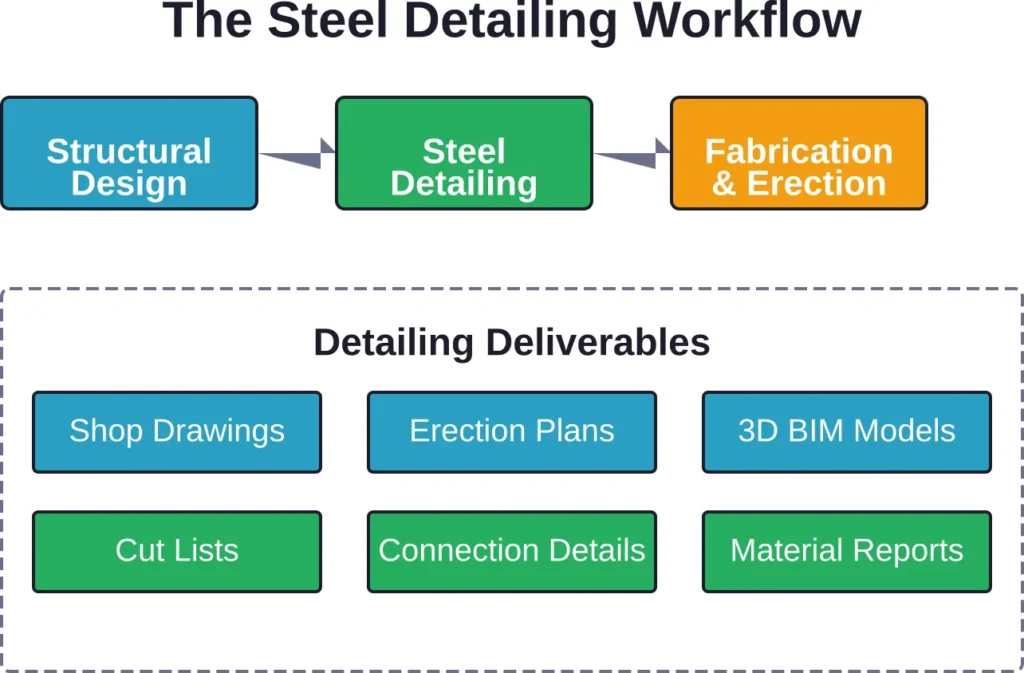
Structural steel detailing is the production of detailed plans and drawings for steel fabricators and erectors. These documents—commonly called shop drawings and erection plans—provide every measurement, material specification, bolt location, weld type, and assembly sequence needed to fabricate and install steel components.
A steel detailer takes the structural engineer’s design drawings (which show loads, member sizes, and connection types) and creates comprehensive fabrication documents that answer questions like:
- What’s the exact length of each beam after accounting for connection material?
- Where do bolt holes get drilled, and at what diameter?
- What weld sizes and types connect this gusset plate?
- How do pieces get marked for identification on-site?
- In what sequence should members be erected?
The engineer says “use a W12x50 beam with a bolted connection.” The detailer specifies that beam is 23 feet 7⅜ inches long, requires eight ¾-inch diameter A325 bolts in a specific pattern, connects to a ⅜-inch plate, and gets marked as piece B-47.
That level of precision makes the difference between steel that fits perfectly and costly field delays.
Why Structural Steel Detailing Matters
Real talk: engineering designs alone aren’t buildable. They show the structural concept, but fabrication shops need dimension-specific instructions. Detailing fills that gap.
Here’s what happens without proper detailing:
- Fabricators guess at dimensions and connections, leading to misfit pieces
- Field crews spend hours figuring out assembly sequences instead of working
- Bolt holes don’t align, requiring expensive on-site modifications
- Material gets wasted because cut lists weren’t optimized
- Safety risks increase when connection details are ambiguous
According to OSHA’s Safety Standards for Steel Erection (published January 18, 2001, effective July 18, 2001), a ‘critical lift’ is defined as a lift that exceeds 75% of the rated capacity of the crane or derrick, or requires the use of more than one crane or derrick. Proper detailing documentation supports safe execution of such operations.
Detailing also enables coordination. It catches clashes between steel and other building systems (mechanical, electrical, architectural) before fabrication begins. Finding a conflict in a 3D model costs time. Finding it on-site costs tens of thousands.
What a Steel Detailer Actually Does
A steel detailer is the person who produces detailed drawings for the manufacture and erection of steel structures. This isn’t drafting in the traditional sense—it requires deep understanding of steel behavior, connection design, fabrication methods, and construction sequencing.
Detailers work closely with structural engineers, fabricators, and general contractors. They interpret engineering drawings, apply industry standards (like AISC specifications), and create documents that are both technically accurate and practically buildable.
Core Responsibilities
Steel detailers handle multiple technical tasks throughout a project:
- Model creation: Building 3D models of the steel structure in specialized software
- Shop drawing production: Generating detailed fabrication drawings for each steel member
- Connection design: Detailing how members connect (bolted, welded, or hybrid)
- Material takeoffs: Calculating exact quantities of steel, bolts, welds, and other materials
- Clash detection: Identifying conflicts with other building systems before fabrication
- Erection sequence: Planning the order in which steel gets assembled on-site
- RFI management: Coordinating with engineers when design clarifications are needed
The role demands fluency in industry standards. ASTM specifications define material properties—for example, ASTM A615 covers carbon-steel reinforcing bars; grades include Grade 40 [280], Grade 60 [420], and Grade 75 [520]. Detailers must know which standards apply to which components.
The Steel Detailing Process Step-by-Step
So how does a project actually move from engineering drawings to shop-ready documents? Here’s the typical workflow:
1. Receipt of Structural Drawings
The engineer provides structural plans showing member sizes, connection types, loads, and design intent. These are conceptual—they don’t include fabrication-level detail.
2. 3D Model Creation
Detailers build a complete 3D model of the steel structure using software like Tekla Structures, SDS/2, or Advance Steel. This model becomes the single source of truth for all subsequent drawings.
The model includes every beam, column, brace, plate, bolt, and weld. It’s georeferenced to match the building’s coordinate system.
3. Connection Detailing
Each connection gets designed in detail. For a typical beam-to-column moment connection, the detailer specifies:
- Plate dimensions and material grade
- Bolt quantity, size, grade, and spacing
- Weld types, sizes, and locations
- Stiffener requirements
- Clearance dimensions for field access
This is where NIST research on CIMsteel Integration Standards (CIS/2) becomes relevant. These standards, endorsed by the American Institute of Steel Construction, define how connection data gets exchanged electronically between detailing and fabrication systems.
4. Shop Drawing Generation
The software automatically generates shop drawings from the 3D model. Each drawing shows a single piece or assembly with all fabrication information: dimensions, material callouts, hole locations, weld symbols, and piece marks.
Shop drawings go to the fabrication shop, where they’re used to program cutting machines, drill presses, and welding stations.
5. Erection Drawing Creation
Erection plans show how steel gets assembled on-site. They include member locations, elevations, piece marks, and connection references. They’re organized by erection sequence—what goes up first, second, third.
These drawings are critical for crew safety and efficiency. Erectors use them to plan crane positions, lifting sequences, and temporary bracing.
6. Engineer Review and Approval
Before fabrication begins, the structural engineer reviews all shop drawings to verify they match design intent. This isn’t rubber-stamping—engineers check connection capacities, member orientations, and load paths.
Detailers incorporate any redlines or comments, then reissue for final approval.
7. Fabrication and Erection Support
As fabrication and construction proceed, detailers provide ongoing support: answering questions, issuing revisions, coordinating field changes, and updating the model to match as-built conditions.
Structural vs. Miscellaneous Steel Detailing
Not all steel detailing is the same. The industry draws a distinction between structural and miscellaneous steel.
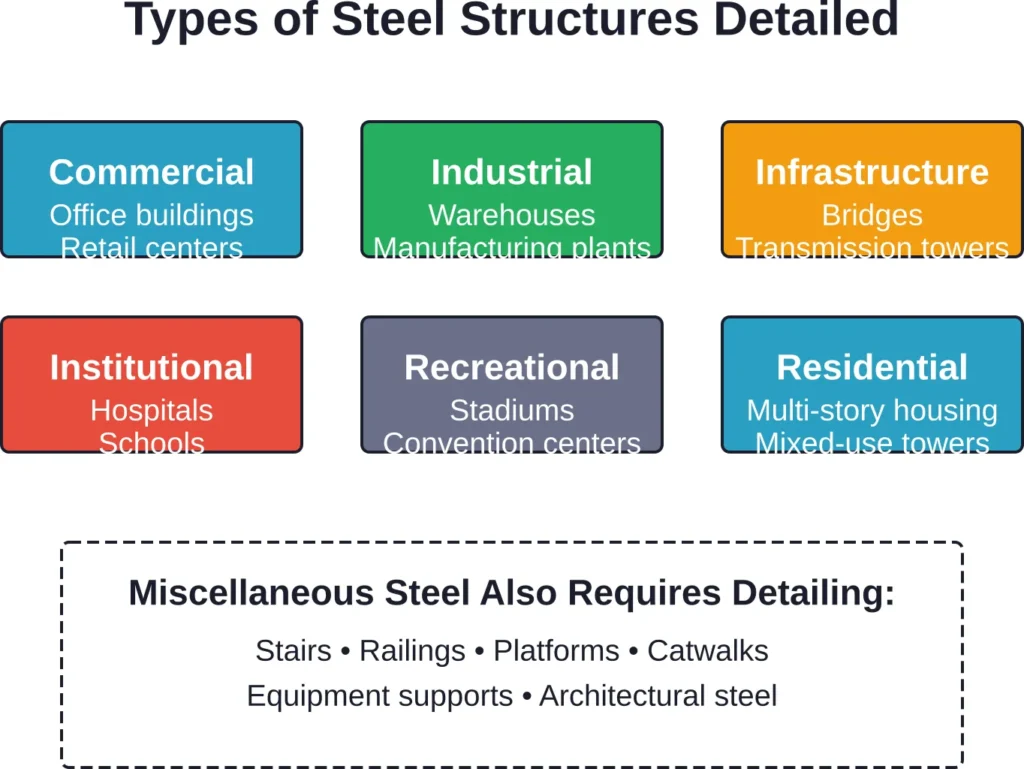
Structural steel refers to the primary load-bearing frame: columns, beams, braces, trusses, and the connections that make them work together. This is governed by strict engineering standards and building codes. Structural detailing focuses on member capacity, connection strength, and structural integrity.
Miscellaneous steel covers everything else: stairs, railings, platforms, ladders, lintels, embed plates, and ornamental elements. These items don’t carry primary building loads, but they still require precise detailing for fabrication and installation.
Miscellaneous steel often involves tighter architectural coordination. A stair tower needs to align with door openings, floor elevations, and handrail heights. The detailing is just as technical, but the focus shifts toward fit and finish.
Many detailers specialize in one category or the other, though larger firms handle both.
Software and Standards Detailers Use
Modern steel detailing is software-intensive. Hand drafting disappeared decades ago—today’s projects demand 3D modeling, automated drawing generation, and digital data exchange.
Primary Detailing Software
Three platforms dominate the structural steel detailing market:
- Tekla Structures: Industry-leading 3D modeling software with extensive connection libraries and automated drawing generation
- SDS/2: Widely used in North American fabrication shops, tightly integrated with CNC fabrication equipment
- Advance Steel: AutoCAD-based detailing solution popular in smaller firms
All three support Building Information Modeling (BIM), IFC file exchange, DXF/DWG compatibility, and DSTV data formats for CNC machines.
Industry Standards
Steel detailing isn’t freeform creativity—it follows established technical standards:
- AISC specifications: The American Institute of Steel Construction publishes design and detailing standards, connection manuals, and code requirements
- ASTM material standards: Define steel grades, mechanical properties, and testing procedures
- AWS welding standards: Specify weld types, sizes, inspection criteria, and symbols
- OSHA safety requirements: Govern erection safety, including documentation and planning mandates
- CIS/2 data standards: Enable digital data exchange between detailing and fabrication systems
According to research documented by NIST, the CIMsteel Integration Standards play a significant role in automating erection and surveying of constructional steelwork, reducing errors and improving efficiency.
What Makes Steel Detailing Complex
On the surface, detailing might sound straightforward: measure things and draw them. But the reality is far more nuanced.
Connection Design Challenges
Connections are where detailing gets tricky. A simple beam-to-column connection might involve moment capacity calculations, bolt spacing rules, edge distance requirements, weld accessibility, and clearance for erection bolts.
Detailers must balance structural requirements (what the engineer needs for strength) with fabrication constraints (what the shop can actually build) and erection practicality (what the field crew can safely install).
Tolerance Management
Steel fabrication works to tight tolerances—often ±⅛ inch. But buildings aren’t that precise. Concrete foundations shift. Floor slabs vary in elevation. Columns aren’t perfectly plumb.
Detailers build in adjustment mechanisms: slotted holes, shim spaces, field-weld locations. They must anticipate where flexibility is needed without compromising structural performance.
Multi-Discipline Coordination
Steel doesn’t exist in isolation. It shares space with ductwork, electrical conduit, plumbing, fire protection, and architectural features.
Detailers coordinate with other trades to avoid conflicts. A beam might need a web penetration for a duct. A column might need an embed plate for a future curtain wall attachment. These don’t show up on structural drawings—detailers must identify and detail them.
Project-Specific Requirements
Every project has unique conditions. Seismic zones require special connection detailing. High-rise buildings need construction sequencing for core-first or perimeter-first erection. Renovation projects must interface with existing structures.
Detailers adapt standard practices to project-specific demands, often developing custom connection solutions when standard details won’t work.
| Drawing Type | Primary User | Key Information Shown | Typical Scale |
|---|---|---|---|
| Shop Drawings | Fabrication shop | Member dimensions, hole locations, welds, material specs | ¾”=1′-0″ to 1½”=1′-0″ |
| Erection Plans | Field erection crew | Member locations, elevations, piece marks, sequences | ¼”=1′-0″ to ½”=1′-0″ |
| Anchor Bolt Plans | Concrete contractor | Bolt locations, projections, templates, tolerances | ½”=1′-0″ to 1″=1′-0″ |
| Connection Details | Engineer, fabricator | Plate sizes, bolt patterns, weld specifications | 1½”=1′-0″ to 3″=1′-0″ |
Get Structural Steel Detailing Support for Fabrication Projects

Structural steel detailing is used to prepare coordinated fabrication information for steel manufacturing and construction workflows. Powerkh supports detailing workflows with BIM modelling, shop drawings, and fabrication coordination services.
Need Structural Steel Detailing Support?
Talk with Powerkh to:
- prepare steel shop drawings and BIM models
- support fabrication and installation workflows
- improve coordination before production starts
- support delivery from design through fabrication
Review your structural steel detailing requirements with the Powerkh team.
How Detailing Impacts Project Success
Quality detailing shows up in project outcomes. When it’s done right, fabrication runs smoothly, steel arrives on-site ready to install, and erection proceeds on schedule.
When it’s done poorly, the consequences cascade:
- Field crews discover mismatched bolt holes and must drill new ones
- Members arrive at incorrect lengths, requiring return trips to the shop
- Connection capacities don’t match loads, triggering engineering re-design
- Clashes discovered during erection force last-minute workarounds
- Schedule delays compound, pushing out dependent trades
Research from Stanford’s Center for Integrated Facility Engineering explores how optimizing member sizing, detailing, and topology simultaneously can reduce costs while maintaining strength and serviceability requirements in large-scale steel structures.
The University of Tennessee’s work with AISC on interactive 3D connection models demonstrates how proper understanding of structural steel design—starting with accurate detailing—fundamentally shapes how effectively students and professionals can execute projects.
Career Path and Skills Required
Structural engineering technicians assist engineers in outlining designs, gathering data, performing graphic imaging, drawing sketches, and interpreting structural markups. They participate in the full project lifecycle from design through construction.
Becoming a skilled detailer typically requires:
- Technical education in drafting, structural technology, or civil engineering
- Proficiency in 3D modeling software (Tekla, SDS/2, or Advance Steel)
- Understanding of steel design principles and connection behavior
- Familiarity with AISC specifications and ASTM standards
- Knowledge of fabrication methods and erection procedures
- Strong spatial reasoning and attention to detail
- Communication skills for coordinating with engineers and contractors
Many detailers start in entry-level positions, learning software and standards under supervision, then gradually take on more complex projects and connection design responsibilities.
Academic certificates in structural technology prepare students for roles assisting design engineers or construction managers in outlining designs, gathering data, and performing analysis of structures.
The Future of Steel Detailing
The field continues to evolve alongside construction technology. Several trends are reshaping how detailing gets done:
BIM integration: Steel models now coordinate with architectural, mechanical, and other building systems in unified BIM environments, catching clashes earlier and enabling better collaboration.
Automation: Software increasingly handles repetitive tasks like standard connection generation, freeing detailers to focus on complex custom work.
Direct fabrication links: Digital data flows directly from detailing software to CNC machines, reducing transcription errors and setup time.
Reality capture: Laser scanning and photogrammetry provide as-built data for renovation projects, improving accuracy when connecting new steel to existing structures.
Advanced analysis integration: NIST research on macromodel-based simulation of progressive collapse in steel frame structures informs how detailers approach connection redundancy and robustness.
Despite automation advances, the human expertise remains essential. Software can’t replace the judgment needed to balance structural requirements, fabrication constraints, and erection practicality.
Frequently Asked Questions
Structural engineering involves analyzing loads, determining member sizes, and designing connections to meet building codes and safety requirements. Steel detailing takes those engineering designs and creates the specific fabrication and erection drawings that shops and field crews use to build the structure. Engineers focus on structural performance; detailers focus on buildability.
Project timelines vary significantly based on size and complexity. A small industrial building might require 2-4 weeks for complete detailing. A mid-rise office building could take 8-16 weeks. Large complex structures like stadiums or high-rises might need 6-12 months of detailing work. The process often runs concurrently with design development rather than waiting until design is 100% complete.
Some fabrication shops maintain in-house detailing departments, while others outsource to specialized detailing firms. Larger fabricators typically employ their own detailers for better integration with fabrication processes. Smaller shops often contract detailing to independent firms or offshore providers. Either approach can work well if communication and quality control are strong.
Tekla Structures dominates the global market and is standard for complex commercial projects. SDS/2 is extremely popular in North American fabrication shops due to tight integration with shop equipment. Advance Steel serves smaller firms and those already using AutoCAD. All three platforms support BIM workflows, IFC data exchange, and connections to CNC fabrication equipment.
Yes, steel detailing is well-suited to remote work. Detailers need powerful computers with specialized software and reliable internet for file sharing and collaboration, but the work itself doesn’t require physical presence. Many firms employ distributed teams or offshore detailers. The key is establishing clear communication protocols with engineers, fabricators, and project teams.
The American Institute of Steel Construction (AISC) offers certification programs for steel fabricators and erectors, though direct detailer certification is less formalized. Many detailers pursue software-specific certifications from Tekla, SDS/2, or Autodesk. Professional development often comes through employer training, industry conferences, and AISC educational resources rather than formal licensing.
Directly, no—building codes govern structural design and engineering. But detailers must understand code requirements because they affect connection details, material specifications, weld requirements, and inspection protocols. Seismic design codes, for example, mandate specific connection detailing practices. Detailers work within the framework established by engineers to meet code requirements.
Conclusion
Structural steel detailing bridges the gap between engineering vision and constructed reality. It transforms conceptual designs into the precise, dimension-specific instructions that fabrication shops and erection crews depend on.
Without quality detailing, even the best structural engineering can’t be built efficiently. With it, steel projects proceed smoothly from shop floor to building site, meeting schedules and budgets while maintaining the structural integrity that keeps buildings standing.
The role demands technical expertise, software proficiency, and practical construction knowledge. It requires understanding structural behavior, fabrication methods, erection sequences, and coordination across disciplines.
For anyone involved in steel construction—whether as engineer, fabricator, contractor, or owner—understanding what steel detailing entails and why it matters is fundamental to project success.
If you’re managing a steel project, invest in experienced detailers early. If you’re considering a career in construction technology, steel detailing offers a technical, challenging path with strong demand and growth potential.