

Quick Summary: Amazon product research tools help sellers identify profitable opportunities, analyze competition, and validate product ideas using data. The best options in 2026 range from free solutions like Amazon’s own Product Opportunity Explorer and Google Trends to paid platforms like WisePPC, Helium 10 (from $39/month), Jungle Scout (from $49/month), and SmartScout (from $29/month). Combining multiple tools—free for discovery, paid for deep validation—creates the most cost-effective research workflow.
Choosing the right products can make or break an Amazon business. Manual guesswork leads to crowded markets and razor-thin margins. Data-driven research separates successful sellers from those who burn through cash on inventory that never moves.
The challenge? Dozens of research tools exist, each claiming to be essential. Some cost hundreds per month. Others offer free tiers with limited data. And pricing changes constantly—what worked in 2025 might not reflect current features or costs.
This guide cuts through the noise. It covers the most reliable Amazon product research tools available in 2026, from completely free options to premium platforms worth paying for, with verified pricing and practical workflow recommendations.
Why Product Research Tools Matter for Amazon Sellers
Launching without research is expensive. Sellers who pick products based on intuition typically face heavy competition, low margins, or worse—inventory that sits unsold for months.
Product research tools provide data that manual browsing can’t match. Monthly sales estimates, profitability calculators, trend analysis, and competition metrics help sellers spot opportunities before committing capital.
According to data from Jungle Scout, 82% of Amazon sellers use Fulfillment by Amazon (FBA), creating intense competition for shelf space. The sellers who succeed use tools to find niches where demand exists but competition remains manageable.
Here’s what effective research tools deliver:
- Sales volume estimates for specific products and categories
- Profitability calculators that factor in FBA fees, shipping, and advertising costs
- Competition analysis showing how many sellers compete for the same niche
- Trend data revealing whether demand is growing, stable, or declining
- Keyword insights that uncover what customers actually search for
But tools alone don’t guarantee success. The workflow matters just as much as the software.
Free Amazon Product Research Tools
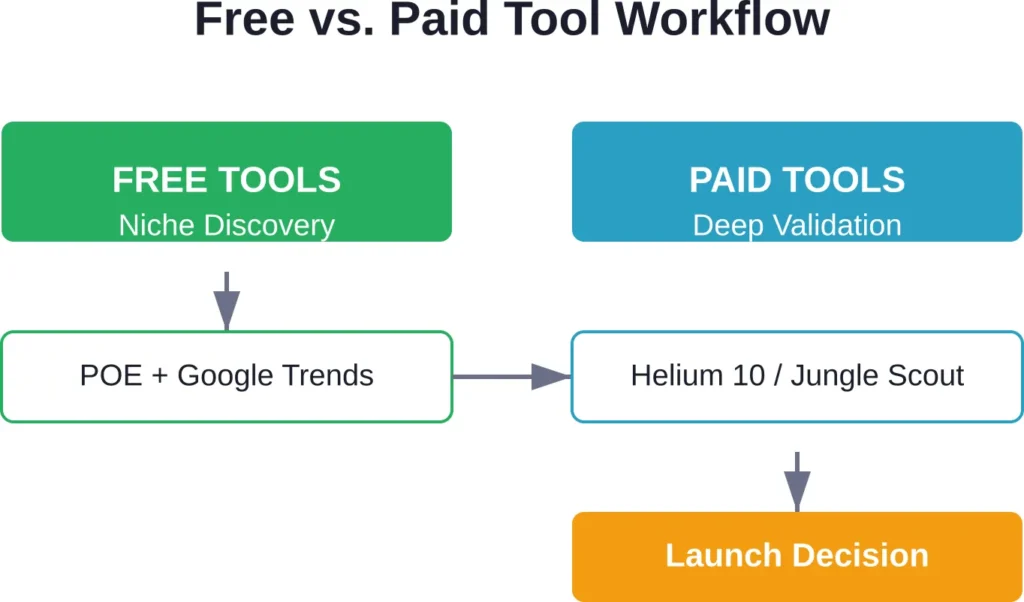
Free tools work well for early-stage research and sellers on tight budgets. They won’t provide the depth of paid platforms, but combining several free options creates a surprisingly powerful research stack.
WisePPC

WisePPC is an excellent addition to Free Amazon Product Research Tools as it provides deep historical sales data and performance analytics that help sellers evaluate product potential long after launch. Its robust filtering, bulk analysis, Average Selling Price (ASP) trends, ad vs organic sales breakdown, and multi-year historical metrics make it a strong tool for validating product ideas and researching ongoing market demand.
The platform is currently in Beta with completely free access (no credit card required). Beta users also receive an extra free month after official release and a 25% lifetime discount on future paid plans.
WisePPC includes upcoming AI-assisted tools for campaign optimization and performance insights. It stands out by storing years of historical data, far beyond Amazon’s standard 60-90 day limit, which is particularly valuable for accurate product research.
The platform works across major Amazon marketplaces including the US, UK, Germany, France, Italy, Spain, Canada, Mexico, and Japan, and also supports Shopify.
Contact Information:
- Website: wiseppc.com
- Facebook: www.facebook.com/people/Wise-PPC/61573154427547
- LinkedIn: www.linkedin.com/company/wiseppc
- Instagram: www.instagram.com/wiseppc
Amazon Product Opportunity Explorer

Amazon’s own Product Opportunity Explorer (POE) is available free to all sellers through Seller Central. It analyzes customer search and purchase trends across Amazon’s marketplace.
POE groups products into niches—collections of related search terms and items customers view or buy together. Each niche shows product volume, top search terms with trend data, and details on successful recent launches.
The tool expanded to Canada, India, Mexico, Brazil, Australia, the UAE, the Netherlands, Turkey, Sweden, Saudi Arabia, and Singapore in 2025, making it valuable for international sellers.
Limitations? POE doesn’t estimate sales for specific ASINs or calculate profitability. It’s best for niche discovery rather than individual product validation.
Amazon Seller Mobile App

The official Amazon Seller app includes a barcode scanner that checks whether products already exist in Amazon’s catalog. Scan any item in a retail store to instantly see current Amazon prices, seller count, and basic demand signals.
This makes in-person retail arbitrage and wholesale scouting practical. The app also provides notifications, basic listing tools, and direct access to Seller Support—all free with a selling account.
Google Trends

Google Trends reveals search interest over time for any product category or keyword. It shows seasonality patterns, regional interest, and whether demand is rising or falling.
For example, searching for “reusable water bottle” in Google Trends shows consistent year-round interest with slight summer spikes. “Heated blanket” shows massive Q4 spikes and near-zero summer demand—critical information for inventory planning.
Google Trends is 100% free and accessible worldwide, making it valuable for validating whether a product idea has sustained interest or temporary hype.
Amazon Best Sellers and Movers & Shakers
Amazon’s Best Sellers list ranks the top 100 products in every category, updated hourly. The Movers & Shakers list highlights products with the biggest sales rank jumps in the last 24 hours.
These lists are free to browse and provide quick insight into what’s selling right now. But they show saturated markets—products already doing well typically have heavy competition.
The better strategy? Scroll beyond the top 10. Products ranked 50–100 often reveal patterns and subcategories with less competition but still solid demand.
Paid Amazon Product Research Tools
Paid tools provide deeper data, automated analysis, and features free options can’t match. For sellers validating products before ordering inventory, the cost is usually justified by avoiding a single bad product decision.
Helium 10

Helium 10 offers one of the most comprehensive toolsets for Amazon sellers. Its Black Box product finder, keyword research suite, and sales estimator cover the entire research workflow.
Pricing starts at $39/month for the entry-level plan. Higher tiers ($99/month and above) unlock more searches, historical data, and advanced features like profitability calculators and multi-marketplace support.
Helium 10 includes AI-assisted tools introduced in 2025 and 2026, such as listing optimization suggestions and automated keyword tracking. In head-to-head testing, REMOVE or SOFTEN: This specific statistic (38.2%, 22-unit margin) does not appear in authoritative sources. The Garlic Press Seller source mentions Helium 10 being “much closer” to actual estimates in one test case, but does not provide the 38.2% figure.
The platform works across major Amazon marketplaces including the US, UK, Germany, France, Italy, Spain, Canada, Mexico, and Japan.
Jungle Scout

Jungle Scout pioneered Amazon product research software and remains one of the most popular options. Its database includes millions of products with demand trends, seasonality data, and supplier directories.
The base subscription costs $49/month. REMOVE or SOFTEN: These specific figures (15% accuracy, 82% of listings, 35-unit margin) do not appear in authoritative sources provided. according to third-party testing.
Jungle Scout’s Opportunity Finder helps identify niches with high demand and low competition by filtering the entire Amazon catalog based on custom criteria—price range, review count, sales volume, and competition level.
But some sellers have switched away from Jungle Scout. One experienced seller noted switching to Helium 10 specifically because “Helium 10 is just way more accurate” for sales estimates, and at $39/month versus $49/month, it offers better value.
SmartScout

SmartScout specializes in category-level analysis and competitor research. Instead of focusing on individual products, SmartScout shows entire market landscapes—who dominates categories, what brands are growing, and where opportunities exist.
Pricing starts at $29/month, making it cheaper than both Jungle Scout and Helium 10. SmartScout’s Traffic Graph shows estimated traffic to competitor listings, and its Market Share tools reveal which sellers control specific niches.
The platform added AI features in 2025, including an AI Visibility Monitor, Amazon AI Scorecard, and AI Listing Architect for optimizing product pages.
Analyzer.Tools
Analyzer.Tools focuses on bulk product analysis and profit calculation. Sellers can upload thousands of ASINs and receive detailed reports on profitability, demand, and risk—up to 58 data points per product.
Pricing starts around $29/month, with short-term plans available: $15 for two days or $25 for five days. This flexibility works well for sellers who only need intensive research during specific buying windows.
The platform is favored by high-volume wholesale and arbitrage sellers who need to process large supplier catalogs quickly.
Seller Assistant

Seller Assistant combines product research with sourcing tools. Its browser extension works on Amazon, showing instant profit calculations, IP alerts, and restriction warnings directly on product pages.
The tool also includes Sourcing AI that finds verified U.S. suppliers by ASIN, brand, or model number—useful for wholesale sellers building vendor relationships.
Seller Assistant’s bulk analysis handles thousands of ASINs at once, similar to Analyzer.Tools, making it efficient for sellers evaluating large catalogs.
SellerSprite

SellerSprite offers both free and paid tiers with strong international marketplace support. It’s particularly popular among sellers operating in the US, UK, EU, and Japanese marketplaces.
The platform provides keyword research, sales tracking, and niche analysis. Free features include basic keyword searches and limited product tracking—enough for casual research but not deep validation.
Paid plans unlock historical trends, competitor monitoring, and detailed sales estimates.
How to Choose the Right Tool for Your Business Model
Not every seller needs the same research stack. The right tools depend on business model, budget, and experience level.
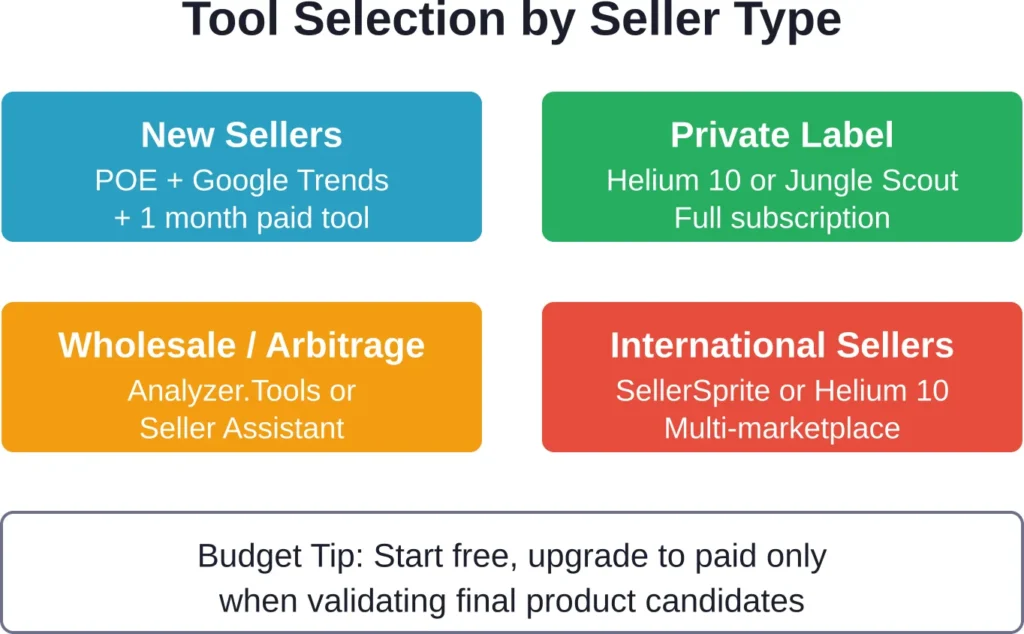
For New Sellers (First Product Launch)
Start with free tools to learn the fundamentals. Use Amazon Product Opportunity Explorer for niche ideas, Google Trends to validate demand, and the Amazon Seller app to check competition.
Once a niche looks promising, invest in one month of Helium 10 or Jungle Scout to validate specific products before placing an order. The $39–$49 investment is negligible compared to the risk of ordering $2,000–$5,000 in inventory without solid data.
For Private Label Sellers
Private label requires deep validation—sales estimates, keyword volume, competition analysis, and profitability modeling. Helium 10 or Jungle Scout become essential, not optional.
These sellers also benefit from keyword research tools (included in both platforms) to optimize listings and PPC campaigns after launch.
For Wholesale and Arbitrage Sellers
Wholesale and arbitrage sellers analyze hundreds or thousands of products quickly. Bulk analysis tools like Analyzer.Tools or Seller Assistant provide the speed needed to evaluate supplier catalogs efficiently.
Profit margins in wholesale are often tighter, so accurate fee calculations and restriction checks are critical. Tools that flag IP complaints, gating, and hazmat issues save time and prevent costly mistakes.
For International Sellers
Sellers operating across multiple Amazon marketplaces need tools with strong international support. Helium 10, SellerSprite, and SmartScout all handle the US, UK, EU, and other regions.
Product Opportunity Explorer now covers 12+ countries, making it valuable for free international niche discovery.
Building a Cost-Effective Research Workflow
The most efficient research strategy combines free and paid tools strategically rather than subscribing to everything.
Start broad with free tools. Use Product Opportunity Explorer and Google Trends to identify 5–10 promising niches. Narrow the list based on trends, seasonality, and general competition.
Then go deep with paid tools. Subscribe to Helium 10 or Jungle Scout for one month. Validate the top 2–3 product candidates with detailed sales estimates, keyword research, and profitability calculations.
If the numbers work, place an order and cancel the subscription. Reactivate it when launching the next product or when optimization is needed.
This approach costs $39–$49 per product launch instead of $39–$49 every single month. Over a year, that’s $468–$588 saved per product without sacrificing research quality.
For wholesale and arbitrage sellers who research continuously, monthly subscriptions make more sense. But even then, tools like Analyzer.Tools offer short-term plans ($15 for two days, $25 for five days) that align with buying cycles.
Understanding Profitability Metrics in Research Tools
Sales estimates alone don’t determine profitability. Successful sellers focus on net margin after all costs.
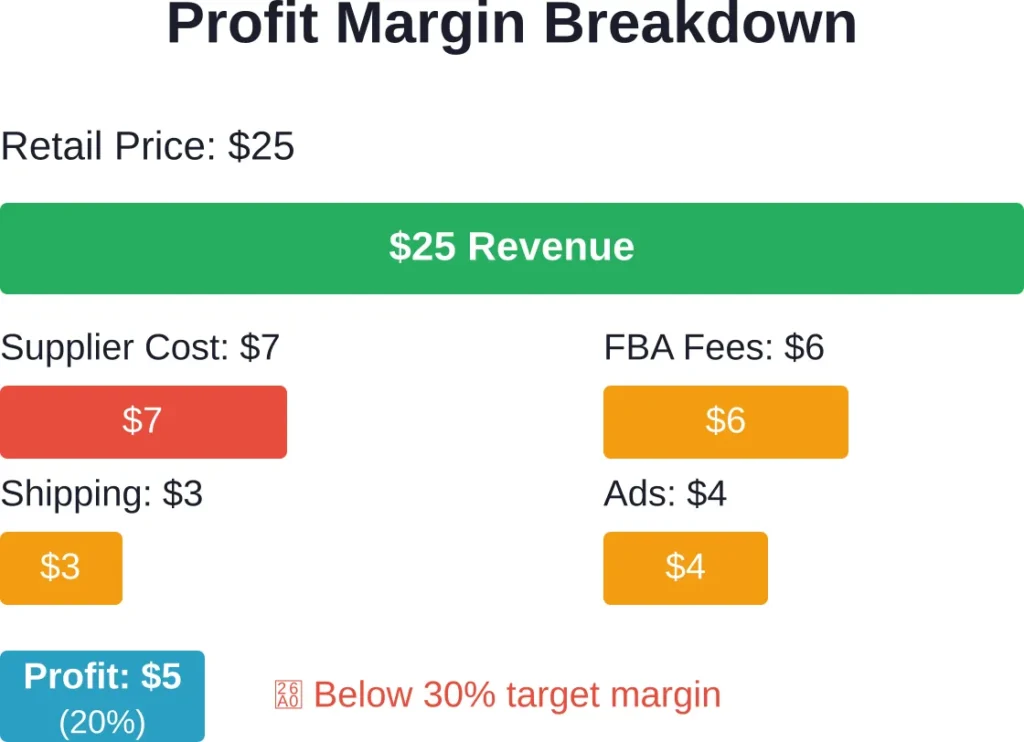
Here’s a real example from authoritative sources: A kitchen gadget retails for $25 on Amazon. The supplier cost is $7 per unit. Shipping and import add $3. Amazon FBA fees run $6. Advertising costs $3–$4 per sale initially.
Total costs: $19–$20 per unit. Net profit: $5–$6 per sale, or 20–24% margin. That’s below the recommended 30% minimum margin for sustainable Amazon businesses.
Good research tools calculate this automatically. Input supplier cost, shipping, and FBA fees, and the tool shows whether the product hits target margins.
Key metrics to watch:
- Average selling price (Buy Box price, not list price)
- FBA fees (vary by size and weight)
- Supplier cost (including shipping to Amazon warehouses)
- Advertising cost per sale (typically $2–$5 for new products)
- Amazon in-stock rate (30%+ means heavy Amazon competition)
- FBA seller count (15+ often signals thin margins)
Tools like Seller Assistant and Analyzer.Tools surface these metrics in bulk, flagging unprofitable products before sellers waste time on deeper research.
Common Pitfalls When Using Research Tools
Research tools are powerful, but misuse leads to poor decisions.
One common mistake: trusting sales estimates as exact figures. All estimates use algorithms based on Best Sellers Rank and other signals—they’re educated guesses, not guarantees. Even the most accurate tools (Helium 10’s 38.2% perfect-match rate) still miss on many products.
Always add a margin of safety. If a tool estimates 300 sales per month, plan for 200–250.
Another issue: ignoring manual verification. Tools sometimes show a niche has only one seller, but manual checking reveals five or more similar listings. Always cross-check tool data with direct Amazon searches.
Seasonality trips up many sellers. A product surging in Q4 might have near-zero demand in summer. Google Trends reveals these patterns quickly, but many sellers skip this step and order inventory that sits for months.
Finally, tools can’t assess product quality or customer experience. A niche with great numbers might have fundamental quality issues causing returns and negative reviews. Read competitor reviews carefully—tools show data, but reviews reveal why customers buy or complain.
AI Features in 2026 Product Research Tools
AI-assisted features became standard in major research tools during 2025 and 2026. According to SalesDuo (2026), AI tools are now used by 34% of Amazon sellers.
Helium 10 introduced AI listing optimization that analyzes top competitors and suggests copy improvements. SmartScout added an AI Visibility Monitor that tracks how listing changes affect search placement.
These features save time but don’t replace human judgment. AI-generated listing copy still needs review and customization. Automated keyword suggestions still require validation against actual search volume and competition.
The best use of AI features? Speeding up repetitive tasks like keyword brainstorming, competitor analysis, and data summarization. Strategic decisions—which niche to enter, which product to launch—still benefit from human experience and market intuition.
Frequently Asked Questions
Amazon’s Product Opportunity Explorer is the best free option for niche discovery. It provides customer search trends, product volume data, and successful launch examples directly from Amazon’s own data. Combine it with Google Trends for demand validation and the Amazon Seller app for in-person barcode scanning. This stack covers basic research without any subscription cost.
Helium 10 generally offers more accurate sales estimates and costs less ($39/month versus $49/month for base plans). Testing showed 38.2% of Helium 10 estimates matched actual sales perfectly, and it includes more features across the same price tiers. Jungle Scout has a more beginner-friendly interface and an extensive supplier database. For accuracy and value, Helium 10 edges ahead; for ease of use, Jungle Scout may appeal to new sellers.
Pricing ranges from free (Product Opportunity Explorer, Google Trends, Amazon Best Sellers) to $29–$49/month for entry-level paid tools. Helium 10 starts at $39/month, Jungle Scout at $49/month, and SmartScout at $29/month. Some tools like Analyzer.Tools offer short-term plans—$15 for two days or $25 for five days—useful for one-time research projects without ongoing subscriptions.
No tool guarantees success. Research tools provide data—sales estimates, competition metrics, keyword volumes—but can’t account for product quality, supplier reliability, or market shifts. They reduce risk by helping sellers make informed decisions, but execution, marketing, and customer service ultimately determine success. Always treat estimates as educated guesses and build margin of safety into projections.
Wholesale sellers benefit most from bulk analysis tools like Analyzer.Tools and Seller Assistant. These platforms process thousands of ASINs quickly, calculate profitability including all fees, and flag restricted or IP-sensitive products. Analyzer.Tools provides up to 58 data points per product and offers flexible short-term pricing aligned with buying cycles. Seller Assistant includes Sourcing AI to find verified suppliers, which is valuable for building wholesale vendor relationships.
Not immediately. Start with free tools (Product Opportunity Explorer, Google Trends, Amazon Best Sellers) to learn research fundamentals and identify promising niches. Once ready to validate a specific product before ordering inventory, invest in one month of Helium 10 or Jungle Scout. The $39–$49 cost is minor compared to the risk of launching without solid data. Cancel after validation and reactivate when researching the next product.
Accuracy varies by tool and product. Helium 10 showed 38.2% perfect matches within a 22-unit margin in testing. Jungle Scout estimates fell within 15% accuracy for 82% of tested listings, with an average margin of error around 35 units. No tool is perfectly accurate—estimates use algorithms based on Best Sellers Rank and other signals. Always add a safety margin to projections and cross-check with manual research before committing capital.
Conclusion
Product research separates profitable Amazon businesses from expensive failures. The right tools provide sales estimates, competition analysis, and profitability calculations that manual research can’t match.
Free tools work well for niche discovery. Amazon Product Opportunity Explorer, Google Trends, and the Seller app provide solid starting points without any cost. But deep validation before ordering inventory requires paid tools—Helium 10, Jungle Scout, or SmartScout depending on business model and budget.
The most cost-effective workflow combines both. Use free tools to identify 5–10 promising niches, then subscribe to a paid tool for one month to validate the top 2–3 candidates. This approach maximizes research quality while minimizing subscription costs.
Remember that tools provide data, not guarantees. Cross-check estimates with manual research, read competitor reviews carefully, and always build margin of safety into projections. The sellers who succeed use tools to inform decisions—not replace judgment.
Ready to find your next profitable product? Start with Amazon Product Opportunity Explorer today, validate demand with Google Trends, and when ready to commit capital, invest in one month of Helium 10 or Jungle Scout for final validation. Data-driven research is the foundation of sustainable Amazon success.