

Quick Summary: The best SEO web development companies in 2026 combine technical excellence with strategic search optimization across multiple platforms. This list features 15 agencies—from niche specialists to full-service firms—that deliver measurable organic growth without relying on outdated tactics. Each agency brings distinct strengths in areas like technical SEO, content strategy, and conversion optimization.
SEO isn’t what it was five years ago. The field has fractured into dozens of specializations—technical audits, content operations, local optimization, enterprise migration, and now generative engine optimization. The search landscape continues to evolve with new platforms and user behaviors fundamentally changing what success looks like.
Finding an agency that understands this shift matters more than ever. Some firms still chase keyword rankings and traffic metrics that no longer correlate with revenue. The best ones measure what actually moves the needle: qualified leads, conversion rates, and organic contribution to pipeline.
This list cuts through the noise. The 15 agencies below were selected based on demonstrated results, technical depth, and adaptability to the evolving search landscape—including optimization for AI-powered platforms like ChatGPT and Perplexity.
What Separates Elite SEO Web Development Companies From the Rest
Not every digital marketing firm qualifies as an SEO web development company. The distinction matters. A true SEO-focused web development agency builds sites with organic search baked into every architectural decision—URL structure, schema markup, JavaScript rendering, Core Web Vitals, international targeting, and content management workflows.
Generic web shops bolt SEO on afterward. That approach fails when Google’s crawlers hit client-side rendering issues, or when a site migration tanks six months of ranking gains because nobody mapped redirects properly.
Technical Competence Beyond WordPress Plugins
The agencies worth hiring understand server-side rendering, log file analysis, and how Googlebot allocates crawl budget across large sites. They catch canonicalization errors before launch. They know when to use hreflang and when a subdomain structure makes more sense than subdirectories.
Many teams claim technical SEO expertise. Few can diagnose why a site lost 40% of its organic traffic post-migration or explain why certain page templates aren’t getting indexed despite being crawlable.
Strategic Thinking Aligned With Business Outcomes
Elite agencies ask about customer lifetime value, sales cycle length, and conversion paths before they touch a keyword tool. They understand that ranking for high-volume terms means nothing if those visitors bounce or don’t convert.
According to research on generative AI in marketing, practitioners report significant productivity gains from AI integration, though specific percentages vary by study. The best agencies have already integrated these tools into their workflows—not as replacements for strategic thinking, but as accelerants for content production, competitive analysis, and technical audits.
How We Evaluated These SEO Web Development Companies
Ranking agencies requires a framework that separates legitimate expertise from marketing fluff. The methodology here prioritizes measurable results over self-reported capabilities.
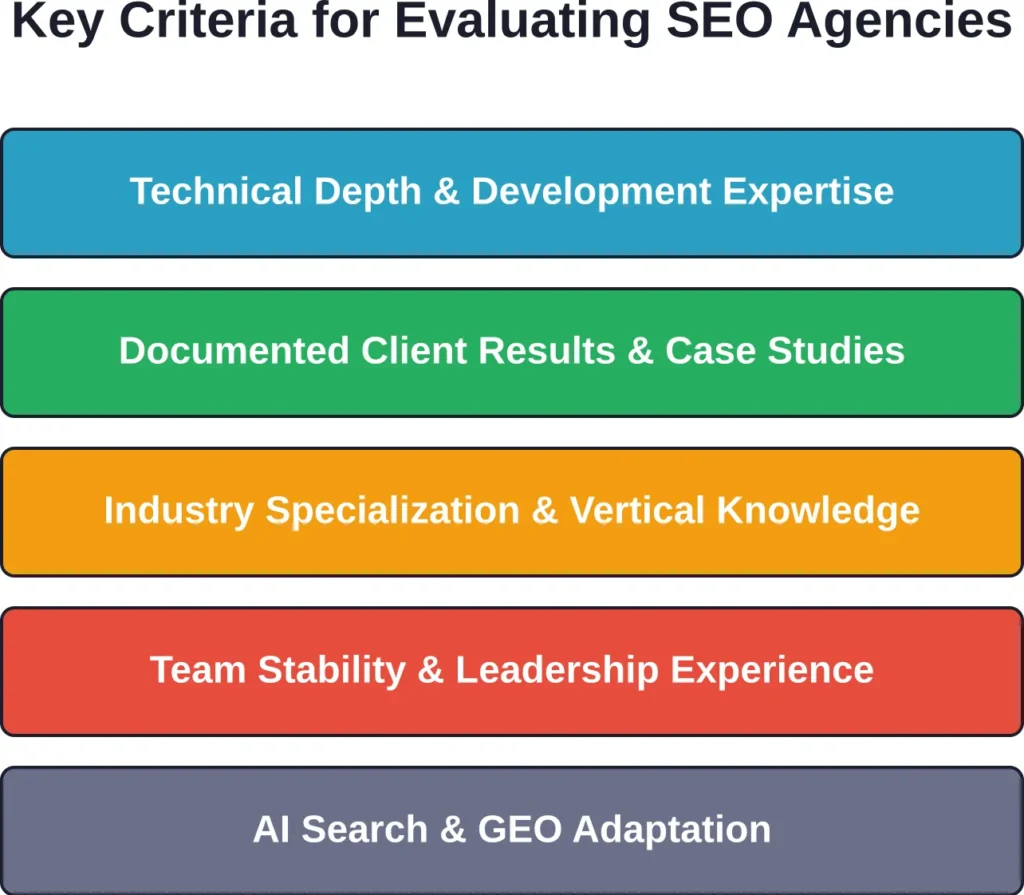
Each company was evaluated across six core dimensions:
- Client results: Documented case studies showing organic traffic growth, conversion improvement, or revenue attribution from SEO
- Technical depth: Evidence of advanced capabilities in site architecture, migrations, JavaScript SEO, or enterprise-scale optimization
- Industry specialization: Focus areas that demonstrate deep vertical expertise rather than generalist positioning
- Leadership experience: Founder and executive team backgrounds in search, development, or digital strategy
- Team stability: Median employee tenure as a proxy for institutional knowledge and client service continuity
- Adaptation to AI search: Demonstrated understanding of optimization for ChatGPT, Google SGE, Perplexity, and other generative platforms
Agencies that publish transparent case studies with specific metrics earned higher consideration than those relying on vague testimonials. Firms with clear vertical specialization ranked above generalists claiming expertise in every industry.
The Top 15 SEO Web Development Companies in 2026
These agencies represent the current state of the art in SEO-driven web development. Each brings something distinct to the table—whether that’s technical prowess, content strategy, vertical specialization, or a track record solving specific problems other firms can’t handle.
1. Lengreo
Lengreo operates at the intersection of B2B digital marketing and technical web development. The agency specializes in full-cycle SEO, lead generation, and custom website development for companies seeking measurable growth through organic search and conversion-focused digital assets.
What sets them apart is their integrated approach that treats web development and SEO as revenue engines rather than isolated tactics. They combine technical website audits and optimizations with strategic content planning, link building, and hyper-personalized outreach, delivering documented improvements in rankings, traffic, and qualified opportunities. Their methodology emphasizes listening to client needs and tailoring tools rather than applying pre-packaged solutions.
Best for: B2B companies in competitive sectors needing integrated SEO and web development, SaaS and service providers focused on lead generation and conversion rate optimization, and businesses that want a single partner for marketing strategy, technical implementation, and ongoing performance.
Contact Information:
- Website: Lengreo.com
- Phone: +31 686 147 566
- Email: [email protected]
- Address: Vrijstraat 9 C/D, 5611 AT Eindhoven, Netherlands
- LinkedIn: Lengreo
- Twitter: @Lengreo
- Instagram: @lengreo
2. Mobian Studio
Mobian Studio functions at the crossroads of dedicated engineering teams and performance-oriented web and mobile development. The firm specializes in building scalable digital products with strong emphasis on clean architecture, technical optimization, and AI-enhanced solutions for fast-moving companies.
What sets them apart is their dual outsourcing/outstaffing model combined with end-to-end delivery that prioritizes production-ready code, scalable infrastructure, and seamless legacy integration. They focus on systems designed for long-term maintainability and growth, ensuring websites and applications perform well under increasing traffic and complexity while maintaining excellent user experiences.
Best for: Companies in IT, Healthcare, Fintech, and Logistics needing reliable technical web and mobile development, organizations requiring dedicated teams for scalable product builds, and businesses that want senior-level execution without the overhead of in-house hiring.
Contact Information:
- Website: mobian.studio
- Phone: [email protected]
- Address: Harju maakond, Tallinn, Kesklinnalinnaosa, Masina tn 22, 10113
- LinkedIn: www.linkedin.com/company/mobian-studio
3. Gilzor

Gilzor operates at the intersection of custom software development and growth-focused web solutions. The firm specializes in full-cycle web and mobile development paired with idea validation, UI/UX design, and go-to-market strategies that emphasize performance and user acquisition.
What sets them apart is their strategic approach that connects technical development directly to business outcomes. They deliver high-quality, conversion-oriented websites and applications with strong QA processes, ongoing maintenance, and architecture decisions that support scalability and market fit from the start.
Best for: Startups and SMBs launching or scaling digital products, companies needing custom web development tied to clear growth strategies, and product teams seeking reliable partners for performant, user-centric digital solutions.
Contact Information:
- Website: www.gilzor.com
- Email: [email protected]
- Address: Poland, Warsaw, Office 58, street Adama Mickiewicza 37, 01-625
- LinkedIn: www.linkedin.com/company/gilzor-softwaredevelopment
4. Oski
Oski works at the intersection of enterprise-grade software engineering and modern web development. The firm specializes in cloud solutions, frontend frameworks, AI integrations, and CMS platforms that power high-performance digital experiences across multiple industries.
What sets them apart is their focus on smart, scalable architectures that combine innovative design with robust backend systems. They emphasize AI-accelerated development, seamless cloud deployment, and solutions engineered for reliability, security, and future growth without requiring constant rebuilds.
Best for: Tech-forward enterprises and ambitious startups needing sophisticated web development with cloud and AI capabilities, companies in Travel, Logistics, E-commerce, Education, Fintech, or Insurance seeking industry-specific digital solutions, and organizations prioritizing long-term maintainable and high-performance platforms.
Contact Information:
- Website: oski.site
- Phone: +48571282759
- Email: [email protected]
- Address: Kaupmehe tn 7, 10114 Tallinn, Estonia
- LinkedIn: www.linkedin.com/company/oski-solutions
5. A-Listware
A-Listware operates at the intersection of software development outsourcing and technical consulting. The firm specializes in dedicated development teams, custom web and enterprise applications, UX/UI design, and infrastructure services that deliver secure, responsive digital solutions.
What sets them apart is their ability to seamlessly extend client teams with managed, high-quality developers while providing end-to-end services from architecture and cloud migration to QA, cybersecurity, and ongoing support. They focus on cost-effective yet robust development that integrates smoothly with existing processes.
Best for: Enterprises and SMBs requiring dedicated or augmented development teams for web projects, companies modernizing legacy systems or building scalable applications, and organizations that need reliable technical partners for full-spectrum software and infrastructure solutions.
Contact Information:
- Website: a-listware.com
- Phone: +1 (888) 337 93 73
- Email: [email protected]
- Address: North Bergen, NJ 07047, USA
- LinkedIn: www.linkedin.com/company/a-listware
- Facebook: www.facebook.com/alistware
6. HigherVisibility
HigherVisibility operates as a full-service SEO and digital marketing agency with a focus on local search, franchise optimization, and multi-location businesses. The firm has built proprietary systems for managing SEO at scale across dozens or hundreds of locations.
Their strength lies in solving the operational complexity of coordinating content, citations, and local optimization across distributed business models. For franchises or service businesses with multiple locations, that capability is critical—and rare.
HigherVisibility also maintains a strong track record in conversion rate optimization, recognizing that driving traffic to local pages means little if those pages don’t convert visitors into calls, form fills, or in-person visits.
Best for: Multi-location businesses, franchise systems, service companies with regional branches, and brands that need local search visibility coordinated across markets.
7. Intero Digital
Intero Digital combines SEO with content marketing, public relations, and digital strategy. The agency’s differentiator is integrating earned media with organic search—using PR placements and brand-building to support link acquisition and topical authority.
Their approach works particularly well for brands that need reputation management alongside search visibility, or companies entering new markets where brand awareness is as important as rankings.
Intero’s content operations are more sophisticated than typical SEO shops, with editorial processes closer to a media company than a marketing agency. That rigor shows in their client results, where organic traffic growth often accompanies improvements in brand search volume and direct traffic.
Best for: Brands launching new products, companies in reputation-sensitive industries, and businesses where PR and SEO need to work as a unified channel rather than separate functions.
8. Titan Growth
Titan Growth built its reputation on proprietary technology that automates elements of technical SEO and on-page optimization. The firm’s platform, TitanBOT, crawls sites continuously and implements optimizations at scale—a capability that matters most for large sites with thousands of pages.
Their technology-forward approach distinguishes them from agencies that rely entirely on manual processes. For enterprise clients managing massive product catalogs or content libraries, that automation prevents optimization from becoming a bottleneck.
Titan Growth also emphasizes competitive intelligence, using machine learning to identify gaps in competitor strategies and prioritize opportunities where clients can gain ground efficiently.
Best for: Enterprise ecommerce, large publishers, and companies with complex sites where manual optimization doesn’t scale.
9. Solve
Solve is a B Corp-certified agency that combines web design with SEO—a rare combination done well. Founded in 1998, the same year Google launched, the firm has deep institutional knowledge of how search and web development have evolved together.
Solve is noted as having strong client satisfaction indicators based on published reviews. Their approach emphasizes long-term partnerships over transactional projects, with many client relationships spanning years.
Solve’s dual expertise in design and SEO means they avoid the common problem where beautiful sites perform poorly in search, or SEO-optimized sites deliver subpar user experiences. Their work integrates both from the start.
Best for: Companies planning site redesigns or rebuilds where SEO can’t be compromised, brands that value design as a competitive differentiator, and businesses seeking long-term agency partnerships.
10. Sure Oak
Sure Oak specializes in content-driven SEO with a focus on editorial quality and E-E-A-T (Experience, Expertise, Authoritativeness, Trustworthiness). The agency’s methodology centers on building topical authority through comprehensive content that genuinely serves user intent.
They avoid the thin-content, high-volume approach common in SEO content mills, instead producing fewer pieces at higher depth. That philosophy aligns with Google’s increasing emphasis on helpful, experience-driven content written by subject matter experts.
Sure Oak also invests heavily in content promotion and link acquisition, recognizing that even the best content needs amplification to compete in crowded verticals. Their integrated approach to content creation, promotion, and technical optimization delivers results in industries where trust and credibility are prerequisites to ranking.
Best for: YMYL (Your Money, Your Life) industries like healthcare and finance, brands that need content strategy emphasizing expertise and trust, and companies competing in verticals where thin content is penalized.
11. Silverback Strategies
Silverback operates at the intersection of SEO strategy and enterprise web development. The firm specializes in large-scale content operations and technical optimization for brands that need to coordinate SEO across multiple business units.
What sets them apart is their approach to SEO program architecture. Rather than treating organic search as a marketing tactic, Silverback embeds it into product development, customer experience design, and revenue operations. Their clients typically see SEO as a primary growth channel, not a secondary traffic source.
The agency publishes in-depth research on search trends and maintains one of the more rigorous evaluation frameworks for assessing other agencies—a signal of intellectual honesty rare in the space. They also update their content regularly, with their latest agency rankings refreshed as recently as March 2026.
Best for: Enterprise B2B companies, SaaS platforms with complex product catalogs, and brands that need SEO integrated with broader growth strategy.
12. First Page Sage
First Page Sage takes a research-driven approach to SEO that prioritizes original content and strategic planning over volume tactics. The firm’s methodology centers on creating demonstrably better content than competitors, backed by thoughtful audience research and topic modeling.
They focus heavily on what they call provable lead generation and ROI—tracking organic’s contribution to pipeline rather than stopping at traffic metrics. Their evaluation framework for other agencies weighs factors like average review score, leadership experience, founder-led status, median employee tenure, and AI visibility score.
According to their published methodology, they allocate 20% of their scoring to average review score, 15% to median employee tenure, and 15% to AI visibility—reflecting their belief that team stability and adaptation to AI-powered search are critical differentiators.
First Page Sage also segments their recommendations by industry, publishing separate rankings for SaaS, financial services, healthcare, home services, real estate, and manufacturing. That vertical specialization demonstrates depth that generalist agencies rarely achieve.
Best for: Companies that need original content strategy, B2B firms with long sales cycles, and brands in competitive verticals where differentiation through content is essential.
13. Thrive Internet Marketing Agency
Thrive combines SEO with full-service digital marketing, offering a one-stop solution for companies that want integrated campaigns across organic search, paid ads, social media, and web design.
The agency’s strength lies in coordinating multiple channels toward unified business goals. They’ve documented results like updating high-priority location and service pages, improving site performance through targeted content and backlink campaigns, and driving measurable increases in lead volume.
While Thrive’s generalist positioning means they lack the vertical depth of specialist agencies, their breadth makes them a fit for companies that need marketing operations built from scratch or fully rebuilt.
Best for: Small to mid-sized businesses that need multiple marketing channels managed cohesively, companies launching new markets, and brands that prefer a single agency relationship over coordinating multiple specialists.
14. Victorious
Victorious focuses exclusively on SEO, with particular strength in competitive commercial verticals. The agency’s approach emphasizes rapid results through aggressive content production paired with technical optimization.
Their model works especially well for brands entering crowded markets where established competitors dominate organic search. Victorious accelerates the timeline to visibility through a combination of content velocity, link acquisition, and on-page optimization.
The firm has documented success with ecommerce, SaaS, and service businesses that need to scale organic traffic quickly to support growth targets. Their focus on speed distinguishes them from agencies that favor slower, more methodical approaches.
Best for: Growth-stage companies with aggressive revenue targets, brands entering competitive markets, and businesses that need measurable organic results within 6-12 months.
15. Directive
Directive specializes in B2B and enterprise SaaS, bringing deep expertise in long sales cycle optimization. The agency understands that SaaS SEO differs fundamentally from standard SEO because recurring revenue changes what a conversion is worth, and multi-stakeholder buying journeys require content across more funnel stages than most agencies build for.
As one analysis notes, the best SaaS SEO agencies measure demos, trials, and ARR contribution—not just sessions and keyword positions. Directive’s methodology aligns with this philosophy, tracking organic’s contribution to pipeline and closed revenue rather than stopping at lead volume.
They also understand the technical nuances of optimizing product-led growth motions, where free trials, freemium models, and self-service signups create different conversion paths than traditional gated content.
Best for: B2B SaaS companies, enterprise software platforms, and businesses with complex, multi-stakeholder buying processes that require bottom-of-funnel content strategy.
Understanding SEO Web Development vs. Standard Web Development
The term “SEO web development” describes a hybrid discipline. It’s not web development with SEO tacked on, nor SEO that assumes someone else will handle the technical implementation. It’s a unified practice where every architectural decision considers organic search implications.
Why Most Development Shops Fail at SEO
Traditional web development agencies optimize for aesthetics, load time, and user experience. Those factors matter for SEO—but they’re insufficient.
A beautifully designed site that relies entirely on client-side JavaScript rendering may never get indexed properly. A blazing-fast site built on a headless CMS might lack the structured data and internal linking architecture to compete in search. A conversion-optimized landing page that cannibalizes existing rankings through duplicate content will undermine organic performance even as it improves paid campaign efficiency.
Standard development shops miss these nuances because SEO isn’t their core expertise. They’ll implement what an SEO consultant tells them to—but they won’t proactively catch the issues that consultants miss during spec review.
Why Most SEO Agencies Fail at Development
The inverse problem is just as common. SEO agencies that lack development chops produce site recommendations that are theoretically correct but practically impossible to implement.
They’ll propose URL structure changes that break session persistence. They’ll recommend consolidating subdomain content without understanding DNS, SSL, or CDN implications. They’ll specify schema markup that conflicts with the site’s template architecture.
Then the client’s development team pushes back, explaining why the recommendations aren’t feasible—and the SEO agency lacks the technical depth to propose workable alternatives.
The AI Search Revolution and What It Means for SEO Agencies
The agencies on this list share one characteristic: they’ve adapted their methodologies for a search landscape that includes ChatGPT, Google’s Search Generative Experience, Perplexity, and other AI-powered platforms.
This shift represents more than incremental change. Research from UC Berkeley describes the rise of Generative Engine Optimization tools that give speedy, versatile, and accurate output—fundamentally different from traditional search engines that return lists of links.
What GEO Changes for SEO Agencies
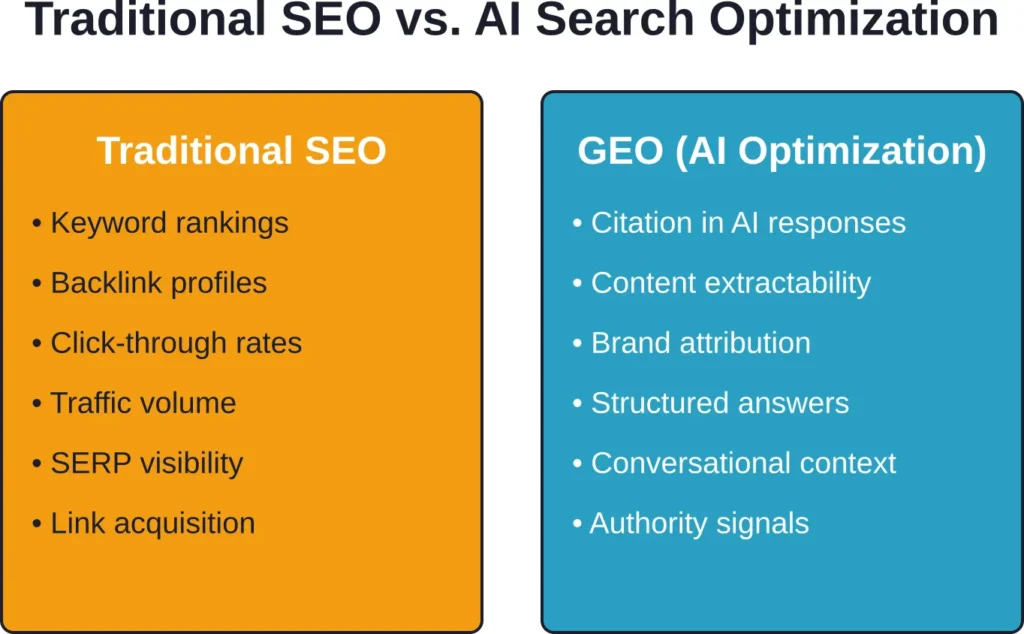
Optimization for generative engines requires different tactics than traditional SEO. Where Google’s algorithm prioritizes backlinks and relevance signals, AI platforms often synthesize information from multiple sources without necessarily crediting any single origin.
That dynamic changes what success looks like. Ranking #1 for a keyword matters less if the answer engine pulls your content into a summary without driving traffic to your site. The goal shifts from capturing clicks to ensuring your brand and information are represented in AI-generated responses.
The best agencies have started optimizing for citation in AI summaries—structuring content in ways that make it easy for language models to extract and attribute. They’re also focusing on branded search as a hedge, recognizing that when generative engines cite sources, strong brand recognition increases the likelihood of attribution.
Why This Matters When Choosing an Agency
Agencies that haven’t adapted to AI search are optimizing for a landscape that’s already changing. Search continues to evolve rapidly, and the nature of search behavior is transforming.
Ask prospective agencies how they’re adjusting their strategies for SGE, ChatGPT, and other AI platforms. If they can’t articulate a clear answer, or if they dismiss the question as premature, that’s a signal they’re behind the curve.
Matching Agency Specialization to Business Needs
The worst hiring decisions happen when companies select agencies based on reputation rather than fit. An elite SaaS SEO agency may fail spectacularly for a multi-location service business, and vice versa.
SaaS and B2B
SaaS SEO differs from standard SEO because recurring revenue changes what a conversion is worth. A typical ecommerce transaction generates one-time value; a SaaS signup creates a revenue stream that compounds over months or years.
That math changes everything about keyword targeting, content strategy, and conversion optimization. Agencies specializing in SaaS understand these nuances. They build content for bottom-of-funnel intent—comparison pages, alternative pages, integration guides, and use case documentation that targets prospects actively evaluating solutions.
They also understand multi-stakeholder buying. Enterprise SaaS purchases involve multiple decision-makers, each with different concerns. Content strategy must address the end user, the technical evaluator, the procurement team, and the executive sponsor.
Directive, First Page Sage, and Silverback Strategies all demonstrate strong track records in this vertical.
Ecommerce and Retail
Ecommerce SEO prioritizes product page optimization, category architecture, and technical issues like faceted navigation and duplicate content at scale. The challenge is maintaining clean URL structures and internal linking while giving customers filtering and sorting options they expect.
Agencies specializing in ecommerce understand how to structure product taxonomy for both users and search engines. They know when to noindex filtered views, how to consolidate similar products without losing long-tail rankings, and how to optimize for commercial intent keywords that drive revenue rather than traffic.
Titan Growth and Victorious bring particular strength in this vertical.
Multi-Location and Franchise
Local SEO at scale requires systems that traditional agencies can’t deliver. Managing optimization across dozens or hundreds of locations involves different challenges than single-site SEO.
Each location needs unique content, accurate citations, Google Business Profile optimization, and localized link building—but those efforts must scale efficiently. The agencies that succeed in this space build proprietary systems for managing local search at enterprise scale.
HigherVisibility specializes in this area, with documented success managing SEO for franchise systems and multi-location service businesses.
Content and Media
Publishers and content-driven businesses need agencies that understand editorial SEO—topic clusters, content velocity, and the interplay between timeliness and evergreen value.
The optimization challenge for media properties differs from commercial sites. Traffic volume matters more than conversion optimization, because monetization depends on pageviews, ad impressions, and audience growth rather than direct sales.
Agencies with media backgrounds understand how to balance SEO optimization with editorial integrity. They know how to structure content hubs, optimize for featured snippets and news carousels, and build systems that allow editorial teams to publish at velocity without sacrificing quality.
Sure Oak and Intero Digital both bring content expertise that translates well to media and publishing contexts.
Red Flags When Evaluating SEO Web Development Agencies
Not every firm claiming SEO expertise deserves consideration. Certain signals indicate an agency lacks the depth to deliver results—or worse, might actively harm organic performance through outdated tactics.
Guaranteed Rankings
Any agency guaranteeing specific rankings is either lying or using tactics that will eventually trigger penalties. Search algorithms are too complex, competitive dynamics too unpredictable, and Google’s guidelines too restrictive for legitimate guarantees.
The best agencies guarantee process—thorough audits, strategic planning, quality execution—but stop short of promising outcomes they can’t control.
Focus on Traffic Over Conversions
Agencies that pitch traffic growth without connecting it to business outcomes are optimizing for the wrong metrics. Traffic means nothing if it doesn’t convert.
First calls should center on conversion goals, customer lifetime value, and how organic search contributes to revenue. If the conversation stops at keyword targets and traffic projections, that’s a warning sign.
No Vertical Specialization
Agencies claiming equal expertise across every industry rarely excel at any. Deep vertical knowledge comes from repeated problem-solving in similar contexts—understanding the compliance requirements in healthcare, the seasonal patterns in retail, or the sales cycle complexity in enterprise software.
Generalists can execute basic SEO. But solving hard problems requires pattern recognition that only comes from vertical focus.
Resistance to Transparency
Legitimate agencies share case studies, explain their methodology, and provide clear reporting on what they’re doing and why. Firms that resist transparency—refusing to document their processes, share login credentials, or explain their link building tactics—are hiding something.
SEO should never be a black box. If an agency can’t or won’t explain their work in plain language, walk away.
| Agency Selection Criteria | Why It Matters | How to Evaluate |
|---|---|---|
| Documented Case Studies | Proof of results in similar contexts | Request 3+ examples with specific metrics, vertical relevance, and timeline |
| Technical Depth | Ability to solve complex implementation challenges | Ask about experience with your tech stack, site architecture, and scale |
| Vertical Experience | Understanding industry-specific challenges and opportunities | Review client roster and published content in target vertical |
| Team Stability | Continuity and institutional knowledge | Ask about median tenure and who will work on the account directly |
| AI Adaptation | Preparedness for evolving search landscape | Request their perspective on GEO and how it changes their approach |
What to Expect From a High-Performing SEO Agency Relationship
Hiring an SEO web development agency is the start, not the finish. The relationship’s success depends as much on internal collaboration as on the agency’s capabilities.
The First 90 Days
Elite agencies spend the first month diagnosing rather than executing. Expect comprehensive technical audits, competitive analysis, and strategic planning before significant implementation begins.
That discovery phase should produce:
- A technical SEO audit identifying crawlability issues, indexation problems, and site performance barriers
- Competitive gap analysis showing where competitors rank and how they got there
- Keyword research and content opportunity mapping aligned with business priorities
- A prioritized roadmap with expected impact and resource requirements for each initiative
Agencies that rush into execution without thorough discovery often waste budget on low-impact work.
Communication and Reporting Cadence
Expect biweekly or monthly check-ins with detailed reporting on work completed, results observed, and plans for the next period. Reports should connect SEO activity to business metrics—not just rankings and traffic, but leads generated, pipeline influenced, and revenue attributed where possible.
The best agency relationships involve regular strategic conversations, not just status updates. Quarterly business reviews should step back from tactical execution to assess whether the overall strategy is working and what adjustments might improve results.
When Results Appear
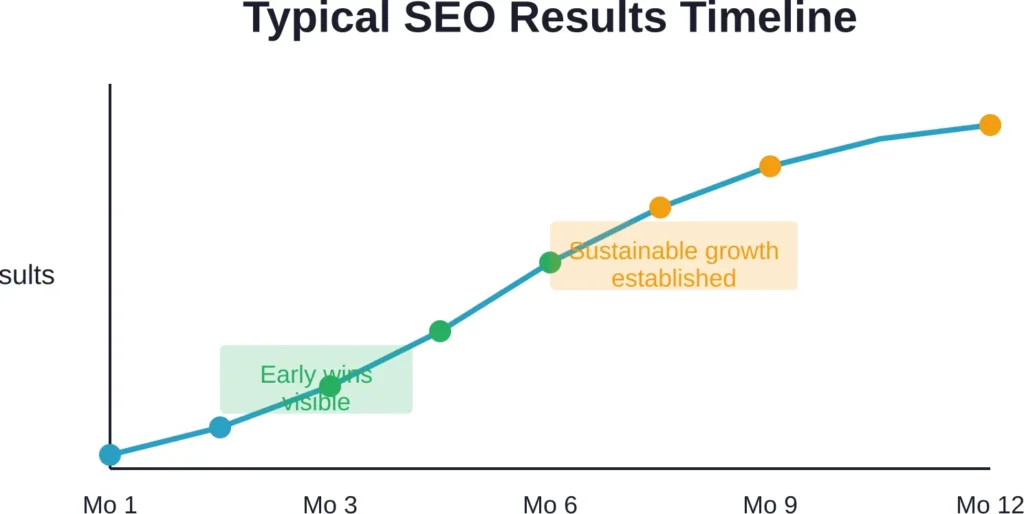
SEO is not a sprint. Depending on site authority, competitive intensity, and the scope of changes required, meaningful results typically emerge between three and nine months after engagement.
Early wins—technical fixes, quick content updates, low-hanging fruit—can produce faster results. But sustainable organic growth from competitive content, authority building, and architectural improvements takes time.
Agencies promising dramatic results in weeks are setting unrealistic expectations.
Budget Considerations for SEO Web Development Projects
SEO services span an enormous range. Small businesses might engage agencies for a few thousand dollars monthly. Enterprise companies routinely invest six figures annually in comprehensive SEO programs.
Understanding what different budget levels buy helps set realistic expectations.
What Different Investment Levels Deliver
Based on patterns observed across agency offerings, typical engagement structures break down as follows:
Monthly retainers below a certain threshold generally cover only basic services—monthly reporting, minor on-page updates, and limited content. These engagements rarely move the needle for competitive markets.
Mid-range monthly engagements support more substantive work: technical audits, content creation, link building, and ongoing optimization. This is where most growing businesses land when they’re serious about organic growth.
Higher monthly investments fund comprehensive programs with dedicated teams, custom tooling, extensive content operations, and integrated strategies across multiple channels. Enterprise clients with complex sites typically require this level of support.
Project-based work—site migrations, audits, or strategy development—varies widely based on scope but provides alternatives to ongoing retainers for companies with specific needs.
What’s Not Included in Standard Pricing
Most agency fees cover strategy, implementation, and reporting—but not third-party costs like content production at scale, premium tools, or paid promotion to amplify content.
Clarify what’s included before signing. Hidden costs for tools, freelancers, or ad spend can double the effective investment.
Questions to Ask Before Hiring an SEO Web Development Company
Due diligence separates good hiring decisions from expensive mistakes. These questions reveal whether an agency is truly equipped to deliver results.
About Their Process
- What does your discovery and audit process look like in the first 30 days?
- How do you prioritize which SEO initiatives to tackle first?
- What’s your approach to content creation—in-house writers, freelancers, or client subject matter experts?
- How do you handle link building, and what tactics do you avoid?
- What tools do you use, and are licensing costs included?
About Results and Reporting
- Can you share three case studies in our industry with specific metrics and timelines?
- How do you measure success, and what KPIs do you track?
- What does your reporting look like, and how often do we review performance?
- How long does it typically take to see meaningful results?
- What happens if results don’t meet expectations?
About Team and Collaboration
- Who specifically will work on our account, and what are their backgrounds?
- What’s the median tenure of team members working with clients?
- How much access will we have to senior strategists versus junior implementers?
- What level of collaboration do you expect from our internal team?
- How do you handle knowledge transfer if team members leave?
About Adaptation and Innovation
- How are you adapting your methodology for AI search platforms like ChatGPT and SGE?
- What’s your perspective on GEO versus traditional SEO?
- How do you stay current on algorithm updates and industry changes?
- Can you describe a recent situation where you had to pivot strategy based on search landscape changes?
The Future of SEO Web Development
The agencies that thrive in 2026 and beyond will be those that evolve beyond traditional search optimization to embrace a broader conception of organic discovery.
Integration With Product and Experience
SEO is moving upstream—becoming part of product development rather than a post-launch marketing tactic. The best agencies already work this way, embedding search considerations into IA planning, feature prioritization, and customer journey design.
MIT CISR research on business models indicates significant evolution in how companies structure operations, with growing adoption of ecosystem and platform approaches. That shift reflects a broader trend toward platform thinking, where organic visibility becomes a product feature rather than a marketing channel.
Automation and AI Augmentation
Agencies are leveraging AI to scale operations that once required massive teams. Content research, competitive analysis, technical audits, and even content production are increasingly augmented by AI tools.
But strategy remains human. The agencies winning in 2026 use AI to execute faster, not to replace strategic thinking. They’ve integrated tools like ChatGPT into workflows without losing the judgment that separates great SEO from algorithmic box-checking.
Measurement Beyond Traffic
The industry is finally moving past vanity metrics. Leading agencies now track organic’s contribution to pipeline, revenue, and customer acquisition costs—connecting SEO to the metrics executives actually care about.
That shift requires tighter integration with analytics, CRM systems, and attribution models. Agencies that can demonstrate ROI in business terms—not just traffic and rankings—will command premium relationships with sophisticated clients.
Frequently Asked Questions
An SEO agency focuses primarily on optimization tactics—content, links, and on-page changes—often recommending technical changes that separate development teams must implement. An SEO web development company combines optimization strategy with technical implementation capability, handling both the “what should change” and “how to build it” under one roof. This integration prevents the common problem where SEO recommendations are theoretically correct but technically infeasible, or where development teams build beautiful sites that fail in search.
Typical timelines range from three to nine months for meaningful results, depending on site authority, competitive intensity, and scope of work. Quick wins from technical fixes or low-hanging content opportunities can appear within weeks. But sustainable organic growth from new content, authority building, and architectural improvements requires patience. Agencies promising dramatic results in 30-60 days are either targeting very weak competition or setting unrealistic expectations. For competitive commercial keywords, expect six months minimum before judging success.
Specialist agencies typically deliver stronger results in their focus area—whether that’s SaaS SEO, local search, or ecommerce optimization—because they’ve solved similar problems repeatedly and built institutional expertise. Full-service firms offer convenience and integrated campaigns across channels, which matters when SEO needs to coordinate with paid media, social, or PR. The right choice depends on whether depth or breadth is more valuable. For companies where organic search is a primary growth channel, specialists usually outperform generalists. For businesses needing multiple channels managed cohesively, full-service makes sense.
Investment levels vary enormously based on company size, market competitiveness, and scope of work. Industry patterns suggest small businesses typically engage agencies starting in the low thousands monthly for basic ongoing optimization. Growing companies targeting competitive markets generally invest in the mid-range monthly to support comprehensive programs including technical work, content creation, and link building. Enterprise organizations with complex sites often allocate higher monthly amounts or more for dedicated teams and custom solutions. Project-based work like audits or migrations may range from several thousand to well into five figures depending on site complexity. Check specific agency websites for current budget guidelines.
Critical questions include: Can you share case studies in our industry with specific metrics? Who will work on our account and what’s their experience level? How do you measure success and what KPIs do you track? What’s your process for the first 90 days? How are you adapting for AI search platforms like ChatGPT? What’s your approach to link building and what tactics do you avoid? How much collaboration do you need from our internal team? What tools do you use and are they included in fees? Agencies that can’t answer these clearly either lack experience or aren’t transparent about their methods.
In-house SEO works for companies with sufficient resources to hire and retain specialists across multiple disciplines—technical SEO, content strategy, link building, and analytics. But the skill depth required for competitive SEO means most companies need at least senior-level talent, which is expensive and hard to retain. Agencies provide access to diverse expertise without the overhead of full-time specialists. Hybrid approaches—an in-house strategist working with an agency for execution—often deliver the best balance. Very large companies with substantial organic traffic typically justify full in-house teams. Smaller businesses usually get better ROI from agency partnerships.
Good agencies provide transparent reporting that connects activity to business outcomes—not just rankings and traffic, but leads, conversions, and revenue attribution where possible. Warning signs include: resistance to explaining their methods, focus solely on vanity metrics like keyword rankings, inability to show steady progress over time, or surprise algorithm updates that tank results. Ask for access to Google Analytics and Search Console data. Review whether they’re proactively identifying opportunities or just executing a static plan. Request case studies of similar clients. If the agency can’t clearly articulate what they’ve done and what results it produced, that’s a red flag.
Choosing the Right SEO Web Development Partner
The agencies on this list represent some of the strongest options available in 2026—but “best” is contextual. The right partner depends on business model, competitive landscape, internal capabilities, and strategic priorities.
SaaS companies with complex buying journeys need different expertise than multi-location service businesses. Brands entering crowded markets require different tactics than established players defending organic share. Companies with technical debt need different support than those starting fresh.
Start by clarifying objectives. Is the goal rapid growth, sustainable competitive advantage, or fixing technical problems that are holding performance back? Different goals demand different agency strengths.
Then evaluate agencies against the criteria that matter most: documented results in similar contexts, technical depth appropriate to site complexity, vertical expertise in relevant industries, team stability that ensures continuity, and demonstrated adaptation to AI search.
The best agency relationship is one where the firm becomes an extension of the internal team—understanding the business deeply enough to make strategic recommendations, not just execute tasks. That level of partnership requires mutual commitment, transparent communication, and patience to let SEO mature.
Choose carefully. The right agency can transform organic search from a traffic source into a primary growth engine. The wrong one wastes budget and opportunity cost while competitors pull ahead.