

Quick Summary: Europe is home to some of the world’s most innovative architectural engineering firms, from multidisciplinary giants like Arup and Ramboll to specialized design powerhouses like Foster + Partners and Zaha Hadid Architects. This comprehensive guide profiles the top 11 architectural engineering companies shaping Europe’s built environment in 2026, covering their expertise, notable projects, and what sets each firm apart in the competitive European market.
The European architectural engineering landscape represents a fascinating blend of heritage and innovation. From London to Milan, Stockholm to Barcelona, the continent’s leading firms are reshaping cities with projects that balance cutting-edge technology, sustainability imperatives, and timeless design principles.
But here’s the thing—not all architectural engineering companies are created equal. Some specialize in towering skyscrapers and mega-infrastructure, while others excel at cultural institutions or sustainable urban planning. Understanding which firms lead in which domains can make all the difference whether you’re seeking a partner for a major development, exploring career opportunities, or simply interested in who’s driving architectural innovation across Europe.
The firms profiled here represent the cream of the crop in European architectural engineering. They’ve earned their positions through decades of iconic projects, technical excellence, and the ability to tackle increasingly complex challenges in an era where buildings must be smarter, greener, and more responsive to human needs than ever before.
What Defines a Top Architectural Engineering Company?
Before diving into the rankings, it’s worth understanding how architectural engineering firms distinguish themselves in today’s competitive market. The best companies don’t just design beautiful buildings—they solve complex technical problems.
Architectural engineering sits at the intersection of architecture and engineering disciplines. These firms integrate structural, mechanical, electrical, and environmental systems into cohesive building designs. The top players employ multidisciplinary teams that can handle everything from initial concept through construction documentation and site supervision.
Scale matters, but it’s not everything. While some of the firms on this list employ thousands across multiple continents, others maintain boutique operations focused on design excellence. What they share is a track record of completed projects that push boundaries and satisfy clients.
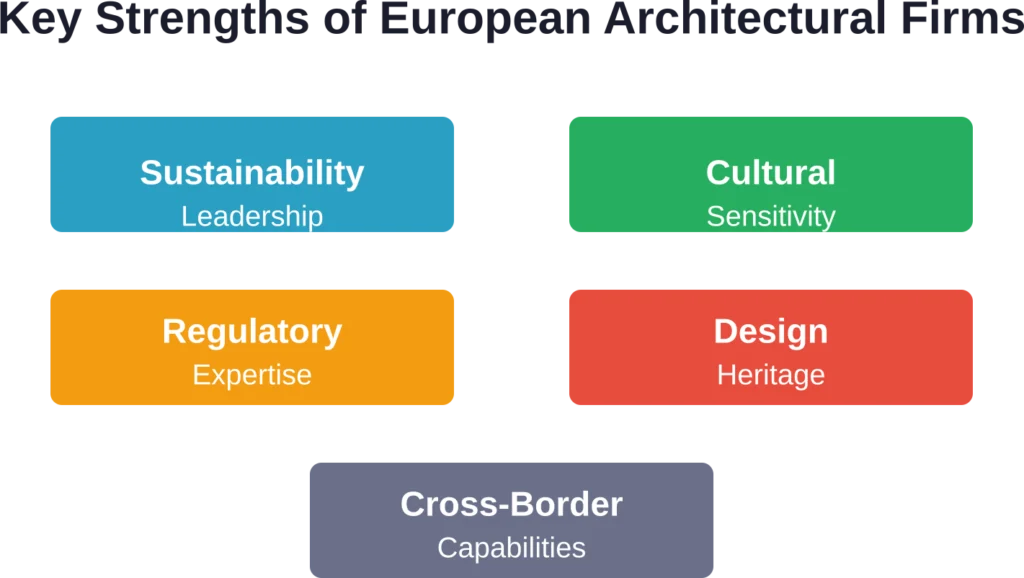
Geographic reach provides another differentiator. Pan-European firms bring valuable experience navigating different regulatory environments, construction practices, and cultural expectations. This versatility proves essential for multinational developers and institutions undertaking projects across borders.
Sustainability credentials have become non-negotiable. Every firm profiled here demonstrates expertise in energy-efficient design, sustainable materials, and environmentally responsible building practices. Many have dedicated research divisions exploring the future of green architecture.
How European Firms Compare Globally
European architectural engineering companies punch well above their weight on the world stage. Several of the firms listed here regularly appear on global rankings alongside American and Asian competitors.
The European approach tends to emphasize design heritage and contextual sensitivity. Where American firms might prioritize efficiency and scalability, European practices often invest more time in site analysis and integration with existing urban fabric. This doesn’t make one approach superior—just different.
Regulatory environments shape firm capabilities. European companies have become experts at navigating stringent energy codes, preservation requirements, and planning restrictions. This expertise translates well to other markets with similar regulatory complexity.
Real talk: European firms face challenges too. The fragmented market across dozens of countries creates complexity that doesn’t exist in more unified markets. Language barriers, varying professional certification requirements, and different construction standards all add friction.
That said, the best European firms have turned these challenges into competitive advantages. Their ability to work across cultural and regulatory boundaries makes them attractive partners for complex international projects.
The Top 11 Architectural Engineering Companies in Europe
Now, let’s explore the firms that define excellence in European architectural engineering. Each brings unique strengths and has left an indelible mark on the built environment.

1. Powerkh
Powerkh is a UK-based BIM and VDC consultancy with offices in the United States and Ukraine, supporting architectural and engineering teams across Europe. The company provides BIM modelling, design coordination, Scan to BIM, and technical support for residential, commercial, and industrial projects.
Their services include BIM modelling from LOD 100 to LOD 500, clash detection, constructability review, structural detailing, and coordination between architectural, structural, and MEP systems. Powerkh also works with point cloud data and existing building modelling for renovation and reconstruction projects.
The company uses Autodesk Revit, Navisworks, and BIM-based workflows to help teams improve coordination, manage project information, and support design and construction processes with more accurate models and documentation.
Contact Information:
- Website: www.powerkh.com
- Email: [email protected]
- Facebook: www.facebook.com/100064039650167
- LinkedIn: www.linkedin.com/company/powerkh
- Instagram: www.instagram.com/powerkh_com
- Address: 3, Lavinia Walk, Taw Hill, Swindon SN25 1AP
- Phone: +44 7490 426678

2. Arup
Founded in London in 1946, Arup has evolved into one of the world’s most respected multidisciplinary engineering and design firms. The company operates as an independent trust owned by its employees—a structure that encourages long-term thinking over short-term profits.
Arup’s European operations span dozens of offices from Scandinavia to the Mediterranean. The firm employs thousands of professionals globally, with a significant concentration in Europe handling projects across infrastructure, buildings, and urban planning.
What sets Arup apart is its deep technical expertise combined with design ambition. The firm has provided engineering services for some of Europe’s most iconic contemporary structures, including the Pompidou Centre in Paris and the Sydney Opera House (though designed before the firm’s major European expansion, it established the template for Arup’s integrated approach).
Sustainability runs through Arup’s DNA. The firm pioneered environmental engineering services decades before green building became mainstream. Today, Arup’s SPeAR sustainability appraisal tool helps clients evaluate project impacts across environmental, social, and economic dimensions.
Recent European projects showcase Arup’s range: the structural engineering for Copenhagen’s waste-to-energy plant topped with a ski slope, masterplanning for major urban regeneration schemes in Manchester and Birmingham, and complex infrastructure projects connecting European cities.

3. Foster + Partners
When people think of contemporary European architecture, Foster + Partners often comes to mind first. Founded by Norman Foster in London in 1967, the practice has become synonymous with high-tech architecture and innovative structural solutions.
Foster + Partners integrates architecture and engineering from the earliest design stages. This holistic approach produces buildings where structural systems, environmental controls, and aesthetic expression work in harmony rather than compromise.
The firm’s portfolio reads like a greatest-hits compilation of European architecture. The reconstructed Reichstag in Berlin, with its iconic glass dome, transformed a historic parliament building into a symbol of transparency and sustainability. The Millau Viaduct in France—while primarily an infrastructure project—demonstrates Foster’s ability to create elegance at monumental scale.
Urban projects represent another Foster + Partners strength. The practice has masterplanned entire districts, from business centers to residential neighborhoods, across European cities. These projects show sophisticated understanding of how buildings shape urban life and vice versa.
Sustainability innovation continues to drive the practice. Foster + Partners pioneered double-skin facades, natural ventilation strategies for tall buildings, and integrated renewable energy systems. The firm’s research division constantly explores emerging technologies and materials.

4. Zaha Hadid Architects
Zaha Hadid Architects brought a distinctive vision to European architecture—one characterized by flowing forms, dynamic geometries, and spaces that challenge conventional notions of how buildings should look and function. Though founder Zaha Hadid passed away in 2016, the practice continues under the leadership of Patrik Schumacher.
Based in London, ZHA has completed groundbreaking projects across Europe that push the boundaries of what’s possible in architectural engineering. The firm’s designs demand advanced structural engineering, often requiring custom software and fabrication techniques.
The MAXXI Museum in Rome exemplifies ZHA’s approach: a building where walls, floors, and ceilings flow into one another, creating dynamic spaces that feel alive. Achieving this required close collaboration between architects and engineers to develop structural systems that could realize the complex geometries.
Infrastructure projects have become a significant part of ZHA’s European portfolio. The firm designed striking transit stations, bridges, and port facilities that bring architectural ambition to utilitarian building types. These projects prove that infrastructure can inspire while serving practical needs.
Computational design tools enable much of ZHA’s work. The practice developed sophisticated parametric modeling capabilities that allow exploration of complex forms while ensuring structural feasibility and cost control. This technological expertise positions ZHA at architecture’s cutting edge.

5. Ramboll
Ramboll might not have the name recognition of some architecture-focused firms, but this Danish engineering consultancy ranks among Europe’s most capable multidisciplinary practices. Founded in 1945, Ramboll employs thousands of professionals across architecture, engineering, and management consulting.
The firm’s strength lies in integrating multiple engineering disciplines with architectural services. Ramboll handles structural, mechanical, electrical, environmental, and acoustical engineering in-house, enabling seamless coordination on complex projects.
Scandinavian projects showcase Ramboll’s design sensibility and technical prowess. The firm contributed to numerous Copenhagen developments that epitomize Danish design principles: clean lines, natural materials, and exceptional attention to user experience and environmental performance.
Infrastructure represents a core Ramboll competency. The firm has engineered bridges, tunnels, transit systems, and other civil works across Europe. These projects demand rigorous analysis and conservative engineering—domains where Ramboll excels.
Sustainability credentials run deep. Ramboll has provided environmental consulting and sustainable design services for decades. The firm developed proprietary tools for energy modeling, daylighting analysis, and life-cycle assessment that inform design decisions from the earliest stages.

6. BIG (Bjarke Ingels Group)
BIG burst onto the European architectural scene in the early 2000s with projects that combined playful formal inventiveness with pragmatic problem-solving. Founded by Danish architect Bjarke Ingels in Copenhagen in 2005, the firm has grown rapidly while maintaining a distinctive design philosophy.
BIG describes its approach as “pragmatic utopianism”—creating ambitious architectural visions that remain grounded in practical and economic realities. This philosophy produces buildings that surprise and delight while actually getting built and functioning well.
Copenhagen projects established BIG’s reputation. The Mountain Dwellings housing complex stacks residential units atop parking in a sloping structure that gives every apartment a terrace and garden. The 8 House creates a three-dimensional neighborhood with diverse housing types connected by continuous pedestrian paths.
International expansion brought BIG projects across Europe. The firm designed commercial developments, cultural institutions, and masterplans from Scandinavia to the Mediterranean. Each project responds to specific site conditions while maintaining BIG’s optimistic design sensibility.
Engineering innovation enables BIG’s architectural ambitions. The firm works closely with structural and environmental engineers to develop systems that support unconventional forms without excessive cost. This collaborative approach produces technically sophisticated buildings that don’t look or feel over-engineered.
7. AECOM
AECOM operates at enormous scale—a global infrastructure and design firm with significant European operations. While headquartered in the United States, AECOM’s European offices employ thousands of professionals handling projects across the continent.
The firm’s strength lies in its ability to deliver massive, complex projects that require coordinating numerous disciplines and stakeholders. AECOM can assemble teams spanning architecture, engineering, economics, environmental science, and program management for mega-developments.
Infrastructure dominates AECOM’s European portfolio. The firm has worked on major transport systems, water infrastructure, energy facilities, and urban regeneration programs. These projects showcase AECOM’s technical depth and project management capabilities.
Olympic and major sporting venue projects represent notable AECOM achievements. The firm contributed to London 2012 Olympic Park and numerous stadium and arena developments across Europe. These high-profile, deadline-driven projects demand the coordination expertise AECOM provides.
Urban design and masterplanning services complement AECOM’s engineering capabilities. The firm shapes entire districts and neighborhoods, integrating infrastructure, buildings, and public spaces into coherent urban environments. This comprehensive approach addresses cities’ complex, interconnected challenges.

8. Herzog & de Meuron
Basel-based Herzog & de Meuron has earned international acclaim for buildings that combine rigorous conceptual thinking with exquisite material sensibility. Founded in 1978 by Jacques Herzog and Pierre de Meuron, the practice has completed some of Europe’s most architecturally significant projects.
The firm’s approach emphasizes the expressive potential of materials and construction techniques. Herzog & de Meuron buildings often feature innovative uses of familiar materials—perforated copper, cast concrete, printed glass—deployed in ways that create new visual and spatial effects.
The Tate Modern conversion in London transformed a derelict power station into one of the world’s most visited museums. The project preserved the industrial building’s character while inserting contemporary gallery spaces—a delicate balance of preservation and innovation. The later extension added a dramatic twisted tower that reinterprets the original building’s material palette.
Stadium design has become a Herzog & de Meuron specialty. The firm’s Allianz Arena in Munich pioneered the use of ETFE cushions as building cladding, creating a structure that glows in team colors. This innovation has influenced stadium design worldwide.
European cultural institutions have provided canvases for some of Herzog & de Meuron’s most refined work. Museums, concert halls, and libraries across the continent demonstrate the practice’s ability to create buildings that serve functional needs while enriching urban life through architectural quality.

9. Sweco
Sweco, Europe’s largest architecture and engineering consultancy, might not grab headlines like star architect practices, but the Swedish firm’s impact on the built environment is immense. With thousands of employees across Europe, Sweco delivers thousands of projects annually.
The firm operates as a decentralized network of practices, each maintaining distinct identity while accessing shared resources and expertise. This structure allows Sweco to combine local market knowledge with broader technical capabilities and best practices.
Scandinavian sustainable design principles infuse Sweco’s work. The firm has pioneered energy-efficient building systems, green infrastructure, and circular economy approaches to construction. This expertise positions Sweco well as European regulations push toward net-zero buildings.
Infrastructure and urban planning represent core Sweco competencies. The firm shapes transportation systems, water management, energy distribution, and urban development across Northern and Central Europe. These projects require deep technical knowledge and stakeholder coordination skills Sweco has honed over decades.
Building projects span all sectors—commercial, residential, institutional, industrial. Sweco’s multidisciplinary teams handle architecture, structural engineering, MEP engineering, and sustainability consulting, providing integrated services that streamline project delivery and ensure coordination across disciplines.

10. Rogers Stirk Harbour + Partners
RSHP carries forward the high-tech architecture legacy established by Richard Rogers, whose work (including the Pompidou Centre and Lloyd’s Building) defined a generation of expressive structural design. The practice continues to create buildings where structure, services, and architecture merge into unified expressions.
Based in London, RSHP has completed projects across Europe that demonstrate technical innovation and commitment to urbanism. The firm’s buildings typically feature exposed structure, modular organization, and flexibility for future adaptation—principles derived from Rogers’ long-standing design philosophy.
The European Court of Human Rights in Strasbourg showcases RSHP’s mature approach. The building combines transparency (both literal and symbolic), sustainable design, and sophisticated engineering into architecture that expresses democratic values through form and technology.
Urban projects increasingly occupy RSHP’s attention. The practice has masterplanned major mixed-use developments that knit buildings, public spaces, and infrastructure into vibrant urban districts. These projects show sophisticated understanding of how architecture shapes urban life.
Sustainability has evolved from an add-on to a core driver of RSHP’s design process. The firm pioneered naturally ventilated office buildings, innovative facade systems, and integrated renewable energy. Recent projects push toward net-zero operation and embodied carbon reduction.

11. Snøhetta
Snøhetta approaches each project as a unique response to place, program, and culture. Founded in 1989 with offices in Oslo and New York, this Norwegian practice has built a reputation for thoughtful, contextual design that balances innovation with respect for site and community.
The firm’s European portfolio spans diverse building types and scales. From the Oslo Opera House—a public building that doubles as urban topography—to intimate interventions in sensitive historic contexts, Snøhetta demonstrates versatility and design intelligence.
Landscape integration defines much of Snøhetta’s work. Buildings often blur boundaries between interior and exterior, architecture and landscape. This approach creates rich spatial experiences while addressing environmental performance through passive design strategies.
Cultural projects showcase Snøhetta’s design refinement. Libraries, museums, and performance venues across Europe demonstrate the practice’s ability to create spaces that serve functional needs while enriching users’ experiences through architectural quality, natural light, and material warmth.
Sustainability manifests through design fundamentals rather than technological gimmicks. Snøhetta buildings typically feature excellent daylighting, natural ventilation, local materials, and careful site integration—strategies that reduce environmental impact while enhancing spatial quality. The firm’s Powerhouse Brattørkaia in Trondheim produces more energy than it consumes over its lifecycle.
Emerging Trends Shaping European Architectural Engineering
The firms profiled above aren’t resting on past achievements. They’re adapting to powerful trends reshaping how buildings get designed and delivered across Europe.
Digitalization and Computational Design
Building Information Modeling has moved from novelty to necessity. European firms now routinely develop detailed 3D models that integrate architectural, structural, and MEP systems. These models enable early clash detection, quantity takeoffs, and construction sequencing.
But BIM represents just the starting point. Advanced firms deploy parametric modeling tools that allow rapid exploration of design alternatives. Change one parameter—building height, floor plate size, facade module—and the model automatically updates dependencies throughout the design.
Generative design takes this further. Designers specify performance criteria and constraints, then algorithms generate and evaluate thousands of design options. This approach can reveal solutions humans might never conceive, particularly for complex optimization problems balancing multiple competing objectives.
Fabrication integration closes the digital loop. Many European projects now use design models to directly drive fabrication equipment—CNC mills, robotic arms, 3D printers. This integration enables complex geometries and mass customization while maintaining cost control.
Sustainability and Climate Response
European regulations increasingly mandate high-performance buildings. The EU’s Energy Performance of Buildings Directive requires all new buildings to be nearly zero-energy, with member states implementing progressively stricter requirements.
This regulatory pressure drives innovation in passive design strategies. Leading firms prioritize building orientation, thermal mass, natural ventilation, and daylighting before adding mechanical systems. These fundamentals often deliver better performance and user experience than technology-heavy approaches.
Embodied carbon has emerged as the next frontier. As operational energy use declines, the carbon emissions from materials and construction become proportionally more significant. Forward-thinking firms now conduct life-cycle carbon assessments and specify low-carbon materials.
Circular economy principles are gaining traction. Rather than designing for a single lifecycle, architects increasingly consider how buildings and components can be adapted, disassembled, and reused. This shift requires rethinking fundamental construction approaches.
Climate adaptation complements mitigation efforts. European firms design for more extreme weather—heavier rainfall, longer heat waves, stronger storms. This means better water management, passive cooling strategies, and resilient building systems.
Integrated Project Delivery
Traditional design-bid-build delivery increasingly gives way to more collaborative approaches. Design-build, construction management at-risk, and integrated project delivery methods bring architects, engineers, contractors, and sometimes clients into aligned teams.
These approaches can reduce conflicts, accelerate schedules, and improve outcomes. When everyone shares risk and reward, there’s greater incentive to solve problems collaboratively rather than passing blame and claims.
Early contractor involvement allows construction expertise to inform design. Builders can flag expensive details or suggest alternative approaches before designs get locked in. This dialogue typically produces more buildable, cost-effective designs.
Some European firms now offer expanded services spanning traditional professional boundaries. They might provide construction management, commissioning, or even facilities management—services that create continuity from design through building operation.
Choosing the Right Firm for Your Project
So you’ve learned about Europe’s leading architectural engineering companies. How do you determine which might be right for a specific project?
Start with project type and scale. The massive multidisciplinary consultancies excel at complex projects requiring coordination across numerous specialties. Smaller, design-focused practices might better suit projects where architectural vision drives success.
Geographic considerations matter. Firms with local presence understand regional regulations, construction practices, and supply chains. This knowledge can save time and money while reducing risk. That said, some projects benefit from outside perspective that challenges local conventions.
Review relevant project experience. Most firms showcase completed work on websites and in publications. Look for projects similar in type, scale, complexity, and ambition to yours. How well did the firm solve comparable challenges?
Understand the team structure. Will partners lead your project or delegate to junior staff? What’s the staffing plan across design phases? Meeting the specific people who’d work on your project reveals more than firm reputation alone.
Consider design process and philosophy. Some firms work collaboratively with clients and stakeholders; others prefer more authorial approaches. Some emphasize technical innovation; others prioritize user experience or environmental performance. Alignment on process and priorities helps ensure successful partnerships.
Request references and speak with past clients. Ask about communication, responsiveness, problem-solving, budget and schedule management, and overall satisfaction. Past clients provide insights you won’t get from marketing materials.
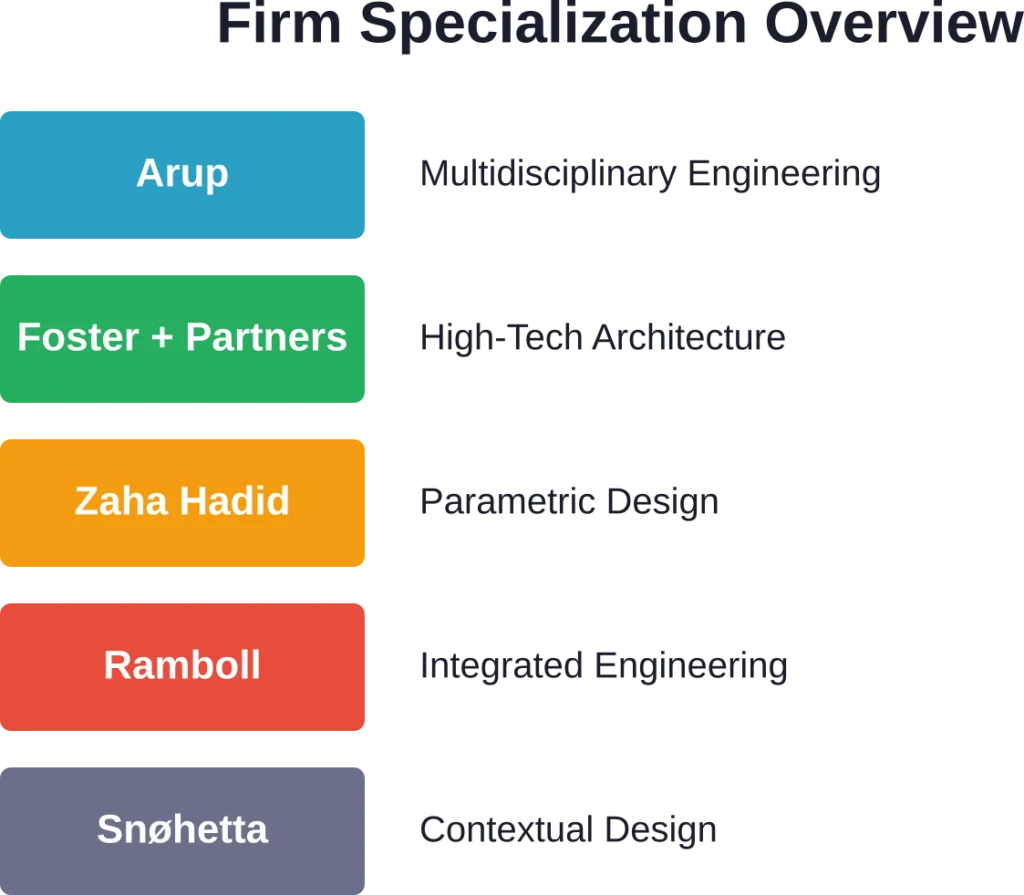
| Firm | Best Suited For | Notable Strengths | Primary European Locations |
|---|---|---|---|
| Arup | Complex multidisciplinary projects | Engineering depth, sustainability expertise | London, Amsterdam, Berlin, Madrid |
| Foster + Partners | High-profile civic and commercial buildings | Integrated design, structural innovation | London, Madrid, Paris |
| Zaha Hadid Architects | Iconic cultural and commercial projects | Parametric design, complex geometries | London |
| Ramboll | Infrastructure and large building projects | Engineering integration, Scandinavian design | Copenhagen, Stockholm, Oslo, Hamburg |
| BIG | Mixed-use and residential developments | Innovative typologies, pragmatic creativity | Copenhagen, London, Barcelona |
| AECOM | Mega-projects and urban masterplans | Scale, project management, multidisciplinary | London, Paris, Frankfurt, Milan |
| Herzog & de Meuron | Cultural institutions, adaptive reuse | Material innovation, architectural craft | Basel, Munich, Berlin |
| Sweco | Sustainable buildings and infrastructure | Technical breadth, local market knowledge | Stockholm, Helsinki, Oslo, Brussels |
| RSHP | Commercial and civic buildings | High-tech design, structural expression | London, Paris, Barcelona |
| Snøhetta | Context-sensitive cultural projects | Landscape integration, passive sustainability | Oslo, Innsbruck |
The Future of Architectural Engineering in Europe
Looking ahead, several forces will shape how European architectural engineering evolves over the coming years.
Artificial intelligence will increasingly augment design processes. Machine learning algorithms can already generate floor plans, optimize building performance, and even suggest aesthetic decisions based on learned preferences. The question isn’t whether AI will impact architecture, but how firms will integrate these tools while maintaining design judgment and creativity.
Prefabrication and modular construction are gaining market share. Off-site fabrication offers quality control, schedule certainty, and reduced site disruption. European firms are developing expertise in designing buildings that exploit these manufacturing advantages while avoiding the aesthetic monotony that plagued earlier prefab efforts.
Mass timber construction is experiencing a renaissance. Cross-laminated timber and other engineered wood products enable tall timber buildings with lower embodied carbon than concrete or steel alternatives. European architects and engineers are at the forefront of exploring timber’s potential.
Adaptive reuse will grow as sustainability priorities and heritage preservation converge. Converting existing buildings avoids the enormous carbon emissions associated with demolition and new construction. The best firms excel at inserting contemporary functionality while respecting existing character.
Healthy buildings have moved from niche concern to mainstream priority. Post-pandemic awareness of indoor air quality, biophilic design, and buildings’ impact on occupant wellbeing is driving new performance criteria. European firms are developing expertise in designing buildings that actively support human health.
The profession itself faces challenges. Architects have historically captured declining percentages of construction project value as delivery methods evolved and other consultants expanded scopes. European firms are responding by offering expanded services, embracing technology, and demonstrating measurable value beyond traditional architectural services.

Career Opportunities in European Architectural Engineering
The firms profiled here employ tens of thousands of professionals across diverse roles. Understanding career paths can help whether you’re entering the field or considering a move.
Traditional architectural roles remain foundational. Design architects develop concepts and lead aesthetic decision-making. Technical architects produce construction documentation and coordinate with consultants. Project architects manage teams and client relationships through project delivery.
Engineering specializations offer parallel tracks. Structural engineers design building frames and foundations. MEP engineers handle mechanical, electrical, and plumbing systems. Sustainability consultants assess environmental performance and advise on green building strategies.
Computational design specialists are increasingly valuable. These professionals develop parametric models, write custom software scripts, and apply data science techniques to architectural problems. Many hold backgrounds in both architecture and computer science.
Project managers keep complex projects on track. They coordinate schedules, budgets, teams, and stakeholders—skills that require understanding design and construction without necessarily leading aesthetic decisions.
Business development and marketing roles support firm growth. These professionals identify opportunities, prepare proposals, and maintain client relationships. Success requires understanding both architecture and business strategy.
Research positions exist at larger firms exploring emerging technologies, materials, and methods. These roles suit those interested in advancing the field rather than delivering individual projects.
Salary expectations vary significantly by location, role, and experience. According to LinkedIn discussions, architects in Germany, Italy, and Spain typically earn €70,000-€90,000, while professionals in the UK may command £100,000+. That said, substantial variation exists based on specialization and firm.
Frequently Asked Questions
Architectural engineering firms integrate multiple engineering disciplines—structural, mechanical, electrical, civil—with architectural design services. Pure architecture firms focus primarily on building design and may coordinate with separate engineering consultants. The firms profiled here offer varying degrees of integration, from full multidisciplinary services to architecture-led practices with close engineering partnerships.
Fee structures vary widely. Traditional percentage-of-construction-cost arrangements are common, typically ranging from 5-15% depending on project complexity and scope of services. Fixed fees provide cost certainty for well-defined projects. Time-and-materials billing applies when scope remains uncertain. Some firms offer alternative arrangements like value-based pricing or integrated project delivery models with shared risk and reward.
Most of the firms listed focus primarily on commercial, institutional, and infrastructure projects where their multidisciplinary capabilities and scale provide advantages. However, several—particularly BIG, Snøhetta, and Herzog & de Meuron—have completed notable residential developments. For custom single-family homes, smaller specialized residential architects often provide better service and value than large multidisciplinary firms.
The UK, Germany, Netherlands, Scandinavia (particularly Denmark and Sweden), and Switzerland host the most internationally competitive firms. These countries combine strong design traditions, technical education systems, supportive regulatory environments, and robust construction markets. Southern European countries including Spain and Italy maintain excellent architectural cultures but have faced economic challenges affecting firm growth.
All the firms profiled demonstrate commitment to sustainable design, though approaches vary. Some pioneered green building practices decades ago and continue leading environmental innovation. Others have strengthened sustainability credentials more recently in response to regulatory requirements and client demand. When environmental performance is a priority, review specific firm experience with certification systems like BREEAM, LEED, or Passive House, and ask about embodied carbon reduction strategies.
Timelines vary enormously based on project size, type, and complexity. A small commercial interior might take 6-12 months from design through construction. A mid-size institutional building typically requires 2-3 years. Major infrastructure or complex urban developments can span 5-10 years or longer. Regulatory approval processes, particularly in historic districts or environmentally sensitive sites, often extend schedules beyond pure design and construction duration.
Yes, most of the firms profiled maintain global practices with projects across multiple continents. Several rank among the world’s largest architecture and engineering firms, not just European leaders. The largest firms operate offices worldwide, while smaller practices often partner with local firms for projects outside their home markets. This international experience enables them to bring global best practices while adapting to local conditions.
Conclusion
Europe’s architectural engineering landscape offers remarkable depth and diversity. From massive multidisciplinary consultancies delivering complex infrastructure to design-focused practices creating cultural landmarks, the firms profiled here represent the continent’s finest.
What unites these diverse practices is commitment to excellence. Whether through technical innovation, design creativity, sustainability leadership, or delivery reliability, each firm has earned its reputation through decades of outstanding work.
The built environment faces unprecedented challenges—climate change, urbanization, resource constraints, social equity. European architectural engineering firms are responding with innovation in materials, methods, and mindsets. They’re proving that buildings can perform better environmentally while enriching human experience.
Choosing among these firms requires careful consideration of project needs, design priorities, and working relationships. There’s no universally “best” firm—only the right fit for specific circumstances. Take time to understand each firm’s strengths, review relevant experience, and meet the teams who’d actually deliver your project.
The future of architectural engineering looks both challenging and exciting. Technology will transform how buildings get designed and built. Sustainability will shift from optional to essential. New materials and construction methods will enable previously impossible projects. Through it all, the human element—creativity, judgment, collaboration—will remain irreplaceable.
Whether you’re planning a major development, exploring career options, or simply interested in the forces shaping European cities, understanding these leading firms provides valuable perspective. They’re not just designing buildings—they’re shaping how Europeans will live, work, and experience the built environment for generations to come.
Ready to explore architectural engineering partnerships? Start by reviewing the firms profiled here, examining their completed projects, and reaching out to discuss your specific needs. The right collaboration can transform vision into reality and create architecture that endures.