

Quick Summary: AI tools have become essential infrastructure for ecommerce businesses in 2026, with platforms shifting from experimental add-ons to core revenue drivers. The highest-impact solutions span customer support automation, personalization engines, content generation, and conversion optimization. According to NRF data, digitally influenced sales now exceed 60%, and by end of 2026, 40% of enterprise applications will include task-specific AI agents.
The ecommerce AI landscape has matured dramatically. What started as experimental chatbots and basic recommendation engines has evolved into sophisticated systems that handle customer conversations, optimize pricing in real-time, and generate entire marketing campaigns.
But here’s the challenge: the marketplace is crowded. Hundreds of vendors promise AI-powered transformation, yet many deliver incremental improvements at best.
This guide cuts through the noise. It focuses on tools that demonstrate measurable impact on revenue and retention, backed by data from authoritative sources including the National Retail Federation and academic research on AI integration in ecommerce business models.
The 2026 Ecommerce AI Landscape
According to IDC, artificial intelligence spending grew 20.7% worldwide in 2021, and the trajectory has only accelerated. According to IDC, China’s artificial intelligence market is projected to exceed $26.7 billion by 2026, with significant investment flowing into retail applications.
More telling: digitally influenced sales currently exceed 60%. NRF research indicates that by the end of 2026, 40% of enterprise applications will include task-specific AI agents.
The shift is fundamental. AI has moved from back-office experiments to customer-facing roles that directly influence conversion rates, average order value, and lifetime customer value.
Real talk: this isn’t about replacing human teams. It’s about augmenting capacity so a five-person support team can handle the volume of fifty, or a solo founder can launch campaigns that look like they came from a full marketing department.
Content Creation and Copywriting
Content production bottlenecks limit growth. AI writing assistants have evolved from clunky template-fillers to genuinely useful tools for generating product descriptions, email campaigns, ad copy, and blog content.
Extuitive — AI Ad Creative Predictor & Tester

Extuitive is a platform that predicts ad performance before you launch any campaign. It analyzes creatives (images, videos, copy) and forecasts CTR, ROAS, engagement, and conversion rates using models trained on real campaign data and 150,000+ AI agents simulating consumer behavior.
What makes Extuitive practical: It lets you validate dozens or hundreds of creatives before spending a single dollar on testing. Shopify integration automatically pulls products and audiences.
Teams use Extuitive to rapidly test large volumes of ads and immediately identify the top performers worth scaling. This dramatically cuts wasted ad spend and speeds up campaign launches.
Pricing: Starts at $99/month (check extuitive.com for latest plans).
Contact Information:
- Website: extuitive.com
- Email: [email protected]
- LinkedIn: www.linkedin.com/company/extuitive
- Twitter: x.com/Extuitive_Inc
- Instagram: www.instagram.com/extuitiveinc
Jasper AI — AI Copywriting Platform

Jasper focuses on marketing copy: ad headlines, email sequences, landing page text, social media posts, and long-form content. The platform includes templates for common ecommerce needs—abandoned cart emails, product launch announcements, seasonal campaign copy.
What makes Jasper practical: it learns brand voice. Feed it existing content, set tone parameters, and the AI adapts output to match. A luxury skincare brand gets different copy than a budget electronics retailer, even when using identical templates.
Teams use Jasper to accelerate drafting, not replace writers entirely. A marketer generates five variations of an email subject line in seconds, picks the strongest, refines it, and ships. Testing shows AI-assisted teams produce campaigns 30-50% faster than manual workflows.
Basic pricing starts at $39/month for individual creators. Team and enterprise plans scale based on usage and collaboration features.
Copy.ai — AI Content Generation

Copy.ai takes a collaborative approach: teams brainstorm inside the platform, developing campaigns from initial brief through final ad copy and supporting content.
The tool generates multiple variations quickly, which is valuable for A/B testing. Instead of manually writing five subject lines, generate twenty, filter to the five strongest, test them, and iterate based on results.
It’s designed for collaboration, allowing teams to work together on campaign development within a single environment. Pricing starts around $49/month depending on plan tier; check their site for current rates.
Predis.ai — AI Social Media Content

Social media demands constant content production. Predis.ai generates posts, captions, hashtags, and even short-form video scripts tailored to platform requirements.
The AI analyzes what performs well on Instagram versus LinkedIn versus TikTok and adjusts output accordingly. A product launch announcement gets reformatted for each channel with platform-appropriate length, tone, and visual suggestions.
Ecommerce brands report saving 10-15 hours per week on social content production, reallocating that time to strategy and community engagement instead of caption writing.
Customer Support and Service Automation
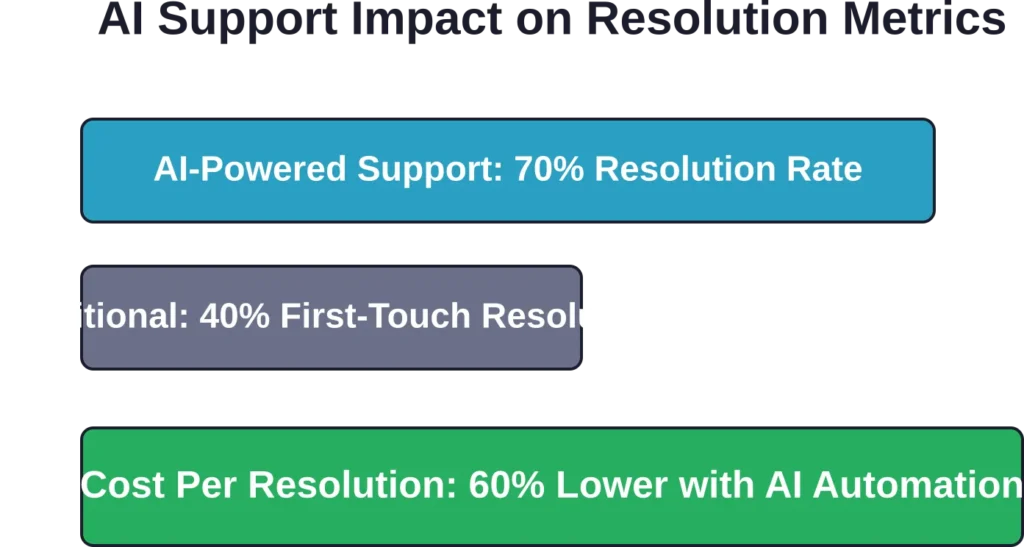
Customer support represents the highest-ROI application of AI for most ecommerce businesses. The math is straightforward: every resolved ticket costs time and money, and AI-powered agents now handle routine inquiries at a fraction of the cost.
Gorgias — AI Helpdesk Built for Ecommerce

Gorgias has become the standard AI helpdesk for Shopify stores and broader ecommerce platforms. The system integrates directly with order management, pulling customer data, purchase history, and shipping status into every conversation.
The AI engine handles common questions—order tracking, return policies, product availability—without human intervention. When escalation is needed, the handoff includes full context so human agents don’t waste time gathering information.
Stores using AI-powered support report resolution time improvements while maintaining or improving customer satisfaction scores.
Pricing varies by ticket volume and features. Check Gorgias’s official site for current plan details, as tiers and capabilities update frequently.
Tidio (Lyro AI Chatbot) — Conversational AI for SMBs

Tidio’s Lyro AI targets small to mid-size businesses that need capable automation without enterprise complexity. The chatbot learns from conversation history and adapts responses based on successful resolution patterns.
What makes Lyro practical: setup takes minutes, not weeks. The AI starts with general ecommerce knowledge and refines its understanding as it processes more customer inquiries specific to the business.
Using AI chatbots can improve lead conversions, largely because response times drop from hours (or days) to seconds.
Lyro AI pricing starts at $39/month.
Fin AI — Deep-Learning Support Agent

Fin AI takes a different approach: rather than handling every inquiry, it focuses on high-confidence resolutions. The system analyzes incoming questions, determines if it can resolve the issue completely, and only engages when certainty is high.
This design reduces the risk of incorrect answers or frustrated customers stuck in bot loops. When Fin doesn’t have confidence, it routes immediately to human agents with full context and suggested responses.
The platform aims for high resolution rates for businesses with well-documented FAQs and knowledge bases, which means the majority of customer inquiries never require human intervention.
Personalization and Recommendation Engines
Generic product recommendations are table stakes. Modern personalization engines analyze browsing behavior, purchase history, demographic data, and real-time session activity to surface the right products at the right moment.
Nosto — AI Product Recommendations

Nosto specializes in on-site personalization: dynamic product recommendations, personalized category pages, and individualized content blocks that adapt to each visitor.
The platform tracks anonymous visitors and known customers, building behavioral profiles that inform what gets displayed. A first-time visitor sees trending products and bestsellers. A returning customer who’s browsed winter coats three times sees those coats featured prominently with complementary items.
Implementation requires embedding Nosto’s JavaScript and configuring recommendation logic. The AI learns continuously, adjusting recommendations based on what actually drives conversions for specific customer segments.
Brands using advanced personalization report meaningful conversion improvements on personalized landing pages compared to static layouts.
ViSenze — AI Visual Search

Visual search changes how customers discover products. Instead of text queries, shoppers upload images—a screenshot from Instagram, a photo of a friend’s outfit—and ViSenze’s AI identifies similar items in the catalog.
The technology uses computer vision to analyze colors, patterns, shapes, and styles. Results surface visually similar products even when textual descriptions differ.
This matters for fashion, home decor, and lifestyle brands where aesthetic fit matters more than keyword matches. Customers don’t need to know the term “mid-century modern walnut credenza”—they just upload a photo and find what they want.
Email Marketing and Lifecycle Automation
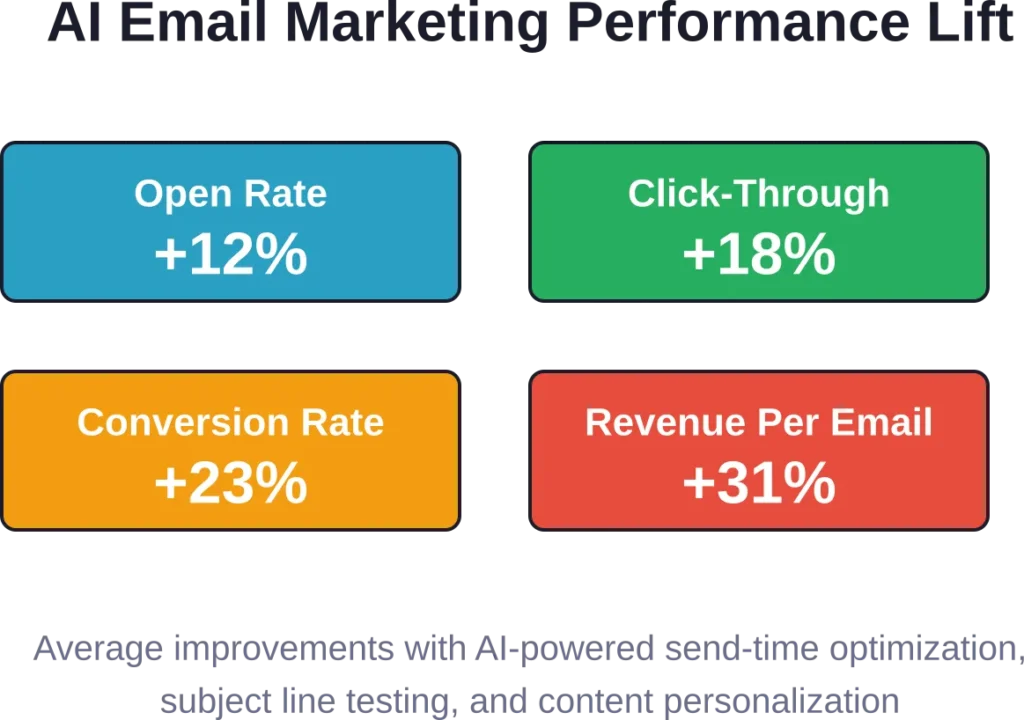
Email remains the highest-ROI channel for most ecommerce businesses. AI elevates email from batch-and-blast to hyper-personalized lifecycle marketing that adapts to individual customer behavior.
Klaviyo — AI-Powered Email and SMS

Klaviyo dominates ecommerce email marketing, and recent AI features push personalization further. The platform predicts optimal send times per individual, recommends products based on purchase probability, and generates subject lines optimized for each recipient segment.
The AI analyzes engagement patterns: when does this customer typically open emails? What product categories have they browsed? How price-sensitive are they based on past purchase behavior? Klaviyo uses these signals to customize content, timing, and offers.
Stores using AI-driven send-time optimization report open rate improvements compared to static send schedules.
Klaviyo pricing scales with contact count. Review their official pricing page for current tier details.
Campaign Monitor — AI Email Design and Optimization

Campaign Monitor emphasizes design and deliverability. AI features include subject line analysis, content suggestions based on engagement data, and automated segmentation that groups contacts by predicted behavior.
The platform’s design tools use AI to suggest layouts, color schemes, and content blocks that align with brand guidelines while optimizing for conversion. Non-designers can produce professional campaigns without starting from scratch.
Essential plan starts at $155/month, with pricing adjustments based on contact volume and feature requirements.
Conversion Optimization and Lead Capture
Converting anonymous traffic into known contacts represents the single highest-leverage moment in the ecommerce funnel. AI-powered popup and conversion tools optimize this moment with precision.
Alia Popups — AI-Powered Lead Capture for Shopify

Alia approaches popups differently: instead of time-based or scroll-depth triggers, the AI analyzes over half a billion popup views to identify the optimal conversion moment for each visitor.
The system considers session behavior, traffic source, device type, browsing patterns, and dozens of other signals. It predicts when a visitor is most likely to convert and displays the popup at that precise moment.
This approach demonstrates improvements in signups compared to basic exit-intent popups. The AI engine continues learning, with the AI engine growing by 100 million views per month to refine timing models.
Alia’s basic plan starts at $100/month for up to 20,000 monthly visitors, with fully managed plans at $200/month that include expert optimization.
TxtCart — AI Conversational SMS Recovery

Abandoned cart recovery via SMS outperforms email for many ecommerce brands. TxtCart uses AI to generate conversational text messages that feel personal rather than automated.
The platform analyzes cart contents, customer history, and engagement patterns to craft recovery messages with appropriate urgency, tone, and offers. A high-value cart from a repeat customer gets different messaging than a first-time browser abandoning a low-value cart.
Brands report higher SMS recovery rates than email-only campaigns, largely due to open rates exceeding 90% and response times measured in minutes rather than hours.
Textline — AI-Powered Business SMS

Textline handles broader business SMS beyond cart recovery: order updates, shipping notifications, customer service conversations, and promotional campaigns. AI features include message suggestions, automated routing, and sentiment analysis.
The platform identifies urgent inquiries and escalates them appropriately. A frustrated customer expressing dissatisfaction routes to senior support; a simple tracking question gets an automated response with shipment details.
Starts at $50/month for up to 300 tickets, scaling based on volume.
Analytics and Business Intelligence
Data without insight is noise. AI-powered analytics platforms surface actionable patterns that manual analysis misses.
Peel Insights — AI Ecommerce Analytics

Peel connects to Shopify, Google Analytics, and marketing platforms to create unified dashboards showing customer acquisition costs, lifetime value, retention cohorts, and revenue attribution.
The AI identifies trends automatically: “Your retention rate for customers acquired via Facebook ads is declining” or “Orders from iOS users have 22% higher average value than Android.” These insights drive immediate action rather than requiring data science expertise.
Pricing is tier-based, starting at $12/month and scaling to $159/month depending on store size and feature requirements.
Heatmap — AI Revenue-Attributed Analytics

Heatmap focuses on on-site behavior: where do visitors click, scroll, rage-click, or abandon? Traditional heatmap tools show activity; Heatmap’s AI connects behavior to revenue outcomes.
The platform identifies which page elements drive conversions versus which get attention but don’t convert. A hero image might attract clicks, but if visitors who engage with it convert at lower rates, that’s actionable insight.
Revenue attribution means teams prioritize optimization efforts on elements that actually impact bottom-line performance, not just vanity metrics like click-through rates.
SEO and Content Optimization
Organic search remains a critical acquisition channel. AI tools analyze search intent, competitive landscapes, and content performance to guide optimization decisions.
Surfer SEO — AI Content Optimization

Surfer analyzes top-ranking pages for target keywords and provides specific guidance: keyword density, content length, heading structure, semantic keyword inclusion, and readability scores.
The tool doesn’t just identify gaps—it scores content in real-time as writers work. A content score climbs from 42 to 78 as recommended keywords get incorporated and structural improvements are made.
Ecommerce teams use Surfer SEO for content optimization, analyzing top-ranking pages and providing guidance on keyword density, content length, heading structure, and readability.
Tier-based pricing starts around $29/month for basic plans, scaling based on content volume and features.
Pricing and Competitive Intelligence
Dynamic pricing adjusts based on competitor prices, demand signals, inventory levels, and market conditions. Manual price monitoring can’t keep pace; AI handles it continuously.
Prisync — AI Dynamic Pricing

Prisync tracks competitor pricing across the web, monitoring hundreds or thousands of SKUs and alerting when prices change. The AI recommends pricing adjustments based on competitive positioning strategy—maintain premium pricing, match market median, or undercut by specific margins.
The platform connects to ecommerce backends to automate price updates, ensuring competitive positioning without constant manual intervention. Brands report margin improvements through optimized pricing that responds to market conditions in real-time.
Pricing varies based on SKU count and update frequency; contact Prisync for current plan details.
Design and Visual Content
Product photography and visual content production consumes significant resources. AI tools accelerate creation while maintaining quality.
Canva — AI-Powered Design

Canva’s AI features include background removal, image enhancement, design suggestions, and template customization. Non-designers produce professional social graphics, email headers, ad creatives, and promotional banners.
The Magic Resize feature adapts designs across formats—create an Instagram post, then automatically generate Facebook, Pinterest, and Twitter versions with optimized dimensions and layouts.
Canva offers a free plan with limited features. Pro plans start at approximately $12.99/month for individuals, with team and enterprise options available.
Photoroom — AI Background Removal and Product Photography

Photoroom specializes in product images: remove backgrounds, adjust lighting, add shadows, and create clean, professional shots without studio equipment.
Ecommerce sellers photograph products on any surface, upload to Photoroom, and get studio-quality images with white backgrounds in seconds. The AI handles edge detection, transparency, and lighting adjustments automatically.
Photoroom offers a free plan with limited features. The Pro plan starts at $7.50/month, providing unlimited background removals and advanced editing capabilities.
Building Your AI Stack: Strategic Considerations
Assembling the right combination of AI tools requires strategic thinking. Not every tool fits every business, and more tools don’t automatically mean better results.
Start With Revenue-Impacting Functions
Prioritize tools that directly influence revenue: customer support (reduces costs, improves satisfaction), personalization (increases conversion rates), and email marketing (drives repeat purchases).
Back-office automation matters, but customer-facing AI delivers faster, more measurable ROI. A chatbot that resolves 60% of inquiries pays for itself within weeks. An AI-powered analytics dashboard provides value but requires interpretation and action to impact revenue.
Evaluate Integration Complexity
Tools that don’t integrate create data silos and manual workflows. Prioritize platforms that connect to existing systems—Shopify, WooCommerce, email marketing platforms, CRM systems.
Check for native integrations first. Zapier and similar middleware solutions work, but they add complexity and potential failure points. Native integrations are maintained by vendors and typically more reliable.
Consider Team Capacity and Expertise
Some AI tools require significant setup, training data preparation, and ongoing optimization. Others work out-of-the-box with minimal configuration.
A solo founder or small team benefits from turnkey solutions like Tidio or Jasper. Larger teams with technical resources can leverage more sophisticated platforms like custom-trained recommendation engines or advanced personalization systems.
Calculate True Total Cost
Subscription fees represent only part of the cost equation. Implementation time, training, integration development, and ongoing optimization all consume resources.
A $50/month tool that saves 20 hours of manual work delivers better ROI than a $500/month platform that requires 10 hours of weekly management.
| Evaluation Criteria | High Priority | Medium Priority | Lower Priority |
|---|---|---|---|
| Revenue Impact | Direct conversion influence | Indirect revenue support | Operational efficiency only |
| Integration Ease | Native platform connections | API or middleware available | Manual data export/import |
| Setup Time | Live within 1 day | Live within 1 week | Requires ongoing development |
| Team Requirements | No technical expertise needed | Basic technical knowledge | Dedicated technical resources |
| Cost Efficiency | ROI positive within 60 days | ROI positive within 6 months | Strategic long-term investment |
The Data Loop: Connecting AI Tools for Compound Value
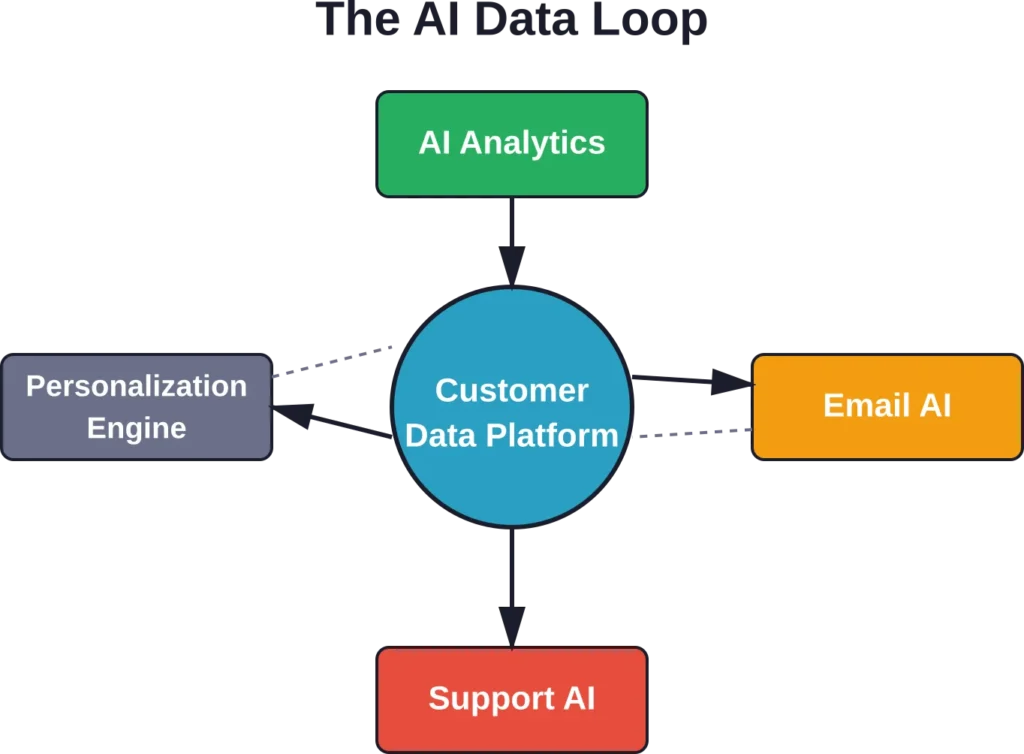
Individual tools provide value. Connected tools create compound effects. The most sophisticated ecommerce operations build data loops where AI systems feed insights to each other.
Here’s how it works: analytics platforms identify high-value customer segments. Personalization engines use those segments to customize product recommendations. Email marketing platforms send targeted campaigns to those segments. Customer support AI prioritizes inquiries from high-value segments.
Each system improves the others. Better segmentation drives better personalization. Better personalization generates more conversion data. More conversion data refines segmentation.
This requires intentional architecture. Choose tools that share data formats, connect via APIs, or integrate through a customer data platform (CDP) that serves as a central hub.
Common Implementation Pitfalls
Even the best AI tools fail when implementation is poor. Avoid these common mistakes:
Insufficient Training Data
AI systems learn from data. Insufficient volume or poor-quality data produces unreliable results. A recommendation engine needs thousands of orders to identify meaningful patterns. A chatbot requires comprehensive FAQs and conversation history to handle inquiries effectively.
Before implementing AI tools, audit available data. If historical data is limited, consider starting with simpler rule-based systems and transitioning to AI as data accumulates.
Ignoring Edge Cases
AI handles common scenarios well but struggles with exceptions. A chatbot trained on US customers might fail with international shipping questions. A pricing algorithm optimized for regular inventory doesn’t handle limited-edition drops appropriately.
Build escalation paths for edge cases. Monitor AI performance continuously and refine training data to incorporate new scenarios.
Over-Automation Without Oversight
Automation without monitoring creates risk. An AI pricing tool that drops prices too aggressively erodes margins. A chatbot that provides incorrect information damages customer trust.
Implement gradually. Start with AI-assisted workflows where humans review recommendations before execution. Transition to full automation only after validating accuracy and outcomes.
Neglecting Customer Experience
Efficiency metrics—resolution time, cost per ticket, automation rate—matter, but customer satisfaction matters more. An AI chatbot that resolves 80% of inquiries but frustrates customers creates long-term damage for short-term efficiency gains.
Monitor satisfaction scores, review customer feedback, and watch for patterns indicating AI failures. When customers repeatedly ask to speak with humans, that’s a signal the AI needs refinement.
Looking Ahead: AI Trends Shaping 2026 and Beyond
The AI ecommerce landscape continues evolving rapidly. Several trends are reshaping what’s possible:
Agentic AI Takes Action
Current AI tools analyze and recommend; agentic AI takes action across systems. By the end of 2026, 40% of enterprise applications will include task-specific AI agents.
These agents don’t just identify a pricing opportunity—they adjust prices. They don’t just recommend a customer segment—they create and launch the campaign. According to Gartner, in a best-case scenario, agentic AI could generate nearly 30% of enterprise application software revenue by 2035.
Voice and Conversational Commerce
Voice-based shopping remains nascent but growing. AI voice assistants handle reorders, answer product questions, and guide discovery through conversational interfaces.
The technology improves as natural language processing advances. Current limitations—difficulty handling complex queries, accent recognition challenges—diminish as models train on more diverse data.
Predictive Inventory and Supply Chain Optimization
AI forecasting models predict demand with increasing accuracy, enabling leaner inventory and reduced stockouts. The systems consider seasonal patterns, trend signals from social media, economic indicators, and historical data to project future demand.
Ecommerce businesses reduce carrying costs while maintaining availability, improving cash flow and customer satisfaction simultaneously.
Hyper-Personalization at Scale
Personalization is moving beyond product recommendations to individualized pricing, custom product configurations, and unique shopping experiences for each visitor.
The technology exists; the limitation is data quality and integration. Brands that build robust customer data platforms and connect AI systems effectively will deliver experiences that feel individually crafted, even at massive scale.
| AI Tool Category | Primary Benefit | Typical ROI Timeline | Best For |
|---|---|---|---|
| Customer Support AI | Cost reduction, faster resolution | 30-60 days | Stores with high ticket volume |
| Personalization Engines | Higher conversion rates, AOV | 60-90 days | Catalogs with 100+ SKUs |
| Email Marketing AI | Improved retention, repeat purchases | 45-90 days | Established customer bases |
| Content Generation | Production speed, testing velocity | Immediate | Content-heavy marketing strategies |
| Analytics and BI | Better decision-making | 90-180 days | Data-driven organizations |
| Conversion Optimization | Lead capture, reduced CAC | 30-45 days | Paid acquisition strategies |
FAQ: Essential Ecommerce AI Tools
Customer support automation typically delivers the fastest and most measurable ROI. AI chatbots and helpdesk tools like Gorgias or Tidio reduce support costs significantly while maintaining or improving customer satisfaction. The impact appears immediately in reduced ticket volume and faster resolution times, making ROI clear within 30-60 days.
Small businesses often see proportionally larger benefits because AI democratizes capabilities previously available only to large teams. A solo founder using Jasper AI for content creation or Tidio for customer support gains capacity that would otherwise require hiring additional staff. Many AI tools offer affordable entry-level plans starting at $39-50/month, making them accessible to businesses of all sizes.
Start with tools that directly impact revenue: customer support (reduces costs, improves satisfaction), conversion optimization (increases lead capture), and email marketing (drives repeat purchases). Evaluate based on your biggest bottleneck—if customer inquiries overwhelm your team, prioritize support AI; if email campaigns are manual and infrequent, prioritize email automation. Check integration compatibility with existing platforms before committing.
Most modern AI tools offer integrations with major ecommerce platforms (Shopify, WooCommerce, BigCommerce) and marketing platforms (Klaviyo, Mailchimp, HubSpot). Check for native integrations first, as they’re more reliable than middleware solutions. Many vendors provide detailed integration documentation and setup support. Request demos or trial periods to validate integration functionality before purchasing.
The primary risks are degraded customer experience and lack of human oversight. AI chatbots that can’t escalate complex issues frustrate customers. Pricing algorithms without guardrails can erode margins. Content generators without human editing produce generic copy that damages brand voice. Mitigate risks by implementing gradually, monitoring performance continuously, maintaining human oversight for critical functions, and building escalation paths for edge cases AI can’t handle.
Budget depends on business size and complexity, but expect $200-500/month for small businesses (under $500K annual revenue) covering essentials like chatbot, email AI, and basic analytics. Mid-size businesses ($500K-$5M revenue) typically allocate $500-2,000/month for comprehensive AI coverage across support, personalization, content, and analytics. Larger operations invest $2,000-10,000+/month for enterprise-grade platforms and advanced capabilities. Calculate ROI based on time saved and revenue impact rather than treating AI tools as pure expense.
AI augments human capabilities rather than replacing teams entirely. Support AI handles routine inquiries, freeing human agents for complex issues requiring empathy and judgment. Content AI accelerates drafting, but humans refine and maintain brand voice. Personalization AI analyzes data patterns, but humans set strategy and interpret insights. The most effective approach combines AI efficiency with human creativity, judgment, and relationship-building. Expect role evolution rather than wholesale replacement—teams shift from execution to strategy and oversight.
Conclusion: Building Your AI-Powered Ecommerce Engine
The ecommerce AI landscape in 2026 offers unprecedented capability. Tools that were experimental two years ago are now battle-tested infrastructure driving measurable revenue and efficiency gains.
The opportunity is clear: digitally influenced sales exceed 60%, AI spending continues to grow at significant rates, and 40% of enterprise applications will include AI agents by end of 2026. Businesses that integrate AI thoughtfully gain compound advantages as systems learn and improve.
But success requires strategic thinking. Start with high-impact tools that directly influence revenue. Prioritize integration and data quality. Implement gradually with human oversight. Monitor performance continuously and refine based on results.
The best AI stack isn’t the one with the most tools—it’s the one where each component delivers measurable value and systems connect to create compound effects.
Ready to build your AI-powered ecommerce engine? Start with one tool in your biggest bottleneck area. Validate impact. Expand from there. The businesses winning in 2026 didn’t implement everything at once—they built systematically, measured ruthlessly, and scaled what worked.