

Quick Summary: This comprehensive guide profiles 15 leading Golang web development companies recognized for their technical expertise, scalability-focused solutions, and proven track records. Each agency brings unique strengths in building high-performance applications using Go’s concurrency and efficiency advantages, spanning fintech, SaaS, microservices, and enterprise solutions across global markets.
Golang has cemented its position as a backend powerhouse. Companies that need fast, scalable, concurrent systems turn to Go—and they need skilled development partners to make it happen.
But here’s the challenge: not every development shop truly understands Go’s concurrency model, or knows how to architect systems that leverage goroutines effectively. The ecosystem is specialized, and finding the right partner matters.
This list highlights 15 agencies that have built their reputations on delivering Golang solutions. No fluff, no fabricated reviews—just companies with verifiable portfolios, technical depth, and client work that speaks for itself.
Why Companies Choose Golang for Web Development
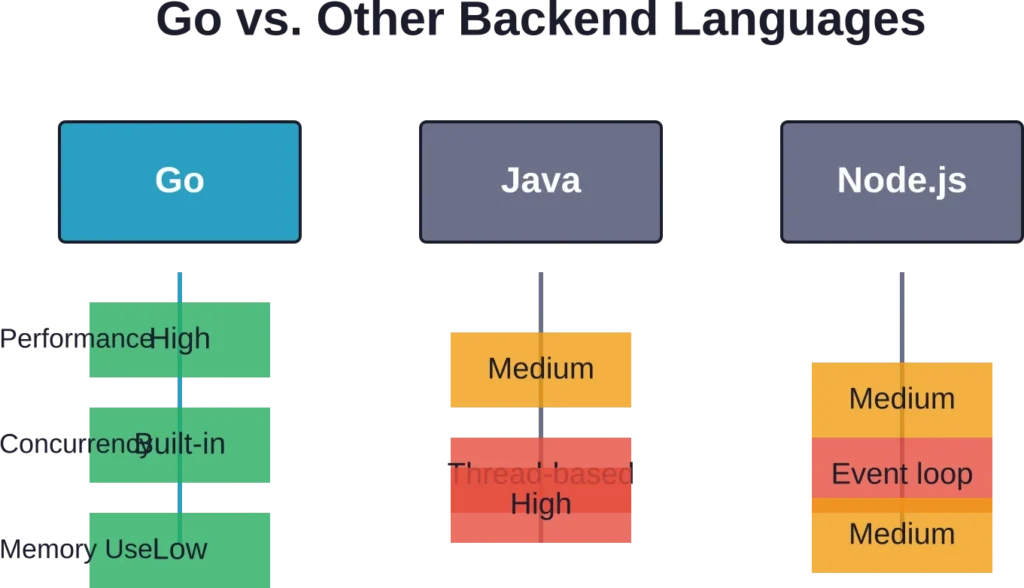
Go solves specific problems exceptionally well. Built-in concurrency through goroutines and channels makes it ideal for services that handle thousands of simultaneous connections. The language compiles to native binaries, eliminating runtime dependencies and simplifying deployment.
Memory efficiency stands out. Go’s garbage collector is designed for low-latency scenarios, and applications typically consume far less RAM than equivalent Node.js or Java services. For startups watching cloud bills, that difference compounds quickly.
The standard library deserves mention. Package net/http provides production-ready HTTP server capabilities out of the box—no framework required for basic services. Many companies run substantial APIs on nothing but the standard library.
Real-World Performance Characteristics
Industry analyses indicate that Go services commonly handle 10,000+ concurrent connections on modest hardware. The goroutine scheduler efficiently multiplexes thousands of lightweight threads onto a handful of OS threads.
Startup time matters for containerized environments. Go binaries boot in milliseconds, compared to seconds for JVM-based languages. That responsiveness translates directly to faster autoscaling and better resource utilization in Kubernetes clusters.
Build times stay manageable even as codebases grow. The compiler is fast—full rebuilds that take minutes in other languages complete in seconds with Go. Developer velocity benefits accordingly.
Best Use Cases for Golang
Microservices architectures benefit enormously. Go services boot fast, scale horizontally with ease, and communicate efficiently over HTTP or gRPC. The ecosystem around service meshes and cloud-native tooling is Go-first.
API gateways and reverse proxies represent another sweet spot. High throughput, low latency, minimal resource footprint—Go checks every box. Major infrastructure projects like Kubernetes and Docker are written in Go for good reason.
Real-time systems and streaming pipelines leverage Go’s concurrency primitives. WebSocket servers, chat systems, live dashboards, and event processing all map naturally to goroutines and channels.
Command-line tools and DevOps utilities are common Go applications. Cross-compilation to multiple platforms from a single codebase, plus single-binary distribution, make Go ideal for tooling.
Top 15 Golang Web Development Companies
These agencies represent the spectrum of Golang expertise available in 2026. Each brings distinct strengths to the table.
1. Oski
Oski delivers smart, well-engineered software solutions with strong capabilities in Golang web development for enterprises and ambitious startups. They focus on cloud-native applications, scalable web architectures, and digital transformation projects.
Their approach leverages modern engineering practices and AI-accelerated development to deliver robust Go-based systems faster while maintaining high quality and architectural excellence.
Technical strengths include backend development with Go, cloud and serverless architectures, API platforms, microservices, and integration with modern frontend frameworks. They excel at building secure, scalable web solutions across multiple industries.
Notable work spans digital platforms for travel, logistics, e-commerce, education, fintech, and insurance sectors, delivering high-performance web applications and backend systems that power critical business operations.
Contact Information:
- Website: oski.site
- Phone: +48571282759
- Email: [email protected]
- Address: Kaupmehe tn 7, 10114 Tallinn, Estonia
- LinkedIn: www.linkedin.com/company/oski-solutions
2. Lengreo
Lengreo serves as a complete marketing and technology partner with specialized expertise in Golang web development. The company focuses on building high-performance backend systems, scalable APIs, and lead-generation platforms that drive measurable business growth.
Their team excels at combining technical implementation with growth strategy, delivering solutions that not only perform exceptionally but also support aggressive client acquisition and conversion goals.
Technical capabilities include custom Golang service architecture, API development, system integration, and performance optimization for high-volume lead processing and B2B platforms. They emphasize clean, maintainable code and seamless connection with frontend and marketing automation tools.
Notable results include powering lead-generation systems that increased client acquisition by hundreds of percent, dramatically reduced cost per lead, and delivered hundreds of qualified opportunities for software, architecture, event tech, and sports tech companies.
Contact Information:
- Website: Lengreo.com
- Phone: +31 686 147 566
- Email: [email protected]
- Address: Vrijstraat 9 C/D, 5611 AT Eindhoven, Netherlands
- LinkedIn: Lengreo
- Twitter: @Lengreo
- Instagram: @lengreo
3. Gilzor
Gilzor is a custom software development studio specializing in Golang web and mobile backend solutions. They help startups validate ideas and build scalable digital products, while assisting established businesses with process automation and platform development.
The team combines strategic thinking with deep technical execution, delivering production-ready Go services that emphasize reliability, performance, and long-term maintainability.
Their Go practice covers full-cycle web development, API architecture, cloud integration, real-time systems, and go-to-market technical foundations. Strong focus on clean architecture, quality assurance, and scalable backend services for web applications.
Portfolio highlights include web platforms for airlines, e-commerce grocery solutions with complex backend logic, and product studio applications handling significant user loads and real-time interactions.
Contact Information:
- Website: www.gilzor.com
- Email: [email protected]
- Address: Poland, Warsaw, Office 58, street Adama Mickiewicza 37, 01-625
- LinkedIn: www.linkedin.com/company/gilzor-softwaredevelopment
4. A-Listware
A-Listware provides software development and consulting with dedicated expertise in Golang web applications and enterprise backend systems. The company focuses on custom development, team augmentation, and modernization projects using Go.
They act as a seamless extension of client teams, delivering high-quality, secure, and responsive Go solutions with full project management and transparent collaboration.
Capabilities cover custom software development, cloud application development, enterprise web systems, API services, legacy modernization, and full-stack Go implementations paired with modern infrastructure practices.
Client projects include enterprise applications, ERP/CRM integrations, cloud solutions, and digital platforms for businesses requiring reliable, scalable web backends and complex business logic processing.
Contact Information:
- Website: a-listware.com
- Phone: +1 (888) 337 93 73
- Email: [email protected]
- Address: North Bergen, NJ 07047, USA
- LinkedIn: www.linkedin.com/company/a-listware
- Facebook: www.facebook.com/alistware
5. Mobian Studio
Mobian Studio builds dedicated engineering teams specializing in Golang backend development for mobile and web platforms. They focus on high-stakes industries including fintech, healthcare, logistics, and IT where performance and reliability are critical.
The company offers both full outsourcing and outstaffing models, delivering senior-level Go expertise with clean architecture, comprehensive documentation, and production-ready delivery standards.
Their Go practice includes scalable backend architecture, API development, microservices, real-time systems, legacy integration, and cloud infrastructure. Strong emphasis on domain-specific compliance and high-load processing.
Notable solutions feature backend systems for healthcare platforms, fintech applications, logistics optimization tools, and enterprise web services that support complex workflows and strict performance requirements.
Contact Information:
- Website: mobian.studio
- Phone: [email protected]
- Address: Harju maakond, Tallinn, Kesklinnalinnaosa, Masina tn 22, 10113
- LinkedIn: www.linkedin.com/company/mobian-studio
6. Codica
Codica specializes in marketplace and platform development, using Go for backend services that demand reliability and scale. The company serves clients worldwide from its European base.
Their Go implementations typically power multi-sided marketplaces, booking platforms, and on-demand service applications. Technical focus areas include payment gateway integration, real-time notifications, and geospatial features.
Architecture patterns favor microservices communicating via message queues, with Go services handling computationally intensive tasks and coordination logic.
Portfolio work includes rental marketplaces, professional services platforms, and logistics management systems with mobile companion apps.
7. Net Solutions
Net Solutions brings over two decades of software development experience, with a Go practice established to serve enterprise digital transformation projects.
Their Go work concentrates on modernizing legacy systems, building integration layers, and developing cloud-native applications. They handle complex migrations where existing systems must remain operational during transition.
Technical strengths include event-driven architectures, CQRS patterns, and building resilient distributed systems. They’re experienced with both monolith decomposition and greenfield microservices development.
Client engagements span healthcare, manufacturing, and financial services, often involving regulatory compliance requirements and security certifications.
8. Cuelogic

Cuelogic focuses on helping startups and growth companies build scalable products. Their Go expertise supports SaaS platforms, API-first architectures, and cloud-native applications.
The company emphasizes rapid development cycles without sacrificing code quality. Go projects leverage automated testing, continuous integration, and infrastructure-as-code from project kickoff.
Technical specializations include building developer tools, data pipelines, and webhook processing systems. They’re well-versed in Go’s concurrency patterns for parallel data processing.
Portfolio highlights feature analytics platforms, workflow automation tools, and integration middleware serving thousands of organizations.
9. Simform
Simform operates as a product engineering partner, with Go development capabilities focused on backend systems, microservices, and cloud infrastructure work.
Their Go practice supports projects requiring high concurrency, real-time processing, and efficient resource utilization. Common use cases include chat systems, notification services, and API gateways.
Development approach integrates cloud architecture design, security best practices, and performance engineering. They work extensively with containerized deployments and serverless patterns where appropriate.
Client work includes collaboration platforms, content delivery systems, and IoT backends processing sensor data from distributed devices.
10. Techuz
Techuz serves mid-market companies and enterprises with custom software development, including specialized Go services for performance-critical components.
Their Go implementations often coexist with other technologies in polyglot architectures. Typical patterns include using Go for API layers, background workers, or data processing components while other languages handle different concerns.
Technical capabilities span RESTful API development, GraphQL servers, WebSocket implementations, and CLI tool creation. They emphasize clean architecture principles and maintainable codebases.
Portfolio cases feature CRM systems, booking engines, and business intelligence platforms requiring complex data transformations.
11. Ardan Labs
Ardan Labs specializes exclusively in Go consulting and training. The company focuses on helping organizations adopt Go for backend systems, microservices, and distributed applications.
Their team includes recognized Go community contributors. They’ve delivered training to thousands of developers worldwide and maintain open educational resources that have become industry references.
Services span architecture design, code review, performance optimization, and team mentoring. They work with enterprises transitioning legacy systems to Go-based architectures.
Notable work includes consulting for large-scale data processing systems and helping financial services companies build compliant, auditable Go services.
12. ThoughtWorks

ThoughtWorks brings deep software engineering practices to Go projects. The consultancy emphasizes sustainable development, continuous delivery, and architectural evolution.
Their Go practice focuses on cloud-native applications, API platforms, and modernization projects. They integrate Go development with broader digital transformation initiatives.
The team’s strength lies in pairing technical execution with organizational change management. They don’t just build systems—they transfer knowledge and establish practices for long-term maintainability.
Client work spans global financial institutions, healthcare providers, and retail companies implementing microservices architectures.
13. Spiria

Spiria operates across web, mobile, and embedded systems, with a strong Go practice focused on backend services and APIs. The Canadian company serves clients throughout North America.
Their approach combines custom software development with product strategy. Go projects typically center on building scalable backends for mobile apps, IoT platforms, and real-time systems.
Technical capabilities include gRPC service development, GraphQL API design, and integration with cloud platforms. They maintain expertise in both Google Cloud and AWS deployment patterns.
Portfolio highlights include connected vehicle platforms, healthcare data systems, and fintech applications requiring strict compliance controls.
14. Curotec

Curotec positions itself as a full-stack development partner with specialized Go capabilities for backend and API work. The Philadelphia-based company has expanded to serve enterprise clients nationally.
Go projects often involve building performant APIs to support React or Vue frontends. They excel at projects requiring real-time features, complex business logic, and integration with multiple data sources.
The development process emphasizes iterative delivery, automated testing, and DevOps from day one. Infrastructure setup includes containerization, orchestration, and monitoring.
Case studies feature e-commerce platforms, SaaS applications, and internal tools for data processing and workflow automation.
15. Boldare
Boldare, headquartered in Poland with global operations, combines product design with technical development. Their Go expertise supports web applications where performance and scalability are critical.
The agency’s Go practice focuses on fintech, logistics, and SaaS sectors. They build systems handling high transaction volumes, complex calculations, and multi-tenant architectures.
Development methodology integrates UX research, iterative prototyping, and agile engineering. Go services are architected for observability, with structured logging, metrics, and distributed tracing from inception.
Client successes include payment processing platforms, supply chain management systems, and analytics dashboards processing millions of events daily.
What to Look for in a Golang Development Partner
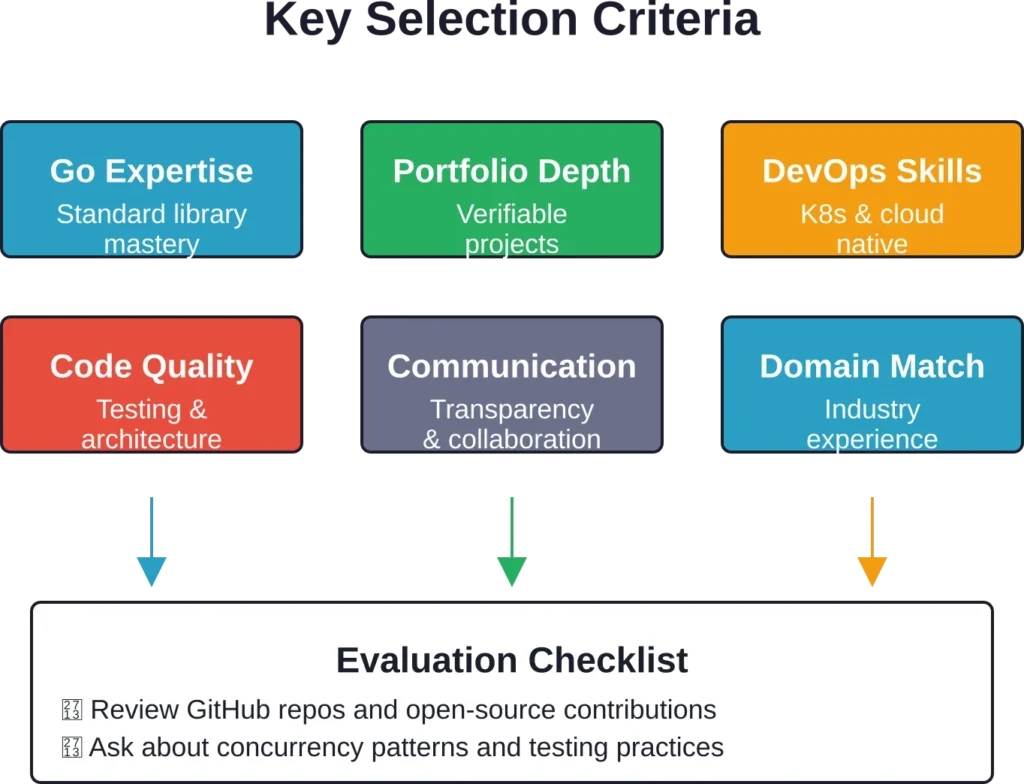
Technical depth separates good agencies from great ones. Look for teams that understand goroutine lifecycle management, context propagation, and proper error handling patterns. Codebases that leak goroutines or misuse mutexes signal inexperience.
Framework familiarity matters less than standard library mastery. Many production Go services use minimal dependencies. A team that reaches for heavy frameworks when the standard library suffices may lack Go-native thinking.
DevOps integration is non-negotiable. Modern Go development assumes Docker, Kubernetes, CI/CD pipelines, and observability tooling. The agency should demonstrate infrastructure-as-code capabilities and monitoring setup.
Portfolio and Case Studies
Examine actual projects, not just technology lists. What problems did they solve? What scale did they reach? Generic “we built a microservice” descriptions reveal little—look for specifics about traffic volume, latency requirements, or architectural challenges overcome.
Open-source contributions indicate community engagement. Developers who contribute to Go projects or maintain popular libraries tend to write better code and stay current with ecosystem evolution.
Client roster diversity suggests adaptability. An agency that’s built fintech APIs, SaaS platforms, and IoT backends has solved varied architectural problems and won’t be learning on your dime.
Common Golang Web Development Services
Most agencies offer overlapping core services, with variations in specialty areas. Understanding these service categories helps frame conversations with potential partners.
API Development and Microservices
RESTful API development remains foundational. Go’s standard library makes building HTTP services straightforward, and frameworks like Echo or Gin add routing conveniences for complex APIs.
gRPC development is increasingly common. For service-to-service communication, gRPC’s performance and type safety advantages over REST make it the default choice in many architectures. Protocol buffer definitions serve as contracts between teams.
GraphQL servers represent another API pattern. Libraries like gqlgen generate type-safe resolvers from schema definitions, and Go’s concurrency helps with the N+1 query problem through dataloaders.
Microservices architecture consulting extends beyond coding. Experienced agencies help with service boundary definition, inter-service communication patterns, data consistency strategies, and operational concerns like distributed tracing.
Cloud-Native Application Development
Kubernetes-native development assumes containerization and orchestration from the start. Applications are designed for horizontal scaling, graceful shutdowns, health checks, and configuration via environment variables or config maps.
Serverless implementations use Go for AWS Lambda, Google Cloud Functions, or similar platforms. Go’s fast cold-start times and low memory consumption make it cost-effective for event-driven workloads.
Cloud platform integration involves working with managed services—databases, message queues, object storage, secrets management. Go SDKs exist for all major cloud providers.
Performance Optimization and Scaling
Profiling and optimization use Go’s built-in tooling. The pprof package reveals CPU hotspots, memory allocation patterns, and goroutine leaks. Experienced developers know how to interpret profiles and apply targeted optimizations.
Load testing and capacity planning determine system limits. Tools like Vegeta (written in Go) stress test services to identify bottlenecks before production traffic hits.
Caching strategies—both in-memory and distributed—reduce load on downstream systems. Go’s concurrency makes cache-aside patterns straightforward to implement correctly.
Legacy System Modernization
Strangler fig patterns gradually replace legacy systems. A Go-based proxy routes traffic selectively to old and new implementations, enabling incremental migration with rollback safety.
API facades abstract legacy complexity. A clean Go API layer shields modern clients from archaic backend systems while migration proceeds.
Database migration support helps move from legacy databases to modern alternatives, or refactor schemas for microservices. Data consistency during transition phases requires careful planning.
Golang Frameworks and Tools in 2026
The Go ecosystem continues evolving. While many production services use minimal dependencies, frameworks and libraries accelerate development for common patterns.
Popular Web Frameworks
Gin remains widely adopted for its performance and familiar API. The framework provides routing, middleware, parameter binding, and validation—enough structure for most HTTP services without heavyweight abstractions.
Echo offers similar capabilities with slightly different design philosophy. Choosing between Gin and Echo often comes down to team preference rather than technical necessity.
Fiber positions itself as an Express-inspired framework optimized for speed. Built on Fasthttp rather than the standard library, it delivers impressive benchmarks but diverges from idiomatic Go patterns.
Buffalo provides full-stack conventions including asset pipeline, ORM, and scaffolding. For teams wanting Rails-like structure, Buffalo reduces decisions about project layout and tooling.
That said, many teams build successfully on the standard library alone. Adding a lightweight router like chi or gorilla/mux often suffices.
Essential Libraries and Tools
ORMs and query builders vary in philosophy. GORM provides ActiveRecord-like patterns, SQLBoil generates type-safe code from schema, and libraries like sqlx add conveniences to database/sql without full ORM abstraction.
Authentication and authorization libraries include jwt-go for token handling, casbin for policy enforcement, and OAuth2 client implementations. Many teams build custom auth using standard crypto packages.
Testing frameworks extend testing package capabilities. Testify adds assertions and mocking, while tools like gomock generate mocks from interfaces.
Observability tooling includes OpenTelemetry for distributed tracing, Prometheus client libraries for metrics, and structured logging packages like zap or zerolog.
| Category | Tool/Framework | Primary Use Case | Adoption Level |
|---|---|---|---|
| Web Framework | Gin | Fast HTTP routing and middleware | Very High |
| Web Framework | Echo | Minimal, performant web services | High |
| Database | GORM | Full-featured ORM | Very High |
| Database | sqlx | Enhanced standard library usage | High |
| Testing | Testify | Assertions and test suites | Very High |
| Logging | Zap | Structured, high-performance logging | High |
| RPC | gRPC | Service-to-service communication | Very High |
How to Evaluate Golang Development Proposals
When agencies submit proposals, look beyond surface-level technology lists. The proposal should demonstrate understanding of your specific challenges.
Technical Approach Assessment
Architecture diagrams should show clear separation of concerns. Microservices boundaries should align with business domains. Data flow between components should be explicit, including error propagation and retry logic.
Technology choices should be justified. If the proposal suggests a particular database, message queue, or cache, the reasoning should connect to your requirements—not just list what the agency is comfortable with.
Testing strategy must be comprehensive. Unit tests, integration tests, end-to-end tests—each serves a purpose. The proposal should specify coverage targets and testing approach for different system layers.
Deployment and operations plans matter as much as code. How will services be deployed? What monitoring will be in place? How are incidents detected and escalated? What does the runbook process look like?
Team Composition and Communication
Developer experience with Go specifically should be quantified. Years with Go, contributions to Go projects, Go-related speaking or writing—these indicate depth beyond general programming skill.
Team structure affects communication. Will there be a dedicated tech lead? How many developers will actively work on the project? What’s the escalation path for decisions?
Communication cadence should be defined. Daily standups, sprint planning, demo sessions, retrospectives—clarity upfront prevents misalignment later.
Project Timeline and Milestones
Realistic timelines account for discovery, architecture, development, testing, and deployment. Proposals that skip discovery or minimize testing phases are red flags.
Milestones should deliver working software incrementally. “Backend complete” is less useful than “user authentication API deployed to staging.” Concrete deliverables enable course correction.
Buffer for unknowns should be explicit. Software projects encounter surprises—good proposals acknowledge this with contingency time rather than presenting overly optimistic schedules.
Cost Considerations for Golang Development
Development costs vary enormously based on project scope, team location, and expertise level. Without discussing specific rates, several factors influence overall investment.
Project Scope Variables
Application complexity drives cost more than anything else. A simple CRUD API differs fundamentally from a distributed system with multiple microservices, event streaming, and complex business logic.
Integration requirements compound complexity. Each external system, API, or legacy component adds integration work, testing surface area, and potential failure modes to handle.
Compliance and security requirements increase effort. Financial services applications need audit logging, encryption at rest and in transit, and often third-party security assessments. Healthcare systems must satisfy HIPAA requirements.
Scale and performance targets affect architecture decisions. Building for 100 concurrent users versus 100,000 requires different approaches to caching, database design, and infrastructure.
Ongoing Maintenance and Evolution
Post-launch support ranges from bug fixes to feature development. Maintenance contracts typically cover dependency updates, security patches, and incident response.
Monitoring and operations have ongoing costs. Cloud infrastructure, logging services, APM tools, and incident management platforms charge monthly fees that scale with usage.
Technical debt accumulates without active management. Allocating budget for periodic refactoring, dependency upgrades, and performance optimization prevents systems from degrading over time.
Golang Development Best Practices
Agencies that follow Go community conventions deliver more maintainable code. These practices have emerged through years of production experience.
Code Organization and Structure
Project layout should follow community standards. The cmd directory contains main applications, internal holds private code, pkg has reusable libraries. This structure makes projects immediately familiar to Go developers.
Package design emphasizes small, focused packages with clear responsibilities. Packages should be named for what they provide, not what they contain. Circular dependencies indicate design problems.
Interface definitions belong in consuming packages, not implementing packages. This “accept interfaces, return structs” pattern reduces coupling and enables easier testing.
Error Handling and Observability
Error wrapping with context helps debugging. Go 1.13’s errors.Is and errors.As (or fmt.Errorf with %w verb) preserve error chains while adding context at each level. Log messages should include enough context to diagnose issues without requiring code inspection.
Structured logging is non-negotiable for production systems. Key-value pairs enable log aggregation and filtering. Avoid formatting strings into log messages—structured data queries better.
Distributed tracing connects requests across service boundaries. Context propagation through HTTP headers or message metadata enables end-to-end request visualization in tools like Jaeger or Tempo.
Concurrency Patterns
Goroutine lifecycle management prevents leaks. Every goroutine should have a clear exit condition, typically via context cancellation or closed channel. Leaked goroutines accumulate until the process crashes.
Channel usage follows idioms. Senders close channels, not receivers. Range over channels until they close. Select statements handle multiple channel operations with timeout protection.
Context propagation enables cancellation and deadline enforcement. Functions taking context can respect client timeouts, preventing wasted work when requests are abandoned.
Questions to Ask Potential Partners
These questions reveal agency capabilities beyond what marketing materials convey.
Technical Depth Questions
How do you handle goroutine leaks in long-running services? The answer should mention profiling, testing, and patterns for ensuring goroutines exit.
What’s your approach to database connection pooling? This reveals understanding of database/sql behavior and production tuning.
How do you structure tests for HTTP handlers? Look for mention of httptest, table-driven tests, and separation of handler logic from HTTP concerns.
What observability stack do you recommend? The answer should cover metrics, logging, tracing, and specific tool choices with justification.
Process and Collaboration Questions
How do you handle changing requirements mid-project? Agile processes should accommodate change without derailing timelines completely.
What does your code review process look like? Reviews should be systematic, with attention to Go idioms, performance, and maintainability.
How do you approach technical debt? Honest teams acknowledge its existence and have strategies for managing it.
What happens if key team members leave during the project? Continuity plans protect against knowledge loss.
Post-Launch Support Questions
What monitoring will be in place at launch? Dashboards, alerts, and runbooks should be deliverables, not afterthoughts.
How do you handle production incidents? On-call rotation, escalation procedures, and postmortem processes indicate operational maturity.
What does your maintenance and support model look like? Clear SLAs, response times, and scope definitions prevent misunderstandings.
Red Flags to Watch For
Some warning signs indicate an agency may not be the right fit. These aren’t dealbreakers individually, but multiple red flags warrant caution.
Technical Red Flags
Over-reliance on frameworks suggests unfamiliarity with Go idioms. Teams that can’t explain why they need a framework beyond “that’s what we always use” may lack Go-native thinking.
Vague architecture discussions should concern you. If the team can’t articulate specific patterns, data flow, or scaling approaches, they’re likely improvising.
Dismissing testing or observability as “nice to have” indicates inexperience with production systems. These aren’t optional in professional Go development.
Unrealistic timelines that skip discovery, underestimate testing, or assume everything works first try signal poor project management experience.
Process Red Flags
Resistance to fixed checkpoints or demos suggests the team wants to avoid accountability. Regular working software demonstrations should be welcome, not threatening.
Lack of questions during scoping indicates the agency isn’t thinking critically about requirements. Good partners challenge assumptions and surface edge cases.
Generic proposals that could apply to any project show lack of engagement. Proposals should reference your specific context, constraints, and goals.
Poor communication responsiveness during sales often continues into delivery. If getting answers is difficult before signing, it won’t improve after.
The Future of Golang Web Development
Go’s trajectory remains strong heading into 2026. Several trends are shaping how companies use the language.
Generics Maturation
Generics, introduced in Go 1.18, continue finding appropriate use cases. Libraries for data structures, algorithms, and functional patterns increasingly leverage type parameters without over-abstracting.
The community is still learning where generics improve code versus where they add unnecessary complexity. Best practices continue emerging through real-world usage.
Improved Developer Tooling
IDE support keeps improving. Language servers, refactoring tools, and debugging capabilities match what developers expect from mature ecosystems.
Dependency management via Go modules has stabilized. The ecosystem has moved past GOPATH and early module growing pains.
Cloud-Native Dominance
Go’s position in cloud-native infrastructure is unassailable. Kubernetes, Docker, Prometheus, Terraform, and countless other projects are written in Go.
This creates a feedback loop: teams running these tools naturally consider Go for their own services. The skills transfer seamlessly.
AI and ML Integration
While Python dominates ML training, Go increasingly handles inference serving. Low latency and high throughput make Go ideal for serving models in production.
Libraries for ONNX runtime, TensorFlow Lite, and other inference engines enable Go services to incorporate ML predictions without Python dependencies.
Making Your Final Decision
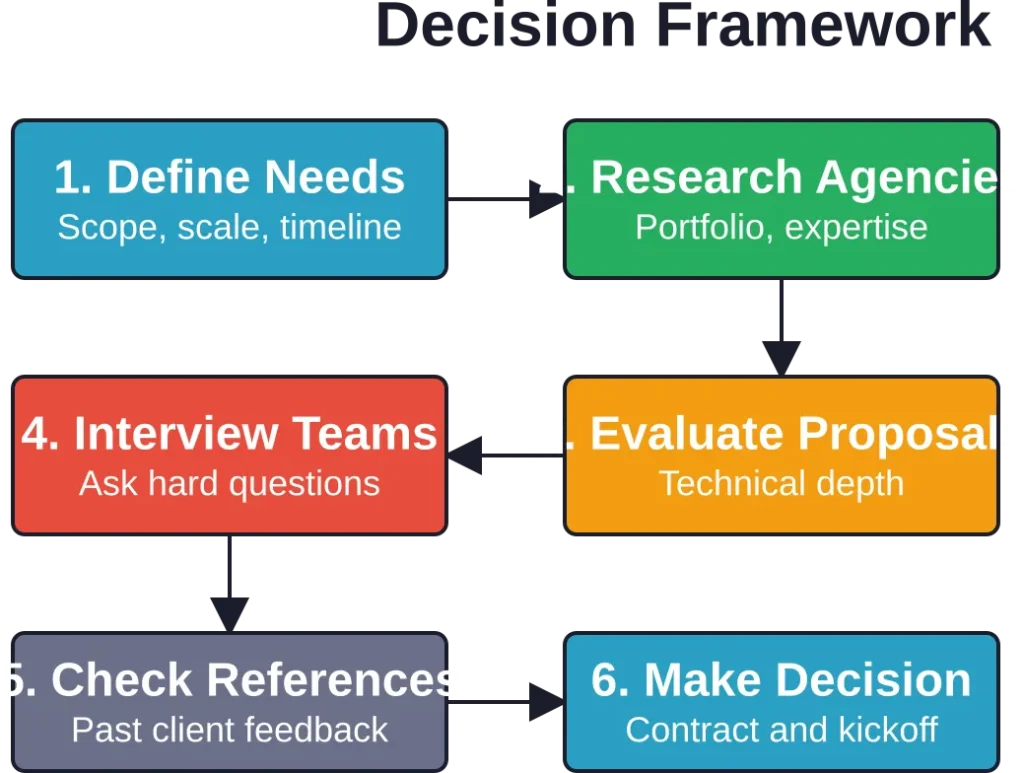
Choosing a development partner is significant. The agency becomes embedded in your technical foundation and influences architecture decisions with long-term consequences.
Trust your technical evaluation, but don’t ignore cultural fit. Teams that communicate clearly, acknowledge uncertainty, and collaborate effectively deliver better results than technically brilliant teams with poor dynamics.
Start with a defined scope project if possible. A 2-3 month initial engagement provides real experience working together before committing to larger initiatives.
Reference checks matter more than portfolios. Speaking with past clients reveals how agencies handle challenges, communication gaps, and changing requirements—things you can’t assess from case studies.
The cheapest proposal rarely delivers the best value. Development cost is dwarfed by opportunity cost of delayed launches, scaling problems, or technical debt requiring rewrites.
Frequently Asked Questions
Go excels at web development through built-in concurrency primitives, fast compilation, and a robust standard library that includes production-ready HTTP server capabilities. The goroutine model allows services to handle thousands of concurrent connections efficiently without complex threading code. Go’s static typing catches errors at compile time, and the language’s simplicity keeps codebases maintainable as teams and projects grow. The single binary deployment model simplifies operations compared to interpreted languages requiring runtime environments.
Project timelines vary dramatically based on scope and complexity. A straightforward API service might take 6-10 weeks from requirements through deployment, while complex microservices architectures can span 6-12 months. Discovery and architecture phases typically consume 2-3 weeks. Teams should expect iterative delivery—working software in staging environments within the first month, with features releasing incrementally. Realistic timelines account for testing, security reviews, and deployment pipeline setup, not just coding time.
Go primarily targets backend services, APIs, and server-side logic where its strengths shine. For frontend development, Go offers frameworks like Templ for server-side rendering and WebAssembly compilation for browser execution, but these approaches remain niche compared to JavaScript ecosystems. Most production Go applications use separate frontend frameworks—React, Vue, or similar—communicating with Go backend services via REST or GraphQL APIs. This separation of concerns aligns with modern architecture patterns and lets each technology focus on its strengths.
Team size scales with project complexity. Simple API projects often need 2-3 developers plus a DevOps engineer. Mid-sized applications might require 4-6 developers organized into feature teams. Large distributed systems can involve 10+ engineers across multiple services, plus dedicated infrastructure, QA, and security specialists. The Go community values small, focused teams over large groups—the language’s simplicity and strong tooling enable smaller teams to accomplish more than equivalent projects in other ecosystems.
Request code samples or access to public repositories demonstrating Go proficiency. Look for idiomatic patterns—proper error handling, interface usage, and concurrency primitives. Ask technical questions about goroutine lifecycle management, testing strategies, or production debugging approaches. Review their open-source contributions to Go projects. Request references from clients with similar technical requirements and speak directly with their technical contacts. Consider a paid discovery phase or small pilot project to assess capabilities before committing to full-scale development.
Maintenance encompasses dependency updates, security patches, performance monitoring, and infrastructure management. Go’s stability means breaking changes are rare, but dependencies should be updated quarterly to address security vulnerabilities. Monitoring systems require attention—reviewing metrics, adjusting alerts, and investigating performance degradation. Database migrations, scaling adjustments, and feature enhancements represent ongoing work. Budget approximately 15-25% of initial development cost annually for maintenance, depending on application complexity and change frequency. Applications with complex business logic or regulatory requirements may require more.
Fintech companies favor Go for payment processing, trading systems, and banking applications requiring high reliability and performance. SaaS platforms leverage Go’s scalability for multi-tenant architectures. IoT and connected device ecosystems use Go for backend services processing sensor data streams. Media and content delivery companies employ Go for real-time systems and CDN infrastructure. E-commerce platforms benefit from Go’s ability to handle traffic spikes during peak shopping periods. Healthcare systems use Go for HIPAA-compliant data processing where performance and security both matter.
Conclusion
Selecting a Golang development partner shapes your technical foundation for years. The agencies profiled here represent proven expertise across diverse project types and industries.
The right choice depends on your specific context—technical requirements, team dynamics, budget constraints, and timeline pressures all factor into the decision. No single agency is universally “best,” but each brings particular strengths to the table.
Invest time in thorough evaluation. Review portfolios critically, ask hard questions, and check references with actual technical contacts. The cheapest option rarely delivers the best value, and the most expensive doesn’t guarantee superior results.
Start with clear requirements. Understanding your scale targets, performance needs, integration points, and compliance constraints enables productive conversations with potential partners.
Consider beginning with a defined-scope engagement. A pilot project reveals how teams collaborate, communicate, and handle challenges without committing to long-term contracts.
Go’s ecosystem continues maturing, and the language’s adoption across cloud-native infrastructure ensures its relevance for years ahead. Building on Go today means joining a vibrant community and leveraging tooling that keeps improving.
Ready to move forward with your Golang web development project? Reach out to agencies on this list, share your requirements, and evaluate proposals with the criteria outlined above. The right partner is out there—finding them requires diligence, not luck.