

Quick Summary: The top SharePoint web development companies in 2026 specialize in custom intranets, migration, integration, and modern workplace solutions. This curated list features 15 agencies with proven expertise in Microsoft SharePoint development, consulting, and implementation—without pricing details, focusing purely on capabilities, service offerings, and what makes each agency stand out for businesses seeking collaboration platform excellence.
SharePoint remains the backbone of digital collaboration for thousands of organizations worldwide. But here’s the thing—implementing it well requires specialized expertise that most in-house teams simply don’t have.
The right development partner transforms SharePoint from a basic document repository into a strategic asset. They build custom workflows, integrate third-party systems, design intuitive intranets, and migrate legacy content without disruption.
This list cuts through the noise. What follows are 15 agencies that consistently deliver exceptional SharePoint solutions across industries, geographies, and project scales.
Why SharePoint Development Expertise Matters in 2026
SharePoint has evolved dramatically. The platform now extends far beyond file sharing into Microsoft Teams integration, Microsoft Viva extensibility, and Microsoft 365 ecosystem connectivity.
Modern SharePoint development demands proficiency in SharePoint Framework (SPFx), Power Platform integration, Azure services coupling, and responsive modern page design. Generic web developers can’t navigate this specialized landscape effectively.
Organizations that partner with dedicated SharePoint agencies report faster deployments, fewer post-launch issues, and significantly higher user adoption rates. The investment in specialized expertise pays dividends in reduced rework and enhanced productivity.
Top 15 SharePoint Web Development Companies
Here are the agencies that consistently deliver exceptional SharePoint solutions across diverse client needs and project scopes.
1. Lengreo
Lengreo positions itself as a strategic SharePoint and Microsoft 365 partner that combines deep technical expertise with proven B2B growth capabilities. The agency delivers full-cycle SharePoint solutions focused on lead generation, client engagement, and digital workplace transformation.
Their service portfolio includes modern intranet development, client portals, knowledge management platforms, and integrated marketing automation within SharePoint and Power Platform. Lengreo excels at creating high-conversion websites, landing pages, and collaboration hubs that drive measurable business results.
The team emphasizes ROI-driven implementations, hyper-personalized user experiences, and seamless integration with marketing tools to boost adoption and engagement.
Client testimonials consistently highlight Lengreo’s ability to deliver tangible growth through intelligent SharePoint solutions.
Contact Information:
- Website: Lengreo.com
- Phone: +31 686 147 566
- Email: [email protected]
- Address: Vrijstraat 9 C/D, 5611 AT Eindhoven, Netherlands
- LinkedIn: Lengreo
- Twitter: @Lengreo
- Instagram: @lengreo
2. Gilzor

Gilzor specializes in building custom SharePoint-based digital products that solve real business challenges. The company focuses on end-to-end development of scalable SharePoint Online and Microsoft 365 solutions for startups and growing businesses.
Their expertise covers idea validation for SharePoint initiatives, custom web and mobile integrations, UI/UX design optimized for adoption, and full-cycle development with rigorous QA. Gilzor delivers tailored intranets, client portals, workflow automation, and product extensions using SharePoint Framework and Power Platform.
The agency maintains a strong focus on user-centric design, scalable architecture, and smooth go-to-market execution for SharePoint solutions.
Clients value Gilzor’s ability to turn complex requirements into functional, attractive, and maintainable SharePoint environments.
Contact Information:
- Website: www.gilzor.com
- Email: [email protected]
- Address: Poland, Warsaw, Office 58, street Adama Mickiewicza 37, 01-625
- LinkedIn: www.linkedin.com/company/gilzor-softwaredevelopment
3. Oski
Oski delivers smart, well-engineered SharePoint and Microsoft 365 solutions for tech-forward enterprises and ambitious organizations. With deep expertise across cloud, frontend, and modern development practices, they create powerful digital workplaces and business applications.
Services include custom SharePoint development, AI-enhanced solutions, modern intranet and portal implementations, CMS integrations, and advanced automation using Power Platform. Oski works across multiple industries including fintech, logistics, education, and e-commerce.
The team focuses on scalable architecture, exceptional user experience, and seamless integration with existing systems to accelerate business performance.
Clients rely on Oski for high-quality, future-proof SharePoint implementations that drive operational excellence.
Contact Information:
- Website: oski.site
- Phone: +48571282759
- Email: [email protected]
- Address: Kaupmehe tn 7, 10114 Tallinn, Estonia
- LinkedIn: www.linkedin.com/company/oski-solutions
4. A-Listware
A-Listware is a trusted SharePoint development and consulting partner with extensive experience in building and managing enterprise-grade Microsoft 365 solutions. The company specializes in dedicated development teams and tailored SharePoint implementations.
Their offerings cover custom software development on SharePoint, application services, UX/UI design, testing & QA, IT consulting, team augmentation, legacy modernization, and cloud migrations. A-Listware delivers enterprise applications, workflow automation, and integrated collaboration platforms.
The agency ensures seamless integration with client teams, 24/7 expert support, and cost-effective high-quality delivery.
Organizations choose A-Listware as a reliable long-term partner for complex SharePoint projects and digital transformation initiatives.
Contact Information:
- Website: a-listware.com
- Phone: +1 (888) 337 93 73
- Email: [email protected]
- Address: North Bergen, NJ 07047, USA
- LinkedIn: www.linkedin.com/company/a-listware
- Facebook: www.facebook.com/alistware
5. Mobian
Mobian builds dedicated engineering teams that deliver production-ready SharePoint and Microsoft 365 solutions on time and within budget. The company specializes in mobile-integrated SharePoint experiences, AI-powered features, and scalable digital workplaces.
They offer end-to-end product development, full-stack SharePoint solutions, legacy system integration, AI & automation within Microsoft 365, and post-launch support. Mobian works with companies in healthcare, fintech, logistics, and IT sectors.
The agency operates through dedicated teams or outstaffing models, maintaining clean architecture, clear documentation, and senior-level execution.
Clients appreciate Mobian’s ability to ship reliable, scalable SharePoint solutions without the overhead of building in-house teams.
Contact Information:
- Website: mobian.studio
- Phone: [email protected]
- Address: Harju maakond, Tallinn, Kesklinnalinnaosa, Masina tn 22, 10113
- LinkedIn: www.linkedin.com/company/mobian-studio
6. New Peak Solutions

New Peak Solutions delivers SharePoint implementations for organizations seeking strategic collaboration platform investments. The agency balances technical sophistication with pragmatic business focus.
Their service mix includes intranet portals, project management sites, document centers, and team collaboration spaces. New Peak integrates SharePoint with Microsoft Teams to create unified communication and content environments.
The company emphasizes iterative development—launching minimum viable intranets quickly, then enhancing based on user feedback. This agile approach accelerates time-to-value compared to traditional waterfall projects.
New Peak’s client base spans education, nonprofits, professional services, and technology sectors—organizations that value collaboration but operate with budget consciousness.
7. Softura

Softura provides end-to-end SharePoint services with particular strength in custom development and third-party integration. The agency serves enterprise clients with sophisticated technical requirements.
Development capabilities include custom web parts, SPFx solutions, responsive designs, and complex workflow automation. Softura integrates SharePoint with Salesforce, SAP, Oracle, and numerous industry-specific platforms.
Their team handles both SharePoint Online cloud implementations and hybrid configurations that maintain on-premises components for compliance or legacy system reasons.
Softura’s geographic presence spans North America, Europe, and Asia-Pacific, enabling follow-the-sun support for global enterprise clients.
8. BrightStarr
BrightStarr focuses on SharePoint intranets that drive employee engagement and organizational transparency. The agency emphasizes design aesthetics alongside functional excellence.
Services include branding, information architecture, content strategy, and mobile-responsive layouts. BrightStarr builds intranets that serve as true digital hubs—integrating news, events, resources, directories, and applications.
The company leverages out-of-the-box SharePoint capabilities creatively, minimizing custom code to reduce long-term maintenance burden. This approach balances uniqueness with sustainability.
BrightStarr’s methodology includes stakeholder workshops, user persona development, and content governance planning—ensuring intranets align with organizational communication strategies.
9. Virteva
Virteva delivers SharePoint consulting with emphasis on Microsoft 365 ecosystem integration. The agency helps organizations maximize their Microsoft licensing investments through strategic SharePoint deployment.
Core services span intranet development, collaboration site provisioning, document management configuration, and Microsoft Teams integration. Virteva emphasizes governance frameworks that prevent SharePoint sprawl.
The consultancy works extensively with Viva Connections, creating employee experiences that surface SharePoint content within Microsoft Teams. This integration approach meets users where they already work.
Virteva’s client base includes healthcare systems, financial institutions, and government agencies—sectors where security, compliance, and accessibility requirements demand specialized expertise.
10. 2toLead
2toLead specializes in SharePoint implementations for small and mid-sized organizations seeking enterprise-grade collaboration without enterprise complexity. The agency makes SharePoint accessible to resource-constrained teams.
Services include templated intranet deployments, standard migration packages, and fixed-scope implementation projects. 2toLead balances best practices with budget realities.
The company offers managed services that provide ongoing SharePoint administration for organizations without dedicated IT staff. This subscription model makes continuous optimization economically viable.
2toLead’s approach emphasizes rapid deployment, user training, and practical governance—helping smaller organizations achieve SharePoint success without overengineering solutions.
11. Techcronus
Techcronus positions itself as a major SharePoint partner with worldwide delivery capabilities. The agency emphasizes comprehensive SharePoint consulting that spans implementation, customization, migration, and scalable solution architecture.
Their service portfolio covers modern intranet development, SharePoint Online transitions, hybrid environment configuration, and Power Platform integration. Techcronus works across industries including healthcare, finance, manufacturing, and professional services.
The team focuses on ROI-driven implementations that align SharePoint capabilities with specific business objectives. Their approach combines technical execution with change management support to drive user adoption.
Client testimonials highlight Techcronus’s ability to handle complex enterprise deployments while maintaining project timelines and scope discipline.
12. Beyond Intranet
Beyond Intranet specializes in transforming SharePoint into engaging digital workplaces. Their core competency lies in intranet design that prioritizes user experience and organizational culture reflection.
The agency offers templated accelerators alongside fully custom builds. Services include employee communication portals, knowledge management systems, departmental collaboration sites, and executive dashboards.
Beyond Intranet integrates Viva Connections, Teams, and Yammer into cohesive digital workplace ecosystems. Their design-first philosophy ensures SharePoint implementations feel modern rather than utilitarian.
The company maintains a strong repository of case studies demonstrating measurable improvements in employee engagement metrics post-deployment.
13. Affirma Consulting
Affirma brings decades of Microsoft ecosystem experience to SharePoint projects. The consultancy serves mid-market and enterprise clients with complex integration requirements.
Their technical depth extends to Azure infrastructure, identity management, compliance configuration, and enterprise search optimization. Affirma handles large-scale migrations involving terabytes of content and intricate permission structures.
The team emphasizes governance frameworks that keep SharePoint environments organized as they scale. This includes information architecture planning, metadata strategy, and retention policy implementation.
Affirma’s Microsoft certifications and partner status reflect sustained investment in platform expertise across evolving SharePoint versions.
14. HingePoint
HingePoint focuses on SharePoint as a business process platform rather than just a collaboration tool. The agency builds custom applications that automate workflows, manage contracts, track projects, and handle compliance documentation.
Their development approach leverages SharePoint Framework, Power Apps, Power Automate, and custom APIs. HingePoint excels at connecting SharePoint to external systems—ERP platforms, CRM databases, and industry-specific applications.
The consultancy serves regulated industries where audit trails, version control, and permission granularity matter critically. Financial services, healthcare, and legal sectors represent core client verticals.
HingePoint’s solutions often replace disparate legacy systems with unified SharePoint-based platforms that centralize information while maintaining security boundaries.
15. Entrance Consulting
Entrance Consulting specializes in SharePoint Online and Microsoft 365 cloud migrations. The firm guides organizations through digital transformation initiatives that modernize collaboration infrastructure.
Services include cloud readiness assessments, hybrid configuration, phased migration execution, and post-migration optimization. Entrée handles both technical migration mechanics and user training to ensure smooth transitions.
The consultancy’s methodology emphasizes minimal disruption—maintaining business continuity while migrating active environments. Their approach includes pilot groups, iterative rollouts, and comprehensive testing protocols.
Entrance works extensively with clients moving from on-premises SharePoint 2010, 2013, and 2016 installations to cloud-native SharePoint Online architectures.
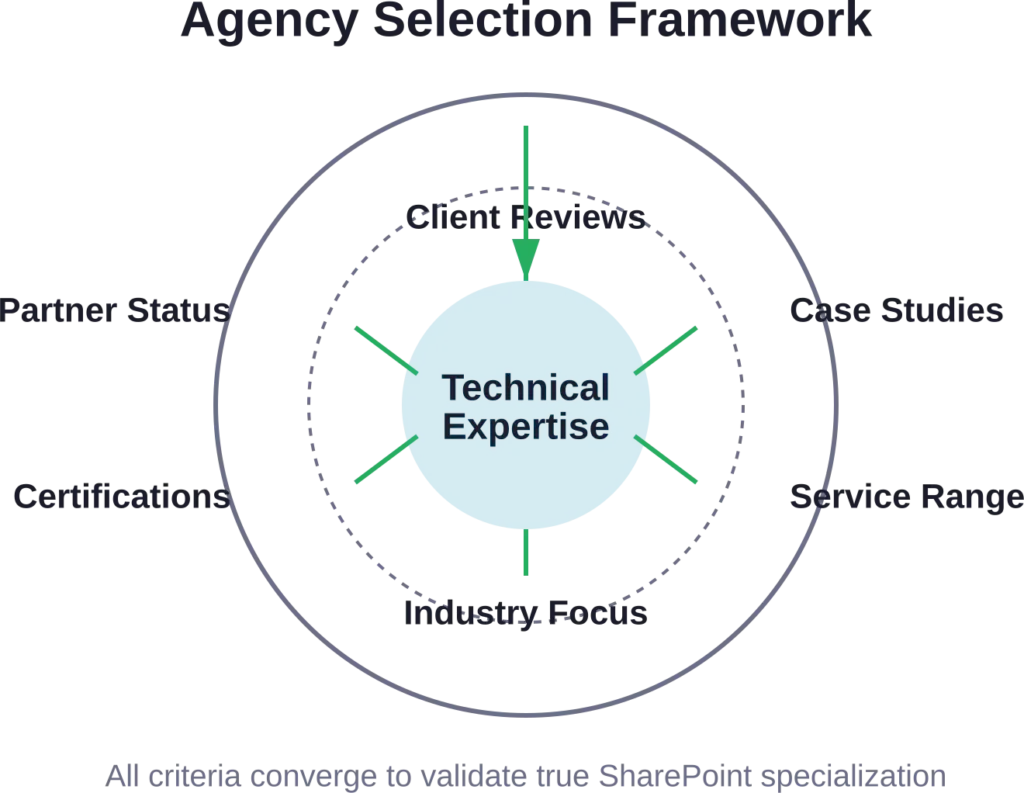
Key Capabilities That Separate Elite SharePoint Developers
Not all SharePoint agencies deliver equal value. Certain capabilities distinguish truly exceptional partners from adequate providers.
Microsoft Partnership and Certifications
Microsoft Solutions Partner designations validate that agencies meet rigorous technical and business requirements. Microsoft’s Solutions Partner program requires demonstrated customer success metrics, certified personnel, and proven technical competency across solution areas.
Look for agencies with certified professionals holding credentials like Microsoft Certified: SharePoint Administrator Associate or Microsoft 365 Certified: Developer Associate. These certifications confirm current platform knowledge.
Proven Migration Methodology
Migration expertise matters immensely. Agencies should articulate clear methodologies covering content inventory, permission mapping, metadata preservation, incremental migration strategies, and rollback procedures.
The best firms conduct pilot migrations, validate content integrity, and maintain parallel environments until cutover confidence reaches absolute certainty. Ask about their largest migration project and how they handled unexpected challenges.
Design and User Experience Focus
Technical capability alone produces mediocre intranets. Elite agencies employ UX designers who understand information architecture, visual hierarchy, mobile responsiveness, and accessibility standards.
Review agency portfolios critically. Do their SharePoint intranets look modern? Is navigation intuitive? Does content hierarchy make sense at a glance? Design quality directly impacts user adoption.
Integration Architecture Experience
SharePoint rarely exists in isolation. Agencies should demonstrate experience integrating with common enterprise systems—Salesforce, SAP, Workday, DocuSign, and industry-specific platforms.
Integration complexity spans simple embed scenarios to sophisticated bidirectional data synchronization. Validate that agencies understand APIs, authentication protocols, and middleware options.
Governance and Training Capabilities
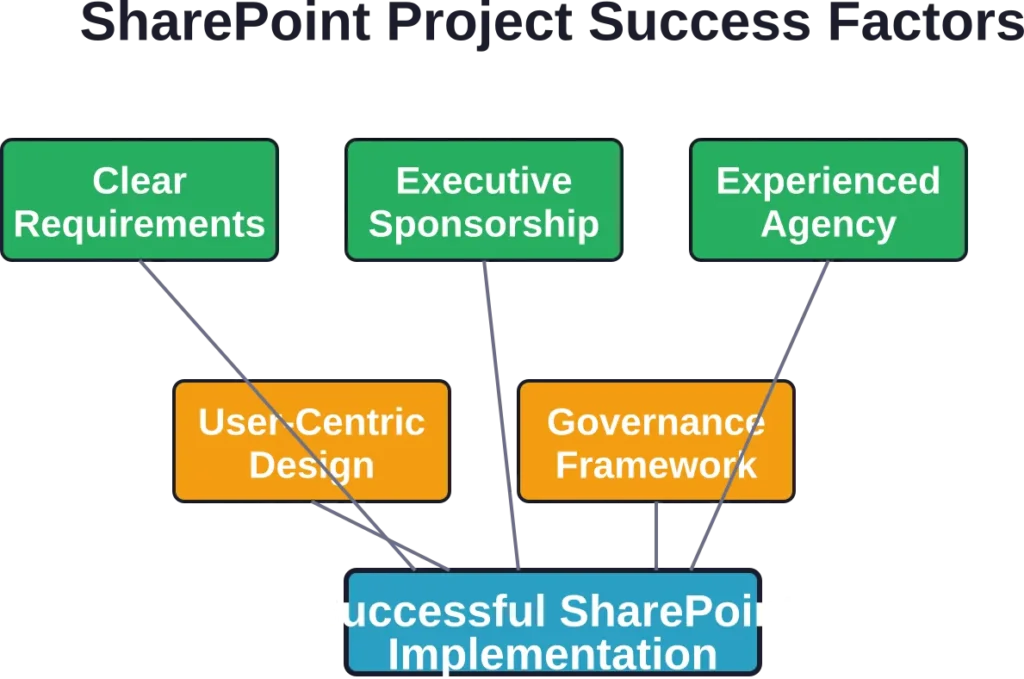
Technical implementation represents only half the challenge. Successful SharePoint deployments require governance frameworks, admin training, end-user education, and change management support.
Strong agencies provide documentation templates, governance playbooks, video tutorials, and train-the-trainer programs. These elements ensure SharePoint environments remain healthy long after project completion.
Common SharePoint Development Project Types
Understanding typical engagement models helps organizations identify which agency specializations align with their needs.
Net-New Intranet Builds
These projects create branded employee portals from scratch. Scope includes information architecture, design, development, content migration, and launch support. Timelines typically span three to six months depending on complexity and organizational readiness.
Platform Migrations
Migration engagements move content from legacy SharePoint versions or competing platforms to SharePoint Online. These projects emphasize planning, risk mitigation, and minimizing disruption to active users. Duration varies dramatically based on content volume and complexity.
Custom Application Development
Purpose-built applications address specific business processes that generic software can’t accommodate. Development follows agile methodologies with iterative releases, user testing, and refinement cycles. These engagements often extend over multiple phases as requirements evolve.
Microsoft 365 Integration Projects
Integration initiatives connect SharePoint with Teams, Viva, Power Platform, and external systems. Scope focuses on workflow orchestration, data synchronization, and unified user experiences across tools. These projects often run parallel to broader digital workplace transformations.
Optimization and Enhancement
Many organizations have functioning but underperforming SharePoint environments. Enhancement projects audit current state, identify improvement opportunities, and implement targeted fixes. Common focus areas include search optimization, permission cleanup, navigation simplification, and performance tuning.
| Project Type | Typical Timeline | Primary Complexity Drivers | Key Success Metrics |
|---|---|---|---|
| Intranet Build | 3-6 months | Customization depth, content volume, stakeholder alignment | User adoption rate, engagement metrics, findability scores |
| Migration | 2-9 months | Content volume, permission complexity, customization count | Zero data loss, minimal downtime, user satisfaction |
| Custom Application | 2-5 months | Integration points, workflow complexity, user roles | Process efficiency gains, error reduction, time savings |
| Microsoft 365 Integration | 1-4 months | System count, data flow complexity, authentication | Cross-platform workflow adoption, reduced context switching |
| Optimization | 1-3 months | Technical debt, organizational change readiness | Performance improvements, search relevance, governance compliance |
Questions to Ask Prospective SharePoint Development Partners
Due diligence conversations reveal agency capability depth and cultural fit. These questions uncover what marketing materials often obscure.
What’s your team’s Microsoft certification profile? Understand both the number and types of certifications. Follow-up: how do you maintain currency as SharePoint evolves?
Can you share three client references with similar project scopes? Speak directly with past clients about their experience, particularly regarding how the agency handled challenges and changes.
What’s your typical project methodology? Understand whether they follow agile, waterfall, or hybrid approaches. How do they handle requirement changes mid-project?
How do you approach governance and training? Technical delivery alone doesn’t ensure success. Validate their change management capabilities.
What does your support model look like post-launch? Understand options for ongoing support, whether through managed services, retained hours, or ad-hoc engagement.
How do you handle project risk and scope management? Every project encounters surprises. How does the agency communicate issues and propose solutions?
What’s your experience with our industry? Industry knowledge accelerates projects because agencies understand common workflows, compliance requirements, and terminology.
Real talk: if an agency can’t provide articulate answers to these questions, consider that a significant red flag.
Red Flags When Evaluating SharePoint Development Firms
Certain warning signs indicate agencies that over-promise and under-deliver. Watch for these concerning patterns.
Vague case studies: Legitimate agencies showcase specific client challenges, solutions implemented, and measurable outcomes. Generic descriptions suggest limited actual experience.
Offshore-only development teams: While geographic diversity offers advantages, agencies without onshore presence often struggle with communication, time zone coordination, and cultural alignment.
Lack of Microsoft partnership: Non-partner agencies can deliver quality work, but partnership status demonstrates sustained platform investment and access to Microsoft resources.
Rigid fixed-scope promises: SharePoint projects evolve as stakeholders see capabilities emerge. Agencies that refuse any scope flexibility often create adversarial dynamics.
Minimal design portfolio: If their previous intranets look dated or generic, expect similar results. Design capability matters enormously for user adoption.
No governance discussion: Agencies that skip governance conversations focus solely on initial delivery—leaving you with an environment that becomes chaotic as it grows.
SharePoint Development Costs: What to Expect
While this guide excludes specific agency pricing, understanding general cost structures helps budget planning and proposal evaluation.
SharePoint projects typically follow either fixed-fee or time-and-materials billing. Fixed-fee works when requirements are stable and well-defined. Time-and-materials suits exploratory or evolving projects where scope crystallizes during development.
Project costs correlate primarily with scope complexity, customization depth, integration requirements, and content volume. A basic intranet using mostly out-of-the-box capabilities costs significantly less than a heavily customized portal with numerous third-party integrations.
Migration projects scale with content volume and technical complexity. Moving ten terabytes with intricate permission structures requires more effort than migrating two terabytes of straightforward document libraries.
Managed services and ongoing support typically price as monthly retainers or hour blocks. These arrangements provide predictable costs for routine maintenance, user support, and incremental enhancements.
Geographic location influences costs. Agencies in major metropolitan areas typically command higher rates than those in secondary markets, though remote delivery models have compressed geographic pricing variations.
The Future of SharePoint Development in 2026 and Beyond
SharePoint continues evolving rapidly. Several trends shape how leading agencies approach development work.
Microsoft Viva integration has become standard rather than optional. Modern intranets increasingly serve as Viva Connections backends, surfacing content directly in Microsoft Teams. Agencies optimize SharePoint specifically for this consumption model.
AI and automation capabilities through Power Platform integration enable sophisticated workflows without custom code. Leading developers leverage these tools to deliver complex business applications faster and more sustainably.
Mobile-first design has shifted from nice-to-have to mandatory. With distributed workforces and field employees, SharePoint experiences must work flawlessly on smartphones and tablets.
Governance and compliance automation addresses growing regulatory pressure around data residency, privacy, and retention. Sophisticated agencies implement technical controls that enforce policy automatically rather than relying on user discipline.
Low-code approaches using SharePoint Framework, Power Apps, and standard web parts reduce custom code dependencies. This shift lowers long-term maintenance burden while maintaining flexibility.
Making Your Final Agency Selection
Choosing the right SharePoint development partner requires balancing multiple factors—technical capability, cultural fit, budget alignment, and strategic vision.
Start by clarifying your own requirements. What business problems need solving? What does success look like? Who are your key stakeholders and what do they need? Clear requirements enable more productive agency conversations.
Interview multiple agencies. Three to five conversations provide sufficient perspective without creating analysis paralysis. Use consistent questions to enable meaningful comparison.
Request detailed proposals that articulate approach, timeline, deliverables, assumptions, and pricing structure. Vague proposals indicate agencies that haven’t invested time understanding your situation.
Check references thoroughly. Speak with at least two past clients for each finalist agency. Ask about communication quality, problem-solving approach, and how they handled challenges.
Evaluate chemistry and communication style. You’ll work closely with this partner for months. If initial conversations feel difficult, imagine how challenging the actual project will be.
Consider starting with a smaller engagement before committing to a major initiative. A discovery phase or pilot project provides direct experience with agency capabilities and working style at limited risk.
Frequently Asked Questions
SharePoint development companies offer comprehensive services including custom intranet design and development, SharePoint migration from legacy versions or competing platforms, custom application development using SharePoint Framework and Power Platform, Microsoft 365 integration that connects SharePoint with Teams and other tools, workflow automation, document management configuration, and ongoing support and optimization. Many agencies also provide governance consulting, user training, and managed services for organizations that need continuous administrative support.
SharePoint project timelines vary significantly based on scope and complexity. A basic intranet using mostly standard features might launch in two to three months. More complex custom intranets with extensive branding, custom applications, and integrations typically require four to six months. Large-scale migration projects can span three to nine months depending on content volume and technical complexity. Custom application development follows agile cycles, often delivering initial versions within two to three months with iterative enhancements continuing afterward. Most agencies provide timeline estimates during initial discovery conversations once they understand specific requirements.
Selection should consider multiple factors beyond cost. Evaluate Microsoft partnership status and team certifications to validate technical expertise. Review case studies and portfolios to assess whether they’ve handled projects similar to yours. Request client references and actually call them to understand real working relationships. Assess their governance and training capabilities, not just technical delivery. Consider communication style and cultural fit since you’ll collaborate closely for months. Compare their proposed methodology and how they handle scope changes. Industry experience matters because agencies familiar with your sector understand common workflows and compliance requirements. Trust your instincts about which partner feels like the right long-term collaborator.
Yes, SharePoint offers extensive integration capabilities with most common enterprise systems. Modern SharePoint development leverages APIs, Power Platform connectors, and custom middleware to connect with CRM platforms like Salesforce, ERP systems like SAP and Oracle, HR systems like Workday, document signing tools like DocuSign, and numerous industry-specific applications. Integration complexity ranges from simple content embedding to sophisticated bidirectional data synchronization. Experienced SharePoint developers assess your specific integration requirements during discovery and recommend appropriate technical approaches. The key is working with agencies that have demonstrated integration architecture experience rather than SharePoint-only specialists.
The terms often overlap but emphasize different aspects. SharePoint consulting focuses on strategy, planning, requirements gathering, information architecture, governance framework design, and advisory services. Consultants help organizations define what they need and how SharePoint should be configured to meet business objectives. SharePoint development emphasizes technical implementation—actually building custom web parts, creating workflows, configuring sites, migrating content, and integrating systems. In practice, most agencies provide both consulting and development as complementary services. The best partnerships include strategic planning that informs technical execution rather than treating them as separate engagements.
Microsoft partnership status isn’t absolutely required, but it provides valuable validation. Solutions Partners (the current designation replacing Gold Partner) meet specific technical competency requirements, maintain certified staff, and demonstrate proven customer success metrics. Partnership provides agencies with direct Microsoft support, early access to product roadmaps, and specialized training resources—advantages that benefit clients indirectly. That said, some excellent smaller agencies deliver outstanding SharePoint work without formal partnership. The key is validating expertise through certifications, case studies, references, and demonstrated technical depth regardless of official partnership status. Partnership status should weigh in your decision but not serve as the sole determining factor.
Post-implementation support varies by agency and engagement structure. Most provide a stabilization period immediately following launch—typically 30 to 90 days—where they monitor performance, address issues, and handle user questions as the organization adjusts to the new environment. Beyond that, organizations need ongoing governance, administration, user support, and incremental enhancements. Options include managed services where agencies handle day-to-day administration, retained hour packages for periodic support and feature additions, or ad-hoc engagement for specific needs. Many organizations also invest in train-the-trainer programs so internal staff can handle routine administration while engaging agencies for specialized technical work. Discuss post-launch support options during initial conversations to ensure alignment.
Final Thoughts on Selecting SharePoint Development Partners
The right SharePoint development company transforms collaboration infrastructure from administrative burden into strategic advantage. Organizations that invest in specialized expertise realize returns through increased productivity, improved knowledge management, and enhanced employee experience.
This list provides a starting point for exploration. Each agency brings distinct strengths—some excel at complex enterprise migrations, others specialize in stunning intranet design, still others focus on custom application development or small business implementations.
Your specific needs should drive selection. A healthcare system implementing a compliance-focused document management platform requires different expertise than a creative agency building an engaging employee portal. Match agency specialization to your priority requirements.
Start conversations early. SharePoint projects benefit from thoughtful planning rather than rushed execution. Engage agencies during the exploration phase, not after you’ve committed to aggressive timelines.
The collaboration platform landscape continues evolving. SharePoint remains the dominant enterprise choice precisely because Microsoft continuously enhances capabilities, integrates with emerging tools, and supports diverse deployment models. Partnering with agencies that stay current ensures your implementation leverages modern capabilities rather than yesterday’s approaches.
Ready to transform your digital workplace? Reach out to two or three agencies from this list that align with your project scope. The conversations alone will clarify your requirements and help refine your approach—even before formal engagement begins.