

Quick Summary: Finding the right web app design partner in 2026 means looking beyond portfolios to evaluate real-world results, specialized expertise, and team structure. The top agencies combine strategic UX thinking with modern design systems, AI-assisted workflows, and measurable business impact. This guide profiles 15 leading web app design companies across different specializations—from SaaS-focused studios to enterprise transformation experts—helping you match your project needs with the right agency capabilities.
The web app design landscape has shifted dramatically. It’s not about pretty interfaces anymore—it’s about designing systems that handle complexity gracefully while feeling effortless to use.
Traditional graphic design roles are expected to grow by only 3% through 2034, while UX, UI, and Product Design roles are projected to grow by 16% over the same period. The market is clearly rewarding strategic design thinking over decorative work.
Here’s the thing though—finding the right agency isn’t straightforward. Some specialize in early-stage SaaS products. Others excel at enterprise transformations. A few focus exclusively on mobile-first experiences.
This guide cuts through the noise. We’ve analyzed portfolios, reviewed client outcomes, and examined team structures to identify 15 agencies that consistently deliver results across different project types.
What Makes a Web App Design Agency Stand Out in 2026
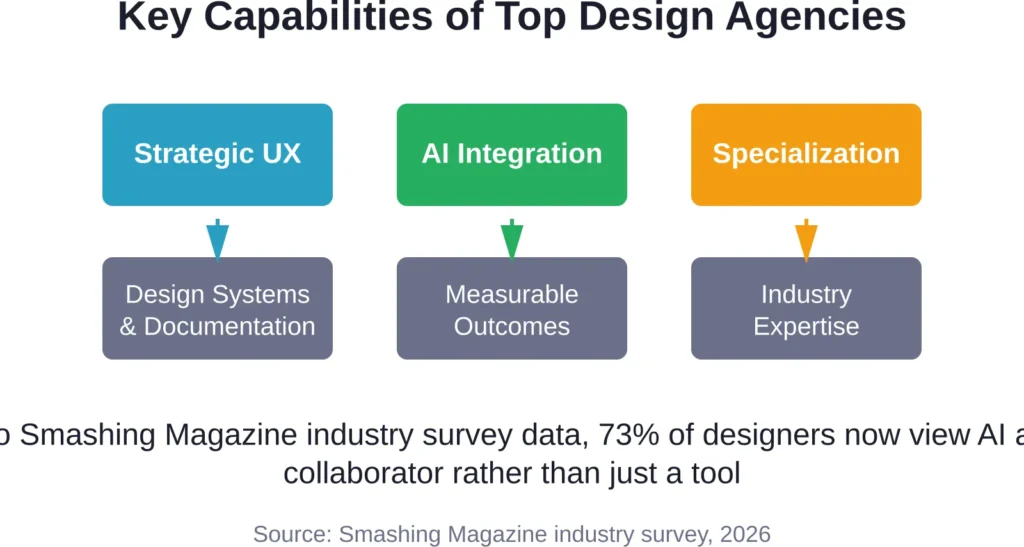
The bar has risen considerably. Agencies that thrive now combine multiple capabilities that were once separate disciplines.
Strategic UX thinking comes first. The best agencies don’t just execute your vision—they challenge assumptions, identify edge cases, and propose solutions you hadn’t considered. They treat design as a problem-solving discipline, not a service.
AI integration has become standard practice. Practitioners report that AI-assisted workflows can significantly improve productivity when used strategically for research analysis, documentation, and accessibility testing. Top agencies leverage AI for user research analysis, design system documentation, and accessibility testing—but keep humans in control of strategic decisions.
Real talk: agencies claiming AI will replace designers aren’t the ones you want. The smart shops use AI to handle grunt work so designers can focus on complex interaction problems and user empathy work that machines can’t replicate.
Measurable outcomes matter more than awards. While recognition from Awwwards or similar platforms signals design excellence, the agencies on this list prove their value through client metrics: conversion improvements, reduced support tickets, faster task completion, successful funding rounds.
The Shift Toward Specialized Expertise
Generalist agencies are losing ground to specialists. A firm that designs everything from e-commerce stores to healthcare dashboards to nonprofit sites rarely matches the depth of one focused solely on SaaS applications or enterprise software.
Specialization shows up in several ways. The agency understands your industry’s specific UX patterns. They’ve solved your exact problem type multiple times. Their portfolio demonstrates relevant complexity—not just visual polish.
But there’s a balance. Too narrow and they lack adaptability. Too broad and they lack expertise. The agencies below hit that sweet spot.
Top 15 Web App Design Companies Worth Considering
These agencies represent different strengths and specializations. Each excels in specific scenarios—no single agency is perfect for every project.
1. Gilzor — Custom Digital Product Design & Development
Gilzor specializes in building custom web and mobile applications from idea to launch, with a strong focus on UI/UX design that drives user adoption and conversion. They create functional, attractive digital products tailored to client goals across multiple industries.
Their track record includes successful projects such as an e-commerce grocery app for a startup that aggregates hundreds of stores and an airline passenger boarding application. One standout involved developing a brain-training mobile app that gained over 1,000 uploads in the first month. They deliver full-cycle services including idea validation, user-centric UI/UX design, web development, and go-to-market support.
What stands out is their user-centric design approach combined with technical execution. Designers and developers collaborate closely to produce intuitive interfaces, scalable architectures, and products that connect effectively with target audiences while meeting business objectives.
The approach works best for startups validating ideas, SMBs scaling with new web or mobile channels, and product studios enhancing existing platforms with modern design and features.
Contact Information:
- Website: www.gilzor.com
- Email: [email protected]
- Address: Poland, Warsaw, Office 58, street Adama Mickiewicza 37, 01-625
- LinkedIn: www.linkedin.com/company/gilzor-softwaredevelopment
2. Lengreo — Marketing-Driven Web Solutions
Lengreo acts as a complete marketing and tech partner, building websites, landing pages, and web applications that generate qualified leads and measurable business growth. Their website development services emphasize designs that push businesses forward through strategic user experiences.
Client results include a 400% increase in annually acquired clients for a US software company, over 50 business opportunities for a UK architecture firm, and a 53.6% conversion rate boost for a Ukrainian IT company. They combine discovery, prototyping, design development, and implementation with ongoing optimization.
What stands out is their integration of B2B digital marketing strategy directly into web design and development. Every project ties design decisions to lead generation, SEO performance, and conversion metrics rather than aesthetics alone.
The approach works best for B2B companies and tech/service providers seeking web applications and sites that actively drive sales pipelines and ROI.
Contact Information:
- Website: Lengreo.com
- Phone: +31 686 147 566
- Email: [email protected]
- Address: Vrijstraat 9 C/D, 5611 AT Eindhoven, Netherlands
- LinkedIn: Lengreo
- Twitter: @Lengreo
- Instagram: @lengreo
3. Oski — Smart Web Application Engineering
Oski designs, develops, and maintains well-engineered web solutions for tech-forward enterprises and ambitious startups. They focus on frontend solutions and intuitive user experiences that combine innovative design with robust performance.
Their work spans cloud-based platforms, AI integrations, and industry-specific web applications in travel, logistics, e-commerce, education, fintech, and insurance. Projects emphasize scalable, secure solutions with seamless accessibility and user-friendly interfaces powered by modern frameworks.
What stands out is their full-lifecycle approach — from design and development to deployment and support — accelerated by AI tools while prioritizing quality and business impact. They deliver aesthetically pleasing, intuitive web experiences that help companies reimagine operations.
The approach works best for enterprises and growth-stage startups needing reliable, scalable web applications with strong frontend focus and industry-specific functionality.
Contact Information:
- Website: oski.site
- Phone: +48571282759
- Email: [email protected]
- Address: Kaupmehe tn 7, 10114 Tallinn, Estonia
- LinkedIn: www.linkedin.com/company/oski-solutions
4. A-listware — UX/UI-Focused Software Development

A-listware delivers UX/UI design alongside software development and dedicated teams for web and enterprise applications. Their designers create vibrant, responsive interfaces that ensure user engagement and brand alignment while supporting complex business needs.
They specialize in SaaS UI design, responsive web applications, custom software, cloud solutions, and enterprise platforms including ERP, CRM, and web portals. Services encompass full development, testing, and modernization with seamless team integration.
What stands out is the close collaboration between UX/UI specialists and development teams to produce high-quality, secure, and user-centric digital solutions. They act as an extension of client teams, focusing on clean, engaging designs that deliver real business value.
The approach works best for enterprises, SMBs, and startups requiring dedicated support for web application design, development, and ongoing enhancement.
Contact Information:
- Website: a-listware.com
- Phone: +1 (888) 337 93 73
- Email: [email protected]
- Address: North Bergen, NJ 07047, USA
- LinkedIn: www.linkedin.com/company/a-listware
- Facebook: www.facebook.com/alistware
5. Mobian — End-to-End Web & AI Product Design
Mobian builds dedicated teams for designing, developing, and scaling digital products with strong emphasis on mobile-first web applications and AI-enhanced experiences. They deliver production-ready solutions from wireframes to deployment.
Expertise covers end-to-end product development, scalable architecture, legacy integration, and domain-specific solutions for IT, healthcare, fintech, and logistics. Projects feature clean code, intuitive interfaces, and systems designed for both current and future scale.
What stands out is their dual outsourcing/outstaffing model combined with senior-level execution. Teams maintain high standards in architecture, documentation, and user experience while providing post-launch support and continuous partnership.
The approach works best for companies in regulated or complex industries that need reliable web and AI-powered applications delivered on time with seamless technical and design quality.
Contact Information:
- Website: mobian.studio
- Phone: [email protected]
- Address: Harju maakond, Tallinn, Kesklinnalinnaosa, Masina tn 22, 10113
- LinkedIn: www.linkedin.com/company/mobian-studio
6. Vide Infra — Startup-Focused Platform Design

Vide Infra specializes in helping startups develop professional platforms and attract attention. Their case studies demonstrate an understanding of startup realities—limited budgets, tight timelines, need to impress investors.
They’ve built both promotional websites and SaaS platforms, understanding how the two need to work together. The promotional site generates leads; the platform converts them. Both need consistent design language and smooth handoff.
Vide Infra’s approach prioritizes getting to market quickly with a solid foundation that can scale. They avoid over-engineering early versions but build design systems that accommodate future features.
The agency works best with pre-seed through Series A startups that need investor-ready product design without enterprise agency overhead.
7. Constructive — Nonprofit and Social Impact Focus
Constructive carved out a unique niche: digital experiences for nonprofits, foundations, and social impact organizations. They understand the specific challenges of mission-driven organizations.
Nonprofit web applications have distinct requirements—donor management, volunteer coordination, impact storytelling, accessibility compliance, often with constrained budgets. Constructive’s entire process accounts for these factors.
Their portfolio includes major foundations and advocacy organizations. The work emphasizes clarity, emotional connection, and removing barriers to action—whether that’s donating, volunteering, or spreading awareness.
While specialized, this focus means they’re extraordinarily effective for their target market. A generalist agency won’t have their depth of understanding around nonprofit user behaviors and stakeholder dynamics.
8. Takt — Enterprise UX Transformation
Takt focuses on enterprise-scale UX challenges. They work with large organizations redesigning legacy systems, consolidating multiple platforms, or modernizing complex workflows.
Enterprise projects involve unique constraints: diverse user roles, integration requirements, change management, compliance considerations. Takt’s methodology addresses all of these systematically.
They excel at conducting extensive user research across multiple departments, identifying common patterns, and designing scalable solutions that work for varied use cases. Their design systems accommodate enterprise complexity while maintaining consistency.
Expect longer engagements—enterprise transformations rarely happen quickly. But the thorough approach reduces risk for organizations where deployment failures affect thousands of employees or customers.
9. Outcrowd — Mobile-First Web Applications

Outcrowd specializes in designing web applications with mobile experiences as the primary focus. Given mobile traffic patterns, this approach makes sense for many modern applications.
Their process starts with mobile constraints—smaller screens, touch interfaces, variable connectivity—then scales up to desktop rather than the reverse. This ensures core functionality works everywhere.
The agency brings particular strength in progressive web apps (PWAs) that bridge native and web experiences. They understand service workers, offline functionality, and app-like interactions within browsers.
Outcrowd works well for consumer-facing applications, field service tools, and any scenario where mobile usage dominates analytics.
10. KOTA — Data Visualization and Dashboard Design
KOTA specializes in applications where data visualization drives the user experience. Think analytics platforms, business intelligence tools, monitoring dashboards, and reporting systems.
Data visualization is genuinely difficult. It requires understanding both visual design principles and statistical communication. Bad data viz misleads users; good data viz reveals insights intuitively.
KOTA’s portfolio demonstrates expertise in choosing appropriate chart types, designing for different data scales, handling edge cases, and making complex datasets explorable. They understand when to use tables versus graphs, how to handle real-time updates, and how to design for both overview and detail.
The agency is ideal for B2B SaaS platforms where data analysis is central to the user experience.
11. Eleken — SaaS Product Design Specialists
Eleken built their entire practice around one thing: making complex SaaS applications feel simple. They’re not chasing trends or building brochure sites. Just product design for web applications.
Founded in 2015, Eleken operates as a distributed team with over 100 designers and SaaS product experts. The specialization pays off in their portfolio—every case study involves real product complexity, not marketing fluff.
What stands out: according to Eleken’s portfolio, their designs have directly contributed to client funding outcomes: $3.6M for Datawisp, $2.3M for Floret, and $18M for Aampe. That’s not coincidence—investors recognize polished, user-tested product experiences.
They treat every engagement as a partnership rather than a vendor relationship. Eleken embeds designers into your team, participates in product strategy discussions, and focuses on outcomes over deliverables.
The approach works best for early-to-growth-stage SaaS companies that need to move fast without sacrificing quality. Less ideal for enterprises with complex procurement or agencies needing white-label work.
12. Clay — Branding-Led Digital Experiences
Clay blends AI, design, and technology into transformative digital experiences. But what really sets them apart is the branding-first approach—they don’t design interfaces in isolation from brand identity.
Their portfolio spans high-profile clients across technology, finance, and consumer sectors. The work demonstrates a consistent ability to translate brand strategy into functional, beautiful web applications.
Clay excels when brand matters as much as function. Think consumer-facing fintech apps, B2B platforms that need to stand out, or established companies launching new digital products where perception drives adoption.
The team brings deep expertise in motion design, advanced interactions, and responsive frameworks that work across devices. Their process integrates brand workshops with UX research from day one.
13. Huemor — Growth-Focused Web Design
Huemor positions itself at the intersection of design and business growth. They’re not interested in pretty mockups that don’t convert—every design decision ties back to business metrics.
The agency works extensively with mid-market companies and established brands looking to redesign legacy web applications. They’ve completed projects for brands like Live Nation, Geico, and United Nations—organizations where risk management and proven processes matter.
Huemor’s strength lies in taking complex stakeholder requirements and translating them into cohesive user experiences. They excel at navigating enterprise politics and technical constraints while still delivering modern, performant designs.
Case studies from the agency demonstrate focus on measurable improvements in business metrics and user satisfaction. The agency documents baseline metrics before redesign and tracks changes after launch.
14. UX Studio — End-to-End Product Design

UX Studio operates with a strategic-minded team experienced in SaaS and digital products. Based in Europe but serving global clients, they bring design thinking methodology to every engagement.
The agency handles everything from initial user research through visual design and usability testing. They’re particularly strong in industries with complex workflows—healthcare software, fintech platforms, enterprise tools.
Their process emphasizes validation before visual design. Expect extensive wireframing, prototype testing, and iteration before pixel-perfect mockups appear. It’s slower upfront but reduces expensive revisions later.
UX Studio also offers team augmentation—embedding designers into your existing product team rather than working as an external agency. The model works well for companies with internal design leadership who need additional capacity.
15. Zajno — Technology-Forward Product Design
Zajno tackles projects where technical complexity meets user experience challenges. Their portfolio includes enterprise systems, data visualization platforms, and workflow automation tools.
One standout case study involves balancing scale with humanity—conveying the power of a complex system without overwhelming users. They achieved this through progressive disclosure, contextual help, and careful information architecture.
The agency brings strong development understanding to their design work. Designers at Zajno prototype in code when needed, understand technical constraints, and collaborate effectively with engineering teams.
This makes them particularly valuable for projects involving real-time data, complex state management, or novel interaction patterns that push beyond standard UI libraries.
How to Evaluate Web App Design Agencies
Portfolio reviews are necessary but insufficient. Every agency showcases their best work. You need to dig deeper.
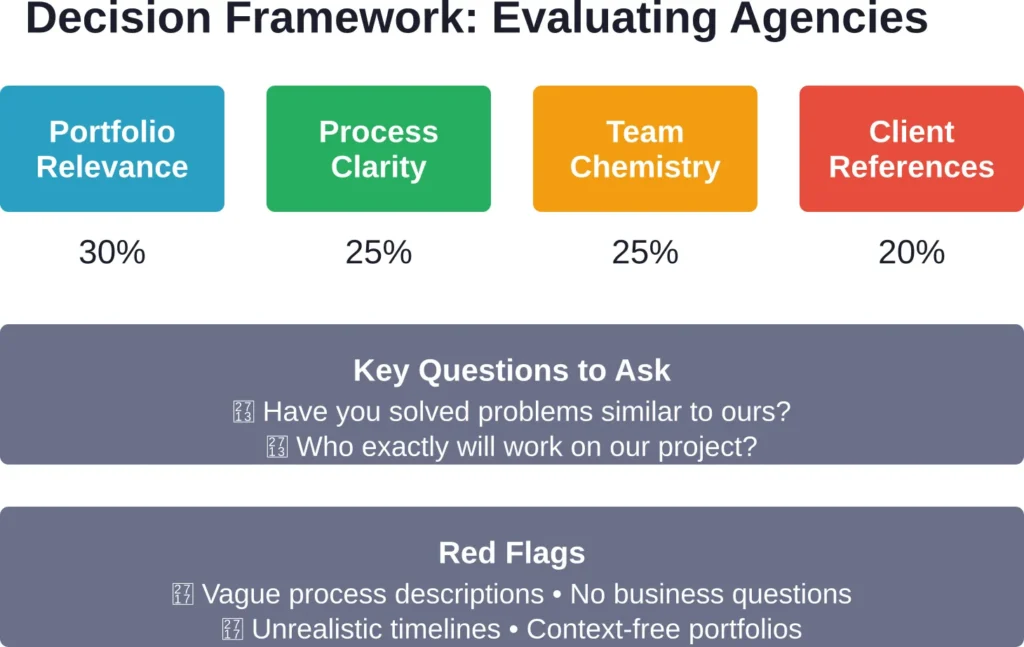
Look for Relevant Complexity
Does their portfolio include projects with similar complexity to yours? An agency that’s designed five simple marketing sites hasn’t proven they can handle a multi-role enterprise application with complex permissions.
Relevant complexity shows up in several ways. Information architecture for large content sets. State management across multi-step workflows. Role-based interfaces serving different user types. Integration with external systems.
Ask direct questions: Have you designed for [specific complexity]? How did you handle [specific challenge]? What patterns did you use for [specific interaction]?
Examine the Process, Not Just Outcomes
Beautiful final designs might have resulted from luck, client direction, or iterating until something worked. A solid process produces good outcomes consistently.
The best agencies articulate their methodology clearly. They explain how they conduct research, how they validate assumptions, how they make design decisions, how they hand off to development.
Red flag: agencies that skip straight to visual design. Good ones start with understanding the problem, mapping user journeys, and wireframing solutions before touching color palettes.
Assess Team Structure and Availability
Who actually works on your project? The senior designers in the portfolio or junior team members? How much partner/director involvement happens after the contract is signed?
Team structure varies significantly. Some agencies assign dedicated teams. Others use resource pools where designers rotate based on availability. Neither is inherently better—but you need to know which model applies.
Ask about typical team composition. For web applications, expect at minimum: UX strategist, UI designer, and someone handling interactions/prototyping. Complex projects add user researchers, design system specialists, and accessibility experts.
Understand Communication and Collaboration Style
Agency-client fit often comes down to communication. Some agencies want high involvement—weekly reviews, Slack access, embedded in your team. Others prefer defined checkpoints with independence between.
Neither style is wrong, but mismatches cause friction. A hands-on founder who wants daily updates will clash with an agency that works in two-week sprints with milestone reviews.
During vetting calls, notice communication patterns. Do they ask clarifying questions or make assumptions? Do they explain design rationale or just present solutions? Do they acknowledge constraints or promise everything?
What to Expect When Working With Design Agencies
Realistic expectations prevent disappointment. Here’s what the engagement actually looks like.
Discovery and Strategy Phase
Every good agency starts with discovery. Expect interviews with stakeholders, reviews of existing analytics, competitor analysis, and user research (if budget permits).
This phase establishes shared understanding. What problem are we solving? For whom? What does success look like? What constraints exist?
Discovery typically takes 1-3 weeks depending on project scope. It feels slow compared to jumping straight into design, but it prevents costly mis-directions later.
Design and Iteration Cycles
Actual design work happens in iterative cycles. The agency presents work, gathers feedback, refines, and repeats. Most projects involve 2-4 major cycles before finalization.
Early cycles focus on structure and flow—wireframes, user flows, information architecture. Later cycles add visual design, interaction details, and edge cases.
Timeline varies enormously based on scope. A focused redesign might complete in 6-8 weeks. An enterprise application could take 4-6 months.
Handoff and Implementation Support
Design doesn’t end when mockups are approved. Implementation often reveals technical constraints or edge cases nobody anticipated.
Better agencies include implementation support—answering developer questions, making adjustments for technical realities, reviewing builds to ensure fidelity.
But here’s the thing: implementation quality ultimately depends on your development team. A brilliant design implemented poorly delivers poor results. Factor developer skill into project planning.
| Project Phase | Typical Duration | Key Deliverables | Client Involvement |
|---|---|---|---|
| Discovery | 1-3 weeks | Research findings, strategy brief, user personas | High — interviews and workshops |
| Information Architecture | 1-2 weeks | Site maps, user flows, wireframes | Medium — review and feedback |
| Visual Design | 2-4 weeks | High-fidelity mockups, design system | Medium — approval checkpoints |
| Prototyping | 1-2 weeks | Interactive prototypes, user testing | Low — observation of testing |
| Handoff | 1 week | Design specs, assets, documentation | Low — developer Q&A |
| Implementation Support | 2-6 weeks | Design QA, adjustments, refinements | Variable — as needed |
Red Flags to Watch For
Not every agency is worth your time or money. Watch for these warning signs.
Over-Promising on Timelines
An agency that promises a complete web application redesign in three weeks either misunderstands the scope or plans to cut corners. Quality design takes time.
Realistic agencies provide ranges rather than fixed dates, explain dependencies, and build buffers for iteration and refinement.
Lack of Process Explanation
If an agency can’t articulate how they work, they probably don’t have a consistent process. You’ll get whatever random approach the assigned designer prefers.
Established agencies have documented methodologies. They explain phases, deliverables, decision points, and how client feedback gets incorporated.
Portfolio Without Context
Pretty screenshots prove nothing without context. What problem did the design solve? What constraints existed? What results occurred after launch?
Agencies serious about outcomes provide case studies with business context, design rationale, and measurable results. Those showcasing only visuals are hiding weak strategic thinking.
No Questions About Your Business
An agency that doesn’t ask detailed questions about your users, business model, competition, and constraints isn’t equipped to design effectively.
Good discovery involves uncomfortable questions that force you to articulate assumptions and priorities. Agencies that skip this step will design based on their assumptions instead of your reality.
Making the Final Decision
Narrowing multiple qualified agencies to one choice involves weighing factors beyond capability.
Start with chemistry. You’ll communicate constantly with this team for weeks or months. Personality mismatches create friction that undermines even technically solid work.
Consider long-term relationship potential. Will this agency support future phases? Can they scale with your needs? Some project types benefit from continuity; others don’t.
Evaluate what happens when things go wrong. Misunderstandings and mistakes are inevitable. Agencies differ dramatically in how they handle problems—some own them and fix fast, others deflect and delay.
References matter. Ask the agency for client contacts from similar projects. Have honest conversations about what worked and what didn’t.
The Reality of Design Agency Budgets
Budget conversations are uncomfortable but necessary. While specific rates and project costs vary widely, understanding general ranges helps set expectations.
According to the BLS, the average web developer or digital designer makes about $80,000 per year or just under $39 per hour.
Agency rates incorporate overhead, tools, processes, and profit margin on top of designer salaries. Smaller boutique agencies and individual contractors typically charge less than established agencies with proven track records.
Project scope dramatically affects total investment. A focused redesign of specific application sections might represent one investment level. A complete platform overhaul with user research, strategy, and design systems represents a much larger commitment.
Most agencies offer either hourly billing or fixed-price projects. Hourly makes sense for ongoing relationships or undefined scope. Fixed-price works better for well-defined projects where scope creep can be managed.
What Influences Project Investment
Several factors drive cost variations beyond base designer rates.
Project complexity is the primary driver. More user roles, more workflows, more edge cases, more integration points—all require additional design time and iterations.
Research needs affect budgets significantly. If the agency conducts extensive user interviews, usability testing, and competitive analysis, expect higher costs than projects that skip research.
Design system development adds value but also cost. Creating reusable components, documentation, and guidelines requires upfront investment that pays off in future consistency and development speed.
Revision cycles impact timelines and budgets. Most proposals include a specific number of revision rounds. Additional cycles beyond that incur extra fees.
Cost Versus Value
The cheapest agency rarely delivers the best value. Poor design creates technical debt, confuses users, and requires expensive rework.
But expensive doesn’t guarantee quality either. Some agencies charge premium rates based on reputation while delivering similar work to mid-tier competitors.
Real value comes from outcomes. An agency that charges more but delivers measurably better conversion, reduced support costs, or faster user task completion often costs less in total impact than a cheap agency producing mediocre work.
Think about total cost of ownership. Initial design investment is one piece. Consider ongoing maintenance, development efficiency, and business impact when evaluating true cost.
Working Effectively With Your Chosen Agency
The client-agency relationship is a partnership. Your involvement significantly affects outcomes.
Provide Context Generously
Agencies can’t read minds. The more context you provide about users, business constraints, technical limitations, and priorities, the better they’ll design.
Share analytics data. Explain failed approaches you’ve tried. Describe specific user feedback you’ve heard. Point out competitor features users request.
This information shapes design decisions from the start rather than requiring corrections later.
Consolidate Feedback
Agencies struggle when different stakeholders provide conflicting feedback directly to designers. The design ping-pongs between preferences rather than progressing toward a solution.
Designate one person—typically a product manager or project lead—to consolidate internal feedback and communicate priorities to the agency.
This doesn’t mean other stakeholders can’t provide input. It means one person synthesizes that input and makes final calls when conflicts arise.
Trust the Process
Effective design processes often feel slow initially. Lots of wireframes and user flows before anything looks polished. Research and strategy before visual design.
Resist the temptation to skip ahead. The best agencies front-load thinking to reduce expensive revisions later. Pushing them to skip straight to high-fidelity mockups usually backfires.
That said, remain skeptical of endless research and strategy with no progress toward concrete designs. Balance exists between rushing and overthinking.
Prepare for Implementation
Design handoff quality varies. Some agencies provide pixel-perfect specifications, annotated flows, and responsive behavior documentation. Others hand over static mockups and expect developers to figure out details.
Clarify handoff expectations upfront. What format will designs be delivered in? What documentation accompanies them? How much implementation support is included?
The implementation phase often reveals edge cases nobody considered during design. Budget time and resources for design adjustments during development.
Trends Shaping Web App Design in 2026
The industry continues evolving rapidly. Several trends are reshaping how agencies approach web application design.
AI as Design Collaborator
AI tools have moved beyond novelty to practical everyday use. Practical applications include generating design variations, writing interface copy, conducting automated accessibility audits, and analyzing user research transcripts.
But AI hasn’t replaced human designers. Instead, it’s shifting their work toward higher-level strategic thinking while automating repetitive tasks. The best agencies use AI to amplify designer capabilities, not replace them.
Eye-tracking AI tools like Attention Insight have been trained on thousands of hours of eye-tracking studies and can predict user attention patterns with approximately 90-96% accuracy. However, human judgment remains essential for interpreting results and making design decisions.
Design Systems as Standard Practice
Design systems have evolved from nice-to-have to essential infrastructure. They ensure consistency, accelerate development, and make maintenance feasible as applications grow.
Modern design systems go beyond component libraries. They include accessibility guidelines, content patterns, motion principles, and responsive behaviors documented clearly for developers.
Agencies now treat design system development as a standard deliverable rather than an optional add-on. The upfront investment pays dividends in development speed and long-term consistency.
Performance-First Design
Performance is no longer just a development concern. Designers now consider payload, rendering cost, and load patterns from initial concepts.
This manifests in several practices. Progressive enhancement that delivers core functionality fast. Lazy loading for below-fold content. Optimized asset delivery. Reduced reliance on heavy JavaScript frameworks.
AI-driven caching can increase cache hit rates by 15% by improving data availability and reducing latency. Performance-conscious agencies leverage these optimizations.
Accessibility as Foundation
Accessibility has shifted from compliance checkbox to design foundation. Modern agencies bake accessibility into every stage rather than testing at the end.
This includes semantic HTML structure, proper contrast ratios, keyboard navigation, screen reader compatibility, and focus management. Designers who understand WCAG guidelines produce better work than those treating accessibility as a developer problem.
But accessibility extends beyond disabilities. It encompasses situational limitations—using an app in bright sunlight, on a slow connection, with one hand occupied, or while distracted.
Frequently Asked Questions
Investment varies dramatically based on project scope, agency tier, and geographic location. Focused projects involving specific feature redesigns might represent lower commitments, while complete platform overhauls with extensive research and design systems require substantially larger budgets. Most agencies work either hourly or fixed-price. For accurate estimates, define your scope clearly and request detailed proposals from 3-4 agencies to compare approaches and investment levels.
Timeline depends on complexity and scope. A focused redesign of specific application sections might complete in 6-8 weeks. A comprehensive web application design including research, strategy, information architecture, visual design, and prototyping typically takes 3-4 months. Enterprise projects with multiple stakeholder groups, complex workflows, and extensive testing can extend to 6-9 months. Rush projects rarely produce quality outcomes—good design requires iteration and validation time.
Specialization usually wins for complex projects. An agency focused on SaaS applications understands subscription models, onboarding flows, and feature adoption patterns better than generalists. Similarly, enterprise-focused agencies navigate complex stakeholder dynamics and integration requirements more effectively. However, generalists can be appropriate for smaller projects or when budget is the primary constraint. Evaluate whether agencies have solved problems similar to yours rather than just experience in your industry.
UX (user experience) design focuses on how the application works—user flows, information architecture, interaction patterns, and problem-solving. UI (user interface) design focuses on how it looks—visual hierarchy, typography, color, and detailed interface elements. Good web applications need both. Many designers handle both disciplines, while larger agencies often have specialized roles. For complex applications, expect dedicated UX strategists who work before visual designers get involved.
It depends on project complexity and your internal capabilities. Freelancers work well for small, well-defined projects or when you have strong internal product management. Agencies provide team diversity—researchers, UX designers, visual designers, interaction specialists—plus established processes and quality assurance. For complex applications, multiple stakeholder groups, or compressed timelines, agencies typically deliver better outcomes. For focused features or ongoing design support, talented freelancers can be effective and more budget-friendly.
Look for three key indicators. First, relevant portfolio work—have they designed applications with similar complexity and solved similar problems? Second, process clarity—can they articulate how they work, what deliverables you’ll receive, and how decisions get made? Third, chemistry—do you communicate well, share design values, and trust their judgment? Request reference calls with past clients on similar projects. Ask about challenges that arose and how the agency handled them. Poor fit often emerges in crisis moments.
Standard deliverables include user research findings and personas, information architecture documentation, wireframes showing structure and flow, high-fidelity visual designs for key screens, interactive prototypes for complex interactions, a design system or component library, responsive specifications for different screen sizes, and implementation documentation for developers. Some agencies also provide usability testing results, content guidelines, and accessibility audits. Clarify deliverables explicitly in your contract—assumptions differ widely across agencies.
Moving Forward With Confidence
Choosing a web app design agency is a significant decision that impacts your product for years. The right partner elevates your application, delights users, and drives measurable business results. The wrong one wastes budget and time while producing mediocre outcomes.
The 15 agencies profiled here represent different strengths, specializations, and approaches. Eleken excels at SaaS product design. Clay brings branding-first digital experiences. Takt handles enterprise complexity. KOTA specializes in data visualization. Match your specific needs to agency expertise rather than choosing based on general reputation.
Remember that capability alone doesn’t guarantee success. Process clarity, communication style, and team chemistry matter enormously. An agency slightly less experienced but highly collaborative often delivers better outcomes than prestigious firms that work in isolation.
Start your evaluation by defining success clearly. What specific problems need solving? What metrics will improve? What constraints exist? Armed with clear criteria, you can evaluate agencies objectively rather than getting swayed by impressive portfolios or persuasive sales pitches.
Request detailed proposals from your short list. Compare not just timelines and investment but approaches, team structure, and how they plan to solve your specific challenges. Reference calls with past clients reveal how agencies handle obstacles and whether they deliver on promises.
The web app design landscape will continue evolving. AI tools, new interaction patterns, and changing user expectations ensure constant change. But the fundamentals remain: understanding users deeply, solving real problems elegantly, and measuring outcomes honestly.
Choose an agency that shares these values, demonstrates relevant expertise, and communicates openly. The investment in finding the right partner pays dividends throughout your product’s lifecycle.
Ready to start your search? Review the agencies listed here, explore their portfolios, and reach out to those matching your needs. The right design partner is waiting—finding them just requires doing the homework.