

Quick Summary: The best website support companies in 2026 include specialized agencies offering maintenance, security, updates, and technical assistance. This guide profiles 15 top-rated firms—from full-service digital partners to dedicated WordPress specialists—helping businesses choose the right support partner based on expertise, service scope, and client satisfaction.
Your website works beautifully today. But what about tomorrow when a plugin breaks? Or next month when a security vulnerability surfaces?
That’s where website support companies come in. They’re the safety net between smooth operations and catastrophic downtime.
The challenge? Finding a support partner that actually delivers. Too many agencies promise 24/7 availability but respond in 48 hours. Others excel at WordPress but fumble custom applications.
This guide cuts through the noise. We’ve analyzed client reviews, service portfolios, and real-world performance to identify the 15 best website support companies operating in 2026.
No pricing comparisons—just pure evaluation of expertise, reliability, and what makes each agency stand out.
What Website Support Companies Actually Do
Website support goes far beyond fixing broken links.
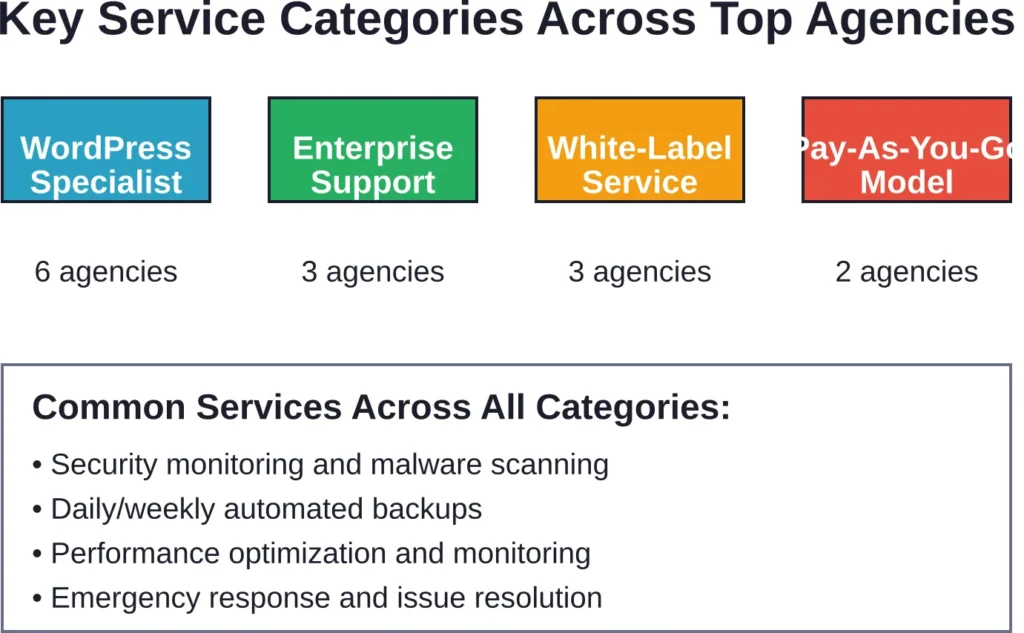
These agencies handle the ongoing technical operations that keep websites functional, secure, and performing well. The scope varies dramatically between providers, but most cover several core areas.
Technical maintenance forms the foundation. Support teams monitor uptime, apply software updates, patch security vulnerabilities, and optimize database performance. They’re the ones who catch problems before visitors notice them.
Content management support helps businesses update text, images, and media without needing in-house developers. Some agencies handle routine content changes as part of their retainer, while others focus purely on technical tasks.
Security monitoring has become non-negotiable. According to Forrester’s 2025 Global Customer Experience Index, in the US, 25% of brands’ customer experience rankings declined in 2025—often due to technical issues including security breaches.
Support companies implement firewalls, scan for malware, manage SSL certificates, and respond to security incidents. The best ones catch threats before they escalate.
Performance optimization ensures fast load times and smooth functionality. Support teams compress images, configure caching, optimize code, and monitor server resources. Page speed directly impacts both user experience and search rankings.
Emergency response separates adequate support from exceptional service. When a site crashes at 2 AM, response time matters. Top agencies offer guaranteed response windows and clear escalation procedures.
How to Choose the Right Website Support Partner
Not all support companies fit all businesses.
Start by assessing your technical stack. WordPress sites need agencies fluent in that ecosystem. Custom applications require deeper development expertise. E-commerce platforms like Shopify demand specialists who understand transaction security and inventory integrations.
Service level agreements (SLAs) define the relationship. Look for clear commitments on response times, resolution windows, and uptime guarantees. Vague promises like “we’ll get back to you soon” won’t cut it when revenue depends on site availability.
Communication style matters more than most businesses realize. Some agencies operate ticketing systems with formal processes. Others prefer Slack channels and informal check-ins. Choose the approach that matches how your team works.
Industry experience provides context. An agency that’s supported healthcare sites understands HIPAA compliance. One with e-commerce clients knows payment gateway quirks. That domain knowledge accelerates problem-solving.
Geographic and timezone considerations affect accessibility. Distributed teams can provide true 24/7 coverage. Single-timezone agencies might leave you waiting during off-hours, depending on your location and needs.
The 15 Best Website Support Companies in 2026
Here’s the list. Each agency brings distinct strengths to website support and maintenance.
1. Oski
Oski builds and maintains smart, scalable web solutions for enterprises and ambitious startups.
Their team designs, develops, deploys, and continuously supports well-engineered software, with strong expertise in CMS platforms including WordPress and Umbraco. They focus on delivering reliable systems that stay performant, secure, and easy to manage long after launch.
Oski emphasizes ongoing maintenance, cloud infrastructure, frontend optimizations, and AI-enhanced features that keep websites running smoothly at scale. Their approach includes proactive monitoring, updates, and improvements to ensure stability and excellent user experiences.
Clients value their ability to act as an extension of internal teams, handling everything from routine care to complex enhancements across industries like e-commerce, travel, logistics, and fintech.
Best for: Organizations needing comprehensive website development combined with reliable long-term support and optimization for enterprise-scale operations.
Contact Information:
- Website: oski.site
- Phone: +48571282759
- Email: [email protected]
- Address: Kaupmehe tn 7, 10114 Tallinn, Estonia
- LinkedIn: www.linkedin.com/company/oski-solutions
2. A-listware
A-listware delivers managed software development and support services that keep digital platforms running efficiently.
They provide dedicated teams for application maintenance, infrastructure management, help desk services, and cybersecurity, ensuring websites and web applications remain secure, updated, and high-performing. Their full-spectrum approach covers everything from routine updates to complex system integrations.
The agency excels at seamless team integration, acting as an extension of client organizations while delivering consistent quality through proactive support and monitoring. They handle cloud solutions, data analytics, and ongoing infrastructure care to prevent issues before they arise.
Clients appreciate the 24/7 expert access and end-to-end management that minimizes downtime and technical headaches.
Best for: Enterprises and growing businesses seeking dependable ongoing website and application support, infrastructure management, and dedicated technical teams.
Contact Information:
- Website: a-listware.com
- Phone: +1 (888) 337 93 73
- Email: [email protected]
- Address: North Bergen, NJ 07047, USA
- LinkedIn: www.linkedin.com/company/a-listware
- Facebook: www.facebook.com/alistware
3. Gilzor

Gilzor specializes in full-cycle web development paired with dedicated post-launch support and maintenance.
Their services include building robust websites and web applications, followed by ongoing care — keeping products up to date, fixing issues based on user feedback, and implementing improvements for better performance and security. They provide quality assurance, troubleshooting, and continuous optimization throughout the product lifecycle.
The team focuses on scalable, high-performance solutions with strong emphasis on maintenance that reduces risks and supports long-term growth. Clients benefit from reliable updates, performance tuning, and strategic guidance that keeps digital assets effective over time.
Best for: Startups and small-to-medium businesses needing both initial website development and consistent ongoing support and maintenance.
Contact Information:
- Website: www.gilzor.com
- Email: [email protected]
- Address: Poland, Warsaw, Office 58, street Adama Mickiewicza 37, 01-625
- LinkedIn: www.linkedin.com/company/gilzor-softwaredevelopment
4. Mobian
Mobian builds dedicated engineering teams that deliver production-ready digital solutions with strong post-launch partnership.
They provide full-stack delivery for web and mobile platforms, legacy integration, and scalable architecture, followed by continued support including bug fixes, performance monitoring, and scaling assistance. Their post-launch model ensures websites and applications stay current and reliable as needs evolve.
The agency offers both outsourcing and outstaffing, allowing clients to maintain control while gaining expert ongoing care. Clean architecture, thorough documentation, and senior-level execution make long-term maintenance straightforward and effective.
Best for: Companies in IT, healthcare, fintech, and logistics that require reliable website and application development combined with dedicated long-term technical support.
Contact Information:
- Website: mobian.studio
- Phone: [email protected]
- Address: Harju maakond, Tallinn, Kesklinnalinnaosa, Masina tn 22, 10113
- LinkedIn: www.linkedin.com/company/mobian-studio
5. Lengreo

Lengreo serves as a complete marketing and tech partner, delivering website development alongside ongoing optimization and support.
They build eCommerce, business, and portfolio websites with full quality assurance and continued maintenance. Their SEO, website audits, optimizations, and performance work help keep sites ranking well and running smoothly.
The team combines technical development with strategic improvements — including conversion optimization, content updates, and digital enhancements — so websites continue to drive results over time. Clients receive proactive care that adapts to changing business needs.
Best for: B2B companies needing website development, SEO-driven maintenance, performance optimization, and integrated marketing support.
Contact Information:
- Website: Lengreo.com
- Phone: +31 686 147 566
- Email: [email protected]
- Address: Vrijstraat 9 C/D, 5611 AT Eindhoven, Netherlands
- LinkedIn: Lengreo
- Twitter: @Lengreo
- Instagram: @lengreo
6. Go Valet

Go Valet combines website support with digital marketing services.
Their support offering includes technical maintenance, content updates, and strategic optimization. But they also handle SEO, analytics, and conversion optimization—treating website support as part of a larger growth strategy.
This integrated approach benefits businesses that want support and marketing under one roof. Changes get implemented faster because the same team understands both the technical architecture and marketing goals.
They work primarily with small to mid-size businesses across professional services, healthcare, and local commerce. Their team understands the practical constraints these businesses face—limited budgets, small internal teams, multiple priorities.
Support packages scale based on need. Smaller sites get essential maintenance and monitoring. Larger operations receive comprehensive support including staging environments, A/B testing, and detailed performance analytics.
Best for: Small to mid-size businesses wanting combined technical support and marketing services from a single partner.
7. WP Experts
WP Experts brings deep technical expertise to WordPress support.
They handle complex custom development, plugin creation, and advanced integrations alongside standard maintenance. Many clients come to them when other agencies can’t solve particularly thorny technical problems.
Their support model offers both retainer-based maintenance and on-demand project work. Businesses can start with basic support and scale up when they need custom development or major technical initiatives.
The team stays current with WordPress core development and emerging technologies. They’ve implemented headless WordPress architectures, complex API integrations, and multi-site networks spanning dozens of properties.
Response times are fast—typically under two hours for critical issues. Their ticketing system prioritizes requests based on business impact, ensuring urgent problems get immediate attention.
Best for: Businesses with complex WordPress implementations, custom functionality requirements, or technically challenging support needs.
8. FixRunner

FixRunner operates on a pay-as-you-go model without long-term contracts.
Businesses submit individual support requests and pay per task completed. No monthly retainers. No unused hours. Just on-demand support when needed.
This model works well for companies with irregular support needs—maybe they need help quarterly, not monthly. It also appeals to businesses hesitant to commit to ongoing contracts before seeing service quality.
FixRunner handles WordPress, Shopify, Wix, Squarespace, and custom HTML sites. Their team includes specialists for each platform, ensuring requests go to someone with relevant expertise.
Turnaround times vary based on request complexity, but most basic maintenance tasks are completed within 24 hours. More complex issues get time estimates upfront so clients know what to expect.
Best for: Businesses with sporadic support needs, companies wanting flexibility without retainer commitments.
9. WP Eagle

WP Eagle has built a comprehensive WordPress maintenance service with transparent processes.
Every site receives daily backups, weekly security scans, monthly plugin updates, and quarterly performance audits. Clients get detailed reports showing exactly what was done and why it matters.
Their support team operates across timezones, providing coverage throughout business hours in North America, Europe, and parts of Asia. Response times for critical issues average under one hour.
They’ve developed specialized expertise in e-commerce support, particularly WooCommerce. Payment gateway issues, inventory synchronization, and checkout optimization are routine requests they handle smoothly.
The agency also offers migration services—moving sites between hosts, upgrading to newer WordPress versions, or transitioning from other platforms to WordPress. These migrations happen with zero downtime through careful planning and execution.
Best for: WordPress sites with e-commerce components, businesses needing reliable international support coverage.
10. Seahawk Media

Seahawk Media provides white-label WordPress services to agencies alongside direct client support.
Their distributed team operates 24/7, handling maintenance, security, performance optimization, and emergency response. They’ve refined their processes through managing thousands of WordPress sites simultaneously.
What distinguishes their service: speed. Average response time for critical issues is under 30 minutes. Most maintenance tasks are completed within hours, not days.
They use advanced monitoring tools that detect issues before they cause user-facing problems. Automated alerts trigger immediate review and resolution, often before clients even know something was wrong.
Their white-label service helps agencies offer WordPress support without building internal maintenance teams. Agencies maintain the client relationship while Seahawk handles technical execution behind the scenes.
Best for: Agencies needing reliable white-label WordPress support, businesses requiring fast response times and 24/7 availability.
11. WebDevStudios
WebDevStudios has built a reputation around enterprise WordPress support and custom development.
The agency handles complex WordPress multisite networks, membership platforms, and publishing systems. Their support model combines proactive monitoring with rapid response to technical issues.
What sets them apart? Deep WordPress core expertise. Several team members have contributed to WordPress itself, giving them insight into how the platform works at a fundamental level.
They’ve supported major media companies, universities, and Fortune 500 brands. That experience shows in how they handle scale and complexity.
Their support packages include security hardening, performance optimization, plugin updates, and emergency response. They also offer strategic consulting for sites planning major upgrades or migrations.
Best for: Enterprise WordPress sites, publishing platforms, and organizations running complex content operations.
12. WP Buffs

WP Buffs specializes in white-label WordPress support for agencies and managed services for direct clients.
Their model focuses on preventive maintenance. Daily backups, security scans, uptime monitoring, and performance optimization happen automatically. When issues arise, their support team addresses them before clients notice.
The agency operates 24/7 with distributed teams across multiple timezones. Response times are measured in minutes for critical issues, not hours.
They’ve refined their WordPress maintenance process through thousands of client sites. That volume creates efficiency—they’ve seen virtually every WordPress issue that exists and know exactly how to resolve it.
Their dashboard gives clients visibility into all maintenance activities, security scans, and performance metrics. Transparency eliminates the “what are we paying for” question that plagues many support relationships.
Best for: Agencies needing white-label WordPress support, small businesses wanting comprehensive WordPress maintenance without hiring developers.
13. Maintainn
Maintainn takes a different approach: unlimited website edits and support for a flat monthly fee.
Need a homepage redesign? Included. Want to add new pages? Covered. Plugin acting weird? They’ll fix it. The model eliminates the anxiety of hourly billing and project estimates.
They handle WordPress, Shopify, and custom sites. Their team includes designers and developers, so support extends beyond pure maintenance into ongoing improvements and optimizations.
Clients submit requests through a simple portal. Maintainn assigns tasks to the appropriate specialist and delivers updates within agreed timeframes. Most requests are completed within 24-48 hours.
The unlimited model works because client needs balance out—some months are quiet, others busy. Businesses get predictable costs and flexibility to request changes whenever needed.
Best for: Growing businesses needing both maintenance and ongoing development, companies tired of hourly billing uncertainty.
14. 10up

10up operates at the enterprise end of the spectrum.
They’ve built and supported websites for Microsoft, Time Inc., and major universities. Their distributed team includes specialists in WordPress, React, and headless CMS architectures.
Support at 10up goes beyond fixing bugs. They provide strategic guidance on technical architecture, performance optimization, and scaling challenges. Many clients rely on them as an extension of their internal technology team.
Their approach emphasizes documentation and knowledge transfer. They don’t want clients dependent—they want them educated. Every support engagement includes clear explanations of what happened and why.
Security and performance audits are standard. They proactively identify vulnerabilities and bottlenecks before they impact users. That preventive focus reduces emergency situations.
Best for: Enterprise organizations, media companies, and brands requiring sophisticated technical support with strategic depth.
15. WP Site Care

WP Site Care focuses exclusively on WordPress maintenance and support.
Their service model centers on proactive care: daily backups, security monitoring, plugin updates, uptime tracking, and performance optimization. Support requests are handled through a dedicated help desk with clear SLAs.
They’ve developed proprietary monitoring tools that track WordPress-specific issues—outdated plugins, security vulnerabilities, performance degradation. Automated alerts ensure problems get addressed immediately.
The agency also offers emergency site recovery. If a site gets hacked or breaks catastrophically, their team can restore it from clean backups and implement additional security measures.
What clients appreciate most: consistency. The same team handles each account, building familiarity with the specific site and business needs. No explaining the same issues to different support agents every time.
Best for: WordPress sites of all sizes needing reliable, consistent maintenance without surprises.
Common Service Models in Website Support
Website support companies structure their services in three primary ways.
Retainer-based support is the most common model. Businesses pay a monthly fee for a defined scope of services—monitoring, backups, updates, and a certain number of support hours. This provides predictability for both parties.
Retainers work well when support needs are consistent month-to-month. The agency can plan resources, and the business gets reliable availability without per-incident charges adding up.
The challenge? Unused hours. Some agencies roll them over, others don’t. Understanding what happens to unused time matters when evaluating retainer agreements.
Unlimited support packages eliminate hour tracking entirely. Pay a flat fee, submit unlimited requests within scope. Maintainn pioneered this model successfully.
This approach removes friction. Businesses don’t hesitate to request small changes because they’re worried about billable hours. That often leads to better-maintained sites with more current content.
The catch: “unlimited” always has practical limits. Most agencies define what counts as included work versus out-of-scope projects. Read those definitions carefully.
Pay-per-task support charges for individual requests without ongoing contracts. FixRunner operates primarily on this model.
It’s ideal for businesses with sporadic needs—maybe they need support quarterly, not monthly. No commitment means no wasted spend during quiet periods.
The tradeoff? Less proactive monitoring. These agencies aren’t watching your site 24/7 because you’re not paying them to. They respond when you reach out, not before.
Security and Performance Standards
Top support companies maintain specific technical standards.
Security protocols typically include daily malware scans, firewall configuration, SSL certificate management, and vulnerability patching. According to Forrester’s 2025 Global Customer Experience Index, 25% of US brands saw their experience rankings decline—technical issues including security problems contributed significantly.
Support agencies that excel implement defense-in-depth strategies. Multiple security layers protect sites from different attack vectors. Single-point security measures aren’t enough anymore.
Performance monitoring tracks page load times, server response times, database query performance, and resource utilization. Most agencies set baseline metrics and alert when performance degrades.
The best ones don’t just monitor—they optimize proactively. They compress images, implement caching strategies, optimize databases, and refine code to maintain speed as sites grow.
Backup strategies vary significantly between providers. Daily backups are standard, but retention periods differ. Some keep 30 days of backups, others 90. Understand what’s included before assuming your data is protected long-term.
Testing backup restoration separates thorough agencies from careless ones. Backups that can’t be restored successfully are worthless. Top agencies regularly test their backup systems to ensure they actually work when needed.
What to Expect During Onboarding
Starting with a new support company involves several standard steps.
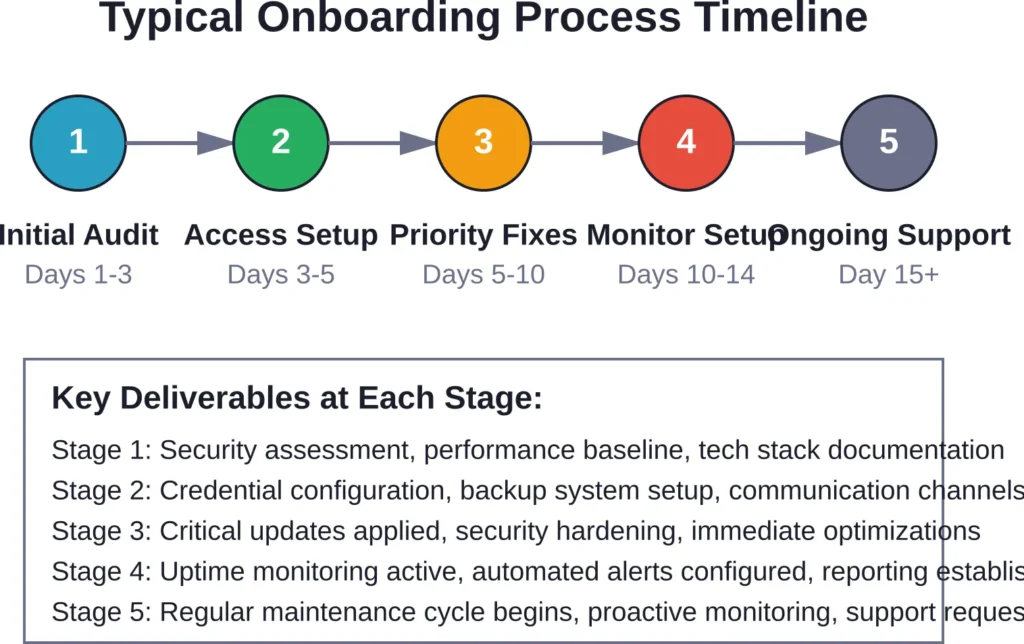
Most agencies begin with a comprehensive site audit. They review current security posture, identify outdated software, assess performance bottlenecks, and document the technical environment.
This audit accomplishes two things: it establishes baseline site health, and it reveals immediate priorities. Addressing critical vulnerabilities before implementing ongoing monitoring prevents emergencies during transition.
Access provisioning comes next. The agency needs appropriate credentials—hosting account access, content management system logins, domain registrar information, and third-party service credentials.
Security-conscious agencies will require specific access levels rather than administrative credentials. They should only request the minimum permissions needed to perform their services.
Communication setup defines how you’ll interact. Will you submit tickets through a portal? Email a dedicated address? Message via Slack? Establishing clear channels prevents confusion when urgent issues arise.
Initial optimizations often happen during the first month. The agency addresses the issues identified in the audit—updating software, tightening security, optimizing performance. This brings the site to their standard baseline before transitioning to maintenance mode.
Red Flags When Evaluating Support Companies
Certain warning signs indicate problematic agencies.
Vague service descriptions top the list. If an agency can’t clearly articulate what’s included in their support package, expect confusion later. “We handle everything” isn’t a service description—it’s a recipe for disappointed expectations.
No clear SLAs leaves response times to chance. Top agencies commit to specific response windows: critical issues within 30 minutes, high priority within 2 hours, routine requests within 24 hours. Numbers vary, but commitments should be explicit.
Unwillingness to provide references raises questions. Established agencies serving real clients happily connect prospects with existing customers. Hesitation suggests either inexperience or unhappy clients.
Offshore-only teams aren’t inherently problematic, but communication and timezone challenges can complicate support relationships. If your business operates 9-5 US Eastern time and your support team works 9-5 in South Asia, someone’s getting midnight calls. Make sure coverage aligns with your needs.
Requesting unnecessary access indicates poor security practices. Support agencies need appropriate permissions, not administrative control over everything. An agency demanding full server root access to fix WordPress plugins doesn’t understand least-privilege principles.
Pressure tactics during sales conversations suggest the relationship will be difficult. Good agencies answer questions, explain their approach, and let prospects decide. Aggressive closing techniques indicate they value the sale more than the fit.
Specialized Support: E-commerce, Membership Sites, and Custom Applications
General website support differs from specialized platform maintenance.
E-commerce sites need agencies familiar with payment gateway integrations, SSL certificate management for checkout pages, inventory system synchronization, and transaction security. A generic WordPress agency might struggle with WooCommerce or Shopify-specific issues.
WP Eagle has developed particular expertise here. They understand the nuances of e-commerce security, performance optimization for product catalogs, and the technical details that make checkout flows work smoothly.
Membership sites present unique challenges: user authentication systems, content access controls, payment processor integrations, and member data management. Support agencies need experience with membership plugins and the specific quirks of gated content architectures.
Custom applications require development expertise beyond standard maintenance. These sites often use custom code, complex integrations, and unique technical stacks. Support teams need the ability to understand, debug, and modify custom functionality.
10up excels in this space. Their distributed team includes developers capable of working with React, Vue, headless architectures, and custom WordPress implementations that go far beyond standard themes and plugins.
When evaluating specialized support, ask specific questions about relevant experience. Generic claims about “supporting all platforms” mean little. Request case studies showing successful work with your specific platform or application type.
The Economics of Outsourced Website Support
Understanding support economics helps contextualize value.
Hiring a full-time developer typically costs $70,000-$120,000 annually in the United States, plus benefits, equipment, and management overhead. That developer handles one site—yours—during business hours.
Outsourced support agencies spread their team across multiple clients, creating efficiency. Their specialists have seen thousands of sites, encountered countless issues, and developed systematic approaches to common problems. That experience accelerates resolution.
The distributed model also enables 24/7 coverage at sustainable cost. No single employer could afford round-the-clock staffing for website support. Agencies serving global clients can justify distributed teams because collective demand supports it.
But there’s a tradeoff. In-house developers know your business intimately and can provide strategic technical guidance beyond pure maintenance. Outsourced agencies offer expertise and availability, but less business context.
The economically optimal approach for most businesses: outsource routine maintenance and monitoring, retain strategic development resources internally or through project-based relationships. Let support agencies handle the operational work so internal teams or strategic partners focus on growth initiatives.
How Support Companies Handle Emergencies
Emergency response processes separate competent agencies from exceptional ones.
Top agencies maintain tiered support structures. Front-line technicians handle routine requests and common issues. Senior developers escalate to when problems require deep expertise. On-call specialists are available for true emergencies outside business hours.
Clear escalation procedures ensure critical issues reach the right people immediately. When a site crashes at 3 AM, the response system should automatically alert senior staff, not wait for the morning shift to check tickets.
WP Buffs has refined this particularly well. Their 24/7 distributed team operates with clear handoff protocols. When one timezone team signs off, they brief the incoming team on active issues. Nothing falls through the cracks during shift changes.
Emergency communication matters as much as technical response. Clients need to know: What happened? What’s being done? What’s the expected resolution timeline? Regular updates during outages prevent the anxiety of silence.
Post-incident reviews provide learning opportunities. After resolving emergencies, strong agencies conduct brief analyses: What caused the problem? How can we prevent recurrence? Should monitoring or backup strategies change? This continuous improvement prevents the same emergency from happening twice.
Migration Support and Platform Transitions
Many support relationships begin with migration projects.
Businesses switching hosting providers, upgrading WordPress versions, or transitioning between platforms need technical expertise to execute moves without downtime or data loss.
WP Eagle specializes in zero-downtime migrations. They plan meticulously, create complete backups, test transitions on staging environments, and execute during low-traffic windows to minimize risk.
The migration process typically involves several phases: backup and audit of the current site, setup of the destination environment, content and database migration, DNS updates, and post-migration testing. Rushing any phase invites problems.
Platform transitions—moving from proprietary systems to WordPress, for example—are more complex than simple hosting moves. Content structures might not map directly. Custom functionality may require rebuilding. Design elements need adaptation.
Agencies handling these transitions need both technical skill and project management discipline. Migrations involve multiple moving parts, dependencies, and potential failure points. Systematic approaches with clear checkpoints prevent chaos.
Reporting and Communication Practices
Visibility into support activities builds trust.
Top agencies provide regular reporting: monthly summaries of all maintenance performed, security scans conducted, issues resolved, and performance metrics. These reports demonstrate value and keep clients informed.
WP Buffs has developed particularly transparent dashboards. Clients log in to see real-time status of their sites, recent maintenance activities, security scan results, and performance trends. No waiting for monthly reports to understand what’s happening.
Communication frequency should match business needs. Some clients want weekly check-ins. Others prefer monthly summaries unless issues arise. Agencies should adapt to client preferences rather than imposing rigid communication schedules.
Documentation practices separate professional operations from casual ones. When agencies resolve issues, they should document what happened, what was done, and why. This creates institutional knowledge that persists even if specific team members change.
Responsive communication between scheduled reports matters too. If a client submits a support request, acknowledging receipt immediately—even if resolution takes hours—prevents the anxiety of wondering whether the message was received.
| Service Component | Basic Support | Standard Support | Premium Support |
|---|---|---|---|
| Uptime Monitoring | Daily checks | Hourly checks | Real-time monitoring |
| Backup Frequency | Weekly | Daily | Daily + on-demand |
| Security Scans | Weekly | Daily | Continuous |
| Response Time (Critical) | 4 hours | 2 hours | 30 minutes |
| Response Time (Routine) | 48 hours | 24 hours | 4 hours |
| Plugin/Theme Updates | Monthly | Weekly | As released (tested) |
| Performance Optimization | Quarterly review | Monthly review | Continuous monitoring |
Long-Term Partnership Considerations
Support relationships often span years, not months.
Look for agencies that invest in client success beyond immediate technical fixes. Do they proactively suggest improvements? Flag emerging security concerns before they become urgent? Recommend strategic upgrades that enhance business outcomes?
Maintainn’s unlimited model encourages this partnership mindset. Because clients aren’t worried about hourly charges, they engage support teams in strategic conversations. Should we rebuild this section? Could we add this functionality? Those discussions lead to continuous improvement rather than reactive maintenance.
Contractual flexibility matters for long relationships. Business needs change. A three-person startup that becomes a 50-person company needs different support levels. Agencies should accommodate growth through scalable service tiers rather than locking clients into static agreements.
Team stability within the agency affects client experience. High turnover means constantly re-explaining context to new support staff. Established agencies with low turnover provide consistency—the same people who learned your site last year are still supporting it this year.
Strategic alignment becomes important over time. If your business is heavily investing in mobile experience and your support agency doesn’t prioritize mobile optimization, friction will develop. The best long-term partnerships involve agencies whose technical philosophy aligns with business direction.
Frequently Asked Questions
Website support focuses on maintaining existing sites—monitoring uptime, applying updates, fixing bugs, optimizing performance, and responding to technical issues. Web development builds new functionality, redesigns sites, and creates custom features. Many agencies offer both, but they’re distinct services. Support is ongoing and operational; development is project-based and transformational.
Industry standards for critical issues (site down, security breach, major functionality broken) range from 15 minutes to 2 hours, depending on service tier. Premium support packages typically guarantee sub-30-minute response times. Standard support usually commits to 1-2 hours. Budget support might specify 4-24 hours. Response time means initial acknowledgment and triage, not necessarily full resolution—complex issues take longer to fix than to assess.
Managed hosting handles server-level maintenance—updates to PHP, MySQL, server security, and infrastructure monitoring. But it doesn’t update your WordPress core, themes, or plugins. It won’t fix broken functionality, optimize your content, or respond to application-level issues. Managed hosting and website support complement each other; neither fully replaces the other. Sites on managed hosting still benefit from application-level support.
Professional support agencies regularly inherit sites built by other developers or agencies. They start with comprehensive audits to understand the architecture, identify customizations, and document the technical environment. Most can support any standard WordPress, Shopify, or common CMS implementation. Highly custom applications may require longer learning curves or specialized expertise. Ask agencies about their experience supporting inherited sites during evaluation.
Reputable agencies acknowledge limitations and bring in additional expertise when needed. Some maintain networks of specialists they can consult on complex problems. Others will recommend transitioning specific issues to developers with relevant experience. The red flag is an agency that keeps billing hours without resolving problems or admitting they’re stuck. Clear SLAs should define escalation procedures and what happens when issues exceed the agency’s capabilities.
Combined hosting and support packages offer convenience—single vendor, integrated billing, unified support contact. The tradeoff is flexibility. If the hosting is mediocre but support is excellent (or vice versa), you’re stuck with both or neither. Many businesses prefer separating hosting and support, choosing best-in-class providers for each. This allows switching one without disrupting the other. But for non-technical businesses, the simplicity of combined services often outweighs the flexibility of separation.
Support costs vary dramatically based on site complexity, service level, and business requirements. Generally speaking, basic monitoring and maintenance for simple sites might run several hundred dollars monthly. Comprehensive support with fast response times for complex sites can reach several thousand monthly. The pay-per-task model eliminates recurring costs but charges per incident. Evaluate cost against the business impact of downtime—losing thousands in revenue during a 4-hour outage makes premium support economical even at higher monthly fees.
Conclusion: Choosing Your Website Support Partner
The right support company becomes invisible—sites run smoothly, issues resolve before impacting users, and technical operations fade into reliable background infrastructure.
Start by clarifying your technical environment and specific needs. WordPress sites have different requirements than custom applications. E-commerce platforms need specialized expertise. Match agency specialization to your platform.
Evaluate service models honestly. Do you need 24/7 coverage? Would business-hours support suffice? Will your usage justify a retainer, or does pay-per-task make more sense? Choose the model that aligns with actual patterns rather than theoretical possibilities.
Review real client experiences through platforms like Clutch, direct references, and case studies. Agencies making bold promises should demonstrate track records delivering them. Look for consistency in feedback themes—if multiple clients praise (or criticize) the same aspects, that pattern reveals reality.
According to Forrester’s 2025 Global Customer Experience Index research, 73% of brands’ customer experience rankings remained unchanged year-over-year. Maintaining excellent digital experiences that keep those customers satisfied is not optional. Website support might seem like an operational detail, but it’s actually a strategic business investment protecting revenue and brand reputation.
The agencies profiled here represent different approaches to that investment—from WordPress specialists to enterprise partners, white-label services to flexible pay-as-you-go models. Each excels in specific contexts for specific clients.
Your task? Identify which context matches yours, then engage potential agencies with specific questions about experience, processes, and philosophy. The right support partner isn’t necessarily the biggest or most expensive—it’s the one whose capabilities, communication style, and service model align with how your business operates.
Start that evaluation today. Your website works now. The question is whether it will still work smoothly six months from now when traffic spikes, plugins conflict, or security vulnerabilities emerge. The right support partner ensures the answer is yes.