

Quick Summary: Architectural engineering is a specialized engineering discipline that focuses on the technical design, analysis, and integration of building systems—including structural, mechanical, electrical, lighting, and fire protection—to create safe, efficient, and sustainable structures. Unlike architects who emphasize aesthetics and space planning, architectural engineers apply engineering principles to ensure buildings perform optimally while meeting safety codes and environmental standards.
Walk into any modern building—a hospital, office tower, or university campus—and you’re experiencing the invisible work of architectural engineers. While architects imagine how spaces look and feel, architectural engineers solve the technical puzzle of making those spaces stand, breathe, and function.
This discipline sits at a fascinating intersection. It borrows from civil engineering, mechanical engineering, and electrical engineering, but it’s laser-focused on one thing: buildings.
And not just any aspect of buildings. Architectural engineers concentrate on the systems that keep occupants safe, comfortable, and productive.
Defining Architectural Engineering
Architectural engineering applies engineering principles specifically to building design and construction. The field emerged as structures grew more complex and required specialized expertise beyond traditional architecture.
Here’s what makes it distinct: architectural engineers don’t typically design floor plans or choose exterior finishes. Instead, they engineer the bones and organs of a building—the structural framework, the HVAC system that maintains air quality, the electrical distribution, the plumbing networks, and the fire suppression systems.
Because people spend 86% of their time indoors, architectural engineers concentrate on indoor building environments that prioritize the human condition and well-being of society. They also promote sustainable practices by lowering energy consumption and environmental impact.
The profession requires deep technical knowledge. Structural analysis, thermodynamics, fluid mechanics, materials science, building codes—all of these form the foundation of architectural engineering practice.
Core Disciplines Within Architectural Engineering
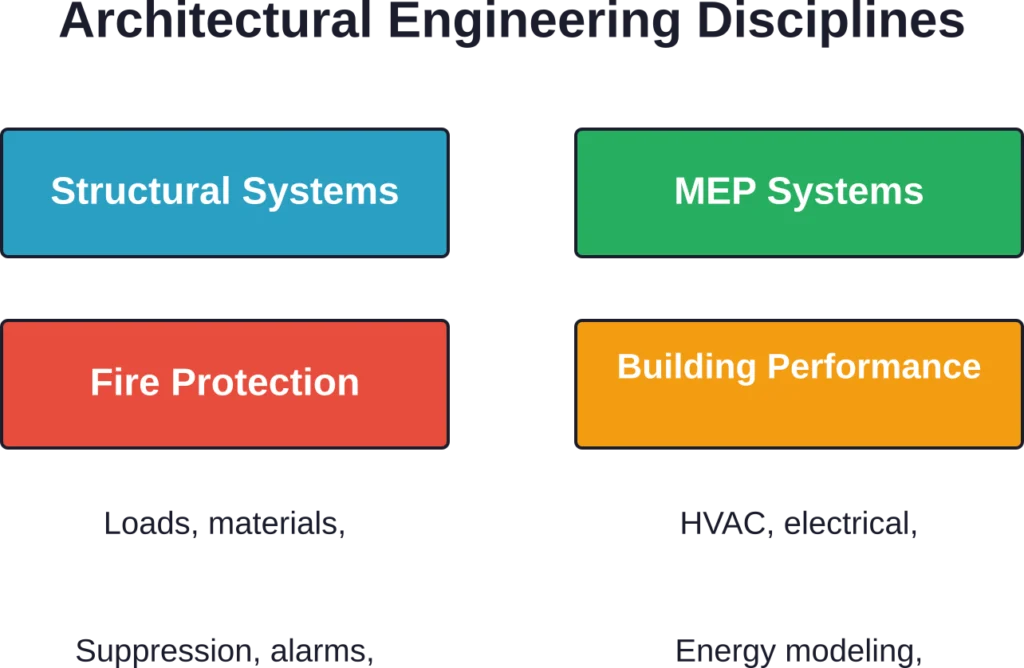
Architectural engineering breaks down into several specialized areas. Most programs and practitioners focus on one or two of these disciplines.
Structural Systems
Structural architectural engineers design the skeleton that holds a building upright. They calculate loads, select appropriate materials (steel, concrete, timber), and ensure structures can withstand wind, earthquakes, and everyday use.
This discipline requires mastery of mechanics, material properties, and building codes. Structural engineers work closely with architects to translate creative visions into buildable, safe realities.
They determine beam sizes, column placements, foundation types, and connection details. Every decision balances safety, cost, and constructability.
Mechanical, Electrical, and Plumbing (MEP)
MEP systems represent the circulatory and nervous systems of buildings. Mechanical engineers design heating, ventilation, and air conditioning (HVAC) systems that maintain comfortable temperatures and healthy air quality.
Electrical engineers handle power distribution, lighting design, emergency systems, and increasingly, renewable energy integration like solar panels.
Plumbing engineers design water supply networks, drainage systems, and specialized systems like medical gas distribution in hospitals.
These disciplines overlap constantly. An electrical engineer’s lighting design affects the mechanical engineer’s cooling load calculations. Coordination is everything.
Fire Protection Engineering
Fire protection specialists design systems that detect, suppress, and manage fires. Sprinkler systems, fire alarms, smoke control systems, and egress planning all fall under this umbrella.
This work is highly regulated. Building codes specify strict requirements based on occupancy type, building height, and use. Fire protection engineers must balance safety requirements with architectural intent and budget constraints.
Building Performance and Sustainability
This emerging focus area examines how buildings actually perform versus how they were designed to perform. Engineers analyze energy consumption, indoor air quality, daylighting effectiveness, and occupant comfort.
Sustainable design has moved from niche to mainstream. Architectural engineers now routinely incorporate energy modeling, renewable energy systems, water conservation strategies, and material lifecycle analysis into their work.
Building performance specialists often use simulation software to predict how design choices will affect energy use, comfort, and environmental impact before construction begins.
How Architectural Engineering Differs from Architecture
The distinction trips up prospective students constantly. Both professions work on buildings. Both require creativity and technical skill. But the focus diverges sharply.
Architects generally design the layout and floor plans of a building, such as the look and feel of a building or structure. They focus on aesthetics, spatial relationships, user experience, and the overall design concept.
Architectural engineers take that concept and make it work. They size the beams, design the air conditioning system, ensure the building meets energy codes, and coordinate all the technical systems.
Think of it this way: architects answer “what should this space be?” Architectural engineers answer “how do we make it stand, how do we keep it comfortable, and how do we keep occupants safe?”
Architects are more deeply involved in the pre-construction phases, developing design concepts and securing client approval. Architectural engineers engage heavily during both design development and construction, solving technical challenges as they arise.
| Aspect | Architect | Architectural Engineer |
|---|---|---|
| Primary Focus | Aesthetics, space planning, user experience | Building systems, structural integrity, technical performance |
| Education | Architecture degree (B.Arch or M.Arch) | Engineering degree (B.S. in Architectural Engineering) |
| Licensure | Architect license (varies by state) | Professional Engineer (PE) license |
| Core Skills | Design, drawing, building codes, client relations | Structural analysis, systems design, calculations, engineering principles |
| Median Salary | $82,840 | Varies by discipline; civil engineers: $89,940 |
| Project Phase | Concept through design development | Design development through construction |
Architectural Engineering vs. Civil Engineering
This comparison is equally important. Civil engineering is broader—it encompasses bridges, roads, dams, water treatment plants, and yes, buildings.
Civil engineers manage a broader range of projects encompassing transportation infrastructure and water systems, while architectural engineers focus specifically on buildings.
An architectural engineering degree dives deeper into building-specific systems. Students take courses in lighting design, acoustics, building energy systems, and HVAC design that civil engineering programs might only touch on briefly.
Civil engineering programs emphasize geotechnical engineering, transportation engineering, and water resources—topics less relevant to building design.
Career paths differ accordingly. Civil engineers might design highways, water distribution networks, or site development. Architectural engineers typically work in building design firms, consulting engineering offices, or construction companies focused on building projects.
According to recent projections, employment of architects is expected to increase by 5% from 2022 to 2032, resulting in approximately 8,200 job openings per year for architects. Civil engineers face similar growth: employment is projected to grow 5% from 2022 to 2032, with approximately 21,200 job openings per year.
The median annual salary for civil engineers stands at $89,940, while architects earn a median of $82,840. For architectural engineers specifically, the median annual wage was $97,310 as of May 2024. Architectural engineers earn significantly above both architect and civil engineer median salaries—$97,310 as of May 2024, with highly experienced architectural engineers earning $166,000 or more.
Education and Career Path
Most architectural engineers hold a bachelor’s degree in architectural engineering. Top programs include Penn State, Cal Poly San Luis Obispo, University of Texas at Austin, and Kansas State University.
The curriculum blends engineering fundamentals with building-specific applications. Students typically take courses including structural analysis, concrete and steel design, fluid mechanics, environmental systems, geotechnical engineering, energy systems, and senior design projects.
After graduation, many pursue licensure as a Professional Engineer (PE). This requires passing the Fundamentals of Engineering (FE) exam, gaining four years of work experience under a licensed engineer, and passing the PE exam in a specific discipline.
Licensure isn’t always required—it depends on the role and state—but it opens doors to higher responsibility, better pay, and the ability to stamp and sign engineering drawings.
Some architectural engineers pursue master’s degrees to specialize further or enter research. Advanced degrees become more valuable for roles in sustainability consulting, building performance analysis, or academia.
Day-to-Day Work and Career Options
What does an architectural engineer actually do daily? It varies by specialization, but common tasks include:
- Performing structural calculations to size beams, columns, and connections
- Using software like Revit, AutoCAD, or specialized analysis programs to model building systems
- Coordinating with architects, contractors, and other engineers to resolve design conflicts
- Reviewing shop drawings submitted by contractors to ensure they match design intent
- Conducting site visits to observe construction progress and address field issues
- Preparing technical specifications and construction documents
- Running energy simulations to optimize building performance
- Ensuring designs comply with building codes and standards
Career options span several industries. Many work for consulting engineering firms that contract with architects and building owners. Others join architecture firms that employ in-house engineers. Construction companies hire architectural engineers for project management and quality control roles.
Some specialize in forensic engineering, investigating building failures or disputes. Others focus on commissioning—testing and verifying that building systems perform as designed after construction.
Government agencies employ architectural engineers to review permit applications, develop building codes, and manage public facilities. Academic and research institutions hire them for teaching and advancing building science.

Get Engineering-Led Support for Building Projects
Architectural engineering combines structural, MEP, and technical systems within the building design process. Powerkh supports project teams with engineering-led BIM coordination, modelling, and technical delivery workflows.
Need Architectural Engineering Support?
Talk with Powerkh to:
- support structural and MEP coordination
- prepare BIM models and technical documentation
- review constructability before construction
- improve coordination between design and site teams
Speak with Powerkh about engineering coordination for your project.
The Role of Technology and Innovation
Architectural engineering has been transformed by technology. Building Information Modeling (BIM) now serves as the primary design and coordination platform. Engineers create detailed 3D models of structural and MEP systems, detecting conflicts before construction begins.
Energy modeling software simulates building performance under various design scenarios. Engineers can test different insulation levels, window types, or HVAC configurations to optimize energy efficiency.
Computational design tools enable parametric modeling—designs that automatically adjust when parameters change. This speeds up design iterations and helps explore more options.
Emerging technologies include:
- Sensor networks that monitor building performance in real-time
- Machine learning algorithms that optimize HVAC operation based on occupancy patterns
- Robotic construction techniques that improve precision and safety
- Advanced materials like self-healing concrete or phase-change materials for thermal storage
- Digital twins—virtual replicas of buildings that enable predictive maintenance
Architectural robotics represents a cutting-edge area where buildings incorporate responsive, intelligent systems. Imagine walls that reconfigure themselves or lighting that adapts automatically to tasks and circadian rhythms.
Sustainability and Environmental Impact
Climate change has elevated the importance of sustainable building design. Buildings are significant contributors to global energy consumption and carbon emissions.
Architectural engineers now routinely incorporate sustainability strategies:
- High-performance building envelopes that minimize heating and cooling loads
- Natural ventilation strategies that reduce mechanical system loads
- Daylighting design that reduces electric lighting energy
- Renewable energy systems like solar panels or geothermal heat pumps
- Water conservation through low-flow fixtures and rainwater harvesting
- Material selection that considers embodied carbon and lifecycle impacts
Green building rating systems like LEED, WELL, and Living Building Challenge have formalized sustainability in the design process. Many projects now target specific certification levels, requiring engineers to document energy performance, material choices, and indoor environmental quality.
Net-zero buildings—structures that produce as much energy as they consume—have moved from experimental to increasingly mainstream. Achieving net-zero requires tight coordination between architectural design, building envelope performance, efficient systems, and renewable energy generation.
Challenges and Future Directions
The profession faces several ongoing challenges. Building codes lag behind technology, sometimes hindering innovation. The complexity of modern buildings requires ever-tighter coordination among disciplines, yet project schedules often compress.
The skilled labor shortage affects the construction industry broadly. Even well-designed buildings can fail if construction quality suffers.
Climate adaptation presents new engineering challenges. Buildings must withstand more extreme weather—heavier rainfall, stronger winds, longer heat waves. Resilience design considers not just normal operation but how buildings perform during and after disasters.
The profession is also grappling with equity issues. Licensure barriers and traditional career paths don’t always serve diverse candidates well. Efforts to streamline licensure requirements and create more flexible pathways are ongoing.
Looking ahead, architectural engineering will likely see greater integration of disciplines. The silos between structural, mechanical, and electrical specializations may soften as integrated design becomes standard practice.
Artificial intelligence will augment—not replace—engineers. AI can optimize designs, identify code violations, or predict building performance, but engineering judgment, creativity, and problem-solving remain fundamentally human.
Frequently Asked Questions
Most architectural engineers hold a Bachelor of Science in Architectural Engineering from an ABET-accredited program. The degree typically requires four to five years of study, covering engineering fundamentals, building systems, structural design, and specialized topics like lighting or acoustics. Some practitioners enter the field with civil or mechanical engineering degrees and gain building-specific expertise through work experience or graduate study.
No. Architecture focuses on the aesthetic design, space planning, and overall vision for buildings. Architectural engineering applies engineering principles to design the technical systems—structural, mechanical, electrical, plumbing—that make buildings safe, functional, and efficient. Architects need architecture degrees and architect licensure; architectural engineers need engineering degrees and often pursue Professional Engineer (PE) licensure.
Licensure requirements vary by role and jurisdiction. Engineers who take legal responsibility for designs—stamping and signing drawings—must hold a Professional Engineer (PE) license. This requires passing the Fundamentals of Engineering exam, gaining work experience under a licensed engineer, and passing the PE exam. Some positions, particularly in large firms where senior engineers review work, don’t require licensure, but career advancement often depends on it.
Employment prospects are steady. Related professions show consistent growth: architects face 5% projected growth from 2022 to 2032 with approximately 8,200 job openings per year, while civil engineers see similar 5% growth with about 21,200 annual openings. Demand for energy-efficient buildings, resilient infrastructure, and sustainable design practices supports continued need for architectural engineering expertise.
Salaries vary by specialization, experience, and location. For context, civil engineers earned a median salary of $89,940 as of 2022, while architects earned $82,840. Architectural engineers typically earn within or above this range, particularly those with PE licensure or specialized expertise in high-demand areas like sustainability or complex structural systems.
It depends on the role and project phase. Design work—calculations, modeling, drawing—can often be done remotely. However, construction administration requires site visits, and coordination meetings benefit from face-to-face interaction. The COVID-19 pandemic accelerated remote work adoption in the industry, and many firms now offer hybrid arrangements combining office and remote work.
The toolkit varies by discipline but commonly includes Revit or AutoCAD for drafting and modeling, structural analysis programs like SAP2000 or ETABS, energy modeling tools like EnergyPlus or IES VE, and computational design platforms like Grasshopper. Coordination and clash detection often happen in Navisworks or similar BIM collaboration software. Familiarity with multiple platforms is increasingly expected.
Conclusion
Architectural engineering occupies a unique and vital position in the building industry. It’s the discipline that transforms architectural visions into physical reality, ensuring buildings stand safely, operate efficiently, and provide healthy environments for occupants.
The field demands a blend of technical rigor and creative problem-solving. Every building presents unique challenges—unusual geometry, tight sites, aggressive sustainability targets, historic preservation constraints. Architectural engineers develop solutions that balance competing requirements: safety, cost, performance, and aesthetics.
As buildings become more complex and expectations for sustainability and resilience increase, architectural engineering expertise becomes more valuable. The profession offers stable career prospects, intellectual challenge, and the satisfaction of creating structures that improve people’s lives.
If technical problem-solving excites you and you want to see your work take physical form in the built environment, architectural engineering might be the right path. The field needs talented professionals who can navigate increasing complexity while keeping sight of the ultimate goal: buildings that serve their occupants and communities well.
Ready to explore architectural engineering further? Research accredited programs, reach out to practicing engineers for informational interviews, and consider internships or co-op experiences that provide hands-on exposure to the field. The built environment needs skilled engineers—it could use your contributions.