

Quick Summary: Breaking an apartment lease early typically results in financial penalties unless you qualify for legal protections. Landlords may charge early termination fees, hold security deposits, or pursue unpaid rent. However, specific circumstances like military deployment, domestic violence, or uninhabitable conditions allow tenants to terminate leases without penalty in many states.
Life happens. Job relocations, financial hardships, relationship changes—any number of situations can make staying in an apartment impossible. But here’s the thing: rental agreements don’t just disappear because circumstances change.
A lease represents a legally binding contract between tenant and landlord. Breaking it early carries consequences that extend beyond simply moving out. Understanding what happens when terminating a lease prematurely helps renters navigate this challenging situation while minimizing potential damage to finances and rental history.
The specifics vary widely depending on state laws, lease terms, and individual circumstances. Some situations provide legal protection. Others leave tenants financially exposed.
Understanding the Legal Foundation of Lease Agreements
Rental leases function as contracts enforceable under state property law. When signing, both parties agree to specific terms for a defined period—typically six months or one year.
The landlord commits to providing habitable housing. The tenant agrees to pay rent through the lease end date. Breaking this agreement without legal justification constitutes breach of contract.
Most states don’t recognize personal inconvenience as valid grounds for penalty-free termination. Wanting to move closer to work, disliking neighbors, or finding a better apartment won’t release someone from lease obligations.
That said, landlords also have responsibilities. According to New York State Attorney General guidance on residential tenants’ rights, property owners must maintain livable, safe, and sanitary conditions. Failure to uphold this “warranty of habitability” can provide legal grounds for lease termination.
Financial Consequences of Breaking a Lease
The financial impact of early lease termination varies considerably based on lease language, state law, and landlord policies.
Immediate Costs
Many leases include early termination clauses specifying exact penalties. Common financial consequences include:
- Loss of security deposit (typically one month’s rent)
- Early termination fees ranging from one to three months’ rent
- Responsibility for rent until a replacement tenant is found
- Advertising costs for finding new tenants
- Legal fees if disputes escalate to court
Community discussions frequently mention security deposit forfeiture as the most immediate financial hit. Landlords often apply these funds toward unpaid rent or re-renting costs.
Ongoing Rent Obligations
Here’s where it gets expensive. In many states, tenants remain responsible for rent through the original lease end date—even after moving out.
Landlords typically have a “duty to mitigate damages” by making reasonable efforts to re-rent the unit. But what counts as “reasonable” varies. Some states require aggressive marketing efforts. Others set lower standards.
Until a new tenant takes possession, the original tenant may owe monthly rent. For someone breaking a lease six months early with $1,500 monthly rent and no replacement tenant found, this could mean paying $9,000 in remaining rent alone.

Credit Score and Rental History Impact
Unpaid rent doesn’t just disappear. Landlords can report delinquent accounts to credit bureaus, which may impact credit scores.
Worse, many landlords report to tenant screening services. A broken lease may create a record that future landlords review during application screening through tenant screening services. This can make securing quality housing difficult for years.
Some landlords pursue collections or file lawsuits for unpaid amounts. Court judgments become public records that appear on credit reports for up to seven years.
Legal Protections for Breaking a Lease
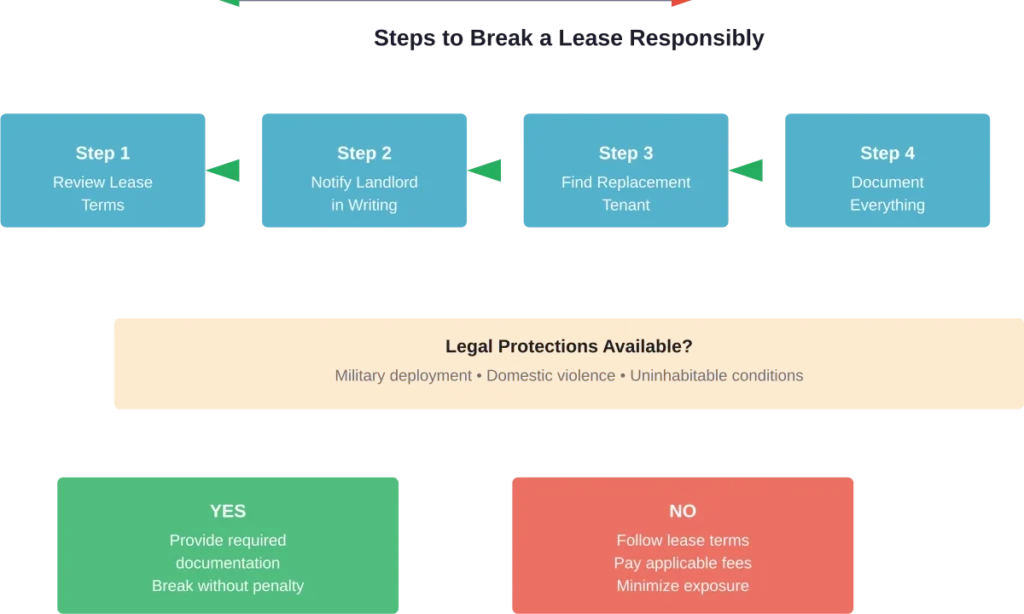
Not all lease terminations result in penalties. Several situations provide legal protection allowing tenants to break leases without financial consequences.
Military Deployment
The Servicemembers Civil Relief Act (SCRA) protects active-duty military personnel who receive deployment or permanent change of station orders. Service members can terminate leases by providing written notice and deployment documentation.
This protection applies to leases signed before military activation. Notice requirements typically range from 30 to 60 days.
Domestic Violence Situations
Many states now allow domestic violence victims to terminate leases early without penalty. Requirements typically include documentation such as:
- Police reports or protective orders
- Medical records documenting injuries
- Court filings related to abuse
- Documentation from domestic violence programs
According to Student Legal Services resources on Colorado lease termination, tenants in certain states must request termination within 30 days of reporting domestic violence incidents. The specific documentation requirements and timelines vary by state.
Uninhabitable Living Conditions
Landlords must maintain habitable premises. Serious violations of health and safety codes may justify lease termination without penalty.
According to New York State Attorney General guidance, tenants have the right to livable, safe, and sanitary apartments. Conditions that may justify breaking a lease include:
- No heat or hot water for extended periods
- Serious mold or pest infestations
- Structural hazards or code violations
- Lack of essential services like plumbing or electricity
The process requires proper documentation. Tenants should report issues in writing, allow reasonable time for repairs, and document landlord failures through photos, inspection reports, or code enforcement notices.
Landlord Harassment or Privacy Violations
Landlords must respect tenant privacy rights. Repeated unauthorized entry, harassment, or failure to provide required notice before entering can constitute lease violations justifying termination.
Most states require 24-48 hours notice before landlord entry except in emergencies. Systematic violations of these rights may release tenants from lease obligations.
Job Relocation or Transfer
Here’s where state laws diverge significantly. Some states recognize job relocations beyond a certain distance (often 50+ miles) as valid grounds for lease termination. Others provide no such protection.
Even without legal protection, many landlords work with relocating tenants. The key is communication and documentation of the job transfer.
Strategies to Minimize Financial Impact
When breaking a lease becomes necessary but legal protections don’t apply, several strategies can reduce financial consequences.
Review the Lease Agreement Thoroughly
Start by reading the lease’s early termination clause. Some agreements specify exact procedures and fees for breaking the lease early. Following these procedures precisely protects against additional penalties.
Look for provisions addressing:
- Required notice periods
- Specific termination fees
- Procedures for finding replacement tenants
- Conditions under which security deposits are returned
Understanding contractual obligations prevents misunderstandings that could escalate costs.
Communicate Early and Professionally
The moment breaking a lease becomes likely, contact the landlord. Early communication provides maximum time to find replacement tenants and demonstrates good faith.
Put everything in writing. Document all communications through email or certified mail. This creates a paper trail if disputes arise later.
Many landlords prefer avoiding vacancies and legal hassles. A cooperative tenant who helps facilitate transition often receives more favorable treatment than one who disappears without notice.
Find a Replacement Tenant
Most states require landlords to make reasonable efforts to re-rent units. But why wait for them? Proactively finding a qualified replacement tenant eliminates ongoing rent obligations.
Steps for finding replacement tenants:
- Get landlord approval before marketing the unit
- List the apartment on rental platforms
- Screen potential tenants for qualifications
- Present qualified candidates to the landlord
- Coordinate showing times and applications
Landlords can’t unreasonably reject qualified replacement tenants in most states. Finding someone who meets standard screening criteria protects against continued rent obligations.
Consider Subletting Options
If the lease permits, subletting allows someone else to occupy the unit temporarily while the original tenant remains legally responsible.
This works best for shorter gaps—like a semester abroad or temporary job assignment. The original tenant continues paying rent but collects equivalent payments from the subtenant.
Critical: Get written landlord approval before subletting. Unauthorized subletting violates most leases and provides grounds for eviction.
Negotiate an Early Termination Agreement
Sometimes the cleanest solution is negotiation. Offer to pay a reasonable termination fee in exchange for release from future rent obligations.
A landlord might accept two months’ rent to avoid vacancy periods, advertising costs, and uncertainty. Get any agreement in writing, specifying that payment satisfies all lease obligations.
Common Situations That Don’t Justify Breaking a Lease
Understanding what doesn’t constitute legal grounds prevents unrealistic expectations.
Student Legal Services resources explicitly note that these common situations typically don’t provide legal protection:
- School transitioning to remote learning
- Graduation or dropping out of school
- Returning home to help family
- Financial hardship or job loss
- Relationship breakups with co-tenants
- Noise complaints or difficult neighbors
- Finding a better or cheaper apartment
These situations may seem compelling personally. But legally, they don’t override contractual lease obligations in most states.
That doesn’t mean landlords won’t work with tenants facing genuine hardships. Many will. But there’s no legal obligation to do so.
State-Specific Considerations
Lease termination laws vary significantly by state. Some states heavily favor tenant protections. Others lean toward landlord rights.
| Consideration | Tenant-Friendly States | Landlord-Friendly States |
|---|---|---|
| Duty to Mitigate | Strong requirement to re-rent quickly | Minimal or no mitigation requirement |
| Early Termination Rights | Multiple protected categories | Limited to federal protections |
| Notice Requirements | 30 days often sufficient | May require 60-90 days |
| Security Deposit Return | Strict timelines (14-30 days) | Longer timelines (30-60 days) |
| Penalty Limits | Caps on termination fees | Fees limited only by lease terms |
Research specific state laws before making decisions. State attorney general offices, legal aid societies, and tenant rights organizations provide reliable information about local regulations.
Documenting Everything
Regardless of circumstances, documentation protects against disputes.
Keep records of:
- All written communications with landlords
- Photos of unit condition before moving out
- Receipts for rent payments and fees
- Copies of lease agreements and amendments
- Evidence supporting legal justifications (if applicable)
- Records of efforts to find replacement tenants
If disputes escalate to small claims court, thorough documentation often determines outcomes. Without paper trails, claims become difficult to prove.
When to Seek Legal Assistance
Complex situations warrant professional legal guidance. Consider consulting an attorney when:
- Landlords refuse to mitigate damages despite state requirements
- Disputes involve significant amounts (several thousand dollars)
- Habitability issues or harassment justify lease termination
- Landlords threaten lawsuits or aggressive collection actions
- Questions exist about state-specific tenant protections
Many legal aid organizations provide free consultations for qualifying low-income tenants. University students often have access to student legal services at no charge.
Frequently Asked Questions
Yes. Many landlords report lease violations to tenant screening services. Future landlords reviewing applications will see broken leases, making approval more difficult. Unpaid balances sent to collections appear on credit reports for up to seven years, further complicating rental applications.
This represents the worst approach. Landlords can pursue unpaid rent through collections or lawsuits, report delinquencies to credit bureaus, and obtain court judgments. These actions severely damage credit scores and create public records that follow individuals for years. Some states allow landlords to pursue wage garnishment for unpaid rent judgments.
Notice requirements vary by state and lease terms. Standard notice periods range from 30 to 60 days for month-to-month leases. Fixed-term leases typically require notice specified in the early termination clause. Military service members covered under SCRA generally need 30 days notice with deployment documentation. Always check specific lease language and state law.
Many landlords negotiate, especially if tenants approach them professionally with reasonable proposals. Landlords often prefer guaranteed termination payments over uncertain vacancy periods. Offering to help find replacement tenants or pay reasonable fees increases negotiation success. Document all agreements in writing before making payments.
This depends on how the lease is structured. If all roommates signed a single lease jointly and severally, all remain responsible for full rent even if one leaves. The remaining tenants must cover the full amount or find a replacement roommate approved by the landlord. Individual leases for each roommate provide more protection, limiting liability to individual obligations.
No. Leases typically transfer to new property owners, who must honor existing lease terms. Tenants continue under the same agreement with the new landlord. Property sales don’t justify lease termination unless the lease specifically includes such provisions.
Tenants facing serious habitability violations have several options depending on state law. These may include withholding rent until repairs are made, using rent money to make repairs directly (repair and deduct), reporting violations to local code enforcement, or terminating the lease based on breach of the warranty of habitability. Document all issues thoroughly and follow state-specific procedures precisely.
Moving Forward Responsibly
Breaking an apartment lease early creates complications. But understanding the process, potential consequences, and available protections allows informed decision-making.
The financial impact ranges from minimal (with legal protections) to severe (without justification or planning). Proactive communication, documentation, and good-faith efforts to minimize landlord losses typically produce the best outcomes.
Before breaking a lease, exhaust alternatives. Can subletting work temporarily? Will the landlord negotiate lease modifications? Does a roommate assumption allow staying within the lease framework?
When breaking a lease becomes unavoidable, follow proper procedures, understand applicable laws, and maintain professional relationships. These steps protect against escalating penalties while preserving rental history for future housing needs.
The lease agreement represents a commitment. But life’s unpredictability sometimes demands flexibility. Balancing contractual obligations with practical realities—while understanding legal rights and responsibilities—creates the foundation for navigating early lease termination successfully.