

Quick Summary: Breaking an NDA can result in serious legal consequences including lawsuits for monetary damages, court injunctions to stop further disclosure, and financial penalties as specified in the agreement. The disclosing party may sue for breach of contract to recover losses, and criminal charges apply only when disclosure involves trade secret theft under the Economic Espionage Act, fraud, or unauthorized access to classified information—not from NDA violation alone.
Non-disclosure agreements show up everywhere in business. Employment contracts, vendor relationships, investor meetings—NDAs protect sensitive information that companies can’t afford to leak.
But what actually happens when someone breaks one? The consequences aren’t always what people expect.
Understanding the legal ramifications of an NDA breach matters whether signing one for the first time or considering disclosure of information covered under an existing agreement. Here’s what the law says and what enforcement actually looks like in practice.
What Is a Non-Disclosure Agreement?
According to Cornell Law School’s Legal Information Institute, non-disclosure agreements are contracts where parties agree that certain information will remain confidential. An NDA binds a person who has signed it and prevents them from discussing any information included in the contract with anyone not authorized by the agreement.
NDAs commonly protect trade secrets, business negotiations, client information, and sometimes conceal undesirable information. They’re widespread across industries—from tech startups protecting product launches to healthcare organizations safeguarding patient data.
The agreement creates a legally binding obligation. Once signed, the signer becomes contractually obligated to maintain confidentiality about specific information detailed in the document.
How NDAs Work in Practice
Most employment NDAs specify what information falls under protection, how long the confidentiality period lasts, and what happens if someone violates the terms.
The contract typically defines confidential information explicitly. This might include proprietary technology, customer lists, financial data, marketing strategies, or upcoming product releases. Some agreements use broad language while others get highly specific about protected material.
Duration varies. Some NDAs last for a set number of years after employment ends. Others claim lifetime protection, though enforceability of perpetual agreements varies by jurisdiction.
Here’s the thing though—not all NDAs are created equal. Some contain unenforceable provisions that courts won’t uphold.
The Legal Consequences of Breaking an NDA
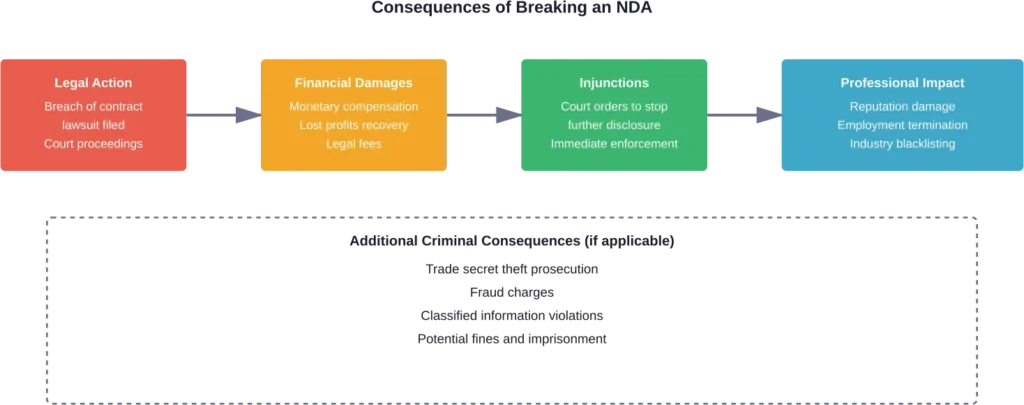
Breaking an NDA constitutes breach of contract. The party whose information was disclosed can pursue multiple legal remedies.
Lawsuits for Monetary Damages
The most common consequence is a lawsuit seeking financial compensation. The disclosing party must prove that the breach caused actual harm and quantify those losses.
Damages might include lost business opportunities, decreased company valuation, costs to develop alternative strategies, or competitive advantages lost to rivals who gained the information.
In some cases, NDAs specify liquidated damages—predetermined penalty amounts for each violation. However, courts won’t enforce these if they’re unreasonable. According to legal analysis from the University of Illinois, penalty clauses that seem punitive rather than compensatory often get struck down. For example, an NDA requiring $1 million per disclosure likely falls on the unenforceable penalty side of the line.
| Legal Remedy | Purpose | When Applied |
|---|---|---|
| Lawsuit for Damages | Compensate for financial losses | After disclosure causes measurable harm |
| Injunctive Relief | Stop further disclosure immediately | When ongoing disclosure threatens irreparable harm |
| Liquidated Damages | Enforce pre-agreed penalty amounts | When damages are difficult to calculate and amount is reasonable |
| Criminal Prosecution | Punish theft of trade secrets | When disclosure involves criminal conduct |
Injunctive Relief
Courts can issue injunctions ordering the breaching party to stop further disclosure. This remedy works when ongoing violations threaten continuing harm that money can’t adequately fix.
An injunction might prohibit someone from sharing information with competitors, require destruction of copied materials, or ban employment with rival companies for a specified period.
Violating a court injunction brings contempt charges—a much more serious matter than the original contract breach.
Financial Penalties and Recovery of Profits
Beyond compensating the harmed party, courts sometimes require the breaching party to surrender profits they gained from the disclosure.
If someone leaked product designs to a competitor and received payment, they’d likely forfeit those funds. Companies that profited from improperly obtained information may also face liability.
Criminal Charges in Serious Cases
NDA violations themselves are civil contract breaches. Criminal charges arise only when the underlying conduct—such as trade secret theft, fraud, or hacking—violates separate criminal statutes.
Trade secret theft can trigger criminal prosecution under federal and state laws, including the Economic Espionage Act, which carries substantial fines and imprisonment.
Disclosure of classified government information violates separate criminal statutes beyond any NDA. Leaking proprietary information obtained through hacking or theft adds criminal charges to civil liability.
Common NDA Violation Examples
Breaches happen in various ways. Some are intentional, others accidental.
Sharing confidential information with a new employer represents a common violation. An engineer might use proprietary code from a previous job at their new company. A sales executive might bring client lists to a competitor.
Public disclosure also breaks NDAs. Posting about unreleased products on social media, discussing confidential matters with journalists, or sharing sensitive details in online forums all constitute violations.
Even casual conversations can trigger breaches. Discussing confidential business strategies with friends or family members not covered by the NDA violates the agreement if those people weren’t authorized to receive the information.
When Breaking an NDA Is Legally Protected
Here’s where things get interesting. Not all disclosures violate enforceable NDA terms.
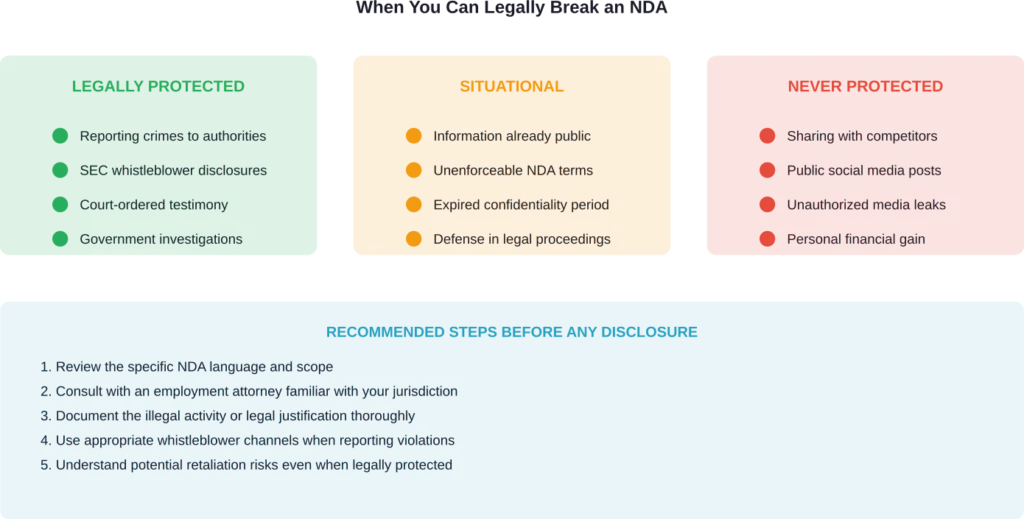
Reporting Illegal Activity
NDAs can’t legally prevent reporting crimes or regulatory violations to appropriate authorities. Harvard Business Review notes that securities violations and fraud can be reported to appropriate authorities despite NDA restrictions.
The Securities and Exchange Commission, Department of Labor, and other government agencies have made clear that NDAs restricting whistleblower reports are themselves illegal. Companies can’t use confidentiality agreements to silence employees who witness misconduct.
The SEC specifically protects confidential reporting of securities violations, including insider trading and market manipulation. Employees can report these issues without NDA liability.
Responding to Legal Process
Court subpoenas and government investigations override NDA obligations. When legally compelled to testify or produce documents, compliance doesn’t constitute breach of contract.
Proper procedure matters though. Notifying the other party about the subpoena before disclosure, when possible, demonstrates good faith and may trigger efforts to quash or limit the order.
Information Already Public
Once information becomes publicly available through other means, NDAs no longer apply to that specific data. If a company publicly announces something previously confidential, the NDA restriction on that information dissolves.
The disclosure must come from an independent source though. Sharing confidential information and then claiming it’s public because others are now discussing it doesn’t work.
How to Avoid Breaking an NDA
Prevention beats dealing with breach consequences.
Read the agreement carefully before signing. Understand exactly what information it covers, how long restrictions last, and what activities are prohibited. If terms seem unclear or overly broad, negotiate changes or seek legal review.
Maintain clear boundaries between confidential and non-confidential information. Don’t discuss protected matters in casual settings. Avoid documenting confidential information in personal files or devices.
When changing jobs, review existing NDAs with previous employers. Don’t bring proprietary materials, customer lists, or confidential documents to a new position. Many breach cases arise from employees who didn’t realize they were violating agreements.
If unsure whether specific information falls under an NDA, ask. Consult the legal department or seek independent legal advice before making questionable disclosures.
Professional and Reputational Consequences
Beyond legal penalties, breaking an NDA damages professional reputation.
Industries talk. Word spreads about people who can’t keep confidences. Future employers become wary of hiring someone with a history of breaching NDAs, regardless of legal outcomes.
Current employment often ends immediately upon discovery of a breach. Companies terminate employees who violate confidentiality agreements, sometimes with cause that affects severance packages and unemployment benefits.
Professional networks suffer too. Business relationships depend on trust. Breaking an NDA signals untrustworthiness that extends beyond the specific incident.
What Employers Should Include in NDAs
From the business side, effective NDAs require specific elements.
Clear definitions of confidential information prevent ambiguity. Vague language like “all company information” won’t hold up as well as specific descriptions of protected data categories.
Reasonable time limits increase enforceability. Perpetual NDAs face more legal challenges than agreements with defined expiration dates tied to legitimate business needs.
Appropriate remedies matter. Liquidated damage clauses should reflect reasonable estimates of actual harm, not punitive amounts designed to intimidate.
Legal compliance is essential. NDAs can’t restrict legally protected whistleblower activity, prevent reporting crimes, or violate public policy. Including such restrictions makes entire agreements vulnerable to being voided.
Frequently Asked Questions
Some NDAs claim perpetual protection, particularly for trade secrets. However, enforceability of lifetime NDAs varies by jurisdiction. Courts more readily enforce NDAs with reasonable time limits tied to legitimate business interests. Information that remains genuinely secret and valuable may receive longer protection than data with limited shelf life.
Intent doesn’t eliminate liability for breach of contract. Accidental disclosure still violates the agreement, though it may affect damages awarded. Courts consider whether the breach was willful when calculating penalties. Immediate notification to the other party and efforts to mitigate harm can reduce consequences, but legal liability remains.
Employers can make NDAs a condition of employment or continued employment in most jurisdictions. Refusing to sign may result in not being hired or losing a job. However, NDAs with illegal or unenforceable terms—like restrictions on reporting crimes or regulatory violations—aren’t valid even if signed under employment pressure.
Costs vary dramatically based on the harm caused. Some breaches result in settlements of tens or hundreds of thousands of dollars. Cases involving valuable trade secrets or competitive harm can reach millions. Legal defense costs alone often exceed $50,000 even before any damages award. The actual amount depends on provable losses, contract terms, and jurisdiction.
Standard NDA breaches are civil matters that don’t result in jail time. However, criminal charges are possible when disclosure involves trade secret theft, fraud, or unauthorized access to classified information. These separate criminal statutes carry potential imprisonment. The NDA violation itself remains civil, but the underlying conduct may be criminal.
Legal protections allow reporting harassment and discrimination despite NDA terms. Many states have passed laws explicitly invalidating NDA provisions that restrict reporting illegal workplace conduct. Federal agencies like the EEOC have made clear that NDAs can’t prevent filing discrimination complaints or participating in government investigations.
Options include negotiating mutual release with the other party, waiting for the agreement to expire, or challenging unenforceable terms in court. NDAs that violate public policy, restrict legally protected activity, or contain illegal provisions may be voidable. Consulting an attorney about specific circumstances provides the best assessment of available options.
The Bottom Line on NDA Breaches
Breaking an NDA triggers real consequences. Lawsuits, financial damages, injunctions, and professional reputation damage all follow violations.
But NDAs aren’t absolute. Legal protections exist for reporting crimes, responding to subpoenas, and whistleblowing on regulatory violations. Understanding both the obligations and the limitations of these agreements matters.
Before signing an NDA, read it thoroughly. Before disclosing information covered by one, understand the risks and protections. And if facing an NDA-related legal issue—whether as someone who disclosed information or a business whose confidential data was leaked—consult qualified legal counsel.
The consequences of getting this wrong are too significant to navigate alone.