

Quick Summary: Failing to pay a speeding ticket can trigger a cascade of consequences including additional fees, license suspension, warrant issuance, and potential arrest. Courts typically enter default judgments within 21 days of non-payment, after which collection fees up to 30% may apply and unpaid fines can be sent to collection agencies. The severity of consequences varies by jurisdiction, but ignoring a traffic citation can escalate a simple fine into a serious legal and financial burden.
Getting a speeding ticket is frustrating. The temptation to toss it in a drawer and forget about it? That’s real. But here’s the thing—ignoring that piece of paper sets off a chain reaction that can turn a manageable fine into a legal nightmare.
Most traffic violations are civil infractions, not crimes. According to the Hawaii State Judiciary, these infractions carry monetary penalties but don’t result in jail time on their own. The problem starts when people assume they can simply avoid paying without consequences.
What actually happens depends on your jurisdiction, the fine amount, and how long the ticket sits unpaid. But the pattern is remarkably consistent across states.
The Timeline: What Happens After You Ignore That Ticket
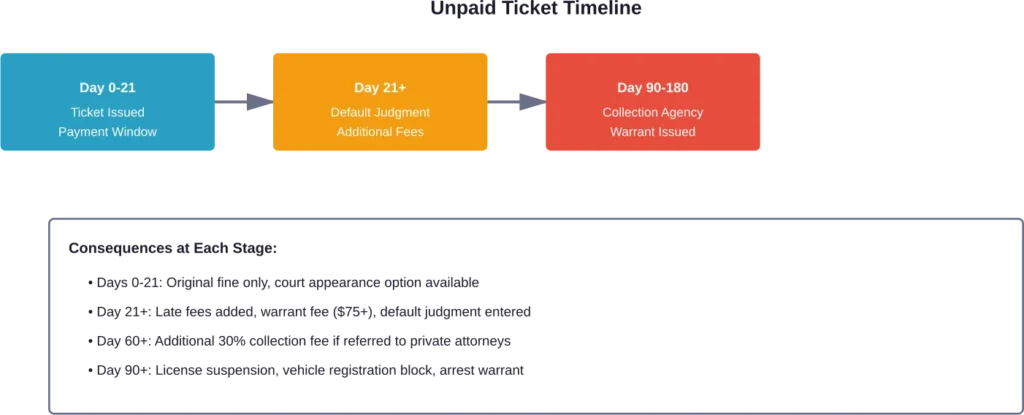
Most courts don’t wait long before taking action. Traffic citations typically require a response within 21 days of issuance. Miss that deadline, and the court may enter a default judgment against you.
According to Hawaii State Judiciary records, courts can enter default judgments on unpaid traffic citations within 21 days of the citation date. Once that judgment is entered, the clock starts ticking on escalating penalties.
Here’s how the timeline typically unfolds:
Immediate Financial Penalties
The original fine is just the beginning. Once a default judgment is entered, courts tack on additional fees that can easily double or triple what was owed.
Effective January 1, 2026, the warrant fee assessed will increase to $75 plus additional fees on warrants issued on offenses occurring on or after September [specific date unclear from source]. That’s on top of the original citation amount.
But wait. It gets worse.
According to Harris County Justice Courts, if the fine remains unpaid for more than 60 days, courts may refer the case to private collection attorneys. At that point, an additional 30% collection fee is assessed on the entire amount due.
So a $200 speeding ticket can quickly become:
- Original fine: $200
- Warrant fee: $75
- Administrative fees: $50-100
- 30% collection fee: $97.50
- Total: $422.50+
The Hawaii State Judiciary notes that unpaid judgments of $500 or less are sent to collection agencies within 90 days of the default judgment date. Judgments exceeding $500 follow within 180 days.
License Suspension and Vehicle Registration Blocks
Financial penalties are only part of the equation. Most states report unpaid traffic violations to motor vehicle agencies, which can result in license suspension or registration holds.
According to federal court records, failure to pay or appear can lead to the court reporting the violation to state motor vehicle or driver-licensing agencies, affecting driving privileges and vehicle registration status.
Texas law is particularly strict. Under Texas Administrative Code § 217.36, municipalities can contract with the state to place notations on vehicle records for owners with outstanding warrants. This prevents vehicle registration renewal until the matter is resolved.
Can’t renew registration? Can’t legally drive. And driving with suspended registration or a suspended license? That’s a separate violation that carries its own fines and potential criminal charges.
Warrants and the Risk of Arrest
Real talk: courts issue arrest warrants for unpaid traffic tickets. These are called non-compliance warrants.
Research from the Washington Law Review examined how profligate state and local courts have become in issuing warrants for minor offenses. The Department of Justice investigation in Ferguson, Missouri discovered the municipal court had issued one warrant for every two residents.
These warrants don’t disappear. They sit in the system, waiting.
Georgetown Law published research documenting how unpaid fines create pathways to incarceration, particularly for low-income individuals. The remedy for those who couldn’t pay became jail time—a few days in custody as penance for a few hundred dollars in unpaid fines.
Sound extreme for a speeding ticket? It happens more often than people think.
How Collection Affects Your Credit and Future
Once a case goes to collections, it can impact credit scores and financial standing. Collection agencies aggressively pursue payment through wage garnishment, bank levies, and liens on property where state law permits.
The 30% collection fee isn’t negotiable. It’s added automatically when the case is referred to private attorneys for collection.
| Time Unpaid | Action Taken | Additional Cost |
|---|---|---|
| 0-21 days | Grace period for payment | $0 |
| 21+ days | Default judgment, warrant issued | $75+ warrant fees |
| 60+ days | Referral to collection attorneys | 30% of total amount |
| 90+ days (under $500) | Collection agency referral | Additional fees vary |
| 180+ days (over $500) | Collection agency referral | Additional fees vary |
What If You Genuinely Can’t Afford to Pay?
Not being able to pay is different from choosing not to pay. Courts recognize this distinction and offer options.
According to Nolo, a legal resource publisher, individuals facing financial hardship may request:
- Payment plans that spread the fine over several months
- Community service in lieu of monetary payment
- Fine reduction based on demonstrated financial hardship
- Extensions on payment deadlines
The key is communicating with the court before the deadline passes. Once a default judgment is entered, options become limited.
Courts don’t automatically offer these alternatives. The defendant must appear or contact the court to request accommodation.
Fighting the Ticket vs. Paying
Contesting a speeding ticket is a legitimate option, particularly when the citation contains errors or the circumstances warrant explanation.
According to Nolo, a routine ticket for moving violations like speeding typically costs between $75 and $400, depending on jurisdiction and how much over the limit the driver was traveling. For some violations, the cost of the ticket plus insurance increases makes fighting worthwhile.
But fighting requires showing up. Failure to appear is treated the same as failure to pay—the court enters a default judgment and the consequences begin.
The Compounding Effect on Insurance Rates
Beyond court fines and fees, unpaid tickets can trigger insurance premium increases. Most states require or permit notification of insurance carriers about traffic violations, even unpaid ones.
Speeding tickets can result in significantly higher insurance premiums for multiple years. That’s potentially thousands of dollars in additional costs beyond the fine itself.
And if the license is suspended for non-payment? Insurance companies may drop coverage entirely or require high-risk SR-22 insurance, which costs significantly more.
Conclusion: The Cost of Ignoring Is Always Higher
What starts as a $100 speeding ticket can balloon into $500+ in fines and fees, a suspended license, an active arrest warrant, and years of elevated insurance premiums. The math is brutal.
The smartest move? Address the ticket immediately. Pay it if the fine is fair, contest it if there’s legitimate grounds, or request hardship accommodation if finances are tight. But don’t ignore it.
Courts and collection agencies don’t forget. And in an era where municipalities increasingly rely on fine revenue, enforcement is only getting stricter.
Check court records for any outstanding citations. Address them now before a routine traffic stop turns into something much worse.
Frequently Asked Questions
While most speeding tickets are civil infractions that don’t carry jail time, courts issue arrest warrants for failure to pay. If stopped by police with an active warrant, arrest is possible. Georgetown Law research documented how unpaid fines create pathways to incarceration, particularly when warrants are issued for non-compliance.
According to the Hawaii State Judiciary, courts may enter default judgments within 21 days of citation issuance. Warrants can be issued shortly after default judgment. Some jurisdictions issue warrants almost immediately after the payment deadline passes, while others allow 30-60 days.
Yes. Texas Administrative Code § 217.36 allows municipalities to contract with state agencies to place holds on vehicle registrations for owners with outstanding warrants. Federal courts note that failure to pay can affect both driving privileges and vehicle registration.
Harris County Justice Courts assess an additional 30% collection fee when unpaid fines are referred to private attorneys for collection, typically after 60 days past due. This fee is added to the total amount owed, including the original fine, warrant fees, and administrative costs.
Most courts offer payment plans, community service alternatives, or fine reductions for financial hardship. However, these accommodations must be requested before the payment deadline. Contact the court immediately if unable to pay the full amount.
When unpaid tickets are sent to collection agencies, they may be reported to credit bureaus, potentially affecting credit scores. Collection agencies can also pursue wage garnishment and property liens in some jurisdictions.
Many states participate in interstate compacts that share information about traffic violations and license suspensions. An unpaid ticket in one state can result in license suspension in your home state. Warrants may also appear in national databases accessible during traffic stops anywhere in the country.