

Quick Summary: Failing to pay tolls can result in violation notices with penalties up to $57.50 per missed toll, according to some toll authorities. Continued non-payment may lead to registration suspension in states like New York and Florida, increased fines with second notices, and potential collections or legal action. The consequences vary by state and toll authority, but unpaid tolls rarely disappear on their own.
Driving through a toll without paying might seem like a minor mistake. But toll authorities take non-payment seriously, and the consequences can snowball fast.
Here’s what actually happens when tolls go unpaid.
Initial Violation Notices and Penalties
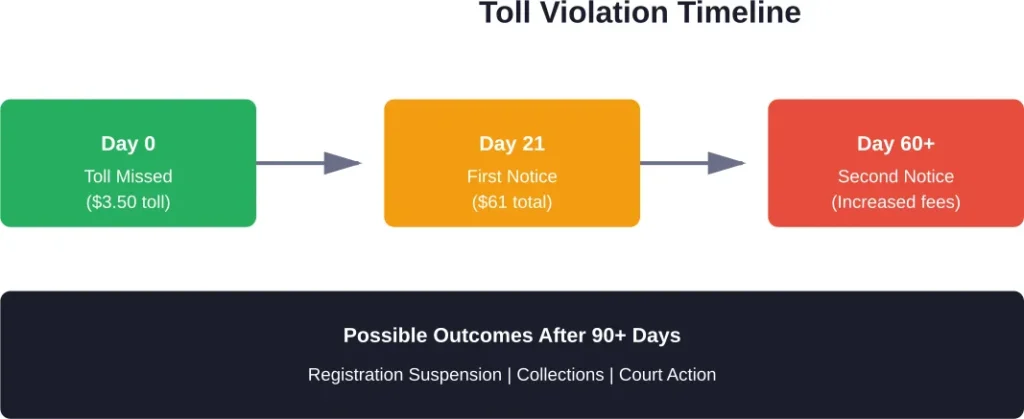
When a vehicle passes through a toll point without payment, the toll authority processes a violation. According to some toll road operators, each violation is assessed a $57.50 penalty in addition to the original toll amount due.
The first notice typically arrives within weeks. Drivers usually have a short window—often five days before or after driving—to pay the toll and avoid the violation altogether.
Miss that window? The penalty gets tacked on.
Escalation: Second Notices and Increased Fees
Ignore the first notice and a second violation notice gets issued. This often comes with additional penalties and administrative fees.
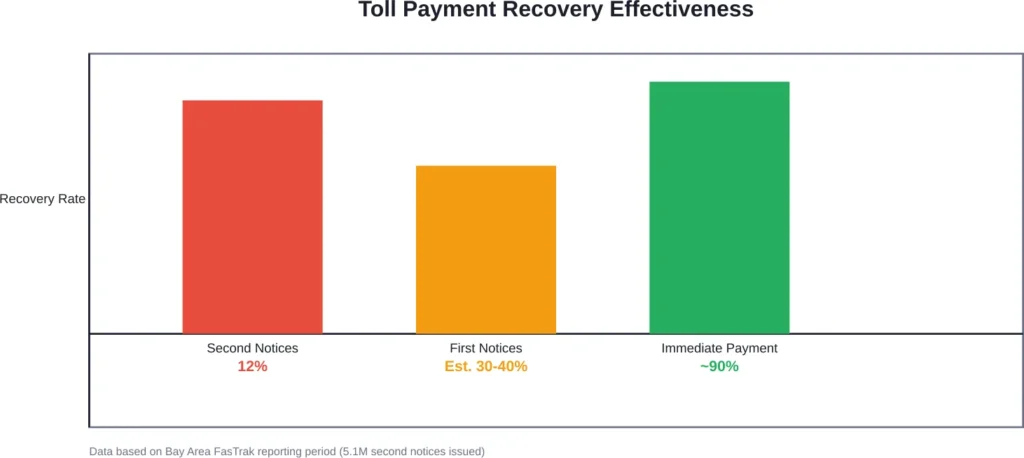
A Bay Area report found that only 12% of 5.1 million second notice violations issued between January 1 and August 31, 2021 resulted in recovered payments. That means most drivers who reach this stage face mounting debt with little resolution.
And here’s where it gets worse.
Registration Suspension and Legal Action
Several states have enforcement mechanisms that go beyond fines. Under New York law (Section 510(3)(d) of the Vehicle and Traffic Law and Part 127 of the Commissioner’s Regulations), the DMV suspends vehicle registrations for failing to pay tolls when 3 or more violations occur within a 5-year period, or when unpaid tolls total $200 or more within a 5-year period.
Florida’s Toll-by-Plate system operates similarly. According to the Florida Highway Safety and Motor Vehicles, toll authorities can prevent registration renewal until violations are resolved.
Can’t renew registration? Can’t legally drive.
| Consequence | Timing | Impact |
|---|---|---|
| First Violation Notice | 2-4 weeks after toll | Original toll + penalty (up to $57.50) |
| Second Notice | 30-60 days | Additional fees, increased total |
| Registration Suspension | 90+ days (varies by state) | Cannot renew registration |
| Collections/Court Action | 120+ days | Credit impact, legal fees, court costs |
Some toll authorities also pursue collections or file court actions for persistent non-payment. Community discussions highlight cases where drivers accumulated thousands in penalties from multiple unpaid tolls.
Why Penalties Don’t Always Work
Real talk: the system isn’t great at recovering unpaid tolls. The penalties often hit lower-income drivers hardest, according to economic justice advocates cited in a 2021 KQED report.
The report called the penalty structure “high pain, low gain”—meaning it creates significant financial burden for drivers while recovering relatively little revenue for toll authorities.
But whether the system works efficiently or not, the consequences for drivers remain real.
How to Avoid Toll Violations
Prevention is straightforward. Set up a toll account (E-ZPass, FasTrak, SunPass, etc.) with automatic replenishment. Keep account information current.
If a violation notice arrives, pay immediately. The difference between paying within the grace period and waiting for a second notice can be $50+ in additional penalties.
Check toll authority websites for payment portals and violation lookup tools. Most allow resolution online within minutes.
Frequently Asked Questions
A violation notice will be mailed to the registered vehicle owner, typically within 2-4 weeks. Paying promptly usually means just the original toll plus a penalty (often $57.50 or similar, depending on the toll authority).
Unpaid tolls don’t typically suspend driver’s licenses, but they can suspend vehicle registration in states like New York and Florida. Virginia law changed effective July 1, 2019 to prohibit license suspensions solely for unpaid court fines and costs, but toll-specific enforcement varies.
Yes, if the toll authority sends the debt to collections. Once in collections, unpaid tolls can appear on credit reports and negatively impact credit scores.
This varies by state and toll authority. Some pursue violations for years, especially if they escalate to court judgments. Statutes of limitations differ, but assuming violations will expire quickly is risky.
Yes. Most toll authorities have dispute processes for incorrect violations—such as malfunctioning transponders, misread license plates, or administrative errors. Check the violation notice for dispute instructions and deadlines.
Contact the toll authority immediately with proof of sale. Registration records may not update instantly, so providing a bill of sale or transfer documentation can resolve the issue.
No. Penalty amounts vary significantly by state and toll authority. Some assess $25 penalties, others $57.50 or more. Second notices often carry higher fees.
The Bottom Line
Unpaid tolls don’t vanish. They accumulate penalties, trigger registration issues, and can escalate to legal action.
The best approach? Pay tolls on time, maintain an active toll account, and address violation notices immediately. The cost of ignoring them far exceeds the cost of resolving them early.
Got a toll violation notice? Don’t wait—check your toll authority’s payment portal today and resolve it before penalties multiply.