
Quick Summary: When you text a landline, your message typically won’t be delivered as a standard SMS because traditional landlines can’t receive texts. However, some carriers offer Text-to-Landline services that convert your message into an automated voice call. The landline owner hears your text read aloud by a computerized voice, and depending on the service, may be able to respond.
Picture this: scrolling through contacts, firing off a quick message, hitting send. Then realizing the number belongs to a landline. What now?
Most people assume the text just vanishes into the void. But the reality is more interesting than that.
What actually happens depends on the carrier, the type of landline, and whether specific services are activated. Some messages get converted to voice. Others bounce back with an error. A few might even enable two-way texting.
Here’s everything worth knowing about texting landlines, from what recipients experience to how businesses leverage this technology for customer communication.
The Basic Reality: Traditional Landlines Can’t Receive Texts
Standard landlines weren’t built for text messaging. The technology simply doesn’t exist on traditional phone lines to process SMS data packets the way mobile networks do.
When someone sends a text to a conventional landline number, the message has nowhere to go. Landline infrastructure operates on circuit-switched voice technology from decades ago. Text messages travel through packet-switched data networks designed for mobile devices.
It’s like trying to send an email to a fax machine. The systems speak different languages.
But wait. That’s not the whole story.
Text-to-Landline Services: The Bridge Between Technologies
Major carriers recognized a gap in communication capabilities and built a workaround. Text-to-Landline services act as translators between mobile texting and traditional phone systems.
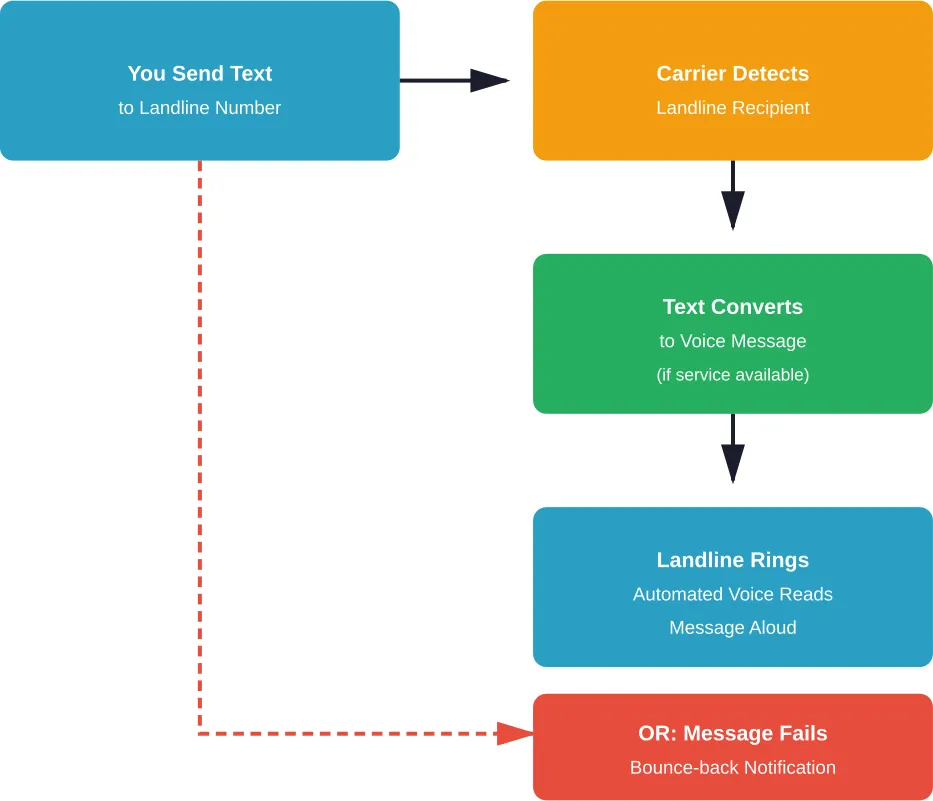
Here’s how it works: when you send a text to a landline number, the carrier detects the recipient is a landline. Instead of failing silently, the system converts your written message into an automated voice recording.
The landline phone rings. Someone picks up. A computerized voice reads your text message aloud, word for word.
According to Verizon’s support documentation, this Text-to-Landline service enables messages to reach non-mobile phones through voice conversion. The recipient hears everything you typed, delivered by text-to-speech technology.
What the Recipient Actually Hears
The experience on the receiving end is straightforward but somewhat robotic. The phone rings normally. When answered, an automated voice announces that a text message has been received.
Then the voice reads the message content. Punctuation gets interpreted as pauses. Emojis either get skipped or described in awkward text form. Abbreviations come through exactly as typed, which sometimes creates confusion.
After the message plays, some services offer the recipient options to replay the message or respond with a voice reply that converts back to text for the sender.
Cost Considerations: Not Always Free
Sending a text to a landline isn’t necessarily the same price as regular texting. Carriers handle billing differently for Text-to-Landline services.
According to Verizon, each successful Text-to-Landline message costs $0.25. Unsuccessful deliveries aren’t charged. Other related texts get billed according to standard messaging plans.
That means if the landline phone never picks up, the sender doesn’t get charged. But once someone answers and the automated voice plays the message, the fee applies.
Most unlimited texting plans don’t automatically cover Text-to-Landline messages. These often count as premium services billed separately from monthly allowances.
The recipient doesn’t pay anything to receive the converted voice message. The cost lands entirely on the sender’s account.
When Text Messages to Landlines Simply Fail
Not all landlines support Text-to-Landline conversion. Whether a message goes through depends on several factors.
First, the carrier matters. Both the sender’s mobile carrier and the landline provider need compatible systems. If either side doesn’t support the service, the text won’t convert to voice.
Second, the landline type affects compatibility. Traditional copper-line phones, VoIP systems, and business phone lines all behave differently. Some VoIP providers enable native SMS capabilities. Others don’t support any text functionality at all.
Third, service activation plays a role. Some landline providers require customers to specifically enable text reception features. Without activation, messages get rejected automatically.
When a text can’t be delivered to a landline, most carriers send a bounce-back notification. The sender receives an automated message explaining the delivery failed because the recipient number doesn’t accept SMS.
Sometimes the error message suggests trying a voice call instead. Other times it simply states the message couldn’t be delivered without further explanation.
VoIP Systems and Modern Landline Alternatives
Not all landlines are created equal anymore. Voice over Internet Protocol systems blur the lines between traditional phones and modern communication.
Many businesses switched from copper-wire landlines to VoIP services years ago. These internet-based phone systems can support text messaging natively, though it requires proper configuration.
Popular VoIP providers like RingCentral, Vonage, and Nextiva offer SMS capabilities as add-on features. When enabled, these numbers can receive and send texts just like mobile phones. Without activation, texts to VoIP numbers typically fail just like traditional landlines.
The catch? The recipient must have specifically set up SMS functionality. A VoIP number without text configuration behaves exactly like an old-school landline when someone tries to text it.
This creates confusion for senders. Looking at a phone number alone provides no indication whether it’s a traditional landline, a VoIP line with texting, or a VoIP line without texting capabilities.
Business Applications: Why Companies Enable Landline Texting
Businesses discovered customers prefer texting over phone calls for many interactions. The problem? Most established companies have landline numbers customers already know.
Changing a long-standing business phone number creates marketing headaches and customer confusion. Text-enabling existing landline numbers solves this problem without disrupting brand continuity.
Companies that implement landline texting report faster customer response times. According to industry sources, sending a text to a business landline takes seconds, while calling can take up to 20-30 minutes depending on queue traffic and issue complexity.
Text open rates also significantly exceed email engagement. Customers check and respond to text messages more reliably than emails buried in crowded inboxes.
Service providers like Weave and similar platforms specialize in converting business landlines into two-way texting systems. These platforms integrate with existing phone infrastructure, enabling appointment reminders, customer service conversations, and marketing communications through the same number customers already call.
Two-Way Messaging: Beyond One-Directional Conversion
Basic Text-to-Landline services only handle one direction: incoming texts converted to voice. Advanced systems enable genuine two-way conversations.
When a business enables full landline texting, recipients can respond via text. The system routes these responses to a web dashboard, mobile app, or designated staff phone numbers.
From the customer’s perspective, it looks like normal texting. Messages send and receive like any mobile conversation. Behind the scenes, the business manages messages through specialized software rather than a physical phone.
This creates seamless experiences where customers text a familiar landline number and get text responses back, never knowing the business uses conversion technology to make it work.
Carrier-Specific Behaviors and Compatibility
Different mobile carriers handle landline texting with varying levels of support. The experience changes depending on who provides service to both sender and recipient.
Verizon explicitly documents its Text-to-Landline service, including pricing and functionality. The network attempts delivery for multiple cycles before marking a message as failed, giving recipients time to answer the voice call.
Other major carriers offer similar services with different terms. Some charge per-message fees. Others bundle Text-to-Landline conversion into premium plan features. A few don’t support the service at all for certain landline types.
International compatibility adds another layer of complexity. Text-to-Landline services typically only function within the same country. Sending a text from a U.S. mobile phone to a landline in another country almost certainly fails.
Regional landline providers also vary in support. According to available data, major providers including British Telecom, Virgin Media, TalkTalk, Plusnet, Vodafone, Sky, EE, and Zen support text-to-landline functionality in the UK market. Similar variations exist across different markets globally.
| Scenario | What Happens | Delivery Success |
|---|---|---|
| Traditional landline with carrier support | Text converts to automated voice call | High if phone answered |
| Traditional landline without carrier support | Message bounces back with error | None |
| VoIP number with SMS enabled | Delivers as normal text message | Very high |
| VoIP number without SMS enabled | Message fails or converts to voice | Low to moderate |
| Business landline with texting service | Delivers to web dashboard or app | Very high |
Error Messages and Delivery Notifications
When texts to landlines fail, carriers send automated notifications explaining what went wrong. The wording varies but generally indicates the recipient can’t receive messages.
Common error messages include phrases like “Message delivery failed,” “Recipient unable to receive messages,” or “Service not available for this number.”
Some carriers provide specific codes identifying why delivery failed. Others send generic notices without detailed explanations.
For successful Text-to-Landline deliveries, senders might receive confirmation that the message was converted to voice. Verizon’s system notifies senders when messages are delivered and when replies are available for retrieval.
According to carrier documentation, networks attempt delivery for up to 5 days before permanently failing messages. During this window, the system retries multiple times in case the landline becomes available.
Messages not delivered within the retry period get deleted from carrier systems. No further delivery attempts occur after the timeout expires.
Reply Capabilities: Can Landline Recipients Respond?
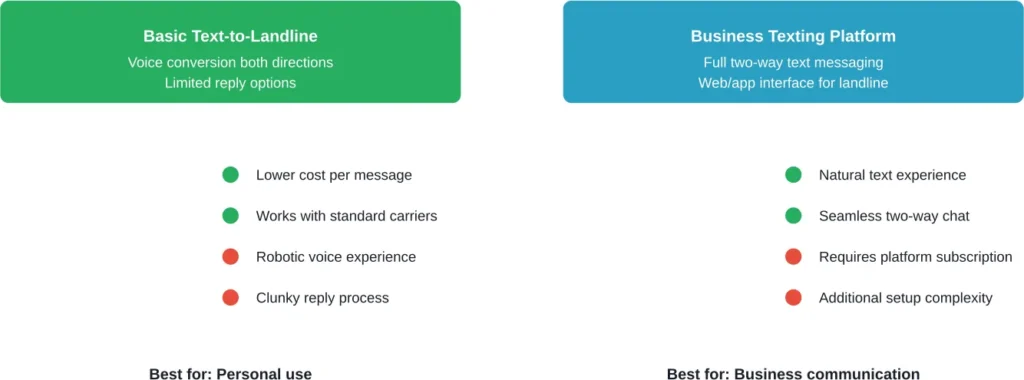
Whether landline recipients can reply depends entirely on the service level supporting the number. Basic Text-to-Landline services offer limited reply options. Advanced business texting platforms enable full two-way conversations.
With basic carrier services like Verizon’s Text-to-Landline, recipients can respond by voice after hearing the automated message. The system records their voice reply and converts it back to text for the original sender.
The sender retrieves this reply by checking messages on their mobile device. The response appears as a text, though it originated as voice recorded by the landline recipient.
This creates a quirky communication loop: text becomes voice, then voice becomes text again. It works, but feels clunky compared to native texting.
Business-grade landline texting eliminates the voice conversion step entirely. Platforms designed for customer communication enable landline users to send typed text responses through web interfaces or mobile apps.
These responses reach the original sender as normal text messages. The entire conversation happens via text, even though one party uses a landline number.
Common Scenarios and User Experiences
Community discussions reveal several typical situations where people accidentally text landlines. Understanding these scenarios helps explain when conversion services activate and when messages simply fail.
The most common scenario involves mixed-up contacts. Someone saves both mobile and home numbers for the same person. When composing a quick text, they select the landline entry by mistake.
If the carrier supports Text-to-Landline and the recipient answers, the message goes through as voice. Otherwise, the sender gets a bounce-back notification and realizes the error.
Another frequent situation happens with business contacts. Customers find a company phone number online and assume it accepts texts. Sometimes it does through business texting platforms. Often it doesn’t, leading to failed delivery and frustrated customers.
Family communication creates complications too. Older relatives sometimes maintain traditional landlines as their only phone service. Younger family members accustomed to texting everyone occasionally forget and send texts to grandparents’ landline numbers.
With Text-to-Landline support, these messages convert to voice calls. Without support, the text fails and the sender must call instead.
Setting Up Landline Texting for Business
Businesses interested in enabling landline texting face several implementation options. The choice depends on budget, technical capability, and communication volume.
The simplest approach involves checking whether existing landline providers offer text capabilities. Some VoIP services include SMS features in standard packages or as affordable add-ons.
Activating these built-in features typically requires logging into the provider’s management portal and enabling SMS for specific numbers. Configuration varies by provider but generally takes minutes rather than hours.
For more sophisticated needs, dedicated business texting platforms offer robust functionality. These services overlay texting capabilities onto existing landline numbers without requiring carrier changes.
Implementation involves subscribing to the platform, verifying ownership of the business number, and configuring how incoming texts route to staff members. Most platforms provide mobile apps and web dashboards for managing conversations.
Integration options extend functionality further. Many business texting platforms connect with customer relationship management systems, scheduling software, and marketing automation tools.
These integrations enable automated appointment reminders, customer survey distribution, and personalized marketing campaigns all through the business’s existing landline number.
Privacy and Security Considerations
Text-to-Landline conversion raises questions about message privacy and security. Understanding how carriers and service providers handle message data matters for sensitive communications.
Basic carrier services convert messages to voice and deliver them as phone calls. The content travels through standard telephone networks after conversion, with the same security characteristics as regular voice calls.
Message content gets temporarily stored during the conversion process. Carriers typically retain converted messages for short periods to enable delivery retries and reply functionality.
Business texting platforms store message histories more permanently. This enables features like searchable conversation archives and compliance documentation but means messages persist in third-party systems.
Companies handling sensitive information should review platform security certifications and data handling policies before implementing landline texting for customer communications.
For personal use, standard Text-to-Landline services through major carriers generally maintain reasonable security standards. However, sensitive information is always better communicated through encrypted channels rather than converted text-to-voice systems.
Future of Landline Communication
Landline usage continues declining as mobile phones dominate personal and business communication. But landline numbers persist, especially for established businesses with brand recognition tied to specific phone numbers.
This creates ongoing demand for technologies bridging old and new communication methods. Text-to-Landline services and business texting platforms fill this gap, extending landline functionality into the modern texting era.
Network infrastructure evolution plays a role too. As carriers phase out traditional copper-wire telephone networks, even “landlines” increasingly run on internet-based systems capable of native text support.
This technical transition makes landline texting simpler to implement over time. VoIP systems designed for text compatibility replace old infrastructure that never could handle SMS.
Eventually, the distinction between landline and mobile numbers may fade entirely from a technical perspective. Numbers will simply be communication endpoints capable of voice, text, video, and other modalities regardless of their origin or format.
Frequently Asked Questions
No, unsuccessful deliveries typically don’t incur charges. According to Verizon, only successful Text-to-Landline messages that convert to voice and reach the recipient cost money (the standard fee is $0.25 per successful message). When a message fails to deliver, carriers don’t charge the sender. The text counts against unlimited messaging allowances only if it successfully delivers.
Yes, but it depends on the service. With basic Text-to-Landline services, the landline recipient can leave a voice reply after hearing the automated message. This voice response converts back to text for the sender. Business texting platforms enable actual typed text responses through web interfaces or apps. Without any Text-to-Landline support, the recipient can’t respond at all through that communication channel.
Phone numbers themselves don’t indicate whether they’re landline or mobile. Area codes and prefixes don’t reliably distinguish between line types anymore. The only way to know for certain is asking the person or trying to send a message and seeing if it delivers. Some third-party number lookup services claim to identify line types, but accuracy varies. When in doubt, calling remains the safest approach for reaching landlines.
Not all carriers support this service uniformly. Major providers like Verizon explicitly offer Text-to-Landline with documented pricing and features. Other carriers have varying levels of support depending on the specific landline provider and service type. International compatibility is particularly limited, with most Text-to-Landline services only functioning within the same country. VoIP providers determine their own SMS capabilities independently of traditional carrier services.
Yes, businesses using landline texting platforms see the sender’s phone number and full message content. These platforms function like normal text messaging systems from the business perspective, displaying sender information, message history, and conversation threads. Basic carrier Text-to-Landline services also identify the sender’s number when delivering the automated voice call. Privacy works the same as regular text messaging, with both parties seeing each other’s numbers.
Emojis create problems for Text-to-Landline conversion. The automated voice system either skips emojis entirely, describes them in awkward text form (“smiling face emoji”), or replaces them with confusing character descriptions. The exact handling depends on the carrier’s text-to-speech engine. For business communication, avoiding emojis in messages to landlines ensures clearer delivery and better recipient understanding of the message content.
Delivery timing varies based on the conversion process and whether someone answers. The initial text-to-voice conversion happens quickly, usually within seconds. The landline then rings like a normal call. If someone answers immediately, they hear the message right away. If nobody answers, carriers retry delivery multiple times over several days. According to carrier documentation, messages remain in delivery queues for up to 5 days before permanent failure.
Making Sense of Mixed Communication Channels
Texting a landline sits at the intersection of old and new communication technologies. What seems like a simple incompatibility, traditional phones versus modern messaging, actually reveals a complex landscape of conversion services, business solutions, and carrier-specific implementations.
For personal use, accidentally texting a landline usually means either a failed message or an awkward automated voice delivery. Not the end of the world, just a reminder to double-check contact information before sending.
For businesses, landline texting represents a genuine opportunity to meet customer preferences without abandoning established phone numbers. The technology exists to make it work seamlessly when properly implemented.
Understanding what happens behind the scenes, from Text-to-Landline conversion to VoIP SMS capabilities, helps navigate these mixed communication scenarios more effectively. Whether sending a quick message or implementing business texting systems, knowing how different technologies interact makes the difference between successful delivery and confusion.
Next time a text goes to a landline, whether by accident or design, the outcome depends on invisible infrastructure decisions made by carriers and service providers. Sometimes the message gets through. Sometimes it bounces back. But the technology connecting these different worlds continues evolving, making what once seemed impossible increasingly routine.