
Quick Summary: If you don’t scratch an itch, it typically subsides on its own within minutes as your nervous system adapts. According to NIH research, scratching actually triggers more inflammation and makes the itch-scratch cycle worse. Resisting the urge allows your skin to heal without damage or prolonged irritation.
That maddening itch on your arm demands attention. Your brain screams for relief. But what actually happens if you just… don’t scratch?
The answer surprises most people. And recent research published in the journal Science on January 30, 2025 reveals exactly why resisting that urge is one of the best things for your skin.
The Science Behind What Happens When You Don’t Scratch
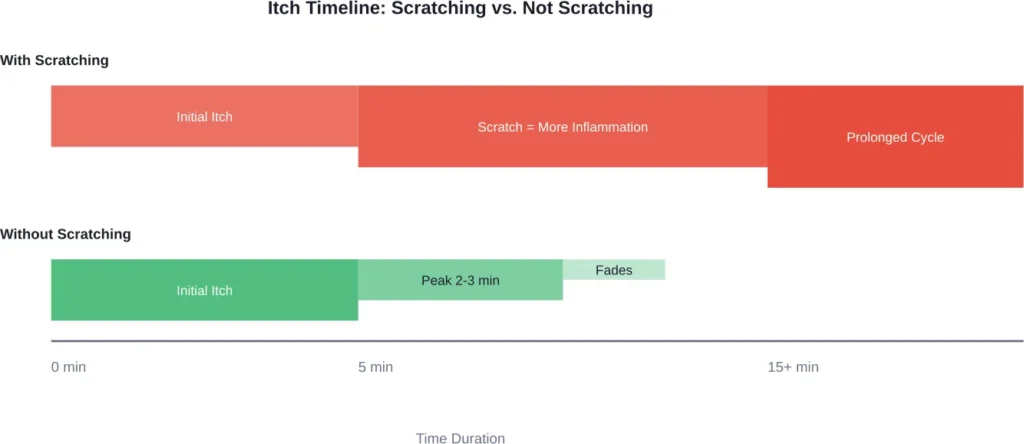
According to NIH research on the neurophysiology of pruritus, an itch is an unpleasant sensation that evokes the urgent desire to scratch. When left alone, most itches resolve within 5-10 minutes as your nervous system adapts to the stimulus.
Here’s what occurs in your body when you resist scratching:
First, the itch signal travels from your skin through specialized nerve fibers to your spinal cord and brain. These signals are triggered by voltage-gated sodium channels on neuronal membranes. Without scratching intervention, the intensity typically peaks within 2-3 minutes, then gradually fades.
Your brain processes the sensation differently when no scratching occurs. The inflammatory response remains localized and controlled. Skin cells continue normal healing processes without additional trauma.
Why Scratching Makes Everything Worse
Research from the University of Pittsburgh School of Medicine, published in January 2025, confirms what parents have been saying for generations: scratching an itchy rash really does make it worse.
The study examined allergic contact dermatitis in mouse models and discovered the mechanism behind this phenomenon. When scratching occurs, it triggers a cascade of inflammatory responses that actually amplify the original itch signal.
According to research cited in the NIH’s Physiology and Pathophysiology of Itch review, approximately 15% of the population suffers from chronic itch conditions. For these individuals, breaking the itch-scratch cycle is essential for healing.
Scratching causes three major problems:
| Problem | What Happens | Result |
|---|---|---|
| Skin Damage | Physical trauma breaks skin barrier | Infection risk increases |
| Inflammation Surge | Chemical mediators flood the area | Swelling and redness worsen |
| Nerve Sensitization | Repeated signals lower itch threshold | Itching becomes chronic |
The Itch-Scratch Cycle Explained
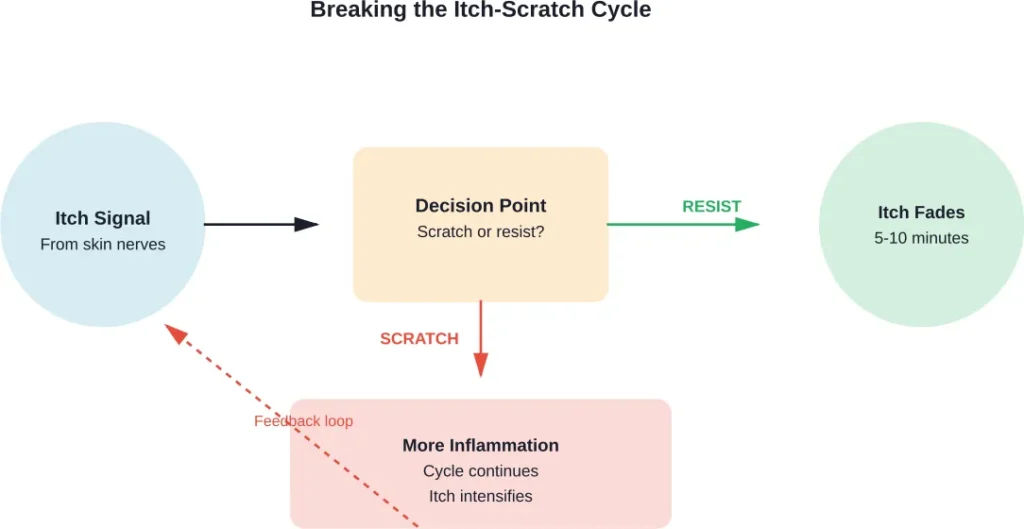
NIH research on neuroimmune perspectives reveals how scratching creates a vicious cycle. Each scratch episode releases inflammatory chemicals that sensitize nerve endings. These sensitized nerves then send more frequent itch signals to the brain.
This explains why conditions like atopic dermatitis become so relentless. The scratching behavior itself perpetuates the problem.
When scratching stops, the cycle breaks. Inflammatory mediators decrease. Nerve sensitivity returns to baseline. Skin barrier function gradually restores.
What Your Brain Does When You Resist
Brain imaging studies show fascinating differences in central nervous system processing of itch between those who scratch and those who resist.
When an itch goes unscratched, the brain’s reward centers don’t receive the dopamine hit that scratching provides. But here’s the thing—that temporary pleasure from scratching comes at a steep cost.
Research from the University of California, San Francisco, published in Seminars in Cutaneous Medicine and Surgery (2011), indicates that resisting scratching allows the brain to adapt more quickly to the stimulus. The sensation becomes less intense through a process called habituation.
Practical Benefits of Not Scratching
Beyond the biological mechanisms, resisting the scratch urge delivers concrete benefits:
Skin integrity remains intact. No broken skin means no entry point for bacteria. The CDC notes that conditions like impetigo and other secondary infections often result from scratched skin.
Healing accelerates. Without repeated trauma, inflammatory markers decrease faster. Redness and swelling resolve in days rather than weeks.
Chronic conditions improve. For the estimated 10% to 30% of children and 2% to 10% of adults with atopic dermatitis in developed countries, breaking the scratch habit is crucial for long-term management.
When Itching Requires Medical Attention
Not all itches are benign. According to the CDC, certain conditions demand professional evaluation:
- Scabies—caused by the human itch mite and intensely itchy, especially at night
- Swimmer’s itch from parasitic exposure in fresh or salt water
- Sporotrichosis, a fungal infection causing severe skin symptoms
- Persistent itch lasting beyond two weeks without clear cause
These conditions won’t resolve simply by avoiding scratching. They require specific medical treatment.
Frequently Asked Questions
Most itches resolve within 5-10 minutes when left alone. The sensation typically peaks at 2-3 minutes, then gradually fades as nerve signals adapt and inflammatory mediators dissipate naturally.
Yes, according to research published in the journal Science on January 30, 2025. Scratching triggers additional inflammation, damages the skin barrier, and creates a feedback loop that makes itching worse and more persistent over time.
Scratching activates reward centers in the brain and temporarily blocks itch signals with pain signals. This creates a brief sensation of relief, but the underlying inflammatory response intensifies, leading to prolonged itching.
Apply a cold compress, use gentle pressure, moisturize the area, or distract yourself with another activity. These methods provide relief without damaging skin or perpetuating the itch-scratch cycle.
Yes. Repeated scratching can lead to skin thickening (lichenification), permanent scarring, changes in skin pigmentation, and increased risk of bacterial infections according to NIH dermatology research.
Absolutely. Itches from dry skin, insect bites, or minor irritation resolve naturally without scratching. However, itches from scabies, fungal infections, or chronic conditions like atopic dermatitis require medical treatment beyond behavioral changes.
Scratching releases inflammatory chemicals and sensitizes nerve endings, lowering the threshold for future itch signals. This creates a self-perpetuating cycle where the skin becomes more reactive to itch triggers over time.
The Bottom Line
When you don’t scratch an itch, your body completes its natural adaptation process without interference. The sensation fades, inflammation stays controlled, and skin heals properly.
Research consistently shows that resisting the urge breaks the destructive itch-scratch cycle. While those first few minutes feel challenging, the long-term benefits far outweigh the temporary discomfort.
For persistent or severe itching, consult a healthcare provider. But for everyday itches? Let them be. Your skin will thank you.