

Quick Summary: Failing a high school class impacts your GPA and may delay graduation, but it’s not the end of your academic journey. Most schools offer recovery options like retaking the course, summer school, credit recovery programs, or online alternatives. Colleges evaluate your entire academic trajectory, so demonstrating improvement and addressing the failure honestly in applications can mitigate its impact on admissions chances.
Seeing that F on your transcript feels terrible. The panic sets in immediately—will this ruin college chances? Does it mean repeating the entire year?
Here’s the reality: failing a high school class is serious, but it’s not catastrophic. Schools understand that academic setbacks happen, and they’ve built systems to help students recover.
This guide breaks down the actual consequences, recovery pathways, and what colleges really think about failed courses.
The Immediate Consequences of Failing a Class
When a student fails a course, several things happen simultaneously. Understanding these effects helps prioritize which issues need addressing first.
Your GPA Takes a Hit
An F translates to a 0.0 in GPA calculations. That zero gets averaged with all other grades, dragging down the overall GPA—sometimes significantly if the failed course carried multiple credits.
The damage depends on timing. A failed class freshman year has more time for recovery through subsequent strong grades. Senior year failures? Those appear on final transcripts colleges actually review.
Class Rank Drops
Schools that calculate class rank will factor in that failing grade. For students aiming for top-10% status for scholarship eligibility or college admissions advantages, one failed course can shift rankings noticeably.
But here’s something worth knowing: many schools have moved away from class rank entirely, recognizing it creates unhealthy competition.
Graduation Requirements Get Complicated
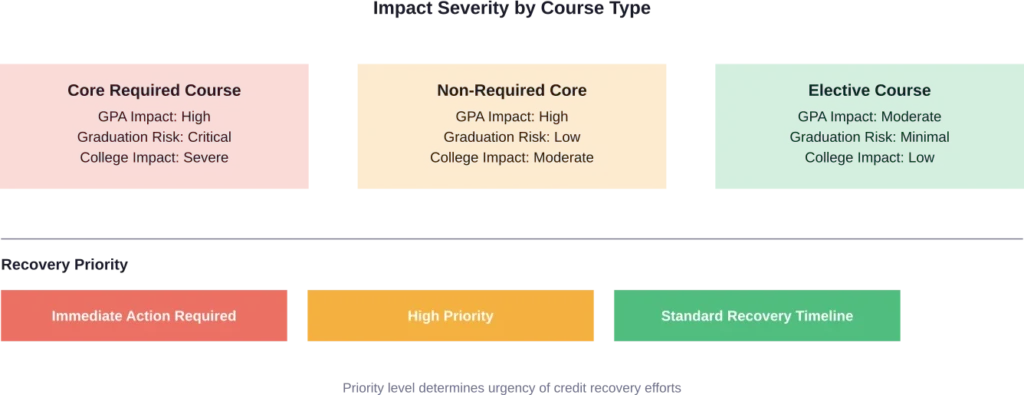
This is where things get serious. Most states require specific credits in core subjects—English, math, science, social studies—to earn a diploma.
Graduation requirements vary significantly by state, with many states implementing exit exams and competency standards. Failing a required course means that credit must be made up somehow before graduation.
Elective failures? Less critical for graduation timelines, though they still damage GPA.
How Failing Affects College Admissions
Now for the question keeping students up at night: what do colleges think about failed classes?
The answer isn’t simple. It depends on the selectivity of the institution, which course failed, when it happened, and what the student did afterward.
Selective Schools Notice Everything
Highly competitive universities examine transcripts closely. They’re looking for consistent academic rigor and performance. A failed core course—especially in junior or senior year—raises red flags about academic preparedness.
That said, admission officers are humans evaluating other humans. Context matters enormously.
The Power of the Upward Trajectory
Colleges value resilience and growth. A student who failed algebra as a freshman, retook it successfully, then went on to excel in higher math? That tells a compelling story about persistence.
Research on academic failure patterns shows that early intervention and demonstrated improvement significantly reduce long-term educational consequences.
The key is showing that failure was a learning moment, not a pattern.
When Failure Matters Less
Some scenarios reduce the impact:
- The failed course is unrelated to intended major
- Overall GPA remains competitive despite the F
- Other application elements (test scores, extracurriculars, essays) are exceptionally strong
- Legitimate extenuating circumstances existed
Community colleges and less selective state schools often focus more on recent performance and completion potential than one bad grade.
Recovery Options: How to Fix a Failed Class
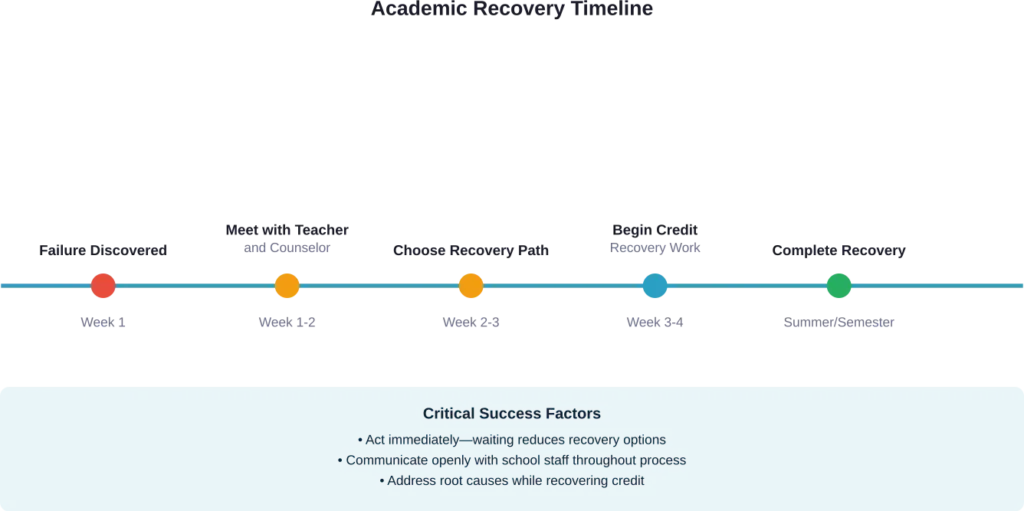
Most schools offer multiple pathways for recovering from course failure. The best option depends on timing, graduation timeline, and school policies.
Make-Up Work and Extra Credit
If the failure is caught early—say, after first semester—some teachers allow make-up work or extra credit to pull the grade up before it’s finalized.
This requires immediate communication. Talk to the teacher first, then the guidance counselor. Some schools have formal policies allowing grade improvement before the academic year ends.
Second-Semester Redemption
For year-long courses where only first semester was failed, acing second semester can sometimes average to a passing grade for the full year.
School policies vary here. Some calculate each semester separately, others average them. Check with counselors about how courses are transcripted.
Summer School
The traditional recovery method. Summer school offers condensed versions of failed courses, letting students earn the credit before the next school year starts.
Benefits: Keeps graduation timeline on track, shows colleges immediate corrective action, often removes the F from GPA calculation (replacing it with the new grade).
Downsides: Costs money at many schools, sacrifices summer for academics, compressed timeline is challenging.
Credit Recovery Programs
Many districts now offer credit recovery—computer-based programs focusing specifically on the standards a student didn’t master, rather than repeating entire courses.
These programs can be completed during the school year, after school, or during summer. They’re often more flexible and self-paced than traditional summer school.
Online Course Providers
Accredited online high schools let students retake courses on their own schedule. Schools must approve the provider first and agree to accept the credit transfer.
This option works well for motivated students who need schedule flexibility or whose schools don’t offer summer programs.
| Recovery Method | Timeline | Best For | Typical Cost |
|---|---|---|---|
| Make-Up Work | Same semester | Early intervention cases | Free |
| Second-Semester Boost | Same academic year | Year-long courses, 1st semester failure | Free |
| Summer School | Summer break | Traditional learners, single course failure | $200-$600 |
| Credit Recovery | Flexible, often 6-12 weeks | Self-directed students, working around schedule | Free to $300 |
| Online Courses | Highly flexible, 8-16 weeks typical | Need maximum flexibility, motivated students | $300-$800 |
Addressing the Failure in College Applications
When that F sits on the transcript colleges will see, addressing it strategically becomes crucial.
The Additional Information Section
Most college applications include an optional additional information section. This is where context belongs—but only if there’s meaningful context to share.
Good reasons to address it: documented medical issues, family emergencies, learning disabilities diagnosed during that period, significant personal circumstances.
Poor reasons: didn’t like the teacher, subject was hard, was busy with extracurriculars.
What to Say (and What Not to Say)
If addressing the failure, be direct, take responsibility, and emphasize growth:
“During sophomore year, I failed Chemistry due to [brief context]. I retook the course through summer school, earning a B+, and went on to succeed in Biology and Physics. This experience taught me the importance of seeking help early and developing better study systems.”
Keep it brief. Two to three sentences maximum.
When Your Counselor Can Help
Guidance counselors write secondary school reports that provide context about students’ academic records and can help admissions committees evaluate transcripts more comprehensively.
Preventing Future Failures
Learning from failure means identifying what went wrong and building systems to prevent recurrence.
Identify the Root Cause
Academic failure rarely comes from one source. Common culprits include:
- Knowledge gaps from previous courses making current material incomprehensible
- Poor time management leading to missed assignments
- Test anxiety sabotaging assessment performance despite understanding material
- Learning disabilities that haven’t been formally diagnosed or accommodated
- Mental health challenges affecting concentration and motivation
- External circumstances (work obligations, family responsibilities) overwhelming academic demands
Research on high school transitions shows that the transition to ninth grade presents particular challenges, with many students experiencing unexpected performance drops—sometimes called the “9th grade shock.”
Build Better Academic Habits
Small systematic changes create significant improvement:
Use a planner religiously. Digital or paper doesn’t matter—what matters is recording all assignments, tests, and deadlines in one place checked daily.
Attend tutoring before falling behind, not after. Most schools offer free peer or teacher tutoring. Weekly sessions prevent small confusion from snowballing into complete lost understanding.
Communicate with teachers proactively. Email when concepts are unclear. Visit during office hours. Teachers want students to succeed and appreciate students who advocate for themselves.
Know When to Get Professional Help
Sometimes struggling academically signals issues beyond study habits. Persistent difficulties despite effort might indicate:
Learning disabilities like dyslexia, dyscalculia, or processing disorders. Formal testing through the school can unlock accommodations like extended test time or alternative assignment formats.
Mental health challenges including depression, anxiety, or ADHD. These conditions dramatically affect academic performance. School counselors can connect students with appropriate resources.
Don’t wait for crisis. According to educational research on student support systems, early identification and intervention prevent small academic struggles from becoming larger patterns of failure.
The Long View: Life After a Failed Class
Here’s something that gets lost in the immediate panic: one failed class rarely determines long-term outcomes.
Will it make getting into Harvard harder? Probably. Does it mean academic and career success are impossible? Absolutely not.
Student feedback and educational resources emphasize that recovery from course failure is possible and that demonstrating growth matters more than isolated setbacks.
Thousands of successful professionals failed classes in high school. What separated those who eventually succeeded was their response to failure—whether they treated it as a catastrophe or a learning opportunity.
College admissions remain accessible through multiple pathways. Community college transfers, gap years with academic improvement, strong standardized test scores compensating for GPA—many routes lead to the same destination.
Frequently Asked Questions
No, grade retention for a single failed class is extremely rare in American high schools. Repeating an entire grade typically only happens when students fail multiple core courses and cannot meet promotion requirements. If the failed course is required for graduation, students need to recover that specific credit through summer school, credit recovery, or retaking just that one course—not the whole grade.
Yes. While highly selective universities scrutinize transcripts closely, many colleges evaluate applications holistically. Community colleges typically have open enrollment policies. State universities often focus more on overall GPA trends than individual courses. What matters most is demonstrating that the failure was addressed, the credit was recovered, and academic performance improved afterward. Context matters significantly in admissions decisions.
This depends entirely on school and district policy. Some schools replace the failing grade with the new grade in GPA calculations while keeping both grades visible on the transcript. Others average the two grades. Some show both grades but only count the higher one toward GPA. Check with the guidance counselor about specific transcript and GPA policies before choosing a recovery method.
The impact varies based on how many total credits have been completed. A single failed class (usually 0.5 to 1.0 credit) among 24+ total high school credits might drop GPA by 0.1 to 0.3 points. Earlier in high school, when fewer credits exist, the impact is larger. Later failures affect GPA less mathematically but appear more concerning to colleges since they represent recent performance.
Generally, withdrawing is preferable to an F if the option exists and timing allows. A W indicates the student recognized the problem and made a strategic decision, while an F represents academic failure. However, multiple withdrawals create their own concerns. Additionally, withdrawal policies vary—some schools allow it only within specific timeframes, and withdrawing from required courses still means needing that credit eventually.
Only if there were legitimate extenuating circumstances—serious illness, family emergency, documented learning disability, significant life disruption. Briefly explain the context (2-3 sentences), take responsibility, and emphasize what was learned and how performance improved. Don’t make excuses like “the teacher was unfair” or “I didn’t try.” If there’s no compelling external reason, it’s often better to let the recovery efforts speak for themselves rather than drawing additional attention to the failure.
Usually yes, if the failure is addressed quickly. Summer school after the failed semester, credit recovery programs during the school year, or approved online courses can all restore the missing credit before graduation. Problems arise when students fail multiple required courses or don’t address failures until senior year. Immediate action preserves on-time graduation. Counselors can map out credit recovery plans to ensure graduation timeline stays intact.
Moving Forward From Academic Setbacks
Failing a high school class stings. The disappointment, stress about college applications, and worry about falling behind are all valid emotions.
But this setback doesn’t define academic potential or future success. What matters now is responding constructively—understanding what went wrong, choosing an appropriate recovery path, and building better academic systems going forward.
Talk to the guidance counselor this week. Explore credit recovery options. Be honest about what led to the failure and get appropriate support if underlying issues exist.
The path forward exists. Thousands of students walk it successfully every year, recovering credits, improving study habits, and going on to achieve their academic goals.
One failed class is a chapter in an academic story, not the ending. How that chapter concludes depends entirely on what happens next.