

Quick Summary: Failing to register for Selective Service is a federal felony punishable by up to five years in prison and a $250,000 fine, though prosecutions are rare. Men who don’t register lose eligibility for federal student aid, federal job training, and most federal employment. For non-citizens, failure to register will delay or prevent U.S. citizenship proceedings.
Most American men know they’re supposed to register for Selective Service when they turn 18. But what actually happens if you skip it?
The short answer: the consequences are more serious than many realize. And they don’t go away when you turn 26.
According to the Selective Service System, nearly all men between 18 and 25 who live in the United States must register. That includes citizens, immigrants, refugees, and even some visitors. The requirement has been on the books since 1980, when President Carter reinstated registration during the Cold War.
The Criminal Penalties: Rarely Enforced but Still Real
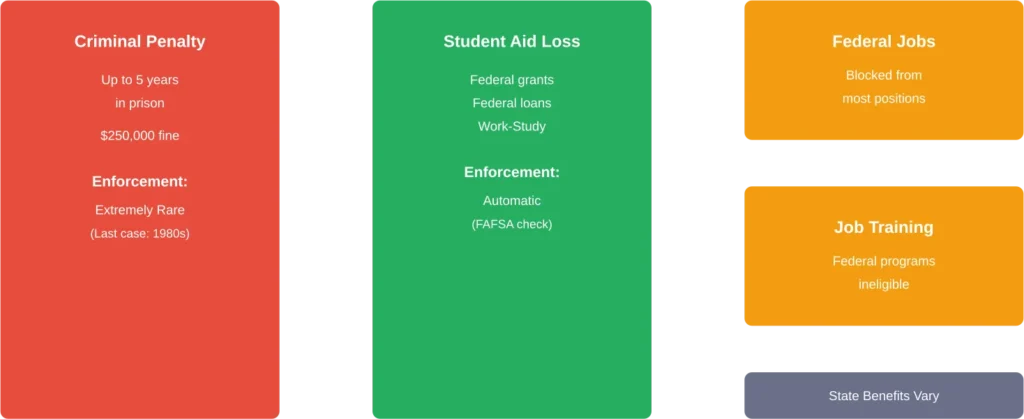
Here’s the thing though—failure to register is technically a federal felony.
According to the Selective Service System’s official FAQ, conviction for failing to register can result in imprisonment for up to five years and a fine of up to $250,000. That’s what the law says.
But here’s what actually happens: prosecutions are extremely rare. Prosecutions for failure to register are extremely rare, with the last known cases occurring in the 1980s. The government simply doesn’t pursue these cases anymore.
That said, the law remains on the books and is technically enforceable. The Military Selective Service Act makes non-registration a violation, and while you won’t likely face criminal charges, the civil penalties are what really matter.
Federal Student Aid: The Big One
The most immediate consequence for most young men is losing access to federal financial aid for college.
According to federal law found in 20 U.S. Code § 1091, students cannot receive any federal student aid—including Pell Grants, Federal Work-Study, or federal student loans—unless they’re registered with Selective Service. This requirement kicks in when you submit your FAFSA (Free Application for Federal Student Aid).
No registration? No federal money for school.
And this isn’t just a delay. If you fail to register between 18 and 25, you permanently lose eligibility for federal student aid. Even registering after you turn 26 won’t restore it.
Federal Employment: Locked Out
Want to work for the federal government? Registration is mandatory for most positions.
According to federal hiring regulations, men born after December 31, 1959, must be registered with Selective Service to be eligible for federal jobs in the competitive service. This applies to executive branch agencies and covers the vast majority of federal civilian positions.
The competitive service includes everything from entry-level administrative roles to professional positions across federal departments. If you didn’t register between 18 and 25, you’re permanently ineligible—even if you try to register later.
Some excepted service positions and contractor roles may not have this requirement, but it’s a major barrier for anyone considering federal employment.
Federal Job Training Programs
Beyond direct federal employment, failing to register blocks access to federally funded job training programs. This includes programs administered under the Workforce Innovation and Opportunity Act and similar initiatives designed to help people develop job skills.
For young men trying to enter the workforce or change careers, losing access to these programs can be a significant setback. And like student aid, the ban is permanent if you miss the registration window.
Immigration and Citizenship: A Permanent Barrier
For non-citizens, the consequences are particularly severe.
According to federal immigration law, male immigrants who fail to register for Selective Service cannot become naturalized U.S. citizens. This includes legal permanent residents (green card holders), refugees, asylum seekers, and others pursuing citizenship.
Immigration authorities specifically ask about Selective Service registration during the naturalization process. If you were required to register but didn’t, your application for citizenship will be denied. Period.
This creates a catch-22 for many immigrants who weren’t aware of the requirement when they turned 18. Even if they later try to register, once they’re past 26, they can’t fix the problem.
State-Level Consequences Vary
Some states add their own penalties on top of federal restrictions. These vary widely but can include:
- Ineligibility for state-funded student aid or scholarships
- Denial of state government employment
- Restrictions on professional licenses in certain fields
- Loss of eligibility for state job training programs
Not all states enforce these penalties, and the specific requirements differ. But in states that do enforce them, the consequences compound the federal restrictions.
Who Must Register and Who’s Exempt
Understanding who needs to register helps clarify why some men face these penalties while others don’t.
According to the Selective Service System, the following groups must register:
- U.S. citizens and dual nationals (regardless of where they live)
- Legal permanent residents (green card holders)
- Refugees and asylum seekers
- Undocumented immigrants living in the U.S.
- Most male non-citizens on student or work visas
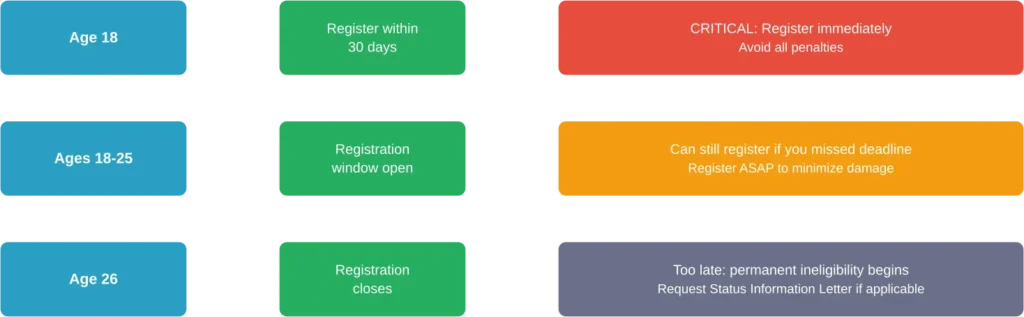
Registration is required within 30 days of turning 18 and must happen before turning 26.
| Group | Registration Required? | Notes |
|---|---|---|
| U.S. Citizens | Yes | Even if living abroad |
| Green Card Holders | Yes | Critical for naturalization |
| Refugees/Asylees | Yes | Must register after arrival |
| Student Visa Holders | Generally Yes | If in the U.S. during ages 18-25 |
| Undocumented Immigrants | Yes | Registration doesn’t affect immigration status |
| Active Duty Military | No | Exempt while serving |
| Short-Term Visitors | No | Tourist visas under 1 year exempt |
Exemptions exist for men currently on active duty in the military, certain categories of non-immigrant visa holders on short visits, and men who are permanently institutionalized or hospitalized.
What If You’re Already Past 26?
This is where things get complicated.
According to the Selective Service System’s guidance for men 26 and older, you can no longer register once you turn 26. The registration requirement only applies to men ages 18 through 25.
But the penalties don’t disappear.
If you failed to register and you’re now over 26, you’re still ineligible for federal student aid, federal employment, and federal job training. For non-citizens, you still can’t naturalize.
Sound familiar? It’s a permanent consequence for missing a temporary window.
Status Information Letters
Men over 26 who didn’t register can request a Status Information Letter from the Selective Service System. This letter documents why you didn’t register and can help in certain situations.
The letter is useful if you have a valid reason for not registering, such as:
- You were hospitalized or institutionalized during the registration period
- You were incarcerated during the entire registration period
- You weren’t in the United States and weren’t a U.S. citizen during that time
In these cases, the Status Information Letter can potentially restore eligibility for federal benefits. But if you simply forgot or didn’t know about the requirement, the letter won’t help much.
Agency Waivers
Some federal agencies have limited authority to waive the registration requirement for benefits. This typically applies only in cases where the individual can demonstrate they didn’t knowingly and willfully fail to register.
Waivers are granted on a case-by-case basis and require documentation showing why registration didn’t occur. The burden of proof is on the applicant, and approval is far from guaranteed.
Common Misconceptions About Registration
Several myths circulate about Selective Service registration and its consequences:
Myth: There’s an active draft. There hasn’t been a military draft since 1973. Registration is just a backup system that would allow the government to quickly implement a draft if Congress and the President authorize one during a national emergency.
Myth: Registering means you’ll definitely be drafted. Registration is not the same as being drafted. It’s simply a database. Even if a draft were reinstated, most registered men wouldn’t be called.
Myth: You can register after 26 to fix the problem. Nope. The Selective Service System won’t accept late registrations after age 26.
Myth: Failure to register only matters during wartime. The penalties—loss of student aid, federal jobs, and citizenship eligibility—apply right now, regardless of whether there’s a draft.
How Registration Actually Works
Registering is straightforward and free. Men can register:
- Online at the Selective Service System website
- By mail using a registration form
- At the post office (though not all locations offer this)
- Automatically when applying for federal student aid (FAFSA)
- Through their state’s driver’s license application in participating states
The process takes just a few minutes and requires basic information: name, date of birth, Social Security number, and address.
Many men register automatically without realizing it. In many states, applying for a driver’s license includes an option to register for Selective Service. The FAFSA application includes a registration option for Selective Service.
Why These Penalties Exist
The consequences for failing to register weren’t always this severe. Congress added most of them in the 1980s when registration was reinstated.
The logic was simple: if registration is mandatory, there need to be enforcement mechanisms. But instead of criminal prosecutions—which are expensive, politically sensitive, and time-consuming—Congress tied registration to federal benefits that young men typically need.
Student aid was the obvious target. Most 18-year-olds don’t think much about federal employment or job training programs, but they definitely care about paying for college. Making student aid contingent on registration created a powerful incentive.
For immigrants, the citizenship requirement serves as both enforcement and a test of civic responsibility. The reasoning is that men seeking to become citizens should have fulfilled this legal obligation.
What to Do Right Now
If you’re between 18 and 25 and haven’t registered, do it today. Seriously—it takes less time than reading this article.
Go to the Selective Service System website and register online. You’ll need your Social Security number and basic personal information. The whole process takes maybe five minutes.
If you’re over 26 and never registered, your options are limited. Request a Status Information Letter from the Selective Service System if you have a legitimate reason for not registering. Document anything that prevented you from registering during the required period.
For non-citizens facing citizenship applications, consult an immigration attorney. Some cases may qualify for waivers or exemptions, but you’ll need professional help navigating that process.
Frequently Asked Questions
Technically yes—failure to register is a federal felony punishable by up to five years in prison and a $250,000 fine according to the Selective Service System. However, prosecutions for failure to register are extremely rare, with the last known cases occurring in the 1980s. The government currently relies on civil penalties (loss of benefits) rather than criminal prosecution.
Yes. Federal law prohibits providing federal student aid to men who haven’t registered with Selective Service. This includes Pell Grants, federal student loans, and Federal Work-Study programs. The FAFSA application checks registration status automatically.
No. The Selective Service System only accepts registrations from men ages 18 through 25. Once you turn 26, you can no longer register, but the penalties for failing to register remain in effect.
Non-citizens who fail to register for Selective Service cannot become naturalized U.S. citizens. This applies to green card holders, refugees, asylum seekers, and others pursuing citizenship. The immigration authorities check registration status during the naturalization process, and failure to register results in automatic denial.
No. Registration is not the same as being drafted. There hasn’t been a military draft since 1973. Registration simply creates a database that the government could use if Congress and the President ever authorize a draft during a national emergency. Most registered men would not be drafted even if a draft were reinstated.
Generally no. According to federal hiring regulations, men born after December 31, 1959, must be registered with Selective Service to qualify for federal employment in the competitive service. This covers most federal civilian positions. The requirement is permanent—registering after age 26 won’t restore eligibility.
Register immediately. You still have until your 26th birthday, and registering now will prevent permanent loss of federal benefits. Visit the Selective Service System website and complete the online registration form. It takes less than five minutes and will save you from a lifetime of consequences.
The Bottom Line
Failing to register for Selective Service carries real, permanent consequences that affect education, employment, and immigration status. While criminal prosecution is unlikely, the civil penalties are automatic and unforgiving.
The system isn’t perfect. Many argue that the permanent nature of these penalties—especially for men who simply didn’t know about the requirement—is excessive. And the fact that registration only applies to men, not women, raises ongoing legal and equality questions.
But until Congress changes the law, the requirement stands. And the penalties are real.
If you’re required to register and haven’t done so, the best time to act was when you turned 18. The second-best time is right now. Don’t wait until you need federal student aid, apply for a federal job, or seek citizenship to discover you’re permanently ineligible.
Visit the Selective Service System website today and take care of it. Your future self will thank you.