
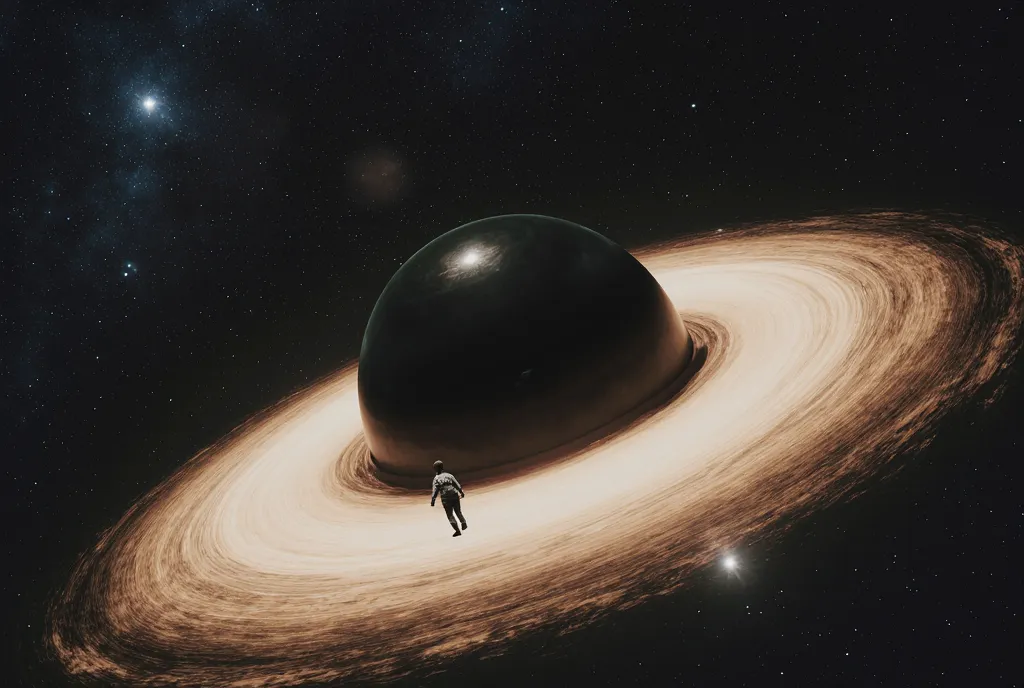
Quick Summary: If you were to fall into a black hole, you’d experience spaghettification—a stretching and compression process caused by extreme gravitational forces. Time would appear to slow down dramatically from an outside observer’s perspective, while you’d perceive it normally. Eventually, you’d cross the event horizon, the point of no return, where not even light can escape, and your fate would be sealed as you journey toward the singularity at the center.
Black holes represent some of the universe’s most extreme objects. These cosmic entities warp spacetime so intensely that nothing—not even light—can escape their gravitational pull once it crosses a certain boundary.
But what would actually happen if you found yourself plummeting toward one?
The answer is stranger than most science fiction. Time becomes elastic. Space stretches like taffy. And the laws of physics behave in ways that challenge our everyday understanding of reality.
According to NASA research, the experience depends heavily on the type of black hole you encounter. The size matters. A lot.
Understanding Black Holes: The Basics
A black hole is a region of spacetime where gravity has become so powerful that it curves space around itself to an extreme degree. These objects form when massive stars collapse at the end of their lives, compressing enormous amounts of matter into an incredibly small space.
The defining feature is the event horizon—the boundary beyond which escape becomes impossible. Think of it as a point of no return.
Black holes come in different sizes. Stellar-mass black holes typically contain 10 to 100 times the mass of our Sun. Supermassive black holes, found at the centers of galaxies, can contain millions or even billions of solar masses.
Here’s the thing though—size dramatically affects what happens when something approaches.
Types of Black Holes
| Type | Mass Range | Typical Size |
|---|---|---|
| Stellar-mass | 5-100 solar masses | ~30 km radius |
| Intermediate-mass | 100-100,000 solar masses | ~1,000 km radius |
| Supermassive | 1 million-10 billion solar masses | 0.001-400 AU |
The Event Horizon Telescope made history by capturing the first direct image of a black hole in the galaxy Messier 87. That breakthrough revealed the dark shadow cast by a supermassive black hole, confirming decades of theoretical predictions.
The Journey Begins: Approaching the Black Hole
Let’s say you’re falling toward a stellar-mass black hole. Long before you reach the event horizon, you’d notice something peculiar.
Gravity doesn’t pull uniformly across your body.
Your feet, being closer to the black hole than your head, experience stronger gravitational force. This difference creates what scientists call tidal forces. And these forces grow exponentially stronger as you approach.
NASA describes this effect in stark terms. Objects approaching a black hole can be “squeezed like a tube of toothpaste, flattened like a pancake, or stretched out like a piece of spaghetti.”
That last description has a name: spaghettification.
Spaghettification Explained
Spaghettification—also called the noodle effect—occurs when the gravitational gradient becomes so steep that it literally stretches objects along the direction of the black hole while compressing them perpendicular to that direction.
For a stellar-mass black hole, this stretching would begin well before you crossed the event horizon. The tidal forces would tear your body apart at the molecular level.
Not a pleasant way to go.
But here’s where size matters. According to NASA visualizations created using supercomputers at the NASA Center for Climate Simulation, supermassive black holes behave differently. Their event horizons are so much larger that the tidal forces at the boundary are actually gentler.
You could potentially cross the event horizon of a supermassive black hole intact, unaware you’d just passed the point of no return.

Time Dilation: When Clocks Stop Making Sense
Now this is where it gets really weird.
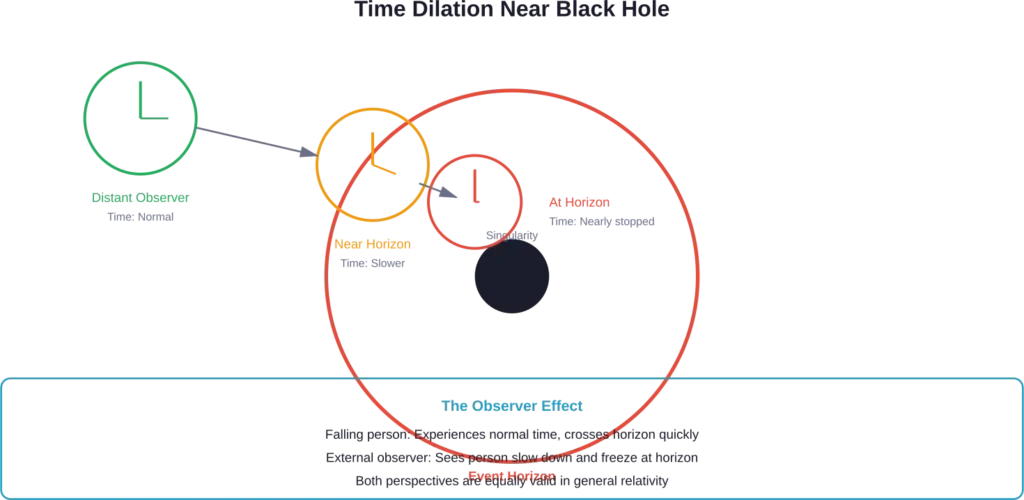
Einstein’s general relativity predicts that time flows differently in strong gravitational fields. Near a black hole, time slows down relative to distant observers.
From your perspective falling into the black hole, time seems to pass normally. Your watch ticks at regular intervals. Your heartbeat feels unchanged.
But to someone watching from a safe distance? You appear to slow down as you approach the event horizon. Your movements become sluggish. Eventually, you seem to freeze at the boundary, never quite crossing it.
This isn’t an optical illusion. Time genuinely passes at different rates depending on gravitational strength.
The effect becomes infinite at the event horizon itself. From the outside universe’s perspective, you never actually cross. You appear suspended there forever, your image gradually fading and redshifting into invisibility.
Yet from your viewpoint, you cross the horizon in finite time and continue falling.
The Observer Paradox
This creates one of the strangest paradoxes in physics. Two equally valid perspectives that tell completely different stories.
An external observer sees you permanently frozen at the event horizon. You experience crossing it and continuing inward. Both perspectives are correct within their own reference frames.
General relativity accommodates this apparent contradiction. The mathematics works. But our intuitions struggle with the concept.
Crossing the Event Horizon
Let’s assume you’re falling into a supermassive black hole, where you might survive to cross the event horizon intact.
What happens next?
The short answer? Nothing special happens at the moment of crossing—at least, nothing you’d notice immediately.
There’s no physical barrier at the event horizon. No wall or membrane. It’s simply a mathematical surface marking the boundary where escape velocity equals the speed of light.
But once you cross, your fate is sealed.
All paths through spacetime now lead toward the singularity at the center. The black hole’s gravity has warped spacetime so severely that “forward in time” and “inward toward the singularity” become the same direction.
You can no more avoid hitting the singularity than you can avoid tomorrow.
Inside the Event Horizon: The Point of No Return
What’s it like inside a black hole’s event horizon?
Honestly, we don’t know for certain. No information can escape from inside to tell us. But general relativity makes predictions.
The environment would be profoundly strange. Light emitted ahead of you would never reach the singularity—it’s falling too, unable to outrun the inward pull of spacetime itself.
Looking behind you, you might still see the outside universe, though heavily distorted and blueshifted. Light from outside can still fall in, even if nothing can get back out.
NASA’s visualization project generated about 10 terabytes of data using the Discover supercomputer at the NASA Center for Climate Simulation, showing what this journey might look like. The images reveal a warped, distorted view of the cosmos as spacetime geometry twists around you.
Spaghettification continues. Even if you survived crossing the event horizon of a supermassive black hole, the tidal forces grow stronger as you approach the singularity.
Eventually, they’d overwhelm any material structure.
The Singularity: Where Physics Breaks Down
At the center of a black hole lies the singularity—a point where matter is compressed to infinite density and spacetime curvature becomes infinite.
At least, that’s what the equations say.
Many physicists suspect this prediction indicates a limitation of general relativity rather than a physical reality. The theory breaks down at quantum scales, and the singularity represents conditions where quantum effects should dominate.
A complete theory of quantum gravity—still elusive—would presumably replace the singularity with something less problematic. But we don’t have that theory yet.
So what actually happens at the singularity remains one of physics’ deepest mysteries.
Different Black Holes, Different Experiences
The type of black hole dramatically affects the experience.
For stellar-mass black holes, you’d be torn apart by tidal forces long before reaching the event horizon. Death would come quickly, though not pleasantly.
Supermassive black holes offer a different scenario. NASA research indicates you could potentially cross the event horizon intact, experiencing the bizarre environment inside before spaghettification eventually takes over closer to the singularity.
The size difference is staggering. A stellar-mass black hole might have an event horizon just 30 kilometers across. A supermassive black hole like the one at M87—imaged by the Event Horizon Telescope—has an event horizon larger than our entire solar system.
| Black Hole Type | Survival to Event Horizon? | Tidal Forces |
|---|---|---|
| Stellar-mass (10 solar masses) | No | Lethal before crossing |
| Intermediate-mass | Unlikely | Very strong |
| Supermassive (1 million+ solar masses) | Possibly | Gentler at horizon |
Rotating Black Holes: An Added Complication
Real black holes rotate. And rotation adds fascinating complications.
A rotating black hole drags spacetime around with it, creating a region called the ergosphere where nothing can remain stationary. Space itself is being pulled around the black hole.
This rotation also affects the interior structure. According to general relativity, a rotating black hole might contain a ring singularity rather than a point singularity, and potentially even passageways to other regions of spacetime.
Some theoretical models suggest rotating black holes could contain stable orbits inside the event horizon. Wild stuff.
But these remain speculative. The chaotic conditions inside a realistic black hole would likely destroy anything before it could exploit such exotic features.
What We’ve Learned from Observations
The Event Horizon Telescope’s breakthrough imaging of M87’s supermassive black hole in 2019 confirmed many theoretical predictions about black hole shadows and photon rings.
These observations show how light bends around black holes, creating a dark shadow region surrounded by a bright ring of emission from superheated material spiraling inward.
More recently, observations from 2026 reveal that Sagittarius A*—the supermassive black hole at our galaxy’s center—exhibits continuous variability and flaring activity. The James Webb Space Telescope has captured repeated energy fluctuations from hot matter swirling around it.
These observations help constrain models of black hole behavior and confirm predictions from general relativity in extreme gravitational environments.
Recent advances in supercomputer simulations have allowed researchers to model black hole mergers with unprecedented accuracy. The Simulating eXtreme Spacetimes project used nearly 900 previously run black hole merger simulations, revealing how spacetime behaves when two black holes collide.
The Fundamental Mystery
Here’s the fundamental problem: information.
Quantum mechanics says information cannot be destroyed. But black holes appear to destroy information permanently—whatever falls in can never come back out to tell us what happened to it.
This information paradox has puzzled physicists for decades.
Stephen Hawking showed that black holes should slowly evaporate through quantum effects, emitting what’s now called Hawking radiation. But this radiation appears to be completely random, containing no information about what fell in.
So where does the information go?
Proposed solutions involve exotic ideas: information encoded on the event horizon surface, subtle correlations in the Hawking radiation, or even the possibility that information escapes through wormholes to other universes.
We don’t know the answer yet. Solving this paradox likely requires a complete theory of quantum gravity—combining quantum mechanics with general relativity in a consistent framework.
Several candidates exist, including string theory and loop quantum gravity, but none are fully developed or experimentally confirmed.
Could Anything Survive?
Let’s be clear: nothing we know of could survive the complete journey into a black hole.
The tidal forces would eventually overwhelm any material structure, whether biological tissue, metal spacecraft, or diamond crystal. The stretching and compression would tear apart molecular bonds, then atomic nuclei themselves.
Even if you somehow survived the tidal forces, the singularity represents a boundary where known physics breaks down completely. What happens there is genuinely unknowable with current understanding.
That said, the journey to the event horizon of a supermassive black hole might be survivable in principle. If you had a sufficiently advanced spacecraft, you could potentially approach close to the horizon and even cross it before tidal forces became lethal.
But there’s no coming back.
Once across the event horizon, escape becomes physically impossible. Not difficult—impossible. You would need to travel faster than light to get back out, and that violates the fundamental structure of spacetime.
Frequently Asked Questions
Not necessarily. For stellar-mass black holes, tidal forces would tear you apart before you reached the event horizon—death would be quick but not instantaneous. For supermassive black holes, you might survive crossing the event horizon intact, experiencing the strange environment inside before eventually succumbing to increasing tidal forces closer to the singularity.
From your perspective, crossing the event horizon would take finite time—potentially just seconds to minutes depending on your trajectory and the black hole’s size. However, to an outside observer, you would appear to slow down asymptotically, never quite crossing the horizon from their perspective. This difference arises from time dilation effects predicted by general relativity.
No. Light cannot escape from inside the event horizon, so nothing inside can be seen from outside. The event horizon appears as a dark shadow. However, you would see the outside universe (heavily distorted and blueshifted) as you fell inward, even after crossing the horizon yourself.
Spaghettification is the stretching of objects into long, thin shapes by tidal forces near a black hole. It occurs because gravity pulls more strongly on the parts of your body closer to the black hole than on parts farther away. According to NASA, this effect can squeeze, flatten, or stretch objects depending on their orientation and distance from the black hole.
Not exactly. The term “hole” is misleading. Black holes are actually extremely dense objects with enormous mass concentrated in a small region. They’re not empty voids or tunnels. The “hole” refers to the apparent darkness of the region from which light cannot escape, not to an absence of matter.
No, and no one ever will. The event horizon prevents any information from escaping, making it fundamentally impossible to observe what happens inside. The Event Horizon Telescope has imaged the shadow and immediate surroundings of black holes, but the interior remains forever hidden from outside observers.
According to general relativity, yes—all black holes should contain singularities where density becomes infinite. However, many physicists believe this prediction indicates where general relativity breaks down rather than describing physical reality. A complete theory of quantum gravity would likely replace the singularity with something less extreme, but we don’t yet have such a theory.
Conclusion
Falling into a black hole would be the ultimate one-way journey.
The experience depends heavily on the black hole’s size. Smaller stellar-mass black holes would destroy you quickly through spaghettification before you reached the point of no return. Massive supermassive black holes might allow you to cross the event horizon intact, experiencing the bizarre warped spacetime inside before tidal forces eventually overwhelmed you.
Time would behave strangely. From an outside perspective, you’d appear frozen at the event horizon forever. From your viewpoint, you’d cross it in finite time and continue falling toward the unknowable singularity at the center.
NASA’s research and visualizations, created using supercomputers and decades of theoretical work, have given us our best understanding yet of these extreme objects. The Event Horizon Telescope’s images of M87 and Sagittarius A* have confirmed many predictions from general relativity.
But fundamental mysteries remain. What happens at the singularity? Where does information go? What lies beyond the event horizon?
These questions push at the boundaries of physics itself, requiring a deeper understanding that combines quantum mechanics with gravity. Until we develop that understanding, the interior of a black hole remains one of the universe’s deepest secrets.
Want to learn more about the universe’s most extreme phenomena? Explore the latest discoveries from NASA and the Event Horizon Telescope to see how scientists continue unraveling the mysteries of black holes.