
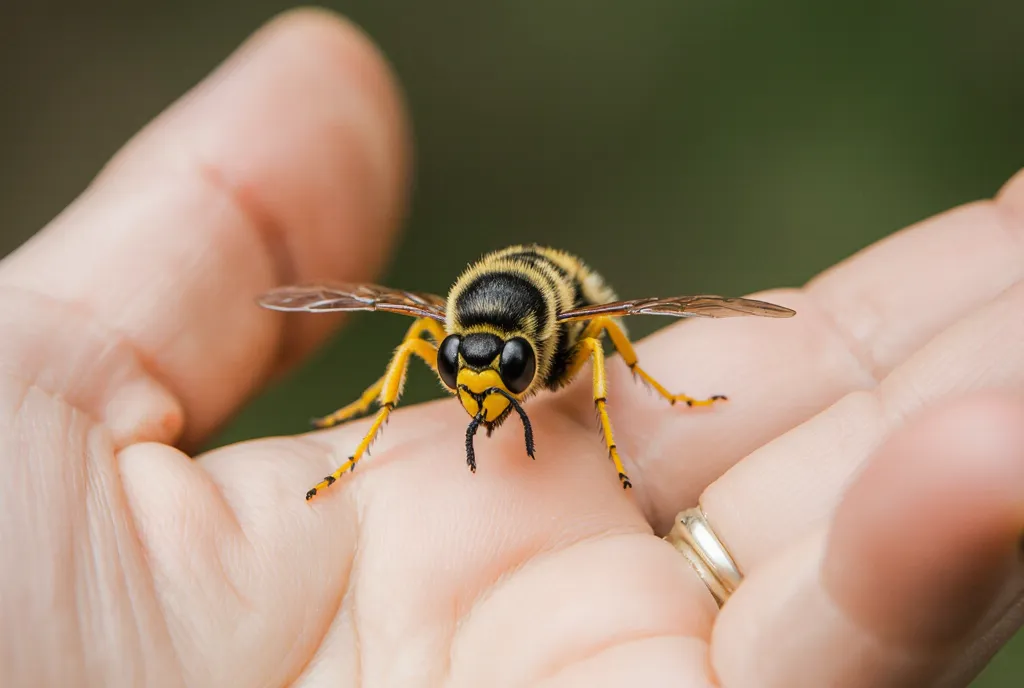
Quick Summary: Killing a yellow jacket queen in early spring prevents an entire colony from forming, potentially stopping thousands of workers from emerging later in summer. However, killing a queen during summer has minimal impact since the colony is already established with thousands of active workers. The timing matters significantly—spring queen elimination is most effective for population control.
The aftermath of killing a yellow jacket queen depends almost entirely on when it happens. And that timing difference? It’s the gap between preventing a colony of thousands versus making virtually no impact at all.
Here’s the thing though—yellow jackets don’t winter as entire colonies like honeybees do. According to Iowa State University Extension, only mated queens survive winter, while the rest of the colony dies off. This biological reality creates a critical window of opportunity.
The Spring Queen Elimination Window
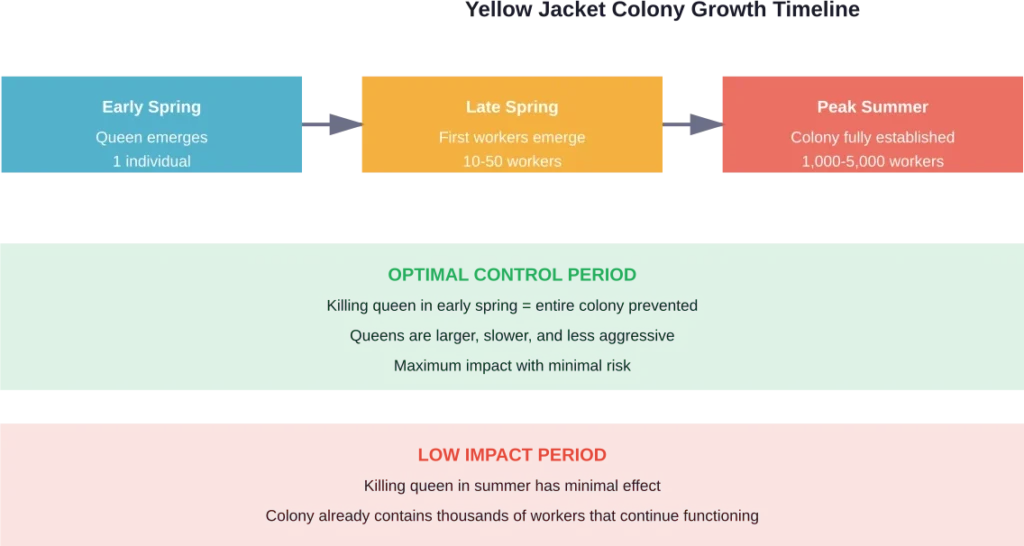
When you kill a queen yellow jacket in early spring, you’re essentially preventing an entire colony before it starts. Each queen that emerges from winter hibernation is searching for a suitable nesting site to establish her colony.
During this period, queens are noticeably larger and slower than the workers you’ll encounter later in summer. They’re also significantly less aggressive—focused on nest building rather than defending territory.
A single queen eliminated in spring prevents what could become a colony containing thousands of workers by late summer. The math is straightforward: one queen equals one potential nest.
What Happens When You Kill a Summer Queen
But wait. Killing a queen during peak summer season? That’s a completely different story.
By mid to late summer, the colony is already fully established with thousands of workers. The queen’s primary egg-laying function has largely been completed. Workers handle foraging, nest maintenance, and defense.
If you eliminate the queen at this stage, the colony doesn’t immediately collapse. Workers continue their routines for days or even weeks. The nest remains active and aggressive—potentially more so, since worker yellow jackets can become increasingly defensive when colony structure is disrupted.
The colony will eventually die out since no new workers are being produced, but you’re not preventing the nuisance that already exists. Those thousands of workers will continue stinging, foraging, and creating problems until cold weather naturally eliminates them.
Species-Specific Nesting Behavior
Michigan State University identifies two common yellow jacket species with distinct nesting preferences. The German Yellowjacket (Vespula germanica) commonly nests in wall voids, attics, and crawlspaces. The Eastern Yellowjacket (Vespula maculifrons) typically builds ground nests.
This matters because killing a queen who’s already established a nest in your wall cavity means dealing with the structural issue regardless. The nest remains, and if other queens are searching for sites the following spring, that same location might prove attractive again.
| Species | Preferred Nest Location | Colony Size | Aggression Level |
|---|---|---|---|
| German Yellowjacket | Wall voids, attics, enclosed spaces | 1,000-5,000 workers | Highly defensive |
| Eastern Yellowjacket | Underground burrows | 1,000-4,000 workers | Very aggressive when disturbed |
| Spring Queens (all species) | Searching for sites | Solo individuals | Low aggression |
The Danger Factor You Can’t Ignore
Real talk: attempting to kill yellow jackets carries significant risk. According to CDC data, deaths from hornet, wasp, and bee stings have ranged from 43 to 89 annually in recent decades, with approximately 80% occurring among males.
North Dakota State University Extension notes that yellowjackets can sting repeatedly because their stinger remains with the insect—unlike honeybees. Each sting injects venom, and disturbing a queen near her developing nest can trigger defensive behavior.
According to Scout’s Pest Control, documented cases exist of severe reactions to repeated yellow jacket stings. The risk escalates dramatically when dealing with established colonies versus individual spring queens.
Why Professional Control Makes Sense
Scout’s Pest Control emphasizes that homeowners should not attempt yellow jacket nest removal themselves. The dangers compound when nests are located in hard-to-reach areas—wall voids, underground, or high in trees.
Professionals have protective equipment, appropriate treatments, and experience identifying nest locations. They can also determine whether you’re dealing with a newly founding queen or an established colony, adjusting the approach accordingly.
For spring queen control, some property owners successfully trap individual queens using specialized traps. This approach works for preventing colony establishment without the risks of direct contact or nest destruction.
The Long-Term Population Impact
Various online forums and community discussions reveal mixed perspectives on queen elimination ethics. Some view aggressive spring queen control as preventive pest management. Others question the ecological impact.
Yellow jackets do serve ecological roles—they’re predators of other insects and can help control pest populations. However, when nesting near human structures and activity areas, they create legitimate safety concerns.
The practical reality? Killing individual spring queens on a residential property has localized impact. Other queens will continue establishing nests in the surrounding area. Consistent annual spring control can reduce the specific nest density on a property, but it’s not eradicating the species from the ecosystem.
Frequently Asked Questions
It depends on timing. Killing a queen in early spring prevents the colony from ever forming. Killing a queen in summer means the existing workers continue functioning for weeks, though the colony won’t produce new workers and will eventually decline.
Early spring offers the optimal window, typically March through early May depending on climate. Queens are searching for nest sites, are larger and slower, and haven’t yet established colonies. One queen eliminated equals one entire colony prevented.
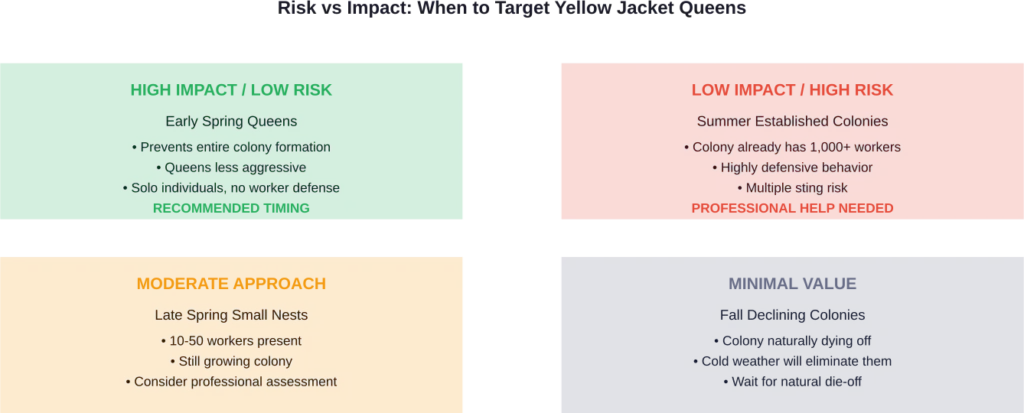
Spring queens pose relatively low risk since they’re solo and less aggressive. However, yellow jackets can sting repeatedly, and some individuals have severe allergic reactions. If the queen is near a developing nest with workers present, the danger increases substantially.
Yes, workers can survive and remain active for days to weeks after the queen dies. The colony doesn’t immediately collapse. Workers continue foraging and defending the nest, though no new workers are produced to replace those that die naturally.
A single queen can establish a colony containing 1,000 to 5,000 workers by late summer, depending on the species and environmental conditions. German and Eastern Yellowjackets commonly reach these population levels in established nests.
Queens that enter homes in early spring are typically seeking shelter or accidentally wandered indoors. Safely removing them prevents potential indoor nesting. If you’re uncertain about the situation or uncomfortable handling it, contact a pest control professional.
No, individual queens don’t reuse nest sites. However, favorable locations may attract different queens in subsequent years. Old nests aren’t reoccupied, but the same wall void or ground area might seem appealing to new queens searching for sites.
Making the Right Decision
The impact of killing a yellow jacket queen hinges on timing and circumstances. Spring elimination provides maximum preventive value with minimal risk. Summer intervention against established colonies offers little benefit and considerably more danger.
For property owners dealing with recurring yellow jacket problems, focusing control efforts on early spring queens makes strategic sense. Trapping or eliminating individual founding queens prevents the thousands of workers that would otherwise emerge by summer.
That said, safety comes first. If you’re uncertain about the situation, dealing with a nest that’s already formed, or uncomfortable with the risks, professional pest control services have the expertise and equipment to handle yellow jackets safely and effectively. The cost of professional service is minimal compared to the medical expenses from severe sting reactions.