
Quick Summary: Skipping necessary stitches can lead to serious complications including prolonged healing time, increased infection risk, excessive scarring, and potential wound reopening. Deep cuts, wounds with gaping edges, cuts that won’t stop bleeding after 10 minutes, or injuries on the face, hands, or joints typically require professional closure within 24 hours to prevent these risks.
You’re slicing vegetables in the kitchen when the knife slips. Blood starts flowing, and you grab a towel to apply pressure. Ten minutes later, you’re staring at the cut wondering: do I really need stitches, or can I just bandage this at home?
It’s a question thousands of people face every day. The answer matters more than you might think.
Stitches—medically called sutures—do more than just close a wound. They’re a critical part of proper healing that can prevent complications ranging from minor scarring to life-threatening infections. But what actually happens when you skip them?
Understanding When a Cut Needs Stitches
Not every cut requires professional medical closure. Minor scrapes and shallow cuts often heal perfectly fine on their own with basic first aid. The problem comes when deeper lacerations don’t get the treatment they need.
According to the American Academy of Family Physicians, it’s generally recommended to close wounds within 18 to 24 hours of injury. Clean lacerations involving well-vascularized tissue, such as the face and scalp, can be closed successfully even later in healthy patients, although risk of complications increases with time.
Signs Your Cut Needs Professional Closure
Several clear indicators suggest a wound needs stitches. Bleeding that doesn’t stop after applying firm pressure for 10 minutes is a red flag. If blood soaks through multiple bandages or continues flowing steadily, that’s your body telling you the wound is too significant for home treatment.
Depth matters significantly. When you can see yellow fatty tissue or deeper structures beneath the skin, the cut has penetrated beyond the superficial layers. These wounds won’t heal properly without professional intervention.
Gaping edges present another concern. If the wound edges pull apart naturally or you can see into the cut, it’s too wide to close on its own. The skin needs to be brought together to heal correctly.
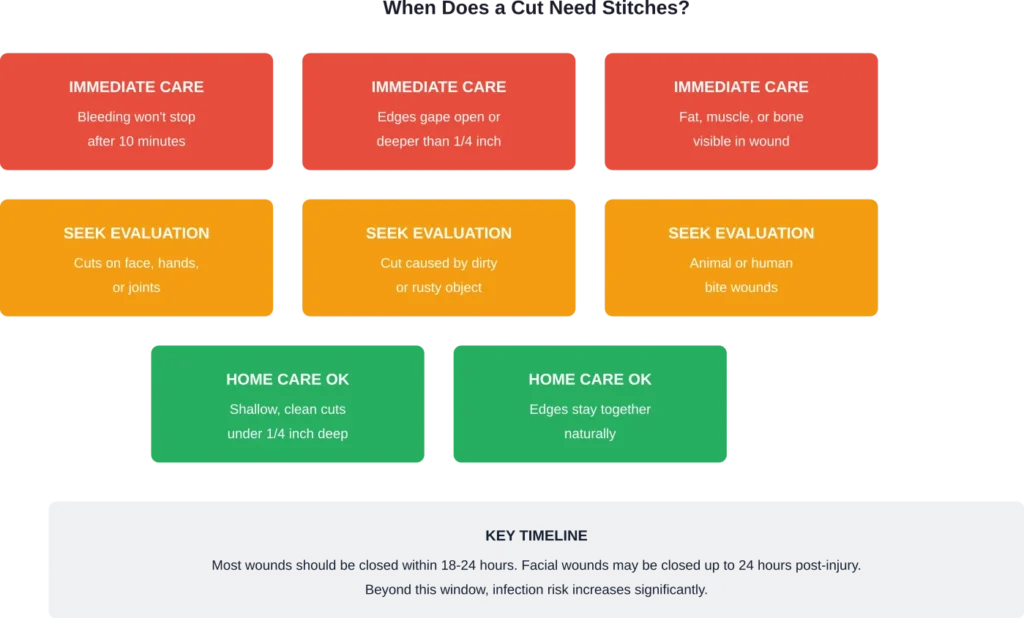
Location also determines urgency. Cuts on the face demand professional attention for cosmetic reasons—even relatively minor facial lacerations can leave noticeable scars without proper closure. Injuries on hands, feet, or genitals are vulnerable to infection and require medical evaluation. Wounds over joints need careful treatment because movement can prevent proper healing.
The Consequences of Skipping Necessary Stitches
Here’s where things get serious. When a wound that needs stitches doesn’t get them, several complications become likely. None of them are pleasant.
Prolonged Healing Time
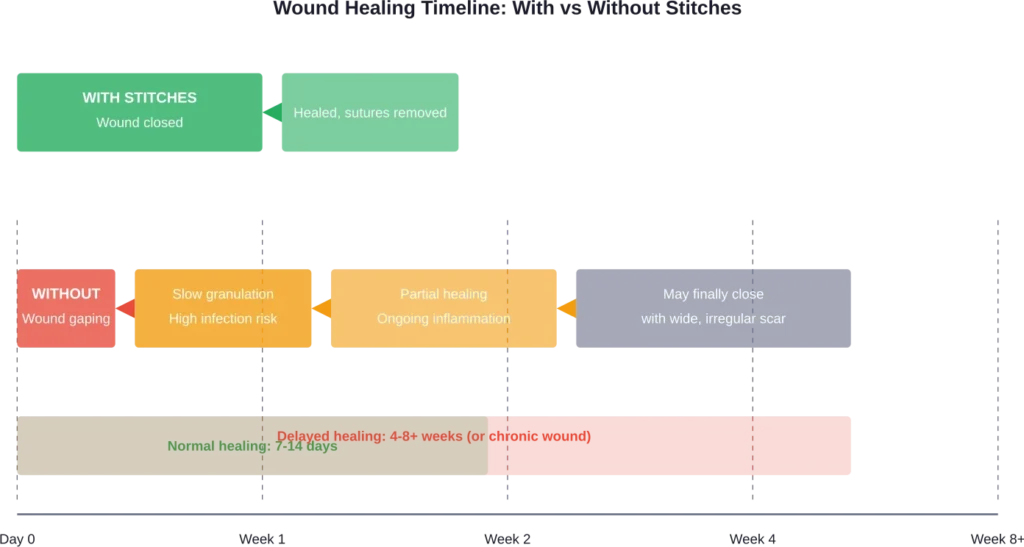
Wounds heal from the bottom up and from the edges inward. A gaping wound has much more distance to cover. What might heal in 7-10 days with proper closure can take weeks or even months without it.
During this extended healing period, the wound remains vulnerable. Every day it stays open is another day for potential complications.
Significantly Increased Infection Risk
This is the most dangerous complication. Open wounds provide a direct pathway for bacteria to enter the body. According to MedlinePlus, signs of infection include increasing pain, redness spreading from the wound, warmth around the area, pus or cloudy drainage, and fever of 100°F (37.7°C) or higher for more than 4 hours.
The CDC emphasizes the importance of proper wound care in preventing serious infections. Some bacteria, like those causing sepsis, can spread through the bloodstream and become life-threatening. Medical research on delayed wound closure has found that immediate closure of carefully selected wounds is safe and is associated with a lower infection rate compared with delayed primary closure.
Infections don’t just delay healing—they can cause permanent damage. In severe cases, untreated wound infections can lead to sepsis, a condition where the body’s response to infection causes widespread inflammation and organ damage.
Excessive Scarring and Keloid Formation
The wound healing research published in Advances in Wound Care notes that scarring constitutes a major burden on the healthcare system. Children are particularly affected and can suffer from long-term physical dysfunction and psychological harm from scars.
Without stitches, wounds typically heal with wider, more irregular scars. The skin forms scar tissue to bridge the gap, but this process is haphazard when edges aren’t properly aligned. Some people develop keloids—raised, thick scars that extend beyond the original wound borders.
Facial scars present obvious cosmetic concerns, but scars on joints can restrict movement. Scar tissue lacks the flexibility of normal skin, potentially limiting range of motion permanently.
Wound Dehiscence (Reopening)
A wound that appears to be healing can suddenly split open again, especially if it’s located where skin experiences tension from movement. This is called dehiscence, and it resets the healing clock back to zero—or worse, because reopened wounds often have damaged tissue that’s even harder to repair.
Wounds over joints are particularly prone to this problem. Every time the joint bends, it pulls at the healing tissue. Without stitches to reinforce the closure, the fragile new skin can’t withstand the stress.
Comparing Healing Outcomes
| Aspect | With Proper Stitches | Without Stitches (When Needed) |
|---|---|---|
| Healing Time | 7-14 days typical | 3-8 weeks or longer |
| Infection Risk | Low (under 5% for clean wounds) | Significantly elevated |
| Scar Width | Minimal, edges aligned | Wide, irregular appearance |
| Wound Reopening | Rare with proper care | Common, especially over joints |
| Pain During Healing | Moderate, decreasing steadily | Prolonged discomfort |
| Functional Impact | Minimal mobility restriction | Potential long-term limitations |
The Critical Time Window
Timing matters enormously. The American Academy of Family Physicians notes that while there’s discussion about a “golden period” for safe repair, studies suggest that depending on the type of wound, it may be reasonable to close even 18 or more hours after injury for clean wounds.
That said, sooner is always better. Bacteria begin colonizing wounds immediately. The longer a wound stays open, the higher the contamination level and infection risk.
For facial wounds, the window extends longer than other body areas due to excellent blood supply, with successful closure possible up to 24 hours post-injury.
What Happens After the Window Closes
If you miss the optimal closure window, medical professionals may opt for delayed primary closure or allow the wound to heal by secondary intention (naturally, without closure). This decision depends on contamination level and infection signs.
Wounds left to heal naturally take significantly longer and produce more prominent scarring. In some cases, surgical scar revision becomes necessary later—a procedure that could have been avoided with timely initial treatment.
Special Considerations for High-Risk Wounds
Animal and Human Bites
Bite wounds carry particularly high infection risk. Human mouths contain numerous bacteria, and animal bites can introduce pathogens that cause serious diseases. These wounds often require special handling—immediate cleaning, antibiotics, and sometimes delayed closure to prevent trapping infection inside.
Contaminated Wounds
Cuts from dirty or rusty objects need thorough professional cleaning before closure. Simply stitching a contaminated wound closed traps bacteria inside, virtually guaranteeing infection. Medical professionals irrigate these wounds extensively and may prescribe prophylactic antibiotics.
According to the CDC, proper wound irrigation and cleaning are the most important aspects of treating minor wounds. There’s no evidence that antiseptic irrigation is superior to sterile saline or tap water for this purpose.
Wounds in Diabetics or Immunocompromised Patients
People with diabetes or weakened immune systems face amplified risks from untreated wounds. Their bodies struggle to fight infections, and healing proceeds more slowly. What might be a minor complication in a healthy person can become a medical emergency for someone with compromised immunity.
Research on complex wound management notes that metabolic disorders such as diabetes mellitus represent systemic factors that complicate healing. It is estimated that 1 to 3% of the health care expenses in developed countries go for complex wound management.
When Home Care Is Actually Appropriate
Not every cut requires a trip to urgent care. Minor wounds that are shallow (less than 1/4 inch deep), have edges that naturally stay together, and stop bleeding within a few minutes can heal well with proper home treatment.
Clean these wounds immediately with running water. Soap around the edges is fine, but avoid getting it directly in the wound. Pat dry gently and apply an antibiotic ointment. Cover with a clean bandage and monitor for signs of infection.
Change the dressing daily and whenever it gets wet or dirty. The wound should show steady improvement—less redness, less pain, and gradual closure of the edges.
Proper First Aid Before Medical Treatment
If you determine a wound needs stitches, proper first aid during those crucial first minutes matters. Apply firm, direct pressure with a clean cloth for at least 10 minutes without peeking. Constant pressure is key—repeatedly checking interrupts clot formation.
Elevate the injured area above heart level if possible. This reduces blood flow to the wound and helps control bleeding.
Don’t use hydrogen peroxide or alcohol directly in the wound. According to the American Academy of Family Physicians, these substances can damage tissue and actually impair healing. Gentle irrigation with clean tap water is sufficient initially.
If bleeding soaks through the first cloth, don’t remove it—add another layer on top and continue pressure. Removing the initial cloth disrupts clotting.
Understanding Suture Types and Removal
Medical professionals choose from several closure methods depending on the wound. Traditional stitches (sutures) work well for most lacerations. Tissue adhesives are suitable for low-tension areas with clean, easily approximated edges. Surgical staples are common for scalp wounds.
| Body Location | Typical Removal Time |
|---|---|
| Face | 3-5 days |
| Scalp | 7-10 days |
| Arms and legs | 7-10 days |
| Joints | 10-14 days |
| Back or chest | 7-10 days |
These timelines reflect how quickly different body areas heal. Facial wounds heal faster due to excellent blood supply, allowing earlier suture removal to minimize scarring. Joints need longer reinforcement because movement constantly stresses the healing tissue.
Long-Term Implications
Decisions made in the hours after an injury can have consequences lasting years or even a lifetime. According to research published in Advances in Wound Care, the global chronic wound care market has been valued at nearly $20 billion in recent years and is projected to exceed $30 billion in the next 5 years. The global scar treatment market represents additional billions.
These numbers reflect the substantial biomedical burden of both under-healing and over-healing. Chronic wounds that never properly close create ongoing medical costs and reduced quality of life. Excessive scarring can require multiple revision surgeries and still leave permanent marks.
For children especially, scarring from inadequately treated wounds can cause long-term psychological impacts alongside physical limitations. A scar that might seem minor to an adult can profoundly affect a child’s self-image as they grow.
Frequently Asked Questions
Generally, wounds should be closed within 18 to 24 hours of injury. Clean facial wounds may be acceptable for closure up to 24 hours post-injury. Beyond these windows, infection risk increases significantly and medical professionals may opt for delayed closure or allowing natural healing. The sooner treatment is received, the better the outcome.
A deep cut can eventually heal without stitches, but not well. Deep wounds that aren’t closed properly take weeks or months to heal instead of days, carry high infection risk, and typically leave wide, irregular scars. Wounds deeper than 1/4 inch or where fat or deeper tissue is visible should receive professional evaluation for proper closure.
Watch for increasing pain rather than improvement, redness spreading away from the wound edges, warmth around the area, pus or cloudy drainage, red streaks extending from the wound, swelling, and fever of 100°F (37.7°C) or higher for more than 4 hours. Any of these signs warrant immediate medical attention, as infections can spread rapidly.
Yes, almost always. Stitches hold wound edges in precise alignment while healing occurs, resulting in a thin, straight scar. Without closure, the body must fill the gap with scar tissue, creating a wider, more irregular appearance. Facial wounds are particularly susceptible to poor cosmetic outcomes without proper closure.
Possibly, depending on the wound type and contamination level. Clean wounds with minimal contamination may still be suitable for closure 18-24 hours after injury. However, the risk of complications increases with every hour of delay. Contact a healthcare provider promptly to evaluate whether delayed closure is appropriate for your specific situation.
Yes. Tissue adhesives (medical glue) work well for low-tension wounds with straight edges that approximate easily. Adhesive strips can close minor lacerations. Surgical staples are common for scalp wounds. Each method has specific applications, and healthcare providers select the most appropriate based on wound location, depth, and tension.
The initial numbing injection causes temporary discomfort, but once anesthesia takes effect, the stitching procedure is painless. A properly closed wound typically hurts less during healing than an open wound because tissue isn’t constantly being pulled and irritated. Open wounds often throb and cause prolonged discomfort throughout the extended healing period.
Making the Right Decision
When you’re standing there with a bleeding cut, the decision feels overwhelming. But the guidelines are actually straightforward.
If bleeding doesn’t stop with 10 minutes of pressure, if you can see into the wound, if edges gape open, or if the cut is on your face, hands, feet, or over a joint—seek medical care. Don’t gamble on infection, scarring, or chronic wounds to avoid an urgent care visit.
For minor cuts that are shallow with edges that naturally stay together, proper home care works fine. Clean thoroughly, apply antibiotic ointment, bandage, and monitor closely for any signs of problems.
The short-term inconvenience of getting stitches pales compared to dealing with complications from wounds that needed closure but didn’t get it. Infections can turn dangerous. Scars can become permanent sources of self-consciousness. Healing that should take days can drag on for months.
Your body is remarkably good at healing—but deep wounds need help. Stitches provide that help, holding tissue in place while your body does its repair work. Skipping them when they’re needed doesn’t save time or trouble. It creates both.
When in doubt, get evaluated. Healthcare professionals can assess the wound properly and recommend the best treatment approach. Most urgent care centers can handle straightforward lacerations without the cost or wait time of emergency rooms. The peace of mind—and the better healing outcome—makes that visit worthwhile.