
Quick Summary: Missing a court date can result in a bench warrant for your arrest, criminal charges for failure to appear, additional fines, and suspension of your driver’s license. Courts treat missed appearances seriously, but immediate action—contacting the court, filing a motion to continue, or seeking legal help—can mitigate consequences and potentially recall warrants.
Ever felt that sinking feeling when you realize you’ve missed something important? Now multiply that by a thousand. That’s what happens when a court date slips by.
Missing a court appearance isn’t like skipping a dentist appointment. The legal system doesn’t send polite reminder emails or reschedule without consequence. Judges issue warrants. Courts add charges. And what started as a minor traffic ticket can snowball into something far more serious.
The good news? Understanding what happens next—and acting fast—can make all the difference between a minor setback and a major legal crisis.
Immediate Consequences of Missing a Court Date
The moment a scheduled court date passes without an appearance, the legal machinery starts moving. And it doesn’t wait around.
Bench Warrants Explained
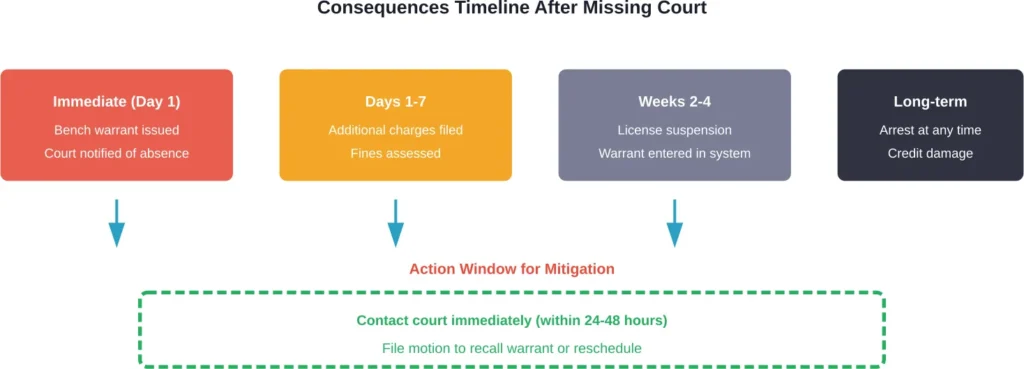
A bench warrant is the most common immediate consequence. This court order authorizes law enforcement to arrest the person who failed to appear and bring them before the judge.
Unlike arrest warrants issued for criminal activity, bench warrants stem directly from court non-compliance. They remain active indefinitely until addressed—meaning the warrant doesn’t expire or disappear with time.
Law enforcement can execute bench warrants during routine traffic stops, at home, or at work. There’s no statute of limitations on these warrants.
Criminal Charges for Failure to Appear
Missing court doesn’t just bring a warrant. In many jurisdictions, it constitutes a separate criminal offense.
According to data from the Illinois court system, failure to appear can be charged as a Class C misdemeanor, punishable by fines up to $500 and potential jail time up to 30 days. This means the original charge now has a companion offense.
For more serious cases—felony hearings or criminal trials—failure to appear itself becomes a more severe charge. The stakes escalate proportionally with the gravity of the original case.
Ex Parte Judgments in Civil Cases
Civil court absences trigger different but equally problematic consequences. When a defendant doesn’t show up, judges often issue ex parte judgments—rulings made without the absent party’s input.
This typically means automatic loss. The plaintiff wins by default, and the absent party forfeits the right to contest the matter or present a defense.
Additional Legal Penalties and Complications
The warrant itself is just the beginning. Missing court sets off a cascade of secondary problems that compound quickly.
Driver’s License Suspension
For traffic-related court dates, many states automatically suspend driving privileges when someone fails to appear. This happens even if the original ticket was minor.
Illinois Legal Aid data shows that Chicago can boot vehicles if a driver accumulates three or more unpaid traffic tickets, or two or more unpaid tickets over a year old. Once booted, the vehicle owner has just 24 hours to either pay all outstanding fines or face impoundment.
Driving on a suspended license becomes another criminal offense—creating yet another legal problem.
Bond Forfeiture and Revocation
Anyone released on a personal recognizance bond or bail has a legal obligation to appear. Missing court violates that agreement.
Courts immediately revoke the bond and order the full bail amount forfeited. For cash bonds, that money is gone. For bail bondsmen arrangements, the bondsman can legally apprehend the person and return them to custody.
Increased Fines and Court Costs
According to the Central Violations Bureau, which processes federal tickets, returned or reversed payments incur a $53 fee. Fines exceeding $2,500 accrue interest when in default.
State and local courts similarly add administrative fees, late charges, and penalty assessments for missed appearances. A $150 traffic fine can balloon to $500 or more with these additions.
| Type of Case | Warrant Type | Additional Charges | Financial Impact |
|---|---|---|---|
| Traffic Ticket | Bench Warrant | Class C Misdemeanor | Fines up to $500 + original ticket |
| Misdemeanor Criminal | Bench Warrant | Failure to Appear (Misdemeanor) | Additional jail time + fines |
| Felony Criminal | Arrest Warrant | Failure to Appear (Felony) | Bond forfeiture + separate felony charge |
| Civil Lawsuit | N/A | Default Judgment | Full judgment amount + court costs |
What to Do Immediately After Missing Court
Panic won’t help. Action will. Here’s what needs to happen right away.
Contact the Court Directly
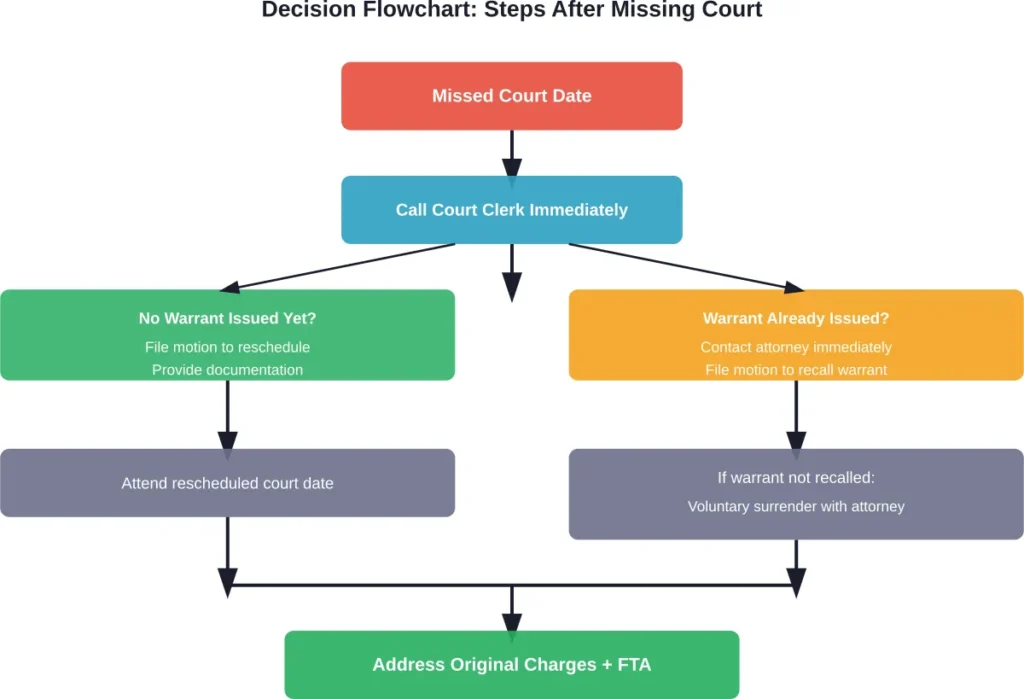
Call the court clerk’s office the same day if possible. Explain the situation honestly and ask about options for addressing the missed date.
Some courts allow administrative recalls of bench warrants if contact happens quickly and the reason for absence was legitimate. But this window closes fast—usually within 24 to 48 hours.
Ask specifically whether a warrant has been issued and if there’s a process to recall it before arrest.
File a Motion to Continue or Reschedule
Most jurisdictions allow defendants to file a formal motion explaining why they missed court and requesting a new date. This motion must include:
- Valid reason for the absence (medical emergency, miscommunication, etc.)
- Supporting documentation (doctor’s notes, proof of emergency, etc.)
- Request to recall any issued warrant
- Proposed new court date
Filing doesn’t guarantee the judge will grant the request, but it demonstrates good faith and responsibility.
Consult a Criminal Defense Attorney
Legal representation makes a tangible difference in these situations. Attorneys can:
- File motions on behalf of the client
- Negotiate with prosecutors for reduced charges
- Appear in court to request warrant recalls
- Navigate local court procedures efficiently
Many defense lawyers offer free consultations to assess the situation and provide initial guidance.
Turn Yourself In (When Necessary)
If a warrant has been issued and can’t be recalled administratively, voluntarily surrendering is often the smartest move.
This demonstrates responsibility to the court and typically results in better treatment than being arrested at a traffic stop or at home. Coordinating with an attorney before surrendering ensures proper representation from the start.
Special Circumstances and Exceptions
Not all missed court dates are treated equally. Context matters.
Immigration Court Absences
According to Department of Justice policy, missing removal proceedings results in an in absentia order—essentially a deportation order issued without the immigrant present.
These orders can be reopened through motions showing exceptional circumstances: lack of notice, serious illness, or other reasons beyond the person’s control. But the burden of proof is high, and deadlines are strict.
Legitimate Emergencies
Courts do recognize genuine emergencies: hospitalization, family death, natural disasters, or situations truly beyond someone’s control.
Documentation is critical. Hospital admission records, death certificates, or police reports provide the evidence courts need to excuse absences and reschedule without penalty.
Lack of Proper Notice
Sometimes people miss court because they never received proper notification. Wrong address, clerical errors, or mail problems can cause this.
If there’s proof the court notice never arrived, judges typically reschedule without sanctions. But the person must act quickly once they discover the missed date.
How to Prevent Missing Future Court Dates
Prevention beats cure every time. Simple systems prevent these problems entirely.
Calendar Systems and Reminders
Set multiple reminders: phone calendar, email alerts, physical calendar at home. Configure reminders for one week before, three days before, and the morning of the court date.
Treat court dates as unmovable appointments—more important than work meetings or social events.
Verify Court Date Details
When receiving a court notice, immediately verify:
- Exact date and time
- Courthouse location and courtroom number
- Type of hearing and what’s required
- Whether attendance is mandatory or optional
Call the court clerk if anything is unclear. Better to ask than assume.
Arrange Transportation in Advance
Transportation problems are common reasons for missed appearances. Plan the route ahead of time. Know where to park. Build in extra time for traffic.
For early morning court dates, consider staying nearby the night before if distance is a factor.
Understanding Court Scams and Warnings
Here’s something important: real courts never demand immediate payment over the phone to avoid arrest.
Multiple federal courts have issued warnings about scammers who call people claiming they missed federal court or jury duty and face arrest unless they pay immediately via Zelle, Venmo, or prepaid cards.
According to alerts from the U.S. District Court for the Middle District of North Carolina, the District of Arizona, and the Northern District of Florida, these calls are fraudulent. Courts send written notices through mail. They don’t call demanding instant payment.
Anyone receiving such calls should hang up and contact the court directly using publicly listed phone numbers—not numbers the caller provides.
Frequently Asked Questions
Yes. Missing court can result in jail time in two ways: arrest on the bench warrant itself, and criminal charges for failure to appear that carry their own jail sentences. For minor cases, jail time is less common if the person addresses the situation quickly. For serious criminal cases, extended jail time becomes much more likely.
Bench warrants remain active indefinitely until recalled by the court or executed by law enforcement. They don’t expire after a certain time period. This means someone could be arrested on a bench warrant years after it was issued, even during routine traffic stops.
If charged with failure to appear as a separate criminal offense and convicted, yes—that conviction becomes part of the permanent criminal record. The bench warrant itself doesn’t appear on criminal records, but arrests resulting from it do. Any conviction stemming from the missed court date creates a criminal history entry.
Yes, and this is strongly recommended. Contact the court clerk as soon as possible—ideally at least a week before the scheduled date. File a formal motion to continue that explains the reason for needing a new date. Courts are much more accommodating when people request changes proactively rather than simply not showing up.
In civil cases, the judge may dismiss the case entirely or reschedule depending on local rules and the reason for the absences. In criminal cases, if the defendant doesn’t appear, a warrant issues regardless of whether the prosecutor or witnesses appear. The defendant’s obligation to attend exists independently.
Not legally required in all cases, but strongly recommended. Attorneys can appear on behalf of clients in some jurisdictions, file motions to recall warrants, negotiate with prosecutors, and navigate procedures that non-lawyers find complicated. For serious cases or when a warrant has been issued, legal representation becomes critical.
Many jurisdictions offer online warrant searches through county sheriff or court websites. Calling the court clerk’s office also works. However, some warrants don’t appear in public databases immediately. Consulting with an attorney who can check through official legal channels provides the most reliable information.
Conclusion
Missing a court date triggers serious legal consequences that escalate quickly. Bench warrants, additional criminal charges, license suspensions, and financial penalties compound the original problem.
But the situation isn’t hopeless. Immediate action—contacting the court, filing appropriate motions, and seeking legal counsel—can mitigate damage and prevent arrest. Courts recognize legitimate emergencies and reward proactive responsibility.
The absolute worst response is ignoring the problem. Warrants don’t disappear. They wait silently in the system until the next traffic stop, background check, or law enforcement encounter.
If a court date has been missed, act today. Contact the court, consult an attorney, and address the situation head-on. The faster the response, the better the outcome.