
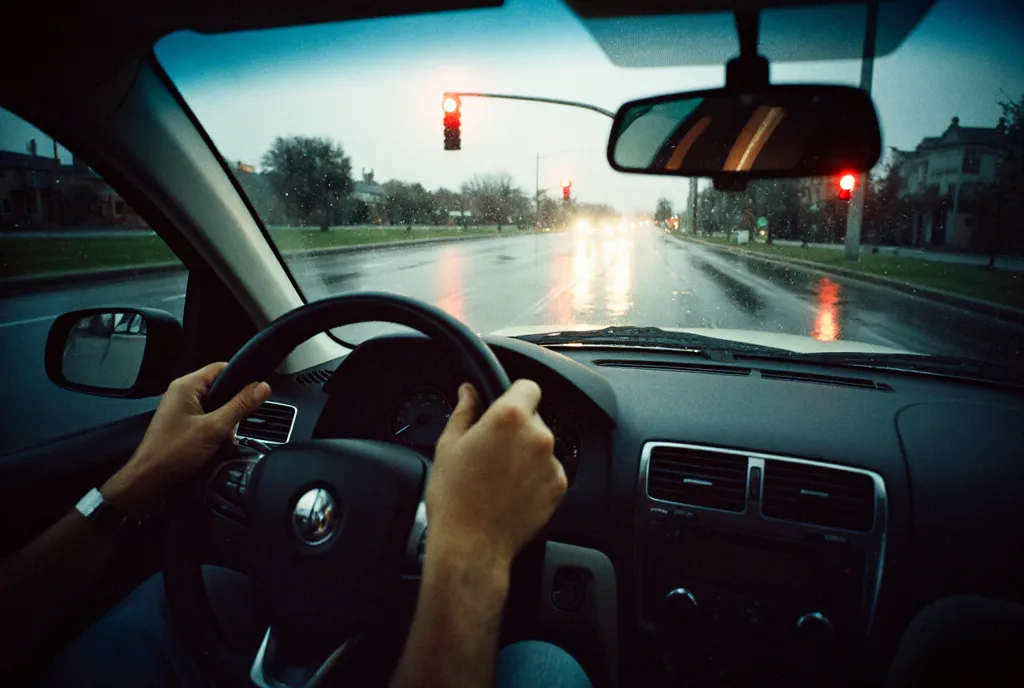
Quick Summary: Running a red light can result in fines up to $250, two demerit points on your driving record, increased insurance rates, and potential license suspension. According to IIHS, red light running crashes killed 1,086 people in 2023. Consequences vary by state and whether the violation was caught by a camera or police officer.
That sinking feeling when you realize you just blew through a red light? It happens. Maybe the light turned faster than expected, or you misjudged the yellow. Whatever the reason, the consequences are real and can hit your wallet hard.
Red light violations aren’t just about money. According to the Insurance Institute for Highway Safety, 1,086 people were killed in crashes involving red light running in 2023 alone. These aren’t just statistics—they’re lives changed forever because someone didn’t stop.
So what actually happens after you run that light? The answer depends on several factors: how you got caught, where you live, and whether this is your first offense.
The Immediate Consequences of Running a Red Light
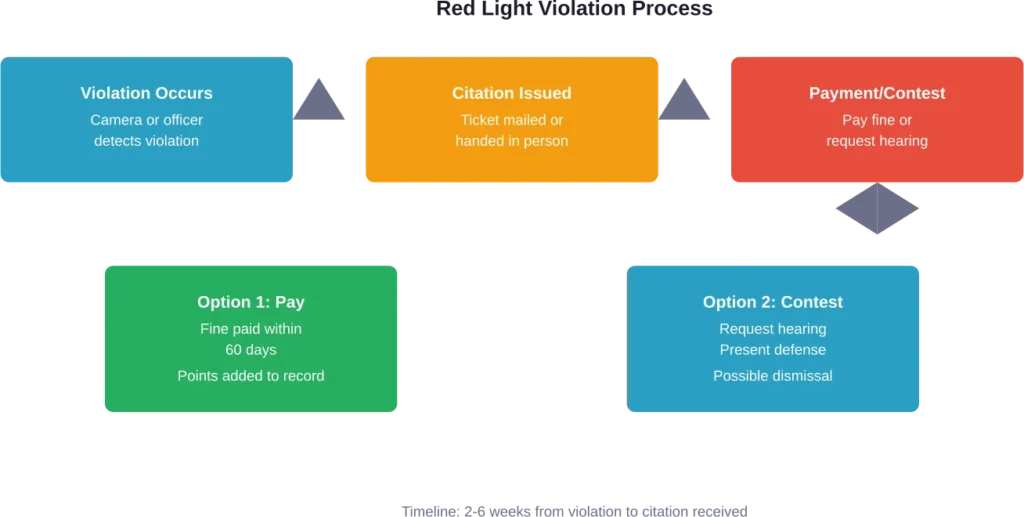
When you run a red light, enforcement happens one of two ways: a police officer pulls you over, or a red light camera captures your violation. Each triggers a different process.
Police stops result in immediate interaction. The officer issues a citation on the spot, and you’ll know right away what you’re facing. Photo radar citations work differently—they arrive by mail weeks later, often catching drivers by surprise.
Here’s the thing though—not receiving a ticket doesn’t mean you’re off the hook. Processing delays can take weeks, and according to legal sources, some jurisdictions charge processing fees up to $100 just for handling the paperwork.
How Red Light Cameras Actually Work
A study conducted at five busy intersections in Fairfax, Virginia found that a motorist ran a red light every 20 minutes on average. That frequency explains why red light safety cameras have become so common.
These cameras trigger when sensors detect a vehicle entering an intersection after the light turns red. They capture multiple photos: your license plate, your vehicle in the intersection, and sometimes even the driver’s face.
The violation gets mailed to the registered owner’s address. This is why keeping your registration current matters—you might miss important notices otherwise.
Financial Penalties: What You’ll Actually Pay
The base fine is just the starting point. Typically, red light violations carry a maximum fine of $250 in most states. But that number doesn’t tell the whole story.
Processing fees, court costs, and surcharges pile on. Some jurisdictions add administrative fees that can reach $100 alone. The final bill often ends up significantly higher than the base fine.
Then there’s insurance. Red light tickets signal risky behavior to insurers, and they respond by raising your rates. Those increases can persist for three to five years, potentially costing hundreds or thousands more than the original fine.
State-by-State Variation
Penalties differ dramatically depending on where the violation occurs. Arizona typically caps fines at $250 plus surcharges, while other states impose different amounts.
Some states treat camera tickets differently than officer-issued citations. Camera tickets might carry lower fines but the same points, or vice versa.
| Penalty Type | Typical Range | Long-term Impact |
|---|---|---|
| Base Fine | $100-$250 | One-time payment |
| Processing Fees | $50-$100 | One-time payment |
| Demerit Points | 2 points | Remains on record 3-11 years |
| Insurance Increase | 10-30% premium hike | 3-5 years of higher rates |
| Traffic School | $50-$150 | May prevent point assessment |
Points on Your Driving Record
Two demerit points typically get added to your record for a red light violation. Doesn’t sound like much, right?
But here’s where it gets interesting. Points accumulate. Get enough violations within a short period, and you’re looking at license suspension.
According to Virginia DMV data, different thresholds trigger different consequences. Accumulate 10-11 points and face a 90-day suspension. Hit 12 or more points, and that suspension extends.
Points also stick around. The conviction stays on your DMV record for years—the exact duration varies by state, ranging from three to eleven years depending on the violation severity and location.
How Points Affect Insurance Rates
Insurance companies don’t care about your excuses. They see points as risk indicators and price accordingly.
A single red light violation marks you as a higher-risk driver. Insurers might raise your premiums by 10 to 30 percent, and those increases compound over multiple policy periods.
Some drivers see their rates jump immediately at renewal. Others might not notice until they shop for new coverage and discover they no longer qualify for good driver discounts.
The Safety Reality Behind Red Light Running
Real talk: this isn’t just about fines and points. People die because of red light running.
IIHS research shows 1,086 fatalities in 2023 from crashes involving red light running. That’s roughly three people every single day.
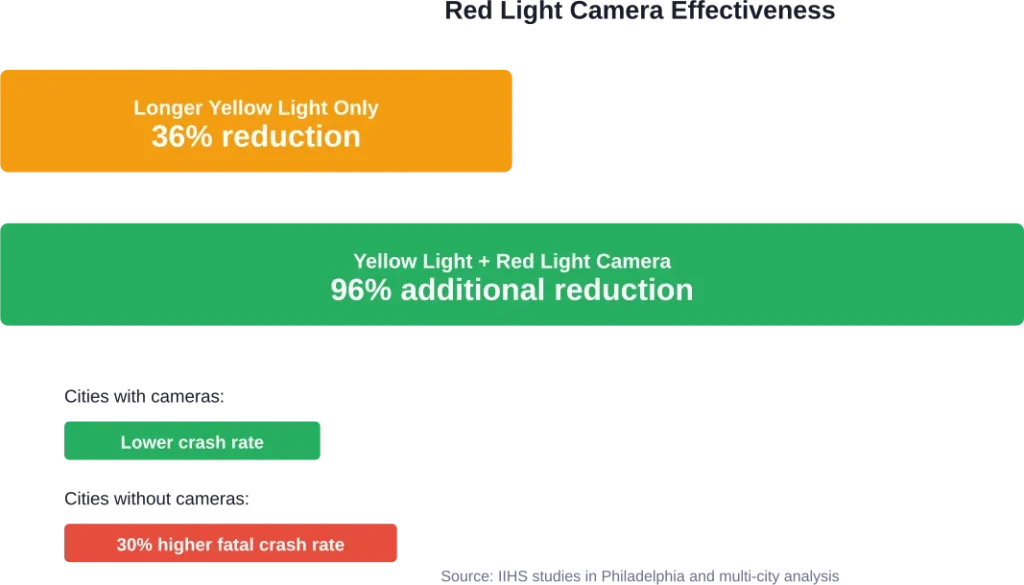
Red light safety cameras exist because enforcement works. An IIHS study in Philadelphia demonstrated that longer yellow lights reduced violations by 36 percent. Adding cameras boosted that reduction by another 96 percent.
The numbers get even more compelling when looking at cities that removed cameras. According to IIHS research comparing 14 cities that ended camera programs with 29 cities that continued them, the fatal red-light-running crash rate was 30 percent higher in cities that turned cameras off.
Automatic Emergency Braking Changes the Equation
Technology is shifting how red light enforcement works. Automatic emergency braking systems are becoming standard in newer vehicles, and they’re making a difference.
According to IIHS research, these systems significantly reduce rear-end crashes—a common complaint about red light cameras. Critics long argued that cameras caused more rear-end collisions when drivers stopped abruptly. Autobrake technology is cutting that problem down.
The data shows that as more vehicles get equipped with this safety tech, red light cameras become even more effective overall by maintaining their primary benefit while reducing secondary crashes.
What to Do When You Get a Red Light Ticket
Got the citation in hand? You’ve got options, but the clock is ticking.
Most jurisdictions give you 60 days to respond. Miss that deadline, and things get worse—additional fines, potential license suspension, or even a warrant in some areas.
Option 1: Pay the Fine
Paying the ticket is admission of liability. The fine gets processed, points hit your record, and the conviction stays there for years.
This makes sense when the violation was clear-cut and fighting it would cost more time and money than it’s worth. But know what you’re accepting: points on your record and likely insurance increases.
Option 2: Request a Hearing
Contesting the ticket means requesting a hearing where you can present your defense. Valid defenses might include:
- Emergency situations that required running the light
- Signal malfunction or timing issues
- Unclear or obstructed traffic signals
- Mistaken identity or incorrect vehicle information
- Following too closely to an emergency vehicle
If you’re found liable at the hearing or the hearing doesn’t go your way, you’ll pay the fine plus any court costs. But if you win, the ticket gets dismissed with no points or insurance impact.
Option 3: Traffic School
Many jurisdictions allow traffic school to avoid points. You pay the fine plus the school fee, complete the course, and the points don’t hit your record.
Traffic school costs typically run $50 to $150 depending on the state and provider. That expense might seem annoying, but it’s cheap compared to years of higher insurance premiums.
Not everyone qualifies though. Repeat offenders or those with recent traffic school completions often can’t use this option.
Photo Radar Citations: A Different Animal
Photo radar tickets operate under different rules than traditional citations. The ticket gets mailed to the registered owner, not necessarily the driver.
This creates some interesting situations. If someone else was driving your car, you might have grounds for dismissal. But you’ll need to provide evidence or identify the actual driver.
Some jurisdictions treat photo radar as a civil violation rather than a criminal one, which changes the penalty structure. Civil violations might not add points but still carry fines.
The processing delay works both ways. You might not remember the incident clearly by the time the ticket arrives, making it harder to mount a defense. But it also means the evidence might be weaker—photos can be blurry, timestamps might be questionable.
Understanding Yellow Light Rules
Here’s what trips people up: when does a yellow light become a red light violation?
Generally speaking, entering an intersection on yellow is legal. The violation occurs when you enter after the light turns red. But that split-second timing is where most disputes happen.
Yellow light duration varies by intersection and is supposed to be calibrated based on approach speed and intersection size. Some drivers argue that improperly timed yellow lights create unfair violations.
Can you get ticketed for running a yellow? In most states, no—yellow means caution and prepare to stop, not that stopping is required. But deliberately accelerating through a yellow to beat the red can still result in a citation for reckless driving.
Special Cases: Right on Red and Left on Red
Right turns on red are legal in most states after coming to a complete stop, unless signs prohibit it. But violations include people turning right on red where it’s forbidden.
A complete stop means wheels stop moving, not just slowing down. Rolling through that right turn counts as running a red light, same two points and similar fines.
Left on red? That’s allowed in specific circumstances in some states—typically when turning from a one-way street onto another one-way street. It’s rare and heavily regulated.
Know your local rules. What’s legal in one state might be a violation in another.
When Red Light Running Causes an Accident
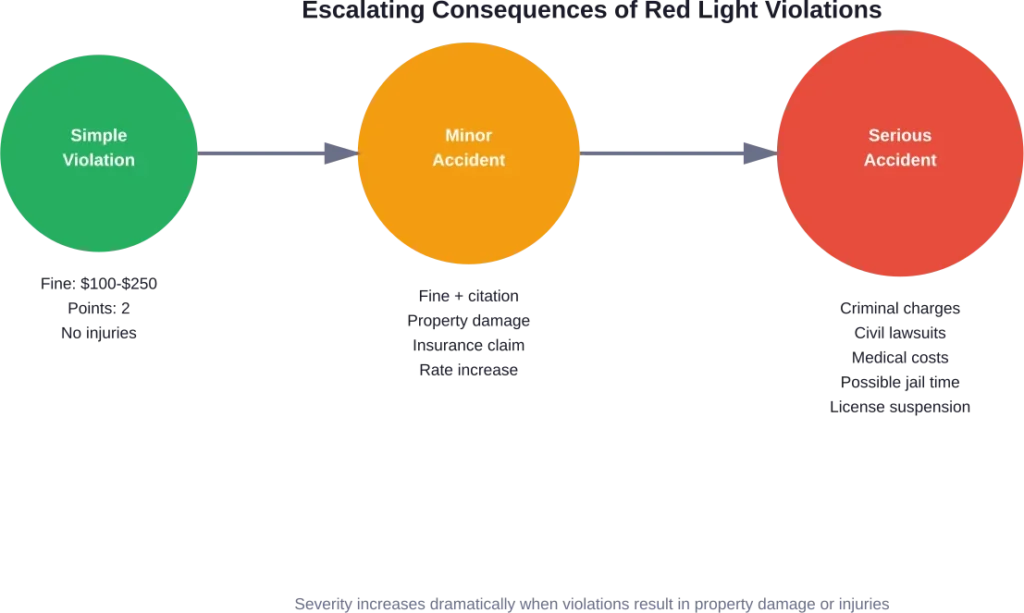
If running a red light leads to a crash, everything escalates. Beyond the traffic violation, you’re looking at potential civil liability for damages and injuries.
Property damage, medical bills, lost wages—all of that falls on the at-fault driver. Insurance might cover some costs, but serious accidents can exceed policy limits quickly.
Injuries or fatalities can result in criminal charges beyond the traffic violation. Reckless driving, vehicular assault, or even manslaughter charges become possible depending on circumstances.
The traffic ticket becomes the least of your worries when lawyers and injury claims enter the picture.
Multiple Violations and License Suspension
One ticket is manageable. Multiple violations in a short period? That’s when license suspension becomes real.
Point thresholds vary by state, but the pattern is similar everywhere. According to DC DMV data, accumulating 10-11 points triggers a 90-day suspension. Twelve or more points extends that suspension and may require completion of additional requirements before reinstatement.
Getting your license back after suspension isn’t automatic. Most states require paying reinstatement fees, completing driver improvement courses, and proving insurance coverage.
During the suspension period, driving anyway results in criminal charges that are far more serious than the original violations. That’s when fines jump into the thousands and jail time becomes possible.
How to Actually Avoid Running Red Lights
Prevention beats dealing with tickets. Some practical steps actually work:
Watch for stale green lights. If the light’s been green for a while as you approach, anticipate it changing. Start preparing to stop rather than speeding up.
Increase following distance. Tailgating the car ahead makes it harder to react when they brake for a yellow. More space means more reaction time.
Know high-enforcement areas. Red light cameras get installed at intersections with high violation rates. If you know where they are, you’ll be more cautious naturally.
Don’t rush yellows. That split-second you save isn’t worth the risk. If you’re not already in the intersection when it turns yellow, stop.
Eliminate distractions. Phone use, eating, or programming navigation while approaching intersections accounts for countless violations. Keep your attention on the road and signals.
Frequently Asked Questions
Red light tickets typically range from $100 to $250 for the base fine, but total costs including processing fees, court costs, and surcharges often exceed $300. Processing fees alone can add up to $100 in some jurisdictions. Insurance rate increases over the following three to five years represent the largest long-term cost, potentially adding hundreds to thousands of dollars in additional premiums.
This depends on state law and whether the violation is classified as a moving violation or civil infraction. In many states, camera tickets do add points to your driving record just like officer-issued citations, typically two points. Some jurisdictions treat camera violations as civil matters that result in fines but no points. Check your specific state’s laws, as treatment varies significantly.
Yes, you can contest any red light ticket by requesting a hearing. Valid defenses include emergency situations, signal malfunctions, unclear or obstructed signals, mistaken vehicle identity, or incorrect citation information. You’ll need to present evidence supporting your defense. If the hearing doesn’t go your way, you’ll pay the fine plus court costs, but successful defenses result in dismissal with no penalties.
Red light violations typically remain on your driving record for three to eleven years depending on the state. The conviction continues affecting your insurance rates for three to five years in most cases. Points may expire sooner than the conviction record itself. Virginia, for example, keeps certain violations on record for different durations based on the offense severity.
If no officer stopped you and no camera captured the violation, you likely won’t receive a citation. However, if a red light camera was present, expect a ticket to arrive by mail within two to six weeks. The citation goes to the registered owner of the vehicle. Not seeing a ticket immediately doesn’t mean you’re clear—processing delays are common with automated enforcement systems.
Red light violations typically add two demerit points to your driving record. These points accumulate with other violations, and reaching certain thresholds triggers license suspension. Accumulating 10-11 points generally results in a 90-day suspension, while 12 or more points can lead to longer suspensions and additional requirements before license reinstatement.
Many states allow drivers to complete traffic school to avoid point assessment for a red light violation. You typically still pay the fine plus the traffic school fee, which runs $50 to $150, but the points don’t appear on your record. This option usually isn’t available for repeat offenders or drivers who recently completed traffic school. Eligibility requirements vary by state and jurisdiction.
Final Thoughts
Running a red light carries consequences that extend far beyond the immediate fine. Two points on your record, insurance increases lasting years, and potential license suspension make even a single violation expensive.
The human cost matters more. Over a thousand people died in red light running crashes in 2023 according to IIHS data. Every violation represents a risk not just to you, but to everyone sharing the road.
If you’ve received a citation, you have options. Paying the fine is simplest but comes with long-term costs. Contesting the ticket or attending traffic school might make sense depending on your situation and driving record.
Better yet? Just stop at red lights. That extra few seconds isn’t worth the financial hit, the insurance headaches, or the risk to yourself and others. The light will turn green eventually.