
Quick Summary: Stopping levothyroxine abruptly can cause severe hypothyroid symptoms including fatigue, weight gain, depression, heart problems, and elevated cholesterol. Levothyroxine has a half-life of roughly seven days, with complete clearance taking four to six weeks; symptoms typically emerge within this timeframe as the medication leaves your system. In rare cases, sudden withdrawal can trigger life-threatening complications like myxedema coma, particularly in patients dependent on the medication for thyroid function.
An estimated 22 million patients received prescriptions for levothyroxine dispensed by U.S. outpatient retail and mail-order pharmacies in 2024, making it one of the most prescribed medications in the United States and other thyroid conditions. But what actually happens if you stop taking it?
The answer isn’t simple. It depends on why you’re taking levothyroxine in the first place, how long you’ve been on it, and what’s happening with your thyroid gland.
Here’s the thing though—stopping this medication isn’t like skipping a vitamin. Your thyroid hormones control nearly every metabolic process in your body. When those levels drop, the consequences can range from uncomfortable to dangerous.
Understanding Levothyroxine and Why People Take It
Levothyroxine is synthetic thyroxine (T4), the primary hormone your thyroid gland produces. When your thyroid can’t make enough hormone on its own—a condition called hypothyroidism—levothyroxine fills that gap.
According to the National Board of Health and Welfare in Sweden, thyroid-hormone replacement was prescribed to approximately 370,000 individuals in Sweden during 2010. Eighty-three percent were women, representing more than 6% of the female population.
The medication treats several conditions:
- Primary hypothyroidism from autoimmune thyroiditis (Hashimoto’s disease)
- Thyroid gland removal after cancer
- Subclinical hypothyroidism with elevated TSH levels
- Goiter prevention
- Thyroid suppression therapy after thyroid cancer
Some patients have absolutely no functioning thyroid tissue. Others have partial thyroid function. This distinction matters enormously when considering what happens if treatment stops.
The Immediate Effects: What Happens in Your Body
When you stop taking levothyroxine, the medication doesn’t disappear from your system immediately. Levothyroxine has a half-life of roughly seven days.
That means it takes about a week for half the medication to clear your bloodstream. Complete clearance takes four to six weeks.
During this window, your thyroid hormone levels gradually decline. If you have some residual thyroid function, your gland may increase production to compensate. TSH levels rise as your pituitary tries to stimulate more hormone production.
But if your thyroid can’t respond—because it’s damaged, removed, or nonfunctional—your hormone levels will continue dropping.
The Metabolic Slowdown
Thyroid hormones regulate your basal metabolic rate. Without adequate levels, your metabolism slows significantly.
Research on thyroid hormone withdrawal shows this creates measurable changes throughout the body. Patients experience alterations in lipid metabolism, cardiovascular function, and energy production at the cellular level.
Everything requiring energy—which is essentially everything—becomes less efficient.
Symptoms of Levothyroxine Withdrawal
As thyroid hormone levels drop, symptoms of hypothyroidism emerge. The timeline and severity depend on your individual situation.
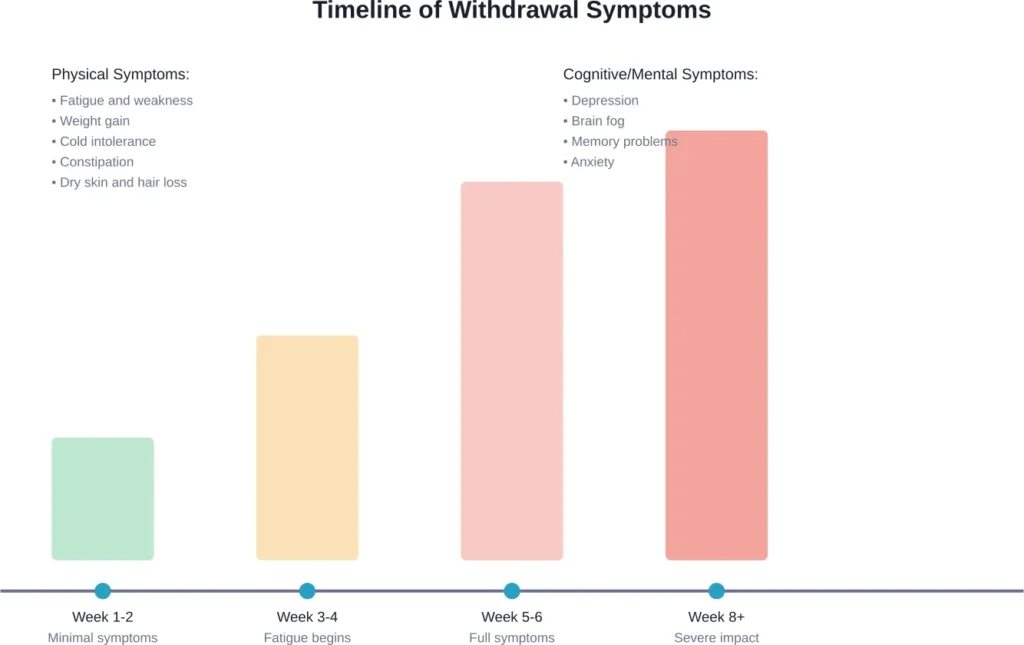
Early Stage Symptoms (Weeks 1-3)
Initially, you might not notice much. The medication still circulating in your system provides some coverage.
Some people report:
- Mild fatigue or reduced energy
- Slight changes in concentration
- Increased need for sleep
These early symptoms are often subtle and easy to dismiss.
Progressive Symptoms (Weeks 4-6)
As hormone levels continue dropping, symptoms become more pronounced:
- Significant fatigue and exhaustion
- Weight gain despite no dietary changes
- Extreme sensitivity to cold
- Constipation
- Dry, flaky skin
- Hair loss or thinning
- Muscle aches and joint pain
- Slowed heart rate
- Depression and mood changes
- Brain fog and memory problems
Research on the effects of levothyroxine withdrawal has documented impacts on patients’ psychological and physical well-being during the hypothyroid state.
Severe Hypothyroidism (Weeks 8+)
Without treatment intervention, severe hypothyroidism develops. This isn’t just uncomfortable—it’s medically dangerous.
Advanced symptoms include:
- Profound weakness and disability
- Facial puffiness and swelling (myxedema)
- Severely elevated cholesterol
- Heart problems including bradycardia and pericardial effusion
- Anemia
- Cognitive impairment
Dangerous Complications From Stopping Levothyroxine
Most people who stop levothyroxine experience uncomfortable but not life-threatening symptoms. But there are serious exceptions.
Myxedema Coma
This is the most dangerous complication. Myxedema coma represents severe, life-threatening hypothyroidism.
It’s rare, but the mortality rate is high even with treatment. Symptoms include:
- Extreme fatigue progressing to unresponsiveness
- Hypothermia
- Slow breathing
- Low blood pressure
- Low blood sodium
- Altered mental status or coma
This typically occurs in patients with no thyroid function who stop medication completely, especially if combined with stress, illness, or cold exposure.
Cardiovascular Effects
Research examining thyroid hormone withdrawal found significant alterations in cardiovascular parameters. The hypothyroid state affects heart rate, blood pressure, and cardiac output.
Patients may experience:
- Bradycardia (dangerously slow heart rate)
- Pericardial effusion (fluid around the heart)
- Worsening heart failure in susceptible individuals
- Elevated blood pressure in some cases
Metabolic and Biochemical Changes
Studies on biochemical effects of levothyroxine withdrawal show significant alterations in multiple parameters including lipid profiles, liver enzymes, and electrolyte balance.
Short-term hypothyroidism induces changes that can complicate other health conditions.
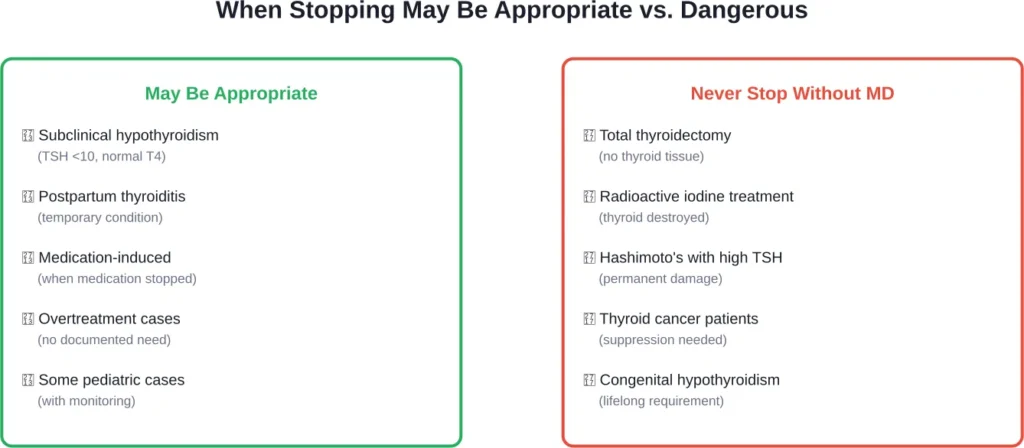
When Stopping Levothyroxine Might Be Appropriate
Despite the risks, not everyone needs lifelong levothyroxine therapy. Some situations where discontinuation might be considered:
Subclinical Hypothyroidism
Patients with mildly elevated TSH but normal thyroid hormone levels sometimes receive treatment. Research on discontinuing levothyroxine in subclinical hypothyroidism shows many patients maintain normal thyroid function after stopping.
Guidelines vary on whether treatment is necessary when TSH is below 10 mIU/L with normal free T4 levels.
Postpartum Thyroiditis
According to research on postpartum thyroiditis, this temporary condition affects a small percentage of pregnant women. The inflammation can cause initial hyperthyroidism followed by hypothyroidism.
Many women recover normal thyroid function within a year. Medication started during the hypothyroid phase may not be needed long-term.
Medication-Induced Hypothyroidism
Some medications temporarily suppress thyroid function. When those medications are stopped, thyroid function may normalize, eliminating the need for replacement therapy.
Children With Hashimoto’s Thyroiditis
Research on predictors for thyroid dysfunction after discontinuation in children with Hashimoto’s thyroiditis found that some pediatric patients successfully discontinue treatment. Research on predictors for thyroid dysfunction after discontinuation found median age at discontinuation was 15.4 years (12.7–18.4 years) with a median duration of levothyroxine therapy of 47 months (20.3–80.3 months).
Levothyroxine was restarted when patients developed overt or subclinical hypothyroidism (thyroid-stimulating hormone [TSH] levels≥10 mIU/L) after discontinuation.
Overtreatment in Older Adults
Studies examining deprescribing practices found that many older adults receive levothyroxine without strong indications. The American Thyroid Association notes that some prescriptions appear to be written without documented hypothyroidism.
Reevaluating the need for medication in these cases makes sense.
How to Safely Discontinue Levothyroxine
If discontinuation is appropriate, the process should never be abrupt. Medical supervision is essential.
The Proper Protocol
Work with your healthcare provider to:
- Confirm the reason for potential discontinuation — Is there evidence your thyroid function has recovered or that treatment wasn’t necessary?
- Conduct baseline testing — Measure TSH, free T4, and possibly free T3 before any changes.
- Consider gradual tapering — Some doctors reduce the dose incrementally rather than stopping completely.
- Monitor thyroid function — Recheck labs 4-6 weeks after stopping, then again at 12 weeks and 6 months.
- Watch for symptoms — Track energy levels, weight, mood, and other indicators.
The goal is catching problems early if thyroid function doesn’t recover.
What Blood Tests Reveal
TSH is the primary marker. When levothyroxine is withdrawn, TSH rises as the pituitary tries to stimulate the thyroid.
Research on short-term withdrawal shows TSH increases along with changes in the T3 to T4 ratio. If TSH rises above 10 mIU/L, most guidelines recommend restarting treatment.
Free T4 and free T3 levels also provide important information about actual hormone availability.
Special Considerations for Thyroid Cancer Patients
Patients treated for differentiated thyroid cancer face different considerations. Levothyroxine serves two purposes:
- Hormone replacement after thyroidectomy
- TSH suppression to reduce cancer recurrence risk
These patients often take higher doses to keep TSH suppressed. Stopping medication isn’t just about hypothyroidism—it affects cancer management.
Research on thyroid hormone withdrawal before radioactive iodine therapy in differentiated thyroid cancer patients has examined cardiometabolic effects including alterations in cardiovascular parameters. This controlled process differs from simply stopping medication.
Missing Doses vs. Stopping Completely
What if you miss a dose occasionally versus stopping altogether?
Missing one dose typically causes minimal impact due to levothyroxine’s long half-life. If you miss a dose, take it as soon as you remember, or take the next scheduled dose—don’t double up.
But here’s the difference: occasional missed doses don’t cause the progressive hormone depletion that stopping completely does.
Some people miss doses due to side effects or forgetfulness. If that’s happening regularly, talk to your doctor. The issue might be:
- Wrong dosage requiring adjustment
- Taking medication incorrectly (timing, food interactions)
- Brand or formulation issues
- Need for reevaluation of treatment necessity
The FDA tightened potency specifications for levothyroxine sodium products to a 95 percent to 105 percent potency specification until expiration date, down from the previous 90 to 110 percent range, to ensure the drug retains its potency over its entire shelf life.
Alternative Thyroid Medications and T3/T4 Combinations
Some patients on levothyroxine don’t feel optimal despite normalized TSH levels. Research notes that treatment doesn’t always provide complete regression of symptoms even when TSH normalizes.
Research notes that several sources report ratios of triiodothyronine (T3) to thyroxine (T4) may be relevant in treatment outcomes, and treatment with levothyroxine does not always provide complete regression of associated symptoms despite normalised TSH levels.
Options include:
- Adding synthetic T3 (liothyronine) to levothyroxine
- Switching to combination T3/T4 medications
- Natural desiccated thyroid (though standardization varies)
These approaches don’t eliminate the need for medication, but they might improve symptom control for some patients.
Why Some Patients Want to Stop
Despite the importance of thyroid hormone replacement, some patients consider stopping. Common reasons include:
- Side effects from incorrect dosing
- Medication costs
- Difficulty remembering daily medication
- Concerns about long-term medication use
- Feeling well and assuming treatment is no longer needed
- Preference for “natural” approaches
Many of these concerns can be addressed without stopping medication. Dosage adjustments, generic alternatives, reminder systems, and patient education often resolve issues.
Research on barriers to deprescribing levothyroxine found that doctors identified time constraints, concern about patient reactions, and uncertainty about when discontinuation is appropriate as barriers to discussing medication discontinuation with patients. Barriers include time constraints, concern about patient reactions, and uncertainty about when discontinuation is appropriate.
Long-Term Consequences of Untreated Hypothyroidism
For those who genuinely need levothyroxine, staying off medication creates cumulative health risks:
| System Affected | Long-Term Consequences |
|---|---|
| Cardiovascular | Elevated cholesterol, atherosclerosis, heart failure, pericardial effusion |
| Metabolic | Weight gain, insulin resistance, metabolic syndrome |
| Neurological | Cognitive decline, depression, peripheral neuropathy |
| Reproductive | Menstrual irregularities, infertility, complications in pregnancy |
| Musculoskeletal | Muscle weakness, joint pain, reduced bone density |
| Hematologic | Anemia, reduced oxygen delivery to tissues |
These aren’t just quality-of-life issues. Untreated hypothyroidism increases mortality risk through cardiovascular disease and other complications.
Monitoring After Restarting Medication
If you stopped levothyroxine and need to restart, the process requires patience.
It takes 4-6 weeks for levothyroxine levels to stabilize after starting or changing doses. Lab testing before that window doesn’t accurately reflect the medication’s effect.
Your doctor will likely:
- Start at an appropriate dose based on your previous requirement
- Test TSH and free T4 after 6-8 weeks
- Adjust dosage if needed
- Retest 6 weeks after any dose change
- Continue monitoring until stable
Symptoms may take longer to improve than lab values. Give treatment adequate time to work.
Frequently Asked Questions
This depends entirely on your thyroid function. People with no working thyroid tissue will develop severe symptoms within 4-8 weeks. Those with partial function might tolerate longer periods, but symptoms will still emerge. Missing a few doses causes minimal impact, but deliberately stopping creates progressive hormone depletion that becomes dangerous over time.
Weight loss doesn’t cure hypothyroidism. While obesity can affect thyroid function tests, losing weight doesn’t restore a damaged or absent thyroid gland. Some patients may need dose adjustments after significant weight changes, but this requires medical evaluation and testing—not self-discontinuation.
Most people first notice increasing fatigue and reduced energy levels around weeks 3-4. Brain fog, difficulty concentrating, and increased need for sleep often follow. Physical symptoms like weight gain, constipation, and cold intolerance typically appear later as hormone depletion progresses.
No. Thyroid storm occurs with hyperthyroidism (too much thyroid hormone), not hypothyroidism. Stopping levothyroxine causes the opposite problem—too little thyroid hormone. The dangerous complication from stopping is myxedema coma, not thyroid storm. Abruptly stopping antithyroid medications used for hyperthyroidism (a different class from levothyroxine) can trigger thyroid storm, a medical emergency.
Absolutely not without medical supervision. Pregnancy increases thyroid hormone requirements. Untreated hypothyroidism during pregnancy risks serious complications including miscarriage, preterm birth, low birth weight, and developmental problems for the baby. Most women need dose increases during pregnancy, not discontinuation.
Yes, levothyroxine can be restarted at any time. The medication begins working immediately, though it takes 4-6 weeks to reach steady state and for symptoms to fully improve. Your doctor will determine the appropriate starting dose based on your current thyroid function tests and previous medication history.
The only way to know is through medical evaluation including thyroid function testing. Your doctor will check TSH, free T4, and possibly thyroid antibodies to assess whether your thyroid can function adequately without medication. Some conditions like postpartum thyroiditis may resolve, while others like Hashimoto’s thyroiditis or post-surgical hypothyroidism are permanent.
The Bottom Line on Stopping Levothyroxine
Levothyroxine isn’t a medication you should stop on your own. The consequences range from uncomfortable to life-threatening, depending on your underlying thyroid condition.
For patients with no thyroid function—whether from surgery, radioactive iodine treatment, or complete gland destruction—this medication is literally replacing a vital hormone. Stopping it creates the same crisis as if your thyroid suddenly disappeared.
But not everyone needs lifelong treatment. Cases of subclinical hypothyroidism, temporary thyroid conditions, or questionable treatment indications warrant reevaluation.
The key is working with your healthcare provider to determine whether discontinuation makes sense for your specific situation. If it does, the process requires gradual withdrawal, careful monitoring, and readiness to restart if needed.
Never stop levothyroxine because you feel well. Feeling well means the medication is working. Never stop because of unverified concerns about side effects—most problems come from incorrect dosing, not the medication itself.
If you’re experiencing side effects, struggling with medication adherence, or questioning whether you still need treatment, have that conversation with your doctor. Testing and evaluation provide answers. Self-discontinuation provides only risk.
Your thyroid hormones control metabolism, heart function, brain activity, body temperature, and countless other processes. Respect the importance of maintaining adequate levels—whether through your own thyroid gland or medication that fills that role.