

Quick Summary: Saying ‘Beetlejuice’ three times summons the mischievous bio-exorcist ghost from Tim Burton’s 1988 cult classic film. The same person must say his name consecutively to make him appear, creating a binding agreement that brings the chaotic character into the living world. This rule became a central plot device in both the original movie and its 2024 sequel.
Tim Burton’s 1988 film Beetlejuice introduced audiences to one of cinema’s most bizarre supernatural rules: say a ghost’s name three times, and he appears. But what exactly happens when someone utters “Beetlejuice, Beetlejuice, Beetlejuice”? And why does this specific incantation hold such power?
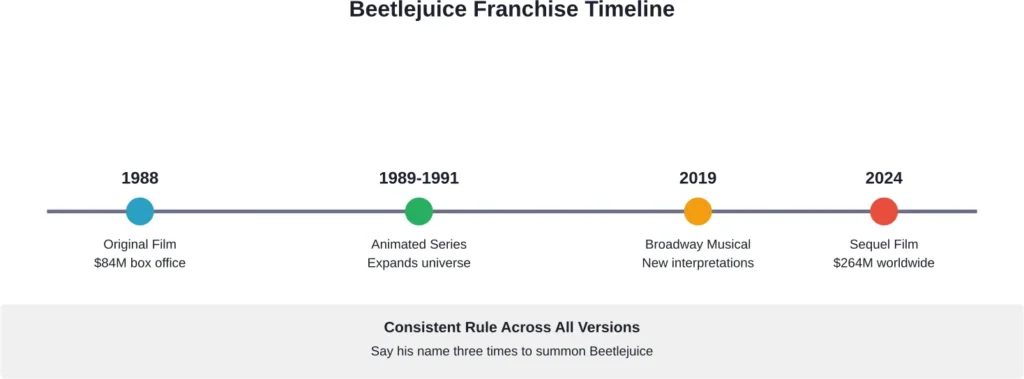
The film became a critical and commercial success, grossing $84 million against a $15 million budget according to Wikipedia. It won the Academy Award for Best Makeup and three Saturn Awards, cementing its place in horror-comedy history. Nearly four decades later, the 2024 sequel Beetlejuice Beetlejuice brought the ghost with the most back to theaters, earning $264 million worldwide.
Here’s the thing though—the rules surrounding Beetlejuice’s summoning aren’t just throwaway movie magic. They’re carefully constructed world-building that makes the entire premise work.
The Summoning Ritual: How It Actually Works
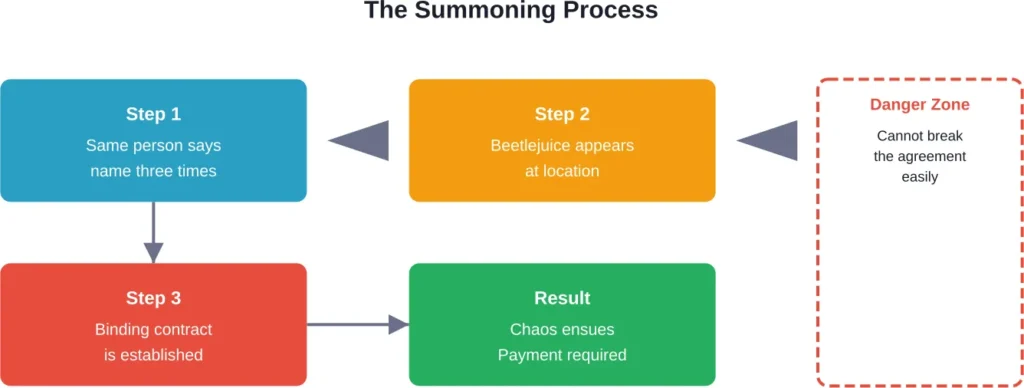
According to the established lore in Burton’s films, summoning Betelgeuse (spelled Beetlejuice for simplicity) requires specific conditions. The same person must say his name three consecutive times. Not two people taking turns. Not someone saying it twice and then stopping. Three times, from one voice.
When the ritual works, Beetlejuice appears wherever he’s been called. In the original film, this happens when Lydia Deetz desperately needs help saving her ghostly friends Adam and Barbara Maitland. She calls his name three times, and the self-proclaimed “bio-exorcist” materializes to wreak havoc.
But saying his name creates more than just an appearance. It establishes a contract.
The Binding Agreement
In the film, saying Beetlejuice’s name three times summons him and establishes a binding agreement with whatever deal he proposes. When Lydia summons Beetlejuice, he immediately demands marriage as payment for his services. The act of summoning created an obligation she couldn’t easily escape.
This contractual element makes the three-name rule particularly dangerous. You’re not just calling a ghost for help. You’re entering into a supernatural agreement with a chaotic entity who follows his own twisted logic.
Why Three Times? The Symbolism Behind the Number
The number three carries significant weight across folklore, religion, and storytelling traditions. Burton didn’t randomly pick this number—it’s deeply rooted in cultural symbolism.
In many traditions, repeating something three times gives it power. Think about fairy tales where wishes come in threes, or religious contexts where trinity represents completeness. The rule of three appears everywhere from “third time’s the charm” to baseball’s three strikes.
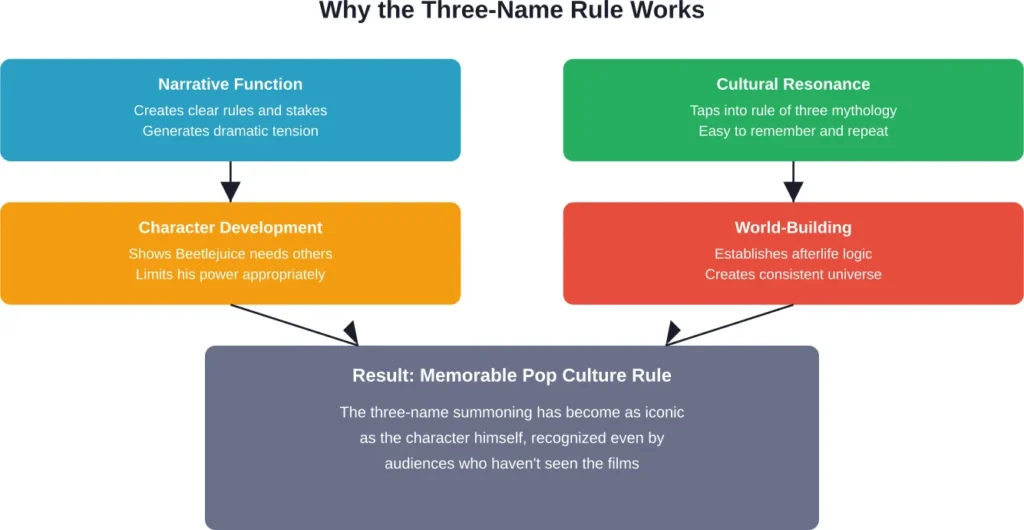
For Beetlejuice specifically, the three-name requirement serves multiple narrative purposes. It prevents accidental summonings (people mention his name in conversation all the time), creates dramatic tension (will someone finish the third repetition?), and establishes clear rules for the supernatural world.
World-Building Through Rules
The three-name rule represents meticulous world-building. Burton’s afterlife operates on specific logic, and the summoning ritual fits perfectly within that framework. Dead characters can’t simply appear wherever they want. Living people can’t see ghosts without special circumstances. But say a ghost’s name three times? That creates a bridge between worlds.
This internal consistency makes the film’s premise believable despite its absurdist elements. The rules might be strange, but they’re consistent strange.
Why Beetlejuice Can’t Say His Own Name
Here’s where it gets interesting. Beetlejuice himself can’t say his own name. Throughout both films, he refers to himself indirectly or spells it out letter by letter. But he never actually speaks “Beetlejuice” aloud.
The film never explicitly states why this limitation exists, but the logic tracks. If saying his name three times summons him, and he could say it himself, he’d have complete freedom to come and go from the living world. The restriction keeps him bound to the afterlife’s rules, preventing him from becoming too powerful.
This creates a power dynamic where Beetlejuice needs living people to summon him. He’s powerful and chaotic, sure, but fundamentally constrained. He must convince, trick, or manipulate the living into saying his name. It makes him simultaneously threatening and pathetic—a perfect tragicomic character.
| Aspect | Rule | Narrative Purpose |
|---|---|---|
| Number of repetitions | Exactly three times | Prevents accidents, creates tension |
| Who can summon | Same person must say all three | Establishes clear responsibility |
| Beetlejuice saying his name | He cannot | Limits his power, requires manipulation |
| Result of summoning | Binding contract formed | Raises stakes, adds consequences |
| Breaking the contract | Extremely difficult | Forces characters to deal with chaos |
The Original Film’s Use of the Summoning Rule
In the 1988 original, the summoning rule drives key plot moments. Adam and Barbara Maitland discover Beetlejuice’s advertisement in the afterlife handbook. They’re warned against using him—he’s crude, dangerous, and unpredictable. But desperation makes people (even dead people) take risks.
The Maitlands refuse to summon him despite their problems. It’s Lydia, the living teenage girl, who finally says his name three times. This moment represents her taking control of her situation, even though she doesn’t fully understand the consequences.
Real talk: the film uses the summoning as a point of no return. Once Lydia calls Beetlejuice, the stakes escalate immediately. His appearance transforms the story from quirky ghost comedy into full supernatural chaos.
The 2024 Sequel Expands the Lore
Almost 40 years after the original, the 2024 sequel Beetlejuice Beetlejuice brought the character back. The film received a 77% rating from Rotten Tomatoes and grossed $264 million worldwide according to community reports.
The sequel maintains the three-name summoning rule while exploring new contexts. Different characters summon Beetlejuice under different circumstances, but the core mechanic remains unchanged. This consistency respects the original while expanding the universe.
What Would Actually Happen If You Said It In Real Life?
Okay, so what about the real world? If someone stands in front of a mirror and says “Beetlejuice” three times, does anything happen?
Obviously, no ghostly bio-exorcist appears. Beetlejuice is a fictional character created by Michael McDowell and Larry Wilson for Tim Burton’s film. The summoning ritual exists only within that fictional universe.
That said, the cultural impact is real. The phrase “say his name three times” has become so associated with Beetlejuice that people reference it constantly. The cultural impact of the summoning rule is significant enough that many people reference it when discussing the character, even in casual contexts.
The rule has transcended the film to become a cultural touchstone. People who’ve never even seen Beetlejuice often know about the three-name summoning. It’s entered the collective consciousness alongside other horror movie rules like “don’t go in the basement” or “never split up.”
The Broader Cultural Context
Beetlejuice isn’t the only supernatural entity with specific summoning rules. Candyman requires saying his name five times in a mirror. Bloody Mary has various regional requirements. These rituals tap into deep-seated human fascination with speaking things into existence.
Burton’s genius was making Beetlejuice’s rule simple, memorable, and functional within his narrative. Three times. Same person. That’s it. Easy to understand, impossible to forget.
The Character Behind the Name
Beetlejuice—officially spelled Betelgeuse after the star—is portrayed by Michael Keaton in both films. Stephen Ouimette voiced him in the animated series, while Alex Brightman played him in the Broadway musical.
The character describes himself as a “bio-exorcist,” someone who removes living people from haunted houses. It’s a twisted inversion of traditional exorcism, perfectly fitting Burton’s darkly comedic vision.
What makes Beetlejuice compelling isn’t just his chaotic energy. It’s that he’s bound by rules he can’t break. He needs to be summoned. He can’t say his own name. He operates within a supernatural bureaucracy that constrains him. These limitations make him funnier and more interesting than an all-powerful ghost would be.
| Version | Actor/Voice | Key Difference |
|---|---|---|
| 1988 Film | Michael Keaton | Original portrayal, crude and chaotic |
| Animated Series (1989-1991) | Stephen Ouimette | More kid-friendly, protagonist role |
| Broadway Musical (2019) | Alex Brightman | Expanded backstory and motivations |
| 2024 Sequel | Michael Keaton | Older, same chaotic energy |
Does the Rule Ever Get Broken?
Throughout the franchise, the three-name rule remains remarkably consistent. But the films do explore edge cases and complications.
For instance, what happens if someone says the name twice and then stops? Nothing. The spell requires completion. What if two different people alternate saying his name? Doesn’t work—same person, three times.
The 2024 sequel reportedly explores additional nuances while maintaining the core mechanic. The rule itself never breaks, but characters find creative ways to work within or around it. This reinforces the world-building rather than undermining it.
Failed Summonings Create Tension
Some of the most effective moments in the original film involve almost summoning Beetlejuice. Characters say his name once, twice—then stop. The audience knows the rule, creating suspense around whether someone will complete the third repetition.
This dramatic device works because the rule is so clearly established. Break the rule, and the tension disappears. Maintain it consistently, and every near-summoning becomes a moment of suspense.
The Legacy of “Say My Name”
The phrase “say my name” has become intrinsically linked to Beetlejuice. In one of the film’s most memorable scenes, he desperately tries to get someone to say his name three times, repeatedly shouting “say my name!”
This scene encapsulates the character’s entire predicament. He’s powerful but powerless. Chaotic but constrained. He can manipulate, cajole, and threaten, but ultimately he needs someone else to speak the words that give him freedom.
The 2024 sequel’s title—Beetlejuice Beetlejuice—plays directly with this rule. It’s two-thirds of the summoning ritual right there in the name. Clever marketing that reminds audiences of the core mechanic while avoiding actually completing the spell.
Frequently Asked Questions
In the film universe, saying “Beetlejuice” three times summons the ghost to your location and creates a binding contract with him. The same person must say his name three consecutive times for the summoning to work. In reality, nothing happens—Beetlejuice is a fictional character.
The number three carries significant symbolic weight in folklore and storytelling traditions. Burton used this rule to prevent accidental summonings, create dramatic tension, and establish clear supernatural rules within his film’s universe. The requirement also limits Beetlejuice’s power by making him dependent on living people to say his name.
No, Beetlejuice cannot say his own name throughout the films. This limitation prevents him from summoning himself freely and maintains the power dynamic where he needs living people to call him into their world. He must manipulate others into speaking the summoning words.
No, Beetlejuice is a fictional character from Tim Burton’s films. Saying his name three times in real life won’t summon anything supernatural. However, the rule has become such a cultural touchstone that many people reference it jokingly when someone mentions his name multiple times.
Betelgeuse is the character’s proper name, spelled after the red supergiant star. Beetlejuice is the phonetic spelling used throughout the films and marketing because it’s easier to pronounce and remember. Both refer to the same character portrayed by Michael Keaton.
The 2024 sequel Beetlejuice Beetlejuice maintained the core three-name summoning rule established in the original 1988 film. While the sequel explored new contexts and situations, the fundamental mechanic remained consistent to respect the established lore.
Anyone can summon Beetlejuice by saying his name three times consecutively. However, the films show that doing so creates consequences—the summoner typically ends up obligated to the chaotic ghost in some way. Both living and dead characters have summoned him throughout the franchise.
The Enduring Appeal of Simple Rules
Nearly four decades after the original film’s release, the Beetlejuice summoning rule remains instantly recognizable. That’s the mark of effective world-building—creating rules simple enough to remember but meaningful enough to matter.
Burton’s film universe operates on clear supernatural logic. Dead people have handbooks. Ghosts can’t leave their houses. Bio-exorcists exist but must be summoned with specific rituals. These rules create boundaries that make the chaos feel purposeful rather than random.
The three-name requirement specifically balances accessibility with consequence. It’s easy enough that desperate characters might try it, but serious enough that doing so changes everything. Perfect narrative design.
Conclusion: The Power of Saying Someone’s Name
What happens if you say Beetlejuice three times? In Burton’s carefully constructed universe, you summon a chaotic ghost who brings supernatural mayhem and demands payment for his services. You create a binding agreement you can’t easily break. You invite trouble into your world, whether you’re living or dead.
The rule works because it’s grounded in deeper storytelling traditions while serving multiple narrative functions. It limits Beetlejuice’s power, creates dramatic tension, establishes clear world-building logic, and taps into cultural associations with the number three.
The 1988 original grossed $84 million and won an Academy Award. The 2024 sequel earned $264 million worldwide. Between them, an animated series, a Broadway musical, and countless cultural references have kept the character alive for nearly 40 years. At the center of it all remains one simple, memorable rule.
Say his name three times—but only if you’re ready for the consequences. In fiction and in cultural memory, some invocations can’t be taken back once spoken.
Want to experience the chaos firsthand? Both Beetlejuice films showcase the summoning rule in action, demonstrating exactly why some ghosts are better left unsummoned. Just remember: if you’re watching with friends, be careful not to say his name too many times out loud.