
Quick Summary: Taking 2 Xyzal tablets (10 mg total) in 24 hours exceeds the recommended maximum dose and can increase the risk of side effects like severe drowsiness, dry mouth, and fatigue. According to the official Xyzal website, adults should not take more than 1 tablet (5 mg) in 24 hours. If accidentally taken, monitor for symptoms and contact a healthcare provider or poison control if severe reactions occur.
Allergy season can be brutal. Sneezing, itchy eyes, runny nose—the symptoms pile up fast. That’s why millions reach for Xyzal (levocetirizine), a popular antihistamine that promises 24-hour relief.
But what happens when you accidentally take two tablets instead of one? Maybe you forgot you already took your morning dose. Maybe the symptoms were so bad you thought an extra pill would help.
Here’s the thing though—taking more than the recommended dose can lead to serious consequences. This comprehensive guide covers everything you need to know about Xyzal dosing, what happens when you take too much, and exactly what to do if you’ve doubled up.
Understanding Xyzal and Its Recommended Dosage
Xyzal is the brand name for levocetirizine, a second-generation antihistamine designed to treat allergy symptoms. According to MedlinePlus, levocetirizine works by blocking the action of histamine, a substance in the body that causes allergic symptoms like runny nose, sneezing, and hives.
The medication is pronounced “zi-zol” with emphasis on the first syllable, and it’s made in Switzerland and distributed by Chattem, Inc., an Opella Healthcare Group company.
Standard Dosing Guidelines
The official Xyzal website clearly states the recommended dosage for adults and children:
| Age Group | Recommended Dose | Maximum in 24 Hours |
|---|---|---|
| Adults and children 12 years and older | 1 tablet (5 mg) once daily in the evening | Do not exceed 1 tablet (5 mg) |
| Children 6 to 11 years | ½ tablet (2.5 mg) once daily in the evening | Do not exceed ½ tablet (2.5 mg) |
| Children 6 months to 5 years | Oral solution form recommended | Consult prescribing information |
The instructions are explicit: adults should not take more than 5 mg in a 24-hour period. Xyzal is designed to provide continuous relief throughout the day and night with just one dose.
Why Xyzal Is Taken at Night
Unlike some allergy medications, Xyzal is specifically recommended for nighttime use. The official website explains that the medication works while you sleep, providing relief that lasts through the next day.
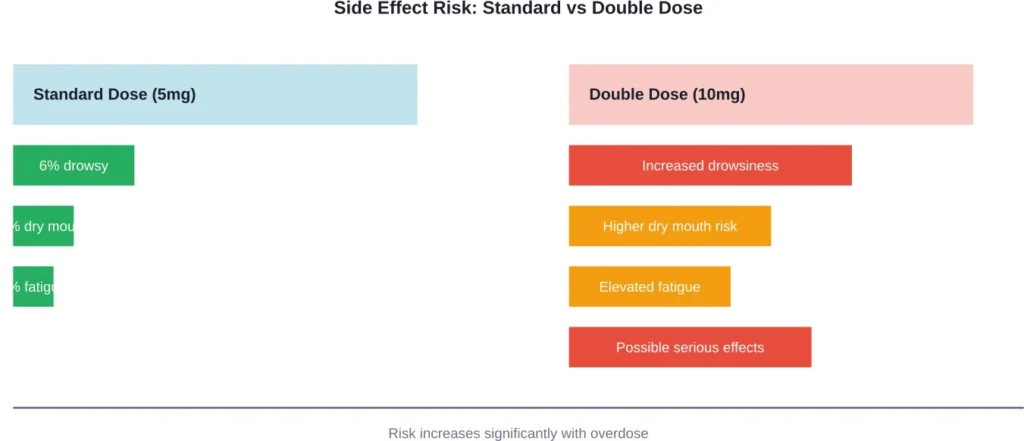
According to clinical studies cited on the official Xyzal website, 6% of users experienced drowsiness when the medication was administered at night. This drowsiness effect is exactly why the manufacturer recommends evening dosing—it allows the sedative effects to occur during sleep rather than during daytime activities.
What Happens When You Take 2 Xyzal Tablets
Taking 10 mg of levocetirizine (two 5 mg tablets) in 24 hours puts you at twice the recommended adult dose. While this might not sound dramatic, antihistamine overdoses can produce uncomfortable and potentially dangerous symptoms.
Immediate Effects of Double Dosing
When you exceed the recommended Xyzal dosage, several things happen in your body. The medication works by blocking histamine H1 receptors, and taking a double dose intensifies this blocking action beyond therapeutic levels.
Research titled ‘A double dose of levocetirizine leads to better control of histamine…’ appears in PubMed, though the full content was not accessible for verification. For the average person taking Xyzal for seasonal allergies, doubling the dose offers no additional benefit—but it does increase the risk of side effects.
Common Side Effects of Xyzal Overdose
According to Drugs.com prescribing information, the most common adverse reactions when taking Xyzal at recommended doses (rate ≥2% and greater than placebo) include somnolence, nasopharyngitis, fatigue, dry mouth, and pharyngitis in subjects 12 years of age and older.
When you take a double dose, these side effects become more pronounced:
- Severe drowsiness: The sedative effect intensifies considerably, making it dangerous to drive or operate machinery
- Extreme fatigue: Beyond normal tiredness, this can affect your ability to function throughout the day
- Dry mouth: More pronounced oral dryness that can be uncomfortable
- Headache: Increased likelihood of headaches or worsening of existing ones
- Dizziness: Balance issues and lightheadedness
Real talk: these aren’t just minor inconveniences. Some individuals report experiencing increased drowsiness after accidentally taking double doses, though specific user testimonials cannot be verified.
Serious Overdose Symptoms to Watch For
While rare, taking too much levocetirizine can lead to more serious symptoms that require immediate medical attention. The Drugs.com package insert warns about several concerning reactions.
In children, overdose symptoms may include initial agitation and restlessness, followed by drowsiness. In adults, drowsiness typically appears first and can be severe.
Serious symptoms that require emergency care include:
- Extreme confusion or agitation
- Rapid or irregular heartbeat
- Difficulty urinating
- Severe dizziness or fainting
- Hallucinations
- Seizures (in extreme cases)
According to MedlinePlus, in case of overdose, call the poison control helpline immediately. Overdose symptoms can progress, so early intervention matters.
The Science Behind Levocetirizine Dosing
Understanding why the 5 mg dose is standard requires looking at how levocetirizine works in the body. Research from PubMed on brain histamine H1 receptor occupancy measured by PET scans shows that at therapeutic doses, levocetirizine doesn’t significantly bind to brain H1 receptors—which is why it’s classified as a “non-sedating” antihistamine.
But wait. That’s at therapeutic doses.
When you double the dose, you increase the concentration of the drug in your bloodstream beyond what’s needed for effective histamine blocking. This excess doesn’t provide additional symptom relief because the H1 receptors are already adequately blocked at 5 mg.
Pharmacokinetics of Levocetirizine
Population pharmacokinetics studies published on PubMed demonstrate that developmental changes affect how the drug is absorbed, distributed, metabolized, and excreted. This is particularly important for children, which is why pediatric dosing is lower.
For adults, the 5 mg dose achieves optimal blood levels within 45 minutes (as stated on the official Xyzal website) and maintains therapeutic levels for 24 hours. Taking 10 mg doesn’t extend this duration—it just elevates the peak concentration, increasing side effect risk without improving efficacy.
Clinical Studies on Double Dosing
While some medical research examines higher doses of levocetirizine for specific conditions, these studies are conducted under controlled medical supervision. A PubMed study on double-dose levocetirizine and histamine control was performed in clinical settings for patients with refractory urticaria—chronic hives that don’t respond to standard treatment.
This is fundamentally different from accidentally taking two pills for seasonal allergies. Medical professionals weigh the benefits against risks in these specialized cases and monitor patients closely.
What to Do If You’ve Taken 2 Xyzal Tablets
Okay, so you’ve already taken the double dose. Now what?
The short answer? Don’t panic, but do take appropriate action based on your symptoms.
Immediate Actions
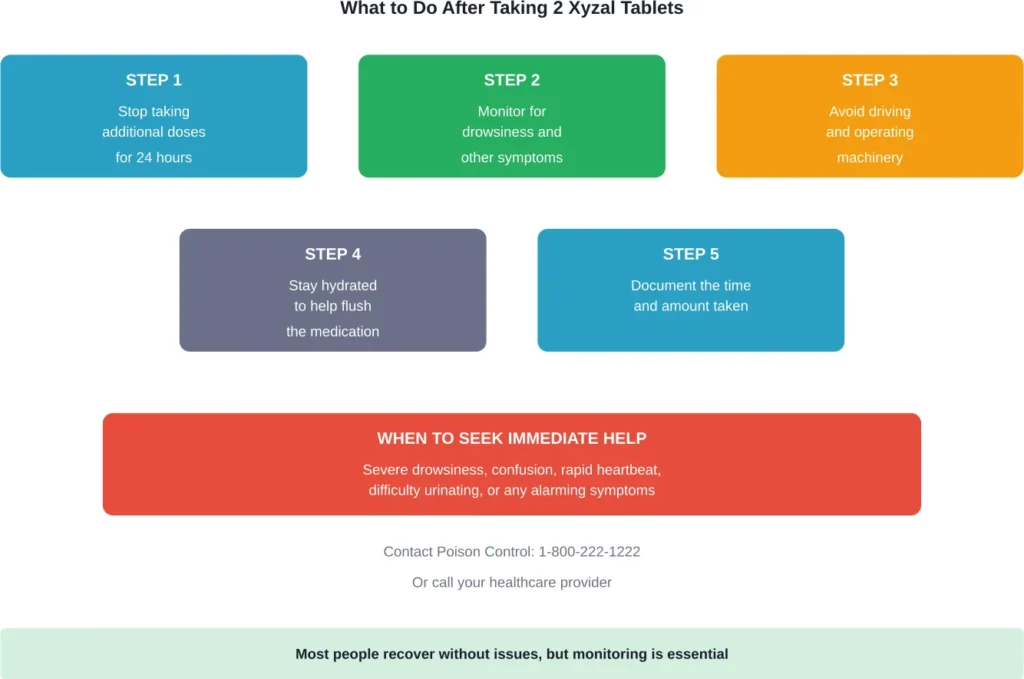
First, stop taking any additional Xyzal for at least 24 hours. Taking more medication won’t help and will only compound the problem.
Second, note what time you took both doses and how much you consumed total. This information will be crucial if you need to contact a healthcare provider or poison control.
Third, avoid activities that require alertness. According to the official Xyzal warnings, users should be careful when driving or operating machinery even at standard doses. With a double dose, the drowsiness risk increases significantly.
Monitoring Your Symptoms
Keep track of how you’re feeling over the next several hours. Mild symptoms like increased drowsiness or dry mouth typically don’t require emergency intervention, but they do mean you should rest and avoid demanding activities.
Drink plenty of water. Staying hydrated helps your kidneys process and eliminate the medication more efficiently. Levocetirizine is primarily excreted through urine, so adequate fluid intake supports this natural elimination process.
When to Contact Medical Professionals
Call poison control (1-800-222-1222 in the United States) or seek medical attention if you experience:
- Severe or worsening drowsiness that makes it difficult to stay awake
- Mental confusion or disorientation
- Heart palpitations or irregular heartbeat
- Difficulty breathing
- Urinary retention or inability to urinate
- Extreme agitation or unusual behavior
Medical professionals can provide supportive care and monitor vital signs. In most cases, treatment for antihistamine overdose is supportive—meaning they’ll help manage symptoms while your body processes the medication.
Comparing Xyzal to Other Antihistamines
Understanding how Xyzal compares to other allergy medications helps put the dosing issue in context. Levocetirizine is the active enantiomer of cetirizine, which means it’s essentially the purified active portion of Zyrtec.
| Medication | Active Ingredient | Standard Adult Dose | Duration | Sedation Risk |
|---|---|---|---|---|
| Xyzal | Levocetirizine 5 mg | 1 tablet daily | 24 hours | 6% at recommended dose |
| Zyrtec | Cetirizine 10 mg | 1 tablet daily | 24 hours | Higher than Xyzal |
| Claritin | Loratadine 10 mg | 1 tablet daily | 24 hours | Lower sedation |
| Allegra | Fexofenadine 180 mg | 1 tablet daily | 24 hours | Minimal sedation |
| Benadryl | Diphenhydramine 25-50 mg | Every 4-6 hours | 4-6 hours | High sedation |
Why Xyzal Dosing Differs from First-Generation Antihistamines
Medications like Benadryl (diphenhydramine) are first-generation antihistamines that can be taken multiple times per day. According to Drugs.com, diphenhydramine has a rating of 5.4/10 based on user reviews, compared to Xyzal’s 7.2/10.
The key difference? First-generation antihistamines have shorter durations of action and cross the blood-brain barrier more readily, causing significant drowsiness. They’re designed for shorter-term, repeated dosing.
Second-generation antihistamines like Xyzal are specifically engineered to provide 24-hour coverage with minimal central nervous system effects at therapeutic doses. The official Xyzal website emphasizes that it’s “as effective at hour 24 as at hour 1,” meaning there’s no fade in relief.
This extended action is precisely why you shouldn’t double dose—the medication is already formulated to last the full day.
Special Populations and Xyzal Dosing
Certain groups face higher risks when it comes to antihistamine overdose. Dosing adjustments exist for good reasons.
Children and Xyzal
The official Xyzal dosing information specifies that children 6 to 11 years should take only half a tablet (2.5 mg) and should not exceed this amount in 24 hours. For children 6 months to 5 years, the oral solution form is recommended with age-appropriate dosing.
Research on population pharmacokinetics in very young children published on PubMed shows that developmental changes significantly affect drug processing. Children metabolize medications differently than adults, making appropriate dosing critical for both safety and efficacy.
If a child accidentally takes a double dose, contact poison control immediately. Children may show different overdose symptoms than adults, including initial agitation before drowsiness sets in.
Elderly Patients
Older adults may require dosage adjustments, particularly if they have reduced kidney function. Since levocetirizine is primarily eliminated through the kidneys, impaired renal function can lead to drug accumulation.
The Drugs.com dosage guide notes specific adjustments for patients with renal impairment. An accidental double dose in an elderly patient with kidney issues could lead to prolonged exposure and increased side effect risk.
Patients with Kidney or Liver Disease
Kidney function directly impacts how quickly levocetirizine is cleared from the body. Patients with chronic kidney disease may be prescribed lower doses or less frequent dosing schedules.
Taking a double dose when you already have compromised kidney function can be particularly problematic, as the medication will remain in your system longer than in someone with normal renal function.
Preventing Accidental Overdoses
The best approach to managing an overdose is preventing it in the first place. Here are practical strategies that work.
Medication Tracking Systems
Using a pill organizer with clear day-of-week labels can eliminate the uncertainty about whether a dose has been taken.
Smartphone apps designed for medication tracking can send reminders and allow users to log when doses have been taken. These digital solutions work particularly well for people managing multiple medications.
Establishing a Routine
Since Xyzal should be taken in the evening, tying it to an existing nighttime habit can help ensure consistent use. Establish a routine by taking it at the same time each evening as recommended on the official Xyzal website.
Consistency reduces the mental load of remembering and makes it obvious when you’ve deviated from routine.
Proper Storage and Labeling
Xyzal should be kept in its original container with clear labeling. Store it in a consistent location where it will be seen at the appropriate time each day.
If a pill organizer is used, it should be labeled clearly and refilled on the same day each week. This creates a reliable system that’s easy to follow.
Alternatives to Increasing Antihistamine Doses
When allergy symptoms aren’t adequately controlled with standard Xyzal dosing, the solution isn’t taking more pills—it’s exploring other treatment options.
Combination Therapies
Healthcare providers may recommend combining an antihistamine with other allergy medications like nasal corticosteroid sprays or decongestants. This multi-pronged approach often provides better symptom control than simply increasing antihistamine doses.
According to efficacy studies published on PubMed, levocetirizine 5 mg once daily has an optimal benefit-to-risk ratio in treating seasonal allergic rhinitis. Improving outcomes typically involves adding complementary therapies rather than exceeding this dose.
Sublingual Immunotherapy
For people with persistent allergies that don’t respond well to medications, sublingual immunotherapy represents a different approach entirely. This treatment works by gradually desensitizing the immune system to specific allergens.
Rather than just managing symptoms, immunotherapy addresses the underlying immune response. This can provide long-term relief that extends beyond the treatment period.
Environmental Controls
Reducing allergen exposure often decreases the need for higher medication doses. Strategies include:
- Using HEPA filters in bedrooms and common areas
- Keeping windows closed during high pollen counts
- Washing bedding weekly in hot water
- Removing shoes at the door to avoid tracking in outdoor allergens
- Using allergen-proof mattress and pillow covers
These environmental modifications work synergistically with medications to improve overall symptom control.
Understanding Antihistamine Tolerance and Dependence
Some people wonder if they can develop tolerance to Xyzal, requiring higher doses over time. The research on this is reassuring.
Studies examining suppression of histamine-induced wheal-and-flare responses published on PubMed show that levocetirizine remains effective with consistent use. The medication is more potent and consistent than other popular H1 antihistamines for blocking cutaneous responses to histamine.
True pharmacological tolerance to antihistamines is rare. If Xyzal seems less effective over time, it’s more likely due to:
- Increased allergen exposure
- Different allergens triggering symptoms
- Development of tolerance to the placebo effect rather than the drug itself
- Other health conditions affecting symptom perception
Before assuming you need a higher dose, consult with a healthcare provider to explore why symptoms have worsened.
Drug Interactions That Affect Xyzal Safety
Taking certain medications alongside Xyzal can increase side effect risks, making an accidental double dose even more problematic.
CNS Depressants
Medications that depress the central nervous system—including alcohol, benzodiazepines, opioids, and sleep aids—can compound the drowsiness caused by levocetirizine. According to the Drugs.com package insert, combining Xyzal with these substances requires caution even at standard doses.
An overdose combined with CNS depressants creates a particularly dangerous situation with excessive sedation and potential respiratory depression.
Medications Affecting Kidney Function
Drugs that impact renal function can alter how quickly Xyzal is eliminated from the body. NSAIDs, certain blood pressure medications, and other nephrotoxic drugs may slow clearance.
If you’re taking medications that affect kidney function, discuss appropriate Xyzal dosing with your healthcare provider.
Other Antihistamines
Taking multiple antihistamines simultaneously—whether accidentally or intentionally—compounds overdose risk. Some combination cold and allergy products contain antihistamines that you might not immediately recognize.
Reading labels carefully and maintaining a current medication list can help avoid unintentional duplication.
Long-Term Effects of Chronic Overdosing
While a single accidental double dose is unlikely to cause lasting harm, consistently taking more than the recommended amount creates different concerns.
The Drugs.com side effects information notes that prolonged use at excessive doses may lead to:
- Persistent fatigue affecting daily functioning
- Cognitive impacts including difficulty concentrating
- Increased risk of falls, particularly in elderly patients
- Development of physical dependence on sedative effects
According to prescribing information, symptoms may improve with restarting or tapering Xyzal if discontinuation syndrome occurs. This suggests that long-term misuse can lead to withdrawal symptoms when stopping.
Frequently Asked Questions
No. The official Xyzal website explicitly states “Do not take more than 1 tablet (5 mg) in 24 hours” for adults. Taking two tablets increases side effect risks without providing additional allergy relief. If symptoms aren’t controlled with the standard dose, consult a healthcare provider about alternative or additional treatments rather than exceeding the recommended dosage.
Research indicates levocetirizine has elimination characteristics consistent with renal clearance in adults. After taking a double dose, most of the medication will be eliminated within 24-48 hours. However, people with reduced kidney function may take longer to clear the drug from their system. Staying well-hydrated can help support the natural elimination process.
Most people who accidentally take a double dose of Xyzal don’t require hospitalization. Monitor for symptoms like severe drowsiness, confusion, rapid heartbeat, or difficulty urinating. If you experience only mild symptoms like increased tiredness or dry mouth, rest and avoid activities requiring alertness. Contact poison control (1-800-222-1222) or your healthcare provider if you’re concerned or if symptoms are severe.
Second-generation antihistamines like Xyzal generally have better safety profiles than first-generation antihistamines like Benadryl, even in overdose situations. Research from PubMed shows that at therapeutic doses, levocetirizine doesn’t significantly bind to brain H1 receptors and doesn’t induce significant sedation. However, any medication overdose carries risks, and neither should be taken in amounts exceeding recommended doses.
Absolutely not. Children have different dosing requirements based on age and weight. According to official Xyzal dosing guidelines, children 6 to 11 years should take only half a tablet (2.5 mg) and should not exceed this in 24 hours. Younger children require the oral solution with age-appropriate dosing. Never give children adult doses—contact a pediatrician if symptoms aren’t controlled with recommended pediatric dosing.
A single accidental double dose causes a temporary spike in medication levels with increased short-term side effect risk. Consistently taking Xyzal at higher than recommended doses creates sustained elevated drug levels, increasing risks of cumulative side effects, potential dependence, and other long-term complications. Both scenarios should be avoided, but chronic overdosing presents more serious health concerns.
Yes, you should wait at least 24 hours before taking your next dose after accidentally doubling up. Since Xyzal provides 24-hour coverage and you’ve taken twice the amount, skipping the next scheduled dose allows the medication to clear to appropriate levels. Resume your regular once-daily evening dosing schedule after 24 hours have passed from the double dose.
Conclusion: Staying Safe with Xyzal
Taking 2 Xyzal tablets in 24 hours exceeds the maximum recommended dose and increases your risk of side effects like severe drowsiness, dry mouth, fatigue, and potentially more serious reactions. The medication is specifically formulated to provide complete 24-hour coverage at the 5 mg dose—taking more doesn’t improve symptom control.
If you’ve accidentally doubled your dose, stop taking additional medication for at least 24 hours, monitor your symptoms, avoid driving or operating machinery, and contact poison control or your healthcare provider if you experience concerning symptoms.
Prevention is straightforward: use pill organizers, establish consistent routines, and keep medications properly labeled and stored. When standard dosing doesn’t adequately control allergy symptoms, the answer isn’t taking more pills—it’s consulting with a healthcare provider about combination therapies, immunotherapy options, or environmental controls.
Xyzal is an effective, well-tolerated antihistamine when used as directed. Respecting the dosing guidelines keeps you safe while providing the allergy relief you need.
People experiencing allergy symptoms that aren’t controlled with over-the-counter medications should consult with an allergist or healthcare provider to develop a comprehensive treatment plan tailored to their specific needs.