

Quick Summary: Montelukast can be taken in the morning, though it’s typically prescribed for evening use because asthma symptoms worsen at night. Studies show morning dosing remains effective, but timing consistency matters more than the specific hour chosen. The medication achieves peak concentration 3-4 hours after dosing regardless of timing.
Montelukast, commonly sold under the brand name Singulair, is usually prescribed as an evening medication. But what actually happens if the dose gets taken in the morning instead?
The short answer: morning dosing still works. Research shows montelukast remains effective regardless of the time taken, though evening administration aligns better with asthma’s natural patterns.
This matters because asthma symptoms aren’t random. They follow a predictable rhythm, worsening between midnight and early morning hours. Understanding how timing affects montelukast helps optimize symptom control.
How Montelukast Works in Your Body
Montelukast blocks cysteinyl leukotriene receptors (specifically CysLT-1) in the airways. These receptors respond to inflammatory substances released during allergic reactions and asthma attacks.
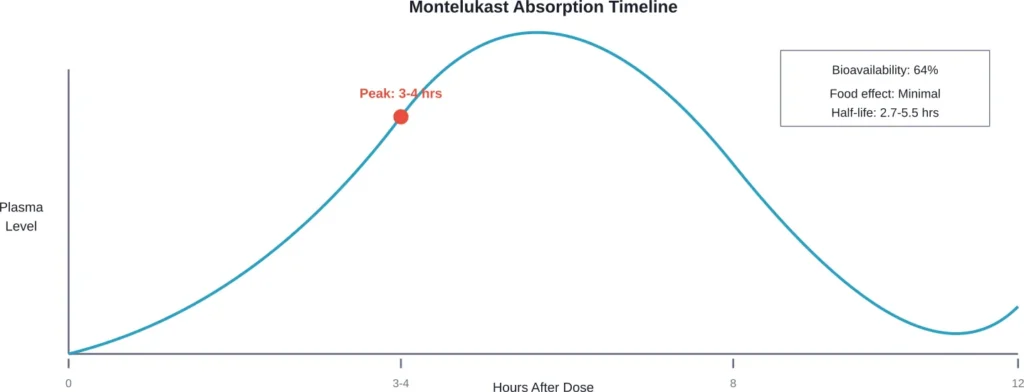
According to the National Institutes of Health, after taking a 10 mg tablet on an empty stomach, montelukast reaches peak plasma concentration in 3 to 4 hours. The oral bioavailability sits at 64%, meaning about two-thirds of the dose enters circulation.
Here’s what’s interesting: food doesn’t significantly affect morning bioavailability or peak concentration. The medication absorbs consistently whether taken with breakfast or on an empty stomach.
But the timing of that peak concentration matters for symptom prevention.
Why Evening Dosing Is Typically Recommended
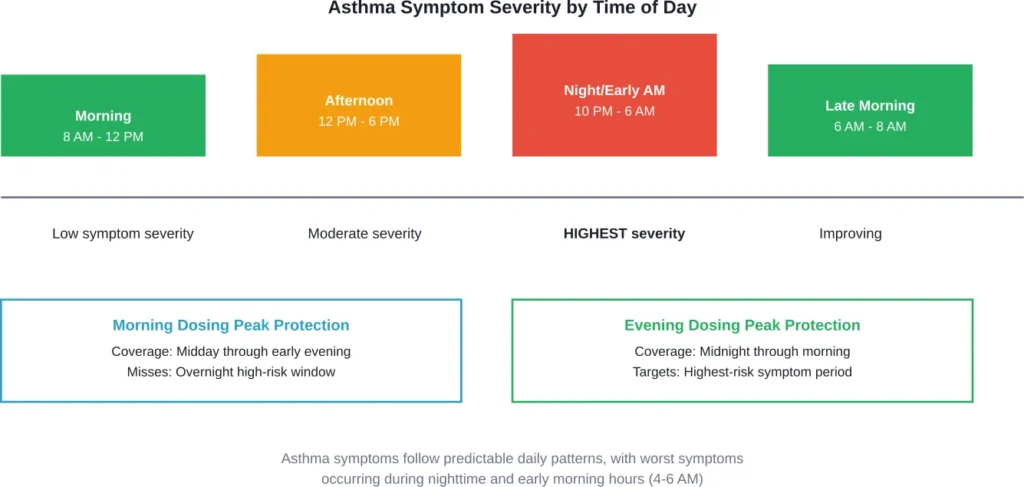
Asthma follows a circadian pattern. Symptoms consistently worsen during nighttime hours, peaking between 4 AM and 6 AM.
Research on pulsatile release formulations of montelukast has examined evening dosing strategies. The goal: deliver montelukast during early morning hours when asthma attacks most commonly occur.
When taken at bedtime around 8-10 PM, montelukast peaks around midnight to 2 AM. This creates protective levels during the high-risk window for breathing difficulties.
Research on cross-linked alginate beads has explored montelukast delivery timing for asthma symptom management.
Evening dosing also helps with allergic rhinitis. Morning nasal congestion and sneezing respond better when medication levels build overnight.
What Actually Happens With Morning Dosing
Taking montelukast in the morning shifts the protection window. Peak levels occur around midday to early afternoon instead of overnight.
Does this reduce effectiveness? Not necessarily.
According to the Asthma and Allergy Foundation of America, montelukast can be taken in the morning. The medication remains safe and continues providing symptom control.
The key consideration: what triggers need coverage? For daytime exercise-induced bronchoconstriction or daytime allergen exposure, morning dosing might actually provide better protection during peak activity hours.
Research has examined morning versus evening administration for preventing exercise-induced bronchoconstriction, with evidence supporting effectiveness regardless of dosing time.
Absorption and Food Effects
NIH data confirms food doesn’t significantly impact montelukast absorption when taken in the morning. A standard breakfast doesn’t reduce bioavailability or peak concentration.
This differs from some medications that require specific food timing. Montelukast offers flexibility.
That said, consistent timing matters more than the specific meal chosen. Taking montelukast with breakfast daily creates predictable blood levels.
Clinical Evidence on Timing Flexibility
Specific research examined whether montelukast’s effectiveness varies by dosing time for exercise-induced bronchoconstriction. The study included 24 children and evaluated both morning and evening administration.
Results showed montelukast prevented exercise-induced symptoms regardless of when children took their dose. However, the research noted that evening dosing remains the standard recommendation for asthma maintenance.
Research has examined the time-dependent efficacy of single-dose montelukast on exercise-induced asthma in pediatric patients. The focus was onset of action and duration, not specifically comparing morning versus evening.
What’s clear: montelukast works throughout a 24-hour period once steady-state levels are achieved with daily dosing.
| Dosing Time | Peak Concentration Window | Best For | Considerations |
|---|---|---|---|
| Evening (6-10 PM) | Midnight to 4 AM | Nighttime asthma, morning allergies | Standard recommendation, aligns with symptom patterns |
| Morning (7-9 AM) | Midday to early afternoon | Daytime triggers, medication adherence | Effective but less aligned with asthma circadian rhythm |
| Pre-exercise (2+ hours before) | During physical activity | Exercise-induced bronchoconstriction only | Single dose, not for daily maintenance |
Special Considerations for Different Conditions
Exercise-Induced Bronchoconstriction
For preventing breathing difficulties during exercise, timing rules change completely.
According to MedlinePlus, montelukast should be taken at least 2 hours before exercise when used specifically for this purpose. Peak levels during the workout provide optimal protection.
Critical warning: if already taking montelukast daily for asthma, don’t take an additional dose before exercise. The once-daily dose provides continuous protection. Taking extra doses within 24 hours isn’t recommended.
Allergic Rhinitis Only
Patients using montelukast solely for allergies (not asthma) have more flexibility. Drugs.com notes that while evening dosing remains standard, the medication’s 24-hour coverage means morning dosing works equally well for allergy control.
Consistent daily timing matters more than the specific hour chosen.
Combined Asthma and Allergies
According to Drugs.com prescribing information, patients with both asthma and allergic rhinitis should take only one dose daily in the evening. This single dose addresses both conditions.
Don’t take separate morning and evening doses for the two different conditions.
Practical Dosing Guidelines
Standard dosing according to Drugs.com:
- Adults and children 15+: one 10 mg tablet daily
- Children 6-14 years: one 5 mg chewable tablet daily
- Children 2-5 years: one 4 mg chewable tablet or granule packet daily
For oral granules, the NHS notes they must be taken within 15 minutes of opening the packet. They can be placed directly on the tongue or mixed with cold soft food like yogurt or ice cream.
Don’t dissolve granules in liquid. Don’t save mixed granules for later use.
What If You Switch Timing?
Switching from evening to morning dosing (or vice versa) is generally safe. The medication’s steady-state levels maintain coverage during the transition.
But here’s the thing: consistency matters more than timing perfection. Switching back and forth creates inconsistent blood levels and reduces effectiveness.
Choose one time and stick with it. If morning administration helps with medication adherence because it’s easier to remember, that consistency may outweigh the theoretical benefit of evening dosing.
Side Effects and Timing
Common side effects include headache, abdominal pain, and upper respiratory infections. These occur regardless of dosing time.
Serious neuropsychiatric events have been reported with montelukast, including agitation, depression, sleep disturbances, and suicidal thoughts. The FDA added a boxed warning about these risks.
Some patients wonder if evening dosing increases sleep-related side effects. Available evidence doesn’t show timing significantly affects the incidence of neuropsychiatric symptoms.
Anyone experiencing mood changes, behavioral shifts, or disturbing thoughts should contact their healthcare provider immediately, regardless of dosing time.
When Morning Dosing Makes Sense
Real talk: medication only works if it’s actually taken. Adherence beats theoretical optimization.
Morning dosing may be preferable when:
- Remembering evening medications proves consistently difficult
- Primary triggers occur during daytime hours (workplace allergens, afternoon exercise)
- Other evening medications already create a complex nighttime routine
- The patient experiences primarily daytime symptoms
Some patients report successfully using morning dosing without noticeable reduction in symptom control. Consistent daily use matters more than perfect timing.
The Bottom Line on Timing
Montelukast taken in the morning remains effective for asthma and allergy control. The medication absorbs well, reaches peak levels in 3-4 hours, and provides 24-hour coverage.
Evening dosing aligns better with asthma’s natural patterns, targeting nighttime inflammation when symptoms typically worsen. For classic asthma presentation, bedtime administration offers theoretical advantages.
But morning dosing isn’t wrong. It’s still effective, especially when improved adherence is the result. Consistent daily use at the same time beats perfectly timed doses that get skipped.
Talk with a healthcare provider about individual symptom patterns, trigger timing, and medication adherence challenges. The best dosing time is the one that controls symptoms while fitting into daily life.
Frequently Asked Questions
Yes, switching is generally safe. The medication maintains coverage during the transition. However, choose one consistent time rather than alternating, as consistency maintains steady blood levels and improves effectiveness.
According to NIH data, a standard meal doesn’t significantly influence oral bioavailability or peak concentration when montelukast is taken in the morning. The medication can be taken with or without breakfast.
MedlinePlus recommends taking montelukast at least 2 hours before exercise when used specifically for exercise-induced bronchoconstriction. If already taking it daily for asthma, don’t take an additional pre-exercise dose within 24 hours.
Morning dosing shifts peak protection to daytime hours, which may reduce overnight coverage compared to evening dosing. However, the medication still provides 24-hour control. Discuss symptom patterns with a healthcare provider to optimize timing.
Evening typically means between 6 PM and 10 PM. The goal is achieving peak levels during overnight hours when asthma symptoms worsen. Consistency matters more than the exact hour chosen.
Yes, children can take montelukast in the morning. Research on exercise-induced bronchoconstriction showed effectiveness regardless of dosing time in pediatric patients. Adherence is especially important for children, so choose the time that ensures consistent daily dosing.
Montelukast reaches peak blood levels 3-4 hours after a single dose and begins working relatively quickly. However, full therapeutic benefit for asthma control typically develops with consistent daily dosing over several days to weeks.