

Quick Summary: BIM modeling (Building Information Modeling) is a digital process that creates intelligent 3D models containing detailed information about a building’s physical and functional characteristics. These models enable architects, engineers, and construction professionals to collaborate more effectively throughout a project’s lifecycle, from initial design through construction to facility management.
The construction industry has undergone a massive transformation over the past two decades. What used to require stacks of paper blueprints and endless coordination meetings now happens in shared digital environments where everyone sees the same information in real time.
That transformation? It’s powered by BIM modeling.
But here’s the thing—Building Information Modeling isn’t just fancy 3D drawings. It’s a fundamental shift in how buildings and infrastructure get planned, designed, constructed, and managed. And the numbers back that up: one study by McKinsey found that 75% of companies adopting BIM reported positive returns on their investments.
So what exactly is BIM modeling, and why has it become the standard approach for modern construction projects?
Understanding BIM Modeling: Beyond the Basics
Building Information Modeling represents both a technology and a process. At its core, BIM creates digital representations of buildings and infrastructure that contain far more than geometric data.
Think of a traditional CAD drawing. It shows lines, shapes, and dimensions. A BIM model, on the other hand, contains intelligent objects that understand what they are. A wall knows it’s a wall. It knows its materials, thermal properties, cost, manufacturer, installation date, and maintenance requirements.
This intelligence transforms how projects get delivered. Instead of separate drawings for architecture, structure, and mechanical systems, BIM creates a unified model where all disciplines work together. When the architect moves a wall, the structural engineer and mechanical contractor see that change immediately.
The Digital Representation Advantage
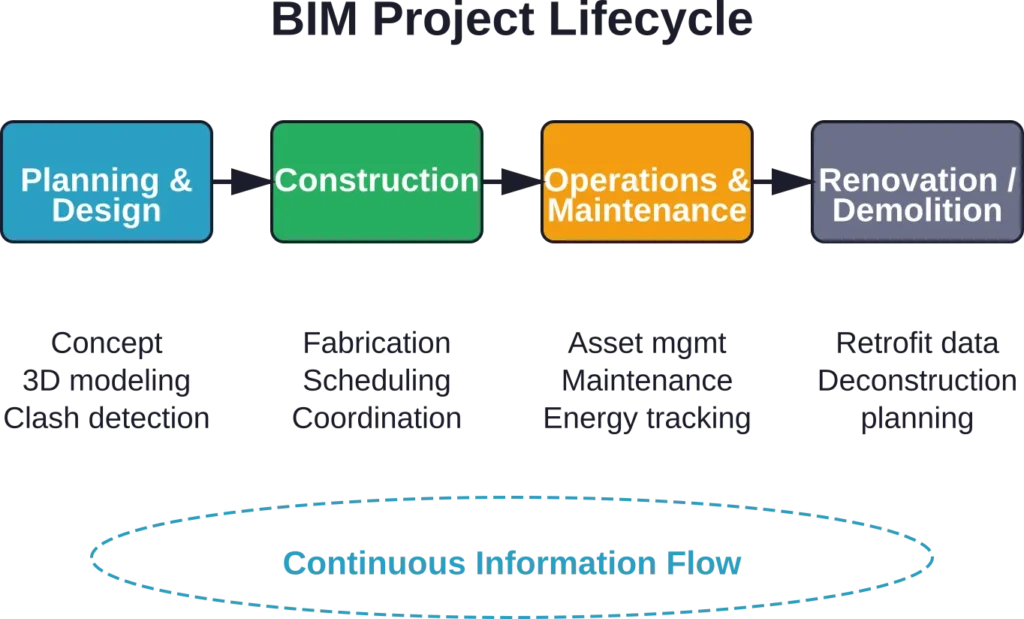
BIM models serve as shared knowledge resources for information about facilities. They form a reliable basis for decisions throughout a building’s lifecycle—from initial conception through demolition.
According to buildingSMART International, the organization behind IFC (Industry Foundation Classes) standards, BIM provides machine interpretability of information and thereby enables automation of workflows. It’s vendor-neutral and available to everyone, published under ISO 16739.
Real talk: this standardization matters. The construction industry historically struggled with software interoperability. A 2004 National Institute of Standards and Technology report conservatively estimated that $15.8 billion was lost annually by the U.S. capital facilities industry due to inadequate interoperability.
How BIM Modeling Actually Works
The BIM process differs significantly from traditional design and construction workflows. Instead of sequential handoffs—architect finishes, passes to engineer, then to contractor—BIM enables simultaneous collaboration.
Here’s how it typically unfolds:
Project teams establish information requirements early. ISO 19650 standards, which provide the international framework for BIM implementation, require appointing parties to define exchange information requirements at project outset. This ensures everyone knows what information needs capturing and when.
Design teams then build the model collaboratively. Architects create the building envelope and spatial layouts. Structural engineers add load-bearing systems. MEP (mechanical, electrical, plumbing) engineers route systems through the structure. All within the same coordinated environment.
The model evolves throughout the project. During construction, it becomes the reference for fabrication and installation. After completion, facility managers use it for operations and maintenance. Some organizations maintain these models for decades, updating them as buildings change.
Model View Definitions and Data Exchange
Not every stakeholder needs every piece of information. An energy analyst doesn’t need detailed door hardware specs. A cost estimator doesn’t need HVAC control sequences.
That’s where Model View Definitions come in. According to buildingSMART Technical documentation, MVDs are subsets of the IFC schema created for specific data exchange needs between software platforms. They must be recognized as separate standards in their own right—not just filters applied to a complete model.
This targeted data exchange improves efficiency. Teams extract only the information relevant to their specific tasks, reducing file sizes and processing time while maintaining data integrity.
Key Benefits That Drive BIM Adoption
Organizations don’t adopt BIM because it’s trendy. They adopt it because it delivers measurable improvements across multiple dimensions.
Cost Reduction and Risk Mitigation
BIM catches problems before they reach the construction site. Clash detection identifies conflicts between building systems—like a duct running through a beam—during design rather than in the field.
The financial impact? Significant. Those McKinsey findings showing 75% positive ROI reflect costs reduced through fewer change orders, less rework, and more accurate material quantities.
Construction delays drop when coordination happens digitally. Building components can be prefabricated to exact specifications derived directly from the model, arriving on site ready for installation.
Enhanced Collaboration Across Disciplines
BIM fundamentally changes team dynamics. Instead of working in silos with periodic coordination meetings, disciplines collaborate continuously within the shared model environment.
An architect adjusting room layouts sees immediate feedback about structural implications. The mechanical engineer understands spatial constraints for equipment. The contractor identifies installation sequences that minimize trade conflicts.
This collaborative approach particularly benefits complex projects—hospitals, data centers, transit facilities—where system integration determines success.
Improved Project Delivery Speed
Parallel workflows enabled by BIM compress project schedules. Traditional sequential processes—wait for architecture completion before starting engineering—give way to concurrent development.
Design decisions happen faster when impacts are visible immediately. Questions get answered within the model rather than through RFI cycles that can take days or weeks.
BIM Standards and Protocols
For BIM to work across organizations and borders, standards are essential. Several frameworks now govern how BIM gets implemented globally.
ISO 19650 Series
The ISO 19650 series provides the international standard for information management using building information modeling. Part 1 covers concepts and principles. Part 2 addresses the delivery phase of assets.
These standards establish clear requirements. For instance, ISO 19650 mandates that appointing parties establish project information standards and protocols at project initiation. This ensures all participants understand information requirements, exchange formats, and delivery timelines.
More recently, ISO 19650-6 addresses health and safety information—recognition that BIM should capture safety-critical data throughout the building lifecycle.
Industry Foundation Classes
IFC provides the universal language for BIM. As an open, international standard (ISO 16739-1:2024), IFC enables data exchange between different software platforms without proprietary limitations.
According to buildingSMART, adoption of IFC produces significant time and cost saving benefits. Information sharing, collaboration, integration, and effective communication between all parties becomes possible through this common schema.
The results speak for themselves. In Finland, IFC is being used by 60% of Finnish municipalities for submitting planning applications in 3D, demonstrating real-world viability at scale.
| Standard | Focus Area | Key Benefit |
|---|---|---|
| ISO 19650-1 | Concepts and principles | Establishes common terminology and workflows |
| ISO 19650-2 | Delivery phase management | Defines information requirements and exchange protocols |
| ISO 16739 (IFC) | Data schema specification | Enables vendor-neutral data exchange |
| BCF (BIM Collaboration Format) | Issue management | Standardizes communication about model-based issues |
Common BIM Software and Tools
The BIM ecosystem includes dozens of software applications, each serving specific purposes within the overall workflow.
Authoring tools—like Autodesk Revit, Graphisoft Archicad, and Bentley MicroStation—create the primary building models. These platforms enable architects, engineers, and contractors to develop detailed representations of building systems.
Coordination platforms such as Navisworks aggregate models from multiple disciplines, enabling clash detection and construction sequencing. They don’t create geometry but analyze it.
Specialized applications handle specific tasks. Energy analysis tools evaluate building performance. Quantity takeoff software extracts material counts for estimating. Facility management systems use BIM data for operational decisions.
The key? Interoperability. Check software documentation for IFC certification and compatibility with project standards before committing to specific tools.
Get BIM Modelling Support for Design and Coordination

BIM modelling helps project teams coordinate design information, technical systems, and construction documentation within a shared digital workflow. Powerkh supports BIM delivery with modelling, coordination, and technical documentation services.
Need BIM Modelling Support?
Talk with Powerkh to:
- develop BIM models for project delivery
- support structural and MEP coordination
- prepare technical drawings and documentation
- improve collaboration across design teams
Talk with Powerkh about BIM coordination and modelling support.
Implementing BIM: Critical Success Factors
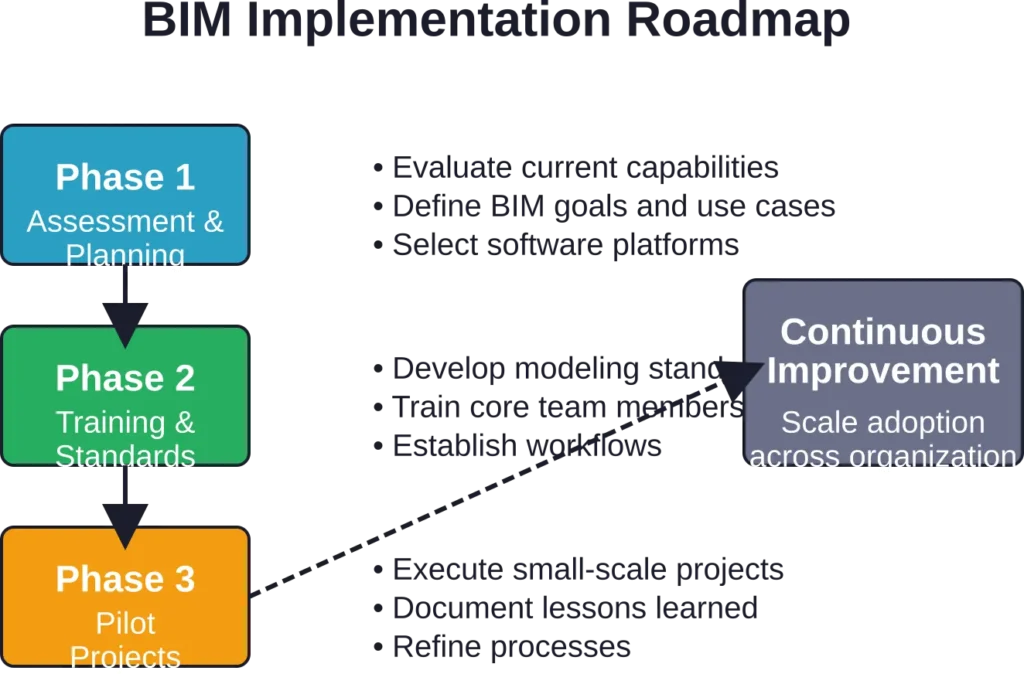
Adopting BIM involves more than buying software. Successful implementation requires strategic planning and organizational commitment.
Establish Clear Information Requirements
Start by defining what information the project actually needs. Not every project requires the same level of detail or the same data attributes.
Owner organizations should develop BIM requirements documents that specify standards meeting their needs for planning, design, construction, and operations. The National Institute of Building Sciences calls these Project BIM Requirements, and they define the ways BIM will be used on specific projects.
Invest in Training and Process Development
Software skills matter, but understanding BIM workflows matters more. Teams need to grasp how information flows between disciplines, when data gets exchanged, and how models support decision-making.
Many organizations underestimate this learning curve. Plan for it. Allocate time and resources for team development.
Start with Pilot Projects
Don’t launch BIM on the most complex, high-stakes project. Choose pilot projects that allow learning without catastrophic consequences if things go wrong.
Document lessons learned. Refine processes based on actual experience. Scale gradually as competence grows.
BIM and Emerging Technologies
BIM doesn’t exist in isolation. It increasingly connects with other technologies to expand capabilities and value.
Digital twins extend BIM into operations. These real-time digital replicas of physical buildings connect BIM models with IoT sensors, creating dynamic representations that reflect current building conditions and performance.
Artificial intelligence and machine learning analyze BIM data to optimize designs, predict maintenance needs, and identify patterns humans might miss. Generative design tools explore thousands of design options based on performance criteria.
Reality capture through laser scanning and photogrammetry creates as-built BIM models of existing facilities. This technology proves particularly valuable for renovation projects where original design documentation may be incomplete or inaccurate.
Challenges and Limitations
BIM delivers significant benefits, but implementation isn’t without obstacles.
Upfront costs can be substantial. Software licenses, hardware upgrades, training programs, and process development require investment before returns materialize.
The learning curve is real. Teams accustomed to traditional workflows need time to adapt. Productivity often drops initially before improving.
Legal and contractual frameworks haven’t fully caught up with BIM workflows. Questions about model ownership, liability for model accuracy, and insurance coverage require careful consideration. Academic research at Cal Poly highlights these legal considerations, noting that while owners may believe they’re entitled to own the model, the rights of architects and other contributors need clear definition.
Interoperability remains imperfect despite standards like IFC. Data translation between platforms sometimes loses information or introduces errors. Teams must verify data integrity when exchanging models.
The Future of BIM Modeling
BIM continues evolving as technologies mature and adoption spreads.
Cloud-based collaboration platforms remove geographic barriers. Teams distributed across continents work within shared model environments as if they occupied the same office.
Mobile BIM applications bring model access to the construction site. Field personnel view models on tablets, verify installations against design intent, and document conditions directly within the model environment.
Integration with project management and enterprise systems creates seamless information flow from design through procurement, construction, and operations. BIM data feeds directly into cost tracking, scheduling, and facility management platforms.
Government mandates accelerate adoption. Many countries now require BIM for public projects, driving industry-wide competence development. The U.S. General Services Administration includes BIM requirements in facilities standards for federal building projects, following similar requirements in the UK, Scandinavia, and Singapore.
Frequently Asked Questions
CAD (Computer-Aided Design) creates geometric representations—lines, arcs, and shapes—without embedded intelligence. BIM builds object-oriented models where elements understand what they are and how they relate to other components. A BIM door knows it’s a door, its dimensions, materials, cost, and fire rating. A CAD drawing shows door geometry but contains no additional data.
Pricing varies significantly based on platform, licensing model, and feature sets. Check vendor websites for current pricing, as costs change frequently and differ by region. Most major BIM platforms now use subscription models rather than perpetual licenses. Consider total cost of ownership including training, hardware requirements, and ongoing support.
Absolutely. While BIM is associated with large complex projects, small firms gain advantages too. Improved coordination reduces errors even on modest projects. Better visualization helps clients understand designs. As-built models support future renovation work. Many smaller practices start with basic BIM capabilities and expand as competence grows.
Not at all. BIM proves valuable for renovation, retrofit, and facility management projects. Reality capture technologies create BIM models of existing buildings. These models then support renovation planning, system upgrades, and ongoing operations. Many facility owners now maintain BIM models of their entire building portfolios.
BIM training operates on two levels. Software training teaches specific tool operation—how to model in Revit, coordinate in Navisworks, or analyze in specialized applications. Process training addresses BIM workflows, information management, collaboration protocols, and standards compliance. Both matter. Technical skills without process understanding limits BIM effectiveness.
BIM excels at managing changes because modifications propagate automatically through coordinated models. Change a beam size, and all related drawings, schedules, and quantities update. This coordination reduces errors that occur in traditional workflows when changes in one document don’t reach others. Version control systems track model evolution over time.
BIM projects use multiple file formats. Native formats are specific to each software platform—RVT for Revit, PLN for Archicad. IFC provides the open standard for data exchange between platforms. BCF (BIM Collaboration Format) communicates issues and coordination points. Many projects also generate traditional outputs—PDFs, DWG files, specifications—from BIM models for stakeholders not working directly in BIM environments.
Getting Started with BIM Modeling
Ready to begin your BIM journey? Start with education. Understand what BIM can and can’t do for your specific situation.
Define clear objectives. What problems are you trying to solve? Better coordination? Faster approvals? Improved facility management? Specific goals drive effective implementation strategies.
Connect with the broader BIM community. Organizations like buildingSMART provide resources, standards, and educational materials. Industry associations offer training and certification programs. Online communities share practical implementation experiences.
BIM represents a fundamental shift in how the built environment gets created and managed. The technology enables new levels of collaboration, coordination, and information management throughout building lifecycles.
But technology alone doesn’t deliver results. Successful BIM adoption requires commitment to new processes, investment in training, and willingness to change established workflows.
The construction industry continues finding ways to become more efficient and effective. BIM modeling stands as a proven approach that’s transforming how buildings and infrastructure get delivered—from initial concept through decades of operational life.
Whether you’re an architect exploring design options, an engineer coordinating complex systems, a contractor planning construction sequences, or a facility manager maintaining existing buildings, BIM offers capabilities that weren’t possible a generation ago.
The question isn’t whether to adopt BIM. For most organizations, it’s how to adopt it effectively—building competence, establishing standards, and capturing value throughout project lifecycles.