

Quick Summary: Amazon sellers in 2026 have access to dozens of powerful free tools that cover product research, keyword tracking, profit calculation, and competitor analysis. The best free resources include Amazon Seller Central’s native Business Reports and Brand Analytics, Keepa for price history tracking, WisePPC, Jungle Scout’s Sales Estimator, and Sonar for keyword discovery. While paid tools offer automation and deeper insights, strategic use of free tools can launch and grow an Amazon FBA business without upfront software costs.
Launching an Amazon FBA business doesn’t require a massive software budget. The landscape of free tools has matured significantly, and sellers can now access professional-grade data without spending a cent upfront.
But here’s the thing—not all free tools deliver real value. Some offer limited searches that run out within hours. Others gate their best features behind paywalls disguised as “free trials.” The challenge isn’t finding free tools; it’s finding the ones that actually work.
This guide focuses on tools that provide genuine utility without hidden costs, combining native Amazon features with third-party solutions that have earned trust in seller communities over the past several years.
Why Free Tools Matter in 2026
The Amazon seller software market has grown crowded. Premium platforms charge anywhere from $49 to several hundred dollars monthly, creating a significant barrier for new sellers testing product ideas or operating on tight margins.
Free tools level the playing field. They allow sellers to validate products, track competitors, and analyze market trends before committing to paid subscriptions. Many experienced sellers continue using free tools even after scaling, reserving premium software for specific use cases where automation justifies the cost.
According to community discussions across seller forums, many successful sellers still rely primarily on free tools combined with manual analysis rather than full-suite paid platforms. The key is knowing which tools to combine and how to use them efficiently.
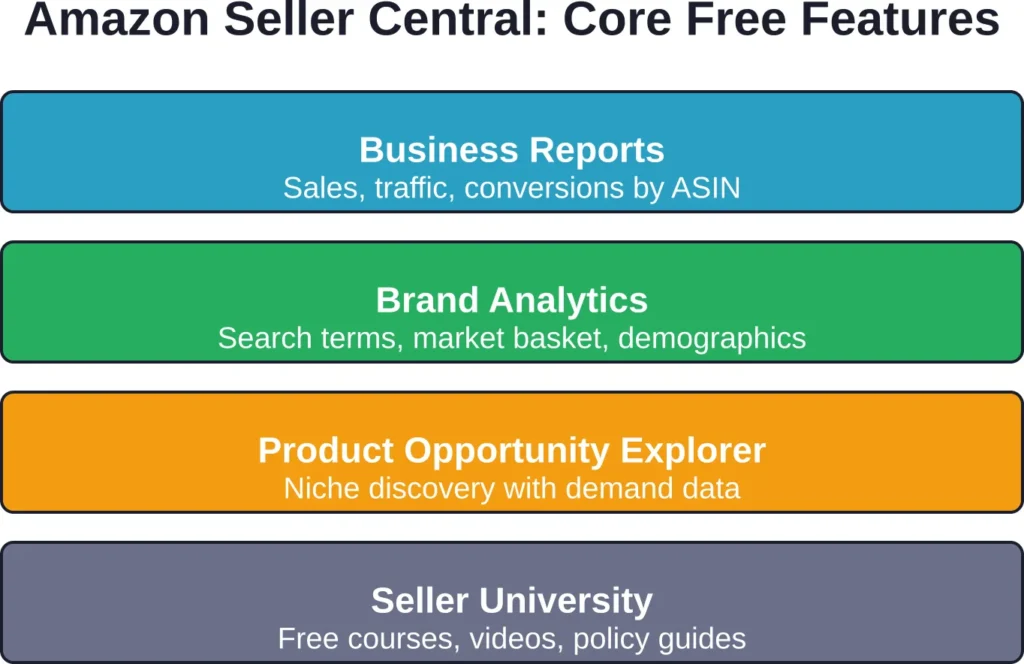
Amazon Seller Central: Your First and Most Powerful Free Tool
Amazon provides sellers with a comprehensive analytics suite directly within Seller Central—completely free with your seller account. These native tools often get overlooked because sellers assume third-party software offers superior data.
Real talk: Amazon’s own data is the most accurate because it comes directly from the source. Third-party tools estimate and extrapolate; Amazon reports show exactly what happened in your account.
Business Reports
Business Reports provide detailed metrics on sales, traffic, and conversion rates. The dashboard tracks sessions, page views, Buy Box percentage, units ordered, and total sales—all broken down by ASIN, date range, and marketplace.
For diagnosing sales drops or identifying high-performing products, Business Reports are essential. The mobile app also provides quick access to key metrics, though the desktop version offers more granular filtering options.
Brand Analytics
Brand Registry members get free access to Brand Analytics, which includes Amazon Search Terms reports, Market Basket Analysis, and Demographics data. The Search Terms report shows top search keywords, click share, and conversion share—data that typically costs money from third-party tools.
This feature alone can replace paid keyword research tools for many sellers, particularly when launching new products or optimizing existing listings.
Product Opportunity Explorer
Product Opportunity Explorer identifies niches with customer demand and manageable competition. It surfaces search terms with high click volumes but lower competition metrics, helping sellers discover product opportunities before they become saturated.
The tool is available to Professional sellers and provides data on search volume, average price points, and competitive density—information that would typically require premium subscriptions elsewhere.
Seller University and Training Resources
Amazon Seller University offers free courses, video tutorials, and guides covering account setup, listing optimization, inventory management, advertising fundamentals, and international expansion. The content is official, accurate, and regularly updated—unlike some third-party courses that may contain outdated or incorrect information.
As one Seller Central moderator noted, Amazon provides comprehensive, free learning resources that eliminate the need for expensive third-party courses promising “secret strategies.” The platform includes step-by-step tutorials, policy guides, and performance issue resolution frameworks.
WisePPC: Amazon PPC Optimization & Analytics

WisePPC is a powerful analytics and automation platform built specifically for Amazon (and multi-marketplace) sellers to manage, optimize, and scale their PPC campaigns. It connects directly to Amazon Ads API, providing deep visibility into performance with long-term historical data storage, bulk actions, advanced filtering, and real-time insights far beyond what Amazon’s native console offers.
Sellers use WisePPC to cut wasted ad spend, improve ACoS/TACoS, identify winning keywords and placements, and make data-driven bid adjustments at scale. With features like gradient-highlighted tables, multi-metric charts, placement-level analysis, and bulk editing of thousands of targets, it turns overwhelming campaign data into clear, actionable decisions.
The platform is currently in open beta with generous free access (no credit card required for early users) and offers lifetime perks for beta testers. While some advanced automation features are still rolling out, core analytics, historical data retention, bulk tools, and campaign management are already fully functional and deliver immediate value for both new and experienced Amazon advertisers.
For sellers serious about profitable PPC growth, WisePPC stands out as a centralized, intuitive hub that replaces spreadsheets and guesswork with professional-grade campaign intelligence.
Contact Information:
- Website: wiseppc.com
- Facebook: www.facebook.com/people/Wise-PPC/61573154427547
- LinkedIn: www.linkedin.com/company/wiseppc
- Instagram: www.instagram.com/wiseppc
Keepa: Price History and Tracking

Keepa is the gold standard for Amazon price and sales rank history tracking. The browser extension and website are free, displaying historical price charts, sales rank graphs, and Buy Box winner data directly on Amazon product pages.
Sellers use Keepa to identify pricing trends, spot seasonal demand patterns, and evaluate product stability before sourcing. A product with volatile pricing and erratic sales rank signals potential supply issues or saturated competition.
The free version limits certain data points and tracking alerts, but the core price history and sales rank charts remain fully accessible. For product research and competitive analysis, the free tier delivers substantial value.
Jungle Scout Sales Estimator (Free Version)

Jungle Scout offers a free sales estimator tool that converts Amazon Best Seller Rank (BSR) into estimated monthly sales figures. Enter a product’s category and BSR, and the tool returns a sales estimate.
While the free estimator lacks the precision of Jungle Scout’s paid database, it provides a useful ballpark figure when evaluating product potential. Sellers can manually check BSR on product pages and run quick estimates without committing to a subscription.
The tool is particularly helpful during initial product screening—filtering out products with insufficient sales volume before investing time in deeper research.
Amazon FBA Revenue Calculator

Amazon’s FBA Revenue Calculator is often underutilized despite being one of the most practical free tools available. It calculates FBA fees, referral fees, and estimated profit based on product dimensions, weight, category, and price.
Accurate profit calculation is fundamental. Many sellers misjudge profitability by overlooking dimensional weight charges or category-specific referral fees. The FBA calculator eliminates guesswork, showing exactly what Amazon will charge before sourcing inventory.
The tool also compares FBA versus FBM (Fulfillment by Merchant) costs, helping sellers decide which fulfillment method maximizes margins for specific products.
Sonar by Sellics: Keyword Research
Sonar is a free Amazon keyword tool that generates keyword suggestions based on seed terms. Enter a product-related keyword, select the marketplace, and Sonar returns hundreds of related search terms pulled from Amazon’s database.
The tool doesn’t provide search volume data in the free version, but the keyword list itself is valuable for listing optimization and PPC campaign development. Sellers can identify long-tail variations and niche terms competitors might miss.
Sonar works across multiple Amazon marketplaces, making it particularly useful for international sellers validating keyword relevance in different languages and regions.
Google Trends: Market Validation

Google Trends isn’t Amazon-specific, but it’s invaluable for assessing product seasonality and long-term demand trends. Search interest over time reveals whether a product category is growing, declining, or seasonal.
Before sourcing products with high upfront costs, sellers can validate sustained interest. A product showing declining search trends over several years may indicate a saturated or fading market—valuable insight that can prevent costly inventory mistakes.
Google Trends also compares multiple search terms, helping sellers choose between similar product variations based on consumer interest levels.
SellerSprite Free Features

SellerSprite offers a mix of free and paid features, with the free tier providing limited keyword searches, product tracking, and basic market analysis. The platform supports multiple marketplaces including the US, UK, EU, and Japan.
Free users can run daily keyword searches and access limited competitor tracking. While the free version imposes search limits, strategic use during product research phases can yield valuable insights without subscription costs.
The tool also includes reverse ASIN lookup in limited quantities, allowing sellers to extract competitor keywords for listing optimization.
Amazon Request a Review Button
Embedded directly in Seller Central, the Request a Review button allows sellers to solicit customer feedback in a single click. This free feature automates review requests without third-party email software or subscription fees.
According to BrightLocal research, a significant majority of consumers trust online reviews as much as personal recommendations as much as personal recommendations. Review velocity directly impacts click-through rates and conversion, making this simple tool surprisingly impactful.
The feature is fully compliant with Amazon policies, eliminating the risk associated with aggressive third-party review solicitation methods.
ZIK Analytics (Limited Free Access)

ZIK Analytics primarily targets eBay sellers but offers Amazon product research features in its free tier. The platform provides limited searches for product opportunities, competitor analysis, and niche discovery.
While not as robust as dedicated Amazon tools, ZIK’s free searches can supplement other research methods, particularly for sellers operating across multiple platforms who want consolidated data access.
Limitations of Free Tools and When to Upgrade
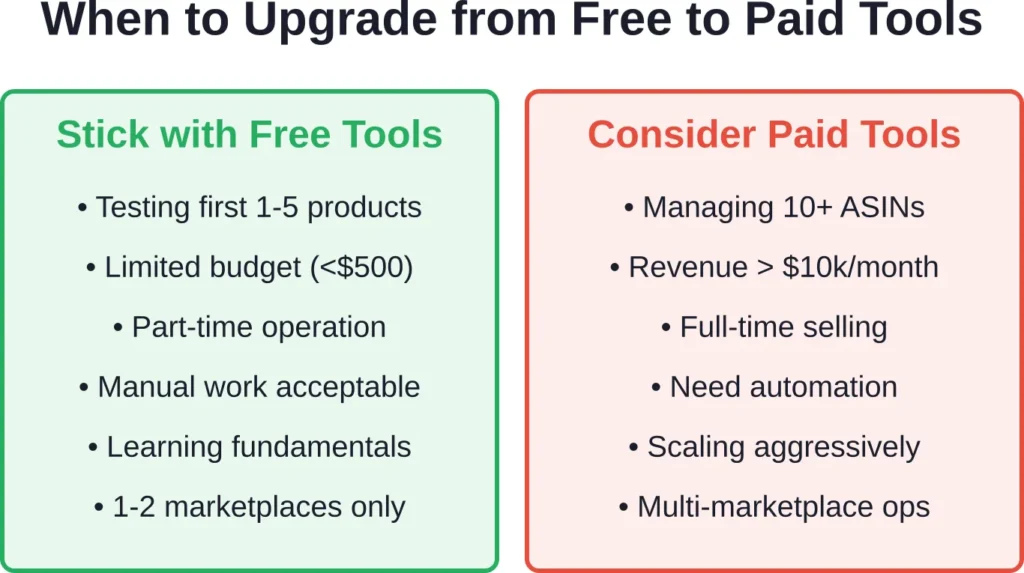
Free tools come with constraints. Limited searches, restricted data access, and lack of automation mean sellers invest more time in manual analysis. For high-volume sellers or those managing large catalogs, the time cost eventually exceeds the subscription cost of premium software.
But wait. That doesn’t mean free tools aren’t viable long-term. Many sellers build profitable businesses using exclusively free resources by focusing on fewer, better-researched products rather than launching dozens of ASINs simultaneously.
The decision to upgrade hinges on scale and time value. If manual research consumes hours that could generate more revenue elsewhere, paid tools justify their cost. If launching cautiously with limited capital, free tools provide everything needed to validate and launch initial products.
| Tool Category | Best Free Option | Key Limitation | When to Upgrade |
|---|---|---|---|
| Product Research | Product Opportunity Explorer + Jungle Scout Estimator | Limited daily searches, no automation | Managing 10+ ASINs or launching multiple products monthly |
| Keyword Research | Sonar + Brand Analytics | No search volume data (Sonar) | Running large PPC campaigns requiring precise bid data |
| Price Tracking | Keepa (free tier) | Limited alerts, no API access | Tracking 20+ competitors or needing instant repricing |
| Profit Analytics | FBA Calculator + Business Reports | Manual calculation, no COGS tracking | Need automated P&L across multiple marketplaces |
Combining Free Tools for Maximum Impact
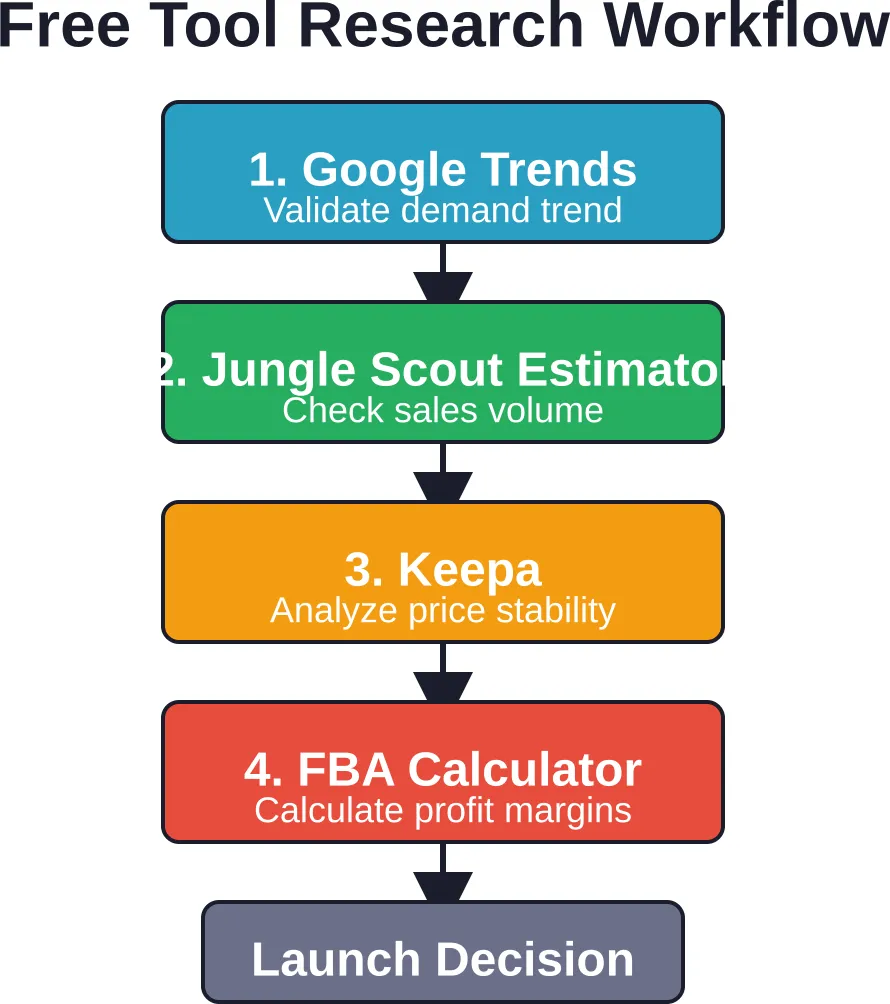
The real power emerges when combining multiple free tools into a cohesive workflow. Start with Google Trends to validate demand longevity. Use Product Opportunity Explorer to identify specific niches. Check sales estimates with Jungle Scout’s free calculator, then verify pricing stability with Keepa.
Once a product passes these filters, run profit calculations through Amazon’s FBA calculator. Use Sonar to build a keyword list, then cross-reference top terms against Brand Analytics search data. Launch the product and monitor performance through Business Reports.
This workflow costs nothing and covers the full product lifecycle from research through performance monitoring. The limitation is time—each step requires manual input. But for sellers validating their first products or operating part-time, the time investment is manageable and the financial risk is minimal.
Tools to Avoid: Free in Name Only
Some “free” tools are marketing funnels disguised as utilities. They offer one or two free searches, then gate all meaningful data behind immediate upgrade prompts. Others provide genuinely free access but harvest and resell user data—a risky proposition given Amazon’s strict policies on data sharing.
Community discussions highlight tools that promise free access but require credit card information for “trials” that auto-convert to paid subscriptions. These aren’t inherently malicious, but they’re not truly free either. Genuine free tools—like those listed here—require no payment information and provide ongoing access without bait-and-switch tactics.
Emerging Trends: AI Features in Free Tools
Several free tools have begun incorporating AI-assisted analysis for trend prediction, listing optimization suggestions, and competitor monitoring. While premium platforms offer more sophisticated AI features, even free tiers now include basic machine learning models that surface insights from large datasets.
SellerSprite’s free tier includes limited AI-powered keyword suggestions. Amazon’s own Product Opportunity Explorer uses algorithms to surface trending niches. These features don’t replace human judgment, but they accelerate initial filtering when evaluating hundreds of potential products.
The trend toward AI democratization means free tools will continue improving, narrowing the capability gap with premium software—at least for core research functions. Automation and scale will remain the primary differentiators for paid platforms.
Building a Free Tool Stack: A Practical Example
A practical free tool stack for a new seller might include Amazon Seller Central (Business Reports, Brand Analytics, Product Opportunity Explorer), Keepa for price tracking, Jungle Scout’s free estimator for sales validation, Sonar for keyword discovery, Google Trends for demand trends, and the FBA Revenue Calculator for profit analysis.
This combination covers product research, keyword optimization, competitor monitoring, and profit calculation—the core pillars of Amazon FBA success. The entire stack costs zero dollars and integrates through manual workflows that take 2-4 hours per product researched.
As the business scales, sellers can selectively add paid tools where bottlenecks emerge—perhaps a premium keyword tracker once PPC spend justifies precise bid optimization, or automated repricing software once managing multiple high-volume ASINs.
Frequently Asked Questions
Yes. Amazon Seller Central provides comprehensive analytics, Amazon’s FBA calculator handles profit projections, and free tools like Keepa, Sonar, and Jungle Scout’s estimator cover research needs. Many sellers launch profitable products using exclusively free resources, though manual workflows require more time investment than automated paid platforms.
No single free tool replicates the full functionality of premium suites, but combining Amazon’s Product Opportunity Explorer for niche discovery, Jungle Scout’s free sales estimator for volume validation, Keepa for price tracking, and Sonar for keywords creates a comprehensive free stack covering most core research functions.
Tools from reputable providers like Amazon’s native features, Keepa, Sonar, and Jungle Scout’s free estimator are safe. Avoid tools requiring Seller Central login credentials (except Amazon’s official apps), tools promising unrealistic data access, or platforms requesting excessive permissions. Stick to established tools with transparent privacy policies and active user communities.
Premium Amazon seller software typically costs $49-$300 monthly. Using free tools exclusively eliminates this recurring expense—potentially resulting in significant annual savings. The tradeoff is time; manual research using free tools takes 2-4x longer than automated platforms. Calculate whether your hourly opportunity cost justifies subscription fees as your business scales.
Free sales estimators like Jungle Scout’s tool provide ballpark figures, not precise data. Accuracy depends on category, BSR volatility, and seasonality. For initial product screening, this accuracy suffices. Final sourcing decisions should incorporate multiple data points including pricing trends, review velocity, and competitive density—not estimates alone.
Absolutely. Tools provide data and efficiency, but they don’t replace product selection judgment, supplier negotiation skills, listing optimization expertise, or customer service quality. Sellers using free tools can compete by focusing on fewer, better-researched products and leveraging manual analysis where paid users rely on automation. Success correlates more strongly with execution quality than tool cost.
Upgrade when manual workflows consume time worth more than subscription costs, typically when managing 10+ ASINs, generating $10,000+ monthly revenue, running substantial PPC campaigns requiring precise bid optimization, or expanding to multiple international marketplaces. If research bottlenecks prevent launching profitable products, paid tools justify their expense. Otherwise, free tools remain viable indefinitely.
Final Thoughts
Free Amazon seller tools have evolved from basic calculators into sophisticated research platforms capable of supporting profitable businesses from launch through scaling. The key is strategic combination—no single free tool does everything, but a well-constructed stack covers all essential functions.
Start with Amazon’s native features in Seller Central. These provide the most accurate data and comprehensive analytics at zero cost. Layer in Keepa for competitive intelligence, Jungle Scout’s estimator for sales validation, Sonar for keyword discovery, and Google Trends for market validation. This foundation costs nothing and eliminates the most common product research mistakes.
As the business grows, evaluate paid tools based on specific bottlenecks rather than general capability. If keyword research consumes excessive time, upgrade that function. If competitor tracking across dozens of ASINs becomes unmanageable, add automated monitoring. Selective upgrades maximize value while controlling costs.
The tools matter less than the process. Sellers using free resources but following rigorous research methodologies outperform those with premium software but inconsistent analysis. Master the fundamentals with free tools, then add paid features where they genuinely multiply results rather than simply duplicating manual work at higher cost.