

Quick Summary: Amazon repricer tools automate price adjustments to help sellers win the Buy Box and stay competitive. The best options in 2026 include Seller Snap (AI-driven, supports 21 marketplaces), Aura Repricer (game theory algorithms), and BQool (budget-friendly with multi-channel support). Plans typically start around $99-$100/month, with some platforms offering trial periods.
Pricing products on Amazon isn’t a set-it-and-forget-it task anymore. The marketplace changes by the minute, with competitors adjusting prices, Buy Box ownership shifting, and inventory levels fluctuating. Manual repricing? That’s a losing strategy when sellers are managing hundreds or thousands of SKUs.
Amazon repricer tools solve this problem by automatically adjusting prices based on real-time market conditions, competitor behavior, and custom business rules. But not all repricing software is created equal. Some use outdated rule-based logic while others deploy sophisticated AI algorithms. Some support only Amazon while others handle multichannel selling.
This guide breaks down the best Amazon repricer tools available in 2026, comparing features, pricing structures, and performance to help sellers choose the right solution for their business model.
Streamline Operations and Scale Performance with WisePPC

For sellers looking to move beyond simple repricing and focus on holistic performance, WisePPC provides a comprehensive analytics and optimization toolkit. As an Amazon Ads Verified Partner, the platform focuses on centralized data management and actionable insights to improve advertising efficiency and overall marketplace growth.
Key capabilities for marketplace sellers include:
- Unified Analytics: Consolidates data from Amazon and other marketplaces into a single dashboard, eliminating the need for manual spreadsheets or third-party reporting tools.
- Long-Term Data Retention: Stores historical performance data indefinitely, bypassing Amazon’s standard 60-90 day limitation to facilitate trend analysis and seasonal planning.
- Bulk Campaign Optimization: Enables simultaneous updates to bids, budgets, and targeting across thousands of campaigns, reducing manual administrative tasks.
- Real-Time Performance Tracking: Provides immediate visibility into key metrics such as TACOS, ACOS, and profit margins, allowing for faster reactions to marketplace shifts.
- Granular Filtering: Offers deep segmentation of campaign data by cost type, match type, and placement to identify the specific drivers of revenue.
To begin optimizing your marketplace presence, register for an account at WisePPC.
What Is an Amazon Repricer and Why Sellers Need One
An Amazon repricer is software that automatically adjusts product prices on Amazon based on predefined rules or algorithms. The goal is simple: win the Buy Box, maximize profit margins, and stay competitive without constant manual intervention.
Here’s the thing though—the Buy Box drives approximately 82% of Amazon sales. Without it, products become virtually invisible to most shoppers. Repricing software monitors competitor prices, shipping times, seller ratings, and other factors that influence Buy Box eligibility, then adjusts prices within parameters set by the seller.
Traditional repricing strategies involved checking competitor prices manually and updating listings through spreadsheets or Amazon Seller Central. That approach doesn’t scale. When dealing with dozens of sellers competing for the same ASIN, prices can change multiple times per hour. Automation becomes necessary, not optional.
How Repricing Algorithms Work
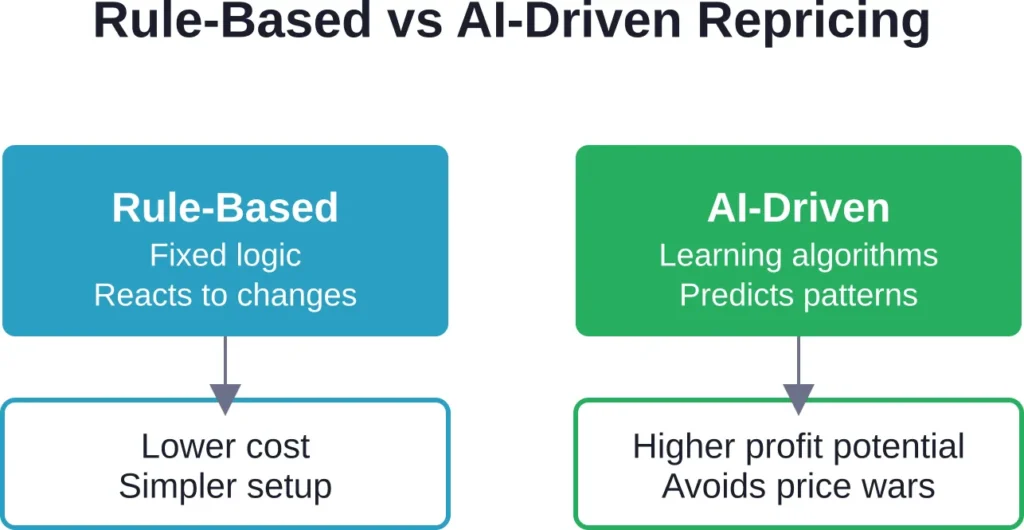
Most repricers fall into two categories: rule-based and algorithmic (AI-driven).
Rule-based repricers follow straightforward logic. Sellers set parameters like “match the lowest price” or “stay $0.50 above the lowest competitor.” These systems react to market changes but don’t predict or optimize beyond the rules programmed into them.
Algorithmic repricers use machine learning and game theory to make smarter pricing decisions. They analyze historical data, competitor patterns, and market trends to find the optimal price point—not just the lowest one. This approach helps avoid destructive price wars while maximizing Buy Box wins and profitability.
Our Top Amazon Repricer Picks for 2026
After analyzing the competitive landscape and evaluating features, pricing, and performance metrics, several repricer tools stand out for different seller profiles and business needs.
Seller Snap: Best AI-Driven Repricer

Seller Snap uses game theory algorithms to optimize pricing decisions without triggering destructive price wars. Rather than simply matching the lowest price, it calculates the optimal price point that balances Buy Box wins with profitability.
The platform supports 21 Amazon marketplaces plus Walmart Marketplace, making it suitable for multichannel sellers. Built-in analytics track ACOS (Advertising Cost of Sale), ROAS (Return on Ad Spend), and other performance metrics directly within the dashboard.
One standout feature: inventory optimization insights that help boost turnover rates. The system identifies slow-moving inventory and suggests pricing adjustments to accelerate sales without unnecessary margin erosion.
Pricing starts at $99/month for the Core plan. The Scale plan begins at $299/month with annual billing. Premium options at $499/month offer tailored configurations.
Real talk: Seller Snap’s AI takes time to learn. New users should expect a 2-3 week learning period where the algorithm analyzes competition and adjusts strategies. Short-term price fluctuations during this phase are normal.
Aura Repricer: Best for Advanced Strategy Control

Aura focuses on giving sellers granular control over repricing strategies while still leveraging algorithmic optimization. The interface allows custom rules based on competitor performance, seller feedback ratings, fulfillment method, and dozens of other variables.
The platform offers a 15-day free trial with full feature access—no credit card required upfront. Plans start at $100/month for the Starter package, which includes basic repricing functionality and support for one marketplace.
What sets Aura apart is its approach to competitor analysis. The system categorizes competitors by quality metrics (seller rating, fulfillment speed, return policies) and allows different pricing strategies based on who the competition is. Matching prices against a high-quality FBA seller requires a different strategy than competing with a low-feedback merchant-fulfilled seller.
The reporting dashboard provides detailed insights into repricing events, showing exactly when prices changed, why they changed, and the resulting impact on Buy Box percentage and sales velocity.
BQool: Best Budget-Friendly Option

BQool has been a staple in the Amazon repricing space for years, offering solid functionality at competitive price points. The platform provides both repricing tools and additional seller utilities like review management and feedback automation.
The repricing engine uses customizable rules that sellers can tailor to their business model. While not as sophisticated as AI-driven alternatives, BQool’s rule-based system works well for sellers with straightforward pricing strategies and clear margin requirements.
Multichannel support includes Amazon and several international marketplaces. The platform also offers repricing for used and refurbished products—a niche that some competitors overlook.
Pricing structures vary based on features and marketplace coverage, but BQool generally positions itself as a mid-tier option accessible to growing sellers who’ve outgrown manual repricing but aren’t ready for premium AI solutions.
RepricerExpress: Best for International Sellers

RepricerExpress stands out for its extensive marketplace coverage, supporting Amazon sites across North America, Europe, Asia, and Australia. The platform handles currency conversions automatically and adjusts pricing strategies based on regional competitive dynamics.
The repricing logic combines rule-based and velocity-based approaches. Sellers can set standard rules while also enabling velocity optimization, which adjusts prices based on how quickly inventory needs to move.
One useful feature: the ability to schedule different repricing strategies for different times of day or days of the week. Sellers can be more aggressive during peak shopping hours and conservative during slow periods, maximizing profit when competition is lower.
The platform offers a freemium model where new sellers can access basic repricing features at no cost—though limitations apply. Paid plans unlock advanced features, faster repricing cycles, and priority support.
Informed.co (formerly Appeagle): Best Enterprise Solution

Informed.co targets high-volume sellers and enterprises with complex repricing needs. The platform goes beyond basic Buy Box competition, incorporating demand forecasting, inventory health metrics, and profitability optimization into pricing decisions.
The AI engine analyzes hundreds of variables including seasonality, historical sales data, competitor behavior patterns, and market trends. This approach helps sellers maintain optimal prices across thousands of SKUs without manual oversight.
Integration capabilities include connections to inventory management systems, accounting software, and business intelligence platforms. For enterprises managing multiple brands or operating across numerous marketplaces, these integrations streamline operations significantly.
Pricing operates on a custom quote basis, reflecting the tailored nature of enterprise deployments. Sellers should expect higher monthly costs but also dedicated account management and custom algorithm tuning.
Key Features to Evaluate in Repricing Software
Choosing the right repricer requires understanding which features matter most for specific business models and growth stages.
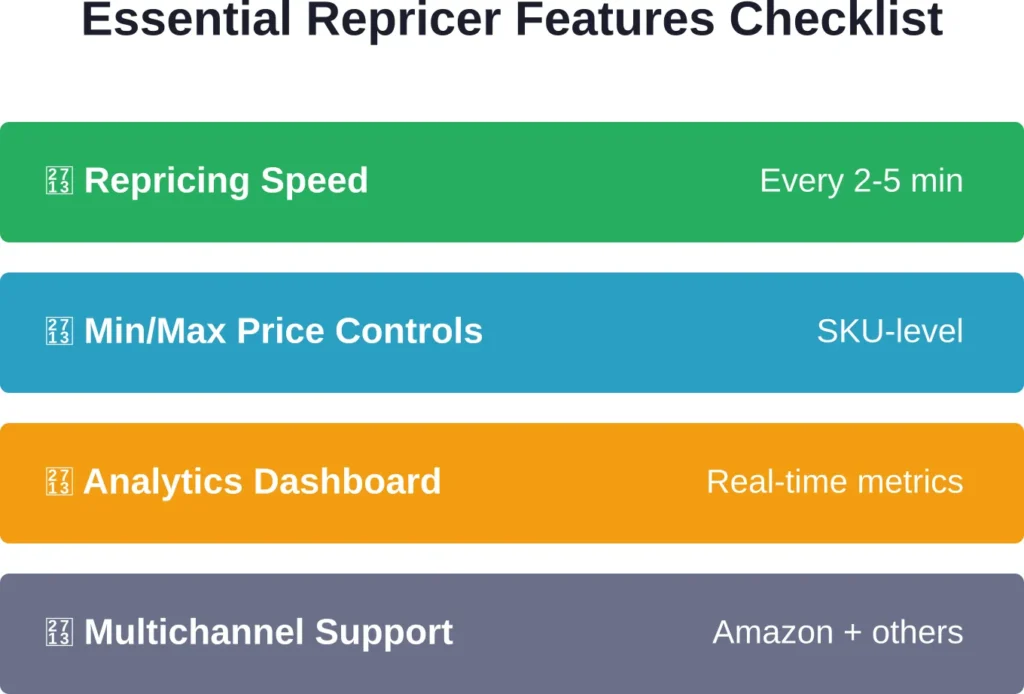
Repricing Speed and Frequency
How often does the software check competitor prices and adjust listings? Some repricers update every 15 minutes, others every few minutes, and premium options offer near-real-time repricing.
For high-competition ASINs with frequent price changes, repricing speed directly impacts Buy Box win rate. Slower repricing means competitors gain an edge during the gap between price checks.
That said, ultra-fast repricing isn’t always necessary. Low-competition products or items with stable pricing don’t benefit much from sub-minute repricing cycles. Match repricing frequency to product category dynamics.
Algorithm Intelligence
Does the repricer use simple rules or sophisticated algorithms? Rule-based systems work fine for straightforward scenarios but struggle with complex competitive situations.
AI-driven repricers analyze competitor patterns to predict behavior. If a competitor consistently undercuts by $0.25 during business hours but raises prices overnight, the algorithm learns this pattern and adjusts strategy accordingly.
Game theory approaches consider the broader competitive landscape. Rather than reacting to each price change individually, these systems calculate the equilibrium price where Buy Box wins and profit margins both optimize.
Customization and Control
Can sellers set minimum and maximum prices? Floor prices prevent margin erosion during aggressive price wars. Ceiling prices ensure products don’t overprice when competition is limited.
Advanced platforms allow SKU-level rules, category-based strategies, and time-based scheduling. Sellers might reprice aggressively for slow-moving inventory while maintaining conservative strategies for bestsellers with healthy margins.
Control also means the ability to pause repricing on specific products, exclude certain competitors from calculations, or manually override algorithm decisions when necessary.
Multichannel Support
Many sellers operate across multiple Amazon marketplaces (US, UK, Germany, Japan, etc.) or sell on non-Amazon channels like Walmart, eBay, or Shopify.
Multichannel repricers consolidate pricing management into a single platform. Instead of juggling separate tools for each marketplace, sellers manage everything from one dashboard with unified reporting.
Cross-channel pricing strategies help maintain consistent margin targets across platforms while accounting for different fee structures, competition levels, and customer demographics.
Reporting and Analytics
What insights does the repricer provide beyond price change logs? Effective reporting tracks Buy Box percentage over time, correlates price changes to sales velocity, and calculates profitability after fees and advertising costs.
Analytics should answer questions like: Which products benefit most from repricing? What’s the optimal price point for each SKU? How do pricing changes impact advertising performance?
Integration with Amazon Advertising data allows sellers to see how repricing affects PPC campaigns. Lower prices might improve conversion rates but reduce margin per sale—analytics quantify these trade-offs.
Pricing Models and What to Expect
Repricer pricing varies widely based on features, supported sales volume, and marketplace coverage. Understanding the cost structure helps sellers budget appropriately and avoid surprise fees.
Subscription Tiers
Most repricers use tiered subscription models. Entry-level plans typically start around $99-$100/month and support limited SKU counts or single marketplace coverage.
Mid-tier plans in the $299/month range expand SKU limits, add multiple marketplace support, and include advanced features like velocity-based repricing or enhanced analytics.
Premium and enterprise tiers at $499/month and above offer custom configurations, dedicated support, API access, and integration capabilities for complex operations.
According to corroborated data from multiple sources, a 15-day free trial with full feature access is common among repricer platforms. Transparent plans starting at $99/month serve smaller sellers, while the Scale tier begins at $299/month with annual billing and supports up to three channels. Premium options at $499/month provide tailored configurations.
Percentage-Based Pricing
Some repricers charge a percentage of sales instead of flat monthly fees. This model aligns costs with revenue—sellers pay more as they sell more, but avoid high fixed costs during slow periods.
Percentage-based pricing typically ranges from 0.5% to 2% of monthly sales. For high-volume sellers, this can become expensive compared to flat-rate plans. For new or seasonal sellers, it provides flexibility without upfront commitment.
Calculate the break-even point between flat-rate and percentage-based pricing based on monthly sales volume. Many sellers outgrow percentage models as revenue scales.
Hidden Costs to Watch For
Setup fees, onboarding charges, or integration costs sometimes appear beyond advertised subscription rates. Premium support, custom algorithm tuning, or additional user seats may incur extra fees.
Some platforms charge separately for each marketplace beyond the first. A plan that includes Amazon US might cost extra to add Amazon UK, Germany, or Japan.
Trial period limitations matter too. Some “free trials” require credit card details upfront or auto-convert to paid plans without explicit confirmation. Look for trials that don’t require payment information and clearly communicate when the trial ends.
Common Repricing Strategies Explained
Effective repricing requires more than just software—it requires strategic thinking about competitive positioning, margin targets, and business goals.
Race to the Bottom (and Why to Avoid It)
The simplest strategy: always match or undercut the lowest competitor price. This approach maximizes Buy Box win rate but destroys profit margins.
Community discussions highlight a critical statistic: many new sellers struggle with profitability. Aggressive race-to-bottom repricing contributes to this failure rate. Winning sales at unprofitable prices doesn’t build sustainable businesses.
Better approach: set intelligent floor prices based on actual costs plus desired margin. Let the algorithm optimize within that range rather than chasing every price drop.
Competitive Positioning Strategy
Rather than competing against all sellers, target specific competitor types. Price aggressively against merchant-fulfilled sellers while maintaining premium positioning against other FBA sellers.
This strategy leverages FBA advantages (faster shipping, Prime eligibility) to justify slightly higher prices. Customers often choose FBA sellers at $25.99 over merchant-fulfilled sellers at $24.99 because of delivery speed and reliability.
Advanced repricers allow filtering competitors by fulfillment method, seller rating, and other quality metrics. Pricing rules apply different logic based on competitive context.
Velocity-Based Repricing
Adjust pricing based on inventory turnover goals. Products with high stock levels or approaching long-term storage fees get priced more aggressively to accelerate sales.
Best-sellers with low inventory might maintain higher prices to maximize margin while supply lasts. The repricing strategy changes dynamically based on inventory health rather than competition alone.
This approach requires integration between the repricer and inventory management systems. The software needs real-time stock level data to make informed pricing decisions.
Time-Based Strategy Variations
Pricing strategies can vary by time of day, day of week, or season. Be aggressive during peak shopping hours when conversion rates are higher, then ease back during slow periods.
Holiday seasons or Prime Day events warrant different strategies than normal selling periods. Some sellers prepare for high-volume events by slightly raising prices to capture margin during increased demand.
Automated scheduling prevents the need for manual strategy changes. Set it once and the repricer handles the transitions automatically.
Repricer Comparison: Feature and Pricing Breakdown
Direct comparison helps sellers evaluate options based on specific needs and budget constraints.
| Repricer | Starting Price | Algorithm Type | Marketplaces | Trial Period |
|---|---|---|---|---|
| Seller Snap | $99/month | AI-driven (game theory) | 21 Amazon + Walmart | Available |
| Aura Repricer | $100/month | Hybrid rules + AI | Multiple Amazon | 15 days full access |
| BQool | Mid-tier pricing | Rule-based | Amazon + international | Varies |
| RepricerExpress | Freemium available | Rule + velocity-based | Extensive global | Free tier included |
| Informed.co | Custom quote | Advanced AI | Enterprise coverage | Custom arrangement |
But wait. Price isn’t everything. A $99/month repricer that increases Buy Box wins by 20% and boosts monthly profit by $2,000 delivers far better ROI than a free tool that saves money but loses sales.
Calculate expected return based on current sales volume, average margin, and projected Buy Box improvement. Most sellers see positive ROI within the first month if they’re moving decent volume.
| Feature | Budget Tools | Mid-Tier Tools | Premium Tools |
|---|---|---|---|
| Repricing Speed | 15-30 minutes | 5-10 minutes | 1-5 minutes |
| Algorithm Type | Basic rules | Advanced rules + some AI | Full AI with ML |
| Analytics Depth | Basic logs | Standard dashboards | Comprehensive BI |
| Support Level | Email only | Email + chat | Dedicated account manager |
| Custom Rules | Limited templates | Flexible customization | Fully programmable |
How to Choose the Right Repricer for Your Business
Selection criteria depend on business size, product categories, competitive environment, and growth trajectory.
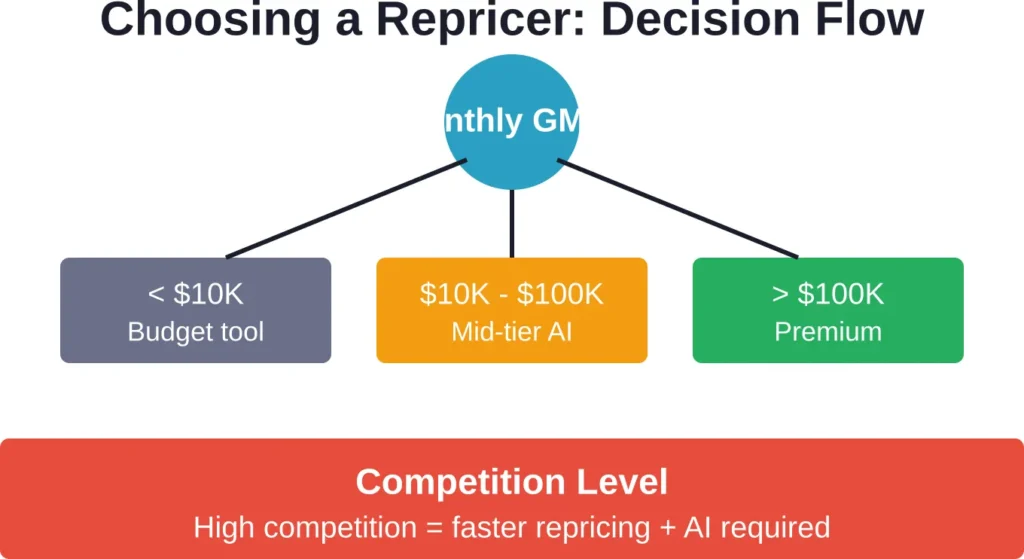
Assess Your Sales Volume
Sellers doing under $10,000 monthly gross merchandise value (GMV) might not justify premium repricer costs. Budget tools or freemium options make more sense until revenue scales.
Sellers between $10,000 and $100,000 monthly GMV benefit from mid-tier solutions with solid algorithms and reasonable pricing. This range supports the cost while capturing meaningful ROI.
Above $100,000 monthly GMV, premium tools become worthwhile. The margin improvements from sophisticated algorithms can generate thousands in additional monthly profit, easily covering subscription costs.
Consider Product Category Dynamics
Highly competitive categories (electronics, supplements, toys) require faster repricing and smarter algorithms. Dozens of sellers compete for the same ASINs with prices changing constantly.
Niche categories with limited competition don’t need ultra-fast repricing. Simple rule-based systems work fine when only a handful of sellers compete and prices remain relatively stable.
Private label brands have different needs than resellers. Private label sellers often have more pricing flexibility and fewer direct competitors, allowing for value-based pricing strategies rather than pure competitive repricing.
Evaluate Technical Requirements
Some repricers require technical setup, API configuration, or integration with existing business systems. Others offer plug-and-play solutions with minimal setup.
Consider internal technical resources. Enterprises with IT teams can handle complex implementations. Small sellers might need user-friendly platforms with guided onboarding.
Integration requirements matter for sellers using inventory management software, accounting systems, or business intelligence platforms. Ensure the repricer connects to existing tools or offers equivalent functionality built-in.
Test During Free Trials
Most quality repricers offer trial periods—use them. Run the repricer alongside existing pricing strategies and compare results.
Monitor Buy Box percentage, sales velocity, and profit margins during the trial. A good repricer should show measurable improvement within the first week or two.
Test customer support responsiveness during trials. Submit questions through available channels and evaluate response quality and speed. Support matters when repricing issues impact sales.
Setting Up Your Repricer for Success
Proper configuration determines whether a repricer delivers results or creates problems. These setup steps apply across most platforms.
Configure Floor and Ceiling Prices
Before activating automated repricing, establish minimum prices that protect margins. Calculate actual costs including product cost, Amazon fees, shipping, storage, and desired profit margin.
Add a safety buffer. If break-even is $18.50, set the floor at $19.50 or $20.00 to prevent algorithm errors or unexpected fee changes from creating losses.
Ceiling prices prevent unrealistic pricing when competition disappears temporarily. Without ceilings, repricers might set absurdly high prices that scare away customers even when Buy Box eligible.
Segment SKUs by Strategy
Not all products should use the same repricing approach. Group SKUs by characteristics: high-margin items, slow movers, seasonal products, competitive ASINs, etc.
Apply different repricing rules to each segment. High-margin products can maintain conservative pricing focused on profitability. Slow-moving inventory needs aggressive repricing to free up capital and warehouse space.
Review segments regularly. Products move between categories as market conditions change, competition shifts, or inventory levels fluctuate.
Start Conservative, Then Optimize
Don’t immediately activate the most aggressive repricing settings. Begin with conservative rules that prevent large price swings while the algorithm learns market dynamics.
Monitor performance daily for the first week or two. Check for unexpected behavior, margin erosion, or pricing errors. Adjust rules based on observed results.
Gradually increase aggressiveness as confidence builds. Most repricers improve performance over time as algorithms accumulate data and recognize patterns.
Monitor and Adjust Continuously
Set up alerts for unusual activity: sudden price drops below thresholds, loss of Buy Box for key products, or margin compression across categories.
Review repricing reports weekly at minimum. Identify which products benefit most from automated repricing and which might need manual oversight.
Market conditions change. New competitors enter, manufacturers adjust wholesale prices, Amazon modifies fee structures. Repricing strategies that worked last quarter might need adjustment today.
Common Repricing Mistakes and How to Avoid Them
Even sophisticated repricers cause problems when configured incorrectly or used without strategic oversight.
Setting Floors Too Low
The most common mistake: floor prices that seem reasonable but don’t account for all costs. Sellers forget about long-term storage fees, advertising costs, returns processing, or seasonal fee increases.
Build comprehensive cost models before setting minimums. Include every expense category and add buffer room for unexpected costs.
Review floors quarterly or when cost structures change. Amazon fee adjustments, shipping rate increases, or product cost changes all impact profitability calculations.
Ignoring Competitor Quality
Not all competitors are equal. Matching prices with low-quality sellers (poor ratings, slow shipping, merchant-fulfilled) can drag prices down unnecessarily.
FBA sellers with strong ratings can often price 5-10% higher than low-quality competitors and still win Buy Box through superior delivery performance and customer trust.
Use competitor filtering features to exclude poor-quality sellers from repricing calculations. Compete against equivalent sellers, not against the absolute bottom.
Over-Reliance on Automation
Repricers automate pricing, but they don’t replace strategic thinking. Algorithms don’t understand product lifecycles, brand positioning, or promotional calendars.
Manually override repricing for products running advertising campaigns, featured in promotions, or experiencing unusual demand spikes. Automation works best for steady-state operations, not exceptional circumstances.
Review algorithm decisions regularly. Question price changes that seem counterintuitive and investigate the reasoning. Sometimes manual intervention improves outcomes.
Neglecting Multichannel Consistency
Sellers operating across multiple marketplaces sometimes create pricing conflicts. A product selling for $29.99 on Amazon US and $24.99 on Amazon UK (after currency conversion) creates arbitrage opportunities and brand confusion.
Use multichannel repricers to maintain pricing consistency across platforms. Set rules that account for regional fee differences while preserving relative positioning.
Monitor for channel conflicts where automated repricing on one platform undermines pricing strategy on another.
Advanced Repricing Tactics
Once basic repricing operates smoothly, advanced tactics can further optimize performance and profitability.
Seasonal Strategy Scheduling
Create repricing calendars that adjust strategies based on predictable seasonal patterns. Q4 holiday shopping, back-to-school periods, or Prime Day events warrant different approaches than regular selling periods.
Schedule more aggressive pricing during high-volume periods when conversion rates are elevated. Ease back during slow periods to preserve margins when every sale counts more.
Historical data informs seasonal strategy. Analyze past years to identify when demand peaks, how competition behaves during events, and what pricing strategies delivered best results.
Inventory-Aware Repricing
Link repricing decisions to inventory health metrics. Products approaching long-term storage fee dates need clearance pricing. Items with excessive stock relative to sales velocity benefit from temporary price reductions.
Low-stock situations allow for margin expansion. When inventory is limited and reordering will take time, raise prices to maximize profit from remaining units while maintaining acceptable sales velocity.
This requires integration between repricer and inventory management systems, but the profitability impact justifies the setup effort for mid-sized and larger sellers.
Competitive Intelligence Gathering
Use repricer data to understand competitor behavior patterns. When do specific sellers change prices? How do they respond to your price movements? What pricing strategies do they employ?
This intelligence informs strategic decisions beyond automated repricing. Identify aggressive competitors worth avoiding and passive competitors where pricing opportunities exist.
Some repricers offer competitive analysis dashboards that visualize these patterns. Even basic repricing logs can reveal useful insights with careful analysis.
Frequently Asked Questions
Repricing frequency varies by platform and plan tier. Budget repricers typically update every 15-30 minutes, mid-tier solutions every 5-10 minutes, and premium platforms every 1-5 minutes or near real-time. Faster repricing matters most for highly competitive ASINs where Buy Box ownership changes frequently. For stable, low-competition products, slower repricing intervals work fine.
No repricer can guarantee Buy Box ownership because Amazon’s algorithm considers multiple factors beyond price: seller performance metrics, fulfillment method, shipping speed, customer service ratings, and inventory availability. Repricers optimize price—a major Buy Box factor—but can’t control other variables. Quality sellers using good repricers typically see significant Buy Box percentage improvements, but guarantees aren’t realistic.
Not necessarily. Many modern repricers support multiple Amazon marketplaces (US, UK, Germany, Japan, etc.) within a single platform. Multichannel repricers handle cross-marketplace pricing with unified dashboards and reporting. Budget options might limit marketplace coverage, requiring separate tools or plan upgrades for international expansion. Check marketplace support before committing to a platform if selling internationally.
Reputable repricers include safeguards like floor and ceiling prices that prevent catastrophic errors. If a glitch occurs, most platforms offer price change logs showing exactly what happened and when. Sellers can quickly identify and correct errors through manual overrides. Quality repricers also provide support to investigate and resolve issues. This is why setting proper minimum prices is critical—they act as fail-safes against algorithm mistakes.
Not completely. Rule-based repricers work well for sellers with straightforward pricing strategies, stable competition, and clear margin requirements. They’re typically less expensive and simpler to configure. AI repricers deliver superior results in complex, highly competitive environments with frequent price changes and numerous competitors. The best choice depends on business size, category competitiveness, and budget. Many successful sellers use rule-based tools effectively.
Compare Buy Box percentage and sales before and after implementing repricing. If Buy Box wins increase from 60% to 80% and that correlates with 25% sales growth, calculate the profit increase from additional sales. Subtract the repricer’s monthly cost from that profit increase to determine net ROI. Most sellers with meaningful volume ($10K+ monthly GMV) see positive ROI within 30-60 days. Track metrics closely during trial periods to project long-term value.
Technically possible but not recommended. Running multiple repricers on the same inventory creates conflicts where tools fight each other, creating price instability and wasting repricing cycles. Some sellers use different repricers for different marketplaces or product categories, but this requires careful segmentation to prevent overlap. For most businesses, selecting one quality repricer and configuring it properly delivers better results than juggling multiple tools.
Making the Final Decision
Choosing an Amazon repricer isn’t just about features and pricing—it’s about finding the tool that aligns with business goals, technical capabilities, and growth trajectory.
Start by honestly assessing current business metrics. What’s monthly sales volume? How many SKUs require repricing? How competitive are the primary product categories? What’s the current Buy Box win rate? These answers guide platform selection.
Take advantage of free trials. Most quality repricers offer 7-15 day trials with full feature access. Run trials on actual inventory and measure real results: Buy Box percentage changes, sales velocity shifts, and margin impact.
Don’t choose based on price alone. A $300/month repricer that increases monthly profit by $3,000 beats a $99/month tool that increases profit by $500. Calculate expected return, not just cost.
Consider long-term scalability. A platform that works for current needs but can’t scale as the business grows requires eventual migration—a hassle worth avoiding. Choose tools that support growth through tiered plans or flexible pricing.
Read beyond marketing claims. Look for user reviews from sellers with similar business profiles. Community discussions often reveal real-world experiences that don’t appear in official documentation.
The right repricer becomes an invisible but powerful component of a profitable Amazon business. Prices adjust automatically, Buy Box wins increase, margins stay healthy, and sellers focus on sourcing, marketing, and strategic growth rather than constant price monitoring.
Ready to take the next step? Identify the 2-3 repricers that best match business needs and start free trials this week. The sooner testing begins, the sooner data-driven decisions become possible. The Amazon marketplace doesn’t wait—competitive pricing advantages compound over time, making early optimization increasingly valuable.