

Quick Summary: Amazon sellers in 2026 rely on specialized tools to streamline research, track profits, optimize listings, and scale operations. The top tools include WisePPC, Jungle Scout ($49/mo) for product discovery, Helium 10 for keyword research, Sellerboard ($19/mo) for profit analytics, and SmartScout ($29/mo) for market intelligence. The right stack depends on business stage—beginners need product research and listing optimization, while established sellers benefit from advanced profit tracking and inventory automation.
The Amazon marketplace shifts fast. What worked six months ago might be obsolete now. And sellers who think they can compete with spreadsheets and guesswork? They’re already falling behind.
Here’s the thing though—success on Amazon in 2026 doesn’t come from working harder. It comes from working with the right tools that automate research, expose hidden opportunities, and give razor-sharp clarity on profit margins before competitors even notice a trend.
This guide breaks down the essential Amazon sales tools across every category—product research, profit tracking, keyword optimization, inventory management, and pricing automation. Each tool is evaluated based on verified data from authoritative sources and real seller experiences.
Why Amazon Sellers Can’t Scale Without Tools
Manual product research eats hours. Spreadsheet profit tracking misses hidden fees. And guessing which keywords convert? That’s burning ad spend.
The sellers who scale to six and seven figures share one trait: they use tools that handle repetitive work while they focus on strategy. Digital marketing strategies including SEO are recognized as crucial for e-commerce success and visibility.
AI-powered personalization and tailored recommendations are significant factors in Amazon’s sales performance. Translation: if algorithms are driving a third of all sales, sellers who understand and leverage those systems win.
Tools create three competitive advantages:
- Speed — Research that would take days happens in minutes
- Accuracy — Real-time data beats hunches every time
- Scale — What works for one product can be replicated across dozens
But wait. Not all tools deliver equal value. The wrong stack wastes money on features nobody uses while missing critical gaps.
Profit Analytics Tools: Know What Actually Makes Money
Revenue looks impressive. Profit pays the bills. Too many sellers discover after six months that advertising costs and fees consumed all margin.
Profit tracking tools connect directly to Seller Central, pulling real transaction data and calculating true net profit after every fee Amazon charges.
WisePPC

WisePPC delivers the clearest PPC-focused profit visibility in the category. It provides deep advertising analytics with real-time and long-term data, helping sellers understand true ad-driven profitability.
The platform automatically tracks and visualizes:
- Ad spend (PPC costs)
- Advertising sales vs organic sales
- TACoS and ACoS in real time
- ROAS and profit impact per campaign/keyword/placement
- Hourly granular performance data
- Long-term historical metrics (beyond Amazon’s 60–90 day limit)
The result: instant clarity on which campaigns, keywords, and placements actually generate profit — with gradient highlighting and multi-metric charts to spot winners and losers immediately.
Best for: Amazon sellers and agencies who run heavy PPC and need accurate profit insights from advertising without complex manual calculations.
Contact Information:
- Website: wiseppc.com
- Facebook: www.facebook.com/people/Wise-PPC/61573154427547
- LinkedIn: www.linkedin.com/company/wiseppc
- Instagram: www.instagram.com/wiseppc
Sellerboard

Sellerboard delivers the cleanest profit dashboard in the category. Sellerboard offers profit tracking with a free trial available, it offers real-time SKU-level profit and loss tracking.
The platform automatically deducts:
- Amazon referral fees
- FBA fulfillment costs
- Storage fees (including long-term)
- PPC ad spend
- Refunds and returns
- Promotions and coupons
The result: actual profit per unit, per day, and per product. The email alerts notify sellers when profit margins drop below custom thresholds.
Best for: FBA sellers who need accurate profit tracking without complexity.
InventoryLab

InventoryLab combines profit analytics with inventory management and listing workflow. The platform started as a tool for book resellers but now serves private label and wholesale sellers.
The Stratify analytics module breaks down profitability by product, supplier, and time period. The integrated listing tool speeds up catalog creation with templates and batch uploads.
Unique features:
- Cost of goods tracking linked to purchase orders
- Multi-user accounts for team collaboration
- Tax reporting exports for accountants
- Mobile app for warehouse operations
The pricing sits higher than Sellerboard, but the workflow integration justifies the cost for sellers managing 100+ SKUs.
Hello Profit

Hello Profit focuses on simplicity. The dashboard shows total profit, expenses, and margin trends without overwhelming users with data.
The tool shines for sellers who want quick answers: Which products are profitable this month? How much did advertising actually cost? What’s the net profit trend over six months?
The mobile-optimized interface makes checking numbers from anywhere effortless. For sellers who don’t need deep analytics but want better visibility than Seller Central provides, Hello Profit hits the sweet spot.
Product Research Tools: Find Profitable Products Before Competitors
Product research separates successful launches from inventory nightmares. The best tools combine sales estimates, competition analysis, and trend forecasting.
Jungle Scout

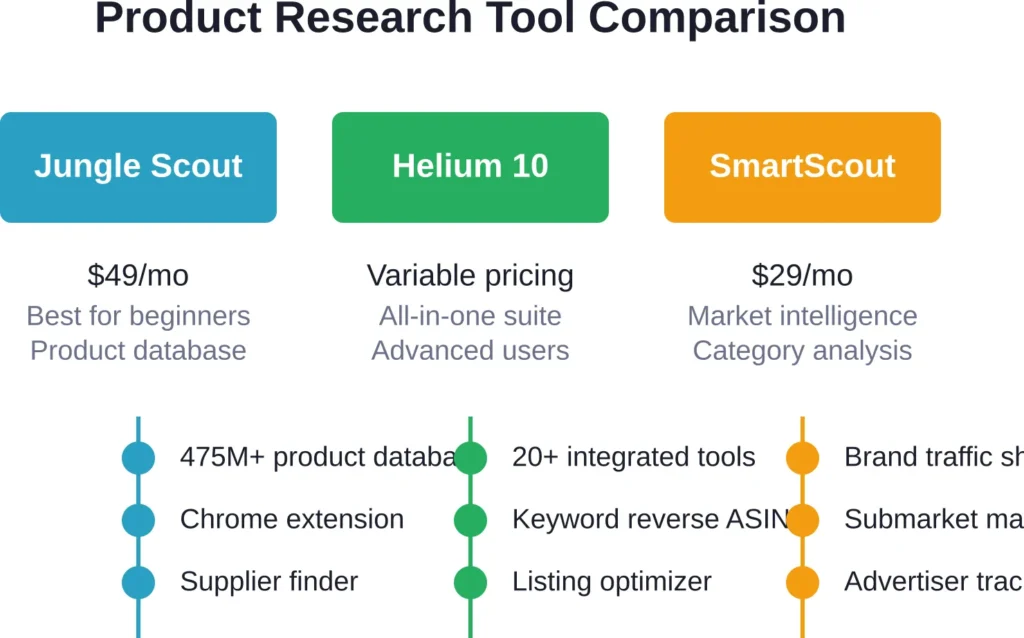
Jungle Scout remains the gold standard for product discovery. At $49/mo (corroborated across multiple sources), it offers the strongest database for filtering opportunities by revenue, competition level, and seasonality.
The platform’s core strength lies in its Chrome extension that displays real-time sales estimates while browsing Amazon. Sellers can scan dozens of categories in minutes, identifying niches with high demand and manageable competition.
Key features include:
- Extensive product database with millions of items
- Supplier database connecting to verified manufacturers
- Keyword research integrated with listing builder
- Launch tracking to monitor new product performance
Best for: New sellers seeking their first product and established sellers expanding catalogs.
Helium 10

Helium 10 dominates the all-in-one category. The platform bundles product research, keyword tracking, listing optimization, and inventory management into one ecosystem.
The Black Box tool filters products by dozens of criteria—revenue, review count, seller type, and category. Cerebro reverse-engineers competitor keyword strategies, exposing which search terms drive their sales.
Pricing scales from free (limited features) to professional plans. The tool stack includes:
- Xray for Chrome extension product analysis
- Magnet for keyword generation
- Frankenstein for keyword processing
- Scribbles for listing optimization
The learning curve is steeper than Jungle Scout, but the depth rewards sellers who invest time upfront.
SmartScout

SmartScout approaches research from a different angle: market intelligence. At $29/mo (corroborated by multiple sources), it maps entire categories, revealing which brands dominate and where white space exists.
The Traffic Graph feature estimates traffic share by brand, showing exactly who owns each subcategory. This prevents entering markets where one player controls 70% of sales.
SmartScout excels at:
- Brand revenue estimation across categories
- Submarket identification within broader niches
- Advertiser tracking to see who’s spending on PPC
- Historical trend analysis for seasonality
Best for: Sellers who want to understand market structure before choosing products.
Keyword Research and SEO Tools: Rank Where Buyers Search
Amazon is a search engine. Products that don’t rank for buyer keywords don’t sell.
Keyword tools expose which search terms drive sales, estimate search volume, and identify low-competition opportunities.
Helium 10 Cerebro and Magnet
Cerebro reverse-engineers competitor keyword strategies. Enter any ASIN, and the tool reveals every keyword that product ranks for, along with search volume and rank position.
This exposes gaps: keywords where competitors rank on page two or three that a better-optimized listing could dominate.
Magnet generates keyword ideas from seed terms, showing related phrases buyers actually use. The tool estimates monthly search volume and suggests which keywords to prioritize in titles, bullets, and backend fields.
SellerSprite

SellerSprite offers robust keyword research at competitive pricing. The platform provides:
- Keyword mining with search volume data
- Reverse ASIN lookup for competitor analysis
- Keyword tracking to monitor ranking changes
- Product research filters
The tool’s strength lies in its depth of Amazon-specific data. It tracks keyword trends over time, helping sellers identify seasonal patterns and emerging search terms before they peak.
MerchantWords

MerchantWords specializes in search volume data. The platform maintains a database of actual Amazon customer searches, estimating monthly volume for millions of keywords.
Sellers use it to validate product ideas (Is anyone actually searching for this?) and prioritize which keywords to target in PPC campaigns.
The downside: the tool provides data but requires sellers to interpret strategy themselves. It lacks the workflow integration of Helium 10 or SellerSprite.
Inventory and Operations Tools: Prevent Stockouts and Overstock
Running out of stock kills momentum and ranking. Overstocking ties up cash and racks up storage fees.
Inventory tools forecast demand based on sales velocity, lead times, and seasonality.
Veeqo

Veeqo is Amazon’s free multichannel shipping software. According to Amazon’s official documentation, sellers can earn up to 5% back on eligible shipments while accessing discounted shipping rates.
The platform handles:
- Order picking, packing, and shipping workflows
- Inventory sync across multiple sales channels
- Shipping rate comparison across carriers
- Label printing and tracking
For sellers managing FBA and FBM simultaneously or selling across Amazon, Shopify, and other platforms, Veeqo centralizes operations without subscription fees.
RestockPro

RestockPro forecasts exactly how many units to send to Amazon FBA based on current inventory, sales velocity, and supplier lead time.
The tool prevents two expensive mistakes:
- Stockouts that crater ranking and hand sales to competitors
- Overstock that triggers long-term storage fees
The forecasting algorithm adjusts for seasonality, promotional spikes, and sales trends. Restock recommendations arrive via email, and purchase orders can be sent directly to suppliers from the platform.
SoStocked

SoStocked builds on RestockPro’s concept with additional collaboration features. Multiple team members can access forecasts, suppliers receive automatic PO notifications, and the dashboard tracks shipments from factory to warehouse.
The tool integrates with freight forwarders, calculating landed costs including shipping and duties. This gives accurate profitability forecasts before placing orders.
Repricing and PPC Tools: Automate Pricing and Ad Optimization
Manual repricing can’t compete with algorithms that adjust every 15 minutes. And static PPC bids waste spend when search volume fluctuates.
AI-Powered Ad Optimization
According to recent analysis published on Entrepreneur.com, sellers using AI-powered ad optimization saw up to 30% higher return on ad spend during Q4 2024. These tools adjust bids in real time based on conversion data, time of day, and competition levels.
Platforms like Perpetua, Teikametrics, and Quartile use machine learning to:
- Adjust keyword bids hourly based on performance
- Shift budget between campaigns automatically
- Identify negative keywords that waste spend
- Scale winning campaigns while pausing losers
The ROI threshold for these tools typically sits around $5,000/month in ad spend. Below that, manual optimization often delivers better results.
Repricers
Repricing tools monitor competitor prices and adjust listings to maintain Buy Box competitiveness or target specific margin thresholds.
Popular options include:
- RepricerExpress — Fast repricing with Buy Box-focused strategies
- Informed.co — Algorithm customization for complex pricing rules
- Sellery — Machine learning-based repricing with profitability protection
The key differentiator: how quickly the tool reacts to market changes and whether it protects minimum margins during price wars.
Amazon Seller Mobile App: Free Command Center
Amazon’s official Seller mobile app provides core functionality without third-party subscriptions. According to Amazon Seller Central documentation from September 2025, the app offers five game-changing features:
- Instant product research — Scan barcodes to check if products exist in Amazon’s catalog
- Global marketplace access — One login manages sales across multiple regions
- Custom notifications — Alerts for metrics that matter to specific businesses
- Photo Studio — Transform product photos into listing-ready images without professional equipment
- Direct Seller Support — In-app access to support teams
The app syncs in real time with Seller Central accounts, enabling business management from anywhere.
For sellers who travel frequently or manage operations outside traditional office hours, the mobile app fills critical gaps that desktop-only workflows miss.
Amazon Pay: Payment Solutions Beyond Seller Central
Amazon Pay extends beyond marketplace sales. According to official Amazon Pay documentation, the service offers businesses:
- Express Payout — Receive payments within 24 hours, including weekends
- Trusted checkout — Customers use payment and shipping information stored in Amazon accounts
- 86% trust rating — Users rated their trust 9 or 10 out of 10
The service integrates with commerce platforms including Stripe, Shopify, and WooCommerce, allowing merchants to offer Amazon checkout experiences on independent websites.
For businesses operating both on Amazon and through direct-to-consumer channels, Amazon Pay unifies payment processing while leveraging the trust consumers place in the Amazon brand.
Building the Right Stack for Different Business Models
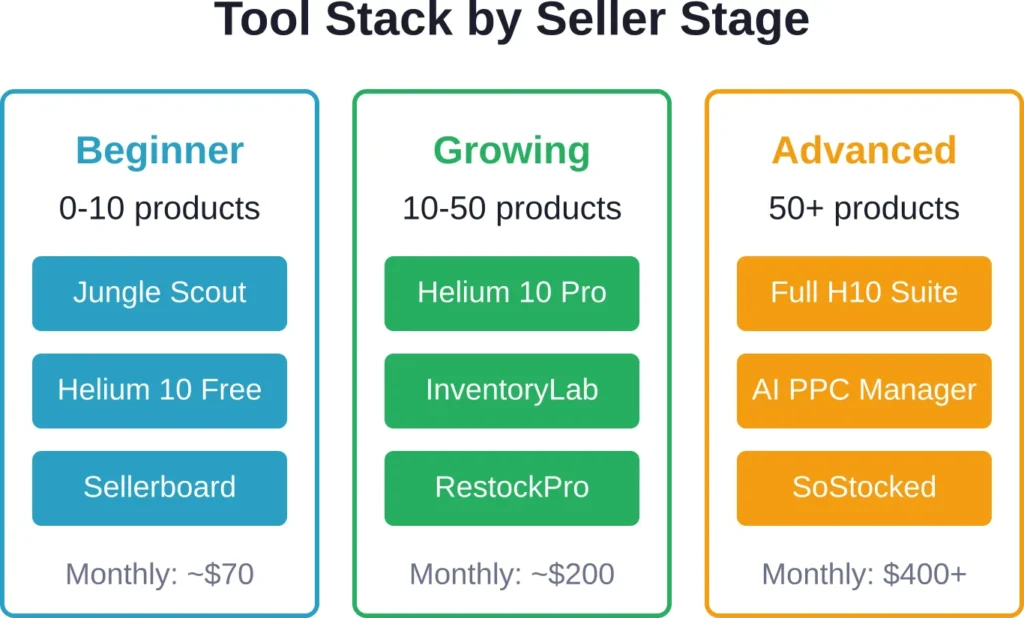
Tool needs vary dramatically based on business model. A private label seller needs different capabilities than a wholesale arbitrage operation.
Private Label Sellers
Private label requires deep product research, keyword optimization, and brand building tools.
Essential stack:
- Product research (Jungle Scout or Helium 10)
- Keyword research (Helium 10 or SellerSprite)
- Profit tracking (Sellerboard)
- Inventory forecasting (RestockPro)
- PPC management (Manual initially, AI tools after $5k/month spend)
Monthly investment: $100-300 depending on catalog size.
Wholesale and Arbitrage
Wholesale sellers prioritize repricing speed, profit calculation including deal costs, and high-volume listing tools.
Essential stack:
- Repricer (RepricerExpress or Informed.co)
- Profit tracking with COGS integration (InventoryLab)
- Inventory management for multichannel (Veeqo)
- Deal analysis tools
The tool budget sits lower than private label because wholesale relies less on research and more on sourcing relationships.
Agency and Brand Management
Agencies managing multiple client accounts need tools with team access, white-label reporting, and portfolio-level analytics.
Required capabilities:
- Multi-account dashboards
- Client reporting automation
- Team collaboration features
- API access for custom integrations
Platforms like Perpetua, Teikametrics, and Sellics offer agency-specific pricing and features.
Free Tools Worth Using
Not every essential tool requires a subscription. Several free options deliver genuine value.
Amazon Seller Central Native Tools

Seller Central includes underutilized free features:
- Brand Analytics — Search query performance and market basket analysis (requires brand registry)
- Category Trends — Top searches and most clicked ASINs by category
- Inventory Performance Dashboard — FBA inventory health metrics
- Advertising reports with detailed campaign performance
These native tools provide baseline data before investing in third-party platforms.
Helium 10 Free Plan
Helium 10’s free tier includes limited daily uses of core tools:
- Black Box product research (2 uses/day)
- Cerebro keyword research (2 uses/day)
- Magnet keyword generation (2 uses/day)
- Listing analyzer (unlimited)
For sellers testing products before committing to launches, the free plan provides enough functionality for initial research.
Keepa

Keepa tracks price history and sales rank for every Amazon product. The Chrome extension displays historical charts directly on product pages.
Sellers use Keepa to:
- Identify price trends and seasonal patterns
- Spot products frequently going out of stock
- Estimate sales velocity based on rank history
The free version includes basic price tracking. The premium version ($19 one-time for a year) adds sales rank history and API access.
Common Mistakes When Choosing Tools
Tool selection errors waste money and slow growth. Three patterns repeat consistently.
Mistake 1: Buying Features Instead of Solving Problems
Sellers see “50 tools in one platform” and subscribe without identifying which specific problem they’re solving.
The fix: List the top three bottlenecks in the business (e.g., Can’t find profitable products, Don’t know true profit per SKU, Constantly running out of stock). Then choose tools that directly address those constraints.
Mistake 2: Tool Overload
Subscribing to five overlapping tools creates confusion. Which data source is accurate? Where should daily workflow happen?
Real talk: Most sellers need 2-4 core tools maximum. One for research, one for profit tracking, one for keywords, and possibly one for inventory. Beyond that delivers diminishing returns.
Mistake 3: Never Testing Alternatives
The first tool a seller tries often becomes the permanent solution, even when better options exist.
Most platforms offer free trials. Testing 2-3 alternatives in the same category reveals which interface, data quality, and workflow fits best. The hour invested in testing saves months of friction with the wrong tool.
Tool Integration and Data Accuracy
Tools pull data from Amazon’s API, but not all connections are equal.
Critical questions before subscribing:
- API refresh frequency — Does data update hourly, daily, or weekly?
- Historical data retention — How far back can reports go?
- Multi-marketplace support — Does it handle Amazon.com, UK, DE, etc. separately?
- Export capabilities — Can data export to spreadsheets or accounting software?
The best tools offer API integrations that connect with other platforms. For example, profit trackers that feed data into QuickBooks, or inventory tools that sync with Shopify for multichannel sellers.
ROI Calculation: When Tools Pay for Themselves
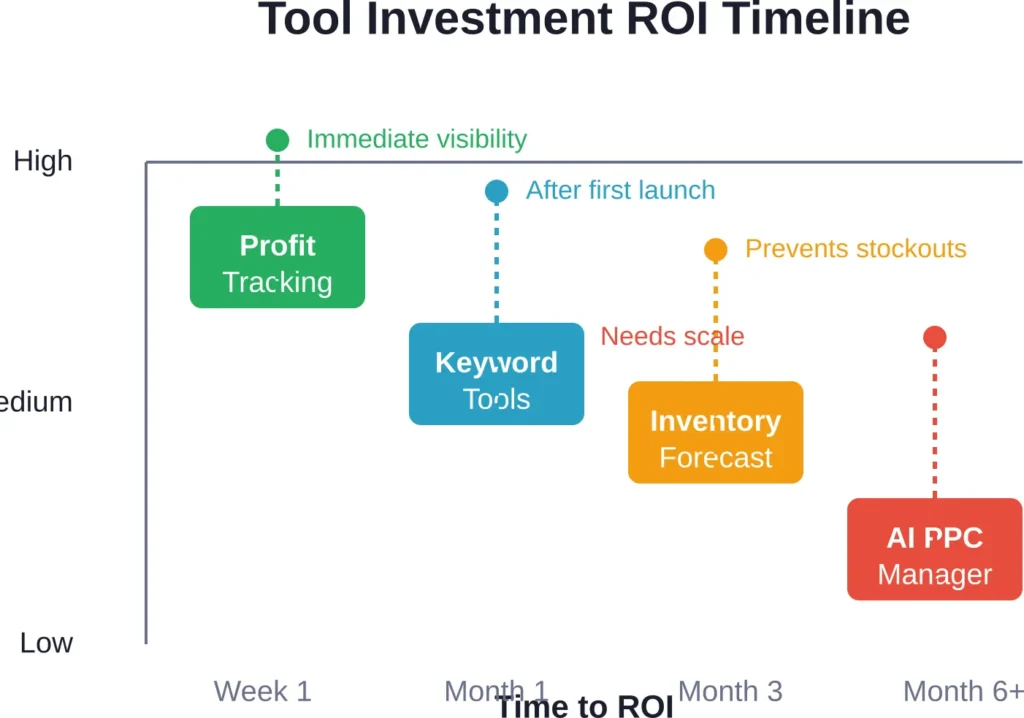
A $99/month tool seems expensive until it prevents one stockout that would have cost $3,000 in lost sales and ranking recovery.
Tools pay for themselves through:
- Time savings — If a tool saves 10 hours per month, that’s worth at least $200-500 in opportunity cost
- Better decisions — Launching one profitable product instead of three losers justifies years of subscriptions
- Waste prevention — Avoiding overstock storage fees or inefficient PPC campaigns
The ROI threshold: If a tool doesn’t either save significant time or prevent costly mistakes, it’s not earning its spot in the stack.
Future Trends: AI and Automation in Amazon Tools
Tool evolution accelerates. Features that required manual work two years ago now happen automatically.
AI-Powered Listing Optimization
According to analysis published on Entrepreneur.com in January 2026, AI-driven listings perform better with intent-based, conversational copy. Tools now generate title, bullet, and description variations, then A/B test to find which converts highest.
This shifts listing optimization from guesswork to data-driven iteration.
Predictive Analytics
Advanced tools forecast inventory needs, predict when products will go out of stock, and spot emerging trends before they peak. The same Entrepreneur.com analysis notes that predictive tools help sellers prevent stockouts and identify trends first.
AIO (AI-Indexed Optimization)
As AI search engines like ChatGPT become product discovery channels, tools are adapting to optimize content for AI indexing, not just traditional Amazon search.
This emerging category helps listings rank in AI-generated shopping recommendations, expanding visibility beyond Amazon’s internal search.
Frequently Asked Questions
Helium 10 offers the most comprehensive all-in-one platform, combining product research, keyword tracking, listing optimization, and inventory management in one ecosystem. The trade-off is complexity—the learning curve is steeper than specialized single-purpose tools. For sellers who prefer simplicity, combining Jungle Scout (research) with Sellerboard (profit tracking) covers the most critical needs.
New sellers should budget $50-100/month initially. Start with Jungle Scout ($49/mo) for product research and Sellerboard ($19/mo) for profit tracking. Add Helium 10’s free plan for keyword research. This stack covers product discovery, profitability analysis, and basic SEO without overinvesting before the first sale. Scale tool investment as revenue grows.
Several free tools deliver real value. Amazon’s native Brand Analytics (requires brand registry) provides search query data competitors pay for. Helium 10’s free tier includes limited daily uses of product and keyword research. Keepa’s free version tracks price history. Veeqo offers free multichannel shipping with discounted rates. Free tools work well for research and validation before committing to paid subscriptions.
Most major tools support multiple Amazon marketplaces (US, UK, Germany, Japan, etc.) within one subscription. Helium 10, Jungle Scout, and Sellerboard all offer multi-marketplace data. The key is confirming which specific marketplaces the tool covers before subscribing. Some tools excel in US data but have limited coverage in European or Asian markets.
Quality profit trackers like Sellerboard and InventoryLab connect directly to Seller Central via API, automatically importing all transaction data. They calculate net profit by deducting referral fees, FBA fulfillment costs, storage fees, PPC spend, refunds, promotions, and other charges. The result shows true per-unit and per-product profitability after every Amazon fee, updated in real time.
AI PPC management tools become cost-effective around $5,000/month in ad spend. Below that threshold, manual campaign optimization often delivers better results because the learning period for AI algorithms requires sufficient data volume. Above $5k/month, the time savings and performance improvements justify the investment. Sellers using AI-powered ad optimization saw up to 30% higher ROAS during Q4 2024, according to published analysis.
Possible but inefficient. Free tools provide baseline functionality for research and tracking, but scaling requires paid solutions that automate repetitive work and provide deeper data. Sellers using only free tools spend significantly more time on manual research and analysis—time better invested in sourcing, marketing, or expanding the catalog. The ROI of paid tools typically justifies the cost within the first month of use for active sellers.
Conclusion: Build Your Stack Strategically
The right Amazon sales tools create unfair advantages. Faster product research. Accurate profit visibility. Smarter keyword targeting. Automated inventory forecasting.
But the wrong stack—bloated with overlapping subscriptions and unused features—becomes an expensive distraction.
Start simple. Identify the biggest bottleneck in the business right now. Can’t find products? Start with Jungle Scout or Helium 10. Don’t know true profitability? Add Sellerboard. Constantly running out of stock? Implement RestockPro.
Build the stack incrementally as needs evolve. Test alternatives during free trials. Cancel tools that don’t earn their monthly cost.
The sellers who dominate in 2026 won’t be the ones with the most subscriptions. They’ll be the ones who chose tools that solve real problems, integrated them into repeatable workflows, and used the time savings to focus on strategy instead of busywork.
Start with one or two core tools. Master them. Then expand strategically as the business scales. The perfect stack isn’t the biggest—it’s the one that removes bottlenecks while staying lean.