

Quick Summary: Meta ads optimization tools in 2026 range from native Advantage+ automation to third-party platforms like Extuitive, Madgicx, SegmentStream, and WinningHunter. The best choice depends on whether you need creative intelligence, attribution modeling, or automation—most advertisers layer multiple tools to cover creative testing, performance tracking, and scaling decisions that Ads Manager alone can’t handle.
Running Meta ads in 2026 feels expensive before you even open Ads Manager.
In competitive ecommerce categories, CPMs typically range from $12 to $18. Advantage Plus campaigns now absorb most of the budget, pushing more decisions into automated systems. You get scale, but you also lose visibility.
The overall median CPC declined from 19 cents to 15 cents over the past year, according to Emplifi data analyzed by eMarketer. That’s not because ads got cheaper—it’s because advertisers reallocating spend into automation and performance efficiency drove sharper returns. Meta’s ad revenue grew 26% while Google’s grew 12.6%, and Meta is forecasted to reach $243 billion in 2026, edging past Google’s $239 billion worldwide.
Here’s the thing though—Ads Manager alone won’t tell you where your diminishing returns start. It won’t show you that your last $10K in Meta spend generated $800 in marginal revenue while shifting that budget to YouTube would’ve generated $4,500. It won’t flag when a creative ran briefly or stayed active for an extended period. And it definitely won’t recover conversions lost beyond Meta’s 7-day attribution window.
That’s why optimization tools exist.
This guide breaks down the most effective Meta ads optimization tools tested in 2026, organized by what they actually solve: creative intelligence, attribution modeling, automation, and reporting. Some are native to Meta, others are third-party platforms built to fill the gaps Ads Manager leaves wide open.
Why Meta Ads Optimization Tools Matter More in 2026
Meta platforms held 72% of overall social network ad spending in 2025, according to eMarketer. But that dominance comes with a catch: the platform optimizes for its own goals, not necessarily yours.
Advantage Plus campaigns push most targeting, placement, and creative decisions into automated systems. According to Meta Engineering, advertisers who turned on Advantage+ creative’s AI-driven targeting features experienced a 22% increase in ad ROI. But that automation works best when you feed it the right signals—and that’s where third-party tools come in.
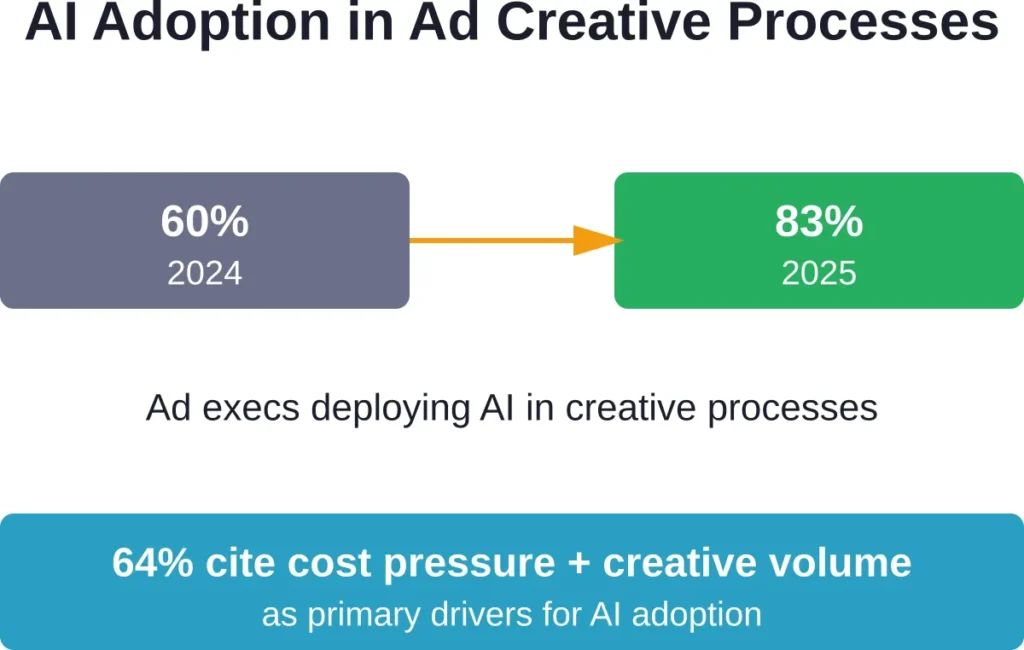
Real talk: 83% of ad executives deployed AI in creative processes in 2025, up from 60% in 2024. Cost pressure and creative volume demands drove adoption for 64% of those advertisers. Dynamic creative optimization (DCO) now assembles pre-built components like headlines, images, and calls to action based on audience signals. Agentic AI manages end-to-end campaign workflows, from planning through performance analysis, with minimal human intervention.
The short answer? Meta’s native tools give you automation. Third-party platforms give you control, transparency, and the ability to see what’s actually working—not just what Meta says is working.
Category 1: All-in-One Campaign and Scaling Platforms
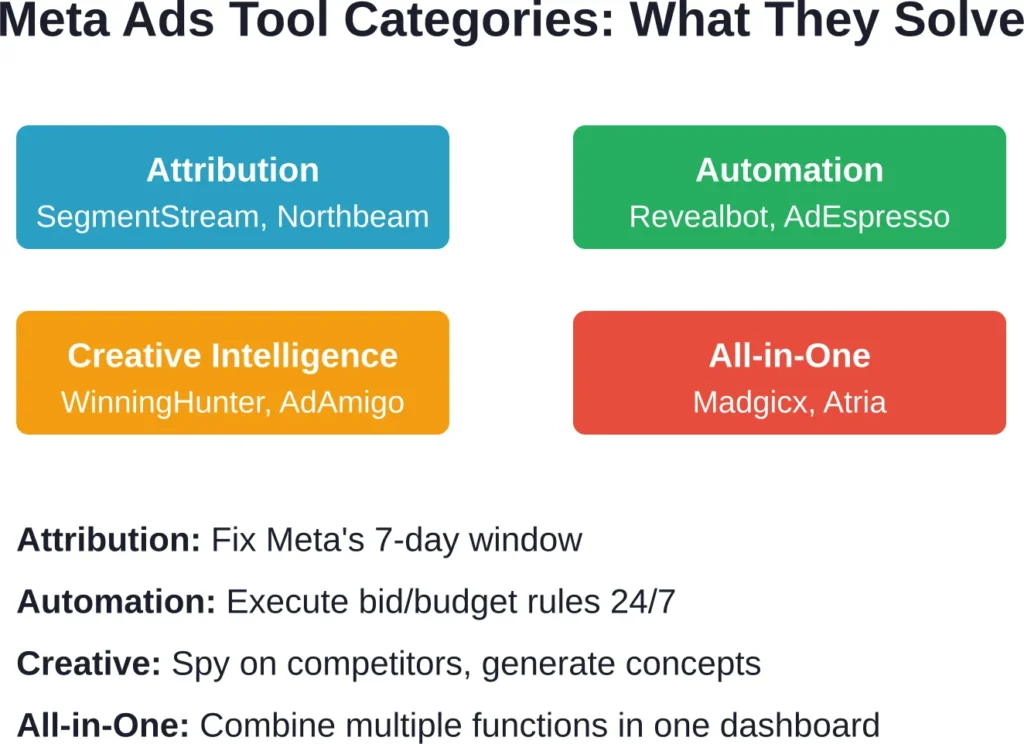
These platforms handle multiple optimization tasks in a single dashboard: creative testing, audience insights, budget automation, and reporting. They’re built for ecommerce brands and agencies running significant monthly spend.
Extuitive
Extuitive is an AI-native platform that forecasts real-world Meta (and TikTok) ad performance before launch using AI consumer models trained on 150k+ real behaviors and brand-specific data. It enables brands to generate, validate, and scale only winning creatives.
Core capabilities: AI creative generation (copy, images, video), pre-launch performance prediction (CTR, ROAS, engagement), simulated consumer testing, intelligent audience targeting, Shopify integration for automated product/audience analysis, scaled ad scoring and ranking.
Strengths: Extremely fast creative validation (minutes instead of weeks), strong reduction in wasted ad spend, accurate predictive modeling validated against live campaigns, end-to-end workflow from brief to launch, excellent for high-volume creative testing and scaling.
Limitations: Higher price point suited for mid-to-large spenders, requires sufficient historical data for best model accuracy, newer platform with growing but not massive user base, primarily focused on Meta/TikTok rather than full multi-channel.
Pricing starts at $1,000 per month (Starter plan: 500 ads scored, 200 AI creations). Professional at $2,500/month for higher volume.
Contact Information:
- Website: extuitive.com
- Email: [email protected]
- LinkedIn: www.linkedin.com/company/extuitive
- Twitter: x.com/Extuitive_Inc
- Instagram: www.instagram.com/extuitiveinc
Madgicx
Madgicx combines AI-driven audience segmentation, creative insights, and automated budget allocation. It’s one of the most widely adopted third-party platforms for Meta ads.
Core capabilities: AI audience targeting, creative intelligence dashboard, automated bid and budget rules, ad copy generation.
Strengths: strong creative analytics, deep integration with Shopify, automated scaling logic that moves budget toward winning ad sets.
Limitations: steep learning curve for new users, pricing scales with ad spend, limited multi-channel support beyond Meta.
Pricing starts at approximately $99 per month.
Atria
Atria positions itself as an AI-native Meta ads tool. It generates ad creative from a brand kit or product feed, automates campaign workflows, and surfaces performance analytics in a unified dashboard.
Core capabilities: AI creative generation, automated campaign setup, performance forecasting, budget optimization.
Strengths: fast creative production, integrated workflow from brief to launch, predictive performance modeling.
Limitations: newer platform with smaller user base, pricing not publicly listed, limited third-party integrations.
WinningHunter

WinningHunter focuses on ecommerce scaling by combining Shopify revenue signals with live ad tracking. Product-level tracking shows how long a specific ad has been active, helping separate short tests from sustained scaling.
Core capabilities: Shopify revenue tracking, ad library monitoring, competitor ad intelligence, niche filtering by engagement type and funnel structure.
Strengths: tight Shopify integration, competitive intelligence built in, fast insight-to-action workflow.
Limitations: less robust for non-ecommerce advertisers, limited creative production features.
Pricing starts at approximately €49 per month with a free trial available.
Category 2: Meta’s Native Optimization Tools
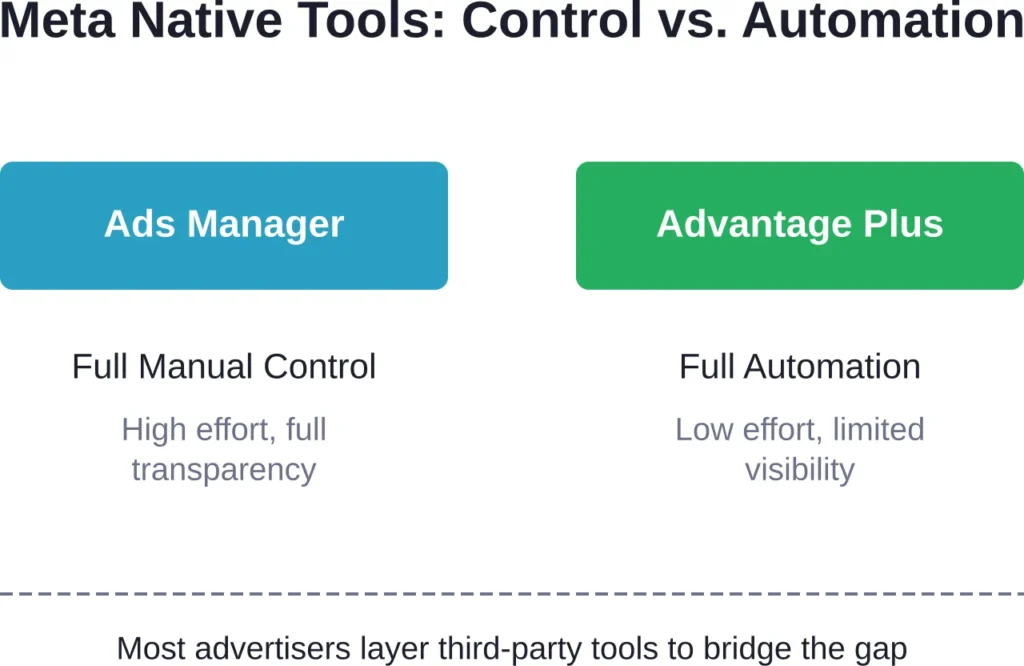
Meta’s built-in features are free, deeply integrated, and increasingly powerful. But they’re also designed to serve Meta’s goals first.
Meta Ads Manager
This is the foundation. Campaign structure, targeting, placements, creative uploads, and basic reporting all live here. Ads Manager gives you the levers to build campaigns manually or delegate decisions to Advantage Plus automation.
Strengths: zero cost, full campaign access, real-time spend and delivery data.
Limitations: attribution is limited to Meta’s 7-day click and 1-day view window. No multi-touch modeling. No insight into which creative elements drive performance. Reporting is fragmented across tabs, and exporting data for external analysis is clunky.
Advantage Plus Creative
Advantage Plus creative automatically tests variations of your ads by adjusting brightness, contrast, aspect ratios, and even adding music to video content. It’s built into campaign setup—no separate tool required.
According to Meta, advertisers who enabled these features saw a 22% increase in ad ROI. The system works best when you upload multiple creative assets (10 to 20 unique ad concepts per campaign instead of three to five near-identical variations).
Strengths: no extra cost, seamless integration, real-time optimization.
Limitations: you don’t control which variations win. Meta doesn’t surface granular data on why one variation outperformed another. Creative testing is still a black box.
Advantage Plus Shopping Campaigns
This campaign type automates targeting, placements, and budget allocation. You set a budget and conversion goal, and Meta’s algorithm handles the rest. It’s the default recommendation for ecommerce brands.
Strengths: fast setup, strong performance for brands with solid conversion signals, scales efficiently.
Limitations: zero targeting transparency. You can’t exclude placements or audience segments. Budget distribution is opaque. If performance drops, diagnosing the cause is nearly impossible.
Category 3: Attribution and Measurement Platforms
Meta’s attribution window stops at 7 days post-click. If a customer clicks an ad on Monday and buys on the following Tuesday, Meta doesn’t count it. These platforms fix that.
SegmentStream
SegmentStream leads for teams running Facebook alongside other channels. It recovers conversions lost beyond Meta’s 7-day window, validates Facebook’s in-platform reporting against external data sources, and supports custom attribution modeling.
Core capabilities: AI-native measurement, multi-model attribution (first-touch, last-touch, data-driven), incrementality testing, cross-channel budget optimization.
Strengths: solves the multi-touch attribution problem, integrates with Google Analytics 4, Shopify, BigCommerce, and major ecommerce platforms, automated optimization recommendations.
Limitations: requires technical setup, pricing scales with monthly tracked users, overkill for single-channel advertisers.
Pricing not publicly listed; typically starts around $1,000 per month for mid-market brands.
Northbeam
Northbeam specializes in DTC attribution plus creative analytics. It blends multi-touch attribution modeling with creative performance breakdowns, showing which ad concepts drive the highest customer lifetime value.
Core capabilities: blended attribution model, creative-level LTV tracking, cohort analysis, channel contribution reporting.
Strengths: tight focus on DTC brands, creative performance insights that go deeper than Meta’s native reporting, clean dashboards.
Limitations: higher price point, limited support for lead generation or B2B campaigns, setup requires developer resources.
Pricing typically starts around $1,000 per month.
Triple Whale

Triple Whale is built for Shopify brands. It aggregates data from Meta, Google, TikTok, and Shopify into a single dashboard, with a focus on profit tracking rather than revenue alone.
Core capabilities: multi-platform ad attribution, profit and margin tracking, cohort analysis, creative performance benchmarking.
Strengths: Shopify-first design, profit-centric reporting, fast onboarding.
Limitations: Shopify dependency, less robust for brands on BigCommerce or custom platforms, limited media mix modeling.
| Platform | Core Focus | Attribution Depth | Starting Price |
|---|---|---|---|
| SegmentStream | Multi-channel measurement + optimization | Custom attribution, incrementality testing | ~$1,000/mo |
| Northbeam | DTC attribution + creative analytics | Blended model, LTV tracking | ~$1,000/mo |
| Triple Whale | Shopify profit tracking | Multi-platform aggregation | Varies by plan |
| Madgicx | Campaign automation + creative insights | Meta-native attribution extended | $99/mo+ |
Category 4: Automation and Rules Engines
These platforms execute pre-defined logic to adjust bids, budgets, and campaign status based on performance triggers. Think of them as conditional workflows that run 24/7.
Revealbot

Revealbot is a rules-based automation engine for Meta, Google Ads, and Snapchat. It monitors campaign performance and executes actions when conditions are met—pause ads below a target ROAS, increase budget on winning ad sets, duplicate high performers.
Core capabilities: CPA and ROAS rule engine, automated budget shifts, bulk ad operations, Slack notifications.
Strengths: highly flexible rule builder, supports multiple ad platforms, transparent execution logs.
Limitations: requires upfront rule configuration, doesn’t replace strategic decision-making, pricing scales with ad spend.
Pricing starts at approximately $45 per month.
AdEspresso
AdEspresso focuses on structured split testing for SMBs and agencies. It automates the creation of campaign variations, tests them against each other, and surfaces winning combinations.
Core capabilities: A/B testing framework, campaign duplication, performance reporting, team collaboration tools.
Strengths: beginner-friendly interface, visual split test builder, good for agencies managing multiple clients.
Limitations: less powerful than Revealbot for complex automation, limited to Meta and Google Ads.
Pricing starts at approximately $49 per month.
Category 5: Creative Intelligence and Ad Spy Tools
These platforms monitor competitor ads, surface trending creatives, and provide inspiration for new campaigns. They’re not optimization tools in the traditional sense—they’re research and ideation platforms.
Meta Ad Library
Meta’s official Ad Library is free and comprehensive. It shows every active ad from any advertiser on Facebook and Instagram, with filters for region, platform, and ad type.
Strengths: free, official source, complete transparency for all active ads.
Limitations: no engagement metrics, no filtering by performance, no revenue estimates, clunky search interface.
WinningHunter (Competitor Intelligence)
Beyond its core ecommerce tracking features, WinningHunter offers competitor ad intelligence. It monitors ad activity across niches, tracks engagement patterns, and flags ads that have been running consistently—an indicator of sustained performance.
Core capabilities: ad library monitoring, engagement filtering, niche categorization, product-level ad tracking.
Strengths: tight Shopify integration, fast filtering, revenue signal overlay.
Limitations: limited to ecommerce, no cross-platform monitoring beyond Meta.
AdAmigo.ai

AdAmigo.ai combines creative generation with competitor analysis. It scans trending ads, identifies patterns, and uses AI to generate similar concepts tailored to a specific brand.
Core capabilities: AI creative generation, ad trend analysis, competitor monitoring, multi-format output (static, video, carousel).
Strengths: fast creative production, trend-aware outputs, good for high-volume testing.
Limitations: creative quality varies, requires human review before launch, less control over brand consistency.
Category 6: Reporting and Data Aggregation
Ads Manager reporting is clunky. Exporting data, building dashboards, and sharing reports with stakeholders requires manual work. These platforms automate that.
Supermetrics
Supermetrics pulls data from Meta, Google Ads, TikTok, and dozens of other platforms into Google Sheets, Data Studio, BigQuery, or Excel. It’s a data connector, not an optimization engine.
Core capabilities: API data extraction, scheduled refreshes, multi-source aggregation, pre-built report templates.
Strengths: wide platform coverage, flexible output destinations, affordable for small teams.
Limitations: doesn’t provide insights or recommendations—just raw data, requires manual dashboard setup.
Whatagraph
Whatagraph is a white-label reporting platform for agencies. It pulls data from Meta, Google, and other sources, then generates branded PDF or web reports automatically.
Core capabilities: automated report generation, white-label branding, multi-client dashboards, scheduled email delivery.
Strengths: agency-friendly, fast setup, good for client reporting.
Limitations: limited data transformation, no optimization logic, focused on presentation rather than analysis.
Funnel.io

Funnel.io is data infrastructure for marketing teams. It aggregates data from 500+ sources, cleans it, and pushes it to data warehouses or BI tools.
Core capabilities: data aggregation, transformation, warehouse integration, API connectivity.
Strengths: enterprise-grade data pipeline, supports complex multi-touch attribution models, strong customer support.
Limitations: high price point, overkill for small teams, requires technical resources to configure.
Pricing typically starts around $1,000 per month.
How to Choose the Right Meta Ads Optimization Tools
Here’s the thing: there’s no single “best” tool. The right stack depends on what you’re trying to solve.
Start with these questions:
Do you trust Meta’s attribution? If not, prioritize attribution platforms like SegmentStream or Northbeam. They recover conversions Meta misses and validate in-platform reporting against external data sources.
Are you spending more than $50K per month? At that scale, automation and creative intelligence tools pay for themselves. Revealbot, Madgicx, and WinningHunter all deliver ROI when spend is high enough to generate statistically significant test results.
Do you run campaigns on multiple platforms? If Meta is just one channel in a larger media mix, choose tools with cross-platform support. SegmentStream, Supermetrics, and Funnel.io all aggregate data from Meta, Google, TikTok, and other sources.
Is creative production a bottleneck? Platforms like Atria and AdAmigo.ai generate ad concepts at scale. They won’t replace a creative team, but they’ll speed up ideation and testing.
Are you managing campaigns for clients? Agencies need white-label reporting and multi-client dashboards. Whatagraph and AdEspresso are built for that workflow.
Most advertisers layer tools. A typical stack might include:
- Meta Ads Manager (foundation)
- Advantage Plus (automation)
- SegmentStream or Northbeam (attribution)
- Madgicx or WinningHunter (creative intelligence and scaling)
- Supermetrics or Funnel.io (reporting)
That’s not overkill—it’s coverage. Each tool fills a specific gap.
| Tool | Best For | Key Strength | Starting Price |
|---|---|---|---|
| Madgicx | Ecommerce scaling | AI audience targeting + creative insights | $99/mo |
| SegmentStream | Multi-channel measurement | Custom attribution + incrementality testing | ~$1,000/mo |
| WinningHunter | Shopify brands | Revenue signals + competitor intelligence | €49/mo |
| Revealbot | Agencies | Rules-based automation across platforms | $45/mo |
| Northbeam | DTC attribution | Creative-level LTV tracking | ~$1,000/mo |
| Supermetrics | Data aggregation | Pull data into Google Sheets or BI tools | Varies |
Common Mistakes When Using Meta Ads Optimization Tools
Buying tools doesn’t fix bad strategy. Here are the most common mistakes:
Over-automating too early
Automation works when there’s enough conversion data to train the algorithm. If campaigns are generating fewer than 50 conversions per week, automated rules and bid adjustments will chase noise rather than signal.
Wait until you have statistical significance before turning on automation.
Ignoring data quality
Value-based bidding tells Meta which conversions matter most. If a $500 purchase and a $20 purchase both count as one conversion, the algorithm optimizes for volume, not revenue.
Set up proper conversion value tracking in Ads Manager before layering third-party tools on top.
Choosing tools based on features, not outcomes
A tool with 50 features you don’t use is worse than a tool with five features that solve your exact problem. Start with the outcome you need—better attribution, faster creative testing, automated budget shifts—then pick the tool that delivers it.
Not testing tool assumptions
Third-party attribution platforms use different models than Meta. Northbeam might attribute 60% of conversions to Meta while Ads Manager claims 80%. Neither is “wrong”—they’re measuring different things.
Run incrementality tests to validate attribution claims. Turn off Meta ads for a control group and measure the true lift.
The Role of AI in Meta Ads Optimization
AI isn’t new to Meta ads. The platform has used machine learning for bidding, delivery, and targeting for years. But 2025 and 2026 brought a new wave: agentic AI that manages end-to-end campaign workflows with minimal human intervention.
According to IAB research cited by eMarketer, 83% of ad executives deployed AI in creative processes in 2025. That’s up from 60% in 2024. Cost pressure and creative volume demands drove adoption for 64% of those advertisers.
Dynamic creative optimization (DCO) assembles pre-built components like headlines, images, and calls to action based on audience signals. Agentic AI manages campaign planning, creative production, media buying, and performance analysis—all in one automated workflow.
But wait. AI doesn’t replace strategy. It accelerates execution of good strategy and amplifies bad strategy faster.
Winning advertisers under Meta’s Andromeda system (the AI engine powering Advantage Plus) feed the algorithm with 10 to 20 unique ad concepts per campaign instead of three to five near-identical variations. The AI tests variations faster, but it still needs diverse creative inputs to work with.
Creative volume is now a competitive advantage—and AI tools make high-volume creative production feasible.
Meta Ads Optimization in 2026: What Changed
The median CPC on Meta dropped from 19 cents to 15 cents over the past year. That’s a 21% decline—but it’s not because Meta got cheaper.
Meta’s global ad marketplace is splitting into two distinct cost curves. Retail’s mixed online–offline goals make optimization harder. Ecommerce benefits from clearer conversion signals. The algorithm rewards advertisers who feed it clean, high-volume conversion data—and punishes those who don’t.
Meta’s ad revenue grew 26% while Google’s grew 12.6%. Meta is forecasted to reach $243 billion in 2026, edging past Google’s $239 billion worldwide for the first time. That growth comes from automation, not manual campaign management.
Advantage Plus campaigns now absorb most advertiser budgets. According to Meta, advertisers who turned on Advantage+ creative’s AI-driven targeting features experienced a 22% increase in ad ROI. But that automation works best when paired with third-party tools that surface what’s happening under the hood.
So what does that mean for optimization tools? Attribution, creative intelligence, and automation platforms are no longer optional for advertisers spending more than $50K per month. They’re table stakes.
How to Build a Meta Ads Tool Stack
Start with the foundation: Meta Ads Manager and Advantage Plus. Those are free and required.
Next, add attribution. If campaigns run longer than 7 days (they should), Meta’s native attribution window misses conversions. SegmentStream, Northbeam, or Triple Whale fix that.
Then layer creative intelligence. WinningHunter, AdAmigo.ai, or the Meta Ad Library (free) provide inspiration and competitor insights. Creative testing is the highest-leverage optimization activity—more ads, more tests, more winners.
Add automation last. Revealbot and AdEspresso execute rules-based logic—pause underperformers, scale winners, shift budgets. But automation only works when there’s enough data to make statistically valid decisions.
For reporting, Supermetrics or Funnel.io pull data into dashboards. Whatagraph generates client reports automatically.
A typical stack for a $100K/month ecommerce advertiser might look like this:
- Meta Ads Manager (campaign setup)
- Advantage Plus (automation)
- SegmentStream (attribution)
- WinningHunter (creative intelligence)
- Madgicx (scaling automation)
- Supermetrics (reporting)
Total cost: $1,200–$1,500 per month. That’s 1.2–1.5% of ad spend—well within the typical range for tooling overhead.
Frequently Asked Questions
Start with Meta Ads Manager and Advantage Plus. Both are free and built directly into the platform. Once campaigns generate consistent conversion volume (50+ conversions per week), add a creative intelligence tool like WinningHunter or use the Meta Ad Library for competitor research. Avoid complex automation or attribution platforms until there’s enough data to justify them.
Yes. Advantage Plus automates targeting, placements, and budget allocation, but it doesn’t fix attribution gaps, surface creative insights, or explain why performance changed. Third-party tools like SegmentStream, Madgicx, and WinningHunter provide the transparency and control that Advantage Plus hides behind automation.
Industry benchmarks suggest 1–2% of monthly ad spend for tooling overhead. For a $50K/month advertiser, that’s $500–$1,000 per month. Attribution platforms (SegmentStream, Northbeam) typically start around $1,000 per month. All-in-one platforms (Madgicx, Atria) start around $99 per month. Automation tools (Revealbot, AdEspresso) start around $45–$49 per month.
Neither is “correct”—they measure different things. Meta’s attribution window stops at 7 days post-click. Third-party platforms like SegmentStream and Northbeam extend that window and use multi-touch models. Run incrementality tests (turn off Meta ads for a control group) to validate attribution claims and measure true lift.
Ad spy tools (Meta Ad Library, WinningHunter) show what competitors are running. Creative intelligence tools (Madgicx, Northbeam) analyze which creative elements drive performance and provide recommendations. Most platforms combine both functions—WinningHunter shows competitor ads and tracks Shopify revenue signals, while Madgicx surfaces creative insights alongside automation.
It depends on budget and complexity. All-in-one platforms (Madgicx, Atria) are faster to set up and easier to manage. Specialized tools (SegmentStream for attribution, Revealbot for automation, WinningHunter for creative intelligence) offer deeper functionality but require more integration work. Most advertisers spending over $100K per month layer specialized tools for better coverage.
Most tools are built for ecommerce, where revenue and ROAS are clear success metrics. Lead generation campaigns optimize for cost per lead (CPL) and lead quality, not revenue. Platforms like Revealbot and AdEspresso support lead gen workflows. Attribution platforms like SegmentStream can track lead-to-sale conversion rates if CRM data is integrated. Avoid tools with heavy Shopify dependencies.
Conclusion
Meta Ads Manager gives you the foundation. Advantage Plus gives you automation. But neither gives you transparency, extended attribution, creative insights, or cross-channel measurement.
That’s why third-party optimization tools exist.
The right stack depends on what you’re solving for. Attribution platforms like SegmentStream and Northbeam recover conversions Meta misses. Creative intelligence tools like WinningHunter and AdAmigo.ai speed up testing and ideation. Automation platforms like Revealbot and Madgicx execute scaling logic 24/7. Reporting tools like Supermetrics and Funnel.io aggregate data across platforms.
Most advertisers layer tools. A typical stack includes Meta Ads Manager, an attribution platform, a creative intelligence tool, and a reporting connector. Total cost ranges from 1–2% of monthly ad spend.
Don’t buy tools for features. Buy them for outcomes. Start with the problem you need to solve, then pick the tool that solves it. Test assumptions. Validate attribution claims with incrementality studies. And remember: automation amplifies strategy—it doesn’t replace it.
Ready to optimize your Meta ads? Start by auditing your current stack. Identify the gaps—attribution, creative testing, automation, reporting—and add one tool at a time. Measure the impact. Iterate.
The best tool is the one that moves your metrics.