

Quick Summary: Small businesses can dramatically improve marketing efficiency using AI tools that automate content creation, customer engagement, and campaign management. The top AI marketing tools for 2026 include platforms for social media scheduling, email automation, content generation, customer relationship management, and analytics—many offering free tiers or affordable pricing starting under $20 monthly.
The global digital advertising and marketing market is projected to reach $786.2 billion by 2026, according to industry projections cited in American Marketing Association content. Yet most small business owners struggle to capture their share of this growth.
Here’s the thing though—content marketing is 62% cheaper than traditional marketing, according to research cited in American Marketing Association content. The catch? Creating consistent, high-quality content demands time that most small business owners simply don’t have.
Artificial intelligence changes that equation entirely.
AI-powered marketing tools now handle everything from writing social media posts to analyzing customer behavior, freeing up valuable hours every week. According to Northwestern University’s research, 28% of employed adults in the U.S. used ChatGPT to get work done as of March 2025.
But which tools actually deliver results for small businesses operating on tight budgets?
Why Small Businesses Need AI Marketing Tools
Time ranks as the most finite resource for entrepreneurs. Small business owners wear multiple hats daily—handling sales calls, managing inventory, troubleshooting operations, and somehow finding time for marketing.
Traditional marketing demands constant attention. Writing blog posts takes hours. Scheduling social media across platforms eats up entire afternoons. Email campaigns require careful segmentation and personalization.
AI tools compress these hours into minutes.
The U.S. Small Business Administration emphasizes that AI applications help small businesses “do more with less,” providing solutions for operational issues that previously required entire marketing teams.
Real talk: the competitive landscape has shifted. Businesses that haven’t adopted AI for basic marketing tasks now compete against rivals who produce content three times faster, personalize customer experiences at scale, and optimize campaigns continuously—all while spending less.
Content Creation and Copywriting Tools
Writing marketing copy demands both creativity and consistency. Small businesses need blog posts, product descriptions, ad copy, email newsletters, and social media content—often publishing daily across multiple channels.
Extuitive
Extuitive is an AI-powered advertising platform built specifically for Shopify stores that combines creative generation with predictive validation. The platform analyzes your store, products, and customer data, then generates high-converting ad creatives in minutes.
Small businesses use Extuitive to create complete ad campaigns — including copy, images, videos, reels, and pricing tests — and then validate them before spending a single dollar on ads. Its AI consumers (150k+ simulated buyers) predict CTR, ROAS, and conversion rates with high accuracy.
The intuitive interface requires no marketing experience — simply connect your Shopify store and let the AI agents do the heavy lifting.
Extuitive stands out with its pre-launch testing system that dramatically reduces wasted ad spend while helping small teams compete with much larger marketing budgets.
Contact Information:
- Website: extuitive.com
- Email: [email protected]
- LinkedIn: www.linkedin.com/company/extuitive
- Twitter: x.com/Extuitive_Inc
- Instagram: www.instagram.com/extuitiveinc
ChatGPT for Marketing Content

ChatGPT has become synonymous with AI content creation for good reason. The platform generates everything from blog outlines to complete social media calendars in seconds.
Marketing teams use ChatGPT to brainstorm campaign ideas, rewrite headlines for A/B testing, draft customer service responses, and create content variations for different audience segments. The conversational interface means no learning curve—just describe what content is needed.
Pricing starts with a capable free tier. Paid plans unlock faster response times and access to advanced models.
Jasper AI

Jasper specializes specifically in marketing copy, trained on high-converting examples from successful campaigns. The platform includes templates for specific formats: Facebook ads, Google ads, product descriptions, email subject lines, and blog introductions.
Small businesses benefit from Jasper’s brand voice feature, which maintains consistent tone across all generated content. Train the system once on existing materials, then every piece matches that established voice.
The tool integrates with SEO workflows, suggesting keywords and optimizing content for search visibility.
Copy.ai

Copy.ai focuses on speed and variety. Generate 20 headline variations in ten seconds. Create week-long social media content calendars with a single prompt.
The platform excels at overcoming writer’s block—when staring at a blank page, Copy.ai produces starting points that teams can refine. Small businesses working without dedicated copywriters find this particularly valuable.
Free plans include generous usage limits for teams testing AI content creation.
Social Media Management and Automation
Social media demands constant feeding. Algorithms favor accounts that post consistently, but creating daily content stretches small business resources thin.
Hootsuite with AI Integration

Hootsuite combines scheduling with AI-powered content suggestions. The platform analyzes what performs well, then recommends optimal posting times and content types.
Small businesses manage multiple social accounts from one dashboard—schedule a week’s content in an hour, then let automation handle publishing. The analytics dashboard highlights which posts drive engagement and conversions.
AI features suggest hashtags, optimize post text for each platform, and alert teams to trending topics relevant to their industry.
Sprout Social

Sprout Social brings sophisticated listening capabilities to small businesses. The platform monitors brand mentions, competitor activity, and industry conversations across social channels.
AI analyzes sentiment—distinguishing positive mentions from complaints that need immediate response. Automated tagging organizes incoming messages by topic, routing customer questions to appropriate team members.
The unified inbox consolidates comments, direct messages, and reviews from every platform into one feed.
Buffer

Buffer prioritizes simplicity and affordability. The clean interface makes social scheduling accessible even for complete beginners.
AI features analyze posting history to identify best-performing content types and optimal publishing schedules. Pablo, Buffer’s image creator, generates social graphics with proper dimensions for each platform.
Analytics track clicks, engagement, and reach across platforms. Small teams appreciate Buffer’s straightforward approach—no overwhelming features, just effective posting automation.
| Tool | Best For | Key AI Feature | Starting Price |
|---|---|---|---|
| Hootsuite | Multi-platform management | Content recommendations | Check official site |
| Sprout Social | Social listening | Sentiment analysis | Check official site |
| Buffer | Simplified scheduling | Performance optimization | Free tier available |
Email Marketing Automation
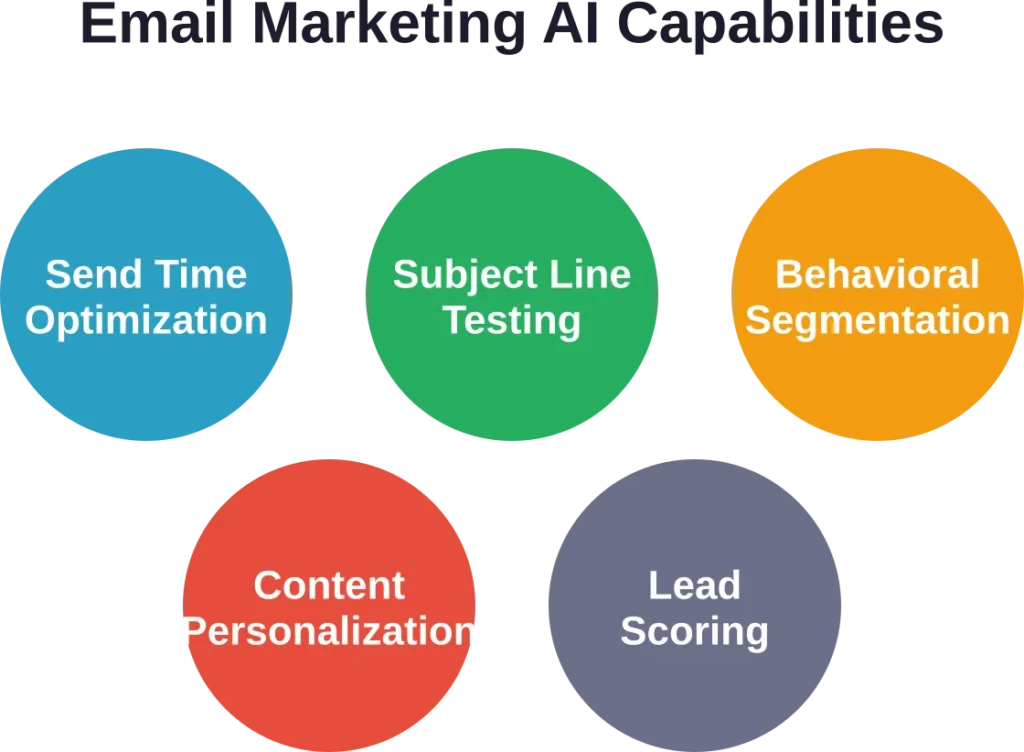
Email remains one of the highest-ROI marketing channels. But effective email marketing requires segmentation, personalization, and timing—all areas where AI excels.
HubSpot Marketing Hub
HubSpot’s AI features automate entire email sequences based on customer behavior. When someone downloads a guide, they automatically enter a nurture sequence. When they visit pricing pages, the system triggers different messages.
The platform scores leads using machine learning, helping small sales teams prioritize outreach. AI analyzes which leads match patterns of past customers who converted.
Email subject line optimization tests variations automatically, sending each recipient the version most likely to prompt opens based on their past behavior.
Free CRM tools make HubSpot accessible for small businesses just starting with marketing automation.
Mailchimp with AI

Mailchimp’s AI features predict optimal send times for each subscriber. Rather than blasting everyone at 10 AM, the system staggers delivery when individual recipients typically engage with email.
Content optimizer analyzes email copy, flagging potential spam triggers and suggesting improvements. Product recommendation engine automatically inserts items each customer is most likely to purchase.
Behavioral targeting creates segments based on website activity, purchase history, and email engagement without manual tagging.
Seventh Sense
Seventh Sense specializes purely in send-time optimization. The AI studies each contact’s email behavior patterns, then delivers messages when they’re most likely to open and click.
This tool integrates with existing email platforms rather than replacing them. Small businesses using HubSpot or Marketo can add Seventh Sense to improve deliverability and engagement rates.
One account-based marketing campaign using strategic AI targeting achieved a 58% increase in page views, according to American Marketing Association data from 2022.
Customer Relationship Management with AI
Managing customer relationships manually becomes impossible as businesses scale. AI-powered CRM systems track interactions, predict needs, and automate follow-up.
Salesforce Einstein

Salesforce Einstein layers AI capabilities across the entire CRM platform. Lead scoring identifies which prospects warrant immediate attention. Opportunity insights predict which deals are likely to close.
The system suggests next-best actions—call this customer, send that email, schedule this demo. Small sales teams operate with the efficiency of larger organizations.
Einstein analyzes email and calendar data to automatically log customer interactions, eliminating manual data entry.
Zoho CRM with Zia
Zia, Zoho’s AI assistant, answers questions about sales data conversationally. “Which leads visited pricing this week?” “Show deals likely to close this month.”
The AI detects anomalies—sudden changes in deal velocity, unusual customer behavior patterns, emerging trends in support tickets. Alerts notify teams of situations requiring attention.
Workflow automation triggers actions based on customer behavior. When a lead reaches a certain score, Zia creates tasks, sends emails, and notifies sales reps automatically.
Pipedrive

Pipedrive focuses on sales pipeline visibility with AI recommendations. The system identifies bottlenecks—stages where deals stall—and suggests process improvements.
Revenue forecasting uses historical patterns to predict monthly and quarterly results. Small businesses gain visibility into future cash flow.
Smart contact data pulls information from email signatures and public sources, automatically enriching CRM records without manual research.
Analytics and Performance Optimization
Data without interpretation wastes potential. AI analytics tools transform raw numbers into actionable insights.
Google Analytics 4 with AI Insights

GA4’s machine learning identifies significant changes automatically. Traffic spike on Tuesday? The system explains which sources drove it. Sudden drop in conversions? AI pinpoints the likely cause.
Predictive metrics forecast churn probability and potential revenue from customer segments. Small businesses allocate marketing budget more effectively.
Anomaly detection alerts teams to unusual patterns—potential technical issues, unexpected campaign performance, emerging opportunities.
Tableau with AI

Tableau’s Einstein Discovery analyzes marketing data to uncover hidden patterns. Which customer segments generate highest lifetime value? What factors predict campaign success?
Natural language queries let non-technical users explore data: “Show social media ROI by channel” or “Compare email performance this quarter versus last.”
Automated insights surface without manual analysis—the system continuously monitors data and flags noteworthy findings.
Brand24

Brand24 monitors online mentions across social media, blogs, forums, and news sites. AI categorizes mentions by sentiment, separating praise from complaints.
The platform tracks competitor mentions alongside your brand, revealing market share of voice. Small businesses identify influencers, trending topics, and reputation issues requiring response.
Automated reports summarize weekly brand health, highlighting changes that need attention.
Conversation and Customer Support AI
Customer questions arrive 24/7, but small teams can’t staff support around the clock. AI chatbots and virtual assistants fill the gap.
Intercom with AI Chatbots

Intercom’s bots handle common questions automatically—shipping times, return policies, account access. When conversations require human expertise, the system routes them to appropriate team members.
AI analyzes support conversations to identify frequent issues. Small businesses spot product problems, confusing website elements, and documentation gaps.
Proactive messaging triggers based on customer behavior. Visitors stuck on checkout pages receive automatic assistance offers.
Drift Conversational Marketing

Drift transforms website chat from reactive support to proactive sales. Bots qualify leads with conversational questions, then route hot prospects directly to sales calendars.
The platform identifies returning visitors and personalizes conversations based on their history. Small sales teams connect with ready-to-buy visitors immediately.
Meeting scheduling happens within the chat interface—no email back-and-forth finding available times.
ManyChat for Social Messaging

ManyChat automates conversations on Facebook Messenger, Instagram, and WhatsApp. Bots answer product questions, collect leads, process orders, and send shipping updates.
Visual flow builders make chatbot creation accessible without coding. Small businesses build sophisticated conversation paths with drag-and-drop interfaces.
Broadcast messaging reaches subscribers with promotions and updates, typically achieving higher open rates than email.
Marketing Automation and Workflow Tools
Connecting different marketing tools traditionally required custom development. AI-powered automation platforms eliminate technical barriers.
Zapier with AI Actions

Zapier connects over 5,000 applications, automating workflows between them. When someone fills a contact form, Zapier adds them to email lists, creates CRM records, sends Slack notifications, and updates spreadsheets—all automatically.
AI features now generate automation suggestions based on the tools businesses use. The platform identifies repetitive tasks and recommends workflow automation.
Small businesses eliminate hours of manual data transfer between systems.
Make (formerly Integromat)
Make handles complex, multi-step automations with visual workflow builders. AI analyzes data flowing through automations, extracting information and making routing decisions.
The platform excels at data transformation—reformatting information as it moves between applications with different requirements.
Error handling automatically retries failed steps and alerts teams to issues requiring attention.
ActiveCampaign

ActiveCampaign combines email marketing, CRM, and automation in one platform. AI predicts which contacts will engage with specific campaigns, optimizing send lists automatically.
The system recommends automation workflows based on business goals—welcome sequences for new subscribers, re-engagement campaigns for inactive contacts, post-purchase follow-ups.
Predictive sending determines optimal delivery times per contact, similar to dedicated tools but integrated with the entire marketing platform.
| Tool Type | Primary Benefit | Best Use Case |
|---|---|---|
| Content Creation AI | Speed and volume | Businesses needing constant content output |
| Social Automation | Consistent presence | Multi-platform brand building |
| Email AI | Personalization at scale | E-commerce and lead nurturing |
| CRM Intelligence | Sales efficiency | Managing growing customer bases |
| Analytics AI | Data-driven decisions | Optimizing marketing spend |
| Chatbots | 24/7 availability | Customer support and qualification |
Implementing AI Marketing Tools Effectively
Adopting AI tools requires strategic thinking beyond simply signing up for software.
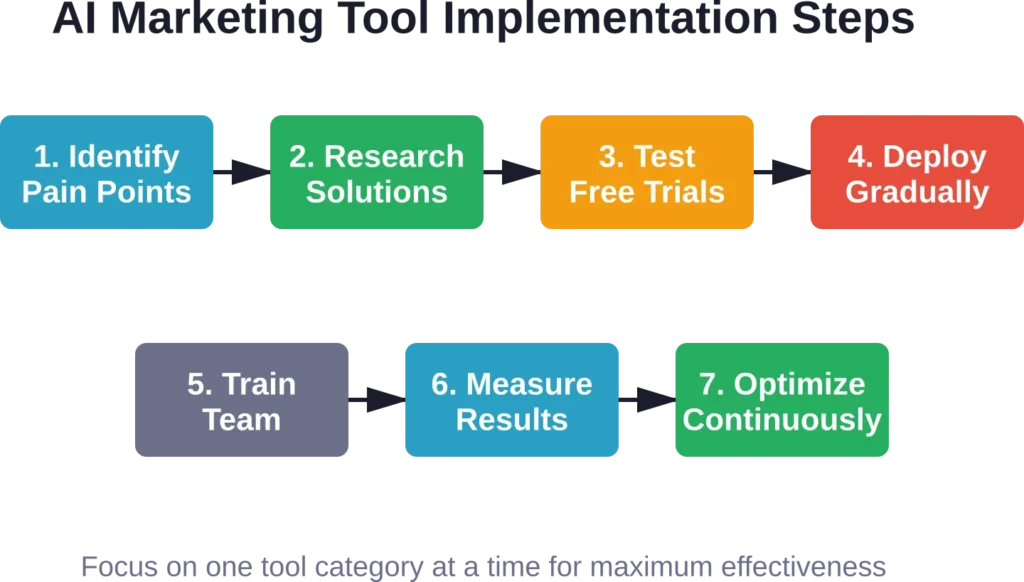
Start with the biggest pain point. Which marketing task consumes most time or creates the biggest bottleneck? Address that first rather than trying to automate everything simultaneously.
Most platforms offer free trials. Test tools with real workflows before committing to annual contracts. Many businesses discover that expensive platforms offer capabilities they’ll never use, while affordable alternatives solve their specific needs perfectly.
According to a Gartner study cited by marketing technology sources, marketers use only 58% of their martech stack’s full capabilities. Implementing fewer tools thoroughly beats deploying many tools superficially.
Training matters. The U.S. Small Business Administration hosts workshops on AI marketing skills, including webinars on digital marketing and social media with AI. Resource partners offer practical, hands-on sessions designed specifically for small and mid-sized businesses.
Integration determines whether tools multiply efficiency or create new headaches. Choose platforms that connect with existing systems—the CRM should sync with email marketing, social scheduling should pull from content calendars, analytics should track conversions from all channels.
But wait. What about the human element?
AI handles repetitive tasks and data analysis brilliantly. Strategy, brand voice, creative direction, and relationship building still require human judgment. The most effective approach combines AI efficiency with human creativity.
Common Challenges and Solutions
Nearly every small business encounters similar obstacles when adopting AI marketing tools.
Learning curves intimidate teams unfamiliar with AI. Most modern platforms address this with templates, pre-built workflows, and guided setup processes. The barrier to entry has dropped dramatically—many tools now require zero technical knowledge.
Data quality limits AI effectiveness. Machine learning models trained on incomplete or inaccurate data produce unreliable results. Clean existing customer data before connecting it to AI systems. Remove duplicates, standardize formats, fill critical gaps.
Integration complexity frustrates small teams lacking dedicated IT staff. Prioritize platforms designed for business users rather than developers. Cloud-based tools with pre-built connectors eliminate most technical hurdles.
Cost concerns stop many small businesses from exploring AI tools. The reality? Many powerful platforms offer free tiers sufficient for businesses just starting. Affordable paid plans typically cost less than hiring one part-time marketing assistant.
According to Harvard Business School research, software company SAP successfully leveraged AI tools to begin selling to small and medium enterprises (SMEs), which had previously been uneconomical for its in-person sales approach. The lesson: AI makes capabilities previously available only to large enterprises accessible to businesses of any size.
Measuring ROI from AI Marketing Tools
Justifying marketing technology spend requires demonstrating measurable results.
Track time savings first. How many hours per week do tools reclaim? Multiply by team hourly costs to calculate direct savings. Most businesses discover AI tools pay for themselves through time savings alone.
Monitor output volume. How much more content gets published? How many additional leads get nurtured? Increased marketing activity typically translates to increased revenue.
Measure quality improvements. Do AI-optimized emails achieve higher open rates? Does automated lead scoring improve sales conversion rates? Do chatbots resolve customer issues faster?
Compare before-and-after metrics across key performance indicators: website traffic, lead generation, conversion rates, customer acquisition cost, lifetime value.
Industry reports suggest companies using marketing automation effectively can achieve significant improvements, with some campaigns showing engagement increases of 58% or more.
Frequently Asked Questions
Small businesses benefit significantly from AI marketing tools because these platforms compress hours of manual work into minutes. With limited staff and budget, small businesses gain competitive advantages by automating content creation, social media management, email campaigns, and customer analysis. The cost of most AI tools remains far below hiring additional marketing staff, while delivering comparable output.
Start with the marketing channel driving most business results. E-commerce businesses typically benefit most from email automation with AI personalization. Service businesses often see better returns from CRM systems with lead scoring. Content-focused businesses should prioritize AI writing and social scheduling tools. Identify the biggest time sink or performance bottleneck, then address that specific problem first.
Many free AI tools provide substantial value for small businesses. ChatGPT’s free tier handles most content creation needs. HubSpot offers capable free CRM and email tools. Buffer and Mailchimp include free plans sufficient for businesses with smaller audiences. Free tiers typically impose usage limits or restrict advanced features, but deliver core functionality effectively. Businesses often operate successfully on free plans for months before upgrading.
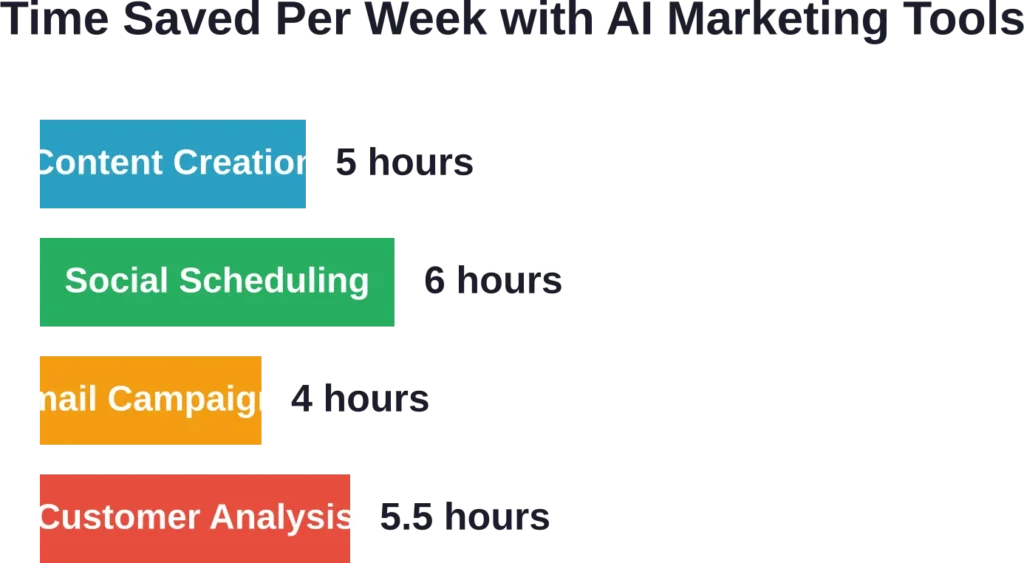
Typical time savings range from 10-20 hours weekly for small businesses actively using AI across multiple marketing functions. Content creation tools save 3-5 hours. Social media automation reclaims 4-6 hours. Email marketing AI saves 2-4 hours. Analytics automation saves 2-3 hours. CRM automation saves 3-5 hours. Actual savings depend on business size, marketing complexity, and how thoroughly teams adopt available automation.
AI tools augment rather than replace human marketers. Artificial intelligence excels at repetitive tasks, data analysis, personalization at scale, and content generation speed. Humans remain essential for strategy development, brand voice definition, creative direction, relationship building, and nuanced decision-making. The most effective approach combines AI efficiency with human creativity and judgment. Small businesses typically see best results when AI handles execution while people focus on strategy.
AI-generated content requires human review before publication, especially for customer-facing communications. Most platforms include approval workflows preventing automated content from reaching customers without oversight. Start with AI-assisted rather than fully automated processes—let tools draft content that team members review and refine. As confidence builds and AI learns brand voice, gradually increase automation. Maintain human oversight for sensitive communications, complex situations, and crisis response.
Evaluate tools based on specific business needs rather than feature lists. Consider existing technology—choose tools that integrate with current platforms. Assess learning curves—complex enterprise software often overwhelms small teams. Test free trials with real workflows, not generic demos. Check customer support quality, since small businesses rarely have in-house technical expertise. Read reviews from similarly-sized businesses in the same industry. Price matters, but calculate total cost including setup time and training, not just subscription fees.
Moving Forward with AI Marketing
The marketing landscape continues evolving rapidly. MIT Sloan research indicates that AI platforms are transforming how consumers search and discover brands. Businesses that don’t adapt risk becoming invisible to potential customers.
The good news? AI marketing tools have never been more accessible, affordable, or user-friendly. Small businesses now access capabilities previously available only to enterprises with million-dollar marketing budgets.
Start small. Choose one tool addressing the biggest marketing bottleneck. Master that platform thoroughly before adding others. Build expertise gradually rather than deploying ten tools simultaneously and using none effectively.
The businesses succeeding in 2026 aren’t necessarily the ones with the most sophisticated technology. They’re the ones using available tools consistently and strategically.
AI won’t do marketing for small businesses. But it will do much of the marketing work, freeing business owners to focus on strategy, relationships, and growth.
The question isn’t whether to adopt AI marketing tools. That ship has sailed. The question is which tools to implement first and how to deploy them most effectively for specific business goals.
Explore the options above. Test a few platforms. Start automating.
The competitive advantage is waiting.