

Quick Summary: Multi-touch attribution tools for Meta ads help marketers track customer journeys across touchpoints despite iOS 14.5 signal loss and cookie deprecation. Top solutions like AdStellar AI, Cometly, and Northbeam use server-side tracking and Conversions API integration to recover 30-60% more conversion data than native Meta reporting. The right tool depends on budget, technical resources, and whether teams prioritize granular journey mapping or algorithmic optimization.
Meta’s native attribution dashboard doesn’t tell the full story anymore.
Since iOS 14.5 rolled out App Tracking Transparency, marketers have watched their conversion visibility collapse. Revenue shows up in bank accounts, but Meta’s interface can’t connect it back to specific campaigns. The platform reports conversions 72 hours late—or not at all.
Here’s the thing though: attribution coverage has dropped to 30–60% of 2020 levels. iOS Safari traffic now has 15–25% attribution coverage due to ATT opt-in rates. Chrome desktop sits at 20–40% after third-party cookie deprecation hit 80% completion in Q1 2026.
Multi-touch attribution tools fill this gap by capturing first-party data that Meta can’t see, then feeding it back through the Conversions API. They track touchpoints across devices, map customer journeys, and show which ads actually drive revenue.
This guide breaks down the nine best attribution tools for Meta ads, how they handle signal loss, and which one fits different marketing team structures.
Why Meta’s Native Attribution Isn’t Enough in 2026
Meta Ads Manager uses a 7-day click, 1-day view attribution window by default. It gives 100% credit to the last touchpoint within that window. Everything else gets zero.
That model breaks down when customers interact with multiple ads over weeks. Someone might see a brand awareness video on day one, click a carousel ad on day twelve, and convert after a retargeting ad on day fifteen. Meta’s default window only catches the retargeting ad.
But the real problem is signal loss, not the model.
iOS users who opted out of tracking—roughly 75–85% of them—become invisible to Meta’s pixel. The platform can’t track their journey from ad click to purchase. Desktop Chrome users face similar issues as third-party cookies disappear. EU traffic under GDPR consent walls creates additional blind spots.
The result? Meta might show 50 conversions when 100 actually happened. Budget allocation decisions based on incomplete data send money to the wrong campaigns.
Multi-touch attribution tools solve this by collecting conversion data server-side, where iOS restrictions and cookie deprecation don’t apply. They capture every touchpoint, then reconstruct the journey Meta couldn’t see.
Book a Demo to Predict Campaign Performance with Extuitive
Extuitive is an AI-first platform designed to validate creative content and predict ad performance before a single dollar is spent. By integrating a brand’s historical data with over 150,000 AI-modeled consumer personas, it eliminates the guesswork typically associated with multi-touch attribution by forecasting success at the pre-launch stage.
- Predictive Performance: Uses 150,000+ AI consumer agents to forecast click-through rates and return on ad spend.
- Creative Validation: Evaluates ad copy, visuals, and messaging against real-world behavioral simulations.
- Audience Identification: pinpoints high-intent microsegments most likely to convert based on proprietary behavioral models.
- Rapid Asset Generation: Produces optimized images, reels, and ad concepts in minutes, tailored specifically to a brand’s product data.
- Seamless Integration: Connects directly to Shopify and major social media platforms to automate product and audience analysis.
Book a demo or start a subscription with Extuitive to ensure every campaign is optimized for maximum impact before it goes live.
How Signal Loss Impacts Attribution Coverage
Not all traffic is equally trackable in 2026. Attribution coverage varies dramatically by source.
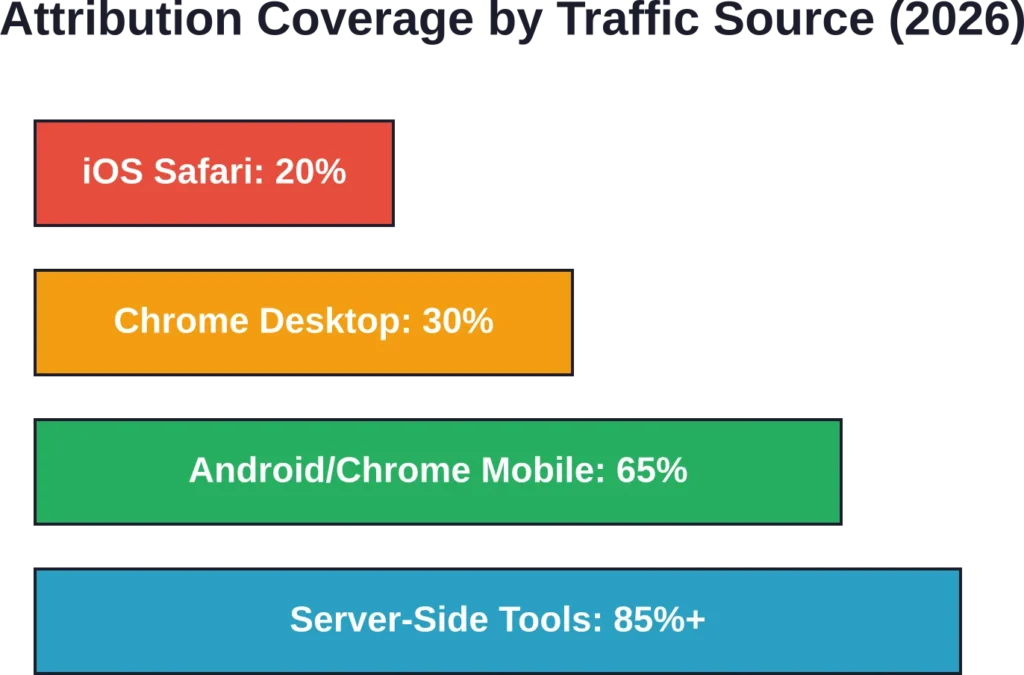
iOS Safari users with ATT enabled represent the biggest blind spot. Only 15–25% opt into tracking, which means attribution tools can only see roughly 20% of that traffic segment. If iOS Safari accounts for 40% of total traffic, only 8% of overall sessions become attributable.
Chrome desktop fell from near-universal tracking to 20–40% coverage as Google completed 80% of third-party cookie deprecation in Q1 2026. The exact percentage depends on whether users cleared cookies, enabled tracking protection, or browse in incognito mode.
Android and Chrome mobile maintain better coverage—around 65%—because cookie restrictions haven’t hit mobile browsers as hard. But that’s still a 35% visibility gap.
Server-side attribution tools bypass these restrictions entirely by collecting conversion events on the merchant’s server, not in the browser. They push that data to Meta’s Conversions API, which accepts server events without requiring cookies or device IDs. Coverage jumps to 85%+ for brands using properly implemented server-side tracking.
Core Multi-Touch Attribution Models
Multi-touch attribution distributes conversion credit across multiple touchpoints instead of giving 100% to the last click. Different models use different rules for splitting credit.
| Model | How Credit Is Distributed | Best For |
|---|---|---|
| Linear | Equal credit to every touchpoint | Teams new to MTA who want simple, unbiased starting point |
| Time Decay | More credit to recent touchpoints | Short sales cycles where last few interactions matter most |
| U-Shaped (Position-Based) | 40% first touch, 40% last touch, 20% middle | Balancing awareness and conversion campaigns |
| W-Shaped | 30% first, 30% lead conversion, 30% sale, 10% others | B2B or multi-stage funnels with clear milestones |
| Algorithmic (Data-Driven) | Machine learning assigns credit based on actual impact | Large data sets (500+ conversions/month) with mature tracking |
Linear attribution works well for teams just starting with multi-touch models. Every ad gets equal credit, which prevents over-indexing on last-click conversions. The downside? It treats a quick retargeting click the same as a high-impact brand awareness video.
Time decay gives more weight to interactions closer to conversion. Someone who clicked three ads gets credit split like 20% (first), 30% (second), 50% (third). This makes sense for e-commerce with short consideration windows.
U-shaped models recognize that first and last touch both matter. The initial ad that introduced the brand gets 40%, the final conversion ad gets 40%, and everything in between splits 20%. This approach values both awareness and conversion efforts.
W-shaped adds a middle milestone—usually lead capture or demo request in B2B contexts. First touch, milestone, and conversion each get 30%, with remaining 10% distributed across other interactions.
Algorithmic models use machine learning to calculate which touchpoints actually influence conversions based on historical data. They require significant volume—typically 500+ conversions per month—to produce reliable results. But when data volume supports it, algorithmic attribution outperforms rule-based models.
Here’s the catch: model choice matters less than data quality. Upper-funnel channels like display and social often receive less than 15% combined credit despite driving 40% of initial awareness, not because the model is wrong, but because signal loss makes their contribution invisible.
Top 9 Multi-Touch Attribution Tools for Meta Ads
These nine platforms handle server-side tracking, Conversions API integration, and multi-touch attribution for Meta campaigns.
1. AdStellar AI (with Cometly Integration)

AdStellar AI focuses on real-time attribution dashboards that show which ads, ad sets, and campaigns drive revenue—not 72 hours later, but as conversions happen.
The platform uses first-party data collection to capture conversions Meta can’t see, then sends that data back through Meta’s Conversions API. This improves campaign optimization while giving marketers a complete view of performance.
Real talk: the dashboard updates in real time. Teams running high-velocity testing see results within hours, not days. That speed matters for brands spending $100k+ monthly who need to kill underperforming ads fast.
AdStellar integrates with Cometly’s attribution engine for multi-touch modeling. The combination handles both immediate performance tracking and longer-term journey analysis.
Best for: E-commerce brands with $25k–$500k monthly Meta spend who need fast feedback loops.
2. Cometly

Cometly built its reputation on accurate server-side tracking that bypasses iOS restrictions. The platform captures conversion events on the server, matches them to ad clicks using first-party cookies, and pushes clean data to Meta’s Conversions API.
Attribution modeling includes linear, time decay, U-shaped, and algorithmic options. Teams can switch between models to compare how credit distribution changes budget recommendations.
The AI-powered optimization layer suggests budget reallocation based on attributed revenue, not just reported conversions. For brands where Meta’s dashboard shows 60 conversions but 100 actually happened, Cometly’s recommendations reflect the full 100.
Setup requires installing a server-side pixel and configuring Conversions API. Technical lift varies by implementation complexity.
Best for: Paid media teams wanting AI-driven optimization and multiple attribution models.
3. Triple Whale

Triple Whale targets Shopify brands specifically. The platform pulls data from Shopify, Meta, Google, TikTok, and email tools into one dashboard.
Attribution uses a blend of pixel tracking and Conversions API data. Triple Whale’s “Pixel Perfect” feature claims to capture conversions other tools miss by combining browser tracking with server events.
The interface emphasizes simplicity. Metrics like “attributed revenue” and “blended ROAS” show up front, without digging through menus. For small teams without dedicated analysts, this streamlined approach removes friction.
Multi-touch attribution is available but not the primary focus. Triple Whale leans toward aggregated performance metrics rather than granular journey mapping.
Best for: Shopify brands under $100k monthly spend who want simple cross-platform dashboards.
4. Northbeam

Northbeam specializes in machine learning attribution models that adapt as campaigns evolve. The platform ingests data from ad platforms, analytics tools, and CRMs, then uses algorithmic attribution to assign credit.
The standout feature is incrementality testing. Northbeam runs controlled experiments—showing ads to one group, withholding from another—to measure true lift. This separates causation from correlation in attribution models.
Journey visualization maps every touchpoint from first impression to conversion. Marketers see exactly how many times customers interacted with Meta ads, which creative formats appeared, and how those interactions sequenced with other channels.
Pricing sits at the higher end. Northbeam typically works with brands spending $500k+ monthly across paid channels.
Best for: Mid-market and enterprise brands with complex multi-channel strategies and budget for premium tools.
5. Hyros

Hyros tracks users across devices using a proprietary identity resolution system. Someone who clicks a Meta ad on mobile, then converts on desktop, gets tracked as one person—not two separate sessions.
The platform prints a unique tracking parameter onto every ad click. That parameter follows users through the website, into email links, across subdomains, and even into phone call tracking systems. When conversion happens, Hyros traces it back to the original ad.
This aggressive tracking approach works well for high-ticket offers where customers research extensively before buying. A $5,000 course purchase might involve ten touchpoints over three weeks. Hyros connects all of them.
Setup complexity is higher than most competitors. Teams need to implement tracking parameters across all campaigns, configure subdomain tracking, and integrate with CRM systems. Expect increased setup complexity and timeframe for full deployment.
Best for: High-ticket offers, courses, and coaching programs with long consideration cycles.
6. Wicked Reports

Wicked Reports focuses on subscription and repeat-purchase businesses. The platform tracks not just first purchase but lifetime value attribution—showing which ads acquire customers who stick around.
Attribution models include first-click, last-click, and linear, plus a proprietary “Wicked Multi-Touch” model that weights touchpoints by engagement quality. A video view that lasted 30 seconds gets more credit than a three-second impression.
The ROI tracking dashboard breaks down performance by customer cohort. Marketers see which campaigns acquired customers with 90-day LTV above target, not just which campaigns drove the most day-one sales.
Integration works smoothly with email platforms, subscription billing systems, and CRMs. This makes Wicked particularly strong for brands where revenue compounds over time.
Best for: Subscription boxes, memberships, and repeat-purchase e-commerce focused on LTV.
7. SegmentStream

SegmentStream combines multi-touch attribution with conversion modeling. When signal loss prevents tracking a specific user, the platform uses machine learning to estimate their journey based on similar attributable users.
This hybrid approach acknowledges that 30–60% of traffic won’t have complete journey data. Instead of ignoring that segment, SegmentStream models probable paths and includes estimated attribution in aggregate reports.
The platform integrates with Google Analytics 4, Meta Conversions API, Google Ads, and most major ad platforms. Data flows into a unified warehouse, then algorithmic attribution runs across the complete data set.
SegmentStream requires technical setup—teams need to configure BigQuery or another data warehouse, set up server-side tracking, and map conversion events. The payoff is highly accurate attribution even with significant signal loss.
Best for: Technical teams comfortable with data warehouses who need modeling to fill signal loss gaps.
8. Rockerbox

Rockerbox built its platform for marketing teams at brands with $1M+ annual ad spend. The tool centralizes data from Meta, Google, TikTok, Pinterest, TV, podcasts, and offline channels into one attribution model.
Multi-touch attribution uses either rule-based models (linear, time decay, position-based) or Rockerbox’s proprietary algorithmic model. The algorithmic version requires minimum thresholds—typically 1,000+ conversions monthly—to produce stable results.
Deduplication is a core strength. When a customer clicks a Meta ad, then later clicks a Google search ad, many attribution tools double-count the conversion. Rockerbox identifies duplicates and assigns fractional credit appropriately.
The platform includes budget planning tools that forecast outcomes based on historical attribution data. Teams model “what if” scenarios—like shifting 20% of budget from Meta to Google—before committing dollars.
Best for: Established brands with $1M+ ad spend running integrated campaigns across six-plus channels.
9. Meta Ads Manager (Native Attribution)

Meta’s built-in attribution isn’t multi-touch, but it’s worth understanding as a baseline.
The platform offers last-click attribution within configurable windows: 7-day click and 1-day view (default), or extended options like 28-day click. Meta also provides “Estimated Action” metrics that model conversions lost to iOS tracking restrictions.
Estimated Actions use aggregated data and statistical modeling to fill gaps. If Meta’s pixel tracked 50 conversions but modeling estimates 20 more probably happened, the dashboard shows 70 “estimated” conversions.
This modeling helps, but it’s not a substitute for first-party server-side data. Estimated Actions can’t attribute specific conversions to specific ads—they provide directional guidance, not granular optimization data.
Best for: Teams under $25k monthly spend who can’t justify third-party attribution tools yet.
Key Features to Evaluate in Attribution Tools
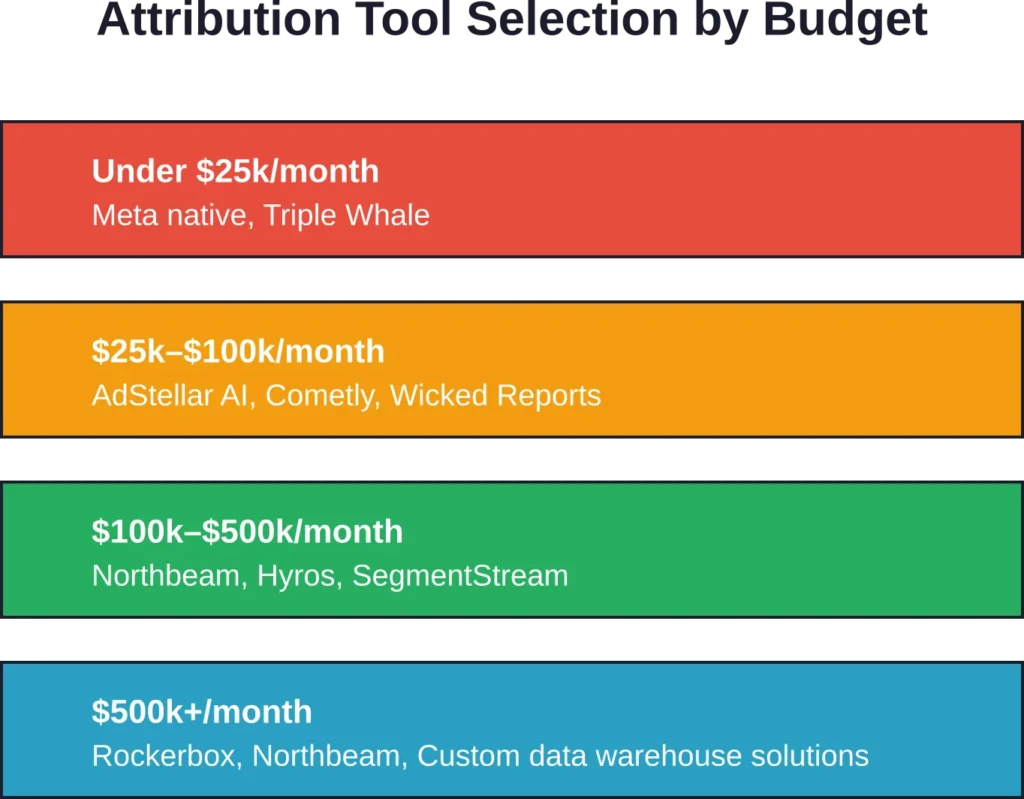
Not all attribution platforms handle Meta ads the same way. These five features determine whether a tool actually solves signal loss problems or just visualizes incomplete data.
Server-Side Tracking and Conversions API Integration
Server-side tracking is non-negotiable in 2026. Tools that rely only on browser pixels may miss significant conversion data.
Proper implementation captures conversion events on the merchant’s server—after checkout completes, after payment processes, after the order enters the fulfillment system. That data gets sent to Meta’s Conversions API with order ID, customer email hash, and other matching parameters.
Meta’s algorithm uses server events to optimize delivery even when it can’t track individual users. If 100 purchases happen but Meta’s pixel only sees 40, Conversions API data tells the algorithm “60 more conversions happened from this campaign” without exposing individual customer identities.
Check whether the attribution tool requires manual Conversions API setup or handles it automatically. Some platforms automate Conversions API configuration. Others require manual setup.
Cross-Device Identity Resolution
Customers don’t convert on the device where they first see an ad. Someone scrolls Instagram on their phone during lunch, researches on a work laptop that afternoon, and completes checkout on a home computer that evening.
Attribution tools use identity resolution to connect those three sessions to one person. Methods include:
- Deterministic matching: email address, phone number, or login credentials confirm same person across devices
- Probabilistic matching: IP address, user agent, browsing patterns, and timing suggest likely same person
- First-party ID graphs: brands that collect email addresses early can match site visitors to known customers
Hyros and Northbeam emphasize cross-device tracking heavily. Triple Whale and Wicked Reports handle it but don’t make it a core differentiator. Meta native attribution barely attempts cross-device matching beyond logged-in Facebook users.
Attribution Model Flexibility
Teams need to switch between models as strategy evolves. A brand launching new products might start with last-click to measure bottom-funnel efficiency, then shift to U-shaped once awareness campaigns scale.
The best tools let marketers compare models side by side. Run linear, time decay, and algorithmic simultaneously, then see how credit distribution changes for each campaign. This comparison reveals which upper-funnel ads get ignored by last-click models.
Cometly, Rockerbox, and SegmentStream offer multiple models with easy switching. Platforms built around one proprietary model—like Hyros’s tracking-parameter approach—lock teams into that methodology.
Real-Time vs. Delayed Reporting
Meta native attribution updates with 24–72 hour delays. Server-side tools can show conversions within minutes.
For teams testing five ad variations daily, real-time data means killing losers by 2 PM instead of three days later. That speed compounds—better tests per week means faster learning and higher overall performance.
AdStellar AI and Cometly prioritize real-time dashboards. Northbeam and Rockerbox update hourly but emphasize longer-term trend analysis over minute-by-minute changes. SegmentStream’s modeling process introduces slight delays—reports update every few hours after batch processing completes.
Data Export and Warehouse Integration
Attribution tools shouldn’t be data dead-ends. Marketing teams need to export attributed conversion data into internal dashboards, combine it with CRM data, or push it to business intelligence platforms.
SegmentStream and Rockerbox integrate directly with BigQuery, Snowflake, and Redshift. Attribution runs inside the data warehouse, so analysts can join attribution data with any other table.
Cometly, Triple Whale, and Wicked Reports offer CSV exports and API access. Teams can pull data programmatically but need to handle warehousing separately.
Meta native attribution exports work through the platform’s reporting API. Data quality matches what the dashboard shows—useful for historical analysis but limited by the same signal loss issues.
Common Attribution Implementation Mistakes
Even the best attribution tool fails if implementation is wrong. These four mistakes cause the most problems.
Skipping Server-Side Tracking Validation
Teams install a server-side pixel, see events flowing into Meta’s Events Manager, and assume everything works. Then they discover three months later that 30% of conversions never fired server events due to a misconfigured webhook.
Validation requires checking that server events fire for every order, not just most orders. Pull a list of 100 recent order IDs from the e-commerce platform, then verify that all 100 appear in the attribution tool and Meta’s Events Manager.
Common failure points include:
- Webhook timeouts when order volume spikes
- Missing events for specific payment methods (PayPal, Apple Pay, buy-now-pay-later)
- Server events firing before payment confirmation completes
- API rate limits causing event drops during peak hours
Fix these before trusting attribution data for budget decisions.
Ignoring Attribution Window Alignment
Meta’s default 7-day click window doesn’t match reality for many products. Furniture purchases, B2B software, and high-ticket courses often have 14–30 day consideration periods.
If attribution tools use a 30-day window but Meta’s campaign optimization uses 7 days, the attribution report says “this campaign drove 200 conversions” while Meta’s algorithm only knows about 120. Budget flows to campaigns with better 7-day performance, even if they underperform on a 30-day basis.
Align attribution windows across tools and platforms. When consideration cycles run long, extend Meta’s attribution window to match the analysis window in third-party tools.
Treating All Conversions Equally
A $500 order and a $50 order both count as “one conversion” in most attribution models. Linear attribution gives them equal weight, which skews credit toward campaigns that drive small purchases.
Value-based attribution weights conversions by revenue or profit. A campaign with 50 conversions averaging $400 revenue gets more credit than a campaign with 100 conversions averaging $80.
This becomes critical for brands with wide price ranges. Platforms like Northbeam and Rockerbox support value-based attribution natively. Others require custom configuration or manual analysis.
Not Testing Incrementality
Attribution shows correlation—this ad appeared before this conversion—but can’t prove causation. Multi-touch models distribute credit across touchpoints without knowing which touchpoints actually influenced the decision.
Incrementality testing measures true lift. Hold back a portion of audience from seeing ads, then compare conversion rates between exposed and unexposed groups. The difference is incremental impact.
Northbeam builds incrementality testing into its platform. Other tools require teams to run holdout tests manually, then adjust attribution models based on results.
Without incrementality validation, attribution models often over-credit retargeting and under-credit prospecting. Someone who was going to buy anyway sees a retargeting ad five minutes before checkout. Attribution gives the ad full credit, but incrementality testing reveals that 80% would have converted without it.
Choosing the Right Attribution Tool for Your Team
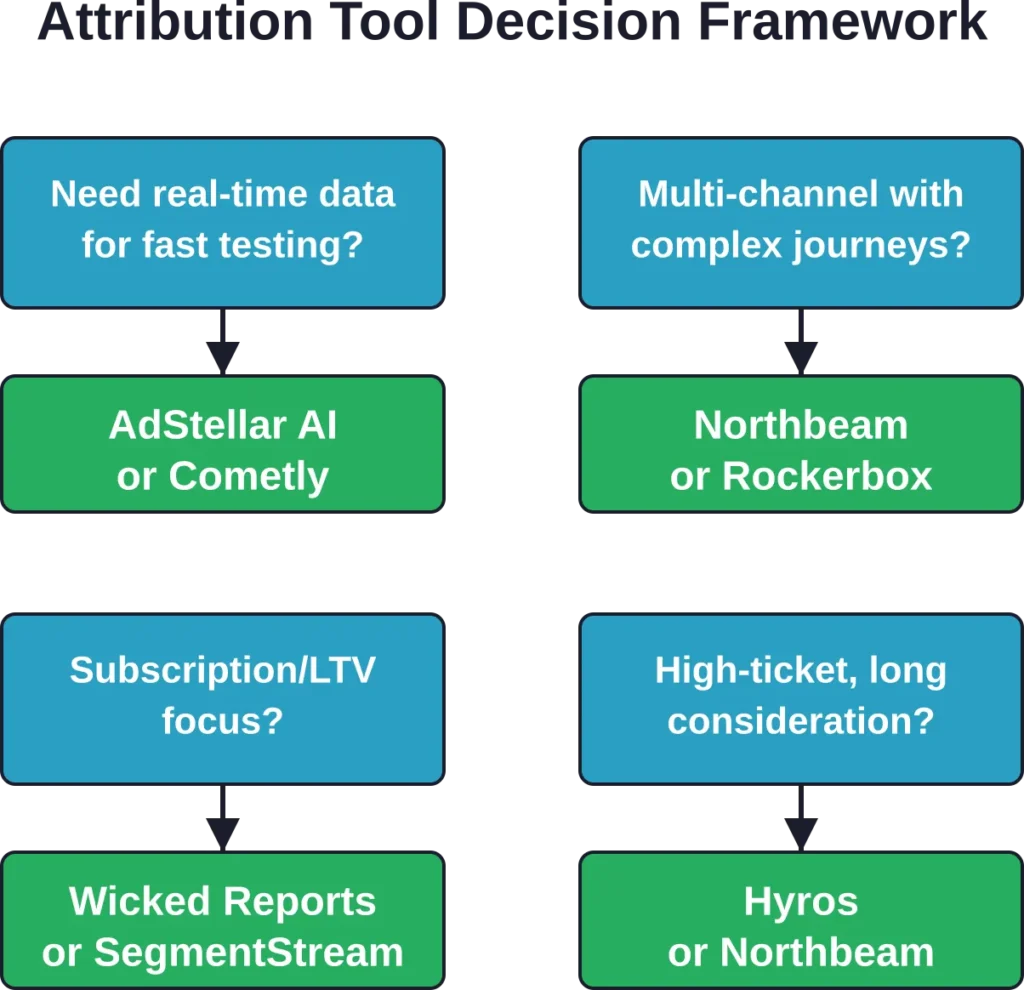
Budget, team structure, and strategic priorities determine which tool fits.
For Teams Under $25k Monthly Spend
Start with Meta’s native tools plus Triple Whale if running Shopify. The cost of sophisticated attribution platforms often exceeds the incremental value they provide at this spend level.
Focus on proper Conversions API setup before worrying about multi-touch modeling. Getting clean server-side events flowing to Meta improves campaign optimization more than switching from last-click to linear attribution.
Track blended metrics—total revenue divided by total spend across all channels—to spot major problems. If blended ROAS drops significantly but Meta’s dashboard shows stable performance, that’s a signal that attribution issues exist.
For Teams Spending $25k–$100k Monthly
This is where dedicated attribution tools start paying for themselves. AdStellar AI and Cometly both fit this budget range and solve the biggest problem: recovering lost conversion visibility.
Prioritize server-side tracking accuracy and real-time reporting over sophisticated modeling. Teams at this level run enough tests that fast feedback loops matter more than perfect attribution math.
Use linear or time-decay models to start. Algorithmic attribution typically requires 500+ conversions monthly for stable results. Simple multi-touch models still provide better insights than last-click alone.
For Teams Spending $100k–$500k Monthly
Northbeam, Hyros, and SegmentStream become viable options. Conversion volume supports algorithmic modeling, and budget at risk justifies investment in precision tools.
Look for platforms that integrate with existing marketing stacks. Teams at this scale usually run six-plus tools (ad platforms, email, SMS, analytics, CRM). Attribution that lives in a silo creates more problems than it solves.
Start testing incrementality. Northbeam’s built-in incrementality features help validate that attributed conversions represent real lift, not just correlation.
For Teams Spending $500k+ Monthly
Rockerbox and enterprise implementations of Northbeam handle the complexity that comes with large budgets spread across many channels.
Consider building custom attribution inside a data warehouse. Platforms like SegmentStream enable this approach by running attribution logic on data the brand already owns, rather than sending data to a third-party platform.
At this budget level, attribution accuracy has six-figure impact. A 5% improvement in budget allocation—moving $25k from underperforming to high-performing campaigns—compounds monthly. That makes even expensive attribution tools ROI-positive quickly.
The Future of Multi-Touch Attribution for Meta Ads
Signal loss isn’t getting better. Privacy regulations tighten, browsers restrict tracking further, and platforms like Meta move toward aggregated reporting.
The trajectory points toward three shifts:
First, server-side tracking becomes table stakes. By late 2026, brands still relying on browser pixels alone will operate with 20–40% attribution coverage. Server-side implementations maintain 70–85% coverage despite privacy changes.
Second, modeling fills more gaps. Tools like SegmentStream that combine observed data with statistical estimation will outperform tools that only report what they can track directly. When 40% of conversions happen in the dark, models that estimate those conversions produce more accurate budget recommendations than reports that ignore them.
Third, incrementality testing becomes standard practice. Multi-touch attribution shows which ads appeared before conversions. Incrementality testing proves which ads caused conversions. The combination—attribution for granular optimization, incrementality for strategic validation—creates the most reliable measurement framework.
Meta itself is moving toward this model. The platform’s Conversion Lift studies and Test & Learn tools measure incrementality directly. As these features mature, they’ll complement third-party attribution rather than replace it.
Forward-looking analysis suggests brands spending $100k+ monthly may increasingly adopt hybrid measurement approaches: server-side attribution for day-to-day optimization, plus quarterly incrementality tests for strategic validation.
Frequently Asked Questions
Multi-touch attribution distributes conversion credit across multiple ad interactions instead of giving 100% credit to the last click. Someone might see a Meta video ad, click a carousel ad three days later, and convert after a retargeting ad. Multi-touch attribution assigns partial credit to all three touchpoints based on the chosen model (linear, time decay, U-shaped, or algorithmic).
iOS 14.5 introduced App Tracking Transparency, which requires users to opt into tracking. Roughly 75–85% of iOS users opt out, making their journeys invisible to Meta’s pixel. Third-party cookie deprecation creates similar problems on desktop browsers. As of 2026, 80% of third-party cookie deprecation in Chrome has completed in Q1 2026, reducing attribution coverage to 20–40% for desktop traffic.
Probably not yet. At lower spend levels, focus on implementing Meta’s Conversions API properly and tracking blended metrics across channels. Third-party attribution tools typically cost $500–$2,000 monthly, which represents 2–8% of a $25k budget. That cost often exceeds the incremental value from better attribution at this scale.
Server-side tools capture conversion events after they happen on the merchant’s server—after checkout completes and payment processes. This data collection doesn’t rely on browser cookies or device IDs that iOS restrictions block. The tool then sends conversion data to Meta’s Conversions API, which accepts server events and uses them for campaign optimization even without tracking individual users.
Attribution models are mathematical rules for distributing credit (linear gives equal credit to all touchpoints; time decay gives more credit to recent interactions). Attribution tools are software platforms that collect data, apply models, and report results. Tools like Cometly and Northbeam offer multiple models—teams choose which model to apply to the data the tool collects.
Yes, but it requires proper attribution window configuration. Default 7-day windows miss most touchpoints for purchases with 30–90 day consideration periods. Tools like Hyros and Northbeam extend tracking windows to 90+ days and use cross-device identity resolution to connect touchpoints that span weeks or months. High-ticket offers and B2B products particularly benefit from long-window attribution.
Algorithmic attribution (data-driven models that use machine learning) outperforms rule-based models when sufficient data exists—typically 500+ conversions monthly. Below that threshold, algorithmic models produce unstable results that change dramatically week to week. Rule-based models like linear or time decay work better for lower-volume campaigns and provide consistent, interpretable results.
Conclusion
Multi-touch attribution for Meta ads isn’t optional anymore. iOS restrictions and cookie deprecation have reduced native attribution coverage to 30–60% of historical levels. Revenue happens, but Meta’s dashboard can’t connect it back to campaigns.
The right attribution tool depends on budget and strategic priorities. Teams under $25k monthly should focus on proper Conversions API implementation before investing in sophisticated platforms. Brands spending $25k–$100k benefit most from tools like AdStellar AI or Cometly that prioritize server-side tracking and real-time reporting. Organizations at $100k+ monthly can leverage algorithmic models and incrementality testing through platforms like Northbeam and Rockerbox.
But here’s what matters more than tool choice: clean data collection. Server-side tracking must fire for every conversion. Attribution windows must align across platforms. Value-based models must weight high-revenue conversions appropriately. And incrementality testing must validate that attributed conversions represent real lift.
Start by auditing current attribution coverage. Calculate what percentage of conversions appear in Meta’s dashboard versus backend order data. That gap determines how much value better attribution provides. For most brands in 2026, the gap is 30–50%—which means attribution tools recover tens of thousands of dollars in previously invisible conversions.
Ready to recover lost conversion data and optimize Meta campaigns based on complete attribution? Evaluate the tools above, prioritize server-side implementation, and validate results with incrementality tests. Better attribution leads to better budget decisions, which compounds into significantly higher returns over time.