

Quick Summary: AI tools for Meta Ads automate campaign management, creative testing, and budget optimization across Facebook and Instagram. From native Meta Advantage+ features to third-party platforms Extuitive, like Revealbot and Madgicx, these tools handle audience targeting, bid adjustments, and creative testing in real time, freeing advertisers to focus on strategy while driving better performance at scale.
Meta advertising has evolved beyond simple boost buttons and basic targeting. Between audience segmentation, creative testing, copy variations, budget optimization, and performance tracking across Facebook and Instagram, running effective campaigns now requires juggling dozens of moving parts simultaneously.
AI tools have emerged to handle these complexities. They process millions of signals in real time, adjusting bids, pausing underperforming ad sets, testing creative variations, and reallocating budgets—often faster and more accurately than manual management allows.
Nearly 800 million people a week use ChatGPT alone to answer questions, compare options, and plan next steps. Meanwhile, AI-powered search features have reduced organic traffic by 15-64% across categories. The advertising landscape has shifted dramatically, and Meta Ads automation has become essential for maintaining competitive performance.
Why Facebook and Instagram Ad Automation with AI Matters
Manual campaign management becomes unsustainable once campaigns scale beyond a handful of ad sets. Checking performance metrics every few hours, adjusting bids based on time of day, testing creative variations across audience segments, and reallocating budgets between campaigns—these tasks consume hours daily.
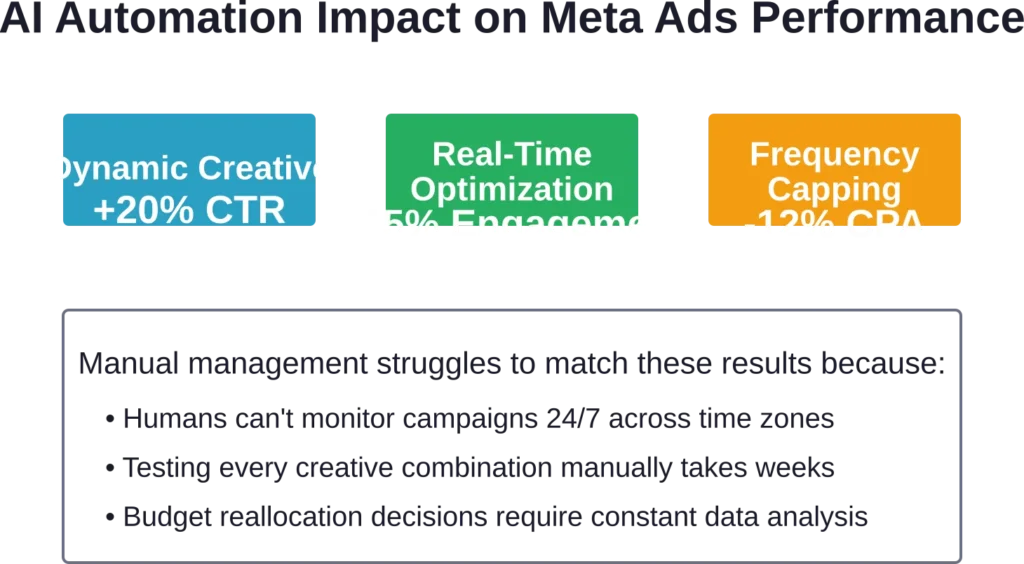
AI automation handles repetitive optimization tasks without human intervention. The technology monitors performance continuously, executing rule-based actions when specific conditions trigger. If cost per acquisition exceeds target thresholds for three consecutive hours, the system pauses that ad set automatically. If return on ad spend drops below a specified level overnight, budgets shift to better-performing campaigns before wasted spend accumulates.
Real talk: automation prevents the budget bleed that happens during off-hours when nobody’s monitoring campaigns. It also eliminates the decision fatigue that comes from making hundreds of micro-adjustments weekly.
Dynamic Creative Optimization and real-time creative optimization can improve performance metrics. Frequency capping—limiting how often the same person sees an ad—can help reduce cost per conversion.
How AI Works Inside Meta Ads Manager
Meta’s native AI features operate through machine learning models trained on billions of ad impressions. The system learns which audiences respond to specific creative formats, which bid strategies yield the best cost per result, and which placements drive the most conversions for particular campaign objectives.
Meta Advantage+ campaigns represent the platform’s most automated option. The system controls audience targeting, creative delivery, budget allocation, and bid optimization with minimal advertiser input. Instead of manually building audiences and selecting placements, advertisers provide conversion data and creative assets while the algorithm handles distribution decisions.
Here’s the thing though—full automation isn’t always optimal. Meta Advantage+ works best when conversion data quality is high and campaign objectives align cleanly with Meta’s optimization targets. For brand awareness campaigns or nuanced targeting scenarios, the black-box approach can produce unpredictable results.
Value-based bidding represents another native AI feature. The system learns which conversions generate the highest customer lifetime value, then optimizes delivery toward audiences likely to produce those valuable conversions rather than simply maximizing conversion volume.
Maintaining performance over weeks and months requires ongoing attention to data quality, creative freshness, and strategic oversight. If a five-hundred-dollar purchase and a twenty-dollar purchase both count as one conversion, the algorithm can’t distinguish between them. Value-based bidding needs accurate purchase value data to function properly.
Top AI Tools for Facebook and Instagram Ads Automation
Third-party tools extend beyond Meta’s native capabilities, offering advanced rule automation, cross-platform management, and specialized creative testing features. Different tools excel at different aspects of campaign management.
Extuitive: Pre-Launch Prediction and Creative Validation
Extuitive is an AI-powered platform that forecasts Meta ad performance before any budget is spent. It analyzes creatives using brand-specific historical data, visual intelligence, and a network of 150,000+ AI consumer agents modeled on real behavior to predict metrics like CTR, ROAS, and purchase intent. The system scores creatives as High/Medium/Low and helps teams kill losers early while scaling winners.
Think of Extuitive as an always-on, hyper-accurate focus group that never sleeps. You upload or generate ad variations (images, Reels, copy, etc.), and the AI agents simulate how real audiences would react — giving instant feedback like “this hook will drive 2.8x better CTR than your average” or “this creative will likely underperform based on visual fatigue patterns.” This eliminates the classic “launch-and-pray” cycle, letting you test hundreds of concepts in minutes instead of burning money on live experiments.
The platform integrates directly with Shopify for automatic product pulls, generates/optimizes creatives, and offers one-click export to Meta Ads Manager. It also provides intelligent audience targeting recommendations and continuously refines predictions as real campaign data flows back in. Many Shopify brands report cutting wasted spend dramatically by validating ads pre-launch.
Pricing starts at $1,000/month (Starter plan) and scales to $2,500/month (Professional) or custom Enterprise, based on the number of ads scored and AI creations allowed.
Contact Information:
- Website: extuitive.com
- Email: support@extuitive.com
- LinkedIn: www.linkedin.com/company/extuitive
- Twitter: x.com/Extuitive_Inc
- Instagram: www.instagram.com/extuitiveinc
Revealbot: Rule-Based Automation and Budget Control

Revealbot provides an automated rule builder that allows managers to automate processes like pausing and restarting ads, controlling budget and bidding processes. The rule builder enables AND/OR operators, custom metrics, timeframes, and testing, as well as rank-based comparisons.
Think of Revealbot as a tireless campaign manager working around the clock. Setting rules like “If CPA exceeds fifty dollars, reduce budget by twenty percent” or “If ROAS drops below three-point-zero for three hours, pause ad set” creates a system that executes automatically. This prevents budget waste during off-hours when nobody’s actively monitoring dashboards.
The platform integrates with Facebook, Instagram, Google Ads, and Snapchat, making it useful for advertisers managing multi-platform campaigns. Bulk actions let managers apply rule sets across hundreds of ad sets simultaneously rather than configuring each individually.
Pricing information should be verified directly with Revealbot, as subscription plans scale based on monthly ad spend managed through the platform.
Madgicx: AI Audience Targeting and Creative Intelligence

Madgicx combines audience insights with creative analysis. The platform’s AI analyzes which audience segments respond to specific creative formats, then suggests optimal audience-creative pairings. The Creative Intelligence feature identifies which ad elements—colors, headlines, calls to action—drive the strongest response rates.
The tool’s Autonomous Budget Optimizer shifts spending toward top-performing ad sets automatically, similar to Revealbot’s budget rules but with additional audience targeting suggestions based on performance patterns. For e-commerce advertisers, the platform integrates with Shopify and WooCommerce to track purchase events and customer lifetime value.
One authentic video ad featuring real people behind a brand increased ROAS within one week of going live, with sales showing significant improvement compared to the previous period. That’s the type of creative insight Madgicx aims to surface—which creative approaches resonate versus generic product shots.
Smartly.io: Enterprise-Scale Creative Production

Smartly.io focuses on creative automation at scale. The platform generates thousands of ad variations from templates, personalizing images, headlines, and offers for different audience segments automatically. For brands running campaigns across multiple markets with localized messaging, this creative production pipeline eliminates manual asset creation bottlenecks.
The platform’s predictive budget allocation uses historical performance data to forecast which campaigns will deliver the strongest returns, then allocates budgets accordingly. Reporting dashboards aggregate data across Facebook, Instagram, Pinterest, Snapchat, and TikTok for cross-platform performance comparison.
Smartly.io targets enterprise advertisers and agencies managing large campaign volumes. Pricing reflects that positioning—contact their sales team for quotes based on specific campaign scale and feature requirements.
Anyword: AI Copywriting for Ad Variations

Anyword specializes in generating ad copy variations using natural language processing. The system analyzes brand voice, campaign objectives, and historical performance data to produce headlines, primary text, and description variations tailored to different audience segments.
The tool integrates directly with Meta Ads Manager, pushing generated copy variations into campaigns for testing. Performance tracking shows which copy patterns drive the highest click-through rates and conversions, feeding those learnings back into the generation model for continuous improvement.
For teams running constant creative testing, Anyword can help address copywriting bottlenecks by generating copy variations that copywriters review and refine before launch. Pricing information is available through official channels and scales based on usage tiers.
AdEspresso: Simplified Testing and Reporting
AdEspresso streamlines split testing setup across Facebook and Instagram campaigns. The interface simplifies creating multivariate tests—comparing different images, headlines, audiences, and placements—without manually building dozens of individual ad sets.
The platform’s reporting dashboard consolidates metrics from multiple campaigns, making cross-campaign performance comparison straightforward. For small-to-medium businesses without dedicated media buying teams, AdEspresso’s simplified workflow reduces the technical complexity of Meta Ads Manager.
Now owned by Hootsuite, AdEspresso integrates with the broader Hootsuite social media management ecosystem. Pricing tiers scale based on monthly ad spend, with current rates available on their website.
Choosing the Right Facebook Ads AI Tool
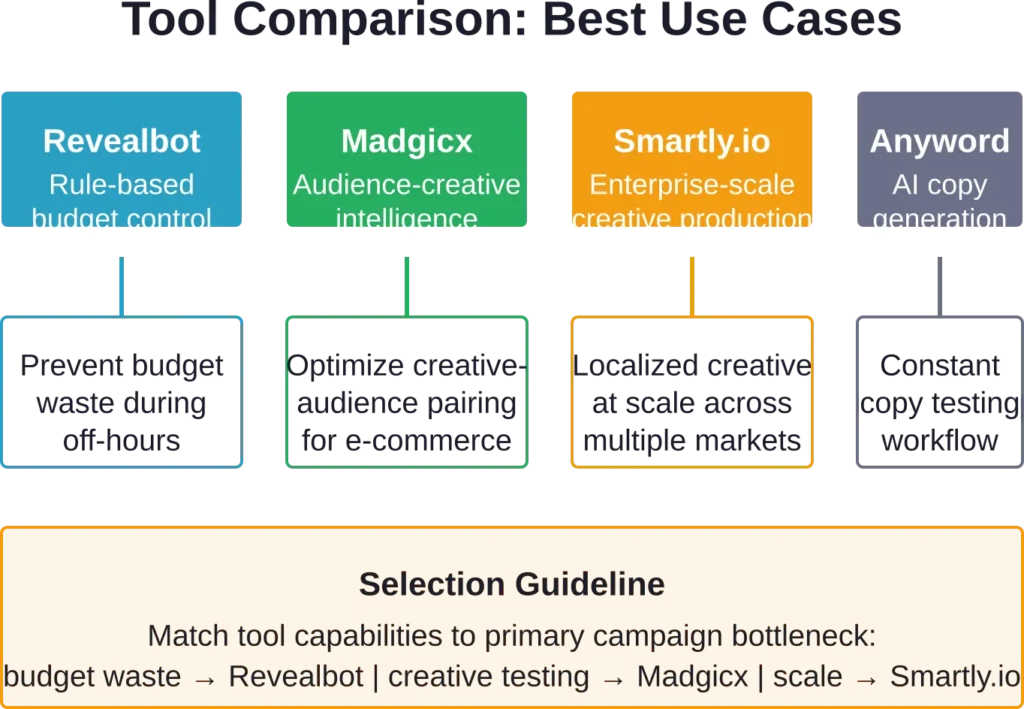
Tool selection depends on campaign scale, team capabilities, and primary optimization goals. A direct-to-consumer e-commerce brand running hundreds of product SKUs faces different challenges than a B2B software company running lead generation campaigns.
For budget management and preventing overnight waste, rule-based automation platforms like Revealbot deliver immediate value. Setting up automated pause rules and budget caps prevents the scenario where a malfunctioning campaign burns through thousands in ad spend before anyone notices.
Creative testing bottlenecks call for tools focused on copy generation or asset production. Anyword addresses copy variations while Smartly.io handles visual asset generation at scale. Teams that test extensively but lack design or copywriting bandwidth benefit most from these specialized tools.
Enterprise advertisers managing campaigns across multiple regions, languages, and platforms need centralized reporting and creative production pipelines. Smartly.io and similar enterprise-focused platforms provide the infrastructure for that scale, though they require corresponding budgets and implementation resources.
Small-to-medium businesses often benefit most from simplified interfaces that reduce Meta Ads Manager complexity. AdEspresso’s streamlined testing setup and consolidated reporting make campaign management more accessible without extensive training.
| Tool | Best For | Key Strength | Typical Users |
|---|---|---|---|
| Revealbot | Budget control | Automated rule execution | Performance marketers, agencies |
| Madgicx | Audience targeting | Creative-audience intelligence | E-commerce brands, DTC companies |
| Smartly.io | Enterprise scale | Creative production pipeline | Large brands, multinational campaigns |
| Anyword | Copy testing | AI-generated ad variations | Content teams, growth marketers |
| AdEspresso | Simplified testing | User-friendly interface | Small businesses, solo marketers |
Setting Up AI Automation in Meta Ads Manager
Before implementing third-party tools, understanding Meta’s native automation features provides a foundation. Advantage+ campaigns and automated rules built into Ads Manager offer starting points without additional software costs.
Advantage+ Shopping Campaigns automate audience targeting for e-commerce product sales. Instead of manually building custom audiences, the system uses Meta’s algorithm to find potential customers based on conversion data. Setting up requires a product catalog connection and conversion tracking via Meta Pixel or Conversions API.
Advantage Campaign Budget distributes spending across ad sets automatically, shifting budget toward better performers throughout the day. Rather than setting fixed budgets per ad set, Campaign Budget Optimization allocates at the campaign level while the algorithm determines optimal distribution.
Automated rules in Ads Manager create basic conditional logic: “If cost per result exceeds X, send notification” or “If ad spend reaches Y, pause ad set.” While less sophisticated than dedicated automation platforms, these native rules handle common scenarios without additional tools.
Setting up conversion tracking accurately is non-negotiable for AI optimization. The algorithm needs reliable conversion data to learn which audiences and placements drive results. Poor tracking produces poor optimization—garbage in, garbage out.
Tracking discrepancies between platform-reported conversions and actual sales can occur due to attribution windows, cross-device tracking, and technical implementation issues. Regular conversion data audits ensure the algorithm optimizes toward accurate signals.
Step-by-Step: Configuring Advantage+ Shopping
Start in Ads Manager by selecting “Create” and choosing the “Sales” campaign objective. Select “Advantage+ shopping campaign” as the buying type. This unlocks automated audience targeting and placement optimization.
Connect the product catalog containing items to promote. Meta pulls product images, names, and prices directly from the catalog for dynamic ad creative. Catalog setup happens in Commerce Manager—ensure product data accuracy before launching campaigns.
Upload creative assets including images, videos, primary text, and headlines. The system tests combinations automatically, but creative quality still matters. High-quality visual assets and compelling copy improve results regardless of automation sophistication.
Set the campaign budget and define the conversion event to optimize toward. For e-commerce, “Purchase” typically makes sense. For lead generation, “Lead” or “Complete Registration” might be more appropriate. The algorithm optimizes delivery toward whichever event gets selected.
Launch the campaign and allow at least seven days for the learning phase. During this period, the algorithm tests delivery across different audiences and placements to identify optimal patterns. Avoid making significant changes during learning—let the system gather data.
Best Practices to Keep Facebook AI Ads Performing
Automation doesn’t mean set-it-and-forget-it. Performance degrades without ongoing maintenance, creative refreshes, and strategic adjustments based on changing business conditions.
Creative fatigue happens when audiences see the same ads repeatedly. Click-through rates decline and cost per result increases. Refreshing creative assets every few weeks prevents this degradation. Even small changes—swapping background colors, updating headlines, or adding new product images—reset audience fatigue.
Conversion data quality directly impacts optimization effectiveness. Regularly audit conversion tracking to ensure events fire correctly and values get passed accurately. Test the purchase flow yourself, check event logs in Events Manager, and compare platform-reported conversions against backend order data.
Seasonal patterns affect ad performance but automation systems don’t inherently account for calendar events. Black Friday, back-to-school periods, or industry-specific seasonal cycles require manual budget and strategy adjustments even with automated optimization running.
Exclusion audiences prevent wasting ad spend on existing customers or people who recently converted. Setting up automated exclusion lists—”Exclude anyone who purchased in the last thirty days”—improves efficiency by focusing budget on new customer acquisition rather than remarketing to recent converters.
Budget pacing matters for campaign performance. Spending the entire monthly budget in the first week produces different results than even daily distribution. Monitor pacing regularly and adjust campaign budgets if algorithms spend too aggressively or conservatively relative to business goals.

Common Pitfalls and How to Avoid Them
Over-automation creates problems when systems make decisions outside intended parameters. Setting up budget rules without caps can cause unexpected pauses or dramatic spend increases. Always configure upper and lower bounds on automated actions.
Interfering during the learning phase disrupts algorithm optimization. Making significant budget changes, audience adjustments, or creative swaps before the seven-day learning period completes resets the process. Exercise patience and let initial learning complete before intervening.
Optimizing for the wrong conversion event produces technically successful campaigns that miss business objectives. If the goal is driving high-value purchases but campaigns optimize for all purchases equally, the algorithm delivers volume over value. Ensure conversion event selection aligns with actual business priorities.
Neglecting creative quality because “the algorithm will figure it out” leads to underperformance. Automation optimizes distribution and targeting but can’t fix poor creative. Blurry product photos, generic stock imagery, and weak copy limit results regardless of optimization sophistication.
Ignoring platform policy changes and feature updates causes campaigns to run on outdated strategies. Meta regularly updates targeting capabilities, automation features, and policy restrictions. Staying informed about platform changes ensures strategies remain compliant and leverage new capabilities.
Where These Tools Fit in the Broader AI Marketing Stack
Meta Ads automation tools represent one component of a broader marketing technology ecosystem. Integration with customer data platforms, analytics tools, and creative management systems determines overall campaign effectiveness.
Attribution tracking across multiple touchpoints requires connecting Meta Ads data with Google Analytics, CRM systems, and other marketing channels. Understanding which Meta campaigns influence downstream conversions—even when the final purchase happens elsewhere—provides clearer ROI visibility.
Customer data platforms aggregate first-party data from websites, apps, email systems, and point-of-sale systems. Syncing this unified customer data back to Meta via Conversions API improves targeting accuracy and attribution measurement beyond pixel-based tracking alone.
Creative management platforms centralize asset storage, approval workflows, and performance tracking across campaigns. For teams producing high volumes of creative variations, integrating creative management with Meta Ads automation streamlines the production-to-distribution pipeline.
Budget allocation tools that work across Google Ads, Meta Ads, TikTok, and other channels help optimize portfolio-level spend distribution. Instead of optimizing Meta campaigns in isolation, cross-platform budget optimization shifts spending toward the channels and campaigns delivering the strongest overall returns.
| Integration Type | Purpose | Impact |
|---|---|---|
| Customer Data Platform | First-party data syncing | Improved targeting and attribution accuracy |
| Analytics Platform | Cross-channel measurement | Clearer ROI visibility and touchpoint analysis |
| Creative Management | Asset production workflow | Faster creative testing and iteration cycles |
| Cross-Channel Budget Optimizer | Portfolio-level allocation | Optimal spend distribution across platforms |
Frequently Asked Questions
Meta Advantage+ operates inside the platform using Meta’s proprietary algorithms, optimizing audience targeting, creative delivery, and budget allocation automatically. Third-party tools like Revealbot or Madgicx add capabilities Meta doesn’t provide natively—advanced rule automation, cross-platform management, specialized creative testing, and custom reporting. Advantage+ works best for straightforward e-commerce and lead generation campaigns, while third-party tools offer more control and specialized features for complex campaign structures.
Many automation platforms price based on monthly ad spend managed, with entry tiers starting around five thousand dollars monthly spend. Below that threshold, Meta’s native automation features and manual management often suffice. Above ten to fifteen thousand monthly, automation tools typically deliver ROI through time savings and performance improvements that exceed their subscription costs. Enterprise tools like Smartly.io target significantly higher spend levels—hundreds of thousands monthly or more.
No. Automation handles repetitive optimization tasks—budget adjustments, bid changes, underperforming ad set pauses—but strategic decisions still require human judgment. Creative strategy, messaging positioning, audience insights, and business objective alignment need human oversight. Think of AI tools as force multipliers that free time for strategic work rather than complete replacements for campaign managers.
Meta’s learning phase typically lasts seven days, during which the algorithm gathers data and identifies optimization patterns. Measurable performance improvements usually appear after two to three weeks once learning completes and campaigns stabilize. Dramatic changes happen occasionally but aren’t typical. Most campaigns show gradual improvement over weeks as systems learn and optimize.
AI optimization works for both, but implementation differs. E-commerce campaigns provide abundant conversion data—purchases happen frequently, giving algorithms rich signals to optimize toward. B2B campaigns with longer sales cycles and fewer conversions require different approaches. Lead quality optimization, multi-touch attribution, and value-based bidding become more important than simple conversion volume optimization. Tools like Revealbot and Madgicx support B2B campaigns, but configuration requires more nuanced setup than straightforward e-commerce optimization.
Setting up guardrails prevents runaway spending. Configure maximum budget caps, establish approval workflows for large changes, and set up notification alerts when unusual spending patterns occur. Most platforms include safety limits—maximum daily spend, minimum ROAS thresholds, or required approvals before pausing high-performing campaigns. Regular monitoring catches issues quickly even with automation running. The goal isn’t eliminating human oversight but reducing the constant attention manual management demands.
Depends on campaign complexity and team bandwidth. Using specialized tools for different functions—Revealbot for budget automation, Anyword for copy generation—provides best-in-class capabilities for each area. But managing multiple platforms adds complexity and integration overhead. For smaller teams, choosing one comprehensive platform simplifies workflows even if individual features aren’t quite as strong as specialized alternatives. Larger teams with dedicated personnel for different campaign aspects benefit more from specialized tool combinations.
Making the Choice: Which AI Tool to Start With
The right starting point depends on the biggest current constraint. If campaigns waste budget overnight or during weekends when nobody’s monitoring, rule-based automation like Revealbot delivers immediate value. If creative testing represents the bottleneck—teams can’t produce enough variations fast enough—copy generation tools like Anyword or creative production platforms like Smartly.io address that constraint directly.
For advertisers new to automation, starting with Meta’s native Advantage+ features provides a low-risk entry point. Testing automated audience targeting and campaign budget optimization within Ads Manager builds familiarity with AI-driven optimization before adding external tools and associated costs.
Trial periods offered by most platforms allow testing before committing to annual contracts. Running a one-month trial of Revealbot or Madgicx alongside existing manual campaigns provides direct performance comparison. Measure time savings, cost per result changes, and overall campaign management efficiency to determine whether the tool justifies its cost.
The advertising landscape continues evolving rapidly. AI-powered search features have already reduced organic traffic by 15-64% across categories. Performance marketing increasingly depends on sophisticated automation to remain competitive as manual optimization becomes unsustainable at scale.
Start with the tool that addresses the most painful current bottleneck. Master its core capabilities. Then evaluate whether adding additional specialized tools delivers incremental value or whether the current setup sufficiently handles campaign needs.
Ready to implement AI automation for Meta Ads campaigns? Begin by auditing current campaign management workflows—identify which tasks consume the most time and which optimization opportunities get missed due to bandwidth constraints. That analysis reveals which AI tool category delivers the highest impact for specific campaign needs.