

Quick Summary: The best AI tools for social media marketing in 2026 combine scheduling, analytics, and content creation capabilities to help teams work smarter. According to G2 Learning Hub, the global social media management market reached $39.14 billion in 2026 and continues growing at 19.70% annually. Top-performing tools like Buffer, Hootsuite, Sprout Social, and HubSpot Marketing Hub offer AI-powered features that automate repetitive tasks while improving engagement and personalization.
Social media marketing has shifted dramatically. What used to require hours of manual work—drafting posts, scheduling across platforms, analyzing performance, responding to comments—can now happen with a few clicks.
AI tools are driving this transformation. The global social media management market was valued at $32.48 billion in 2025 and reached $39.14 billion in 2026, with projections hitting $164.52 billion by 2034 at a 19.70% CAGR, according to G2 Learning Hub research.
But here’s the catch: not all AI social media tools deliver what they promise. Some automate the busywork. Others help generate ideas. A few do both exceptionally well.
This guide breaks down the top AI-powered social media marketing tools evaluated for 2026, based on real-world testing and authoritative industry analysis.
What Makes AI Social Media Tools Worth Using
AI marketing tools solve specific problems. The best ones save time on repetitive tasks while improving results—better engagement, more conversions, faster response times.
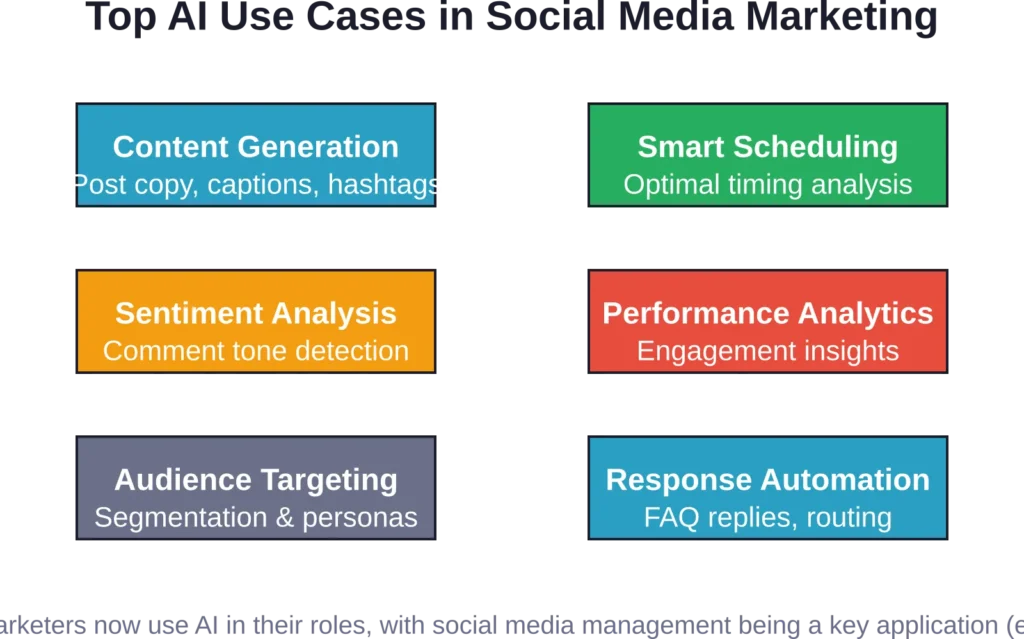
According to eMarketer data, 74% of marketers now use AI in their roles, with social media management being a key application. The technology is maturing rapidly and becoming essential across the marketing function.
Look for tools that deliver in these areas:
- Content generation that sounds human – AI-written posts should match brand voice and require minimal editing
- Smart scheduling – Posting at optimal times based on audience behavior data, not guesswork
- Cross-platform efficiency – Managing multiple accounts without logging in and out constantly
- Analytics that actually inform decisions – Data that shows what’s working and what to change
- Automation that doesn’t feel robotic – Responses and engagement that maintain authentic connections
That said, consumer expectations around AI transparency are rising. Research from eMarketer shows that 91% of consumers expect brands to disclose AI use in marketing, and only 35% of US consumers trust AI-generated content. Brands posting unlabeled AI content now ranks as the number one social media turn-off in Sprout Social’s Q1 2026 Pulse Survey.
The takeaway? Use AI to work faster and smarter, but don’t hide behind it.
Top AI Social Media Marketing Tools for 2026
These platforms represent the current state of AI-powered social media management. Each excels in different areas—scheduling, analytics, content creation, or multi-platform coordination.
Extuitive: AI-Powered Ad Creative Prediction & Generation
Extuitive uses advanced AI to predict the performance of social media ads before you launch them. The platform analyzes images, videos, and copy, then forecasts CTR, ROAS, and conversions using models trained on real campaign data and 150k+ synthetic consumers.
It automatically generates high-performing ad creatives, headlines, and full campaigns tailored for Shopify and D2C brands.
According to Extuitive’s internal benchmarks (Q1 2026), predicted top-performing creatives achieve on average 41% higher ROAS compared to manually selected ones.
The tool also enables rapid repurposing of content across Instagram, TikTok, Facebook, and Pinterest with platform-specific adjustments.
Pricing: Starts at $49/month (Starter plan). Higher tiers for larger ad spend and team access (as of May 2026).
Best for: E-commerce brands and performance marketers who want to cut wasted ad spend and scale creative testing without burning budget on losing ads.
Contact Information:
- Website: extuitive.com
- Email: [email protected]
- LinkedIn: www.linkedin.com/company/extuitive
- Twitter: x.com/Extuitive_Inc
- Instagram: www.instagram.com/extuitiveinc
Buffer: AI Assistant Built Into Your Workflow

Buffer integrates AI directly into the social media publishing process. The AI Assistant detects which platform content targets and adapts suggestions accordingly—what works on LinkedIn won’t necessarily work on TikTok, and Buffer’s AI recognizes that.
According to Buffer’s own data published April 15, 2026, posts created with Buffer’s AI Assistant showed 22% higher engagement compared to non-AI posts. That’s significant.
The tool generates post ideas, rewrites existing content for different platforms, and suggests hashtags based on current trends. Teams can repurpose a single piece of content across multiple channels without manual rewriting.
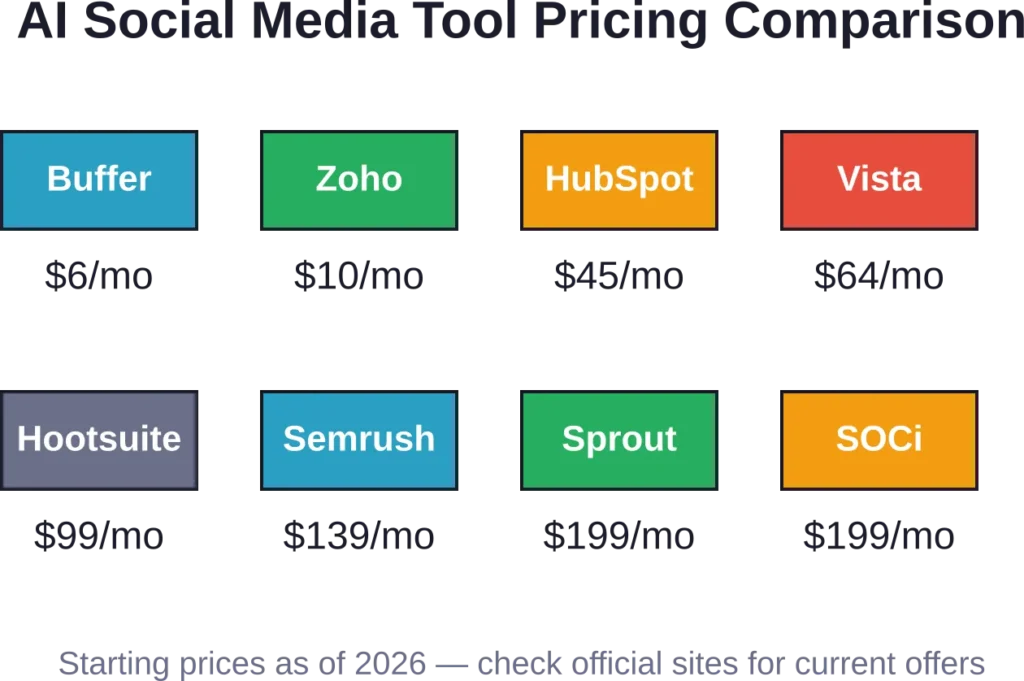
Pricing: Free plan available for three channels. Paid plans start at $6/month/channel as of April 2026.
Best for: Small teams and solo marketers who need platform-specific content adaptation without hiring a full social media team.
Hootsuite: Centralized Scheduling and Management at Scale

Hootsuite remains the workhorse for teams managing multiple accounts. The platform provides a unified dashboard for scheduling, monitoring, and analytics across all major social networks.
Recent AI additions include content suggestions, optimal posting time recommendations, and sentiment analysis on incoming messages. Teams can see everything happening across accounts in one place rather than switching between native platforms.
According to G2’s evaluation, Hootsuite pricing starts at $99/month, positioning it as a mid-tier option for growing teams.
Best for: Marketing teams managing 10+ social accounts who need centralized control and detailed reporting.
Sprout Social: Analytics and Unified Inbox

Sprout Social built its reputation on analytics, and the AI features enhance that strength. The platform processes hundreds of social messages in minutes, prioritizing them based on content and context.
This matters because nearly three-quarters of consumers expect responses within 24 hours. Sprout’s AI helps teams meet that expectation without drowning in notifications.
The unified inbox aggregates messages, comments, and mentions from all platforms. AI categorization flags urgent issues, customer service requests, and sales opportunities separately.
Pricing: Starts at $199/month according to G2 research.
Best for: Customer service teams and brands that prioritize response speed and sentiment tracking.
HubSpot Marketing Hub: CRM Integration for Social
HubSpot connects social media activity directly to customer relationship management data. When someone engages with social content, that interaction appears in their CRM profile alongside email opens, website visits, and purchase history.
This integration enables personalized follow-up at scale. Marketing teams can see which social posts drive actual conversions, not just engagement metrics.
The AI features include content recommendations, A/B test suggestions, and predictive lead scoring based on social engagement patterns.
Pricing: Marketing Hub starts at $45/month according to G2 data.
Best for: B2B companies and sales-driven organizations where social media feeds into broader marketing automation.
Zoho Social: Advanced Analytics on a Budget

Zoho Social delivers enterprise-level analytics at a fraction of typical pricing. The platform tracks performance across channels, identifies trending content types, and suggests optimal posting schedules.
The AI-powered SmartQ feature analyzes when followers are most active and automatically queues posts for those windows. Teams can batch-create content and let the system handle timing.
Pricing: Starts at $10/month, making it one of the most affordable options with serious AI capabilities.
Best for: Budget-conscious teams that won’t compromise on data quality and need detailed reporting.
Vista Social: Multi-Account Management and Automation

Vista Social handles the complexity of managing dozens of social accounts simultaneously. The platform shines for agencies and multi-brand organizations.
AI automation includes content recycling (automatically reposting evergreen content on schedules), conditional posting based on triggers, and cross-platform campaign coordination.
Pricing: Starts at $64/month according to G2.
Best for: Agencies managing client accounts and enterprises with multiple brand presences.
Semrush: Competitive Intelligence Meets Social Planning

Semrush approaches social media through a competitive lens. The platform analyzes what competitors post, when they post, and what performs best for them.
AI features surface content gaps and opportunities. If competitors consistently get engagement on specific topics, Semrush flags those patterns and suggests similar approaches.
The tool integrates social planning with broader SEO and content marketing workflows, making it valuable for teams running integrated campaigns.
Pricing: Starts at $139.94/month for the full suite.
Best for: Content strategists who need competitive intelligence alongside social media management.
SOCi: Multi-Location Social Media at Scale

SOCi specializes in a specific challenge: managing social media for businesses with multiple physical locations. Franchise operations, retail chains, and restaurant groups need local content that maintains brand consistency.
The platform enables corporate teams to create content templates that local managers customize. AI ensures brand voice remains consistent while allowing regional personalization.
Pricing: $199/user/month billed annually according to G2.
Best for: Multi-location businesses that need centralized control with local flexibility.
AI Content Creation Tools for Social Media
Some tools focus specifically on the content creation challenge. They won’t schedule posts or provide analytics, but they excel at generating ideas and drafting copy.
Claude: Structured Writing for Social Copy

Claude handles longer-form content that gets adapted for social media. The AI maintains context across conversations, making it useful for developing campaign narratives or creating content series.
According to Buffer’s analysis, Claude excels at structured writing that requires deep reasoning—product launch announcements, thought leadership posts, educational content.
Pricing: Free tier available; paid plans start at $20/month.
Best for: Content strategists developing campaign narratives that span multiple posts and platforms.
Jasper: Brand Voice Consistency at Scale
Jasper learns brand voice by analyzing existing content. Teams train the AI on approved copy, and it generates new content matching that style.
This consistency matters for brands with strict voice guidelines or multiple content creators who need to sound unified.
Pricing: Starts at $69/month according to Buffer’s tool analysis.
Best for: Enterprises with established brand voice that need consistent content from multiple contributors.
Wordtune: AI Editing and Rewriting

Wordtune focuses on refinement rather than generation. The tool suggests alternative phrasings, adjusts tone (more casual, more formal), and shortens or expands text.
For social media, this means taking existing drafts and adapting them for different platforms or audiences without starting from scratch.
Pricing: Paid plans start at $13.99/month as of April 2026.
Best for: Teams that need to repurpose content across channels with different tone requirements.
How Top Brands Use AI for Social Media Marketing
Real-world applications show what’s possible when AI tools integrate into broader marketing strategies.
Coca-Cola: AI-Driven Personalized Strategies
According to research on how top brands use AI for content marketing, brands implementing personalized AI-driven strategies have seen significant improvements in engagement and conversion metrics.
Netflix: Personalized Content Recommendations
Netflix uses AI to customize content recommendations for different audience segments. The same show gets promoted with different imagery and messaging based on viewer preferences.
Research shows that 80% of content discovery on Netflix comes through AI recommendations, and personalized thumbnails improved click-through rates significantly.
What These Cases Reveal
Both examples share a pattern: AI works best when it personalizes at scale. The technology handles the variation and targeting while humans set strategy and creative direction.
Brands that treat AI as a creative partner rather than a replacement see better results.
What to Consider Before Choosing an AI Social Media Tool
Not every tool fits every situation. The right choice depends on specific needs and constraints.
Team Size and Workflow
Solo marketers need different features than 10-person teams. Buffer’s simplicity works well for individuals. Hootsuite’s collaboration features support larger groups.
Consider who creates content, who approves it, who schedules it, and who analyzes results. The tool should match that workflow.
Platform Coverage
Not all tools support all platforms equally. Some excel at Facebook and Instagram but offer limited LinkedIn features. Others cover TikTok and YouTube comprehensively.
List the platforms that matter most for specific business goals, then verify robust support exists.
Integration Requirements
Social media rarely exists in isolation. Content often originates in Google Docs, gets approved in project management tools, and performance data feeds into broader analytics dashboards.
Check what integrations exist and whether they actually work smoothly. Native integrations typically perform better than third-party connections.
Budget and ROI Timeline
Pricing varies dramatically—from $6/month to $199/month and beyond. But cheaper doesn’t mean better value if the tool can’t handle necessary features.
Calculate the cost of current manual processes. If a team member spends 10 hours weekly on social scheduling, that’s $1,300 monthly at a $32/hour rate. A $99/month tool that reclaims those hours pays for itself immediately.
AI Transparency and Brand Safety
Consumer sentiment around AI-generated content is shifting. According to eMarketer research from May 2026, 28% of social media users worldwide cite unlabeled AI content as their top brand turn-off.
When consumers notice AI in marketing, they’re four times more likely to trust the brand less than more—31% versus just 7%, according to December 2025 Klaviyo and Datalily survey data.
Choose tools that allow human oversight and editing. The AI should assist, not replace, human judgment on what gets published.
Common Mistakes When Implementing AI Social Media Tools
Even good tools produce poor results when implemented badly. These patterns show up repeatedly.
Publishing AI Content Without Editing
AI generates decent first drafts. Rarely does it produce publish-ready copy on the first attempt. Tone might be off. Facts might need verification. Brand voice might need adjustment.
Teams that skip human review quickly develop a generic, obviously-automated presence. Audiences notice.
Ignoring Platform-Specific Best Practices
AI can adapt content for different platforms, but it needs direction. A LinkedIn post shouldn’t use the same hashtag strategy as Instagram. TikTok content requires different pacing than Facebook.
The best results come from combining AI efficiency with platform expertise.
Focusing Only on Content Creation
Creating posts is just one piece. Distribution timing, audience targeting, engagement responses, and performance analysis matter equally.
Tools that only generate content without handling the full workflow create new bottlenecks.
Not Training the AI on Brand Voice
Generic AI output sounds generic. Tools like Jasper and Claude improve dramatically when trained on existing brand content.
Feed the AI approved posts, style guides, and brand messaging documents. The output quality improves significantly.
Neglecting Human Connection
Automation tempts teams to set everything on autopilot. But social media is inherently social. Audiences want to interact with humans, not bots.
Use AI for efficiency, but maintain genuine human engagement when it matters—responding to questions, handling complaints, building community.
Future Trends in AI Social Media Marketing
The technology continues evolving rapidly. Several trends are emerging for the next 12-24 months.
Autonomous AI Agents
According to research on AI adoption in marketing, autonomous AI agents are taking on an expanding range of tasks in marketing workflows. These aren’t simple automation scripts—they’re AI systems that make decisions based on goals rather than rigid rules.
For social media, this means agents that adjust strategy based on performance, test different content approaches, and optimize campaigns without constant human input.
Increased Demand for Transparency
Consumer sentiment research indicates significant concern about increased AI-generated content on social platforms. That level of concern reflects real shifts in how audiences perceive brand authenticity.
Platforms and tools will likely add clearer AI disclosure features. Brands that proactively label AI-assisted content might gain trust advantages.
Generative AI Dominance
According to January 2026 Mediaocean research, 70% of marketing professionals consider generative AI an important priority for their organizations.
Investment and development will concentrate on generative capabilities. Expect better video generation, more sophisticated image creation, and audio content production.
Integration of AI Across Marketing Workflows
According to Harvard’s research on AI in marketing (April 2025), AI presents opportunities to personalize customer experiences at scale and develop technological skills.
Social media AI won’t remain siloed. It’ll connect with email marketing, content management systems, CRM platforms, and advertising tools in unified workflows.
| Tool Category | Primary Function | Typical Use Case | Price Range |
|---|---|---|---|
| Social Management Platforms | Scheduling, publishing, analytics | Teams managing 5+ accounts | $45-$199/month |
| AI Content Generators | Copy creation, ideation | Content teams needing volume | $13-$69/month |
| Social Listening Tools | Sentiment analysis, monitoring | Brand reputation tracking | $99-$300/month |
| CRM-Integrated Platforms | Lead tracking, social selling | B2B sales teams | $45-$150/month |
| Multi-Location Tools | Franchises, local management | Retail chains, restaurants | $199+/month |
How to Evaluate AI Social Media Tools Before Committing
Most platforms offer free trials. Use them strategically.
Set Up a Real Test
Don’t just click around the interface. Run an actual trial campaign. Create a week’s worth of content. Schedule it across platforms. Measure the results.
This reveals friction points—where the workflow breaks down, what features are missing, how accurate the AI suggestions actually are.
Test Platform-Specific Features
If Instagram Reels matter for the brand, test how well the tool handles vertical video. If LinkedIn is crucial, verify the post formatting looks professional.
Generic support often means poor support. Platform-specific features should feel native, not like afterthoughts.
Evaluate AI Output Quality
Generate 10-15 pieces of content. How many need heavy editing? How many capture brand voice accurately? How many are publish-ready?
If every output requires substantial rewriting, the tool isn’t saving time.
Check Analytics Depth
Run a small campaign and examine the analytics. Can the tool answer questions like: Which content types drove the most engagement? When did the audience respond best? Which demographics converted?
Surface-level metrics (likes, shares) aren’t enough. Look for actionable insights.
Test Customer Support
Submit a support question during the trial. How fast is the response? How helpful? For paid tools, support quality matters when problems arise.
Frequently Asked Questions
No single tool dominates every use case. Buffer excels for platform-specific content adaptation at an affordable price point. Hootsuite offers the most comprehensive multi-account management. Sprout Social leads in analytics and customer service integration. The best choice depends on team size, budget, and specific workflow needs.
Pricing ranges from $6/month for Buffer’s basic plan to $199/month for enterprise platforms like Sprout Social and SOCi. Mid-tier options like Hootsuite start around $99/month. Budget-friendly Zoho Social begins at $10/month. Most platforms offer free trials to test features before committing.
Not effectively. AI handles repetitive tasks like scheduling, basic content generation, and performance tracking. But strategy, brand voice, crisis management, and authentic community engagement still require human judgment. According to eMarketer research, 91% of consumers expect transparency about AI use, and 31% trust brands less when they notice AI-generated content. The best results combine AI efficiency with human oversight.
Consumer expectations increasingly demand it. Research shows 91% of consumers expect brands to disclose AI use in marketing. Sprout Social’s Q1 2026 Pulse Survey found that posting unlabeled AI content ranks as the number one social media turn-off among users. Many brands now add subtle disclosures or “AI-assisted” labels to maintain trust.
Facebook, Instagram, LinkedIn, and Twitter receive the most robust AI tool integration. TikTok support is growing but less comprehensive. YouTube has solid support from major platforms. Pinterest and emerging platforms often have limited features. When evaluating tools, verify strong support for whichever platforms matter most for specific business goals.
AI analyzes historical performance data to identify optimal posting times, content formats, and messaging that resonates with specific audiences. Buffer reported that posts created with its AI Assistant showed 22% higher engagement compared to non-AI posts. The technology personalizes content at scale and helps maintain consistent posting schedules, both of which drive better audience response.
Free tiers work well for solo marketers or very small teams managing 1-3 accounts. Buffer offers a capable free plan for three channels. Most free versions limit features like analytics depth, team collaboration, or the number of scheduled posts. As account numbers or team size grow, paid plans become necessary to maintain efficiency.
Choosing the Right Tool for Your Social Media Strategy
The best AI social media tool is the one that actually gets used. Feature lists don’t matter if the interface frustrates the team or the workflow doesn’t match how content gets created.
Start with clear priorities. Rank what matters most: cost savings, time savings, better analytics, multi-platform management, content quality, or something else.
Then test 2-3 tools that align with those priorities. Run real campaigns during trial periods. Measure actual results, not theoretical capabilities.
The global social media management market is projected to reach $164.52 billion by 2034, growing at 19.70% annually. That growth reflects genuine value—teams adopting the right tools see measurable improvements in efficiency and results.
But success requires choosing tools that match specific needs, training teams to use them effectively, and maintaining the human elements that make social media actually social.
The AI handles the repetitive work. Humans handle the strategy, creativity, and authentic connection. When both work together, social media marketing becomes faster, smarter, and more effective.
Ready to improve your social media workflow? Start with free trials of Buffer, Hootsuite, or Zoho Social. Test them with real content for your audience. The right tool will become obvious within the first week.