
Quick Summary: Dynamic creative optimization (DCO) tools help marketing teams personalize ad creative in real time, test variants at scale, and improve campaign performance by matching messaging to audience signals. The best platforms in 2026 combine creative analytics, automation, and AI-driven decisioning to reduce cost per acquisition and increase ROAS without expanding creative headcount.
Performance marketing teams face a recurring problem: creative assets that crush it in week one start losing effectiveness by week three. Audiences develop banner blindness. Competitors adapt. The messaging that drove a 4% click-through rate drops to 1.8%, and no one’s entirely sure why.
That’s where dynamic creative optimization enters the picture.
DCO platforms don’t just swap headlines or swap images randomly. The best ones build feedback loops between campaign data and creative decisions, so teams can understand which specific elements drive performance and act on those insights faster than manual A/B testing allows.
What Dynamic Creative Optimization Actually Means in 2026
Dynamic creative optimization has evolved beyond its original definition. Early DCO meant programmatic assembly: templates that swapped product images or headlines based on audience segments, stitched together at the moment of impression.
That still exists. But the tools earning top ratings now do something more strategic.
Modern DCO combines three capabilities: real-time creative analysis, predictive fatigue detection, and actionable insights that feed directly into production workflows. According to IAB sources from 2014, the programmatic market (including auction and direct deals) was expected to top $10B in 2014 and grow to $20B by 2016, and RTB’s share of that spend was projected to fall below 60% as direct programmatic deals gained ground.
The shift reflects what advertisers actually need. Programmatic assembly solves scale—matching thousands of product SKUs to audience segments. Creative intelligence solves performance—telling you why variant B outperformed variant A by 23%, and which visual element or copy angle made the difference.
Best-in-class platforms do both.
Top Rated Dynamic Creative Optimization Platforms
The tools below represent the highest-rated DCO solutions based on feature depth, user feedback, and measurable performance impact. Each excels in different scenarios.
Extuitive
Extuitive positions itself as a predictive advertising intelligence platform rather than pure automation. The focus: forecasting real-world ad performance before launch using AI customized to your brand data, instead of wasting budget on live testing.
Core capabilities: AI ad generation (copy, images, videos, pricing), pre-launch performance prediction (CTR/ROAS), validation via 150k+ AI-modeled consumer agents, Shopify store integration, audience insights, and scaled creative scoring. It combines historical brand performance with simulated consumer testing for accurate forecasts.
Brands using Extuitive report faster creative cycles, higher CTR and ROAS, and significant reduction in wasted ad spend. For specific performance metrics, contact the vendor directly.
Best for: Shopify/D2C e-commerce brands and performance marketers who want to generate, validate, and launch high-converting creatives in minutes instead of weeks. Teams that need to test hundreds of ad variations at scale without burning budget on losers.
Pricing: Starter — $1,000/month (or $10k/year); Professional — $2,500/month (or $25k/year); Enterprise — custom. Based on ad volume and features.
Contact Information:
- Website: extuitive.com
- Email: [email protected]
- LinkedIn: www.linkedin.com/company/extuitive
- Twitter: x.com/Extuitive_Inc
- Instagram: www.instagram.com/extuitiveinc
Hawky
Hawky positions itself as a creative intelligence platform rather than pure automation. The focus: understanding why specific creative elements perform, not just which ads win tests.
Core capabilities: Element-level creative analysis, predictive fatigue detection, competitor intelligence, and AI-assisted creative production. Hawky tracks creative components—headlines, visuals, CTAs—independently and correlates them with campaign outcomes.
Marketing teams using Hawky have reported improvements in cost per lead and click-through rates. For specific performance metrics, contact the vendor directly.
Best for: D2C brands running multi-channel campaigns who need to understand creative performance at a granular level and iterate quickly. Teams that treat creative as a strategic lever, not just a production task.
Pricing: Custom enterprise pricing. No public starter tier.
Hunch

Hunch builds end-to-end DCO workflows: creative production, automated testing, performance analysis, and optimization recommendations. The platform leans heavily on template libraries and automation to help teams produce and test creative variants at scale.
Core capabilities: Template-based creative automation, A/B testing infrastructure, feed-driven personalization, and multi-channel deployment. Hunch integrates with major ad platforms and simplifies the mechanics of launching hundreds of variants without proportionally expanding creative headcount.
Best for: Ecommerce brands and performance teams managing high-volume creative output. If your workflow centers on product feeds and you need to generate localized or personalized ads efficiently, Hunch handles the production complexity.
Pricing: Not publicly disclosed; enterprise deals based on ad spend and volume.
Smartly

Smartly.io combines creative automation with campaign management across Meta, TikTok, Pinterest, Snapchat, and programmatic channels. The platform’s strength lies in cross-channel orchestration and dynamic template systems.
Core capabilities: Multi-channel creative automation, dynamic templates, catalog integration, and campaign workflow automation. Smartly automates creative versioning for different placements, audience segments, and geographies without manual duplication.
Best for: Agencies and brands running coordinated campaigns across multiple paid social and programmatic channels. Teams that need centralized creative management and consistent messaging across platforms.
Pricing: Enterprise subscription model; pricing scales with ad spend and user seats.
Celtra

Celtra’s Creative Automation Platform focuses on brand-safe creative production at scale. The tool emphasizes governance, approval workflows, and compliance alongside automation—critical for enterprise brands with strict brand guidelines.
Core capabilities: Template-based automation, brand asset management, approval workflows, and multi-format output. Celtra supports display, video, social, and CTV creative formats with centralized version control.
Best for: Enterprise brands with complex approval processes and distributed creative teams. Organizations that need to balance speed and scale with brand consistency and compliance.
Pricing: Enterprise licensing; annual contracts based on creative volume and user count.
ROI Hunter

ROI Hunter specializes in product-level personalization for ecommerce. The platform connects product catalog data to dynamic creative templates and optimizes ad delivery based on inventory, pricing, and performance signals.
Core capabilities: Dynamic product ads, catalog management, automated bidding integration, and product-level performance tracking. ROI Hunter automates creative updates when inventory, pricing, or promotion data changes.
Best for: Ecommerce brands with fluctuating inventory and promotional calendars. Retailers that need creative and bidding strategies synchronized with real-time product data.
Pricing: Percentage of ad spend model; specific rates disclosed during sales process.
Madgicx

Madgicx targets Meta advertisers with AI-driven creative insights, audience segmentation, and automated bidding. The platform bundles creative analysis with tactical campaign management features.
Core capabilities: Creative AI scoring, audience targeting automation, ad copy generation, and Meta-specific optimization. Madgicx scores ad creatives predictively and suggests budget shifts based on performance forecasts.
Best for: Small to mid-sized D2C brands running primarily on Meta. Teams that want integrated creative insights and campaign automation without stitching together multiple tools.
Pricing: For current pricing information, check the official Madgicx website as subscription tiers and features change frequently.
Creatopy

Creatopy (formerly Bannersnack) provides a design-focused automation platform with drag-and-drop editing, animation tools, and template libraries. The emphasis is creative production rather than analytics.
Core capabilities: Design editor, animation and video tools, template marketplace, and multi-format export. Creatopy helps teams produce display, social, and video ads without relying on dedicated designers for every variant.
Best for: Small marketing teams and startups that need affordable creative production tools. Teams without in-house design resources who want to maintain creative quality while scaling output.
Pricing: For current subscription plans and feature availability, check the official Creatopy website as pricing and feature tiers change frequently.
Storyteq

Storyteq builds video-first creative automation workflows. The platform manages versioning, localization, and format adaptation for video campaigns at scale.
Core capabilities: Video template automation, localization workflows, multi-format rendering, and asset management. Storyteq helps brands produce hundreds of video variants from a single master creative.
Best for: Brands investing heavily in video advertising across CTV, YouTube, and social. Teams that need to localize or personalize video content efficiently without re-shooting or extensive post-production.
Pricing: Enterprise model; pricing based on creative volume and output complexity.
Core Features Every Top DCO Platform Should Deliver
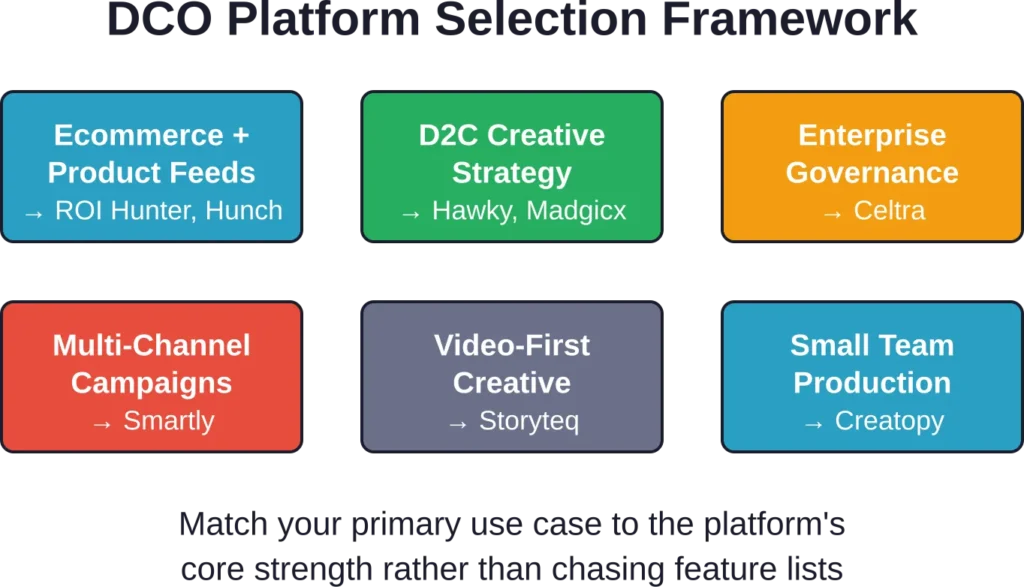
Not all dynamic creative tools are built for the same job. Some excel at high-volume template automation. Others focus on creative analytics. A few manage end-to-end workflows from ideation through deployment.
Here’s what separates platforms that deliver measurable ROI from those that add complexity without clarity.
Element-Level Creative Analysis
Surface-level reporting tells you which ad won. Element-level analysis tells you which headline, background color, call-to-action button, or hero image drove the win.
That granularity matters when you’re running hundreds of variants. If you know the specific elements that correlate with lower cost per lead or higher conversion rates, you can apply those patterns across campaigns instead of treating every test as a standalone experiment.
Look for platforms that tag and track creative components independently—not just whole-ad performance.
Predictive Fatigue Detection
Creative fatigue doesn’t announce itself. Performance degrades gradually, and by the time you notice the drop, you’ve already spent budget on declining returns.
Top-rated tools monitor engagement trends and flag creatives before they hit diminishing returns. Some use machine learning models trained on historical campaign data. Others apply statistical thresholds tied to impression frequency and audience overlap.
Either way, early warning systems prevent wasted spend.
Competitor Intelligence and Benchmarking
Your campaigns don’t run in a vacuum. Competitors launch new messaging, adjust creative strategies, and shift budget allocation. If you’re not tracking what’s happening around you, you’re optimizing in the dark.
Platforms with competitor intelligence modules monitor ad libraries, track creative themes across your vertical, and surface trends before they become saturated. That context helps teams stay ahead of the curve instead of reacting three weeks late.
Automation That Connects to Production
Creative automation without production integration creates bottlenecks. You identify a winning pattern, then wait for designers to build new variants manually.
The best DCO platforms either include native creative production tools or integrate tightly with design software. AI-assisted generation, template libraries, and approval workflows reduce the lag between insight and execution.
Speed matters. If you can iterate on creative twice as fast as competitors, you compound the advantage over time.
The Two Types of DCO and Which One Matters Now
Here’s where terminology gets messy. “Dynamic creative optimization” describes two distinct workflows, and most tools specialize in one or the other.
Programmatic Assembly DCO
This is the original model: modular templates that assemble personalized ads on the fly. The platform stores creative components—headlines, images, CTAs, product feeds—and stitches them together based on audience signals at the moment of ad serving.
Best use case: ecommerce brands with large product catalogs. If you’re running dynamic product ads across thousands of SKUs, programmatic assembly scales efficiently. Feed data connects to creative templates, and the platform generates personalized variants without manual intervention.
Creative Intelligence DCO
This model focuses on analysis and decision support. Instead of assembling ads programmatically, it evaluates creative performance at the element level, identifies patterns, and recommends or automates creative iterations based on data.
Best use case: D2C brands and performance teams running complex creative strategies across channels. When you’re testing messaging angles, visual styles, and offer framing—not just swapping product images—creative intelligence platforms provide the feedback loop between campaign results and creative strategy.
Many top-rated platforms now offer hybrid functionality. But knowing which mode drives value for your specific workflow helps narrow the field.
How to Evaluate DCO Platforms for Your Stack
Feature checklists help narrow options, but real-world fit depends on workflow alignment and team capacity. Here’s a practical evaluation framework.
Define Your Creative Bottleneck
Where does your creative workflow break down? Are you producing enough variants but struggling to understand which elements drive performance? Or is production itself the constraint—too slow, too manual, too dependent on scarce design resources?
Creative intelligence platforms solve the first problem. Automation platforms solve the second. Hybrid tools address both, but often with trade-offs in depth.
Assess Integration Requirements
DCO tools sit at the intersection of ad platforms, analytics systems, creative production software, and asset management. The more friction in those connections, the less value the platform delivers.
Check native integrations for your ad channels, tracking infrastructure, and design tools. API flexibility matters if your stack includes custom or niche systems.
Test Against Real Creative Complexity
Product demos showcase best-case scenarios. Request a pilot test with your actual creative assets, audience segments, and campaign structures.
Can the platform handle your video specs? Does it support your localization requirements? How does it manage brand safety and approval workflows?
Real complexity surfaces friction that polished demos hide.
Calculate Total Cost Beyond Subscription Fees
Platform subscription costs represent one line item. Implementation effort, training time, ongoing maintenance, and opportunity cost of migration all factor into total cost.
A lower-priced tool that requires three months of setup and custom development might cost more than a higher-priced platform that deploys in two weeks.
Model the full cost over a twelve-month period, including team time.
Validate Claims with Reference Customers
Vendor case studies highlight wins. Reference calls with existing customers surface limitations, gotchas, and workflow realities.
Ask about support responsiveness, feature roadmap delivery, and unexpected costs. Reference customers often share insights that sales teams won’t volunteer.
CTV and Emerging DCO Use Cases
Connected TV advertising has pushed DCO into new territory. CTV environments demand different creative specs, measurement approaches, and personalization strategies compared to display or social.
Top DCO platforms for CTV handle dynamic creative insertion, first-party data integration, and cross-device attribution. Innovid leads this category with strong CTV focus, AI decisioning, first-party data integrations, and robust measurement capabilities.
The CTV DCO workflow differs from traditional programmatic display. Creative needs to respect the lean-back viewing experience, limited interactivity, and household-level targeting. Platforms that excel at banner personalization don’t automatically translate to effective CTV creative optimization.
As streaming inventory grows and ad-supported tiers expand across major platforms, CTV-specific DCO capabilities will separate leaders from laggards.
Common DCO Implementation Mistakes
Even strong platforms fail when implementation misses critical steps. These mistakes show up repeatedly in community discussions and user feedback.
Over-Automating Before Understanding Patterns
Automation without insight compounds bad creative decisions at scale. Teams that jump straight to automated creative production before establishing baseline performance patterns often generate high volumes of mediocre variants.
Start with analysis and testing. Identify what works. Then automate production of those patterns.
Ignoring Creative Fatigue Until Performance Drops
Reactive fatigue management means you’ve already wasted budget. Platforms with predictive fatigue detection flag declining engagement before it impacts KPIs.
Set automated alerts and rotation schedules instead of waiting for manual performance reviews to surface problems.
Fragmenting Creative Data Across Tools
When creative production happens in one tool, testing in another, and analysis in a third, no single system has complete visibility. That fragmentation prevents the feedback loops that make DCO valuable.
Prioritize integration depth over feature breadth. A tightly connected workflow beats disconnected best-of-breed tools.
Underestimating Brand Governance Needs
Automation scales mistakes as efficiently as it scales successes. Without proper approval workflows and brand guidelines enforcement, DCO platforms can generate off-brand creative at volume.
Enterprise brands need governance features—approval chains, asset restrictions, compliance checks—even if they slow initial deployment.
Pricing Models and What Actually Drives Cost
DCO platform pricing varies widely, and published rates often obscure the real cost drivers. Here’s what actually determines total expense.
Percentage of Ad Spend
Some platforms charge a percentage of total media spend—typically 1-5%. This aligns vendor incentives with campaign performance but can become expensive as budgets scale.
Watch for minimum spend thresholds and how the platform handles spend across multiple channels or accounts.
Subscription Plus Usage
Base subscription covers platform access; usage fees apply to creative renders, variants produced, or API calls. This model offers predictability at low volumes but can spike unexpectedly during high-activity periods.
Clarify how usage is metered and whether there are hard caps or overage charges.
User Seats and Feature Tiers
SaaS-style pricing based on user count and feature access. Straightforward for budgeting but can create friction when cross-functional teams need occasional platform access.
Check whether view-only or analyst seats cost the same as full production users.
Enterprise Custom Deals
Large brands often negotiate custom pricing based on creative volume, channel count, and support requirements. These deals offer flexibility but lack price transparency during evaluation.
For current pricing across all platforms mentioned, check each vendor’s official website—subscription models and tier features change frequently.
Platform Comparison: Key Differentiators
When platforms offer similar feature lists, subtle differentiators determine real-world effectiveness. Here’s what separates otherwise comparable tools.
| Capability | Why It Matters | Top Platforms |
|---|---|---|
| Element-level tracking | Identifies which specific creative components drive performance | Hawky, Madgicx |
| Predictive fatigue | Prevents wasted spend on declining creatives | Hawky, Madgicx |
| Cross-channel orchestration | Maintains consistent messaging across platforms | Smartly, Celtra |
| Product catalog sync | Automates creative updates with inventory changes | ROI Hunter, Hunch |
| Video automation | Scales video production without re-shooting | Storyteq, Celtra |
| Competitor monitoring | Surfaces market trends and competitive shifts | Hawky |
No platform excels equally across all dimensions. Choosing the right tool means prioritizing the capabilities that address your specific performance gaps.
Integration Ecosystem Considerations
DCO platforms don’t operate in isolation. Their value depends heavily on how well they connect to surrounding systems.
Ad Platform Integrations
Native integrations with Meta, Google, TikTok, Pinterest, Snapchat, and programmatic exchanges determine deployment friction. API-based connections work but often require ongoing maintenance as platforms update specs.
Check whether integrations support bidirectional data flow—not just ad deployment but also performance data retrieval for analysis.
Analytics and Attribution
DCO insights gain power when connected to attribution systems. Platforms that integrate with Google Analytics, Segment, Amplitude, or custom data warehouses enable deeper analysis of how creative performance flows through to conversion and revenue.
Look for flexible data export options if your analytics stack includes custom or proprietary tools.
Creative Production Tools
Integration with Figma, Adobe Creative Cloud, Canva, or other design software reduces manual file transfers and version control headaches. Some DCO platforms include native design tools; others rely on external integrations.
Evaluate whether your team prefers working in familiar design environments or would adopt a platform’s native tools for tighter workflow integration.
Asset Management Systems
Enterprise brands often use DAM systems to manage brand assets, maintain version control, and enforce usage rights. DCO platforms that connect to Bynder, Brandfolder, or similar DAM tools fit more naturally into existing governance workflows.
Team Readiness and Change Management
Platform capabilities matter less if teams can’t or won’t adopt new workflows. Implementation success depends as much on organizational readiness as technical fit.
Skill Requirements
Some platforms require technical skills—API configuration, data mapping, template coding. Others prioritize no-code interfaces accessible to marketers without engineering support.
Assess your team’s technical depth honestly. A powerful platform that requires skills you don’t have creates dependency on vendors or delays while hiring.
Workflow Disruption
Switching DCO platforms means changing creative production workflows, reporting processes, and collaboration patterns. That disruption has real costs in productivity and morale.
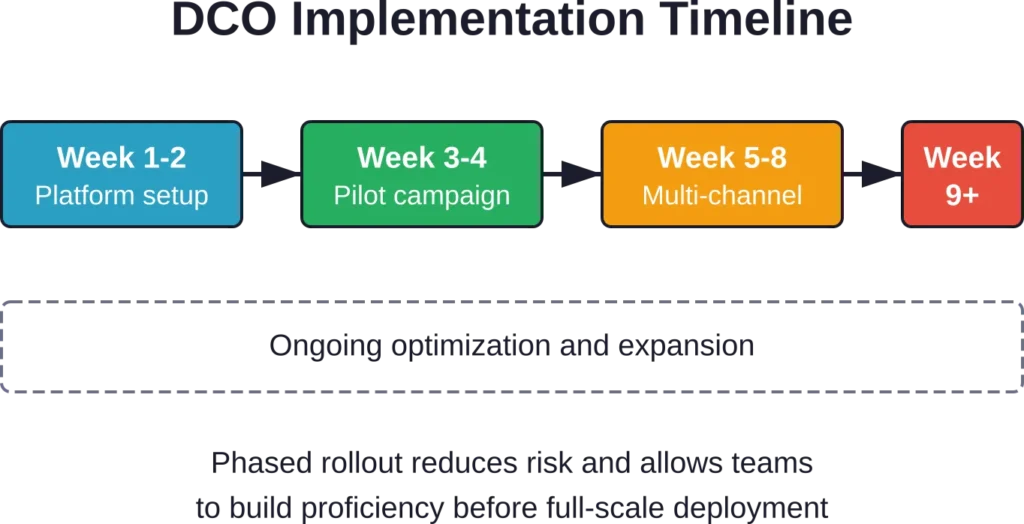
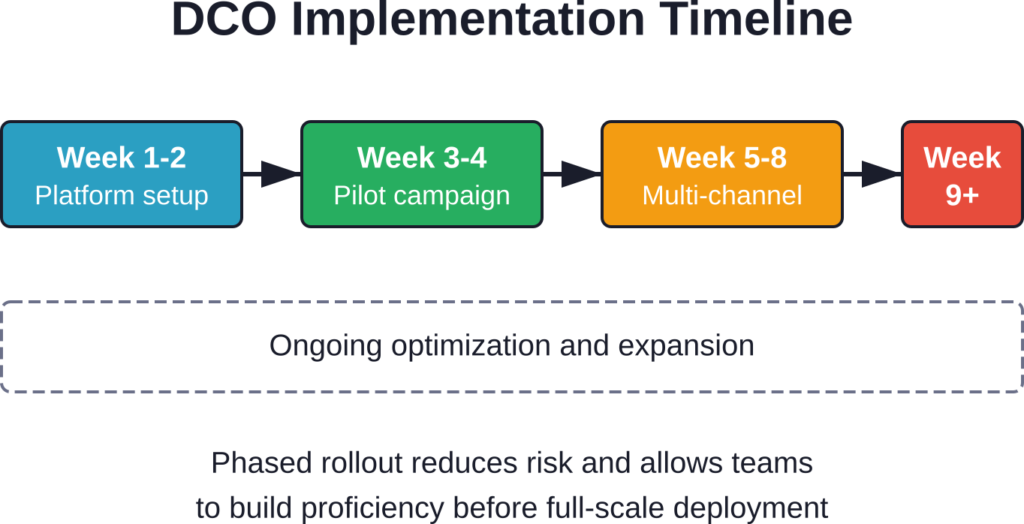
Plan implementation in phases. Migrate one campaign or channel first, validate the workflow, then expand.
Training and Support
Vendor-provided training, documentation quality, and ongoing support responsiveness determine how quickly teams become productive.
Request access to documentation and support resources during evaluation. Test support responsiveness with pre-sales questions—it’s a preview of post-sales experience.
Measuring DCO Platform Performance
Platform selection is just the start. Ongoing measurement determines whether the tool delivers promised value.
Time to Insight
How quickly can teams identify winning creative patterns and act on them? Measure the lag between campaign launch and actionable insights. The best platforms collapse this cycle from weeks to days.
Creative Iteration Velocity
Track how many creative variants the team produces per week before and after platform adoption. Effective DCO should increase output without proportional headcount growth.
Cost Per Creative Variant
Calculate total platform cost plus internal team time divided by variants produced. This metric surfaces whether automation actually reduces per-unit production cost or just shifts expenses.
Performance Lift
Compare campaign KPIs—CTR, conversion rate, cost per acquisition, ROAS—before and after DCO implementation. Control for external factors like seasonality and budget changes.
Real-world performance improvements range widely. Some teams see 20-30% efficiency gains; others experience minimal impact. The difference usually traces to workflow alignment and creative strategy maturity, not just platform features.
Future Trends in Dynamic Creative Optimization
DCO platforms continue evolving rapidly. Several trends are reshaping capabilities and vendor positioning.
AI-Generated Creative Elements
Generative AI now produces headlines, ad copy, background images, and even video components. DCO platforms are integrating these capabilities to reduce dependency on manual creative production.
The technology works best for high-volume, lower-stakes creative—product ads, retargeting, broad awareness campaigns. Brand campaigns and premium creative still benefit from human direction.
Privacy-First Personalization
As third-party cookies disappear and privacy regulations tighten, DCO platforms are shifting toward first-party data and contextual signals for personalization.
Platforms with strong first-party data integrations and contextual targeting capabilities gain advantage as identity-based targeting declines.
Cross-Channel Creative Consistency
Customers interact with brands across search, social, display, CTV, and retail media. DCO platforms are evolving from channel-specific tools to orchestration layers that maintain creative consistency across touchpoints.
The winners will connect creative strategy across channels while respecting each platform’s unique format requirements and user behavior.
Creative-to-Commerce Integration
Ecommerce brands want DCO platforms that connect creative performance to downstream metrics—basket size, repeat purchase, customer lifetime value. Platforms integrating with ecommerce systems and customer data platforms can close that loop.
Frequently Asked Questions
A/B testing compares complete ad variants to identify winners. DCO analyzes creative at the element level—headlines, images, CTAs—and can automate personalization based on audience signals. DCO platforms often include A/B testing but add automation and granular analysis layers.
Not necessarily. Meta’s native tools handle dynamic creative and automated testing reasonably well for simple use cases. DCO platforms add value when you need deeper creative analytics, cross-channel consistency, or integration with external creative production workflows. Madgicx and Hawky target Meta-heavy advertisers with capabilities beyond native platform tools.
Implementation timelines range from two weeks for straightforward deployments to three months for complex enterprise rollouts. Factors include integration requirements, team technical capacity, creative volume, and approval workflow complexity. Phased implementations that start with a single channel or campaign reduce time to first value.
Some can. Platforms like Creatopy and Madgicx offer entry-level pricing accessible to smaller advertisers. However, DCO delivers maximum ROI at scale—the more variants tested and the more data collected, the stronger the insights. Brands spending under $10,000 monthly might find manual optimization more cost-effective than enterprise DCO tools.
Basic DCO requires performance marketing knowledge and creative production capability. Advanced use cases benefit from data analysis skills, API/integration experience, and strategic creative thinking. No-code platforms lower technical barriers, but interpreting insights and applying them strategically still requires marketing expertise.
Enterprise platforms like Celtra and Smartly include approval workflows, asset restrictions, and brand guideline enforcement. Smaller tools offer less governance. If brand compliance is critical—regulated industries, enterprise brands, multi-stakeholder approval chains—prioritize platforms with robust governance features even if they cost more or deploy slower.
Specialized DCO tools offer deeper creative-specific capabilities but require integration with other systems. Broader platforms provide convenience through unified interfaces but may compromise on DCO depth. The right choice depends on whether creative optimization is a core competitive advantage (choose specialized) or one capability among many (choose integrated suite).
Making the Final Decision
Choosing a DCO platform comes down to aligning tool capabilities with organizational needs, workflow realities, and strategic priorities.
Start by diagnosing your specific creative bottleneck. Is production too slow? Are you producing enough variants but can’t identify what drives performance? Do you lack visibility into competitor creative strategies? Different problems require different solutions.
Test platforms against real campaign complexity, not demo scenarios. Pilot with actual creative assets, audience segments, and approval workflows. Surface friction early when switching costs are low.
Calculate total cost including implementation, training, and opportunity cost of migration. A platform that deploys in half the time might justify higher subscription fees.
Validate vendor claims through reference customers who match your use case and scale. Ask hard questions about limitations, support quality, and roadmap reliability.
And remember: the best DCO platform is the one your team will actually use effectively. Sophisticated features matter less than workflow fit and adoption.
Dynamic creative optimization has moved from nice-to-have to competitive necessity for performance marketers operating at scale. The right platform won’t just automate creative production—it’ll fundamentally change how teams think about the relationship between creative decisions and campaign outcomes.
Ready to transform how your team approaches creative optimization? Start with a clear diagnosis of your current workflow gaps, then match those needs to the platforms best equipped to solve them.