
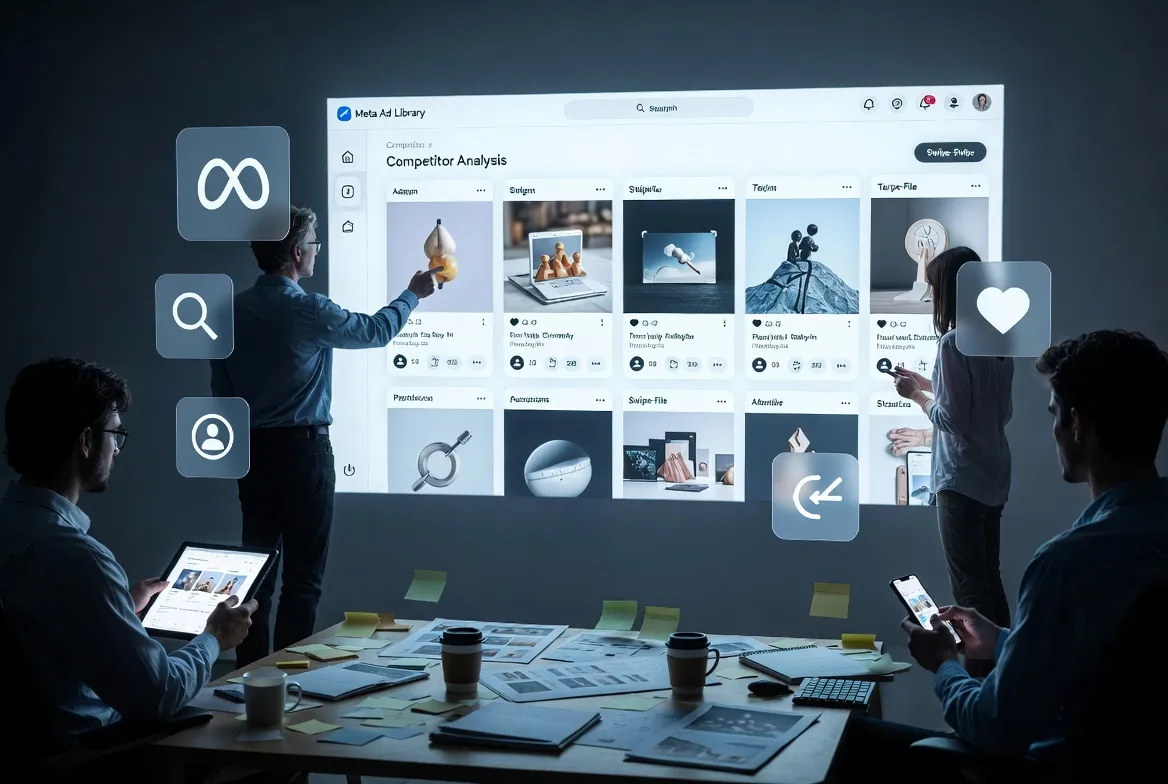
Quick Summary: Facebook ads competitor analysis tools help marketers uncover rival strategies, ad creatives, budgets, and performance insights. The best platforms combine ad library access, filtering capabilities, cross-platform tracking, and creative inspiration features. Top tools include Extuitive, Panoramata (from $89/month), AdSpy ($149/month), BigSpy (from $9/month), and Meta Ad Library (free).
Facebook remains the heavyweight champion of social advertising. Facebook is one of the most used social media platforms for marketing, and the competition is fierce. Understanding what competitors are running, how they’re positioning offers, and which creatives are performing gives marketers a measurable edge.
But here’s the thing—manual competitive research eats time. Scrolling through feeds hoping to catch a competitor’s ad? That’s not scalable.
That’s where Facebook ads competitor analysis tools come in. These platforms automate the intelligence-gathering process, surfacing competitor campaigns, creative variations, targeting clues, and performance indicators in minutes rather than days.
Why Facebook Competitor Analysis Matters
Competitive intelligence isn’t about copying. It’s about context.
Without benchmarks, a $0.88 cost per click might seem reasonable. But if competitors in the same vertical are achieving $0.40, something’s off. According to Semrush research, 20% of marketers considered the ability to benchmark brand performance against the competition to be the most important benefit of competitive intelligence.
Competitor analysis tools reveal:
- Which ad formats competitors prioritize (video, carousel, static images)
- Seasonal campaign patterns and product launch timing
- Messaging angles and offer structures that generate sustained spend
- Landing page strategies tied to specific ad creatives
- Geographic and demographic targeting clues based on ad variations
Real talk: the goal isn’t mimicry. It’s pattern recognition. When three competitors launch similar campaigns in Q2, that signals a market shift worth investigating.
What Makes a Good Facebook Ad Competitor Tool
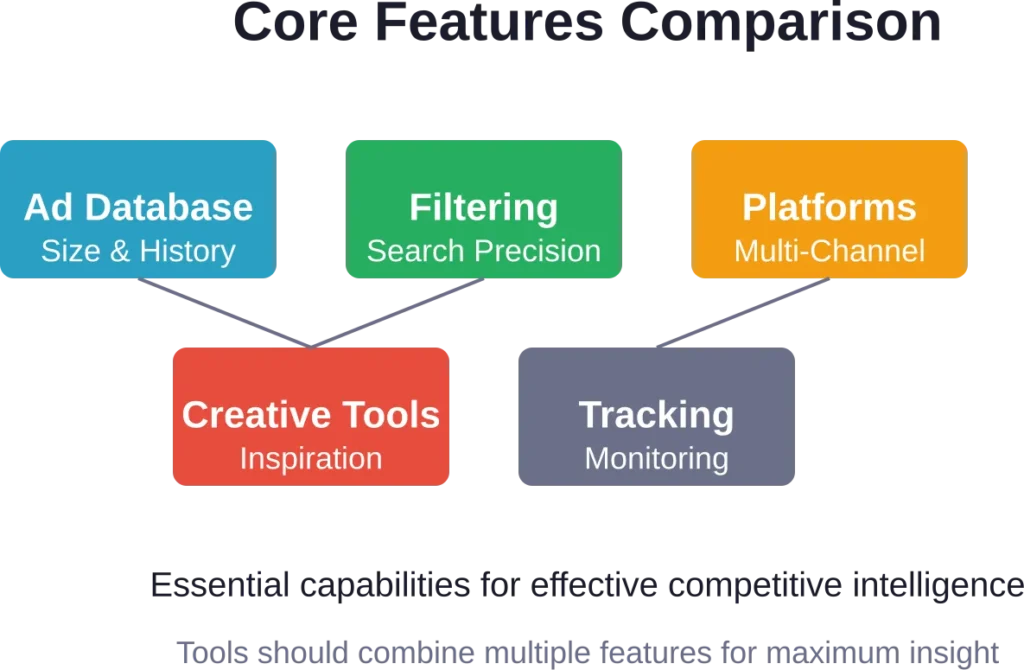
Not all competitor analysis platforms are created equal. The best ones share a few non-negotiable features.
Comprehensive Ad Database
Size matters here. A tool with access to millions of active and historical ads provides better trend data than one tracking thousands. Look for platforms covering multiple years of campaign history—this reveals seasonal patterns competitors repeat.
Advanced Filtering and Search
Generic ad libraries are overwhelming. The best tools let users filter by:
- Industry and vertical
- Ad format (video, image, carousel, collection)
- Date ranges and campaign duration
- Engagement metrics (when available)
- Specific competitors or brand names
- Geographic targeting signals
Filtering transforms raw data into actionable intelligence.
Cross-Platform Coverage
Facebook doesn’t exist in isolation. The strongest competitor analysis happens when teams can compare Facebook strategy against Instagram (80% of companies use Instagram for marketing), TikTok, Pinterest, and Google campaigns from the same brands.
Multi-platform tools reveal how competitors allocate budget across channels and whether messaging stays consistent or shifts by platform.
Creative Inspiration Features
Beyond raw data, top tools offer:
- Swipe files and collections for organizing standout ads
- Performance indicators or engagement estimates
- Download capabilities for creative assets
- Annotation and team collaboration features
These features bridge the gap between analysis and execution.
Top Facebook Ads Competitor Analysis Tools
Now let’s break down the platforms that actually deliver. Each has strengths for different use cases and budgets.
1. Extuitive
Extuitive positions itself as an AI-powered predictive platform that forecasts ad performance before launch using custom AI consumer models.
Key strengths:
- Predicts CTR, ROAS and ranks creatives (High/Medium/Low) before spending budget
- Generates and validates ad creatives, copy, visuals and pricing from Shopify store data
- Uses 150k+ simulated real consumer profiles for highly accurate pre-launch testing
- Integrates with Meta & TikTok + continuous model learning from your own campaign results
Pricing: Starter from $1,000/month (or $10k/year). Professional $2,500/month. Enterprise custom (current pricing may vary).
Best for: Shopify/ecommerce brands and agencies running Meta/TikTok ads who want to reduce wasted spend on testing and scale winning creatives faster.
Contact Information:
- Website: extuitive.com
- Email: [email protected]
- LinkedIn: www.linkedin.com/company/extuitive
- Twitter: x.com/Extuitive_Inc
- Instagram: www.instagram.com/extuitiveinc
2. Panoramata

Panoramata positions itself as a full-funnel competitive intelligence platform, tracking not just ads but also landing pages, email campaigns, and SMS flows.
Key strengths:
- Tracks ads across Meta, TikTok, Pinterest, and Google
- Advanced filtering by date, format, engagement, and more
- Landing page monitoring alongside ad creative
- Email and SMS tracking for complete funnel visibility
Pricing: Free version available. Paid plans start from $89/month (current pricing may vary).
Best for: Marketing teams and agencies that need holistic competitor intelligence beyond just ad creative—particularly valuable for understanding how ads connect to post-click experiences.
3. AdSpy
AdSpy built its reputation on a massive ad database covering Facebook and Instagram with detailed filtering capabilities.
Key strengths:
- Enormous historical ad library
- Granular search filters including engagement metrics
- Affiliate and ecommerce focus with product tracking
- Download capabilities for creative assets
Pricing: Starting at $149/month (verify current pricing with official website)
Best for: Ecommerce brands and affiliate marketers who need deep ad archives and engagement data to identify winning creative patterns.
4. MagicBrief
MagicBrief emphasizes creative organization and collaboration, positioning itself as a creative workflow platform with competitive intelligence built in.
Key strengths:
- AI-powered recommendations and benchmarking
- Storyboard and brief creation tools
- Team collaboration features
- Creative asset organization and tagging
Pricing: 7-day free trial. Paid plans start from $249/month (verify with official website).
Best for: Creative teams and agencies managing multiple clients who need collaborative tools for brief development alongside competitor research.
5. BigSpy
BigSpy offers freemium access to a massive ad library covering Facebook, Instagram, Twitter, and other platforms.
Key strengths:
- Huge ad database with free tier access
- Multi-platform coverage
- Basic filtering and search functionality
- Affordable paid tiers for enhanced features
Pricing: Freemium model; Paid plans from $9/month (verify current pricing)
Best for: Small businesses and solo marketers testing competitor analysis tools for the first time or working with limited budgets.
6. Minea
Minea specializes in product discovery and dropshipping competitive intelligence, with strong focus on ecommerce trends.
Key strengths:
- Product-focused ad tracking
- Winning product identification
- Shopify store analysis
- Trend monitoring for dropshippers
Pricing: Free trial available. Starts from $49/month (verify with official website).
Best for: Dropshippers and ecommerce entrepreneurs hunting for trending products and analyzing how competitors position them.
7. Meta Ad Library (Free)
Meta’s official Ad Library provides transparent access to all active ads running across Facebook and Instagram.
Key strengths:
- Completely free and official
- Search by advertiser name or keyword
- Shows all active ads from any page
- Includes start dates and sometimes spend ranges (for political ads)
Limitations:
- No advanced filtering or sorting
- No historical data beyond active campaigns
- Limited performance indicators
- No organizational or collection features
Best for: Quick spot-checks of specific competitors and basic ad research when budget is zero.
How to Use Competitor Analysis Tools Strategically
Access to data means nothing without a framework for turning it into action.
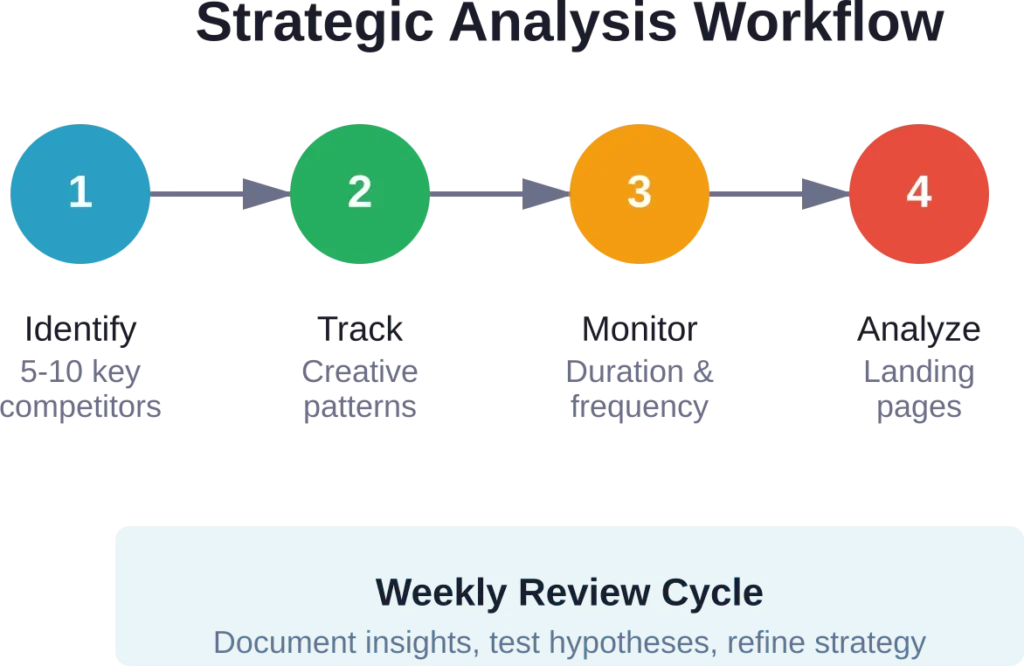
Identify Your Real Competitors
Start by defining who to track. This includes:
- Direct competitors selling the same products
- Indirect competitors solving the same problem differently
- Aspirational brands in adjacent spaces
- New entrants disrupting category norms
Track 5-10 brands consistently rather than sporadically monitoring dozens.
Spot Creative Patterns
Look for patterns across successful campaigns:
- Do top performers use video or static images?
- What emotional angles dominate (fear, aspiration, humor)?
- How long are video ads that seem to run continuously?
- What offer structures appear most frequently (discounts, free trials, bundles)?
Pattern recognition beats one-off inspiration.
Track Campaign Duration
Many marketers value competitor campaign and launch tracking as a key benefit of competitive intelligence. Ads that run for months signal strong performance. Short-lived campaigns often indicate tests or underperformers.
When a competitor launches a campaign and scales it across variations, that’s a success signal worth investigating.
Analyze Landing Page Connections
Don’t stop at the ad. Tools like Panoramata that track landing pages reveal how ad messaging connects to post-click experiences.
Check for:
- Message match between ad copy and landing page headlines
- Offer consistency or strategic variation
- Form length and conversion friction
- Trust signals and social proof placement
Monitor Seasonal Shifts
Compare current campaigns against the same period last year. Seasonal patterns repeat. Brands that advertised heavily in Q4 2025 will likely do the same in Q4 2026.
Historical data helps predict competitor moves before they happen.
Common Mistakes to Avoid
Even with powerful tools, teams make predictable errors that waste time and budget.
Copying Instead of Learning
Direct replication rarely works. Market context, brand equity, and audience relationships differ. A direct-response angle that works for an established competitor might fall flat for a newer entrant.
Extract principles—emotional hooks, offer structures, format choices—not exact executions.
Ignoring Context
An ad running for two days might be a failed test. An ad running for two months is proven. Duration matters more than creative brilliance at first glance.
Similarly, seasonal context matters. Holiday campaigns don’t predict year-round performance.
Analysis Paralysis
Unlimited access to competitor data can become overwhelming. Set boundaries: review competitor activity weekly, not daily. Focus on the top 5 competitors, not all 50 brands in the category.
Consistent light monitoring beats sporadic deep dives.
Neglecting Your Own Data
Competitor intelligence informs strategy but shouldn’t override first-party performance data. Testing always beats speculation. Use competitor research to generate test hypotheses, not gospel.
Choosing the Right Tool for Your Needs
Budget, team size, and use case determine the best fit.
For agencies managing multiple clients, platforms with collaboration features and broad platform coverage (Panoramata, MagicBrief) justify higher costs. The ability to organize insights by client and share findings internally matters.
For ecommerce brands focused on creative testing, tools with massive ad libraries and engagement indicators (AdSpy) provide more raw material for creative teams to draw from.
For small businesses and solo operators, budget-friendly options (BigSpy) or the free Meta Ad Library offer enough intelligence to inform quarterly planning without breaking the bank.
For dropshippers hunting trending products, product-focused platforms (Minea) shortcut the discovery process by highlighting what’s already generating ad spend in the space.
Check the official websites for current feature availability and pricing—subscription tiers and capabilities evolve frequently in this market.
The Role of Broader Competitive Intelligence
Facebook ad tracking represents one piece of a larger competitive intelligence puzzle. According to data from Semrush on competitive intelligence gathering, effective programs combine multiple data sources.
Beyond Facebook ads, complete competitive intelligence includes:
- SEO and organic search positioning
- Google Ads and search marketing strategies
- Email marketing campaigns and flows
- Website changes and product launches
- Pricing shifts and promotional calendars
- Content marketing and thought leadership
Tools like Ahrefs (check official website for current pricing) handle SEO and search ad analysis. Email tracking tools track email campaigns. Website monitoring tools monitor website changes.
Facebook ad tools work best when integrated into a broader competitive monitoring system.
Frequently Asked Questions
Meta Ad Library is the only truly free option with comprehensive coverage. It shows all active ads from any Facebook or Instagram advertiser, searchable by page name or keyword. However, it lacks filtering, historical data, and performance metrics. For basic competitive spot-checks, it’s sufficient. For ongoing analysis, paid tools offer significantly better capabilities.
Weekly reviews strike the right balance for most teams. Daily monitoring creates noise without additional insight—most competitors don’t launch new campaigns daily. Monthly reviews risk missing time-sensitive competitive moves. Weekly check-ins provide enough frequency to spot trends while leaving time for execution.
Most tools provide engagement indicators—likes, comments, shares—for public ads, but they don’t access actual ROAS, conversion rates, or cost data from Meta’s ad platform. Performance signals come from campaign duration (long-running ads typically perform), creative variations (heavy testing suggests optimization), and engagement relative to follower count. Direct performance metrics remain private to the advertiser.
No. These tools access publicly available information through Meta’s Ad Library and standard web scraping of public posts. Since Meta introduced the Ad Library for transparency, accessing this data doesn’t violate terms. Tools don’t hack accounts or access private campaign data—they aggregate what’s already public.
Ecommerce, direct-to-consumer brands, lead generation businesses, and local services see the highest ROI from competitive ad intelligence. These verticals rely heavily on paid social, have clear competitors, and can quickly test insights from competitive research. B2B companies with longer sales cycles still benefit but see slower feedback loops between analysis and results.
Yes, most tools cover both Facebook and Instagram since they run through the same Meta Ads Manager platform. Many also extend to TikTok, Pinterest, YouTube, and Google Display Network. Multi-platform coverage helps teams understand how competitors allocate budget across channels and whether creative strategies remain consistent or shift by platform.
Teams typically identify actionable insights within the first month—creative angles to test, audience segments competitors target, or offer structures worth exploring. Measurable performance impact follows 60-90 days later after implementing and optimizing tests based on competitive intelligence. The value compounds over time as teams build institutional knowledge about market patterns.
Final Thoughts
Facebook ads competitor analysis tools have evolved from basic ad scrapers into sophisticated competitive intelligence platforms. The best ones don’t just show what competitors are running—they reveal why campaigns work, how budgets shift seasonally, and where creative trends are heading.
For brands serious about paid social, these tools aren’t optional extras. They’re table stakes. Markets move too fast and competition is too fierce to rely on intuition alone.
Start with clear objectives. Identify the 5-10 competitors that matter most. Choose a tool that fits the budget and covers the platforms that matter. Then commit to consistent weekly reviews, extracting patterns rather than copying executions.
The brands winning on Facebook aren’t necessarily the most creative or best-funded. They’re the ones learning fastest—from their own tests and from competitive intelligence. Which category will your brand fall into?