
Quick Summary: The best offshore web development companies in 2026 combine technical expertise, cost efficiency, and reliable delivery. This curated list includes 15 top agencies spanning Eastern Europe, Asia, and Latin America, selected based on proven track records, technology stacks, and client satisfaction ratings.
Finding the right offshore web development company has become less about taking a gamble and more about strategic selection. With thousands of offshore development firms worldwide, the challenge isn’t availability—it’s identifying which partners actually deliver.
The numbers tell the story. Offshore software development spending reached $156B in 2024 and is projected to hit $305B by 2029. Meanwhile, 68% of US companies outsource to low-cost countries, making offshore development the norm rather than the exception.
But here’s the thing—not all offshore companies deliver the same value. Some bring senior-heavy teams with enterprise experience. Others excel at rapid MVP delivery for startups. A few specialize in emerging tech like AR/VR or IoT.
This guide profiles 15 top offshore web development companies across different regions and specializations. No fluff, no fabricated rankings—just verified information about agencies with proven track records.
What Makes an Offshore Web Development Company Worth Considering
Offshore web development involves partnering with a software team based in a different country, typically one with lower labor costs. The model has matured dramatically over the past decade.
What was once viewed as risky—trusting critical code to developers thousands of miles away—has become standard practice for startups and Fortune 500 companies alike.
The appeal goes beyond cost savings. Eastern European countries produce exceptional technical talent through strong STEM education programs while maintaining costs 50-60% lower than Western European alternatives. English proficiency among developers in regions like Poland, Estonia, and Ukraine rivals native speakers.
Real talk: the best offshore companies now function as true extensions of in-house teams rather than distant vendors.
Key Factors That Separate Top Performers
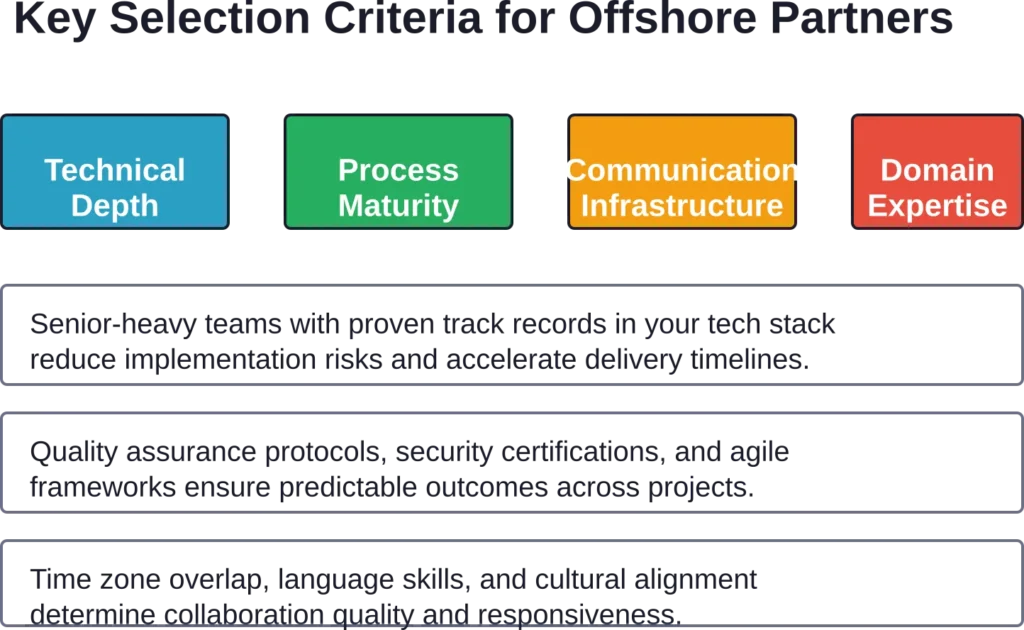
Several characteristics distinguish excellent offshore development partners from mediocre ones. Technical depth matters—agencies with senior-heavy teams (not junior developers learning on client projects) deliver more predictable outcomes.
Process maturity makes a difference. Companies with established quality assurance protocols, security certifications, and project management frameworks reduce risk significantly.
Communication infrastructure matters more than most realize. Time zone overlap, language proficiency, and cultural alignment determine whether collaboration feels seamless or frustrating.
Domain expertise counts. Agencies with deep experience in specific industries (fintech, healthcare, e-commerce) understand regulatory requirements and common pitfalls that generalists miss.
Top 15 Offshore Web Development Companies
The following agencies represent diverse specializations, geographic locations, and engagement models. Each profile highlights core strengths, technology focus, and ideal client types.
1. Mobian Studio

Mobian Studio operates as a European offshore development partner with dedicated teams across multiple time zones. The company brings senior-level engineers that appeal to clients seeking reliable execution without hiring overhead.
Mobian Studio’s approach emphasizes production-ready delivery and long-term partnership. Clients report strong performance in mobile applications, AI-powered systems, and complex platform integrations.
The agency specializes in flexible engagement models—dedicated teams and outstaffing. Technology coverage spans modern mobile frameworks, AI/ML solutions, cloud architecture, and scalable backend systems.
Best for: Companies in IT, Healthcare, Fintech, and Logistics needing fast, high-quality offshore web and mobile development with senior expertise and full-cycle delivery.
Contact Information:
- Website: mobian.studio
- Phone: [email protected]
- Address: Harju maakond, Tallinn, Kesklinnalinnaosa, Masina tn 22, 10113
- LinkedIn: www.linkedin.com/company/mobian-studio
2. Gilzor

Gilzor operates with a global team focused on custom digital product development. The company brings experienced full-stack professionals that appeal to clients seeking reliable technical partners for idea validation to scaling.
Gilzor’s approach emphasizes user-centric solutions and rapid project starts. Clients report strong performance in web platforms, mobile applications, and go-to-market implementations.
The agency specializes in end-to-end project delivery and ongoing support. Technology coverage spans modern web and mobile frameworks, UI/UX design, quality assurance, and emerging technologies.
Best for: Startups and small-to-medium businesses looking for offshore web development partners capable of full-cycle delivery from idea validation to production and maintenance.
Contact Information:
- Website: www.gilzor.com
- Email: [email protected]
- Address: Poland, Warsaw, Office 58, street Adama Mickiewicza 37, 01-625
- LinkedIn: www.linkedin.com/company/gilzor-softwaredevelopment
3. A-Listware
A-Listware operates as an offshore software development and consulting provider with strong delivery capabilities. The company brings skilled and experienced teams that appeal to clients seeking trustworthy extension of their in-house capabilities.
A-Listware’s approach emphasizes seamless integration and high-quality execution. Clients report strong performance in enterprise applications, custom software, and infrastructure solutions.
The agency specializes in dedicated development teams, team augmentation, and full project outsourcing. Technology coverage spans cloud solutions, data analytics, UI/UX, machine learning, and enterprise systems.
Best for: Enterprises, SMBs, and startups needing reliable offshore web development, team extension, and comprehensive technical services with consistent quality.
Contact Information:
- Website: a-listware.com
- Phone: +1 (888) 337 93 73
- Email: [email protected]
- Address: North Bergen, NJ 07047, USA
- LinkedIn: www.linkedin.com/company/a-listware
- Facebook: www.facebook.com/alistware
4. Lengreo

Lengreo operates as a complete marketing and technology partner with offshore delivery. The company brings proactive and dedicated specialists that appeal to clients seeking both technical development and business growth support.
LenGreo’s approach emphasizes results-driven strategies and personalized solutions. Clients report strong performance in website development, lead generation platforms, and digital transformation projects.
The agency specializes in combined web development and performance marketing services. Technology coverage spans modern web frameworks, eCommerce platforms, and integrated marketing tools.
Best for: B2B companies needing offshore web development combined with digital marketing and lead generation capabilities for measurable business growth.
Contact Information:
- Website: Lengreo.com
- Phone: +31 686 147 566
- Email: [email protected]
- Address: Vrijstraat 9 C/D, 5611 AT Eindhoven, Netherlands
- LinkedIn: Lengreo
- Twitter: @Lengreo
- Instagram: @lengreo
5. Oski

Oski operates with a focus on smart software solutions for enterprises and startups. The company brings AI-accelerated engineering teams that appeal to clients seeking high-quality, efficient offshore delivery.
Oski’s approach emphasizes innovation, scalability, and seamless integration. Clients report strong performance in cloud-native applications, frontend platforms, and AI-enhanced systems.
The agency specializes in full-cycle development and maintenance. Technology coverage spans cloud infrastructure, modern frontend frameworks, artificial intelligence, and content management systems.
Best for: Tech-forward enterprises and ambitious startups requiring sophisticated offshore web development with expertise in cloud, AI, and modern digital solutions.
Contact Information:
- Website: oski.site
- Phone: +48571282759
- Email: [email protected]
- Address: Kaupmehe tn 7, 10114 Tallinn, Estonia
- LinkedIn: www.linkedin.com/company/oski-solutions
6. eSparkBiz

eSparkBiz was founded in 2010 with operations in India and the USA. The company positions itself as a scalable offshore partner for growing businesses.
The agency holds a 4.9 rating and emphasizes quality without premium pricing. eSparkBiz covers web development, mobile applications, e-commerce platforms, and custom software.
Technical capabilities span PHP frameworks, JavaScript ecosystems, .NET, and modern cloud infrastructure. The company maintains established processes for remote collaboration and quality assurance.
Best for: Scalable offshore partnerships focused on quality and performance with long-term engagement potential and predictable delivery.
7. IT Craft

IT Craft operates as a boutique offshore development company with selective client acceptance. The company emphasizes cultural fit and strategic alignment over volume growth.
The agency brings strong expertise in web application development, particularly SaaS platforms and B2B software. IT Craft maintains a senior developer ratio above industry averages.
Technology focus includes modern JavaScript frameworks, Ruby on Rails, Python, and API-first architectures. The company favors dedicated team models for ongoing product development.
Best for: Product companies seeking long-term dedicated teams that integrate closely with internal staff and share product ownership mindset.
8. Boldare
Boldare combines software development with product design and strategy consulting. The company helps clients not just build software but validate product concepts and optimize user experience.
Boldare’s multidisciplinary approach includes product managers, UX researchers, designers, and developers working collaboratively. The company specializes in digital product development from concept through launch.
Technical capabilities cover full-stack web development, mobile applications, and cloud infrastructure. Boldare emphasizes lean methodologies and continuous user validation.
Best for: Organizations building new digital products where strategic guidance, user research, and design excellence matter as much as technical execution.
9. Itransition

Itransition has operated since 1999, building a broad portfolio across industries and technologies. The company serves clients globally from multiple development centers in Eastern Europe.
With extensive experience across web development, enterprise software, system integration, and cloud migration, Itransition functions as a comprehensive technology partner.
The company maintains mature processes, industry certifications, and documented methodologies. Itransition’s scale allows flexible resource allocation across projects.
Best for: Organizations needing comprehensive technology services beyond pure development—including consulting, integration, migration, and ongoing support.
10. Vention

Vention was founded in 2002 and has grown to employ over 3,000 developers across the EU and US. The company’s scale enables handling multiple concurrent projects while maintaining quality standards.
Vention demonstrates breadth across technology stacks, industries, and project types. The company has completed 400+ projects spanning web applications, mobile platforms, and enterprise software.
With a 4.9 rating, Vention maintains consistent delivery despite its size. The company offers staff augmentation, dedicated teams, and full project delivery models.
Best for: Large-scale implementations requiring significant development capacity, technology breadth, and the operational stability of an established offshore provider.
11. SumatoSoft

Founded in 2012, SumatoSoft operates across the US, Central & Eastern Europe, and Asia. The company brings a senior-heavy team composition that appeals to clients seeking experienced developers rather than junior talent.
SumatoSoft’s approach emphasizes long-term partnerships over transactional projects. Clients report strong performance in custom web applications, enterprise platforms, and digital transformation initiatives.
The agency holds a 4.8 Clutch rating and specializes in flexible engagement models—dedicated teams, staff augmentation, or full project delivery. Technology coverage spans modern JavaScript frameworks, .NET, Python, and cloud infrastructure.
Best for: Mid-market and enterprise clients needing strategic development partners with senior expertise and comprehensive service offerings.
12. Innowise

Innowise has built its reputation on enterprise-grade delivery and process rigor. The company serves clients across North America and Western Europe from development centers in Eastern Europe.
With hundreds of successful projects completed, Innowise demonstrates particular strength in complex system integrations, legacy modernization, and large-scale web platforms.
The technical team covers full-stack development, cloud architecture, DevOps, and quality assurance. Innowise maintains ISO certifications and follows mature agile methodologies.
Best for: Enterprise organizations running complex digital ecosystems that require process maturity, security compliance, and scalable delivery capacity.
13. HQSoftware

Established in 2000, HQSoftware operates from Estonia and Poland with a strong focus on emerging technologies. The company has invested heavily in AR/VR, IoT, and AI capabilities.
HQSoftware’s 4.9 rating reflects consistent delivery quality across web development, mobile applications, and custom software projects. The company maintains a balanced portfolio serving startups and established enterprises.
Technical expertise covers modern web frameworks, cross-platform mobile development, and hardware-software integration for IoT projects.
Best for: Organizations pursuing innovative digital experiences, particularly those involving augmented reality, virtual reality, or Internet of Things implementations.
14. ELEKS

ELEKS was founded in 1991 and operates primarily from Tallinn, Estonia. The company has evolved into a mature technology partner with deep expertise in enterprise software development.
With a 4.8 rating and decades of experience, ELEKS brings stability and process rigor. The company excels at complex web platforms requiring sophisticated architecture, high performance, and regulatory compliance.
ELEKS maintains strong capabilities in data engineering, machine learning integration, and cloud-native development. The team structure emphasizes senior architects and technical leads.
Best for: Enterprises running complex platforms where performance, scalability, and architectural sophistication cannot be compromised in offshore delivery.
15. Space-O Technologies
Space-O Technologies launched in 2010 from Ahmedabad, India. The company has grown into a full-service digital agency with particular strength in mobile-first web applications.
With a 4.8 rating, Space-O demonstrates consistent delivery across web development, mobile apps, and SaaS platforms. The team combines technical execution with UI/UX design capabilities.
Space-O’s technology coverage includes React, Angular, Node.js, Python Django, and modern DevOps practices. The company offers flexible engagement models suitable for various project sizes.
Best for: Businesses needing mobile-centric web development where responsive design, progressive web apps, and cross-platform consistency are priorities.
Regional Considerations for Offshore Web Development
Geography matters when selecting an offshore development partner. Different regions offer distinct advantages in cost, talent availability, time zone overlap, and cultural alignment.
Eastern Europe
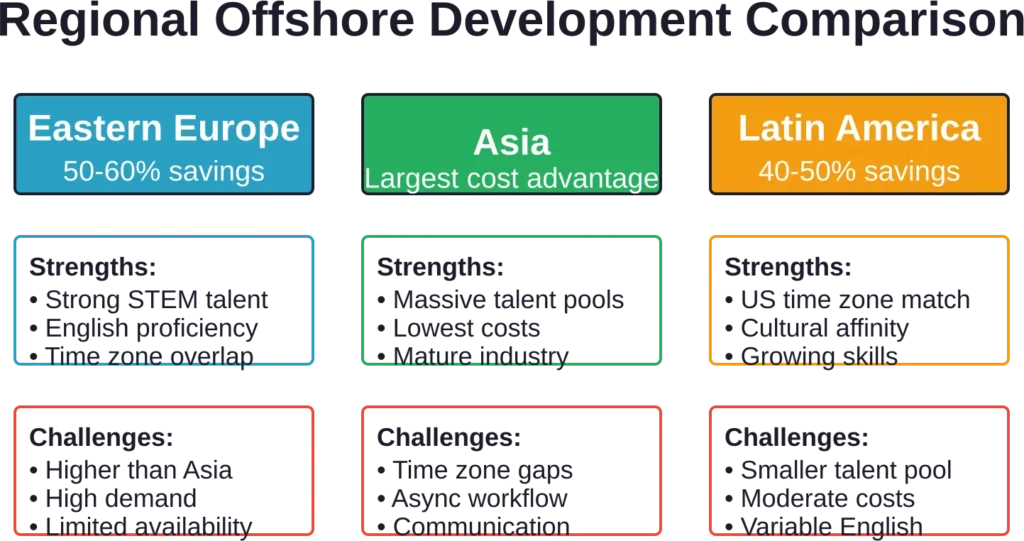
Countries like Poland, Estonia, Ukraine, and Romania have emerged as premier offshore development destinations. The region produces strong technical talent through rigorous STEM education systems.
Eastern European developers typically offer excellent English proficiency and cultural alignment with Western business practices. Time zone overlap with both US East Coast and Western Europe enables real-time collaboration that developers in Asia simply can’t provide.
Companies report approximately 50-60% cost savings compared to Western European alternatives while maintaining comparable quality standards.
Asia
India, Vietnam, and the Philippines represent established Asian offshore markets. India particularly offers massive talent pools and mature software industry infrastructure developed over decades.
Asian locations provide the most significant cost advantages, though time zone differences create collaboration challenges for US and European clients. Asynchronous work models perform better than real-time collaboration for these partnerships.
Technical specialization varies—India brings depth in enterprise technologies, while Vietnam has grown strength in mobile development and modern JavaScript frameworks.
Latin America
Countries like Argentina, Brazil, Colombia, and Mexico have gained traction as nearshore alternatives for North American companies. The region offers reasonable time zone overlap with US business hours.
Latin American developers typically provide better time zone alignment than Eastern Europe for West Coast US companies. Cultural affinity and growing English proficiency improve collaboration quality.
Cost savings fall between Eastern Europe and Asia—typically 40-50% compared to US domestic rates.
Common Engagement Models for Offshore Development
Offshore companies typically offer three primary engagement structures. The right choice depends on project scope, timeline, and internal team capacity.
Dedicated Development Teams
This model assigns a fixed team of developers exclusively to work on projects. The team functions as an extension of the internal staff, participating in planning, standups, and retrospectives.
Dedicated teams work best for ongoing product development where requirements evolve and long-term partnership matters. Clients maintain control over priorities while the offshore company handles recruitment, infrastructure, and management.
Most agencies require minimum commitments of three to six months for dedicated team arrangements.
Project-Based Fixed Scope
Fixed-scope projects define deliverables, timeline, and budget upfront. The offshore company takes responsibility for execution within agreed parameters.
This model suits well-defined projects with stable requirements—rebuilding a website, migrating a platform, or developing a specific feature set. Risk shifts more to the vendor since they commit to delivery within fixed constraints.
Detailed requirements documentation and thorough discovery phases become critical for project success.
Staff Augmentation
Staff augmentation places individual developers or specialists into existing teams. These developers work under the client’s direct management rather than offshore company oversight.
The model provides flexibility for short-term needs, specialized skills, or temporary capacity increases. Staff augmentation works when internal teams need specific expertise without long-term hiring commitments.
Management responsibility remains with the client, which requires stronger internal technical leadership.
Technology Stacks and Specializations
Different offshore companies demonstrate varying depth across technology stacks. Understanding these specializations helps match agencies to project requirements.
Modern JavaScript Ecosystems
Most offshore companies now offer strong capabilities in React, Vue, Angular, and Node.js. These technologies dominate modern web development.
Look for agencies with experience in Next.js, Nuxt, or similar meta-frameworks that add production-ready features. Server-side rendering, static site generation, and edge computing capabilities matter for performance-critical applications.
TypeScript adoption has become a quality indicator—agencies emphasizing type safety typically maintain better code quality and fewer production bugs.
Enterprise Technology Stacks
Some agencies specialize in enterprise platforms—.NET, Java, and established frameworks that power corporate systems. These companies understand enterprise architecture patterns, integration requirements, and regulatory compliance.
ELEKS and Innowise demonstrate particular strength in enterprise development, bringing senior architects who design scalable, maintainable systems rather than quick prototypes.
Emerging Technology Integration
HQSoftware stands out for capabilities in AR/VR, IoT, and hardware-software integration. These specializations matter for companies pursuing innovative digital experiences beyond standard web applications.
Agencies investing in emerging technologies typically maintain smaller client rosters and higher engagement selectivity. They prioritize strategic fit over volume.
Quality Assurance and Security Practices
Quality and security processes separate professional offshore companies from risky vendors. Several factors deserve scrutiny during evaluation.
Testing Infrastructure
Top agencies maintain dedicated QA teams rather than having developers test their own code. Automated testing coverage, continuous integration pipelines, and staging environments become standard practice.
Ask potential partners about test coverage expectations, automated vs manual testing ratios, and quality gates before production deployment.
Security Certifications and Compliance
Companies serving enterprise clients typically hold ISO 27001 certification for information security management. Healthcare-focused agencies need HIPAA compliance experience. Fintech specialists require understanding of PCI DSS standards.
Security practices should include code review processes, dependency vulnerability scanning, and secure development lifecycle integration.
Code Ownership and IP Protection
Contracts should clearly establish that clients own all code, designs, and intellectual property created during engagements. Reputable agencies include explicit IP assignment clauses in standard agreements.
Non-disclosure agreements, access controls, and data handling procedures protect sensitive business information during collaboration.
Cost Considerations Beyond Hourly Rates
While hourly rates provide initial comparison points, total engagement costs depend on multiple factors that many organizations overlook.
Team Composition Impact
A senior-heavy team with developers commanding higher rates often delivers projects faster and with fewer revisions than cheaper junior teams. The apparent savings from low rates disappear when projects drag on or require extensive rework.
Agencies that transparently discuss team composition—ratio of senior to mid-level to junior developers—demonstrate process maturity.
Communication Overhead
Time zone differences create hidden costs in delayed feedback loops and extended project timelines. A 12-hour time difference means questions asked in the morning receive answers the next day.
Agencies in Eastern Europe or Latin America with several hours of overlap with US business hours reduce these coordination costs significantly.
Scaling Flexibility
The ability to scale teams up or down based on project phases affects long-term costs. Some agencies enforce rigid minimums while others accommodate fluctuating needs.
Ask about notice periods for adding or removing team members and minimum commitment durations.
Vetting Process: Questions to Ask Potential Partners
A structured evaluation process helps identify which offshore companies actually fit specific needs. Several key questions reveal important details.
How do you structure teams for new projects? This reveals whether agencies assign dedicated teams or shuffle developers across multiple clients. Dedicated assignment improves continuity and knowledge retention.
What’s your approach to communication and project management? Top companies maintain daily standups, sprint planning, and retrospectives. They use project management tools that integrate with client workflows.
Can you provide client references in our industry? Direct conversations with current or past clients uncover how agencies actually perform under pressure, handle conflicts, and deliver on commitments.
What happens if team members leave mid-project? Attrition affects all companies. Quality agencies maintain documentation, knowledge transfer processes, and bench strength to replace departing developers quickly.
How do you handle IP protection and data security? This question should trigger detailed discussion of security practices, compliance certifications, and legal protections in service agreements.
Red Flags to Watch During Evaluation
Certain warning signs indicate problematic offshore partnerships. Experienced buyers recognize these patterns early.
Vague or evasive answers about team composition suggest agencies will staff projects with junior developers despite initial discussions about senior talent. Demand explicit seniority commitments in contracts.
Reluctance to provide client references or case studies raises concerns about actual track records. Legitimate agencies maintain strong portfolios and willing reference contacts.
Pressure to sign quickly or resistance to detailed contracts indicates potential future conflicts. Professional companies expect thorough legal review and negotiate terms collaboratively.
Significant upfront payments before work begins create unnecessary risk. Standard practice involves payment schedules tied to delivery milestones or monthly billing for dedicated teams.
The Current State of Offshore Development in 2026
The offshore development landscape continues evolving. Several trends shape the market as of May 2026.
AI-powered development tools have changed productivity expectations but not eliminated the need for experienced developers. Companies now seek offshore partners who effectively leverage AI coding assistants rather than those resistant to new tools.
According to recent Yale analysis published in May 2026, AI’s impact on employment shows significant disruption, with computer science majors facing more difficulty finding jobs than humanities majors. The workforce implications remain complex, with experienced developers commanding premium rates while junior positions face pressure.
Remote work normalization has blurred distinctions between offshore, nearshore, and distributed teams. Geographic location matters less than it did pre-2020, though time zone overlap and cost differentials remain relevant.
Enterprises increasingly view offshore development strategically rather than tactically. Many executives have adopted offshore models as permanent components of technology delivery rather than temporary cost measures.
Making the Final Selection
Choosing among qualified offshore web development companies requires matching capabilities to specific needs rather than picking the “best” in abstract terms.
Start with clear requirements. Define whether the project needs senior architectural guidance or efficient execution of well-defined specifications. Identify must-have technical skills and nice-to-have bonuses.
Conduct paid pilot projects before committing to large engagements. A four-to-six-week pilot reveals how agencies actually work—communication patterns, code quality, and problem-solving approaches become visible.
Evaluate cultural fit alongside technical capability. Some organizations prefer formal, process-heavy approaches while others value flexibility and rapid iteration. Mismatched working styles create friction regardless of technical competence.
Consider the long view. Switching offshore partners creates disruption and knowledge loss. Agencies capable of scaling with business growth and evolving with technology changes provide more value than those optimized only for initial projects.
Frequently Asked Questions
Cost savings depend on region and team composition. Eastern European agencies typically deliver 50-60% savings compared to Western European rates, while Asian locations offer the largest cost differentials. However, total project costs reflect more than hourly rates—team efficiency, communication overhead, and revision cycles affect final expenses. Senior-heavy offshore teams often provide better value than cheaper junior teams despite higher rates.
Common risks include communication difficulties from time zone differences and language barriers, quality concerns when agencies staff projects with junior developers despite senior-level promises, intellectual property protection in jurisdictions with varying legal standards, and hidden costs from coordination overhead or extended timelines. Mitigation strategies include thorough vetting, clear contracts with IP clauses, pilot projects before large commitments, and selecting partners with time zone overlap.
Dedicated offshore teams typically need two to four weeks for onboarding and knowledge transfer before reaching full productivity. Initial sprints may feel slower as teams learn codebases, business context, and communication patterns. Project-based engagements with fixed scope should show tangible progress within the first month. Teams that remain stuck in setup after four weeks likely indicate deeper problems with agency competence or project definition.
The decision depends on priorities. Offshore development (typically Eastern Europe or Asia) maximizes cost savings and accesses the largest talent pools but involves greater time zone differences. Nearshore options (Latin America for US companies, Eastern Europe for Western Europe) offer better time zone overlap and cultural alignment at moderate cost savings. Projects requiring extensive real-time collaboration benefit from nearshore proximity while well-defined work with asynchronous communication suits offshore models.
Modern web development requires expertise in contemporary JavaScript frameworks—React, Vue, or Angular with meta-frameworks like Next.js or Nuxt. Backend capabilities should span Node.js, Python, or .NET depending on enterprise needs. Cloud infrastructure knowledge (AWS, Azure, Google Cloud) has become essential. TypeScript adoption indicates code quality standards. DevOps capabilities including CI/CD pipelines and containerization separate mature agencies from basic developers. Familiarity with AI coding assistants shows adaptation to current tool ecosystems.
Verification methods include reviewing detailed case studies with technical architecture explanations rather than marketing summaries, speaking directly with client references about actual experiences and outcomes, conducting technical interviews with proposed team members to assess real capabilities, examining code samples or contributing to open-source projects to evaluate quality standards, and running paid pilot projects that reveal working practices under real conditions. Legitimate agencies welcome scrutiny while questionable vendors resist transparency.
Essential contract provisions include explicit intellectual property assignment giving clients full code ownership, clear team composition commitments specifying seniority levels and minimum retention periods, detailed scope definitions with acceptance criteria for project-based work, payment schedules tied to milestones or monthly billing rather than large upfront fees, confidentiality and data handling procedures covering sensitive information, and termination clauses allowing exit without excessive penalties if relationships fail. Legal review by attorneys familiar with international technology contracts reduces future conflicts.
Conclusion
The best offshore web development companies combine technical expertise, operational maturity, and collaborative practices that make geography nearly invisible. The 15 agencies profiled here represent diverse specializations—from enterprise platforms to emerging technologies, from massive scale to boutique partnerships.
Selecting the right offshore partner requires looking beyond superficial factors like the lowest hourly rate or the longest company roster. Team composition, communication infrastructure, domain expertise, and cultural alignment determine actual project success.
The offshore development market has matured significantly. What once represented a risky cost-cutting tactic has evolved into a strategic capability for technology delivery. Organizations now build long-term relationships with offshore partners that function as extensions of internal teams.
Geographic diversity offers options. Eastern Europe brings strong technical talent and time zone overlap with both US and European clients. Asia provides massive talent pools and maximum cost efficiency. Latin America delivers nearshore convenience for North American companies.
But location alone doesn’t determine quality. Process maturity, security practices, and proven track records separate exceptional offshore companies from risky vendors regardless of geography.
For organizations beginning offshore partnerships, start small. Pilot projects reveal far more about actual working relationships than proposals and sales presentations. Successful pilots expand into dedicated teams. Failed pilots end before causing significant damage.
The offshore development landscape will continue evolving. AI tools change productivity expectations. Remote work blurs traditional boundaries. New regions emerge as technology hubs. Yet fundamental selection criteria—technical capability, communication quality, and collaborative excellence—remain constant.
Ready to explore offshore development partnerships? Begin with clear requirements, evaluate multiple agencies using consistent criteria, and verify claims through references and pilot projects. The right offshore relationship accelerates development velocity, expands technical capabilities, and delivers sustainable cost advantages.