
Quick Summary: The top AI tools for ecommerce in 2026 span customer support agents (Gorgias, Fin AI), advertising (Extuitive), email automation (Klaviyo, Omnisend), product imagery (WearView, Photoroom), copywriting (Jasper, Surfer SEO), personalization (Bloomreach), and analytics (Stackline, Glassbox). Enterprise applications are projected to reach 40% adoption of task-specific AI agents by end of 2026, while digitally influenced sales now exceed 60%. The highest-impact tools resolve issues autonomously, integrate across systems, and deliver measurable ROI through resolution rates, conversion lift, and cost efficiency rather than feature volume alone.
AI has shifted from experimental tech to core infrastructure for ecommerce businesses. It’s not about whether to use AI anymore—it’s about which tools deserve a spot in the stack.
The challenge? The market feels like a sweet shop with unlimited options. AI copywriters, chatbots that never sleep, product photo generators, email optimization engines. But which tools actually move the needle on revenue and retention?
This guide cuts through the noise. We’ll cover the 15 best AI tools for ecommerce in 2026, organized by use case, with pricing, key features, and ROI metrics. No fluff, no invented data—just what the top-ranking businesses are using right now.
How AI Is Used in Ecommerce Today
AI has moved beyond back-office automation. The highest-impact applications are customer-facing and revenue-generating.
According to the National Retail Federation, digitally influenced sales currently exceed 60%. AI agents personalize recommendations, streamline decision-making, and handle auto-replenishment tasks. By the end of 2026, Gartner projects that 40% of enterprise applications will include task-specific AI agents.
Here’s the thing though—not all AI tools deliver equal impact. The difference between high-ROI and low-ROI AI comes down to three factors:
- Resolution rate: Can the tool close the loop without human intervention?
- Conversion lift: Does it measurably increase sales, AOV, or repeat purchase rate?
- Cost efficiency: Does it reduce cost per resolution, cost per acquisition, or labor costs?
Customer-facing AI delivers faster and more measurable ROI than back-office automation alone. The tools below are ranked by how well they meet these criteria.
AI Tools for Ecommerce by Use Case
Let’s break down the top AI tools by function: customer service, email marketing, product imagery, copywriting, SEO, personalization, and analytics.
Advertising & Creative Performance
AI tools that help generate, test, and optimize ad creatives before spending money on traffic.
1. Extuitive
Extuitive is an AI-powered ad intelligence platform for ecommerce that lets brands generate, validate, and predict the performance of ads before launching them. It connects directly to your Shopify store to analyze products, audience, and historical data, then creates high-converting creatives (copy, images, videos, pricing) and tests them with 150,000+ AI-modeled consumers.
The platform forecasts key metrics like CTR and ROAS with high accuracy, helping eliminate weak creatives early. It also provides intelligent audience targeting insights and scales creative testing.
Integrations: Native Shopify store integration, Meta, TikTok, Figma, Photoshop, Canva + custom API (higher plans).
Pricing starts at $1,000/month (Starter plan, billed annually $10k) for brands spending >$10k/month on ads. Professional — $2,500/month. Enterprise — custom. Includes credits for ad spend on some plans.
Best for: Shopify/D2C brands running Meta and TikTok ads who want to stop wasting budget on testing losers and scale winning creatives faster.
Contact Information:
- Website: extuitive.com
- Email: [email protected]
- LinkedIn: www.linkedin.com/company/extuitive
- Twitter: x.com/Extuitive_Inc
- Instagram: www.instagram.com/extuitiveinc
Customer Service & Support Agents
AI support agents resolve customer issues autonomously, reducing ticket volume and cost per resolution.
2. Gorgias

Gorgias is an AI customer service platform built specifically for ecommerce. It integrates with Shopify, Magento, and BigCommerce, pulling order data, tracking info, and customer history into a single interface.
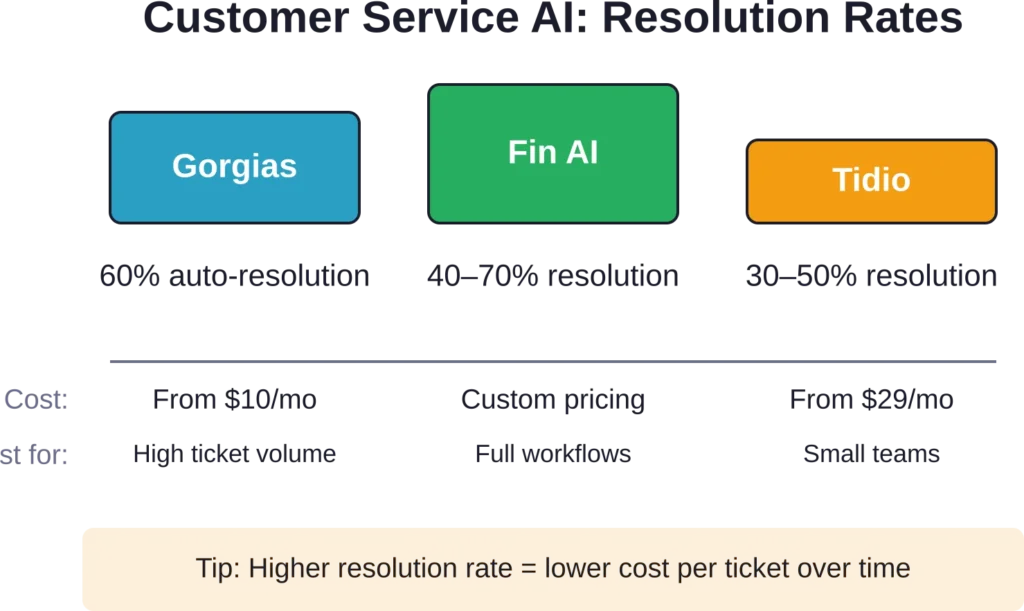
The AI Agent feature resolves up to 60% of inquiries without human intervention. It handles order tracking, returns, product questions, and basic troubleshooting.
Pricing starts at $10 per month for tickets. The AI Agent tier pricing is available based on resolution volume. This can result in significant savings compared to hiring additional full-time support staff.
Best for: Shopify stores with high ticket volume looking to automate repetitive inquiries.
3. Fin AI

Fin AI focuses on end-to-end resolution across systems. It doesn’t just answer questions—it takes action: processes refunds, updates orders, schedules deliveries.
The platform connects to Shopify, Klaviyo, Zendesk, and custom APIs. It learns from past interactions and improves resolution accuracy over time.
Pricing is custom—typically structured as cost per resolution or monthly retainer. Stores report 40–70% resolution rates depending on integration depth.
Best for: Mid-to-large ecommerce teams that want AI to handle full workflows, not just chat.
4. Tidio

Tidio is a live chat and chatbot platform with AI-powered response generation. It’s lighter-weight than Gorgias or Fin, but easier to set up.
The AI bot answers FAQs, qualifies leads, and routes complex issues to humans. It’s solid for stores just starting with AI support.
Pricing ranges from free (limited features) to $29 per month for the Communicator plan.
Best for: Small teams or solo founders who need AI chat without a full helpdesk migration.
Email Marketing & Lifecycle Automation
AI email tools optimize send time, subject lines, product recommendations, and segmentation at scale.
5. Klaviyo

Klaviyo is a widely-used email platform for ecommerce. It integrates with Shopify, WooCommerce, and Magento, syncing real-time purchase data.
The AI features include predictive analytics (lifetime value, churn risk, next purchase date), automated segmentation, and product recommendation blocks. Klaviyo’s AI writes subject lines, optimizes send time per recipient, and A/B tests creative variants.
Pricing scales with contacts and starts around $39 per month for small businesses.
Best for: Ecommerce brands that want deep email personalization tied to purchase behavior.
6. Omnisend

Omnisend is a multichannel platform (email, SMS, push) with built-in ecommerce automation. It’s easier to set up than Klaviyo but less customizable.
The AI generates product recommendations, subject lines, and send-time optimization. It also handles cart abandonment, browse abandonment, and post-purchase flows out of the box.
Pricing includes a free plan option and paid professional tiers.
Best for: Small-to-mid-sized stores that need multichannel automation without complex workflows.
7. GetResponse

GetResponse is a legacy email platform that added AI features in 2024. It’s not ecommerce-native, but it’s affordable and flexible.
The AI writes email copy, generates subject lines, and optimizes send times. It lacks deep ecommerce integrations compared to Klaviyo or Omnisend.
Pricing is affordable for businesses of various sizes.
Best for: Brands using multiple sales channels (not just ecommerce) who want one unified email platform.
Product Imagery & Visual Content
AI product imagery tools generate photos, backgrounds, and virtual try-ons without expensive photoshoots.
8. WearView

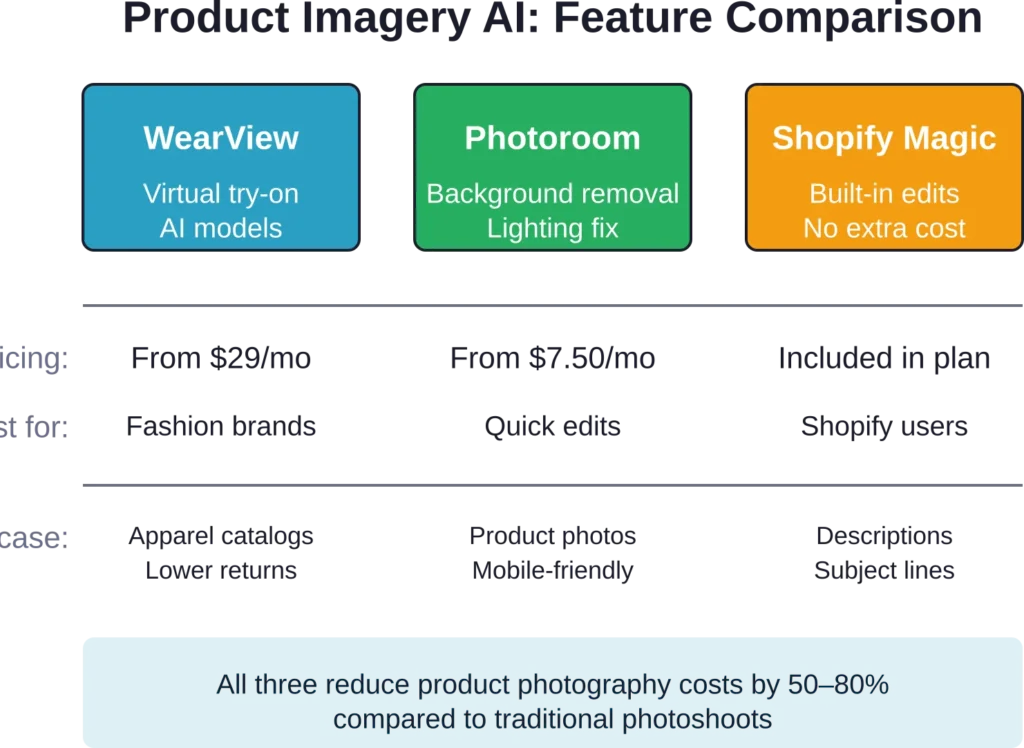
WearView is a complete fashion AI suite: virtual try-on, AI model generation, and video creation. Upload a product photo, and it generates lifestyle images with AI models wearing the item.
It’s built for fashion and apparel brands. The try-on feature helps show how items fit different body types.
Pricing starts at $29 per month.
Best for: Fashion and apparel brands that need scalable product imagery without hiring models.
9. Photoroom

Photoroom is a background removal and product photo editing tool with AI capabilities for image enhancement.
Pricing: free plan with limited features; Pro plan starts at $7.50 per month.
Best for: Small brands or solo sellers who need quick product photo edits.
10. Shopify Magic

Shopify Magic is a suite of AI tools built into the Shopify admin. It includes product description generation, email subject lines, and image editing.
It’s free with any Shopify plan (starting at $39 per month). No extra integrations or logins.
Best for: Shopify merchants who want AI without adding another tool to the stack.
Copywriting & SEO Content
AI copywriting tools generate product descriptions, blog posts, ad copy, and SEO-optimized content.
11. Jasper

Jasper is a general-purpose AI writing assistant. It’s not ecommerce-specific, but it’s widely used for product descriptions, email copy, and blog content.
The platform includes templates for ecommerce: product descriptions, Amazon listings, Facebook ads, Google ads. It integrates with Surfer SEO for real-time optimization.
Pricing is available starting at the Creator plan tier.
Best for: Marketing teams that need high-volume content across multiple formats.
12. Surfer SEO

Surfer SEO is a content optimization platform. It analyzes top-ranking pages and provides real-time scoring as you write.
The AI Outline Builder generates article structures based on SERP data. The Content Editor scores your draft against competitors and suggests keywords, headings, and length.
Pricing begins at the professional tier level.
Best for: Content teams focused on ranking for high-value keywords.
13. Copy.ai

Copy.ai is a lightweight AI writing tool. It’s faster and cheaper than Jasper, but less customizable.
It generates product descriptions, social posts, email subject lines, and landing page copy. The output quality depends heavily on prompt engineering.
Pricing includes a free plan option and paid professional tiers.
Best for: Solo founders or small teams with basic copywriting needs.
Personalization & Customer Experience
AI personalization engines tailor product recommendations, search results, and landing pages per visitor.
14. Bloomreach

Bloomreach is an enterprise personalization platform. It combines AI-powered search, product recommendations, and content personalization in one suite.
The Loomi AI engine predicts what each visitor wants to see based on behavior, purchase history, and segment data. It adjusts product sorting, banners, and recommendations in real time.
Pricing is custom for mid-to-large ecommerce brands.
Best for: Mid-to-large ecommerce brands with high traffic and complex catalogs.
15. Luigi’s Box

Luigi’s Box specializes in ecommerce site search and product discovery. The AI learns from search queries, click patterns, and conversions to improve relevance.
It handles typo tolerance, synonym mapping, and personalized search results. It’s easier to implement than Bloomreach and more affordable.
Pricing is custom—based on site traffic and product catalog size.
Best for: Mid-sized stores with large catalogs where search is a primary discovery method.
Analytics & Business Intelligence
AI analytics platforms surface insights from sales data, customer behavior, and marketing performance.
16. Stackline

Stackline is an AI-powered market intelligence platform. It tracks market share, competitor pricing, keyword rankings, and advertising performance across Amazon, Walmart, and other marketplaces.
The platform aggregates data from multiple sources and uses AI to identify trends, anomalies, and growth opportunities. It’s built for brands selling on multiple channels.
Pricing is custom—enterprise-level.
Best for: Brands selling on Amazon and marketplaces that need unified competitive intelligence.
17. Glassbox

Glassbox is a digital experience analytics platform. It records user sessions and uses AI to identify struggle points: rage clicks, dead ends, checkout friction.
The AI automatically tags and categorizes issues, so teams don’t need to manually watch hours of recordings.
Pricing is custom.
Best for: Brands optimizing conversion rate and user experience across web and mobile.
How to Choose the Right AI Tools for Ecommerce
Not every store needs every tool. Here’s how to prioritize.
Start With Customer-Facing AI
Customer-facing AI (support, email, personalization) delivers faster ROI than back-office automation. Start where the revenue impact is clearest.
For most stores, that means customer service automation first. A tool like Gorgias or Fin AI can reduce support costs by 40–60% within 60 days.
Evaluate Based on Resolution Rate, Not Feature Count
The best AI tools close the loop. They don’t just generate answers—they resolve issues, complete transactions, or trigger actions.
Look for resolution rate metrics, not feature lists. A tool with a significantly higher resolution rate delivers substantially more value than one with lower resolution, even if the latter has more features.
Prioritize Integration Depth
AI is only as good as the data it can access. Tools that integrate deeply with your ecommerce platform (Shopify, Magento, WooCommerce) deliver better results.
Check for real-time syncing of order data, customer history, inventory, and tracking info. Surface-level integrations (just email or name) limit what the AI can do.
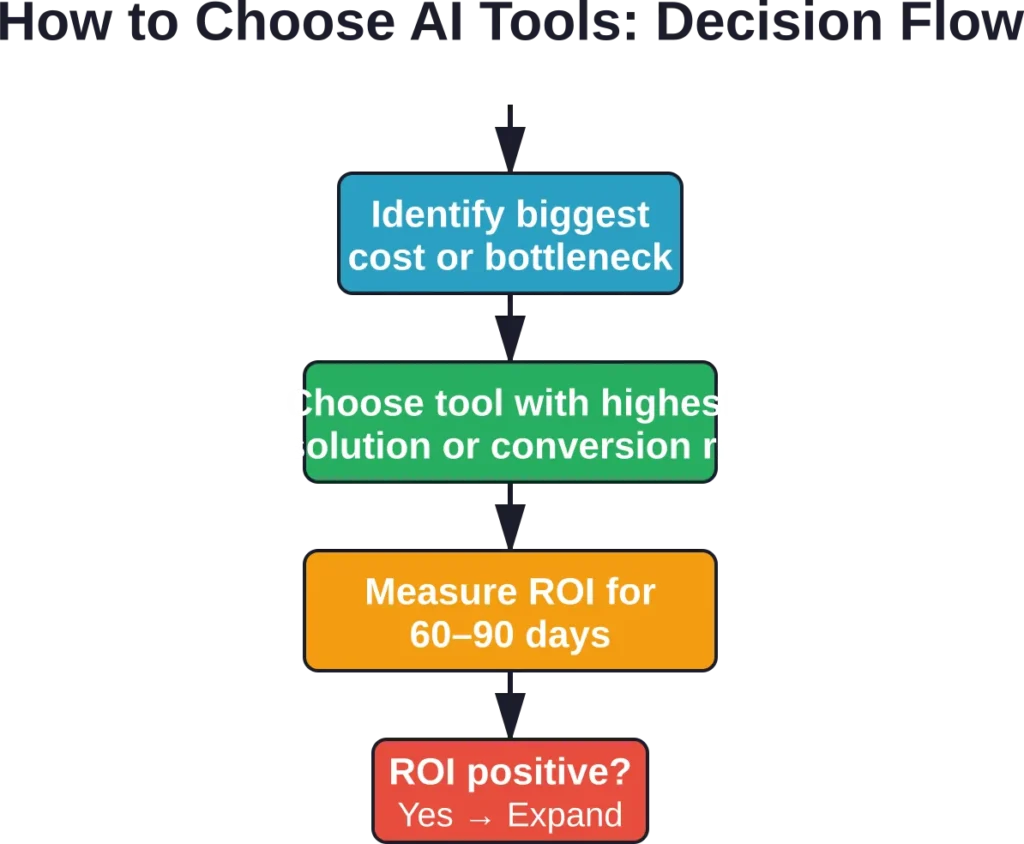
Test ROI on One Tool Before Expanding
Don’t build a full AI stack on day one. Pick one high-impact tool, measure the results for 60–90 days, then add the next.
Track these metrics:
- Cost per resolution (support AI)
- Conversion rate lift (personalization AI)
- Revenue per email (email AI)
- Cost per acquisition (ad copy AI)
If the ROI is clear, expand. If not, adjust or switch tools.
What Separates High-Impact AI Tools From Low-Impact Ones
Real talk: most AI tools are glorified content generators. They save time, but they don’t fundamentally change outcomes.
High-impact AI tools share three traits:
1. They Take Action, Not Just Generate Output
Low-impact AI generates text, images, or recommendations. High-impact AI completes tasks: processes refunds, updates orders, routes tickets, triggers emails.
The difference is autonomy. Tools that require human review or manual steps have limited ROI.
2. They Improve Over Time
The best AI tools learn from interactions. Resolution accuracy improves, recommendations get sharper, and send-time optimization gets more precise.
Static AI (same output every time) doesn’t compound value. Adaptive AI does.
3. They Integrate Across Systems
AI that only works in one silo (just email, just chat, just search) has limited leverage. The highest ROI comes from tools that connect multiple systems: support + order management + CRM + email.
Look for tools with robust APIs and native integrations to your core platforms.
Turning AI Tools Into a Scalable Ecommerce System
The goal isn’t to collect AI tools. It’s to build a system where AI handles repeatable tasks end-to-end.
Here’s what that looks like in practice:
- Customer service: AI resolves 60–70% of tickets autonomously. Complex issues route to humans with full context.
- Email: AI segments lists, optimizes send times, personalizes product recs, and writes subject lines. Humans review strategy and creative direction.
- Product imagery: AI generates lifestyle photos, backgrounds, and virtual try-ons. Humans approve final assets.
- Copywriting: AI drafts product descriptions, ad copy, and blog outlines. Humans edit for brand voice and accuracy.
- Personalization: AI adjusts search results, product sorting, and recommendations per visitor. Humans set business rules and guardrails.
The pattern? AI handles volume. Humans handle judgment.
That’s the shift from AI tools to AI systems.
FAQs
The top AI tools for ecommerce in 2026 include Gorgias and Fin AI (customer service), Klaviyo and Omnisend (email automation), WearView and Photoroom (product imagery), Jasper and Surfer SEO (copywriting), Bloomreach (personalization), and Stackline (analytics). The right mix depends on your biggest cost or bottleneck.
AI tool pricing varies widely. Entry-level tools like Tidio start at $29 per month, while mid-tier platforms like Klaviyo start around $39 per month. Enterprise platforms like Bloomreach and Stackline require custom pricing, typically starting at $2,000+ per month. Many tools offer free trials or freemium plans for small businesses.
Yes. AI customer service agents like Gorgias resolve up to 60% of inquiries autonomously, reducing cost per resolution by 40–60%. This can result in significant monthly savings compared to hiring additional support staff. Resolution rate and integration depth are the key factors.
It depends on your business size and complexity. Small stores can often start with one or two tools (e.g., AI support + email automation). Larger stores benefit from a full stack: support, email, personalization, analytics, and imagery. Start with the highest-impact tool, measure ROI for 60–90 days, then expand.
Customer-facing AI (support, email, personalization) can show measurable ROI within the first few months of implementation. Back-office AI (inventory forecasting, demand planning) typically has a longer implementation and ROI timeline. Track resolution rate, conversion lift, and cost per acquisition to measure impact.
Reputable AI platforms comply with GDPR, CCPA, and SOC 2 standards. Check for data encryption, access controls, and clear privacy policies. For customer service AI, ensure the platform doesn’t store sensitive payment data (PCI compliance). Most enterprise tools offer on-premise or private cloud deployment for added security.
No. AI handles repeatable tasks at scale, but humans are still essential for judgment, strategy, creative direction, and complex problem-solving. The goal is augmentation, not replacement. Teams using AI report higher productivity and lower burnout because AI handles the repetitive work.
Conclusion
AI tools for ecommerce have moved from experimental to essential. The top platforms in 2026 don’t just generate content—they resolve issues, optimize conversions, and deliver measurable ROI.
The highest-impact tools share three traits: they take action autonomously, they improve over time, and they integrate deeply with your core systems.
Start with one tool that addresses your biggest cost or bottleneck. Measure ROI for 60–90 days. If the results are clear, expand. If not, adjust or switch.
The stores winning in 2026 aren’t the ones with the most AI tools. They’re the ones that turned AI into a scalable system.
Ready to get started? Pick one tool from this list, set up a trial, and track the impact. The data will tell you what to do next.