

Quick Summary: Pencil AI excels at predictive analytics but isn’t the only strong AI ad creative platform. This guide covers 8 rigorously tested alternatives—from Coinis’s full-funnel automation to Creatify’s video-first workflows—helping you find the tool that matches your budget, creative volume, and performance tracking needs in 2026.
Pencil AI carved out a niche by analyzing significant ad spend data to predict creative performance before launch. That predictive scoring engine—reportedly accurate in the 84–90% range across various sources—caught the attention of performance marketers who want a number on every asset before hitting publish.
But the AI advertising market exploded from $6.7B in 2023 to a projected $28.4B by 2033, and competition heated up fast. Pencil’s templated output, starting price around $29/month, and reliance on existing brand assets leave gaps that newer platforms rushed to fill.
So what’s actually better? And for whom?
This guide breaks down 8 tested alternatives, each solving a different bottleneck in the creative workflow. Some handle the full campaign loop—generation, publishing, and real-time ROAS tracking. Others specialize in video, brand personalization at scale, or ultra-low entry prices for bootstrapped teams.
The field changed. Here’s how to navigate it.
Why Teams Look Beyond Pencil
Pencil does predictive analytics well. The platform scores creative assets using machine learning trained on historical ad performance data. Teams that already have brand guidelines, product photos, and a library of copy variants find value there.
Three friction points drive teams elsewhere, though.
First: asset dependency. Pencil doesn’t generate creatives from scratch the way newer platforms do. It remixes what the team uploads. Brands without a backlog of high-quality images and videos hit a wall fast.
Second: templated feel. Users across community discussions note that Pencil’s output—especially video—can look formulaic compared to human-produced UGC ads or platforms that lean harder into generative AI trained on diverse creative styles.
Third: workflow fragmentation. Pencil predicts performance but doesn’t publish campaigns or track ROAS natively. Teams still export assets, log into Meta Ads Manager or Google Ads, launch manually, then reconcile performance data across dashboards.
When marketing operations teams juggle tight budgets, small creative teams, or dozens of SKUs, that fragmentation adds friction. Some alternatives close the loop.
The 8 Strongest Alternatives (Tested)
Below are platforms that solve different pieces of the ad creative puzzle. Each entry includes what it does best, where it falls short, typical pricing, and the team profile it fits.
1. Extuitive – Pre-Launch Performance Prediction with AI Consumer Simulation
Extuitive combines AI ad generation with advanced predictive validation. It takes a website or Shopify store URL, generates creatives (images, videos, copy, pricing), then runs them through simulations with 150,000+ AI-modeled consumers to forecast metrics like CTR, purchase intent, and ROAS before any ad spend.
The workflow stands out for its emphasis on prediction over pure creation: generate → simulate real audience reactions → rank winners → launch only the strongest assets. This dramatically reduces wasted testing budget.
Pricing is positioned at the premium/enterprise end. Plans start with a Starter tier at $1,000/month (or $10k/year), scaling to Professional ($2,500/month) and custom Enterprise. No prominent free tier is advertised, but demo access is readily available. This reflects its depth in brand-specific modeling and simulation rather than mass-market volume generation.
What sets it apart? The Polyintelligence engine and AI consumer agents. Instead of generic scoring, Extuitive builds models on your brand’s historical performance plus large-scale behavioral data, then runs thousands of simulated reactions. It’s especially strong at connecting directly to Shopify for context-aware generation and validation.
The limitation: Higher price point makes it less accessible for solo freelancers or very small budgets. The platform prioritizes prediction accuracy and decision support over ultra-high-volume rapid-fire asset creation (though it does generate creatives well).
Best for: Shopify brands, e-commerce teams, and mid-market marketers who want to minimize ad waste through pre-launch intelligence. Ideal for those tired of burning budget on A/B tests and seeking data-backed confidence before going live.
Contact Information:
- Website: extuitive.com
- Email: [email protected]
- LinkedIn: www.linkedin.com/company/extuitive
- Twitter: x.com/Extuitive_Inc
- Instagram: www.instagram.com/extuitiveinc
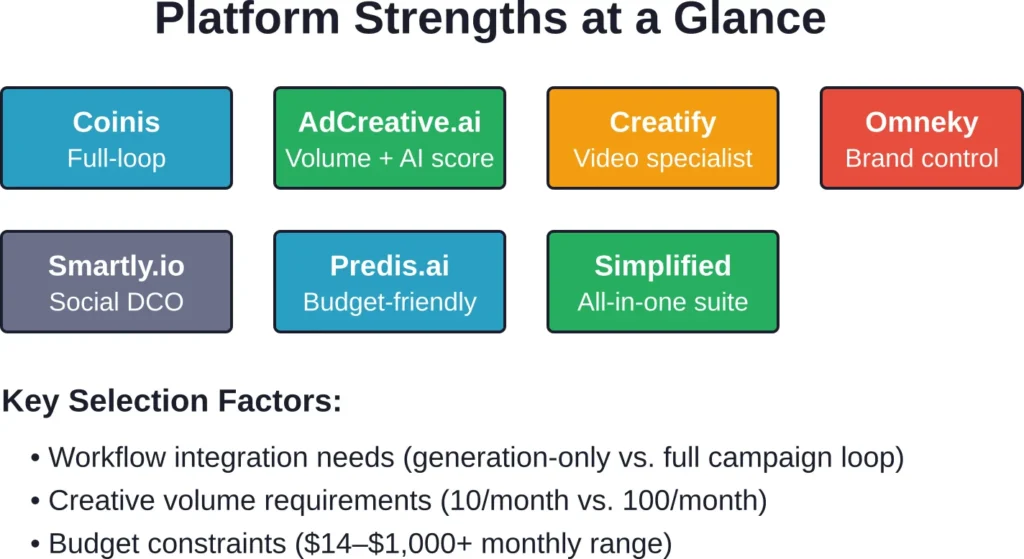
2. Coinis – Full-Loop Automation from URL to ROAS

Coinis takes a product URL and outputs image and video ads, then publishes directly to Meta and tracks return on ad spend in real time. The workflow is tighter than any competitor’s: paste link, review AI-generated assets, approve, launch, monitor.
The free plan offers 15 tokens monthly—enough to generate a handful of ad concepts and test the platform without payment info. That free tier alone beats most paid competitors on access.
Paid plans start at $39/month, positioning Coinis between budget tools and enterprise platforms. The pricing reflects the value: agencies and freelancers producing creative volume for external clients get both generation and campaign management in one subscription.
What sets it apart? Integration depth. Most AI ad generators stop at asset export. Coinis handles Meta campaign setup, budget allocation, A/B test configuration, and real-time performance dashboards. Marketing teams avoid the context-switching tax of logging into separate analytics tools.
The limitation: Coinis focuses heavily on e-commerce and direct-response advertising. Brands running awareness campaigns or complex multi-touch attribution models may need supplemental tools.
Best for: agencies and in-house teams managing multiple ad accounts, especially e-commerce brands that want one platform for creative and campaign execution.
3. AdCreative.ai – High-Volume Display and Social Assets

AdCreative.ai pioneered the AI ad generator category and remains a volume workhorse. The platform generates display ads, social creatives, and video ads using AI trained on $35B in ad performance data. Their Creative Scoring AI predicts performance with 90%+ accuracy before you spend a dime.
Starting price sits at $39/month, matching Coinis but with a different focus. AdCreative.ai excels at static display ads and social posts. Video generation exists but isn’t the platform’s strength.
Speed is the standout feature. Teams producing dozens of ad variants for split testing can crank out assets fast. The interface prioritizes throughput over fine-tuned brand customization.
The trade-off: less workflow integration. AdCreative.ai generates and scores creatives but doesn’t publish or track campaigns. Teams still export assets and manage launches elsewhere.
Another friction point reported in community feedback: the platform sometimes generates ads that require heavy manual editing to match brand guidelines. Teams with strict visual identity standards spend more time tweaking outputs.
Best for: performance marketers who need high creative volumes for testing and already have streamlined campaign management workflows in place.
4. Creatify – Video-First AI for UGC and Product Demos

Creatify specializes in video generation. The platform turns product URLs, blog posts, or raw footage into UGC-style videos, product demos, and social clips optimized for TikTok, Instagram Reels, and YouTube Shorts.
Industry forecasts project video advertising to expand by roughly 16% annually from 2026 to 2033, driven by user attention concentrating on video-first platforms like YouTube and TikTok. Creatify bets the entire platform on that trend.
Pricing starts from $14/month for basic plans, climbing to premium tiers that unlock higher resolution exports, more AI voices, and advanced editing features. The entry price makes Creatify accessible to small brands and solo creators testing video ads without hiring production teams.
What works: the variety of AI avatars, voices, and video templates. Teams can generate multiple creative angles—testimonial style, product showcase, problem-solution narrative—from the same product link.
The catch: video quality varies. Some outputs feel polished; others look noticeably synthetic, especially in avatar-based ads. Brands targeting audiences sensitive to AI-generated content may see lower engagement.
Also, Creatify doesn’t offer campaign publishing or analytics. It’s purely a video generation tool.
Best for: video-first brands, e-commerce teams producing high volumes of short-form content, and creators who want fast UGC-style ads without hiring talent.
5. Omneky – Brand Personalization at Scale

Omneky focuses on brand consistency across high creative volumes. The platform ingests brand guidelines, logo files, color palettes, and tone-of-voice documentation, then generates ads that stay on-brand even when producing hundreds of variants for personalized campaigns.
This matters for multi-SKU brands running localized or audience-segmented campaigns. Omneky can generate dozens of ad variations—each tailored to a specific audience persona—without drifting from visual identity standards.
The platform also supports multi-channel output: display, social, video, and even programmatic creative formats. That breadth makes Omneky appealing to brands with complex media mixes.
Pricing entry points typically start around $44/month based on aggregated community reports, scaling to custom enterprise contracts for larger operations.
The strength: brand control at scale. The weakness: steeper learning curve. Teams need to invest time upfront configuring brand guidelines and audience segments. Small teams without dedicated creative ops roles may find the setup overhead heavy.
Best for: mid-market and enterprise brands managing multiple product lines, regional campaigns, or audience segments that demand personalized creative without sacrificing brand consistency.
6. Smartly.io – Social-First Campaign Automation

Smartly.io built its platform for social advertising teams managing campaigns across Meta, TikTok, Snapchat, and Pinterest. The creative suite generates static and video ads optimized for each platform’s specs, then automates campaign launches and budget allocation.
The platform’s strength is workflow integration for social media managers. Creative generation sits alongside campaign management, reporting, and cross-platform analytics. Teams can build, test, and optimize campaigns without leaving the dashboard.
Pricing starts at $1,000+/month because Smartly.io targets agencies and brands spending six figures monthly on social ads. The platform’s ROI equation works when managing large budgets; for small teams it’s overkill.
What’s different? Smartly.io emphasizes dynamic creative optimization (DCO). The platform automatically tests combinations of headlines, images, CTAs, and audience segments, then shifts budget toward winning variants in real time.
The trade-off: less flexibility for non-social channels. Smartly.io doesn’t handle display network campaigns, programmatic buys, or search ads well. It’s a specialist tool.
Best for: social media teams and agencies managing high ad spend across Meta, TikTok, and other social platforms, especially those running DCO campaigns.
7. Predis.ai – Budget-Friendly Social Content Generator

Predis.ai targets small businesses and solo marketers who need social media content fast. The platform generates static posts, carousel ads, short videos, and captions optimized for Instagram, Facebook, LinkedIn, and Twitter.
Pricing starts at $19/month, undercutting most competitors. Free plans exist but impose tight limits on generation volume and export resolution.
The workflow is simple: input a product URL or write a text prompt, choose a template, and Predis.ai outputs a social-ready asset. The platform includes a content calendar and scheduling features, positioning itself as an all-in-one social media management tool for small teams.
Where it shines: ease of use and low barrier to entry. Where it struggles: creative quality and customization depth. Outputs often require manual tweaking, and advanced brand control options are limited compared to Omneky or AdCreative.ai.
Predis.ai doesn’t predict performance or integrate with ad platforms for campaign publishing. It’s purely a content generation and scheduling tool.
Best for: solopreneurs, small businesses, and early-stage startups producing organic social content and low-budget ad campaigns on tight budgets.
8. Simplified – All-in-One Design and Marketing Suite
Simplified combines AI ad generation with a broader design and marketing toolkit. The platform includes graphic design tools (think Canva-style editor), video editing, copywriting assistance, and social media scheduling.
That breadth makes Simplified appealing to small marketing teams wearing multiple hats. Instead of subscribing to separate tools for design, copy, and ads, teams get one platform.
Pricing starts around $20/month for basic plans. Higher tiers unlock more AI credits, team collaboration features, and premium templates.
The AI ad generator within Simplified handles static images and short videos. Quality sits in the middle of the pack—better than Predis.ai, less polished than Omneky or Creatify.
What’s unique? The copy assistant. Simplified’s AI generates ad headlines, body copy, CTAs, and even long-form blog content. Performance marketers can draft multiple copy variants alongside visual assets without switching tools.
The limitation: jack-of-all-trades risk. Simplified does many things adequately but doesn’t excel at any single function the way specialized platforms do. Teams needing best-in-class video generation or predictive analytics will hit ceilings.
Best for: small marketing teams that value consolidation, especially those managing both organic content and paid ads from a single platform.
How to Choose the Right Alternative
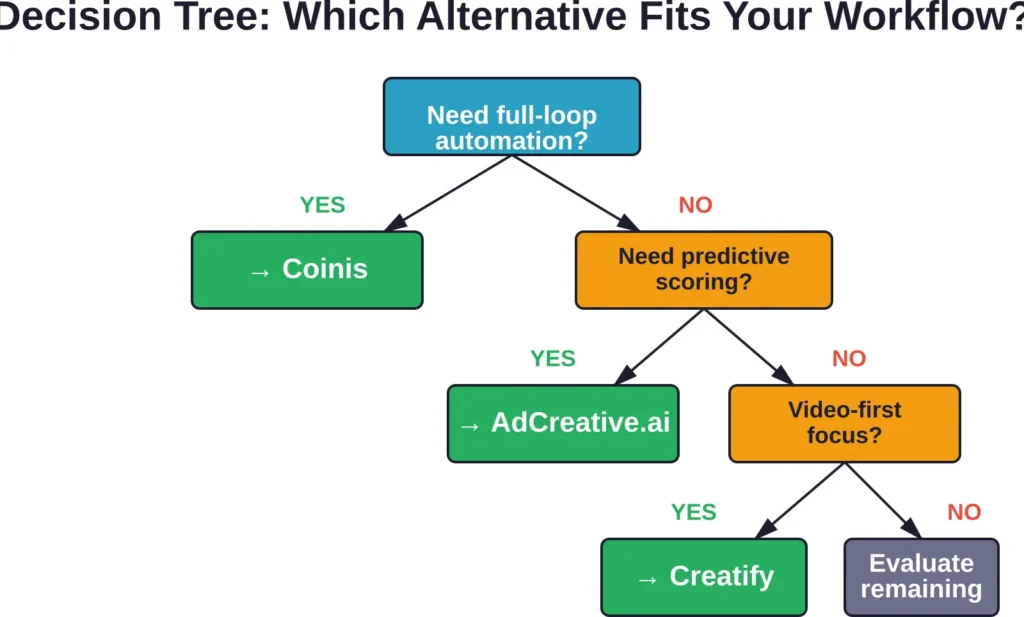
The “best” platform depends on what bottleneck the team faces. Run through these questions.
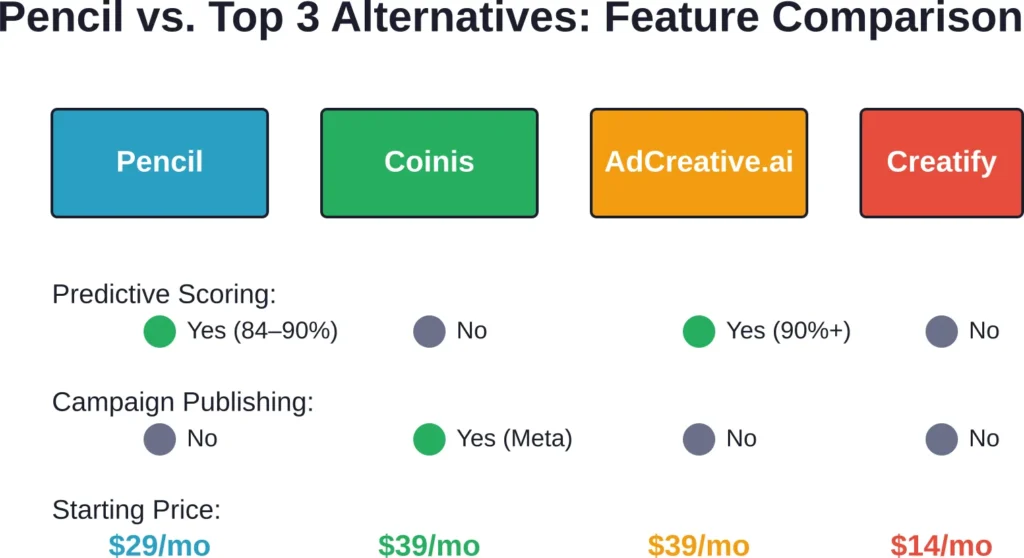
Do you need predictive scoring, or just fast asset generation? Pencil and AdCreative.ai lead on performance prediction. Coinis, Creatify, and Simplified prioritize speed and volume.
Do you want an end-to-end workflow or best-of-breed tools? Coinis closes the loop from generation to ROAS tracking. Most others stop at asset export, requiring separate campaign management platforms.
What’s your creative volume? High-volume teams (50+ ads weekly) benefit from AdCreative.ai’s throughput or Omneky’s brand-controlled scale. Low-volume teams may prefer Creatify’s or Predis.ai’s ease of use.
How much control does the brand need? Strict brand guidelines demand Omneky’s depth. Looser styles work fine with Creatify or Simplified.
What’s your budget? Creatify and Predis.ai start at $14–19/month. Smartly.io demands $1,000+ monthly. Coinis and AdCreative.ai sit at $39/month, balancing features and cost.
Do you already have creative assets, or are you starting from zero? Pencil and AdCreative.ai work best when remixing existing libraries. Coinis and Creatify generate from scratch using product URLs or prompts.
Pricing Comparison Table
Here’s a side-by-side look at verified starting prices and what each tier includes.
| Platform | Starting Price | Free Plan? | What’s Included |
|---|---|---|---|
| Pencil | From $29/mo | No | Predictive scoring, asset remixing, analytics dashboard |
| Coinis | From $39/mo | Yes (15 tokens) | AI generation, Meta publishing, ROAS tracking |
| AdCreative.ai | From $39/mo | Trial only | High-volume ad generation, 90%+ performance prediction |
| Creatify | From $14/mo | Limited | Video generation, UGC-style templates, AI voices |
| Omneky | From $44/mo | No | Brand-controlled personalization, multi-channel output |
| Smartly.io | $1,000+/mo | No | Social DCO, campaign automation, cross-platform analytics |
| Predis.ai | From $19/mo | Yes | Social post generation, scheduling, content calendar |
| Simplified | From $20/mo | Yes | Ad generation, design suite, copywriting AI, scheduling |
Real-World Use Cases
Abstract comparisons help, but concrete scenarios clarify which tool fits which situation.
Scenario 1: E-commerce Brand Launching 50 Product Ads Weekly
A Shopify brand sells 200 SKUs and runs Meta ads for seasonal promotions. The marketing team consists of two people managing campaigns, creative, and analytics.
The bottleneck: generating fresh ad variants fast enough to test messaging angles and avoid creative fatigue.
Best fit: Coinis or AdCreative.ai. Both platforms handle high creative volumes. Coinis wins if the team wants to consolidate campaign publishing and ROAS tracking. AdCreative.ai wins if the team already uses external analytics tools and prioritizes pure generation speed.
Scenario 2: SaaS Startup Testing Video Ads on TikTok
A B2B SaaS startup wants to test short-form video ads on TikTok and Instagram Reels. The team has no video production experience and a $500/month ad budget.
The bottleneck: producing video content without hiring freelancers or agencies.
Best fit: Creatify. The $14/month entry price fits the budget, and the platform specializes in short-form video optimized for social feeds. The team can generate multiple creative angles quickly and test what resonates before scaling spend.
Scenario 3: Agency Managing 20 Client Accounts
A performance marketing agency manages Meta and Google Ads for 20 e-commerce clients. Each client needs 10–15 new ad creatives monthly, tailored to brand guidelines.
The bottleneck: maintaining brand consistency across high client volume without ballooning headcount.
Best fit: Omneky. The platform’s brand control features let the agency configure guidelines per client, then generate on-brand assets at scale. The higher price point (around $44/month+) is justified by billable client work.
Scenario 4: Performance Marketer Optimizing ROAS on Proven Products
A growth marketer runs ads for a mature e-commerce brand. The products convert well, but creative fatigue hits fast. The marketer wants predictive data to avoid wasting budget on underperforming ads.
The bottleneck: identifying winning creatives before launch.
Best fit: AdCreative.ai or Pencil. Both platforms predict performance. AdCreative.ai offers 90%+ accuracy based on aggregated data; Pencil offers similar scoring trained on significant ad spend data. The choice comes down to workflow preference and whether the team already has asset libraries (Pencil) or needs full generation (AdCreative.ai).
What the Data Says About AI Ad Performance
Research from academic sources sheds light on whether AI-generated ads actually outperform human-created ones.
A study from researchers at The University of Queensland, The University of Zurich, and co-authors compared LLM-generated ads to human-created equivalents. Qualitative analysis revealed AI’s advantage stems from crafting more sophisticated, aspirational messages and achieving superior visual-narrative coherence.
Critically, this quality advantage proved robust: even after applying a 21.2 percentage point detection penalty when participants correctly identified AI-origin, AI ads still outperformed human ads. That suggests AI ads work not because people don’t notice them, but because the messaging and visual design genuinely resonate.
Video advertising data tells a parallel story. With user attention increasingly concentrated in video-first platforms such as YouTube and TikTok, video advertising has become one of the fastest-growing segments. Industry forecasts project video advertising to expand by roughly 16% annually from 2026 to 2033, driven by user attention concentrating on video-first platforms like YouTube and TikTok.
Platforms like Creatify and Simplified lean into that trend, prioritizing video output over static display ads. The data supports that strategic focus.
Common Mistakes When Switching Platforms
Teams migrating from Pencil (or any incumbent tool) to an alternative hit predictable friction points. Avoiding these speeds up onboarding.
Mistake 1: Not auditing existing creative workflows first. Teams often chase features without diagnosing the actual bottleneck. If the problem is asset volume, switching to a platform focused on predictive analytics won’t help. Map the workflow, identify the constraint, then choose the tool that solves it.
Mistake 2: Ignoring integration requirements. Some platforms publish directly to ad networks; others export assets for manual upload. If the team runs campaigns across Meta, Google, TikTok, and Pinterest, verify which platforms the new tool supports before committing.
Mistake 3: Underestimating setup time. Tools like Omneky and Smartly.io require upfront configuration—brand guidelines, audience segments, naming conventions. Small teams without dedicated creative ops roles may struggle with the overhead. Budget time for onboarding, or choose simpler tools like Creatify or Predis.ai.
Mistake 4: Skipping trial periods. Most platforms offer free trials or freemium tiers. Test output quality, workflow fit, and interface usability before subscribing annually. Creative quality varies widely; what works for one brand may feel off-brand for another.
Mistake 5: Overlooking team collaboration features. Agencies and multi-person teams need comment threads, approval workflows, and role-based permissions. Solo tools like Predis.ai lack those features. Verify collaboration capabilities match team structure.
Future-Proofing Your Creative Stack
The AI advertising landscape shifts fast. Platforms launch, merge, and pivot features quarterly. A few principles help teams avoid churn.
First: prioritize platforms with API access or integrations. Closed ecosystems lock teams in. Tools that connect to Zapier, Make, or offer native APIs let teams automate workflows and migrate data if needed.
Second: favor platforms actively shipping updates. Check the changelog or product updates page before subscribing. Stagnant tools fall behind fast in AI-driven categories.
Third: balance specialization and flexibility. Best-of-breed tools excel at one thing but require stitching together a stack. All-in-one platforms offer convenience but cap performance. Choose based on team size and sophistication—small teams benefit from consolidation; larger teams can manage complexity.
Fourth: watch pricing model shifts. AI tools increasingly adopt credit-based pricing tied to compute costs. Usage-based models can surprise teams when volumes spike. Clarify whether plans include fixed asset limits or variable credits before committing.
Frequently Asked Questions
Pencil specializes in predictive analytics—scoring creative performance before launch using data from significant ad spend. Most alternatives prioritize generation speed, workflow automation, or specific formats like video. Coinis adds campaign publishing and ROAS tracking; Creatify focuses on video; AdCreative.ai emphasizes volume. Choose based on whether predictive scoring or end-to-end workflow matters more.
Not yet. AI tools excel at high-volume production, remixing existing assets, and generating templated formats. Complex brand campaigns, nuanced messaging, and highly differentiated creative still benefit from human designers. Research from The University of Queensland shows AI-generated ads can outperform human work in certain contexts, but the best results often come from AI-assisted workflows where designers guide and refine outputs rather than starting from scratch.
AdCreative.ai reports 90%+ accuracy based on $35B in ad performance data. Pencil’s predictive models trained on significant ad spend show accuracy in the 84–90% range across community reports. Accuracy depends on data quality, campaign type, and how well the training data matches the target audience. Predictions work best for direct-response e-commerce ads; brand awareness and complex B2B campaigns see lower reliability.
It depends. Pencil and AdCreative.ai work best when teams upload brand assets, product photos, and copy variants for the AI to remix. Coinis and Creatify generate ads from scratch using product URLs or text prompts, making them better for teams without asset libraries. Omneky requires upfront brand guidelines but generates new assets rather than just remixing.
Creatify starts at $14/month for basic video generation. Predis.ai starts at $19/month for social content. Both offer limited free plans. For teams prioritizing features over price, Coinis at $39/month includes generation, Meta publishing, and ROAS tracking—consolidating costs that would otherwise span multiple tools.
Coinis publishes directly to Meta and tracks ROAS natively. Smartly.io automates launches across Meta, TikTok, Snapchat, and Pinterest. Most other platforms—Pencil, AdCreative.ai, Creatify, Omneky, Predis.ai, Simplified—stop at asset export. Teams using those tools manually upload creatives to ad managers or use third-party automation like Zapier.
Start with free plans or trials. Coinis offers 15 tokens on the free tier—enough to generate sample ads and test quality. Creatify, Predis.ai, and Simplified have limited free plans. AdCreative.ai offers trials. Generate 5–10 ads, compare outputs against brand standards, and test one or two live to measure performance before subscribing annually.
Final Verdict: Which Alternative Wins?
No single platform dominates every use case, but patterns emerge.
For teams wanting the tightest workflow—generation, publishing, and ROAS tracking in one dashboard—Coinis leads. The $39/month price point balances features and cost, and the free tier lets teams test before paying.
For performance marketers who prioritize predictive scoring and already manage campaigns elsewhere, AdCreative.ai delivers. The 90%+ accuracy claim and $35B training dataset make it the strongest pure-play AI scoring engine.
For video-first brands, especially those targeting TikTok and Reels, Creatify offers the best format specialization at an accessible $14/month entry price.
For mid-market and enterprise brands managing multiple product lines or regional campaigns, Omneky provides unmatched brand control at scale.
For budget-conscious small teams, Predis.ai and Simplified consolidate content creation and scheduling at $19–20/month.
Pencil still holds value for teams that already built asset libraries and want performance predictions on remixed creatives. But the field caught up fast. Teams starting fresh or hitting workflow friction points now have better-suited alternatives.
The AI ad landscape won’t slow down. Choose tools that integrate, ship updates frequently, and match team size. Test outputs against brand standards before committing. And remember: the best platform is the one that solves the actual bottleneck, not the one with the longest feature list.
Ready to test an alternative? Start with free tiers, generate a batch of ads, and run them live. Data beats speculation every time.